

Persuasive Speech Topics and Ideas for Nursing Students: 2026 Guide to the Best Persuasive Speeches
Persuasive speaking is an essential communication skill that enables individuals to influence opinions, challenge existing beliefs, and encourage meaningful action. It involves presenting ideas in a clear, logical, and convincing manner while using credible evidence and appropriate communication techniques to gain the audience’s support. Unlike communication that focuses primarily on sharing information, persuasive speeches aim to influence how people think, feel, or respond to a particular issue. They require speakers to understand their subject, recognize different viewpoints, and develop arguments that are both relevant and supported by reliable information. In academic, professional, and everyday settings, persuasive communication plays an important role in discussions about social issues, education, public policy, ethics, and healthcare.
In nursing and healthcare, persuasive speaking extends beyond classroom presentations and formal assignments. It is closely connected to patient advocacy, health education, professional collaboration, ethical decision-making, and the promotion of evidence-based practice. Nurses frequently encounter situations in which they must explain treatment options, address health misconceptions, encourage preventive behaviors, and advocate for decisions that protect patient safety. For example, a nurse educating a patient about the importance of medication adherence must communicate the potential consequences of missed doses while addressing the patient’s concerns and explaining the benefits of following the prescribed treatment plan. Similarly, advocating for improved nurse-to-patient ratios may require presenting evidence about staffing levels, patient outcomes, workload, and the quality of care. These situations demonstrate how persuasive communication helps healthcare professionals express concerns, support recommendations, and encourage informed decisions.
Selecting an appropriate subject is one of the most important steps in preparing a successful persuasive speech. A strong persuasive speech topic should present an issue that can be examined from different perspectives and allow the speaker to establish a clear position. The subject should also be sufficiently focused to support meaningful discussion within the available presentation time. For instance, discussing healthcare as a general subject may be too broad to develop a convincing argument. However, examining whether hospitals should implement mandatory nurse-to-patient staffing ratios provides a more specific issue that can be supported with research, practical examples, and opposing viewpoints. The best persuasive speech topics are therefore not necessarily the most controversial or complicated. They are subjects that encourage critical thinking, allow the presentation of credible evidence, and provide opportunities to develop arguments that resonate with the audience.
There are numerous areas from which speakers can develop persuasive speech ideas, depending on their interests, academic requirements, and intended audience. In nursing and healthcare, relevant subjects include patient confidentiality, vaccination policies, mental health awareness, access to healthcare, nursing shortages, patient safety, and the ethical use of artificial intelligence in clinical practice. Other areas include education, environmental protection, technology, social media, public policy, business, personal finance, and social responsibility. For example, a speaker may argue that healthcare facilities should adopt stricter patient privacy measures, that schools should provide comprehensive mental health education, or that governments should invest more heavily in renewable energy. Each subject presents opportunities to examine existing challenges, evaluate possible solutions, and encourage the audience to reconsider established practices or beliefs.
However, choosing a subject that is interesting does not automatically make it suitable for a persuasive speech. The speaker must consider several factors before deciding on a topic:
- Personal interest and subject knowledge: Familiarity with an issue makes it easier to explain its significance, develop relevant arguments, and communicate with confidence.
- Audience relevance: A subject should address issues, experiences, or concerns that the intended audience can understand and relate to.
- Debatability: A persuasive speech needs a clear position that can be supported through reasoning and evidence while acknowledging alternative perspectives.
- Research availability: Reliable academic publications, professional guidelines, statistics, and other credible sources should be available to substantiate the central argument.
- Scope and presentation time: A topic should be narrow enough to explore adequately without overwhelming the audience with unrelated information.
Once an appropriate topic has been selected, the next step involves developing a well-organized argument. Writing a persuasive speech requires more than expressing personal opinions or listing reasons why a particular position should be accepted. The speaker must establish a clear thesis, arrange supporting points logically, provide credible evidence, and anticipate questions or objections from the audience. Counterarguments are particularly important because they demonstrate an understanding of the complexity of an issue and allow the speaker to explain why their position remains reasonable despite alternative viewpoints. A strong speech also needs an introduction that establishes the subject and captures attention, a body that develops the central arguments, and a conclusion that reinforces the main position and provides a meaningful call to action.
Research is equally important because the effectiveness of a persuasive argument depends largely on the quality of its supporting evidence. Facts, statistics, peer-reviewed studies, expert testimony, professional guidelines, and real-life examples can help establish credibility and make complex issues easier to understand. In healthcare-related discussions, for instance, recommendations about vaccination, infection prevention, patient safety, or clinical staffing should be supported by current research and authoritative professional sources rather than personal assumptions. Speakers must also distinguish between established findings and individual opinions, interpret statistics accurately, acknowledge limitations in the available evidence, and cite their sources appropriately. These practices strengthen the argument while promoting responsible and ethical persuasive speaking.
Beyond research and organization, effective persuasion depends on how the message is communicated. Techniques such as ethos, pathos, and logos help speakers establish credibility, appeal to relevant emotions, and present logical reasoning. Vocal expression, appropriate pacing, eye contact, body language, and clear language also influence how an audience receives and interprets a message. A well-researched speech may lose its impact if the speaker presents the information in a disorganized or difficult-to-follow manner. Conversely, a speaker who understands the audience, communicates confidently, and connects evidence to practical experiences can make even a complex subject more accessible and compelling.
This guide explores the principles of persuasive speaking, the process of choosing an appropriate subject, and a wide range of persuasive speech topics and ideas across different academic and professional categories. It covers nursing and healthcare, education, health and wellness, technology and social media, environmental issues, society and public policy, business, and arts and entertainment. It also examines how to develop a persuasive speech outline, identify credible research sources, organize supporting arguments, address counterarguments, and apply effective speaking and presentation techniques. Understanding these elements provides a foundation for developing well-supported arguments, strengthening public speaking skills, and communicating ideas with greater confidence, clarity, and purpose.
Understanding Persuasive Speeches
Persuasive speeches are an important form of communication in which speakers present ideas, opinions, and arguments with the intention of influencing how an audience thinks, feels, or responds to a particular issue. Unlike ordinary conversations, where individuals may simply exchange information or express personal views, persuasive speaking involves developing a clear position and supporting it with logical reasoning, credible evidence, and appropriate appeals. The speaker’s responsibility is not merely to explain an issue but to demonstrate why a particular viewpoint deserves consideration and, where appropriate, encourage the audience to adopt a belief, change an attitude, or take a specific action.
Persuasion is widely used in academic, professional, political, social, and healthcare settings. In everyday life, individuals use persuasive communication when recommending a particular decision, defending an opinion, encouraging behavioral changes, or advocating for improvements in their communities. In healthcare, for example, nurses may need to convince patients of the importance of following prescribed treatment plans, encourage families to consider preventive healthcare measures, or advocate for policies that improve patient safety. These situations require the ability to communicate complex information clearly, understand the concerns of others, and present recommendations that are supported by reliable evidence.
A persuasive speech is therefore built around a central argument that the speaker wants the audience to consider or accept. The argument should be specific enough to guide the discussion while allowing sufficient room for supporting explanations, examples, and opposing viewpoints. A speech about the importance of patient safety, for instance, may become more convincing when it focuses on why healthcare facilities should introduce stricter medication administration protocols. This narrower position gives the speaker an identifiable issue to examine, evidence to present, and a practical recommendation to defend.
When preparing persuasive speeches, several elements work together to determine how effectively a message is communicated:
- A clearly defined position: The speaker establishes what they believe should be accepted, changed, supported, or reconsidered. Without a clear position, the presentation may become a general discussion rather than a persuasive argument.
- Logical reasoning: Ideas are arranged in a meaningful sequence, with explanations showing how the supporting points relate to the central claim.
- Credible supporting evidence: Research findings, statistics, expert opinions, professional guidelines, and real-life examples provide a foundation for the argument.
- Audience awareness: The speaker considers the audience’s existing knowledge, interests, beliefs, concerns, and possible objections when developing the message.
- Effective communication: Appropriate language, organization, vocal expression, and presentation techniques help make the argument understandable and engaging.
- A desired outcome: The speech has a clear objective, such as changing an opinion, encouraging a particular behavior, supporting a policy, or motivating the audience to participate in an initiative.
Understanding these elements provides a foundation for developing a good persuasive speech. It also explains why selecting an appropriate subject is important: the topic must provide enough substance for meaningful discussion and allow the speaker to establish a position that can be defended. Whether addressing nursing practice, education, public health, environmental protection, or social responsibility, the strongest persuasive speech ideas connect a relevant issue with a clear argument and a realistic outcome.
Persuasive speaking is also closely associated with critical thinking. Speakers must examine information carefully, distinguish established facts from assumptions, evaluate the strength of different arguments, and recognize that reasonable people may hold opposing positions. Rather than relying entirely on personal opinions or emotional reactions, an effective speaker considers the available evidence and presents a balanced explanation of why one position is more appropriate or beneficial. This approach is particularly important when discussing sensitive healthcare subjects such as vaccination policies, reproductive health, patient confidentiality, euthanasia, and the allocation of limited medical resources.
The following principles help explain the foundations of persuasive communication and the qualities that distinguish an effective persuasive presentation from other forms of public speaking.
Definition and Purpose of Persuasive Speaking
Persuasive speaking is a form of oral communication intended to influence an audience’s beliefs, attitudes, values, judgments, or behaviors through the presentation of arguments and supporting evidence. It involves identifying an issue, establishing a position, explaining the reasons behind that position, and demonstrating why the audience should consider accepting it. The speaker uses a combination of logical explanations, credible information, relevant examples, and appropriate emotional appeals to make the argument convincing.
In public speaking, persuasion is not simply about winning an argument or proving that another person is wrong. It is about presenting a defensible position in a manner that encourages listeners to examine an issue, reconsider existing assumptions, and make informed decisions. A persuasive presentation should therefore respect the audience’s ability to think independently. Although the speaker may have a preferred outcome, listeners should be given sufficient information and reasoning to evaluate the argument rather than being pressured into accepting it.
According to the University of Kansas’s Public Speaking as Performance textbook, speeches generally have one primary purpose: to inform, persuade, or inspire and entertain. A persuasive speech is distinguished by its intention to move an audience toward a particular belief, judgment, or action, although it may also provide information as part of the argument.
For example, consider a presentation about childhood vaccination. A speaker delivering an informative speech may explain how vaccines work, describe different types of vaccines, and discuss how immunization programs are organized. A speaker delivering a persuasive speech on the same subject may argue that childhood vaccination programs should be strengthened to improve community protection against preventable diseases. Both presentations discuss vaccination, but their objectives differ. The first primarily develops understanding, while the second uses information to support a particular position and encourage action.
The main purposes of persuasive speaking include the following:
1. Changing existing beliefs and attitudes
One important purpose of persuasive speaking is to encourage individuals to reconsider opinions they already hold. People develop beliefs through personal experiences, cultural influences, education, family backgrounds, and information obtained from different sources. However, some beliefs may be based on incomplete information, misconceptions, or outdated assumptions. A persuasive speech introduces relevant evidence and alternative perspectives that may encourage listeners to reconsider their positions.
For example, a speaker may address the misconception that mental health conditions are simply signs of personal weakness. By presenting information about psychological disorders, biological influences, treatment options, and the importance of professional support, the speaker can encourage the audience to adopt a more informed and compassionate understanding of mental health.
2. Encouraging behavioral changes
Persuasive communication can motivate individuals to adopt behaviors that promote personal, professional, or community well-being. Rather than simply explaining what a particular behavior involves, the speaker demonstrates why changing or adopting that behavior is beneficial.
For instance, a speech advocating for regular physical activity may explain the health risks associated with sedentary lifestyles, describe the benefits of exercise, and encourage listeners to incorporate appropriate physical activity into their daily routines. In healthcare, similar arguments may encourage patients to attend routine screenings, follow medication instructions, maintain proper nutrition, or participate in recommended preventive care.
3. Promoting awareness and social responsibility
Some issues require individuals to recognize problems that affect their communities and understand their responsibility in addressing them. Persuasive speeches can bring attention to subjects such as environmental pollution, discrimination, inadequate healthcare access, substance misuse, and unsafe workplace practices.
A speaker discussing antimicrobial resistance, for example, may argue that antibiotics should only be used when clinically appropriate and in accordance with professional guidance. The speech can explain how inappropriate antimicrobial use contributes to resistance and why responsible prescribing and patient education are important for protecting public health.
4. Influencing decisions and policies
Persuasive speaking is frequently used to support or challenge decisions made by institutions, organizations, governments, and professional bodies. Speakers may advocate for changes in legislation, institutional procedures, educational policies, or workplace practices by presenting evidence of existing problems and explaining the expected benefits of proposed solutions.
In nursing, an example would be advocating for appropriate nurse-to-patient staffing levels. The speaker may discuss workload, patient acuity, missed nursing care, patient safety, and staff well-being to support the argument that healthcare facilities should adopt staffing policies that reflect patient needs and clinical demands.
5. Motivating participation and collective action
Some persuasive speech topics aim to encourage audiences to participate in activities or initiatives that require collective involvement. These may include community health campaigns, blood donation programs, environmental conservation projects, fundraising activities, and public education initiatives.
For example, a speaker advocating for increased blood donation may explain the importance of maintaining an adequate blood supply, address common misconceptions about donation, and encourage eligible individuals to participate in organized donation programs. The speech connects an important community need with a practical action that listeners can take.
Persuasive speaking may therefore seek different levels of audience response:
| Intended response | Explanation | Example |
|---|---|---|
| Belief | Encouraging acceptance of a particular idea or position | Convincing listeners that mental health deserves the same attention as physical health |
| Attitude | Influencing how individuals perceive an issue or group | Reducing negative attitudes toward people living with substance use disorders |
| Judgment | Encouraging audiences to evaluate an issue differently | Supporting stricter patient privacy protections |
| Behavior | Motivating individuals to change their actions | Encouraging regular participation in preventive health screenings |
| Policy or collective action | Building support for institutional or community improvements | Advocating for safer staffing policies in healthcare facilities |
These purposes demonstrate that persuasion does not always require an immediate or dramatic change. Sometimes a successful speech simply encourages an audience to question an assumption, become more receptive to a different viewpoint, or consider a recommendation they had previously overlooked. Other times, the intended outcome may involve a specific behavioral commitment or support for a proposed policy.
An important distinction is that ethical persuasion should not depend on deception, intimidation, or the deliberate manipulation of emotions. Speakers should represent evidence accurately, acknowledge relevant limitations, and avoid mischaracterizing opposing arguments. The purpose is to influence through responsible communication and sound reasoning rather than to force agreement.
Characteristics of an Effective Persuasive Speech
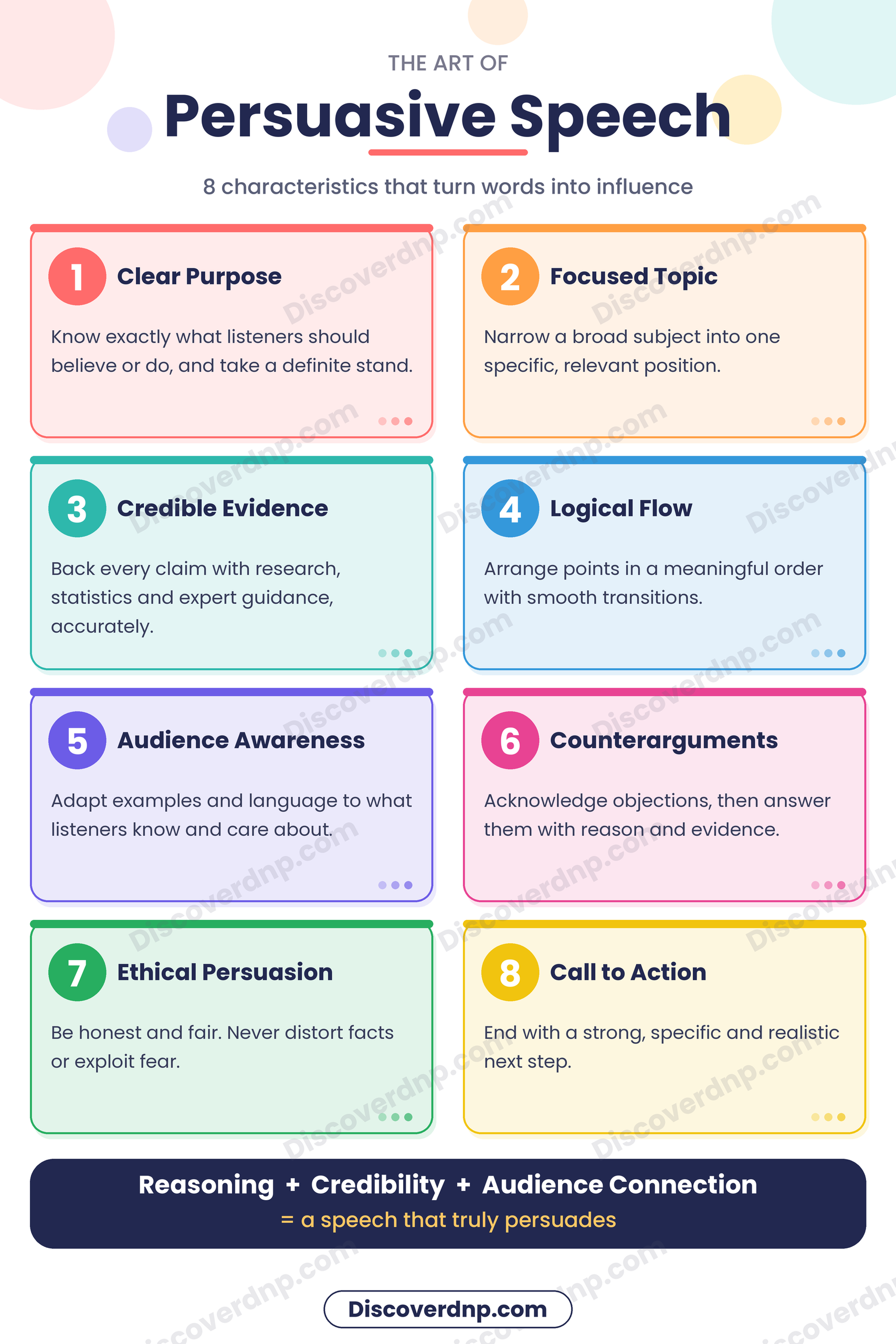
An effective persuasive speech combines a clear argument, credible supporting information, logical organization, audience awareness, and appropriate communication techniques. The speaker must do more than express an opinion or present a collection of facts. They need to establish why the issue matters, demonstrate the validity of their position, address possible objections, and explain why the audience should consider the proposed viewpoint. These elements work together to make the presentation understandable, credible, and convincing.
Not every speech that discusses an important subject successfully persuades its listeners. A speaker may have extensive knowledge of a particular issue but fail to influence the audience because the arguments are poorly organized, the evidence is insufficient, or the presentation does not address listeners’ concerns. Similarly, an emotionally powerful presentation may have limited persuasive value if its claims are inaccurate or unsupported. A strong persuasive speech balances reasoning, credibility, and audience connection.
The following characteristics help distinguish an effective persuasive presentation.
1. A clear purpose and definite position
Every persuasive speech should have a clearly defined objective. The speaker must understand what they want the audience to believe, reconsider, support, or do after listening to the presentation. This objective guides the selection of supporting points, the development of the central argument, and the organization of the entire speech.
A definite position is equally important. A speech that discusses several sides of an issue without establishing a central claim may become an informative discussion rather than a persuasive presentation.
For example, consider the broad subject of patient confidentiality. A speaker could establish the following position:
Healthcare facilities should strengthen patient confidentiality policies to protect personal medical information and maintain trust between patients and healthcare professionals.
This position gives the presentation a clear direction. The speaker can develop arguments concerning patient privacy, professional ethics, electronic health records, unauthorized access, and the consequences of confidentiality breaches.
A well-defined purpose also helps prevent unnecessary information from distracting the audience. Every major point should contribute to explaining, defending, or strengthening the central position.
2. A focused and relevant topic
An effective persuasive speech addresses a subject that is sufficiently narrow to allow meaningful discussion within the available presentation time. Broad subjects often contain too many issues to examine adequately, making it difficult to develop a coherent argument.
For example:
- Broad topic: Healthcare.
- More focused topic: Patient safety in hospitals.
- Specific persuasive position: Hospitals should introduce mandatory medication safety training for all clinical staff.
The specific position provides a more manageable direction for research and argument development. It also allows the speaker to identify relevant evidence, discuss practical implications, and propose a clear recommendation.
Relevance is equally important. A topic should connect with the audience’s interests, experiences, concerns, or responsibilities. An argument about healthcare accessibility may be particularly meaningful to an audience interested in nursing and public health, while an argument about school uniforms may be more appropriate for a school community.
The best persuasive speech topics provide enough substance for discussion while remaining understandable and meaningful to the intended listeners.
3. Credible evidence and factual accuracy
Persuasive arguments become stronger when they are supported by reliable information rather than personal assumptions or unsupported opinions. Evidence helps demonstrate that the speaker has investigated the issue and that the proposed position has a reasonable foundation.
Common forms of supporting evidence include:
- Research findings: Results from peer-reviewed studies, systematic reviews, and other scholarly investigations.
- Statistics: Numerical information that illustrates the scale, frequency, or consequences of a problem.
- Expert testimony: Statements or recommendations from qualified professionals with relevant subject knowledge.
- Professional guidelines: Recommendations issued by recognized organizations, regulatory bodies, and professional associations.
- Real-life examples: Practical situations that demonstrate how an issue affects individuals, institutions, or communities.
- Historical and contemporary developments: Relevant events or policy changes that help explain why an issue deserves attention.
For example, a persuasive speech advocating for improved infection prevention practices should be supported by recognized infection control guidance, relevant research, and evidence about healthcare-associated infections. Simply stating that better hygiene is important may communicate a reasonable opinion, but explaining how appropriate hand hygiene interrupts the transmission of pathogens provides a stronger foundation for the argument.
Evidence must also be accurate and presented in its proper context. Statistics should not be exaggerated, research findings should not be misrepresented, and outdated recommendations should not be presented as current professional guidance. This is particularly important when addressing medical and healthcare subjects because inaccurate information may influence how people understand health risks and clinical decisions.
4. Logical organization and coherent arguments
A persuasive speech should follow a logical structure that allows the audience to understand how individual points contribute to the central claim. Arguments should be arranged in a meaningful sequence rather than presented as unrelated observations.
For example, a speech arguing that hospitals should improve nurse staffing policies could follow this progression:
- Explain the challenges associated with inadequate staffing.
- Discuss how staffing conditions may affect nursing workload and patient safety.
- Present research and professional evidence supporting appropriate staffing practices.
- Address concerns about implementation, including financial and workforce limitations.
- Recommend practical measures for improving staffing decisions.
This progression helps the audience understand the problem, evaluate its consequences, examine the supporting evidence, and consider the proposed solution.
Transitions between major points are also important. Phrases such as another important consideration, in addition to these concerns, and the evidence further demonstrates help connect ideas and prevent the speech from sounding fragmented.
5. Audience awareness and connection
An effective speaker considers the audience throughout the preparation and delivery of a speech. People may have different levels of knowledge, personal experiences, values, and attitudes toward the same subject. A persuasive argument should therefore be adapted to the listeners rather than delivered as though everyone has identical concerns or background knowledge.
For example, when discussing medication adherence, a speaker addressing healthcare professionals may focus on patient education, treatment barriers, clinical follow-up, and communication strategies. When addressing patients and community members, the same subject may require simpler explanations of medication schedules, potential complications, and the importance of discussing concerns with healthcare providers.
Audience awareness involves:
- Identifying what listeners already know about the subject.
- Recognizing common misconceptions or concerns.
- Selecting examples that are familiar and relevant.
- Explaining technical terms that may be unfamiliar.
- Considering the values and experiences that influence audience attitudes.
- Presenting recommendations that are realistic for the intended audience.
Connecting the argument to situations listeners can understand makes the message more meaningful. It also helps the speaker avoid unnecessary technical language or explanations that may distract from the central position.
6. Recognition of opposing viewpoints and counterarguments
Persuasive communication should acknowledge that audiences may disagree with the speaker’s position. Ignoring alternative perspectives can make an argument appear one-sided, particularly when discussing controversial or complex issues.
A strong speaker identifies reasonable objections, explains why people may hold them, and responds with evidence and logical reasoning. This demonstrates that the argument has been examined from more than one perspective.
For example, a speaker advocating for mandatory nurse-to-patient staffing policies may encounter the opposing argument that fixed staffing requirements could increase operational costs and create difficulties for facilities experiencing nursing shortages.
Rather than dismissing these concerns, the speaker can acknowledge the financial and workforce challenges while explaining the importance of considering patient acuity, workload, care quality, and flexible staffing approaches. The argument becomes more credible because it addresses practical limitations instead of pretending they do not exist.
Recognizing an opposing view does not mean that the speaker must abandon their position. It means presenting a reasonable response that helps the audience understand why the proposed position remains defensible.
7. Ethical and responsible persuasion
An effective persuasive speech should influence through honesty, fairness, and respect for the audience. The speaker should not manipulate listeners by deliberately distorting facts, using misleading statistics, presenting false comparisons, or creating unnecessary fear.
Ethical persuasion involves:
- Representing research findings accurately.
- Distinguishing facts from personal opinions.
- Giving appropriate credit to original sources.
- Avoiding exaggerated or misleading statements.
- Acknowledging evidence that may challenge the central argument.
- Respecting individuals who hold different opinions.
- Avoiding emotional appeals that exploit vulnerable audiences.
This characteristic is especially important in healthcare communication. A speaker discussing vaccination, reproductive health, mental health treatment, or end-of-life decisions should recognize the ethical, cultural, and personal considerations surrounding these subjects. The objective should be to encourage informed consideration rather than shame, intimidate, or pressure individuals.
8. A compelling conclusion and clear call to action
An effective persuasive speech should end by reinforcing its central message and clarifying the response the speaker wants from the audience. A conclusion should not introduce several unrelated arguments or simply repeat every point discussed. Instead, it should bring the discussion together and emphasize why the issue deserves attention.
A call to action gives listeners a practical direction for responding to the argument. Depending on the subject, this may involve changing a personal habit, supporting a policy, participating in a community initiative, or advocating for institutional improvements.
For example, a speech about preventing healthcare-associated infections may conclude by encouraging healthcare professionals to consistently follow hand hygiene procedures, participate in infection prevention training, and support a workplace culture that prioritizes patient safety.
The requested action should be realistic, specific, and connected to the arguments presented throughout the speech. A strong conclusion leaves the audience with a clear understanding of the speaker’s position and the significance of the proposed response.
How the characteristics work together
These characteristics should not be treated as isolated requirements. They complement one another throughout the presentation. A focused topic establishes direction, credible evidence supports the argument, logical organization makes the reasoning understandable, and audience awareness helps the speaker communicate effectively. Ethical persuasion protects the integrity of the message, while a meaningful conclusion reinforces the intended outcome.
For instance, when presenting a persuasive argument that healthcare facilities should strengthen patient confidentiality practices, the speaker needs to establish a clear position, explain the risks associated with inappropriate disclosure, support the discussion with professional guidelines and research, acknowledge implementation challenges, and recommend practical improvements. Each element contributes to the credibility and effectiveness of the presentation.
A persuasive speech becomes convincing not simply because the speaker is confident or passionate, but because the message is well-reasoned, appropriately supported, relevant to its audience, and communicated responsibly.
Persuasive Speech vs. Informative Speech
Persuasive and informative speeches are two major forms of public speaking that share several similarities but differ in their primary objectives, approaches, and intended audience responses. Both require research, preparation, clear organization, and the ability to communicate ideas in an understandable manner. However, the main distinction lies in what the speaker wants the audience to gain from the presentation. An informative speech primarily aims to increase knowledge and understanding of a subject, whereas a persuasive speech seeks to influence opinions, encourage a particular judgment, or motivate individuals to take action.
The distinction is important because the same subject can be presented through either approach, depending on the speaker’s purpose. For example, a presentation about childhood immunization can explain how vaccines work, describe their benefits, and discuss common types of vaccines without advocating for a particular decision. This would be an informative speech. However, if the speaker argues that childhood vaccination programs should be expanded to improve community health and prevent vaccine-preventable diseases, the presentation becomes persuasive because it advocates a specific position.
According to the University of Minnesota’s Communication in Practice textbook, informative speeches primarily help audiences acquire knowledge, while persuasive speeches aim to influence beliefs, attitudes, or actions. The distinction is not always absolute because persuasive presentations often contain substantial educational information, and informative presentations may indirectly influence how listeners understand an issue. Nevertheless, each speech should have one clearly established primary purpose.
Key differences between persuasive and informative speeches
| Area of comparison | Informative speech | Persuasive speech |
|---|---|---|
| Primary purpose | To explain, describe, demonstrate, or educate | To influence beliefs, attitudes, judgments, or behaviors |
| Main focus | Developing audience knowledge and understanding | Establishing and defending a particular position |
| Speaker’s approach | Presents information objectively and clearly | Presents an argument supported by evidence and reasoning |
| Central message | Explains what something is, how it works, or why it happens | Explains why an audience should accept a position or take action |
| Use of evidence | Provides facts and explanations to improve understanding | Uses evidence to support and defend a central claim |
| Treatment of opposing views | May explain different perspectives to provide a balanced understanding | Addresses relevant opposing arguments and responds to them |
| Audience response | Understand or learn something new | Consider a position, change an attitude, make a judgment, or act |
| Conclusion | Summarizes important information | Reinforces the central argument and may include a call to action |
| Example | Explaining how antibiotic resistance develops | Arguing that antibiotics should only be used when clinically appropriate |
1. Differences in purpose and intended outcome
The most fundamental difference concerns the outcome each presentation seeks to achieve.
An informative speech is designed to help the audience understand a subject more thoroughly. The speaker acts primarily as an educator, presenting explanations, descriptions, facts, and relevant examples. The objective is to communicate information accurately without making agreement with a particular position the central requirement.
For example, an informative speech about nursing shortages may examine:
- Factors contributing to shortages in the nursing workforce.
- The distribution of nurses across different healthcare settings.
- The effects of workforce shortages on healthcare delivery.
- Recruitment and retention challenges.
- Existing approaches to workforce planning.
The speaker’s main responsibility is to explain the subject and improve the audience’s understanding.
A persuasive speech about the same subject would have a different objective. The speaker might argue that governments should increase investment in nursing education and workforce retention programs to address staffing shortages. The discussion would then focus on establishing why the proposed measures are necessary, presenting supporting evidence, addressing potential objections, and encouraging support for the recommendation.
2. Differences in the presentation of information and arguments
Informative speeches generally emphasize explanation and clarity. The speaker introduces a subject, organizes relevant information, and provides sufficient context for the audience to understand it. Although different perspectives may be discussed, the presentation does not primarily aim to establish that one position is superior.
Persuasive speeches, on the other hand, organize information around an argument. Facts and explanations are selected not only because they are relevant to the subject but also because they help establish the validity of the speaker’s position.
Consider the subject of patient confidentiality:
- Informative approach: Explain what patient confidentiality means, describe the ethical principles governing privacy, discuss common confidentiality risks, and outline professional responsibilities.
- Persuasive approach: Argue that healthcare institutions should strengthen electronic health record security measures to reduce unauthorized access to patient information.
The informative version develops understanding of patient confidentiality, while the persuasive version uses information to support a recommendation.
3. Differences in the use of evidence
Both forms of public speaking require accurate information and credible sources. However, evidence serves slightly different purposes in each.
In an informative speech, evidence helps explain a subject, clarify complex concepts, establish facts, and provide context. For example, a presentation about diabetes may use prevalence statistics, clinical definitions, and research findings to explain the condition and its effects.
In a persuasive speech, evidence must also support the speaker’s central claim. The speaker selects research findings, statistics, professional recommendations, and real-life examples that demonstrate why the proposed position is reasonable.
For instance, when arguing that healthcare facilities should improve diabetes screening programs, a speaker may use evidence concerning early detection, risk factors, complications, and the potential benefits of timely intervention.
This does not mean persuasive speakers should ignore evidence that challenges their position. Responsible persuasion requires acknowledging relevant limitations and responding to reasonable objections rather than presenting only favorable information.
4. Differences in audience engagement
Informative speeches engage audiences by making information understandable, interesting, and relevant. Speakers may use illustrations, demonstrations, case examples, visual aids, and explanations to help listeners understand unfamiliar concepts.
Persuasive speeches require an additional level of engagement because the speaker wants listeners to evaluate an argument and potentially change their thinking or behavior. The presentation must therefore consider audience attitudes, existing beliefs, concerns, and motivations.
For example, when discussing the importance of hand hygiene, an informative speaker may explain proper handwashing procedures and how microorganisms can spread through contact. A persuasive speaker may use evidence and clinical examples to encourage healthcare professionals to consistently comply with hand hygiene protocols.
The persuasive presentation connects the information to a desired response rather than stopping at the explanation.
5. Differences in conclusions
The conclusion of an informative speech generally reinforces the main information presented and leaves the audience with a clearer understanding of the subject. It may summarize important findings or emphasize the practical significance of the information.
A persuasive speech conclusion has a more specific argumentative function. It reinforces the central position, reminds listeners why the issue matters, and may include a call to action.
For example:
- Informative conclusion: Summarize the causes, transmission, symptoms, and prevention of healthcare-associated infections.
- Persuasive conclusion: Reinforce the need for consistent infection prevention practices and encourage healthcare facilities to strengthen staff training and compliance monitoring.
The second conclusion seeks to move the audience toward a specific response.
Examples of the same subjects presented as informative and persuasive speeches
| Subject | Informative speech topic | Persuasive speech topic |
|---|---|---|
| Mental health | Understanding the causes and effects of depression | Universities should expand access to mental health services |
| Vaccination | How childhood vaccines work | Childhood vaccination programs should be strengthened |
| Nursing education | The different pathways to becoming a registered nurse | Nursing education programs should include more simulation-based learning |
| Patient safety | Common causes of medication errors | Hospitals should implement stricter medication safety protocols |
| Technology | Applications of artificial intelligence in healthcare | Healthcare facilities should establish stronger safeguards for the use of AI in clinical decisions |
| Environment | Causes and effects of environmental pollution | Governments should invest more in renewable energy |
| School uniforms | The history and purpose of school uniform policies | Public schools should maintain mandatory school uniform policies |
| Social media | How social media platforms influence communication | Social media platforms should strengthen protections for young users |
These examples demonstrate that the subject alone does not determine whether a presentation is informative or persuasive. The speaker’s intention and the way the subject is developed determine its primary purpose.
For those preparing a speech, the following questions can help establish the correct approach:
- Am I primarily explaining a subject or advocating a particular position?
- Do I want the audience to understand information or reconsider an existing belief?
- Does my central message present a clear claim that can be supported with evidence?
- Am I encouraging listeners to make a decision or take a specific action?
- Does the structure of my presentation reflect its intended purpose?
It is also important to recognize that informative and persuasive speaking are not completely separate activities. A persuasive presentation must often begin by informing the audience about the issue before explaining why a particular position should be accepted. Similarly, an informative presentation may introduce evidence or examples that influence how listeners perceive a subject. The difference is that information supports the central purpose of the presentation rather than replacing it.
For example, a speech advocating for better patient-to-nurse staffing ratios may begin by explaining how staffing levels are determined, describing nursing responsibilities, and discussing patient care demands. However, these explanations serve as a foundation for the central argument that healthcare facilities should adopt appropriate staffing policies.
Understanding this distinction makes it easier to develop a speech that meets assignment requirements, maintains a consistent purpose, and communicates the intended message effectively.
Choosing the Right Persuasive Speech Topic
Choosing the right persuasive speech topic is one of the most important stages of preparing an effective presentation. The subject determines the direction of the argument, the type of evidence required, the issues that will be explored, and the response the speaker hopes to encourage from the audience. Even a well-organized presentation may struggle to persuade listeners if the selected subject is uninteresting, too broad, irrelevant to the audience, or difficult to support with credible information. A carefully selected topic, on the other hand, provides a clear foundation for developing meaningful arguments, presenting convincing evidence, and maintaining the audience’s attention throughout the speech.
A suitable persuasive speech topic should offer an opportunity to take a definite position on an issue that can be examined from different perspectives. It should also be relevant to the intended audience and manageable within the available presentation time. For example, healthcare is an important subject, but it is too broad to serve as a focused persuasive argument in most short presentations. Narrowing it to whether hospitals should implement stricter medication administration protocols creates a more specific issue that can be investigated and defended. The speaker can examine medication errors, patient safety, professional responsibilities, and the potential benefits of standardized procedures.
Choosing a topic also involves understanding the relationship between the speaker, the subject, and the audience. A topic that the speaker finds interesting may not necessarily resonate with listeners, while an issue that attracts considerable public attention may be difficult to discuss convincingly if reliable evidence is unavailable. The selection process should therefore balance personal interest, audience relevance, the debatable nature of the issue, and the availability of supporting information.
Three considerations are particularly important when deciding on a topic:
- Personal interests and audience needs: The speaker should select an issue they understand or genuinely want to investigate while considering what the audience finds relevant and meaningful.
- Relevance and debatability: The subject should address a recognizable issue and allow the speaker to establish a position that can be reasonably supported and challenged.
- Topic scope and research availability: The subject should be sufficiently focused for the presentation duration and supported by credible academic, professional, or other reliable sources.
These considerations help speakers avoid selecting topics simply because they sound interesting or controversial. They also make it easier to develop a clear position, identify appropriate supporting arguments, and prepare a speech that has a meaningful purpose.
Identifying Personal Interests and Audience Needs
One of the most effective ways to begin choosing a persuasive speech topic is to identify subjects that genuinely interest the speaker while considering the needs, experiences, and expectations of the intended audience. Personal interest provides motivation to investigate an issue, understand its different dimensions, and communicate the argument with enthusiasm. Audience relevance, on the other hand, determines whether the subject is likely to attract attention and encourage meaningful participation. A successful topic should ideally bring these two considerations together: it should be something the speaker cares about and something the audience has a reason to consider.
1. Identifying personal interests and areas of knowledge
Personal interests provide a useful starting point when generating potential persuasive speech ideas. Speakers often communicate more effectively when discussing subjects they understand, have experienced, or genuinely want to explore. Familiarity with an issue makes it easier to identify relevant arguments, recognize important questions, and explain complex concepts using practical examples.
For instance, someone interested in healthcare may consider subjects such as:
- Improving patient safety in healthcare facilities.
- Promoting mental health awareness.
- Strengthening patient confidentiality.
- Addressing nursing shortages.
- Improving access to preventive healthcare.
- Encouraging responsible antibiotic use.
- Supporting greater investment in nursing education.
These subjects offer opportunities to develop arguments based on professional responsibilities, healthcare challenges, ethical considerations, and patient outcomes.
However, personal interest does not necessarily mean that the speaker must already be an expert. A topic can also be selected because it presents an opportunity to learn about an unfamiliar issue. What matters is having sufficient motivation to investigate the subject and develop an informed position before delivering the speech.
For example, a speaker with an interest in technology may decide to examine whether artificial intelligence should be used more extensively in clinical decision-making. Although the speaker may initially have limited knowledge of healthcare technology, researching clinical applications, diagnostic support, patient privacy, algorithmic bias, and professional accountability can provide the foundation for a well-supported argument.
2. Connecting personal interests with audience expectations
Having an interesting subject is only one part of topic selection. The speaker must also consider whether the subject will be meaningful to the people listening. A topic may be personally important but have little connection to the audience’s experiences, knowledge, or immediate concerns. This does not automatically make it unsuitable, but the speaker must establish why the issue deserves their attention.
Audience analysis involves examining the characteristics of listeners and understanding how these characteristics may influence their responses to a particular message.
Important considerations include:
- Existing knowledge: Determine whether listeners are familiar with the subject or require background explanations before they can understand the argument.
- Interests and priorities: Consider issues that relate to their education, professional responsibilities, personal experiences, or community concerns.
- Attitudes and beliefs: Recognize that people may approach controversial subjects with established opinions that influence how they interpret information.
- Age and educational background: Adapt technical explanations, examples, and vocabulary to the audience’s level of understanding.
- Cultural and social experiences: Consider how cultural values, economic circumstances, religious beliefs, and social environments may influence perceptions of an issue.
- Practical relevance: Identify whether the subject offers information, recommendations, or solutions that listeners can apply to their lives or professional activities.
For example, when addressing an audience interested in nursing and healthcare, a speaker may choose to argue that healthcare facilities should improve policies for preventing medication errors. The issue is relevant because medication safety affects patients, nurses, pharmacists, healthcare administrators, and the wider healthcare system.
However, if the audience consists primarily of high school students, the speaker may need to explain medication safety in more accessible terms and connect the issue to the importance of responsible medicine use and patient protection.
The University of Florida’s guidance on speech preparation emphasizes that a topic should interest both the speaker and the audience. It also recommends considering listeners’ existing knowledge and attitudes when deciding how to present the subject.
3. Understanding what the audience wants to learn or reconsider
A persuasive speech should address something the audience can recognize as important. This does not mean selecting only familiar or popular subjects. Sometimes, an unfamiliar issue can be highly engaging when the speaker explains its relevance and demonstrates how it affects people’s lives.
For example, an audience may not initially understand the implications of antimicrobial resistance. A speaker can establish relevance by explaining how inappropriate antibiotic use contributes to drug-resistant infections, complicates treatment, and creates challenges for healthcare systems. The audience is then able to recognize that antimicrobial resistance is not simply a clinical concern but also a public health issue.
Similarly, a presentation about electronic health records may become more meaningful when connected to patient confidentiality, unauthorized access to medical information, and the responsibility of healthcare professionals to protect sensitive records.
When considering audience needs, it is helpful to distinguish between three types of relevance:
- Personal relevance: The topic relates to experiences, choices, or concerns that affect individuals directly.
- Professional or academic relevance: The issue connects to education, workplace responsibilities, professional standards, or career development.
- Social relevance: The topic addresses challenges affecting communities, institutions, or society more broadly.
A topic that combines these forms of relevance can provide a particularly strong foundation for persuasion. For example, advocating for improved mental health services in educational institutions addresses individual well-being, academic performance, and institutional responsibility.
4. Brainstorming and developing potential topic ideas
Once personal interests and audience needs have been identified, brainstorming can help generate a variety of possible subjects. Instead of immediately settling on the first idea, speakers should develop several alternatives and consider which ones offer the strongest opportunities for persuasive argumentation.
A practical approach is to begin with a broad area of interest and identify specific issues within it.
| General area of interest | Possible persuasive speech topic |
|---|---|
| Nursing | Healthcare facilities should improve nurse-to-patient staffing policies |
| Patient safety | Hospitals should strengthen medication error prevention programs |
| Mental health | Educational institutions should expand access to mental health services |
| Technology | Healthcare facilities should establish stricter safeguards for artificial intelligence |
| Public health | Governments should invest more in preventive healthcare programs |
| Education | Nursing programs should provide more clinical simulation opportunities |
| Environment | Governments should increase investment in renewable energy |
| Social media | Social media platforms should strengthen protections for young users |
This approach helps transform general interests into specific issues that can support a clear position.
The University of Nebraska’s public speaking textbook recommends beginning with familiar or interesting subjects, identifying possible subtopics, and then narrowing the selection according to audience relevance, assignment requirements, and research availability.
5. Balancing personal interest with audience relevance
The strongest topic is not necessarily the one that interests the speaker most or the one that attracts the greatest public attention. It is the subject that creates a meaningful connection between the speaker’s interests and the audience’s concerns.
For example, a speaker interested in environmental protection may initially consider the broad subject of climate change. However, if the intended audience is interested in healthcare, the issue could be approached through the effects of climate change on public health, heat-related illness, respiratory conditions, and healthcare preparedness.
This connection allows the speaker to retain a personal interest while making the presentation more relevant to the listeners.
Before settling on a subject, speakers can ask themselves:
- Am I genuinely interested in investigating this issue?
- Do I have relevant experience or sufficient background knowledge to understand it?
- Will the audience recognize why the subject matters?
- Can I explain its significance without assuming that everyone already understands it?
- Does the issue provide an opportunity to develop a convincing position?
- Can I identify practical examples that will help listeners connect with the argument?
These considerations help establish a suitable starting point for choosing a topic. They also prevent speakers from selecting subjects solely because they appear popular, controversial, or easy to discuss.
A good persuasive speech should establish a connection between the speaker’s purpose and the audience’s interests. When listeners recognize that an issue relates to their experiences, responsibilities, or concerns, they are more likely to pay attention, evaluate the arguments, and consider the proposed position.
Selecting Relevant and Debatable Issues
An effective persuasive speech topic should address an issue that is meaningful, timely, and open to reasonable disagreement. Persuasion depends on presenting a position that an audience can examine, question, and potentially accept. If a subject involves an established fact that cannot reasonably be challenged, there may be little opportunity to develop a meaningful persuasive argument. Similarly, a topic that has no practical connection to the intended audience may struggle to maintain their interest, even when the subject is important.
Selecting relevant and debatable issues therefore requires examining whether a subject has significance, whether different viewpoints exist, and whether the speaker can establish a defensible position. The objective is not to choose an argument simply because it is controversial. Rather, it is to identify an issue that allows meaningful discussion, evidence-based reasoning, and consideration of possible solutions.
1. Understanding topic relevance
Relevance refers to the significance of an issue to the audience, the wider community, or a particular professional or academic setting. A relevant subject addresses an existing concern, emerging development, practical challenge, or decision that deserves attention.
Relevance may arise from several circumstances:
- Current developments: Issues receiving attention because of recent discoveries, technological changes, public debates, or policy developments.
- Professional challenges: Problems affecting workplace responsibilities, professional standards, service delivery, or organizational performance.
- Public concerns: Issues involving safety, health, education, environmental protection, economic conditions, or social welfare.
- Ethical considerations: Questions involving individual rights, professional responsibilities, fairness, confidentiality, and accountability.
- Community needs: Challenges that affect access to essential services, public resources, and quality of life.
For example, artificial intelligence in healthcare is a relevant subject because technological developments are creating new opportunities and challenges in diagnosis, treatment planning, medical documentation, and patient management. A speaker could argue that healthcare institutions should establish clearer policies governing the use of artificial intelligence in clinical decision-making.
Similarly, the nursing shortage is a relevant subject because it affects workforce planning, working conditions, healthcare accessibility, and the delivery of patient care. A persuasive argument could focus on why healthcare organizations should strengthen recruitment and retention strategies.
A relevant topic does not necessarily have to be a newly emerging issue. Long-standing subjects such as school uniforms, healthcare affordability, euthanasia, and environmental conservation can still provide valuable persuasive opportunities when approached from a meaningful and specific perspective.
2. Choosing issues that allow reasonable disagreement
A debatable issue is one that can be examined from different perspectives because individuals may disagree about the best course of action, the interpretation of evidence, the allocation of resources, or the values involved.
This characteristic is essential when developing a persuasive argument. The speaker needs to establish a position that can be supported with evidence while recognizing that alternative viewpoints may exist.
Consider the following examples:
| General subject | More debatable persuasive position |
|---|---|
| Nursing education | Nursing programs should increase the number of clinical simulation hours |
| Healthcare staffing | Hospitals should adopt mandatory nurse-to-patient staffing standards |
| Vaccination | Schools should require specified vaccinations for attendance, subject to applicable exemptions |
| Mental health | Universities should provide free mental health counseling services |
| Artificial intelligence | Healthcare facilities should require human oversight of AI-assisted clinical decisions |
| Environmental protection | Governments should phase out subsidies for fossil fuels |
| Education | Public schools should maintain mandatory school uniform policies |
| Social media | Social media platforms should restrict targeted advertising to minors |
Notice that the general subjects are broad areas of discussion, whereas the persuasive positions establish specific claims that can be defended.
For example, stating that nursing education is important does not create much room for disagreement. However, arguing that nursing programs should replace some traditional classroom hours with additional clinical simulation training creates a more specific debate involving educational quality, clinical preparedness, resource requirements, and learning outcomes.
A useful way to test a potential persuasive speech topic is to ask whether a reasonable person could disagree with the proposed position. If the answer is yes, the issue may offer sufficient argumentative potential.
3. Distinguishing between factual questions and persuasive issues
Not every question or subject is appropriate for a persuasive presentation. Some questions primarily require factual explanations, while others involve judgments, recommendations, or policy decisions that can be debated.
For instance:
- Factual question: What is hypertension?
- Informative subject: How hypertension affects cardiovascular health.
- Persuasive position: Healthcare providers should prioritize routine blood pressure screening for adults at increased risk of hypertension.
The first question has an established factual answer. The second primarily involves explaining information. The third advances a recommendation that can be supported through research and debated in relation to clinical priorities, healthcare resources, accessibility, and implementation.
This distinction is particularly useful when selecting nursing and healthcare subjects. Many medical topics involve established scientific findings, but decisions about how healthcare services should be organized, funded, regulated, or delivered often provide opportunities for persuasive discussion.
For example, the existence of medication errors is an established patient safety concern. However, whether hospitals should introduce mandatory medication safety certification for particular categories of healthcare personnel is a policy question that allows different arguments.
4. Considering controversial issues responsibly
Some of the best persuasive speech topics involve controversial subjects because they encourage listeners to examine competing beliefs, values, and interpretations. Examples include euthanasia, abortion policies, mandatory vaccination, reproductive healthcare, healthcare rationing, and the use of artificial intelligence in clinical practice.
However, controversy alone does not make a topic suitable. A speaker must be able to examine the issue fairly, distinguish factual evidence from personal beliefs, and recognize the ethical or social considerations involved.
Take euthanasia as an example. A speaker arguing for or against its legalization may need to consider:
- Patient autonomy and the right to make decisions about end-of-life care.
- The ethical responsibilities of healthcare professionals.
- The distinction between euthanasia, assisted dying, and withdrawal of life-sustaining treatment.
- Palliative care and the management of suffering.
- Legal differences across jurisdictions.
- The protection of vulnerable individuals.
- Religious, cultural, and professional perspectives.
The subject requires careful research because it involves medical, ethical, legal, and social considerations. A persuasive argument should not misrepresent opposing positions or rely on emotionally charged statements without supporting evidence.
Similarly, a speech about mandatory vaccination policies should distinguish between established vaccine evidence, public health considerations, individual autonomy, medical exemptions, and the responsibilities of institutions.
Controversial subjects can produce compelling presentations, but they require particular attention to accuracy, respectful language, and ethical reasoning.
5. Establishing a clear position on the issue
Once a relevant and debatable subject has been identified, the speaker should formulate a clear position. This helps distinguish the proposed argument from a general discussion of the subject.
For example:
- General subject: Social media and mental health.
- Persuasive position: Social media platforms should introduce stronger protections against harmful content targeting adolescents.
- General subject: Nursing shortages.
- Persuasive position: Healthcare organizations should improve nurse retention through better staffing arrangements and professional development opportunities.
- General subject: Environmental conservation.
- Persuasive position: Governments should provide greater financial support for renewable energy development.
- General subject: Patient confidentiality.
- Persuasive position: Healthcare facilities should strengthen access controls for electronic patient records.
A clear position also makes it easier to identify supporting arguments and potential counterarguments. The speaker can investigate why the proposed change is necessary, what benefits it may provide, what challenges it may create, and why the recommendation deserves consideration.
An effective topic should therefore satisfy three conditions:
- It addresses an issue that matters to the intended audience or wider society.
- It presents a position that can reasonably be supported and challenged.
- It allows the speaker to develop an evidence-based argument within the available presentation time.
When these conditions are met, the speaker has a stronger foundation for developing a persuasive presentation that is relevant, focused, and intellectually engaging.
Evaluating Topic Scope and Research Availability
After identifying an interesting and debatable subject, the next step is to determine whether it can be adequately explored within the available presentation time and whether sufficient reliable information exists to support the argument. A topic may be important and relevant but still unsuitable if it covers too many issues, requires extensive technical knowledge, or has limited accessible research.
Topic scope and research availability are closely connected. A subject that is too broad may require more information than a short speech can accommodate, while a subject that is too narrow may not provide enough material for meaningful discussion. Similarly, a potentially interesting issue may be difficult to develop into a convincing argument if the speaker cannot find credible evidence to support the central position.
Evaluating these factors before committing to a topic helps prevent unnecessary research difficulties and makes the preparation process more manageable.
1. Narrowing a broad subject into a specific persuasive topic
One of the most common challenges in public speaking is selecting a subject that is too broad for the available presentation time. Broad topics often involve several interconnected issues, making it difficult to examine any of them in sufficient depth.
For example, consider the following progression:
| Topic level | Example |
|---|---|
| Broad subject | Healthcare |
| Narrower subject | Patient safety in hospitals |
| Focused issue | Medication errors in hospital settings |
| Specific persuasive position | Hospitals should introduce mandatory medication reconciliation procedures during patient admission and discharge |
The final position provides a manageable direction for the speech. Instead of discussing every aspect of healthcare safety, the speaker can concentrate on medication reconciliation, explain its importance, examine medication-related risks, and present evidence supporting its implementation.
Other examples include:
| Broad subject | More focused persuasive topic |
|---|---|
| Education | Universities should expand access to academic counseling |
| Mental health | Schools should introduce comprehensive mental health education |
| Technology | Healthcare facilities should establish guidelines for AI-assisted diagnosis |
| Environment | Governments should increase investment in solar energy infrastructure |
| Nursing | Hospitals should improve policies for preventing nurse burnout |
| Public health | Communities should expand access to preventive health screening |
| Social media | Social media platforms should strengthen protections against cyberbullying |
Narrowing a subject does not mean removing its importance. Instead, it allows the speaker to concentrate on the aspects that are most relevant to the central argument.
The University of Nebraska’s public speaking textbook recommends moving from a broad area of interest to a manageable topic by considering personal knowledge, audience relevance, the speaking occasion, and available research resources.
2. Matching the topic to the available speech duration
The amount of time allocated to a presentation should influence how much information the speaker attempts to cover. A five-minute speech cannot reasonably examine an issue with the same depth as a twenty-minute presentation.
When the subject is too broad, the speaker may rush through important arguments, provide insufficient explanations, or introduce several points without adequately supporting them. This often produces a presentation that contains considerable information but lacks depth.
Consider the topic of nursing shortages:
- In a short presentation, the speaker could focus on why healthcare organizations should improve nurse retention strategies.
- In a longer presentation, the argument could examine working conditions, staffing policies, professional development, compensation, leadership, and workforce planning.
Both approaches address the same general issue, but their scope differs according to the time available.
A useful approach is to identify two or three major arguments that can be adequately explained within the assigned duration. Each argument should contribute directly to the central position rather than introduce an unrelated aspect of the subject.
The speaker should also leave sufficient time for an introduction, supporting explanations, responses to opposing viewpoints, and a conclusion. A focused topic makes this organization easier.
3. Determining whether sufficient research is available
A persuasive argument should be supported by reliable information. Before selecting a final topic, speakers should conduct preliminary research to establish whether they can find enough credible material to explain the issue and defend their position.
Research availability is particularly important when dealing with medical, scientific, legal, or public policy subjects because recommendations may depend on current evidence, professional standards, and changing regulations.
Useful research materials include:
- Peer-reviewed journal articles: These provide research findings, systematic reviews, clinical investigations, and scholarly discussions relevant to the subject.
- Academic textbooks: These can help explain foundational concepts, theories, and established principles.
- Professional organizations: Organizations such as the American Nurses Association (ANA), World Health Organization (WHO), and International Council of Nurses (ICN) provide professional guidance, policy statements, and healthcare information.
- Government publications: Health departments, regulatory agencies, and public institutions publish reports, statistics, regulations, and policy documents.
- University research repositories: Academic institutions provide access to dissertations, research papers, and educational resources.
- Reliable statistical databases: These can provide numerical information about healthcare outcomes, disease prevalence, workforce trends, and population health.
For example, someone considering a persuasive speech about nurse burnout should investigate research on occupational stress, working conditions, staffing, professional well-being, and retention. Sources from peer-reviewed nursing journals and professional organizations can help establish the significance of the issue.
Similarly, a topic advocating for increased childhood immunization coverage should be supported by reputable public health guidance, vaccine effectiveness research, and relevant immunization statistics.
4. Assessing the quality and credibility of available sources
Finding information online does not automatically mean that the material is appropriate for an academic persuasive speech. Search results may include personal blogs, commercial websites, outdated publications, opinion pieces, and misleading claims.
Speakers should therefore evaluate the quality of their sources before using them as supporting evidence.
Several questions can guide this assessment:
- Authority: Who produced the information? Does the author or organization have relevant academic, professional, or research expertise?
- Accuracy: Are the claims supported by evidence, references, or verifiable data?
- Currency: When was the material published or updated? Is it still appropriate for the subject?
- Relevance: Does the source directly support the specific argument being developed?
- Purpose: Was the material produced to educate, inform, persuade, advertise, or promote a particular interest?
- Corroboration: Can important claims be confirmed through other independent and reputable sources?
These considerations are particularly important when evaluating health information. For example, a website promoting a particular treatment may contain medical terminology and impressive-looking statistics, but this does not establish that its recommendations are scientifically reliable.
When discussing a clinical issue, peer-reviewed research, established professional guidelines, and authoritative public health publications should generally carry more weight than unsupported online opinions.
It is also useful to look for different types of evidence rather than relying on a single publication. A combination of research findings, official recommendations, statistics, and practical examples can provide a more complete foundation for the argument.
5. Ensuring the topic provides sufficient argumentative material
A subject may have extensive research available but still be unsuitable for persuasion if it does not allow the speaker to establish a meaningful position.
For example, a presentation about the definition of diabetes may have abundant academic resources, but simply defining the condition does not create a persuasive argument. A more appropriate persuasive position would be that communities should expand diabetes prevention and screening initiatives for individuals at increased risk.
The speaker should consider whether the selected issue provides opportunities to develop:
- A clearly identifiable problem or concern.
- A defensible central position.
- Two or three substantial supporting arguments.
- Credible research and practical examples.
- Reasonable opposing viewpoints.
- A realistic recommendation or desired outcome.
If these elements are difficult to identify, the speaker may need to refine the subject or consider a different position.
6. Conducting preliminary research before making the final selection
Preliminary research is a useful way to determine whether a potential subject is practical. It does not require completing the entire research process before choosing a topic. Instead, the speaker gathers enough initial information to understand the issue, identify possible arguments, and establish whether credible supporting materials are available.
For instance, someone considering a speech about mandatory nurse-to-patient staffing ratios could begin by investigating:
- Existing nursing staffing recommendations and regulatory approaches.
- Research examining staffing levels and patient outcomes.
- The effects of workload on nursing practice and staff well-being.
- Financial and operational challenges associated with staffing requirements.
- Possible approaches to improving staffing decisions.
This preliminary investigation helps determine whether the subject has enough depth for a persuasive presentation and whether the speaker can address both supporting arguments and opposing concerns.
The Ohio University Libraries’ public speaking research guidance similarly emphasizes that a suitable topic should meet assignment requirements, interest the speaker, and be neither so broad nor so narrow that relevant research resources become difficult to find.
7. Using a practical evaluation checklist
Before settling on a final persuasive speech topic, it is helpful to assess the subject against several practical criteria.
| Evaluation criterion | Questions to consider |
|---|---|
| Relevance | Does the issue matter to the intended audience? |
| Focus | Can the subject be adequately discussed within the available time? |
| Debatability | Can I establish a position that reasonable people may challenge? |
| Research availability | Can I find credible and relevant supporting evidence? |
| Argument development | Can I identify substantial reasons supporting my position? |
| Opposing viewpoints | Are there alternative perspectives I can acknowledge and address? |
| Practical significance | Can the speech encourage meaningful consideration or action? |
For example, a topic such as Hospitals should strengthen medication safety procedures would generally be a promising choice because it is relevant to healthcare, presents a clear position, and offers opportunities to examine patient safety, clinical procedures, research findings, and implementation challenges.
By contrast, a broad subject such as Everything about nursing would be difficult to develop into an effective short persuasive speech because it encompasses too many unrelated issues.
The most suitable topic is one that balances relevance, manageable scope, argumentative potential, and research availability. Careful evaluation at this stage makes the subsequent process of developing a speech outline, gathering evidence, and organizing supporting arguments considerably easier.
Best Persuasive Speech Topics and Ideas by Category
Choosing a subject becomes easier when persuasive speech topics and ideas are organized around specific areas of interest. Different categories provide opportunities to explore issues affecting healthcare, education, personal well-being, technology, the environment, public policy, business, and popular culture. Each area contains questions that invite discussion, require speakers to take a clear position, and allow them to support their arguments with credible evidence and real-life examples.
A good persuasive speech topic should do more than introduce an interesting subject. It should present an issue about which people can reasonably disagree and encourage the audience to consider a particular viewpoint, change an attitude, or take action. For example, a speech about artificial intelligence can simply explain how the technology works, but a persuasive speech could argue that hospitals should establish stricter guidelines for using AI in clinical decision-making. The second approach gives the speaker a clear position to defend.
The following categories provide a broad list of persuasive speech ideas, including subjects suitable for academic presentations, public speaking assignments, and discussions of professional and social issues. Some are straightforward enough for an easy persuasive speech, while others require more extensive research and careful consideration of opposing viewpoints.
Nursing and Healthcare
Nursing and healthcare provide some of the strongest persuasive speech topics because they involve patient safety, professional ethics, healthcare access, quality of care, and the responsibilities of health professionals. These subjects also allow speakers to connect professional practice with wider social concerns. A persuasive speech can examine whether a particular healthcare policy should change, whether a professional practice should become standard, or whether individuals and institutions should take greater responsibility for protecting patients.
The global nursing workforce, for example, faces challenges involving staffing, distribution, working conditions, professional development, and mental well-being. The World Health Organization (WHO) identifies workforce planning, improved working conditions, education, retention, and nursing leadership as important areas for strengthening nursing services. These issues provide a strong evidence base for speeches about the nursing shortage, safe staffing, and the future of the profession.
Persuasive speech topics and ideas in nursing and healthcare include:
- Hospitals should establish safer nurse-to-patient staffing standards.
- Nurses should have a stronger role in healthcare policy development.
- Healthcare facilities should provide greater mental health support for nurses.
- Medication errors should be treated as a major patient safety priority.
- Hospitals should strengthen hand hygiene and infection prevention programmes.
- Antibiotics should only be used when clinically appropriate to reduce antimicrobial resistance.
- Healthcare professionals should receive regular training in patient communication.
- Every patient should have the right to understand their diagnosis and treatment options.
- Healthcare facilities should improve access to palliative and end-of-life care.
- Nurses should receive better protection when reporting unsafe clinical practices.
- Telehealth services should be expanded to improve access to healthcare in rural communities.
- Hospitals should invest more in electronic health records and interoperable information systems.
- Nursing education should place greater emphasis on evidence-based practice.
- Healthcare institutions should provide culturally appropriate care for diverse populations.
- Patient confidentiality should receive stronger protection in digital healthcare systems.
- Healthcare workers should receive training in disaster preparedness and emergency response.
- Preventive healthcare should receive more public funding than avoidable hospital-based treatment.
- Nurse-led patient education programmes should be expanded to improve chronic disease management.
- Healthcare facilities should adopt stricter policies for preventing workplace violence against nurses.
- Artificial intelligence should support, rather than replace, professional clinical judgment.
Some of these subjects are especially suitable for a persuasive argument because they involve competing priorities. For example, a speech supporting safer nurse-to-patient ratios can examine the relationship between staffing, workload, patient outcomes, and hospital operating costs. The speaker can argue that adequate staffing improves care quality while acknowledging concerns about recruitment difficulties and financial resources.
Antimicrobial resistance is another compelling subject. The WHO reports that drug resistance is a significant global health threat and identifies the misuse and overuse of antimicrobial medicines as important contributing factors. A speech could therefore argue that healthcare facilities should strengthen antibiotic stewardship programmes, improve infection prevention, and educate patients about appropriate antibiotic use.
Other healthcare topics involve ethical questions rather than operational policies. For example, euthanasia, assisted dying, organ donation, reproductive healthcare, and the use of experimental treatments require careful consideration of patient autonomy, professional responsibilities, legal requirements, cultural perspectives, and potential risks. These can become strong persuasive topics when the speaker defines the issue precisely and presents opposing viewpoints fairly.
Education and Academic Life
Education is a broad category with many potential persuasive speech topics because academic policies influence learning opportunities, student performance, professional preparation, and social mobility. Speakers can explore whether schools and universities should change particular teaching methods, revise assessment practices, improve student support, or make education more accessible.
A good persuasive speech in this category should focus on a specific educational decision rather than discussing education as a whole. For example, instead of arguing that schools should improve learning, a speaker could argue that secondary schools should provide compulsory financial literacy lessons. This position is more focused and gives the speaker identifiable points to support.
Persuasive speech ideas about education and academic life include:
- Universities should make mental health support more accessible to students.
- Financial literacy should be a compulsory subject in secondary schools.
- Schools should teach practical life skills alongside traditional academic subjects.
- Universities should provide more scholarships for students from low-income households.
- Group assignments should include individual assessments to promote fairness.
- Schools should reduce excessive homework to protect students’ well-being.
- Practical learning should receive greater emphasis in professional education.
- Universities should offer more career guidance before graduation.
- Students should be taught how to identify misinformation and evaluate online sources.
- Academic institutions should provide stronger support for students with disabilities.
- Schools should introduce comprehensive sex education appropriate to students’ age and context.
- Universities should provide free or affordable access to essential digital learning resources.
- Examinations should not be the only method used to assess academic performance.
- Schools should teach environmental responsibility and sustainability.
- Attendance policies should account for legitimate illness and personal emergencies.
- Academic institutions should provide more opportunities for internships and supervised practical experience.
- Students should receive training in research ethics and plagiarism prevention.
- Universities should make digital literacy a core part of higher education.
- Schools should provide healthy meals to improve concentration and learning.
- Higher education should be more affordable and accessible to disadvantaged communities.
For nursing-related academic presentations, several more specialized topics are available:
- Nursing programmes should include more simulation-based clinical training.
- Clinical placements should provide structured supervision and feedback.
- Nursing students should receive formal training in patient advocacy.
- Evidence-based practice should be integrated throughout nursing education.
- Nursing curricula should include more education on digital health technologies.
- Communication and teamwork should be assessed as essential clinical competencies.
- Nursing schools should provide stronger academic support for clinical documentation and medication calculations.
- Professional education should include more preparation for ethical dilemmas in clinical practice.
One particularly relevant argument concerns the balance between theoretical instruction and practical learning. A speaker could argue that nursing programmes should increase the use of realistic clinical simulations before students enter clinical placements. Supporting points might include opportunities to practise procedures, develop clinical reasoning, receive feedback, and learn from mistakes in a supervised environment. The opposing view could address the cost of simulation equipment, faculty training, and the fact that simulations cannot fully reproduce the complexity of real patient care.
Education topics can also address fairness and access. A speech arguing for affordable higher education, accessible learning materials, or better support for students with disabilities can use evidence about educational participation, financial barriers, and academic outcomes. The most effective persuasive argument identifies a specific problem and proposes a realistic improvement.
Health and Wellness
Health and wellness topics focus on individual behaviour, disease prevention, nutrition, physical activity, mental health, sleep, and access to preventive services. They are often suitable for a good persuasive speech because listeners can relate them to everyday experiences and decisions. They also provide opportunities to discuss the responsibilities of individuals, families, healthcare professionals, employers, schools, and governments.
A speech in this category should distinguish between evidence-based health recommendations and personal preferences. For example, a speaker arguing that schools should provide healthier meals can discuss nutrition, childhood health, food availability, and the role of educational institutions. The argument should rely on credible health information rather than unsupported claims about particular diets or products.
Persuasive speech topics and ideas about health and wellness include:
- Regular physical activity should be treated as an essential part of preventive healthcare.
- Schools should provide healthier meals and limit access to highly processed foods.
- Mental health services should receive funding comparable to physical healthcare services.
- Employers should provide mental health support and wellness programmes.
- Adults should receive regular health screenings based on age and individual risk.
- Public health campaigns should encourage people to stop smoking.
- Sugary drinks should carry clearer health warnings.
- Sleep education should be included in school health programmes.
- Communities should invest more in accessible public exercise facilities.
- Healthcare professionals should receive additional training in mental health awareness.
- Vaccination programmes should be supported through accessible public education.
- Schools should provide comprehensive education about substance misuse.
- Healthy eating should be made more affordable for low-income households.
- Workplaces should provide reasonable opportunities for physical activity during the day.
- People should receive more education about the risks of excessive alcohol consumption.
- Governments should strengthen programmes for maternal and child health.
- Preventive dental care should be more accessible to underserved communities.
- Public health education should address the dangers of antimicrobial resistance.
- Communities should expand access to clean drinking water and sanitation.
- Mental health first-aid education should be more widely available.
Other potential persuasive speech topics include:
- Social media platforms should provide stronger protections against harmful health misinformation.
- Healthcare providers should make nutrition counselling a routine part of preventive care.
- Schools should provide confidential counselling services.
- Governments should invest more in programmes addressing childhood obesity.
- Community health education should be available in local languages.
- Employers should introduce policies that reduce prolonged sitting.
- People should be encouraged to seek professional help for mental health concerns rather than relying solely on online advice.
- Public health programmes should give greater attention to older adults living alone.
Mental health is particularly suitable for persuasive speaking because it involves stigma, access to treatment, public awareness, and institutional responsibility. A speaker might argue that universities should expand confidential counselling services and make appointments easier to access. The argument could examine barriers such as cost, limited service availability, lack of awareness, and fear of discrimination. It should also consider practical challenges, including funding and shortages of qualified professionals.
Another strong subject is preventive healthcare. A speech could argue that communities should invest more in screening, vaccination, health education, and early intervention. The speaker could explain how early identification of health problems may support timely treatment and reduce avoidable complications. The argument should remain balanced by acknowledging that screening programmes require appropriate clinical guidance, follow-up services, and resources.
Technology and Social Media
Technology and social media offer many current persuasive speech topics because digital tools increasingly influence communication, education, healthcare, employment, entertainment, and personal privacy. Artificial intelligence, online learning, digital payments, wearable devices, electronic health records, and social networking platforms all raise questions about their benefits, limitations, and responsible use.
A persuasive speech about technology should move beyond describing how a particular tool works. It should take a position on whether the technology should be adopted, regulated, restricted, improved, or used differently. For example, a speech about artificial intelligence in education could argue that universities should establish clear policies requiring students to disclose when AI tools have contributed to assessed work.
Persuasive speech topics and ideas about technology and social media include:
- Schools and universities should establish clear policies for the responsible use of artificial intelligence.
- Social media platforms should be held more accountable for harmful content.
- Children should have age-appropriate limits on social media use.
- Technology companies should provide stronger protection for users’ personal data.
- Schools should teach digital literacy and online safety.
- Artificial intelligence should not replace human judgment in high-stakes decisions.
- Employers should disclose when artificial intelligence is used in recruitment.
- Social media influencers should clearly disclose paid promotions and sponsorships.
- Online platforms should do more to prevent cyberbullying.
- Students should be allowed to use digital devices for educational purposes in class.
- Governments should strengthen laws protecting individuals from online identity theft.
- Digital textbooks should be made more affordable than printed alternatives.
- Technology companies should make their products more accessible to people with disabilities.
- Online learning should be recognized as a valuable alternative to traditional classroom instruction.
- Social media platforms should provide users with greater control over recommendation algorithms.
- Schools should teach children how to recognize deepfakes and manipulated images.
- Employers should establish boundaries around work-related communication outside working hours.
- Healthcare facilities should expand telehealth while maintaining appropriate patient privacy safeguards.
- Wearable health devices should be subject to clear standards for accuracy and data protection.
- Governments should invest in affordable internet access for underserved communities.
Additional topics with a healthcare focus include:
- Artificial intelligence should be used to support nurses in identifying changes in patient condition.
- Electronic health records should be designed to reduce unnecessary documentation.
- Telehealth should be expanded to improve access to specialist services.
- Patients should have greater control over how their health information is shared.
- Healthcare professionals should receive mandatory training in cybersecurity.
- Mobile health applications should clearly communicate their limitations.
- Hospitals should evaluate the safety of clinical decision-support software before implementation.
- Digital health tools should be accessible to patients with limited internet access or digital skills.
One of the most compelling areas is the responsible use of artificial intelligence. A speaker could argue that AI tools should support clinical decision-making but should not independently replace qualified healthcare professionals. Supporting arguments might examine the potential for faster data analysis, clinical alerts, and administrative efficiency. Counterarguments could address algorithmic bias, inaccurate outputs, data privacy, and the danger of relying on automated recommendations without professional review.
Social media also provides accessible topics for speeches. For example, a speaker could argue that platforms should take stronger action against health misinformation. The discussion could examine how misleading claims about medicines, vaccines, nutrition, and disease prevention may influence public decisions. The speaker should distinguish between legitimate disagreement and demonstrably false health information, while considering concerns about freedom of expression and content moderation.
Environment and Climate Change
Environmental issues provide persuasive speech topics that connect public health, economic development, conservation, energy use, agriculture, and the responsibilities of governments and individuals. Climate change, pollution, deforestation, waste disposal, biodiversity loss, and access to clean water can all be developed into arguments about public policy or personal action.
The United Nations identifies renewable energy, climate adaptation, climate finance, biodiversity, water, food systems, and public health as important areas of climate action. These subjects offer opportunities to develop persuasive arguments supported by scientific evidence and real-world examples.
Persuasive speech topics and ideas about the environment and climate change include:
- Governments should invest more in renewable energy.
- Single-use plastics should be restricted to reduce environmental pollution.
- Schools should make environmental education part of the core curriculum.
- Cities should expand public transportation to reduce traffic-related air pollution.
- Businesses should be held accountable for excessive industrial pollution.
- Communities should invest in tree planting and urban green spaces.
- Governments should strengthen policies protecting endangered species.
- Plastic recycling programmes should be expanded and made more accessible.
- Renewable energy should receive greater public investment than fossil fuel expansion.
- Environmental protection should be considered a public health priority.
- Restaurants and supermarkets should reduce avoidable food waste.
- Households should receive better education about responsible waste disposal.
- Governments should provide incentives for energy-efficient buildings.
- Industrial facilities should be required to monitor and disclose pollution levels.
- Public institutions should reduce unnecessary paper consumption.
- Communities should protect wetlands, forests, and other natural ecosystems.
- Environmental policies should give greater attention to low-income communities affected by pollution.
- Businesses should reduce unnecessary packaging.
- Governments should improve access to safe drinking water and sanitation.
- Climate adaptation should receive greater investment in vulnerable communities.
More focused topics include:
- Hospitals should introduce stronger policies for reducing medical waste.
- Healthcare facilities should use energy-efficient equipment wherever clinically appropriate.
- Pharmaceutical waste should be disposed of through safer systems.
- Nurses should receive education on the health effects of climate change.
- Communities should improve preparedness for heat waves and extreme weather.
- Governments should strengthen air-quality monitoring in densely populated areas.
- Schools should introduce practical programmes on water conservation.
- Public institutions should reduce their dependence on disposable plastic products.
Environmental health is particularly useful for healthcare-related persuasive speeches. A speaker could argue that hospitals should adopt more sustainable waste-management systems without compromising infection prevention or patient safety. The supporting argument might address the volume of disposable materials used in healthcare, safe segregation of clinical waste, recycling where appropriate, and responsible procurement. The speaker should also recognize that some medical materials must remain single-use because of infection-control requirements.
Renewable energy is another subject with considerable argumentative potential. A speech supporting greater investment in solar, wind, and other renewable sources could discuss energy security, air quality, long-term infrastructure, and environmental protection. Opposing viewpoints might raise concerns about initial investment, storage, reliability, land use, and the need for dependable electricity supply. Addressing these considerations helps make the argument more balanced and convincing.
Society and Public Policy
Society and public policy offer persuasive topics involving human rights, equality, public services, law, governance, social responsibility, and community development. These subjects are particularly useful when the speaker wants to argue for a change in legislation, government priorities, institutional policies, or public attitudes.
Unlike topics based only on individual choices, public policy issues often involve decisions that affect entire communities. A persuasive speech may examine who benefits from a policy, who may be disadvantaged, how resources should be distributed, and whether the proposed action is fair and practical.
Persuasive speech topics and ideas about society and public policy include:
- Governments should increase funding for affordable public healthcare.
- Public institutions should improve access to services for people with disabilities.
- Every community should have access to safe drinking water and sanitation.
- Governments should strengthen protections against domestic violence.
- Public transport should be more affordable for low-income households.
- Access to quality education should be treated as a public priority.
- Governments should invest more in affordable housing.
- Communities should receive greater support for mental health services.
- Public policies should provide stronger protection for children against exploitation.
- Governments should strengthen programmes addressing unemployment among young people.
- Laws should provide better protection against workplace discrimination.
- Public institutions should improve access to legal assistance for disadvantaged populations.
- Governments should invest more in services for older adults.
- Communities should expand programmes supporting people experiencing homelessness.
- Public health policies should address the social factors that contribute to disease.
- Governments should improve access to maternal and reproductive healthcare.
- Public institutions should provide greater transparency in the use of public funds.
- Community-based programmes should receive more support in preventing substance misuse.
- Governments should strengthen food safety and consumer protection policies.
- Public policies should promote equal access to employment opportunities.
Additional social and ethical issues that can support more advanced persuasive speeches include:
- Should euthanasia or physician-assisted dying be legally permitted under defined safeguards?
- Should governments provide stronger legal protections for whistleblowers?
- Should voting be compulsory?
- Should public universities provide more financial assistance to disadvantaged students?
- Should governments regulate the advertising of unhealthy products to children?
- Should community service be encouraged as part of secondary education?
- Should public institutions introduce stronger measures to protect personal information?
- Should governments invest more in programmes that reduce maternal and infant mortality?
Some of these subjects, particularly euthanasia, assisted dying, reproductive rights, and criminal justice, involve deeply held moral, religious, cultural, and political beliefs. They can make compelling persuasive topics, but they require careful language and a fair presentation of opposing viewpoints. A speaker discussing euthanasia, for example, should distinguish it from palliative care, withdrawal of life-sustaining treatment, and other end-of-life decisions. The argument should also consider patient autonomy, suffering, professional ethics, legal safeguards, and the protection of vulnerable people.
Public health policy is another strong area for persuasive speaking. A speech could argue that governments should expand community-based maternal healthcare services. The speaker could examine the importance of antenatal care, skilled birth attendance, emergency obstetric services, and access to postnatal support. A focused argument can show how policy decisions affect families and healthcare systems rather than relying on general statements about improving public health.
Business and Workplace Issues
Business and workplace issues provide opportunities to discuss employment rights, leadership, organizational responsibility, professional development, workplace safety, productivity, and economic fairness. These subjects are relevant to different audiences because most people interact with workplaces as employees, employers, customers, or members of professional organizations.
A persuasive speech in this category can examine whether employers should change workplace policies, improve employee benefits, adopt new management practices, or take greater responsibility for workers’ well-being. It can also explore how businesses should balance profitability with ethical conduct and social responsibility.
Persuasive speech topics and ideas about business and workplace issues include:
- Employers should provide paid mental health leave.
- Businesses should offer flexible working arrangements where job responsibilities allow.
- Every workplace should have clear policies against harassment and discrimination.
- Employers should provide regular professional development opportunities.
- Companies should pay employees fairly for overtime work.
- Workplaces should provide appropriate healthcare and wellness benefits.
- Employers should establish policies that protect workers from excessive workloads.
- Businesses should prioritize employee safety over short-term financial savings.
- Companies should provide equal opportunities for career advancement.
- Employers should offer paid internships rather than relying on unpaid labour.
- Businesses should introduce transparent salary structures.
- Organizations should provide parental leave for both parents.
- Employers should protect employees’ right to disconnect outside working hours.
- Companies should adopt environmentally responsible business practices.
- Businesses should be more transparent about how they collect and use customer data.
- Employers should provide financial literacy and retirement planning education.
- Organizations should include employees in decisions that directly affect their working conditions.
- Companies should strengthen workplace policies against bullying and intimidation.
- Employers should provide accessible facilities and reasonable accommodations for workers with disabilities.
- Businesses should be held accountable for misleading advertising.
For healthcare workplaces, relevant topics include:
- Hospitals should provide adequate staffing to reduce excessive workloads.
- Nurses should receive additional compensation for high-risk assignments.
- Healthcare employers should provide structured mentorship for newly qualified nurses.
- Hospitals should establish confidential counselling services for employees.
- Nurses should have greater involvement in decisions affecting patient care.
- Healthcare facilities should provide regular training on infection prevention.
- Employers should introduce stronger policies to prevent workplace violence against healthcare workers.
- Healthcare institutions should support continuing professional development.
- Hospitals should establish fair systems for reporting clinical errors.
- Healthcare organizations should provide adequate rest periods between shifts.
Workplace safety and employee well-being are particularly suitable subjects because they involve both ethical and practical considerations. For example, a speaker arguing that hospitals should introduce stronger measures against workplace violence can examine the effects of intimidation, threats, and physical assaults on healthcare workers. The argument can also discuss staff retention, quality of care, reporting procedures, security measures, and institutional responsibility.
Another useful topic is employee burnout. A speech could argue that employers should address excessive workloads through better staffing, supportive management, reasonable scheduling, and access to mental health services. To make the argument convincing, the speaker should explain how these measures could benefit employees and organizations while acknowledging financial and operational constraints.
Arts, Entertainment, and Sports
Arts, entertainment, and sports provide engaging persuasive speech topics because they connect with popular culture, creativity, identity, recreation, competition, and social influence. These subjects can appeal to a wide audience and often encourage lively discussion because people have different preferences and beliefs about music, films, literature, sports, celebrities, and digital entertainment.
A strong speech should focus on an arguable issue rather than simply expressing whether a particular film, musician, sport, or entertainment platform is enjoyable. For example, instead of arguing that social media influencers are popular, a speaker could argue that influencers should be required to disclose paid endorsements clearly. This creates a specific position that can be supported with evidence and examples.
Persuasive speech topics and ideas about arts, entertainment, and sports include:
- Schools should provide more funding for music and arts education.
- Public libraries should receive greater financial support.
- Streaming platforms should provide fairer compensation to artists.
- Celebrities should be held accountable for misleading product endorsements.
- Social media influencers should clearly disclose sponsored content.
- Video games should be recognized as a legitimate form of creative expression.
- Schools should encourage participation in extracurricular sports.
- Professional athletes should receive better mental health support.
- Sports organizations should strengthen policies against discrimination.
- Female athletes should receive equal recognition and opportunities.
- Children should be encouraged to participate in recreational sports.
- Governments should invest more in public sports facilities.
- Schools should protect time for creative arts alongside academic subjects.
- Films and television programmes should represent different communities more accurately.
- Streaming platforms should provide greater support for local film production.
- Public museums should make cultural education more accessible.
- Book bans in public libraries should be challenged.
- Professional sports should introduce stronger measures against performance-enhancing drugs.
- Sports organizations should prioritize athlete safety over commercial interests.
- Traditional cultural practices should receive greater support through public arts programmes.
Other interesting persuasive speech topics in this category include:
- Should professional athletes be allowed to compete after using performance-enhancing substances under regulated conditions?
- Should schools require students to participate in physical education?
- Should governments provide financial support for local artists?
- Should streaming services produce more educational documentaries?
- Should violent video games be subject to stricter age-rating systems?
- Should sports teams be required to provide equal facilities for male and female athletes?
- Should professional athletes be allowed to express political opinions during sporting events?
- Should museums return cultural objects acquired through colonial exploitation?
- Should artificial intelligence-generated artwork be eligible for major art competitions?
- Should public figures face consequences for promoting harmful health products?
Sports-related subjects can also be connected to health and education. A speaker could argue that schools should provide more opportunities for physical education because regular physical activity can support physical fitness, social interaction, and general well-being. Another speech could examine whether professional sports organizations should provide more comprehensive mental health services to athletes facing pressure, injury, and public scrutiny.
Entertainment topics can address the influence of media on public attitudes and behaviour. For example, a speaker could argue that film and television producers should portray mental health conditions more responsibly. The discussion might examine stereotypes, stigma, representation, and the potential influence of media narratives on public understanding. It should also acknowledge artistic freedom and the distinction between fictional storytelling and clinical education.
Across all these categories, the most effective persuasive speech ideas are those that can be developed into a focused argument. A broad subject such as technology, healthcare, education, or climate change may generate several possible topics, but the speaker should select one particular issue, establish a clear position, and identify evidence that supports it. This approach makes it easier to structure the argument, consider counterarguments, and engage the audience with a relevant call to action.
Persuasive Speech Topics by Audience and Difficulty
Selecting a persuasive speech topic involves more than finding an issue that attracts attention. The subject should also match the audience’s age, interests, background knowledge, and ability to engage with the arguments. A topic that works well for a high school presentation may not provide enough depth for a college-level speech, while a complex policy issue may be difficult to explain effectively in a short beginner presentation.
The level of difficulty also influences how a speaker develops the argument. An easy persuasive speech generally focuses on a familiar issue with accessible evidence and a straightforward position. A more challenging topic may involve legal, ethical, scientific, economic, or political considerations that require extensive research and careful evaluation of opposing viewpoints.
The categories below provide persuasive speech topics and ideas for different audiences and levels of experience. They include familiar subjects for developing public speaking skills, academic and professional issues for more advanced presentations, and unusual topics that can encourage deeper discussion. The aim is to help speakers find a topic that fits the assignment, keeps the audience engaged, and provides enough material for a convincing argument.
Persuasive Speech Topics for High School Students
High school persuasive speeches should address issues that are understandable, relevant, and meaningful to teenagers while providing room for a clear argument. Suitable subjects often involve school policies, friendships, technology, health, personal responsibility, environmental protection, and preparation for adult life. These topics allow speakers to draw on familiar experiences while learning how to support opinions with facts, examples, and logical reasoning.
The best topics for this audience are neither too simple nor unnecessarily complicated. A speech about whether students should have longer lunch breaks, for example, can explore concentration, nutrition, social interaction, and school schedules. A more complex issue, such as national education funding, may also be appropriate, but the speaker would need to narrow it to a specific policy that can be explained within the presentation time.
Persuasive speech topics for high school students include:
- High schools should start classes later in the morning.
- Schools should provide free drinking water throughout the school day.
- Students should be allowed to use phones during designated learning activities.
- Schools should provide more career guidance before graduation.
- Homework should be limited to protect students’ time for rest and extracurricular activities.
- School uniforms should be compulsory in all public schools.
- Schools should provide healthier meals in their cafeterias.
- Every high school should offer basic first-aid training.
- Schools should teach financial literacy before students graduate.
- Students should receive more education about cyberbullying and online safety.
- Physical education should be compulsory throughout high school.
- Schools should provide confidential counselling services.
- Community service should be encouraged as part of high school education.
- Students should be taught how to identify misinformation on social media.
- Schools should provide more opportunities for music, drama, and creative arts.
- High schools should introduce practical lessons on cooking and nutrition.
- Students should have a voice in decisions about school rules.
- Schools should provide better support for students with learning disabilities.
- Teenagers should receive more education about sleep and its effect on academic performance.
- Schools should establish stronger policies against bullying and discrimination.
More health-related topics for high school presentations include:
- Teenagers should receive comprehensive education about mental health.
- Schools should make physical activity available during breaks.
- Adolescents should receive age-appropriate education about substance misuse.
- Schools should provide education about healthy relationships and consent.
- Energy drink consumption should be discouraged among teenagers.
- Young people should receive better education about nutrition and healthy eating.
- Schools should provide information about the risks of vaping and smoking.
- Students should learn basic skills for responding to medical emergencies.
Several of these subjects are especially accessible because they involve policies that directly affect the audience. School uniforms, for instance, can support arguments about equality, school identity, affordability, and discipline. Opposing viewpoints may focus on individual expression, comfort, and the financial burden of purchasing uniforms. A convincing speech should consider both sides rather than simply stating that uniforms are good or bad.
Similarly, a speech supporting later school start times could examine adolescent sleep patterns, concentration, attendance, and academic performance. The speaker should use reliable research and avoid claiming that changing the school schedule automatically improves every student’s results. The argument becomes more persuasive when it recognizes practical challenges such as transportation arrangements, family schedules, and extracurricular activities.
For high school audiences, the language should be clear without being simplistic. Technical terms should be explained, examples should be familiar, and the main argument should be easy to follow. A speaker can use school experiences, community examples, and credible statistics to make the subject meaningful. This approach helps keep the audience engaged while developing essential speaking and critical-thinking skills.
Persuasive Speech Topics for College Students
College-level persuasive speeches can address more complex academic, professional, social, ethical, and public policy issues. College audiences may have greater experience evaluating research and considering different viewpoints, so topics can involve institutional decisions, professional standards, economic questions, technology, healthcare systems, and social responsibility.
A strong college-level topic should encourage critical analysis rather than rely on obvious or unsupported conclusions. For example, instead of arguing that artificial intelligence is useful, a speaker could argue that universities should establish transparent rules governing AI-assisted academic work. This position allows discussion of academic integrity, accessibility, learning outcomes, privacy, and the responsibilities of both students and institutions.
Persuasive speech topics for college students include:
- Universities should establish clear academic policies for the use of generative artificial intelligence.
- Higher education should be more affordable for students from low-income households.
- Universities should provide more paid internship opportunities.
- Colleges should expand access to confidential mental health services.
- Academic institutions should offer more courses in financial literacy.
- Universities should provide stronger support for students with disabilities.
- Research and practical experience should receive equal attention in professional degree programmes.
- Universities should make digital learning resources more affordable.
- College admissions should consider more than standardized examination results.
- Academic institutions should strengthen policies against plagiarism and research misconduct.
- Universities should provide more career preparation and employment support.
- Higher education institutions should invest more in campus sustainability.
- Students should receive greater representation in university decision-making.
- Universities should offer more flexible learning arrangements for students with employment or family responsibilities.
- Employers should place greater value on practical skills and work experience when recruiting graduates.
- Colleges should provide compulsory education on digital privacy and cybersecurity.
- Universities should strengthen support for international and first-generation students.
- Academic institutions should introduce more training in communication and leadership.
- Student accommodation should be more affordable and accessible.
- Universities should expand community-based research and service-learning programmes.
College-level nursing and healthcare topics include:
- Nursing education should incorporate more high-fidelity simulation training.
- Hospitals should adopt evidence-based nurse staffing standards.
- Healthcare professionals should receive training in artificial intelligence and digital health.
- Nursing students should receive more preparation in clinical leadership and patient advocacy.
- Healthcare institutions should strengthen protections for patient data.
- Nurse-led health education should receive greater recognition in preventive care.
- Healthcare facilities should improve support for newly qualified nurses.
- Nursing curricula should include more instruction on climate-related health risks.
- Hospitals should strengthen policies for preventing occupational injuries among nurses.
- Healthcare organizations should involve nurses in decisions about clinical technology.
College presentations can also address difficult ethical and social questions, such as euthanasia, reproductive rights, public health mandates, freedom of expression, and the regulation of emerging technologies. These subjects are suitable when the speaker can define the issue carefully, distinguish facts from value judgments, and acknowledge the strongest opposing arguments.
For example, a speech arguing that universities should regulate AI-assisted academic work could establish that students need to understand when and how AI tools may be used. Supporting arguments might address originality, accuracy, transparency, and the development of independent reasoning. The opposing view could emphasize that AI tools can improve accessibility, support language development, and help students explore complex subjects. A balanced persuasive argument would recommend clear and consistent institutional guidelines rather than assuming that all AI use is either acceptable or unacceptable.
Another suitable college topic concerns the affordability of higher education. A speaker could argue that universities should expand need-based financial aid and reduce unnecessary academic costs. Relevant evidence might include tuition, accommodation, learning materials, student debt, and the relationship between financial pressures and educational participation. The speech should also consider institutional budgets and how financial assistance could be funded.
College-level topics often benefit from scholarly research, government publications, professional guidelines, and institutional reports. Speakers should be prepared to explain statistics, evaluate the limitations of studies, and distinguish between correlation and causation. This level of research makes the argument more credible and helps the audience assess the position rather than simply accept the speaker’s opinion.
Easy Persuasive Speech Topics for Beginners
An easy persuasive speech is not necessarily a speech about an unimportant subject. It is a presentation built around a manageable issue that the speaker can understand, research, and explain without becoming overwhelmed by technical details. Beginners often benefit from choosing familiar subjects with a clear position, accessible evidence, and examples that listeners can easily understand.
A suitable easy persuasive speech topic usually has three characteristics:
- Familiarity: The speaker understands the issue or can learn about it without extensive specialist knowledge.
- A clear position: The topic allows the speaker to support a definite viewpoint rather than simply describe a subject.
- Accessible evidence: Relevant examples, statistics, expert opinions, and reliable sources are reasonably easy to find.
For example, arguing that students should carry reusable water bottles is relatively straightforward. The speaker can discuss plastic waste, the convenience of reusable containers, and practical ways to encourage their use. A more complex argument about national waste-management legislation would require additional knowledge about regulation, infrastructure, public financing, and enforcement.
Easy persuasive speech topics for beginners include:
- Everyone should make time for regular physical activity.
- People should drink enough water throughout the day.
- Students should read books outside their academic requirements.
- Schools should provide more opportunities for extracurricular activities.
- People should reduce unnecessary food waste.
- Reusable shopping bags should replace single-use plastic bags where practical.
- Everyone should learn basic first aid.
- Students should develop a daily study routine.
- People should limit unnecessary screen time.
- Schools should provide healthier snack options.
- Public libraries should receive more community support.
- Everyone should learn basic financial management.
- People should volunteer in their local communities.
- Families should spend more time eating meals together.
- Schools should provide more opportunities for outdoor learning.
- People should avoid spreading unverified information online.
- Employers should encourage reasonable work-life balance.
- Communities should provide more public spaces for exercise.
- Students should learn basic cooking skills.
- People should adopt responsible recycling habits.
Additional easy persuasive speech ideas for healthcare and nursing-related subjects include:
- Hand hygiene should be practised consistently in healthcare settings.
- Patients should ask questions when they do not understand their treatment.
- People should follow appropriate instructions when taking prescribed medicines.
- Basic first-aid education should be available in schools.
- Healthcare workers should communicate clearly with patients.
- Regular health check-ups should be encouraged.
- People should seek reliable medical advice instead of self-diagnosing through social media.
- Hospitals should make patient education materials easier to understand.
- Everyone should know how to recognize the signs of a medical emergency.
- Communities should encourage blood donation among eligible donors.
These topics are manageable because they can be developed around a small number of supporting arguments. For instance, a beginner arguing that everyone should learn basic first aid could organize the speech around three points: first aid can help someone respond promptly to an emergency, basic skills can reduce the risk of further harm while waiting for professional assistance, and wider public knowledge can improve community preparedness. The speaker could use examples involving burns, bleeding, choking, or sudden illness while emphasizing that first aid training does not replace professional medical treatment.
A speech about hand hygiene could similarly focus on infection prevention, protection of vulnerable patients, and the shared responsibility of healthcare workers and visitors. The speaker can use recognized infection-prevention guidance to support the argument without needing to discuss complicated microbiological mechanisms in detail.
Beginners should also avoid choosing a subject merely because it appears easy. A topic that is too familiar or obvious may fail to persuade if the audience already agrees with the position. For example, most listeners may already accept that exercise is beneficial. A more focused argument, such as schools should provide structured physical activity opportunities during the school day, gives the speaker a clearer issue to defend.
The goal is to select an easy persuasive speech that still offers meaningful disagreement, evidence, and a realistic recommendation. A manageable subject allows beginners to concentrate on organizing the speech, presenting a clear position, using supporting examples, and developing confidence in public speaking.
Fun and Interesting Persuasive Speech Topics
Fun and interesting persuasive speech topics make public speaking more engaging by connecting arguments to entertainment, everyday habits, popular culture, food, travel, hobbies, technology, and social experiences. These subjects can create an informal atmosphere and encourage audience participation, especially when listeners have different preferences or experiences.
However, a fun subject still needs a persuasive purpose. Simply discussing favourite films, music, or foods does not necessarily make a presentation persuasive. The speaker should establish a position that can be supported with reasons and evidence. For example, instead of describing the popularity of video games, a speaker could argue that schools should use selected educational games to support problem-solving and collaboration.
Fun persuasive speech topics include:
- Everyone should have at least one hobby that does not involve a screen.
- Schools should organize more educational field trips.
- Board games should be used more often for family and social activities.
- Cooking should be taught as a practical life skill.
- People should try learning a new language.
- Schools should organize more talent shows and creative competitions.
- Reading for pleasure should be encouraged among teenagers.
- Families should spend more time playing outdoor games together.
- Everyone should learn how to prepare a few healthy meals.
- Public parks should provide more facilities for recreational activities.
- People should take regular breaks from social media.
- Schools should organize more cultural exchange activities.
- Museums should offer more interactive educational experiences.
- Communities should organize more local sports tournaments.
- People should support local artists and musicians.
- Students should be encouraged to participate in drama and theatre.
- Board games are better than some forms of passive digital entertainment for social interaction.
- Schools should provide more opportunities for creative writing.
- People should travel locally to learn about their own communities.
- Pets should be adopted from shelters whenever suitable and practical.
Interesting persuasive speech ideas about entertainment and lifestyle include:
- Streaming services should offer more educational content.
- Reality television should be more responsible when portraying relationships and conflict.
- Influencers should be required to disclose sponsored products clearly.
- Video games can be useful tools for developing selected problem-solving skills.
- Schools should organize regular sports and recreation days.
- Traditional music and dance should receive greater attention in education.
- People should support local restaurants and small businesses.
- Social media challenges should be assessed for safety before being promoted to young audiences.
- Public libraries should provide more creative workshops.
- Communities should organize events that encourage intergenerational activities.
Some fun topics are especially effective because they invite listeners to compare different viewpoints. A speech arguing that board games are better than some forms of digital entertainment, for example, could examine face-to-face interaction, teamwork, strategic thinking, and shared experiences. The opposing view might point out that digital games can also encourage cooperation and connect people who live far apart. The speaker can then defend a more precise position, such as families should schedule regular screen-free game activities.
Another example is the argument that cooking should be taught in schools. Supporting points could include independence, nutrition awareness, food safety, and practical preparation for adult life. The topic is relatable because most listeners have experience with food, family meals, or food purchasing. Real-life examples can make the speech lively without distracting from its central argument.
Humour can also improve delivery, but it should support the message rather than replace evidence. A speaker might use a light-hearted example about procrastination when arguing that students should develop better time-management habits. The presentation should still explain the consequences of poor planning and offer practical strategies.
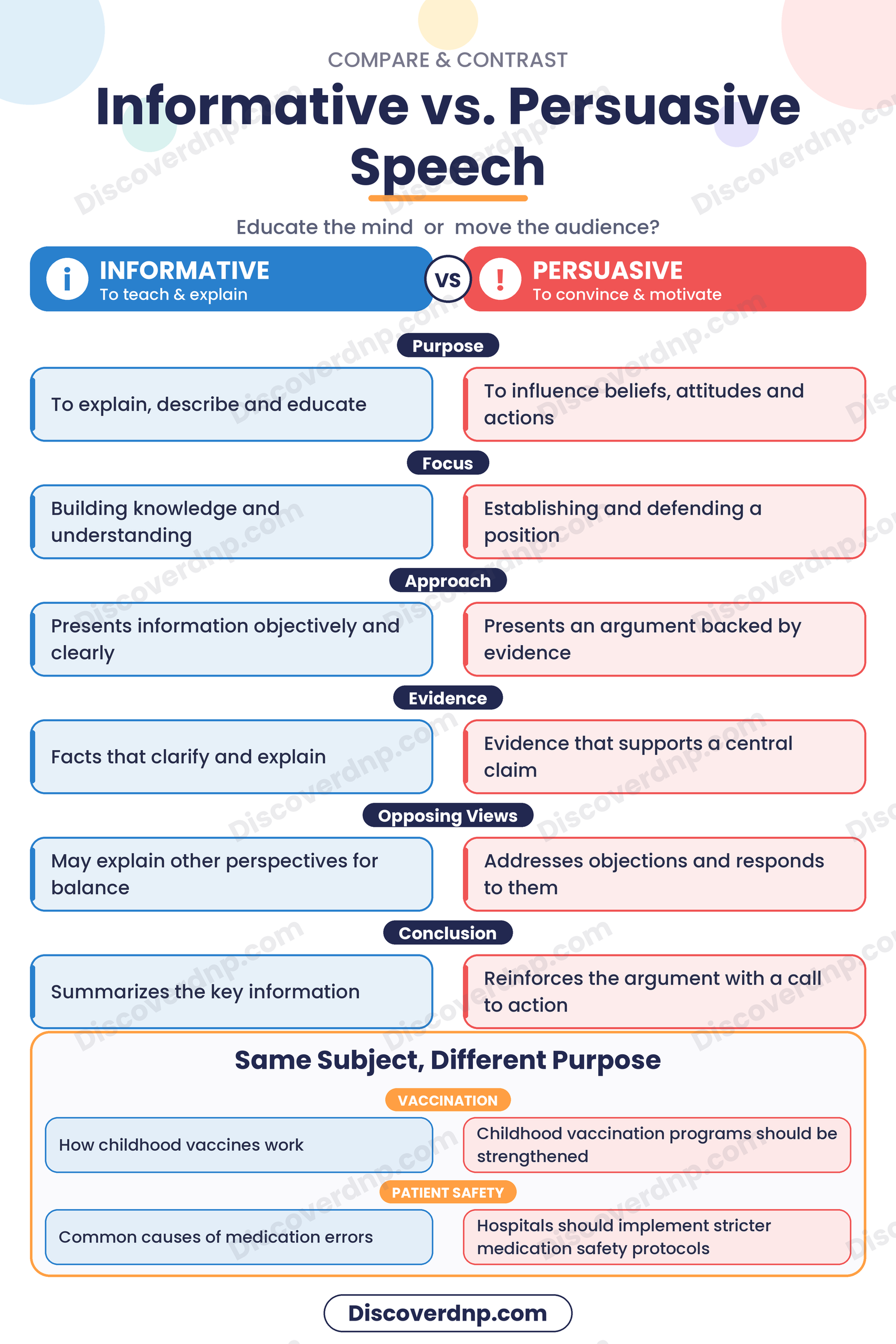
Unique and Challenging Persuasive Speech Ideas
Unique and challenging persuasive speech ideas are suitable for speakers who want to explore less familiar issues, examine competing values, or develop arguments that require deeper research. These topics may involve emerging technologies, ethical dilemmas, legal questions, scientific developments, economic policies, or changes in professional practice.
A unique topic does not have to be completely new. It can be a familiar issue approached from a less common perspective. For example, instead of discussing whether hospitals should use artificial intelligence, a speaker could examine whether patients should have the right to know when an AI system has contributed to a clinical recommendation. This narrower question introduces issues of transparency, informed decision-making, professional accountability, and patient trust.
Challenging topics require careful preparation because they often involve several reasonable viewpoints. The speaker should define important terms, distinguish established evidence from speculation, consider potential consequences, and address counterarguments. A controversial position alone does not make a great persuasive speech; the argument must be defensible and supported by credible sources.
Unique and challenging persuasive speech ideas include:
- Governments should establish stronger legal protections for individuals whose personal data is used to train artificial intelligence systems.
- Patients should have the right to know when artificial intelligence has influenced clinical decisions.
- Hospitals should be required to disclose significant errors involving clinical decision-support technologies.
- Employers should be legally required to assess the impact of workplace automation on affected employees.
- Governments should regulate the use of facial recognition in public spaces.
- Social media platforms should provide independent researchers with controlled access to data for studying harmful online content.
- Universities should recognize selected forms of community-based experience in admissions decisions.
- Public institutions should introduce stronger safeguards against algorithmic discrimination.
- Governments should develop clearer policies for protecting workers displaced by automation.
- Healthcare systems should prioritize climate resilience in the design of hospitals.
- Medical research involving human participants should place greater emphasis on community participation.
- Patients should have greater control over the secondary use of their anonymized health data.
- Public health policies should address the influence of poverty and housing conditions on disease outcomes.
- Governments should strengthen regulation of direct-to-consumer genetic testing services.
- Schools should teach ethical decision-making alongside digital literacy.
- Professional licensing bodies should require regular continuing education in emerging technologies.
- Governments should establish clearer standards for the use of autonomous systems in healthcare.
- Companies should be responsible for the environmental impact of products throughout their life cycles.
- Public funding should prioritize research into diseases that disproportionately affect underserved populations.
- Digital platforms should be required to explain how recommendation systems influence the information users see.
Challenging persuasive topics in nursing, medicine, and healthcare include:
- Should nurses have expanded authority to prescribe certain medications under defined professional and legal safeguards?
- Should healthcare institutions be required to publish nurse staffing levels and patient safety indicators?
- Should assisted dying be legally permitted under carefully defined conditions?
- Should patients have the right to refuse medically recommended treatment even when refusal creates serious risks?
- Should healthcare organizations use predictive analytics to identify patients at risk of deterioration?
- Should genetic information be protected from discriminatory use by employers and insurers?
- Should governments make essential medicines available through stronger price-control policies?
- Should organ donation systems use presumed consent rather than explicit consent?
- Should healthcare facilities be required to provide culturally appropriate end-of-life care?
- Should clinical research participants have greater influence over how research findings are shared and used?
- Should hospitals be held accountable for preventable patient harm caused by unsafe working conditions?
- Should healthcare professionals be allowed to use generative AI to assist with clinical documentation?
- Should health systems invest more in community-based care than in expanding hospital capacity?
- Should access to palliative care be treated as an essential component of universal health coverage?
- Should governments introduce stronger protections for healthcare workers who report unsafe practices?
These subjects are challenging because they involve more than one area of knowledge. For example, a speech about expanded prescribing authority for nurses requires an understanding of nursing education, professional regulation, patient safety, healthcare access, and the scope of practice. A speaker supporting the proposal could argue that appropriately trained nurses may improve access to treatment and reduce delays in care. Opposing arguments might raise concerns about training requirements, clinical accountability, supervision, and differences between healthcare systems. A strong presentation should clarify that prescribing authority varies by jurisdiction and must operate within applicable laws and professional standards.
Another advanced topic is the use of predictive analytics in healthcare. A speaker could argue that hospitals should use validated predictive tools to identify patients who may be at risk of clinical deterioration, provided that appropriate safeguards are in place. The supporting argument might examine early warning systems, timely intervention, and the ability to process large amounts of clinical information. Counterarguments could address inaccurate predictions, biased data, privacy concerns, alert fatigue, and overreliance on technology. This topic provides an opportunity to examine both the potential benefits and limitations of digital healthcare.
Ethical issues such as euthanasia and organ donation can also support challenging persuasive speeches. They require speakers to distinguish between legal definitions, ethical principles, clinical practice, and cultural perspectives. For example, an argument about presumed consent for organ donation should consider the potential effect on donation rates alongside informed consent, public trust, religious beliefs, and safeguards for people who do not wish to donate. Treating the opposing position respectfully is especially important when the issue involves deeply held personal values.
When selecting a challenging topic, the speaker should consider whether sufficient credible research is available and whether the issue can be addressed within the assigned time. A subject may be intellectually interesting but too broad for a short presentation. Narrowing it to one policy decision, ethical question, or practical recommendation makes it possible to develop a stronger argument.
A useful way to assess the difficulty of a potential topic is to consider the following:
- Research demands: Does the issue require specialist knowledge, recent studies, legislation, or technical reports?
- Evidence quality: Are there reliable sources supporting the position and explaining alternative viewpoints?
- Ethical complexity: Does the topic involve competing rights, responsibilities, or social values?
- Argument development: Can the speaker identify several distinct reasons supporting the position?
- Audience familiarity: Will listeners understand the basic issue, or will substantial background explanation be necessary?
- Time available: Can the speaker address the central argument without oversimplifying important details?
The most suitable topic is one that challenges the speaker without making the presentation unmanageable. Whether the goal is an easy persuasive speech for a first presentation or a more advanced argument about healthcare policy, the speaker should choose an issue that can be explained clearly, supported with credible evidence, and connected to the audience’s interests. Audience analysis and topic adaptation are important because the same subject may require different examples, vocabulary, and levels of detail depending on who is listening.
Developing a Persuasive Speech Outline
A persuasive speech outline provides the structure needed to present an argument clearly, logically, and convincingly. It helps the speaker organize ideas, identify the evidence required to support each claim, anticipate opposing viewpoints, and guide the audience toward a particular conclusion or action. Without a clear outline, even a strong persuasive speech topic can become difficult to follow, especially when the presentation includes several arguments, statistics, examples, and counterarguments.
An effective outline connects every part of the speech to one central purpose. The introduction establishes the issue and captures the audience’s attention, while the thesis statement communicates the speaker’s position. The main points develop the argument in a logical order, and the counterarguments address reasonable objections. The conclusion reinforces the central message and provides a clear call to action when the purpose is to encourage a change in attitude, behaviour, or policy.
For example, consider a persuasive speech arguing that hospitals should implement stronger measures to prevent medication errors. The outline could introduce the importance of medication safety, establish the position that healthcare facilities should strengthen medication administration procedures, and develop supporting arguments about patient harm, standardized protocols, and staff training. It could then address concerns about implementation costs and workload before concluding with recommendations for improving medication safety.
A well-developed persuasive speech outline also helps the speaker manage the available presentation time. Each section should contribute to the central argument rather than introduce unrelated information. The following components provide a practical structure for preparing a coherent and effective presentation.
Introduction and Thesis Statement
The introduction is the opening section of a persuasive speech. Its purpose is to capture attention, introduce the subject, establish its relevance, and prepare the audience to understand the argument. Because listeners form an early impression of the speaker and the subject, the introduction should be engaging, focused, and directly connected to the central message.
A strong introduction does not begin with lengthy background information or unrelated statements. Instead, it gives the audience a reason to listen and establishes why the issue deserves attention. The speaker can use a question, a brief story, a relevant statistic, a quotation, or a real-life situation to introduce the subject. The choice should depend on the audience, the speech purpose, and the nature of the topic.
For example, a persuasive speech about preventing medication errors in hospitals could begin with a brief scenario describing a patient who receives an incorrect medication dose because of a communication failure. This situation introduces the importance of medication safety and encourages listeners to consider the consequences of preventable mistakes. The speaker can then introduce the central argument that healthcare facilities should strengthen medication administration procedures.
Several elements contribute to an effective introduction:
1. Attention-getter: The opening statement should attract interest and encourage listeners to pay attention. It may involve a thought-provoking question, a relevant statistic, a short anecdote, or a striking real-world example. For a speech about antimicrobial resistance, the speaker might begin by asking what could happen if commonly used antibiotics became ineffective against certain infections.
2. Introduction of the topic: After attracting attention, the speaker should identify the subject and provide enough background for the audience to understand the issue. The explanation should be brief and focused. A presentation about nurse staffing, for example, should clarify that it concerns the relationship between staffing levels, nurses’ workloads, and patient care rather than discussing every challenge facing healthcare systems.
3. Audience relevance: The introduction should explain why the issue matters to the listeners. This connection can involve their health, education, finances, professional responsibilities, community, or future opportunities. A speech about digital privacy may be particularly relevant to college students because they regularly use online platforms for communication, education, and financial transactions.
4. Speaker credibility: The speaker should establish why the audience can reasonably trust the information being presented. Credibility may come from relevant education, professional experience, personal involvement, or careful research using authoritative sources. A speaker does not need to claim specialist expertise to establish credibility; explaining that the argument is based on recognized clinical guidelines, peer-reviewed research, or government publications can also strengthen confidence.
5. Thesis statement: The introduction should contain a clear statement of the position the speaker intends to defend. It should identify the central argument rather than merely name the subject.
6. Preview of main points: The speaker should briefly indicate the principal arguments that will be discussed. This gives listeners a mental structure for following the presentation.
These elements should connect naturally rather than sound like separate statements placed together. For example, a speech about expanding mental health support in universities could begin with a brief example of a student experiencing psychological distress but struggling to access counselling. The speaker could introduce the wider issue of limited mental health support, explain why it matters to the academic community, and then present a position supporting greater institutional investment in accessible counselling services.
Developing a clear thesis statement
The thesis statement is the central claim of a persuasive speech. It communicates what the speaker wants the audience to believe, reconsider, support, or do. Every major argument in the body should contribute to explaining or defending this statement.
A strong thesis statement should be:
- Specific: It should identify a particular issue rather than introduce an excessively broad subject.
- Debatable: It should express a position that can be supported and challenged.
- Clear: The audience should understand the speaker’s viewpoint without needing lengthy explanations.
- Defensible: It should be possible to support the position with credible evidence and logical reasoning.
- Relevant: It should address an issue that matters to the intended audience.
- Manageable: It should be narrow enough to develop within the available speaking time.
Consider the following examples:
| General subject | Weak thesis statement | Stronger persuasive thesis statement |
|---|---|---|
| Nursing | Nursing is an important profession. | Hospitals should establish safer nurse-to-patient staffing standards to improve patient safety and reduce excessive workloads. |
| Mental health | Mental health affects many people. | Universities should expand confidential counselling services to improve students’ access to mental health support. |
| Technology | Artificial intelligence is changing healthcare. | Hospitals should use artificial intelligence as a clinical support tool while preserving the final decision-making responsibility of qualified healthcare professionals. |
| Environment | Plastic pollution is a serious problem. | Municipal governments should restrict unnecessary single-use plastics and expand accessible waste-management programmes. |
| Education | Financial education is useful. | Secondary schools should make financial literacy a compulsory subject to prepare learners for responsible financial decisions. |
The difference is that the stronger statements establish a definite position and indicate the direction of the argument. They give the speaker something specific to prove.
A thesis statement should also be distinguished from a general purpose statement. The general purpose identifies the broad intention of the presentation, such as persuading the audience to support improved hospital staffing. The specific purpose explains the intended audience response, while the thesis expresses the actual position being defended.
For example:
- General purpose: To persuade.
- Specific purpose: To persuade hospital administrators and healthcare professionals to support safer nurse staffing policies.
- Thesis statement: Hospitals should adopt evidence-based nurse staffing standards because adequate staffing supports patient safety, improves working conditions, and strengthens the quality of care.
The thesis can be presented as a single sentence, followed by a preview of the main arguments. A preview might state that the speech will examine the relationship between staffing and patient safety, the effects of excessive workloads on nurses, and the practical benefits of evidence-based staffing policies.
The introduction should not contain every supporting statistic or counterargument. Its role is to establish the issue and provide a clear direction for the presentation. Detailed evidence belongs in the main body, where the speaker can explain each argument fully. Guidance from university public speaking resources similarly emphasizes the importance of an attention-getter, a clear thesis, audience relevance, credibility, and a preview of the main points.
Organization of Main Points
The main body is where the speaker develops the central argument and demonstrates why the audience should accept the proposed position. It contains the main points, supporting explanations, evidence, examples, and transitions that connect the different parts of the presentation.
A persuasive speech outline should organize these points in a logical sequence. Each main point should support the thesis and contribute something distinct to the argument. If two points communicate essentially the same idea, they should be combined or revised. Similarly, information that does not help establish the central position should be removed, even if it is interesting.
Most short persuasive speeches work well with two or three substantial main points. Longer presentations may require additional points, depending on the assignment and the complexity of the subject. The speaker should prioritize depth and clarity rather than trying to include every possible argument. University of Nebraska and Florida SouthWestern State College public speaking materials recommend developing main points from the speech purpose and research, then arranging them according to an appropriate organizational pattern.
Selecting and developing the main points
The main points should represent the strongest reasons supporting the thesis statement. Each one should be expressed as a complete, declarative statement that communicates a specific part of the argument.
For example, consider the thesis:
Hospitals should strengthen medication administration procedures to reduce preventable medication errors and improve patient safety.
The main points could be:
- Standardized medication administration procedures help reduce avoidable errors.
- Regular staff training improves medication safety practices and clinical awareness.
- Better medication documentation and communication strengthen continuity of care.
Each point addresses a different aspect of the central argument. The speaker can then develop the points using supporting information.
A useful structure for developing each main point is:
- Claim: State the specific argument.
- Explanation: Clarify what the argument means and why it matters.
- Evidence: Present research findings, statistics, professional guidance, expert testimony, or other credible supporting material.
- Example: Illustrate the argument through a realistic situation or documented case.
- Connection to the thesis: Explain how the evidence supports the overall position.
For instance, the first main point could argue that standardized medication administration procedures reduce avoidable errors. The speaker could explain the importance of checking the correct patient, medication, dose, route, and timing. Supporting evidence might come from medication safety guidelines and peer-reviewed research. A practical example could describe how a standardized patient-identification process helps prevent a medication from being administered to the wrong individual. The point should then connect these measures to the broader argument for stronger hospital medication safety policies.
This structure prevents the speaker from presenting statistics or examples without explaining their significance. Evidence is most persuasive when the audience understands what it demonstrates and how it relates to the central claim.
Choosing an appropriate organizational pattern
The order of the main points depends on the nature of the subject and the response the speaker wants to encourage. Several organizational patterns are commonly used in persuasive speeches.
1. Problem-solution pattern
This approach identifies a problem, explains its consequences, and proposes a practical solution. It is particularly useful when the speaker wants the audience to recognize a concern and support a specific change.
For example, a speech about medication errors could follow this sequence:
- Explain the problem of preventable medication errors.
- Discuss contributing factors, such as communication failures, workload pressures, and inadequate documentation.
- Propose solutions, including standardized procedures, staff training, and improved medication reconciliation.
The pattern is effective because it establishes the need for action before presenting the recommended response.
2. Cause-effect pattern
This pattern explains the causes of an issue and the consequences that follow. It can help an audience understand why a particular problem develops and why intervention is necessary.
A speech about nurse burnout might examine excessive workloads, inadequate staffing, and insufficient workplace support as contributing factors. It could then explain how burnout may affect staff well-being, retention, and the delivery of care. The speaker can use the discussion to support a policy recommendation.
3. Topical pattern
A topical arrangement divides the central argument into separate but related areas. Each main point addresses one important reason supporting the thesis.
For example, a speech supporting expanded mental health services in universities could organize its main points around accessibility, early intervention, and academic well-being. Each point provides a distinct justification for the proposed policy.
4. Comparative advantage pattern
This pattern compares two or more possible approaches to a problem and explains why one is preferable. It is useful when the audience must choose between competing solutions.
A speech about improving healthcare access could compare expanding hospital-based services with investing in community-based care. The speaker might argue that community-based services offer better opportunities for early intervention, local access, and continuity of care, while also acknowledging situations that require hospital treatment.
5. Monroe’s Motivated Sequence
Monroe’s Motivated Sequence is a persuasive organizational method designed to move an audience from attention and awareness toward action. It is particularly useful when the speech seeks to motivate listeners to support a proposal or change their behaviour.
The sequence has five stages:
- Attention: Capture interest and introduce the subject.
- Need: Demonstrate that a problem exists and explain why it matters.
- Satisfaction: Present a solution that addresses the identified problem.
- Visualization: Help the audience imagine the likely consequences of adopting or rejecting the solution.
- Action: Explain what the audience should do next.
For example, a speech encouraging hospitals to improve infection prevention could begin with a situation involving a preventable healthcare-associated infection. It would then explain the risks associated with inadequate infection prevention, propose stronger hand hygiene education and monitoring, describe the potential benefits of consistent implementation, and conclude by asking hospital leaders and healthcare workers to support the recommended measures.
This method is especially valuable when the speaker wants the presentation to lead to a practical response rather than simply communicate information. The University of Wisconsin–La Crosse Public Speaking Center identifies Monroe’s five stages as one of the established approaches to organizing persuasive arguments.
Using supporting evidence and transitions
The main points should be supported by relevant evidence rather than personal opinions alone. Depending on the topic, useful supporting material may include:
- Peer-reviewed research and academic publications.
- Government statistics and public health reports.
- Professional guidelines and policy documents.
- Expert testimony from qualified individuals.
- Real-world examples and documented cases.
- Comparisons that illustrate differences between policies or outcomes.
For healthcare subjects, sources such as the World Health Organization, national health authorities, professional nursing organizations, and established medical journals can provide useful evidence. A speaker should explain the source of important statistics and avoid presenting isolated figures without context.
Transitions are also essential because listeners cannot reread a speech as they could an essay. Transitional statements help the audience understand how one point relates to the next. Examples include:
- “Having examined how medication errors occur, the next consideration is how standardized procedures can reduce these risks.”
- “Although staff training is important, training alone cannot address every cause of medication-related harm.”
- “These findings demonstrate the need for stronger hospital policies, which leads to the question of how such policies should be implemented.”
An effective transition may briefly summarize the previous point, introduce the next one, and show how the argument is progressing. This makes the speech easier to follow and strengthens the relationship between the individual arguments.
Example of an organized persuasive speech outline
The following example brings the different organizational elements together using the topic of improving medication safety in hospitals.
Title: Why Hospitals Should Strengthen Medication Safety Procedures
General purpose: To persuade.
Specific purpose: To persuade healthcare administrators and professionals to support stronger medication administration procedures.
Thesis statement: Hospitals should strengthen medication administration procedures through standardized protocols, regular staff training, and improved communication to reduce preventable errors and protect patients.
I. Introduction
- Attention-getter: Introduce a realistic example of a medication error caused by a communication failure.
- Topic relevance: Explain how medication safety affects patients, families, and healthcare professionals.
- Credibility: Establish the argument through recognized medication safety guidance and research.
- Thesis statement: State the need for stronger medication administration procedures.
- Preview: Identify standardized protocols, staff training, and communication as the three main areas of discussion.
II. Main body
A. Standardized medication procedures help prevent avoidable errors.
- Explain the importance of consistent medication administration checks.
- Discuss patient identification, dosage verification, and correct administration routes.
- Support the argument with professional medication safety guidance.
B. Regular staff training strengthens medication safety practices.
- Explain the importance of continuing education and competency assessment.
- Discuss safe medication calculations and recognition of potential adverse reactions.
- Provide examples of how simulation and practical training can reinforce safe procedures.
C. Improved communication and documentation support safer care.
- Explain the importance of accurate medication records and handover communication.
- Discuss medication reconciliation during admission, transfer, and discharge.
- Show how clear communication helps prevent omissions, duplication, and misunderstandings.
III. Counterarguments and rebuttals
- Acknowledge that implementing new procedures may require additional funding and staff time.
- Explain that implementation can be phased and supported through targeted training and appropriate technology.
- Emphasize the importance of evaluating the effectiveness of safety measures.
IV. Conclusion
- Restate the importance of reducing preventable medication errors.
- Review the three supporting arguments.
- Encourage hospital administrators and healthcare professionals to strengthen medication safety policies.
- Close with a memorable statement emphasizing that patient safety depends on consistent, reliable practices.
This example demonstrates how an outline turns a broad subject into a focused persuasive argument. It also provides a framework for deciding which evidence to collect, how much detail to include, and where counterarguments should be addressed.
Counterarguments and Rebuttals
A persuasive speech becomes more credible when it recognizes that the audience may not automatically agree with the speaker. Most meaningful issues have different viewpoints, and listeners may have concerns about the practicality, cost, fairness, effectiveness, or possible consequences of a proposed position.
A counterargument is a reason or claim that challenges the speaker’s position. A rebuttal is the response used to explain why the opposing argument does not invalidate the speaker’s central claim. Addressing these elements demonstrates that the speaker has considered the issue from more than one perspective rather than relying only on information that supports a preferred conclusion.
Ignoring opposing viewpoints can weaken a persuasive argument. Listeners who recognize an important objection may question the speaker’s credibility if it is not acknowledged. Addressing the objection directly shows that the speaker understands the complexity of the issue and can defend the proposed position with reasoned evidence. Persuasive communication guidance also emphasizes the strategic role of counterarguments when developing an argument intended to influence beliefs and behaviour.
Identifying relevant counterarguments
The first step is to consider why a reasonable person might disagree with the thesis. The speaker should think about the potential disadvantages of the proposed action, the concerns of affected groups, and whether alternative approaches might be more practical.
For example, consider the thesis that hospitals should adopt safer nurse-to-patient staffing standards. Possible counterarguments include:
- Financial limitations: Hospitals may argue that recruiting additional nurses would increase operating expenses.
- Workforce shortages: Some facilities may struggle to recruit enough qualified nurses to meet proposed staffing standards.
- Differences in patient needs: A fixed staffing ratio may not account for differences in patient acuity, clinical complexity, and available support services.
- Operational challenges: Changes to staffing policies may require adjustments to scheduling, recruitment, and resource allocation.
These objections should not automatically be treated as inaccurate or unreasonable. They identify real considerations that the speaker needs to address when defending the proposed policy.
Developing effective rebuttals
A strong rebuttal responds directly to an opposing argument using evidence, reasoning, clarification, or a more practical alternative. It should explain why the objection does not outweigh the benefits of the speaker’s position.
For example:
| Counterargument | Possible rebuttal |
|---|---|
| Improving nurse staffing will increase hospital costs. | The speaker can examine the potential financial consequences of inadequate staffing, including overtime, turnover, recruitment expenses, and avoidable complications. |
| There are not enough nurses to implement stricter staffing standards. | A phased approach could combine workforce development, improved retention, recruitment, and better staffing allocation. |
| Every hospital has different patient needs. | Staffing policies can incorporate patient acuity and clinical workload rather than relying only on a single fixed ratio. |
| Existing staffing arrangements are sufficient. | The speaker can use relevant patient safety indicators, workforce data, and research to assess whether current arrangements adequately support safe care. |
The rebuttals should be supported by credible sources. For instance, if the speaker argues that inadequate staffing can increase healthcare risks, the claim should be supported by relevant research rather than a personal assumption. Similarly, a proposed solution should be evaluated for feasibility and potential limitations.
Common approaches to responding to opposing viewpoints
There are several ways to develop a rebuttal, depending on the nature of the counterargument.
1. Refuting an inaccurate claim: If the opposing argument relies on incorrect or misleading information, the speaker can present reliable evidence that corrects it. For example, a claim that all antibiotics are effective against viral infections can be addressed by explaining the distinction between bacterial and viral infections using authoritative medical guidance.
2. Showing that the objection is incomplete: Sometimes an opposing argument contains a valid point but does not consider the entire issue. A hospital may argue that additional staff will increase costs, but this does not account for the possible costs associated with high turnover, excessive overtime, and preventable adverse events.
3. Acknowledging a limitation and proposing safeguards: A speaker can accept that a proposal has practical limitations while explaining how they can be managed. For example, telehealth can improve access to care, but it may not be suitable for every clinical situation. A persuasive argument can support telehealth expansion while recommending in-person assessment when clinically necessary.
4. Comparing alternative solutions: When an objection suggests that another approach would work better, the speaker can compare the alternatives using relevant criteria. A speech about reducing plastic waste might compare restrictions on unnecessary single-use plastics with voluntary recycling programmes and explain why a combination of approaches may be more effective.
5. Clarifying the limits of the thesis: Sometimes an argument appears weaker because the original position is too absolute. A speaker advocating for artificial intelligence in healthcare, for example, should not claim that AI can replace all clinical decision-making. A more defensible position is that validated AI tools can support qualified professionals when their use is appropriately supervised.
Where to place counterarguments in the speech
Counterarguments can be addressed within the main body or in a separate section, depending on the topic and the organizational pattern.
- After the relevant main point: The speaker can present an objection immediately after explaining the argument it challenges. This works well when the opposing view relates to one specific claim.
- Before presenting the proposed solution: In a problem-solution speech, the speaker can acknowledge concerns about existing approaches before explaining why the recommended solution is preferable.
- In a dedicated section: A speech involving several complex objections may benefit from a separate counterargument section near the end of the body, followed by clear rebuttals.
- Through comparative discussion: When the audience must choose between competing policies, objections and responses can be incorporated into the comparison.
The speaker should avoid allowing counterarguments to take over the presentation. The central purpose remains defending the thesis. Opposing viewpoints should receive enough attention to demonstrate fairness and strengthen the reasoning, but the speech should not become a collection of unrelated debates.
It is also important to avoid attacking people who hold different opinions. A persuasive argument should evaluate claims, evidence, and consequences rather than question the intelligence, character, or motives of those who disagree. Respectful language helps maintain audience trust and makes the presentation more effective.
For example, when discussing whether social media platforms should restrict harmful health misinformation, the speaker should recognize concerns about freedom of expression, censorship, and the difficulty of evaluating disputed information. A reasonable rebuttal could argue for transparent moderation standards, independent review, clear appeals processes, and stronger action against demonstrably false claims that create significant risks to public health.
A well-developed counterargument and rebuttal section shows that the speaker has considered the issue carefully. It also gives the audience a clearer basis for evaluating the proposed position.
Conclusion and Call to Action
The conclusion is the final part of a persuasive speech and the speaker’s last opportunity to reinforce the central message. It should leave the audience with a clear understanding of the argument and why the issue matters. In many persuasive speeches, the conclusion should also encourage listeners to reconsider an opinion, change a behaviour, support a policy, or take a specific action.
A strong conclusion should not introduce several new arguments or repeat the entire speech word for word. Instead, it brings the main points together, reinforces the thesis, and ends with a memorable statement. The conclusion should feel like a natural outcome of the arguments already presented.
Several elements contribute to an effective conclusion:
1. Signal that the speech is ending: A transition such as “In conclusion,” “As these arguments demonstrate,” or “Before we finish” helps listeners recognize that the presentation is approaching its final section.
2. Restate the thesis: The speaker should repeat the central position using different wording. This reminds the audience of the purpose of the speech without sounding repetitive.
3. Review the main points: Briefly summarize the strongest arguments supporting the position. This reinforces the logical structure and helps listeners remember the most important ideas.
4. Emphasize the significance of the issue: Explain why the argument matters beyond the presentation itself. This may involve patient safety, educational opportunities, public health, professional responsibility, environmental protection, or community well-being.
5. End with a memorable closing statement: A brief quotation, reference to the opening example, thought-provoking observation, or strong final sentence can give the presentation a sense of completion.
For example, a speech arguing for stronger medication safety procedures could conclude by reminding the audience that standardized protocols, staff training, and effective communication all contribute to safer medication administration. The speaker could then reinforce the idea that preventing medication errors is a shared responsibility requiring consistent action from healthcare professionals and institutions.
Developing an effective call to action
A call to action is a direct request encouraging the audience to do something in response to the persuasive message. It is particularly important when the purpose of the speech is to influence behaviour, encourage participation, or gain support for a proposed change.
A weak call to action is vague and does not tell the audience what is expected. For example, saying “We should all care more about patient safety” expresses a general sentiment but provides little direction. A stronger statement would be: “Hospital administrators should review medication administration policies, introduce regular competency assessments, and establish clear systems for reporting medication errors.”
An effective call to action should be:
- Specific: It should identify the action the audience is expected to take.
- Practical: The requested action should be achievable within the audience’s responsibilities and available resources.
- Relevant: It should connect directly to the central thesis and the arguments developed in the speech.
- Appropriate for the audience: The speaker should consider what listeners can realistically influence.
- Motivating: It should communicate why taking action matters and what the action could help achieve.
The appropriate call to action depends on the topic and the people listening. For example:
| Persuasive speech topic | Possible call to action |
|---|---|
| Medication safety | Healthcare professionals should follow standardized medication checks and report safety concerns through established channels. |
| Mental health services | University administrators should review counselling capacity and improve access to confidential support. |
| Environmental protection | Community members should reduce unnecessary plastic use and support local waste-management initiatives. |
| Digital privacy | Technology users should review privacy settings and support stronger protections for personal information. |
| Financial literacy | School administrators should introduce practical financial education into the curriculum. |
| Nurse staffing | Healthcare leaders should evaluate staffing needs using patient acuity, workload, and relevant safety evidence. |
The call to action should be directed toward people who have the ability to influence the proposed change. A speech about hospital staffing may be addressed to healthcare administrators, policymakers, and nursing leaders rather than asking individual patients to change institutional staffing arrangements. Similarly, a speech about reducing household waste may appropriately ask individual listeners to change purchasing and disposal habits.
Using Monroe’s Motivated Sequence to strengthen the conclusion
Monroe’s Motivated Sequence places the action stage at the end of a persuasive presentation. After gaining attention, demonstrating the need, presenting a solution, and helping the audience visualize its potential effects, the speaker gives listeners a clear instruction about what to do.
For example, a speech encouraging greater participation in community blood donation could use the sequence as follows:
- Attention: Introduce the importance of blood availability during medical emergencies.
- Need: Explain how shortages can affect patients requiring transfusions.
- Satisfaction: Present community blood donation programmes as one way to support the supply of safe blood.
- Visualization: Describe how regular participation can help maintain availability for patients who need transfusions.
- Action: Encourage eligible listeners to consult recognized blood donation services, check eligibility requirements, and register to donate.
The action should be realistic and should not pressure people to act against medical eligibility requirements. This illustrates why persuasive speaking must remain ethical: motivating an audience does not justify making exaggerated claims or overlooking individual circumstances. The University of Florida’s speech-writing guidance identifies a call to action as a particularly strong way to end a persuasive presentation, while public speaking resources also recommend reviewing the main arguments and providing a memorable final statement.
Connecting the conclusion to the introduction
One effective way to make a speech memorable is to return to the opening example, question, or statistic. This technique creates a sense of unity by showing how the arguments developed throughout the presentation relate to the issue introduced at the beginning.
For example, if a speech about patient safety begins with a scenario involving a medication error, the conclusion can return to that situation and explain how standardized procedures, training, and communication could help prevent similar incidents. This allows the audience to see the practical significance of the proposed change.
The final statement should be concise and purposeful. Instead of ending with “That is all I have to say,” the speaker can close with a sentence that reinforces the message and encourages reflection or action.
A possible conclusion for the medication safety speech might be:
Medication safety cannot depend on individual vigilance alone. It requires reliable procedures, properly trained professionals, and clear communication across every stage of care. Hospitals should strengthen these systems and make the prevention of avoidable medication errors a shared priority. Every improvement in medication safety is an important step toward protecting patients and delivering better healthcare.
A persuasive speech outline is most effective when the introduction, thesis, main points, counterarguments, and conclusion work together to support one central purpose. Each section should prepare the audience for the next, while every example and piece of evidence should strengthen the argument. When the presentation ends with a realistic call to action, the speech moves beyond expressing an opinion and gives listeners a clear reason to reconsider their position or participate in meaningful change.
Researching and Supporting Persuasive Arguments
Research is an essential part of developing a convincing persuasive speech because it provides the information needed to explain an issue, support a position, and respond to opposing viewpoints. A speaker may have a strong personal opinion about a subject, but an opinion alone is rarely enough to persuade an audience. Listeners are more likely to consider an argument seriously when it is supported by accurate facts, relevant statistics, credible research, expert testimony, and real-world examples.
Research also helps speakers understand the complexity of an issue before taking a definite position. A topic such as nurse staffing, for example, involves more than the number of nurses working in a hospital. It may require examining patient needs, workload, staff experience, hospital resources, patient outcomes, and professional recommendations. Consulting reliable sources helps the speaker distinguish established findings from assumptions and develop a position that can withstand reasonable criticism.
The purpose of research is not simply to collect information that agrees with the speaker’s viewpoint. It is to understand the issue, identify the strongest available evidence, examine different perspectives, and use that information responsibly. A well-supported persuasive speech should make clear what is known, what remains uncertain, and why the evidence justifies the proposed position.
The research process generally involves three important activities: finding credible academic and professional sources, using facts and expert information effectively, and evaluating evidence before incorporating it into the speech. These activities strengthen the persuasive argument and help the speaker establish credibility with the audience.
Finding Credible Academic and Professional Sources
The quality of a persuasive speech depends heavily on the quality of the information used to support its arguments. A speaker may present an interesting position, but if the supporting material comes from unreliable websites, outdated publications, unverified statistics, or individuals without relevant expertise, the argument may lose credibility. Finding credible academic and professional sources is therefore an essential part of preparing a strong persuasive presentation.
Credible sources provide information that can be examined, verified, and supported by evidence. They help speakers understand the background of an issue, identify relevant research findings, recognize professional recommendations, and examine different perspectives. They are particularly important when discussing subjects involving health, science, education, technology, public policy, and professional practice, where inaccurate information can mislead an audience.
For example, someone preparing a speech arguing that hospitals should strengthen infection prevention procedures should not rely exclusively on personal opinions or social media discussions. The argument would be stronger if supported by research published in peer-reviewed healthcare journals, infection prevention guidelines, reports from recognized public health organizations, and relevant hospital safety data. These sources can provide evidence about infection risks, prevention practices, healthcare-associated infections, and the responsibilities of healthcare professionals.
Types of academic and professional sources
Different sources provide different forms of information. The speaker should select materials according to the subject, the intended audience, and the specific argument being developed.
1. Peer-reviewed academic journals
Peer-reviewed journals are important sources for speeches requiring scientific, clinical, educational, or social research. Before publication, submitted research articles are evaluated by other experts in the relevant field. Reviewers may assess the research methods, accuracy of the analysis, relevance of the findings, and contribution to existing knowledge.
Peer-reviewed research is particularly useful when the speaker needs evidence about relationships between variables, treatment outcomes, professional practices, educational interventions, or social trends.
For example, a persuasive speech arguing that healthcare facilities should introduce stronger nurse staffing policies could use peer-reviewed studies examining the relationship between staffing levels, patient outcomes, nurse workload, and quality of care. Rather than simply claiming that more nurses improve healthcare, the speaker can explain what researchers have found and identify the limitations of the available evidence.
However, peer review does not guarantee that every published finding is correct. Research may have limitations involving sample size, study design, funding, or the population examined. Speakers should therefore examine the methods and conclusions rather than accepting every published result without question.
2. Academic books and textbooks
Academic books and textbooks provide detailed explanations of theories, concepts, historical developments, and professional practices. They are useful when a speech requires background information or an explanation of complex subjects.
For example, a speech about the ethical responsibilities of nurses may benefit from academic books discussing professional ethics, patient autonomy, confidentiality, informed consent, and accountability. These materials can help the speaker explain the principles underlying a particular position.
Textbooks are also useful for understanding foundational subjects such as anatomy, physiology, public speaking, communication, psychology, and research methods. However, because some textbooks are published several years apart, information about rapidly changing subjects should be checked against more recent research and professional guidance.
3. Government publications and official reports
Government departments and public agencies publish reports containing statistics, policy information, regulatory guidance, research findings, and information about public services. These publications are useful when a speech addresses healthcare access, education, employment, environmental protection, population trends, or public expenditure.
For example, a speech about improving maternal healthcare services could use national health reports to examine maternal health indicators, access to antenatal services, skilled birth attendance, and the availability of emergency obstetric care. Government statistics can also help demonstrate the scale of a problem and explain why a policy change may be necessary.
Speakers should check which population the statistics represent, when the information was collected, and whether the data are national, regional, or local. A statistic from one country should not automatically be used to describe another country’s circumstances.
4. Professional organizations and clinical guidelines
Professional associations and recognized organizations publish practice guidelines, position statements, ethical standards, policy recommendations, and educational materials. These sources are valuable because they often reflect the knowledge and professional responsibilities of people working in a particular field.
For nursing and healthcare topics, useful organizations include:
- World Health Organization (WHO) for global public health information, disease prevention, health systems, and healthcare workforce guidance.
- International Council of Nurses (ICN) for nursing ethics, professional standards, leadership, and nursing policy.
- American Nurses Association (ANA) for nursing practice, professional responsibilities, workplace issues, and patient advocacy.
- Centers for Disease Control and Prevention (CDC) for disease prevention, infection control, vaccination, and public health information.
- National Institute for Health and Care Excellence (NICE) for evidence-based health and social care guidance, particularly in the United Kingdom.
For example, a speech advocating stronger hand hygiene practices in healthcare settings could use recognized infection prevention recommendations to explain appropriate hand hygiene procedures and their role in reducing the spread of infection.
Professional guidelines should still be interpreted within their intended context. A recommendation developed for one country, healthcare system, or patient population may not apply identically elsewhere. Speakers should consider local laws, professional regulations, available resources, and clinical circumstances.
5. University research repositories and library databases
University libraries provide access to scholarly articles, academic books, dissertations, research reports, and other educational materials. Many institutions also maintain digital repositories containing research produced by their faculty and students.
Useful academic search platforms include Google Scholar, PubMed, JSTOR, ERIC, and institutional library databases. Their usefulness depends on the subject:
- Google Scholar: Helps identify academic publications, books, theses, and research citations across several disciplines.
- PubMed: Provides access to biomedical and life sciences literature, including research relevant to nursing and healthcare.
- JSTOR: Provides scholarly materials across humanities, social sciences, and other academic disciplines.
- ERIC: Offers educational research, reports, and resources relating to teaching, learning, and educational policy.
- University library databases: Provide access to subscribed academic journals, ebooks, and subject-specific research collections.
These resources can help speakers locate scholarly material that may not appear in ordinary search engine results.
6. Books, reputable news organizations, and established research institutions
Reputable news organizations can provide recent developments, interviews, policy announcements, and real-world examples. They are particularly useful for topics involving current events, public debates, technology, business, and social policy.
For example, a speech about the introduction of artificial intelligence in hospitals could use recent reporting to identify healthcare facilities that have adopted AI-supported systems. The speaker could then use peer-reviewed research to examine whether the technology improves clinical outcomes or creates additional risks.
Research institutions and established nonprofit organizations may also publish reports, surveys, and policy analyses. Their findings can be useful, but speakers should examine the organization’s expertise, funding, research methods, and purpose before relying on the information.
Primary and secondary sources
Another important consideration when researching a persuasive speech is the difference between primary and secondary sources.
- Primary sources provide original or firsthand information. Examples include original research studies, official government datasets, clinical trial results, interviews, original survey findings, legislation, and institutional policy documents.
- Secondary sources interpret, summarize, compare, or analyze information obtained from primary sources. Examples include literature reviews, systematic reviews, academic textbooks, research summaries, and analytical reports.
Both types can strengthen a persuasive argument. Primary sources are useful when the speaker needs to examine original findings or official information. Secondary sources are helpful when the speaker wants an overview of existing research or an explanation of how several studies relate to one another.
For example, a speaker researching the effects of nurse staffing on patient outcomes may consult individual observational studies as primary research and systematic reviews that examine findings from several studies as secondary research. Using both can provide a more complete understanding of the issue.
The distinction between scholarly and popular publications is also important. A scholarly article is generally written for an academic or professional audience and includes supporting references and research details. A popular article is intended for general readers and may simplify complex subjects. Popular sources are not automatically unreliable, but they should not replace specialist research when the speech requires technical or scientific evidence.
Developing an effective research strategy
Finding credible information becomes easier when the speaker searches with a clear research question rather than entering a broad topic into a search engine.
For example, someone preparing a speech about patient safety could begin with the broad subject of medication errors. The research question could then be narrowed to:
How can standardized medication administration procedures reduce preventable medication errors in hospitals?
This question provides a direction for searching academic and professional sources. Relevant search phrases could include:
- Medication administration errors in hospitals.
- Patient safety and medication administration protocols.
- Medication reconciliation and preventable errors.
- Nursing education and medication safety.
- Hospital medication error prevention guidelines.
- Healthcare professional communication and medication errors.
The speaker should examine the titles, abstracts, publication details, and conclusions of the results before deciding which sources are useful. Reading the full article is preferable when the argument depends on specific research methods, findings, or limitations.
It is also helpful to maintain research notes containing the source title, author, publication date, key findings, relevant statistics, and complete citation details. This reduces the risk of losing important information and makes it easier to prepare the speech outline and reference list.
A speaker should not select sources simply because they support the desired conclusion. Research should include information that confirms, qualifies, and challenges the proposed position. This approach helps establish a balanced understanding of the subject and prepares the speaker to respond to counterarguments.
Using Facts, Statistics, and Expert Testimony
Facts, statistics, and expert testimony provide the supporting material needed to make a persuasive argument convincing. They help transform general statements into claims that can be examined and evaluated. When used appropriately, these forms of evidence strengthen the speaker’s credibility, clarify the significance of an issue, and give the audience reasons to consider the proposed position.
However, evidence does not become persuasive simply because it includes numbers, technical language, or quotations from professionals. It must be relevant to the argument, accurately represented, and explained in a way that listeners can understand. A statistic presented without context may confuse the audience, while an expert quotation that does not directly support the thesis may add little value.
Using facts to support persuasive arguments
Facts are statements that can be verified through reliable information or evidence. They may include established scientific findings, documented events, official policies, research observations, and information from recognized professional organizations.
Facts help speakers establish the background of an issue and explain why a particular position is reasonable.
For example, a speech arguing that hospitals should improve infection prevention procedures could use established information about how infections spread, the importance of hand hygiene, and the risks associated with healthcare-related infections. These facts help establish the relationship between infection prevention and patient safety.
Facts are especially useful when the audience needs to understand:
- The nature and extent of a problem.
- The causes or contributing factors associated with an issue.
- The effects of a particular behaviour, practice, or policy.
- The difference between available solutions.
- The likely consequences of taking or failing to take action.
The speaker should distinguish factual statements from opinions and interpretations. For instance, the statement that medication errors can cause patient harm is a factual claim that can be supported by clinical evidence. The statement that every hospital should adopt a particular medication administration policy is a recommendation that requires supporting arguments.
Facts should be connected to the thesis rather than presented as isolated information. After introducing a fact, the speaker should explain what it demonstrates and why it matters to the audience.
Using statistics effectively
Statistics are numerical information used to describe patterns, frequencies, proportions, comparisons, and trends. They can be particularly useful when the speaker needs to demonstrate the scale of a problem or show how an issue changes over time.
For example, a speech about healthcare workforce shortages could use official workforce statistics to explain the number of nurses in a particular country, the distribution of healthcare professionals between urban and rural areas, or changes in workforce demand. These figures can help establish why recruitment, retention, and workforce planning deserve attention.
Statistics can support persuasive arguments in several ways:
1. Demonstrating the size of a problem: A statistic can show how many people are affected by an issue. A speech about mental health services, for example, could use reliable population data to explain the need for accessible support.
2. Showing changes over time: Comparing figures from different years can help demonstrate whether a problem is increasing, decreasing, or remaining relatively stable. A speech about air pollution might examine changes in air quality measurements across several years.
3. Comparing groups or situations: Statistics can help compare healthcare access, educational opportunities, employment conditions, or disease rates between different populations. The speaker should ensure that the groups are comparable before drawing conclusions.
4. Explaining the potential impact of a policy: Data may help illustrate the relationship between an intervention and an outcome. For example, a speech supporting vaccination programmes could use appropriate immunization and disease surveillance data to explain the importance of maintaining vaccine coverage.
5. Making abstract problems more understandable: Numerical information can help listeners understand the scale of an issue that might otherwise seem distant or difficult to visualize.
Interpreting statistics accurately
Statistics must be presented with sufficient context. A number without an explanation may create a misleading impression, even when it comes from a credible source.
When using numerical information, the speaker should examine the following:
- Source: Who collected or published the data?
- Date: When were the figures collected and published?
- Population: Which individuals or groups were included?
- Sample size: How many participants or observations were examined?
- Measurement: What exactly was measured?
- Geographical context: Does the statistic refer to a hospital, community, country, or global population?
- Methodology: How were the figures collected and analyzed?
- Limitations: Are there factors that may affect how the results should be interpreted?
Consider a hypothetical study reporting that 20% of surveyed healthcare workers experienced a particular workplace problem. The speaker should identify the population surveyed, the location, the period covered, and the number of participants. Without these details, listeners might incorrectly assume that the figure represents all healthcare workers everywhere.
It is also important to distinguish between percentages, proportions, and absolute numbers. A reduction from 10 cases to 5 cases represents a 50% decrease, but it also represents five fewer cases. Both descriptions may be accurate, yet the percentage can sound more dramatic without the actual numbers.
Another important distinction is between relative and absolute risk. A treatment might be associated with a 50% relative reduction in a particular risk, but the absolute reduction may be much smaller depending on the starting risk. Explaining both measures can prevent audiences from misunderstanding the significance of research findings.
Speakers should also avoid confusing correlation with causation. If two variables change together, this does not automatically mean that one caused the other. For example, a study may identify an association between longer working hours and increased nurse fatigue. The speaker should not claim that working hours are the only cause without considering other contributing factors, such as workload, staffing, shift patterns, and individual circumstances.
Presenting statistics in an audience-friendly way
A persuasive speech is delivered orally, so the speaker must present numerical information in a form that listeners can understand quickly. Reading long statistical tables or several complicated figures can interrupt the flow of the presentation.
Useful approaches include:
- Round numbers when exact precision is not necessary, while preserving the meaning of the original data.
- Explain percentages using simple comparisons.
- Use a chart or graph when it makes a trend or comparison easier to understand.
- Avoid presenting several unrelated statistics in one sentence.
- Explain why the number matters rather than assuming the audience will recognize its significance.
- Identify the source and date of important statistics.
For example, instead of simply saying, “The report identified a 35% increase,” the speaker should explain what increased, over what period, and in which population. The audience should understand whether the figure refers to hospital admissions, reported incidents, disease cases, or another measurement.
A useful presentation might say:
“According to the national health report published in [year], the number of reported cases increased by 35% over the period examined. This finding suggests that the issue deserves closer attention, although the report’s definition of a reported case and the population covered must be considered when interpreting the increase.”
The actual figure should only be inserted after verifying the relevant report. This example illustrates how a statistic can be introduced, attributed, interpreted, and connected to the argument without exaggerating what the data demonstrate.
Using expert testimony
Expert testimony is information, explanation, or opinion provided by an individual with relevant knowledge, qualifications, or professional experience. It can strengthen a persuasive speech by helping the audience understand technical issues, professional standards, and the practical implications of a proposed position.
Expert testimony may come from:
- Medical doctors and other qualified healthcare professionals.
- Registered nurses and nursing researchers.
- University lecturers and academic researchers.
- Public health specialists.
- Economists and policy analysts.
- Environmental scientists.
- Legal professionals.
- Industry specialists and experienced practitioners.
For example, a speech arguing that nurses should have a stronger role in patient safety decisions could include testimony from nursing leaders, patient safety researchers, or healthcare administrators. Their professional knowledge may help explain how nursing involvement contributes to clinical communication, risk identification, and quality improvement.
Expert testimony can be used in different forms:
1. Direct quotations: The speaker uses the exact words of an expert to emphasize an important point. Direct quotations should be brief and accurately reproduced.
2. Paraphrased expert opinions: The speaker restates an expert’s explanation in their own words while acknowledging the source. This is often more suitable for oral presentations because it maintains a natural speaking style.
3. Professional recommendations: The speaker refers to guidance or recommendations issued by a recognized professional body. For example, a nursing ethics speech could draw on professional codes addressing confidentiality, dignity, and patient advocacy.
4. Research findings: The speaker explains conclusions from a study conducted by specialists in the relevant field. The research design and limitations should be considered before drawing conclusions.
Evaluating expert testimony
Not every person described as an expert is qualified to comment on every subject. A person’s reputation, popularity, or professional title does not automatically make their opinion authoritative in an unrelated field.
When selecting expert testimony, consider:
- Whether the person has relevant education, training, or professional experience.
- Whether their expertise directly relates to the issue being discussed.
- Whether the statement is supported by research or professional evidence.
- Whether the expert has financial, institutional, or personal interests that may influence the opinion.
- Whether the testimony represents an established professional consensus or an individual viewpoint.
- Whether other credible experts or sources support the same conclusion.
For example, a well-known social media personality may have a large audience but may not be qualified to recommend medical treatments. A speech about vaccine safety should therefore prioritize relevant clinical research, public health guidance, and qualified medical expertise rather than relying on the opinions of online influencers.
Expert testimony should also be used fairly. A speaker should not take a statement out of context, exaggerate its meaning, or imply that an expert supports a position they did not endorse.
Combining facts, statistics, and expert testimony
The strongest persuasive arguments often use several types of evidence together. Facts establish what is known, statistics help demonstrate the scale or pattern of an issue, and expert testimony provides professional interpretation.
Consider a speech arguing that hospitals should strengthen support for nurses experiencing workplace burnout.
- Fact: Workplace conditions, workload, and organizational support are relevant factors when examining occupational well-being.
- Statistic: A credible workforce survey or peer-reviewed study may provide figures on burnout prevalence in a defined group of nurses.
- Expert testimony: A nursing researcher or occupational health specialist may explain how prolonged workplace stress can affect staff well-being and professional performance.
- Practical example: A hospital experiencing repeated staff turnover may illustrate why supportive scheduling, adequate staffing, and access to employee assistance services deserve attention.
These forms of evidence work together to establish the problem, explain its significance, and support the proposed solution.
The speaker should avoid overwhelming the audience with too much information. A few strong pieces of evidence that directly support the main points are often more effective than a large collection of unrelated statistics and quotations. Every fact, statistic, and expert statement should have a clear purpose within the persuasive argument.
Evaluating Evidence and Citing Sources
Finding information is only one part of research. Before using material in a persuasive speech, the speaker must evaluate whether it is accurate, relevant, sufficiently current, and appropriate for the intended audience. Even information published by a recognized organization may be unsuitable if it does not directly support the argument, refers to a different population, or has been interpreted incorrectly.
Evaluating evidence also protects the speaker from spreading misinformation, relying on misleading statistics, or presenting personal opinions as established facts. This is particularly important when discussing medical and scientific issues, where inaccurate claims can influence people’s understanding of health risks and treatment decisions.
Evaluating the quality of evidence
A useful method for assessing sources is the CRAAP test. This framework examines five areas: Currency, Relevance, Authority, Accuracy, and Purpose. It is commonly used in academic research to help determine whether a source is appropriate for a particular assignment.
1. Currency
Currency refers to how recent the information is and whether it remains appropriate for the subject being researched.
Some topics require recent information because knowledge, policies, and technology change quickly. For example, a speech about artificial intelligence in healthcare should use current research and policy guidance because the technology is developing rapidly. Similarly, a speech about medication recommendations should consult current clinical guidance rather than relying entirely on an outdated textbook.
Other subjects may not require the newest available publication. A speech about the historical development of nursing theories, for example, may appropriately use older foundational publications.
Questions to consider include:
- When was the source published?
- Has it been revised or updated?
- Has newer research changed the conclusions?
- Does the topic require current statistics or guidance?
- Is the publication date appropriate for the issue being discussed?
2. Relevance
Relevance concerns whether the information directly contributes to the speech’s purpose and supports one of its main arguments.
A source may be credible but still have limited value if it does not address the specific issue. For example, a general article about the importance of healthcare may not provide sufficient evidence for a speech arguing that hospitals should introduce specific medication reconciliation procedures.
The speaker should assess whether the source answers the research question, supports the thesis, and provides information appropriate for the audience.
Questions to consider include:
- Does the information directly relate to the persuasive speech topic?
- Does it support one of the main arguments?
- Is the information detailed enough for the subject?
- Is the source appropriate for the intended audience?
- Does it provide useful evidence rather than simply repeating general information?
3. Authority
Authority refers to the qualifications and credibility of the author, publisher, institution, or organization responsible for the information.
A source written by a specialist in the relevant field is generally more appropriate for technical subjects than one written by an individual without relevant expertise. However, professional qualifications should be considered in relation to the specific claim being made.
For example, a registered nurse with experience in infection prevention may be qualified to discuss clinical infection control practices. However, a claim about the national economic cost of a healthcare policy may require evidence from health economists, government reports, or relevant economic research.
Questions to consider include:
- Who wrote or published the material?
- What qualifications or experience does the author have?
- Is the publisher or institution recognized in the relevant field?
- Does the author have relevant expertise?
- Are the author’s supporting references identifiable?
4. Accuracy
Accuracy concerns whether the information is correct, adequately supported, and presented without misleading interpretations.
The speaker should check whether claims are supported by research, whether statistics are reported correctly, and whether the conclusions follow from the evidence.
For example, a study may identify an association between inadequate sleep and reduced concentration. It would be inaccurate to present that finding as proof that sleep deprivation is the only cause of poor academic performance. Other factors may contribute to the outcome.
Questions to consider include:
- Does the source provide supporting evidence?
- Are research methods and data explained?
- Can the information be confirmed through other credible sources?
- Are conclusions consistent with the findings?
- Does the source acknowledge relevant limitations?
5. Purpose
Purpose refers to the reason a source was created and whether its content may be influenced by particular interests or biases.
Sources may be produced to inform, educate, persuade, advertise, entertain, or promote a particular policy or product. Understanding this purpose helps speakers decide whether the material can be used responsibly.
For example, a pharmaceutical company’s promotional material may contain useful information about a medication, but it should not be treated as an independent evaluation of the medicine’s benefits and risks. The speaker should compare it with clinical research, official medicine information, and independent professional guidance.
Questions to consider include:
- Was the source created to inform, educate, advertise, or persuade?
- Does the author or organization have a financial interest in the subject?
- Are alternative viewpoints acknowledged?
- Does the source use emotionally charged or exaggerated language?
- Is the information supported by independent evidence?
The CRAAP framework helps speakers assess sources systematically, but it should not be treated as a mechanical guarantee of reliability. A source may be current and relevant but still contain methodological weaknesses. Critical examination of the actual evidence remains necessary.
Checking research methods and limitations
When using academic research, speakers should look beyond the abstract or headline. The research method influences how confidently findings can be applied to the argument.
For example, a study examining the effects of a new nursing education programme may use a small group of participants from one institution. Its findings may provide useful preliminary evidence, but they may not apply to all nursing schools or healthcare systems.
Important research considerations include:
- Sample size: Was the study based on enough participants or observations to support its conclusions?
- Sample selection: Were participants selected in a way that could influence the results?
- Study design: Was the research experimental, observational, qualitative, or based on a survey?
- Measurement methods: Were the variables measured consistently and appropriately?
- Confounding factors: Could other variables have influenced the results?
- Generalizability: Can the findings reasonably be applied to other populations or settings?
- Research limitations: Did the authors identify weaknesses or areas requiring further investigation?
Different research designs are useful for different purposes. A randomized controlled trial may help evaluate the effects of an intervention, while qualitative interviews may provide deeper insight into patient or professional experiences. A national survey may identify patterns across a large population, but it may not explain the reasons behind those patterns.
Speakers should avoid assuming that one study settles a complex debate. When possible, they should examine multiple studies, systematic reviews, professional recommendations, and official reports to understand whether the evidence is consistent.
Cross-checking information
Cross-checking involves comparing information from different reliable sources to determine whether important claims are supported consistently. It is especially useful when a statistic or statement has been widely repeated online.
For example, if a speaker finds a claim that a particular intervention significantly reduces hospital-acquired infections, they should try to locate the original research, examine the methodology, and compare the conclusion with independent studies or professional guidelines.
Cross-checking helps identify:
- Incorrectly repeated statistics.
- Outdated research findings.
- Misquoted expert statements.
- Differences between research conclusions and media interpretations.
- Claims based on a single study with limited applicability.
The speaker should give preference to original research or official publications whenever possible rather than relying exclusively on websites that repeat information from other sources.
Distinguishing evidence from bias and misinformation
Persuasive speaking involves presenting a position, but the speaker should not manipulate evidence to make that position appear stronger than it is. Selective reporting, exaggerated claims, misleading comparisons, and emotionally charged statements can weaken the credibility of a presentation.
Common problems include:
- Cherry-picking: Selecting only studies that support the speaker’s viewpoint while ignoring credible findings that challenge it.
- Misrepresenting statistics: Reporting percentages without explaining the underlying numbers or population.
- False cause-and-effect claims: Treating an association between two variables as proof that one causes the other.
- Out-of-context quotations: Using an expert’s statement in a way that changes its intended meaning.
- Overgeneralization: Applying findings from a small or specific population to everyone.
- Outdated information: Using older recommendations when more recent evidence has changed professional practice.
- Unsupported certainty: Presenting a developing or uncertain research finding as an established fact.
For example, a speech about the use of artificial intelligence in clinical practice should not claim that AI always improves diagnostic accuracy or that it is always unsafe. The speaker should examine the particular technology, the clinical setting, the population involved, the quality of validation, and the role of professional oversight.
A balanced persuasive argument does not require the speaker to abandon a clear position. It requires the speaker to represent the available evidence honestly and explain why the position remains reasonable despite limitations or opposing findings.
Citing sources correctly in a persuasive speech
Citing sources is an essential part of ethical academic and professional communication. It acknowledges the people and organizations responsible for the information, allows the audience to verify important claims, and helps prevent plagiarism.
In a written speech outline or manuscript, citations should follow the referencing style required by the assignment or institution. Common systems include APA, MLA, and Chicago. The speaker should apply the selected style consistently and provide a complete reference list or bibliography when required.
However, oral citations are different from the citations used in written academic work. During a presentation, the speaker should identify the source naturally as the information is introduced. This gives listeners enough context to understand where the evidence came from and why the source deserves attention.
A useful oral citation generally includes:
- Author or organization: Identify who produced the information.
- Credentials or expertise: Briefly explain why the author or organization is qualified to discuss the subject.
- Publication or source: Identify the journal, report, book, or other material.
- Publication date: State the year or date when the information was published, particularly when the subject requires current evidence.
For example, a speaker might say:
“According to the World Health Organization’s report on antimicrobial resistance, the inappropriate use of antimicrobial medicines contributes to the development and spread of drug-resistant infections.”
This identifies the organization and the subject of the report. A more detailed citation could include the report title and publication year, allowing the audience to locate the exact document.
Other examples include:
- “In a peer-reviewed article published in the Journal of Nursing Management in [year], the researchers examined the relationship between workplace conditions and nurse well-being.”
- “The national health department’s [year] report identifies important differences in access to maternal healthcare services across the regions examined.”
- “According to a clinical practice guideline published by [professional organization] in [year], healthcare professionals should follow specified procedures when administering the medication.”
The bracketed details in these examples should be replaced with verified source information before the speech is delivered. A speaker should never invent a publication date, author qualification, report title, or research finding.
University public speaking resources recommend including sufficient source details in oral citations so that listeners can identify and locate the original material. A separate reference list or final bibliography slide can provide more complete publication details.
Using direct quotations and paraphrasing
Information from sources can be incorporated into a persuasive speech through direct quotations, paraphrasing, or summarizing. Each method requires appropriate attribution.
- Direct quotation: Uses the exact words of the original source. Quotation marks should be used in the written speech manuscript, and the speaker should identify the source when presenting the quotation.
- Paraphrasing: Restates a particular idea or finding in the speaker’s own words while preserving the original meaning. The source must still be acknowledged.
- Summarizing: Condenses the central ideas of a longer source into a shorter explanation. The original source must also be credited.
For example, suppose a research article explains that excessive workload may affect nurses’ ability to maintain consistent patient care practices.
A direct quotation would reproduce the exact wording from the article. A paraphrase could explain that high workloads may make it more difficult for nurses to maintain all expected care activities. A summary could state that the research identifies workload as an important consideration in nursing practice.
The speaker should not simply replace a few words with synonyms and present the result as original writing. Effective paraphrasing requires understanding the source, expressing the idea independently, and preserving its meaning.
Avoiding plagiarism and maintaining academic integrity
Plagiarism occurs when someone presents another person’s words, ideas, research findings, or creative work as their own without appropriate acknowledgment. It can occur intentionally or unintentionally, including when a speaker copies material from a website, uses an expert’s explanation without attribution, or includes research findings without identifying their source.
To avoid plagiarism:
- Record complete source information when conducting research.
- Cite all borrowed ideas, statistics, quotations, and research findings.
- Use quotation marks when reproducing exact wording.
- Paraphrase by genuinely rewriting the information in your own words.
- Include a complete reference list in the required citation style.
- Identify sources for charts, images, diagrams, and presentation slides.
- Do not invent research findings, citations, expert statements, or publication details.
A speaker should also distinguish personal observations from published research. For example, describing an experience observed during a clinical placement is different from claiming that the experience represents a common outcome across all hospitals. Personal experiences can illustrate an argument, but they should not be presented as proof of a general research finding.
Preparing a reference list and citing presentation materials
A reference list provides the complete publication details of the sources used in the speech. It allows the audience, instructor, or other readers to locate the original information. Depending on the assignment, the speaker may include a reference page in the written outline, a bibliography at the end of the manuscript, or a references slide in the presentation.
For example, an APA-style reference for a journal article generally includes the authors, publication year, article title, journal title, volume and issue information, page range, and DOI when available. The exact formatting depends on the source type and the required edition of the referencing style.
Presentation slides should also acknowledge sources used for direct quotations, statistics, photographs, charts, and diagrams. A brief source note can appear beneath a visual, with complete details provided in the reference slide. The oral citation should still be included when discussing important evidence; a references slide alone may not give listeners enough context during the presentation.
A useful final research check is to ask:
- Can the audience identify where the important evidence came from?
- Are the sources authoritative and appropriate for the topic?
- Have statistics and quotations been represented accurately?
- Have the limitations of the research been acknowledged?
- Are opposing viewpoints represented fairly?
- Have all borrowed ideas and materials been credited?
- Does every major piece of evidence contribute to the thesis?
Researching and supporting persuasive arguments requires more than collecting information that makes a position sound convincing. The speaker must identify credible sources, interpret evidence accurately, assess the limitations of research, and acknowledge the contributions of original authors. Facts, statistics, and expert testimony become valuable when they are carefully selected and clearly connected to the central argument. Proper evaluation and citation also demonstrate academic integrity and help the audience trust the information being presented.
Persuasive Speaking Techniques and Delivery
An effective persuasive speech depends on more than selecting a strong topic, conducting research, and organizing arguments. The way a speaker communicates those arguments also influences whether the audience finds the message credible, understandable, and convincing. Even a well-researched speech may have limited impact if the speaker uses confusing language, speaks too quickly, appears unprepared, or fails to connect with listeners. Persuasive speaking techniques help transform information into a message that captures attention, builds trust, encourages reflection, and motivates action.
Successful persuasive speeches combine several elements, including credible communication, emotional connection, logical reasoning, clear language, and effective delivery. A speaker must understand the audience, explain ideas in a way listeners can follow, and present arguments with confidence. These skills are particularly valuable when addressing nursing and healthcare issues, where persuasive communication may involve patient safety, professional responsibilities, ethical concerns, health promotion, and changes in healthcare policy.
For example, a speech advocating for improved nurse-to-patient staffing ratios should do more than present figures about workload. The speaker should establish an informed and trustworthy position, explain how staffing affects patients and healthcare professionals, and use evidence to support the proposed change. A clear speaking style, appropriate vocal expression, and relevant examples can make the argument easier to understand and more memorable.
The following techniques help speakers develop a convincing message and deliver it in a way that encourages the audience to consider the proposed position.
Applying Ethos, Pathos, and Logos
One of the most effective ways to develop a persuasive speech is to apply the three classical modes of persuasion: ethos, pathos, and logos. These concepts, associated with the Greek philosopher Aristotle, explain how speakers establish credibility, appeal to emotions, and use logical reasoning to influence an audience. Each appeal contributes a different element to the persuasive argument, and combining them can make a speech more compelling than relying on only one approach.
A speaker advocating for a particular healthcare policy, for example, needs to demonstrate an understanding of the issue, explain why it matters to listeners, and provide convincing reasons for supporting the proposed change. Ethos helps the audience trust the speaker, pathos gives listeners a reason to care, and logos helps them understand why the argument makes sense.
1. Ethos: Establishing credibility and trust
Ethos refers to the credibility, character, and perceived trustworthiness of the speaker. An audience is more likely to consider a persuasive argument when it believes the person presenting it is knowledgeable, honest, fair, and genuinely concerned about the subject.
Credibility can develop from several factors:
- Knowledge of the subject: A speaker should understand the topic, relevant terminology, current discussions, and major arguments surrounding the issue.
- Professional or academic qualifications: Relevant education, training, professional experience, or research can strengthen a speaker’s authority. However, qualifications should only be presented when they genuinely apply.
- Reliable information: Using credible academic research, professional guidelines, government reports, and expert opinions demonstrates responsible preparation.
- Honesty and fairness: A persuasive speaker should acknowledge relevant limitations, avoid exaggerating findings, and represent opposing arguments accurately.
- Confident communication: Appropriate eye contact, clear speech, organized arguments, and purposeful body language help communicate preparation and assurance.
For example, a speaker discussing the importance of infection prevention in hospitals can strengthen ethos by demonstrating familiarity with standard precautions, hand hygiene recommendations, and healthcare-associated infection risks. The speaker may refer to established guidance from professional or public health organizations and explain how these recommendations apply to clinical practice.
However, ethos does not require a speaker to pretend to possess expertise they do not have. A nursing student presenting an argument about safe staffing, for instance, can establish credibility by carefully researching nursing workforce reports, professional recommendations, and patient safety studies. The speaker can explain that the argument is based on available evidence rather than claiming personal authority as an experienced nurse manager.
Ethos also involves respecting the audience. Speakers who dismiss opposing opinions, make unsupported accusations, or use misleading information may damage their credibility even when their central argument is reasonable. A trustworthy speaker demonstrates that persuasion is intended to encourage informed consideration rather than manipulate listeners.
2. Pathos: Creating an emotional connection
Pathos refers to appealing to the emotions, values, experiences, and concerns of the audience. Emotional appeals help listeners recognize why an issue matters and how it may affect individuals, families, communities, or society.
A persuasive speech that relies exclusively on statistics may provide useful information without creating a strong personal connection. Pathos helps translate an abstract issue into something listeners can understand and relate to. It can encourage compassion, concern, hope, responsibility, urgency, or a desire for improvement.
Speakers can apply pathos through:
- Personal stories and real-life examples: Describing a relevant experience or hypothetical situation helps listeners understand the human consequences of an issue.
- Descriptive language: Carefully chosen words can help the audience imagine the circumstances surrounding a problem.
- Shared values: Connecting an argument to values such as fairness, dignity, safety, compassion, independence, and responsibility can make it more meaningful.
- Rhetorical questions: Questions that encourage reflection can help listeners consider their own beliefs and responsibilities.
- Appropriate emotional expression: Tone, facial expressions, and vocal emphasis can communicate the seriousness or significance of an issue.
For example, in a persuasive speech advocating for better mental health services in healthcare facilities, a speaker could describe a hypothetical patient who experiences severe anxiety but cannot access timely psychological support. The example may help listeners understand that mental health services are not simply administrative additions; they can influence patient well-being, recovery, and quality of life.
Similarly, a speech supporting improved nurse staffing could begin by asking: What happens when a nurse is responsible for more patients than can be safely monitored and cared for? This question encourages the audience to consider the potential consequences for patients and healthcare professionals.
Emotional appeals should remain ethical and proportionate. Speakers should not exploit suffering, disclose private patient information, use fabricated stories as real experiences, or exaggerate the consequences of a policy. A personal story can illustrate an issue, but it should not be presented as proof that the same outcome occurs in every situation. Emotional connection is most effective when it complements accurate information and reasonable arguments.
3. Logos: Using logic and evidence
Logos refers to persuading an audience through logical reasoning, facts, evidence, and well-organized arguments. It helps listeners understand why a particular position is reasonable and how the available information supports the speaker’s conclusion.
A strong logical argument should contain a clear claim, relevant supporting evidence, an explanation of how that evidence relates to the claim, and a conclusion that follows from the reasoning.
Speakers can strengthen logos by using:
- Facts and research findings: Verified information provides a foundation for the argument.
- Statistics and comparisons: Relevant numerical information can demonstrate the scale, frequency, or consequences of an issue.
- Cause-and-effect reasoning: Explaining how one factor may contribute to another helps listeners understand relationships between events.
- Examples and illustrations: Practical situations can clarify complex arguments.
- Comparisons of alternatives: Examining the advantages and disadvantages of different approaches helps demonstrate why one proposal may be preferable.
- Reasonable conclusions: Claims should be consistent with the evidence rather than extending beyond what the available information can establish.
For instance, a persuasive speech supporting mandatory hand hygiene education for healthcare workers could explain how proper hand hygiene reduces opportunities for microorganism transmission. The speaker could support the argument with relevant infection prevention recommendations and research findings, then explain why regular training, accessible hand hygiene facilities, and compliance monitoring are important.
Logos also requires careful interpretation of evidence. A speaker should not assume that two events are causally connected simply because they occur together. For example, if a study finds an association between nurse staffing levels and patient outcomes, the speaker should consider other factors that may influence those outcomes, such as patient acuity, available resources, and institutional practices.
Combining ethos, pathos, and logos in one persuasive speech
The three appeals are most effective when they work together. A speech that uses only ethos may sound authoritative but fail to explain why the issue deserves attention. One that relies only on pathos may be emotionally powerful but lack sufficient evidence. A speech based exclusively on logos may present strong reasoning without helping listeners recognize the human importance of the issue.
Consider a speech arguing that healthcare facilities should strengthen policies to prevent workplace violence against nurses.
| Persuasive appeal | How it can be applied |
|---|---|
| Ethos | Demonstrate knowledge of workplace safety policies, nursing responsibilities, and professional recommendations. |
| Pathos | Explain how threats, intimidation, and physical assaults can affect nurses’ sense of safety, emotional well-being, and ability to provide care. |
| Logos | Present relevant research, workplace safety findings, and practical arguments for prevention policies, reporting systems, and staff training. |
By combining these appeals, the speaker develops a persuasive argument that is credible, emotionally meaningful, and logically supported. The audience can understand the issue, appreciate its consequences, and evaluate the proposed solution.
Developing Clear and Convincing Language
Language is one of the most important tools in persuasive speaking because it determines how effectively the speaker communicates ideas and influences the audience. A persuasive speech should use words and expressions that make the central argument easy to understand, memorable, and relevant to listeners. Complicated sentences, excessive technical terminology, vague claims, and repetitive expressions can weaken an otherwise strong persuasive argument.
Clear and convincing language does not mean using exaggerated statements or emotionally charged words throughout the presentation. Instead, it involves selecting appropriate words, organizing sentences logically, explaining ideas precisely, and communicating a position with confidence. The goal is to help the audience understand the argument without having to struggle with the speaker’s wording.
1. Use simple, precise, and audience-appropriate language
A speaker should select language that matches the audience’s educational background, familiarity with the subject, and expectations. A speech intended for healthcare professionals may include clinical terminology, whereas a presentation for a general audience should explain unfamiliar terms in accessible language.
For example, when discussing pressure injuries, a speaker addressing nursing students may use terms such as pressure redistribution, tissue perfusion, and skin integrity. However, when addressing members of the public, it may be more effective to explain that pressure injuries develop when prolonged pressure damages the skin and underlying tissue.
Technical language should be used when it improves accuracy, not simply to make a speech sound more academic. Unexplained abbreviations and complicated terminology can prevent listeners from following the persuasive argument.
Precision is equally important. Rather than saying that inadequate staffing is always responsible for poor patient outcomes, a speaker could explain that insufficient staffing may increase workload, delay care, and contribute to patient safety risks under certain conditions. The revised statement is more defensible because it avoids presenting a complex relationship as an absolute certainty.
2. Make claims direct, specific, and convincing
A persuasive speech should communicate a clear position. Listeners should understand what the speaker believes, what change is being proposed, and why the issue deserves attention.
Vague statements make it difficult to identify the central persuasive argument. Consider the following examples:
| Vague statement | Clearer and more convincing statement |
|---|---|
| Hospitals should improve patient care. | Hospitals should strengthen patient safety policies through regular staff training, effective reporting systems, and consistent monitoring of care standards. |
| Nurses need better working conditions. | Healthcare facilities should address excessive workloads, inadequate staffing, and insufficient access to workplace support services. |
| People should care about mental health. | Schools and healthcare institutions should expand access to mental health education, early screening, and appropriate support services. |
| Technology is changing healthcare. | Healthcare facilities should establish clear guidelines for using artificial intelligence in clinical decision-making while maintaining professional oversight. |
Specific statements help the audience recognize the proposed action and evaluate whether the argument is reasonable. They also make it easier for the speaker to organize supporting points and develop a strong conclusion.
3. Use active voice and strong action words
Active voice often makes persuasive language more direct because it identifies who is responsible for an action. It can also help speakers communicate recommendations more confidently.
For example:
- Passive: Patient safety procedures should be reviewed regularly by healthcare administrators.
- Active: Healthcare administrators should review patient safety procedures regularly.
The active version identifies the responsible group and the expected action. This can be particularly useful when advocating for policy changes, professional accountability, and institutional improvements.
Strong action verbs such as strengthen, implement, protect, improve, expand, prevent, monitor, and support can make recommendations more concrete. However, word choice should remain accurate. A speaker should not use forceful verbs to imply that a proposed intervention will guarantee an outcome when the evidence only suggests that it may improve the situation.
4. Use rhetorical devices to strengthen the message
Rhetorical devices are language techniques that help emphasize important ideas, make arguments memorable, and encourage listeners to reflect on a position. They should support the central message rather than distract from it.
Common techniques include:
- Rhetorical questions: Questions that encourage thought without requiring an immediate response. For example, Can a healthcare system provide safe and compassionate care if its professionals do not have the resources and support they need?
- Repetition: Repeating a key phrase to reinforce an important point. For example, Patient safety requires preparation, patient safety requires accountability, and patient safety requires continuous improvement.
- Parallelism: Using similar grammatical structures to create rhythm and emphasis. For example, We must educate patients, support healthcare workers, and strengthen healthcare systems.
- Contrast: Presenting opposing ideas to highlight the importance of a particular position. For example, Preventing medication errors is more effective than relying on corrective action after harm has occurred.
- Metaphors and comparisons: Using familiar concepts to explain complex issues. For example, describing preventive healthcare as an investment rather than an expense can help audiences understand its potential long-term value.
Rhetorical questions and repetition are particularly useful when a speaker wants to emphasize the importance of an issue before presenting supporting evidence or introducing a call to action.
5. Use transitions and signposting to guide the audience
Transitions are words, phrases, or sentences that connect different parts of a speech. Signposting refers to language that tells listeners where the presentation is going and how the next point relates to the overall argument.
Without transitions, a speech may sound like a collection of unrelated statements. Even when individual arguments are strong, the audience may struggle to understand their relationship.
Useful transitions include:
- Introducing an argument: First, the most important consideration is…
- Adding supporting information: Furthermore, the available evidence suggests…
- Explaining consequences: As a result, this situation may affect…
- Introducing a contrasting view: However, opponents of this proposal argue that…
- Responding to an objection: Although this concern deserves consideration…
- Emphasizing significance: More importantly, this issue affects…
- Moving toward a conclusion: Taken together, these points demonstrate why…
For example, a speaker advocating for improved medication safety could move from discussing common causes of medication errors to their consequences and then to possible prevention strategies:
First, medication errors may occur because of communication failures, workload pressures, or weaknesses in medication administration procedures. These errors can place patients at risk of preventable harm. For this reason, healthcare facilities should strengthen medication safety measures through staff education, clear communication protocols, and appropriate verification procedures.
The transitions make the relationship between the problem, its consequences, and the proposed solution easier to follow.
6. Maintain an appropriate tone and avoid exaggeration
The tone of a persuasive speech should reflect the seriousness of the subject and the expectations of the audience. Healthcare topics involving patient safety, professional ethics, and public health generally require a respectful and informed tone. A speaker may express urgency or concern, but should avoid language that sounds hostile, insulting, or unnecessarily dramatic.
For example, when discussing vaccination, a speaker should present established evidence, acknowledge legitimate questions, and explain the importance of informed healthcare decisions. Describing everyone who disagrees as irresponsible is unlikely to encourage meaningful discussion. It may instead make listeners defensive and reduce the speaker’s credibility.
Similarly, when discussing euthanasia, abortion, mental health policy, or other ethically sensitive subjects, speakers should recognize that audiences may hold different personal, cultural, religious, or professional views. A persuasive argument should address the issue respectfully and distinguish evidence-based claims from moral judgments.
The use of qualifiers can also improve accuracy. Expressions such as may contribute to, is associated with, research suggests, and in certain circumstances help communicate uncertainty where appropriate. This does not make an argument weak; it demonstrates that the speaker understands the limits of the available evidence.
7. Use inclusive and audience-centered language
A persuasive speech becomes more relevant when listeners can recognize their experiences, responsibilities, and interests in the message. Audience-centered language connects the argument to concerns that matter to the people listening.
For example, when discussing patient confidentiality, a speaker might explain how protecting health information supports patient trust, professional accountability, and the integrity of healthcare services. This approach helps different audience members understand why the issue matters, even if they have different professional responsibilities.
Inclusive language also avoids unnecessary stereotypes and assumptions. Instead of implying that every patient, nurse, or healthcare facility has the same experiences, the speaker should recognize differences in circumstances and available resources.
The most effective persuasive language is therefore clear without being simplistic, confident without being arrogant, and emotionally engaging without being manipulative. It should help the audience understand the position, follow the reasoning, and recognize the practical significance of the proposed action.
Vocal Expression, Pacing, and Body Language
The way a speaker uses their voice and body can significantly influence how a persuasive speech is received. Vocal expression and nonverbal communication help communicate confidence, sincerity, enthusiasm, and the importance of particular arguments. They also make a presentation more engaging by preventing the delivery from becoming monotonous or difficult to follow.
A speaker who reads continuously from a script, speaks in an unchanging tone, avoids looking at the audience, or moves nervously throughout the presentation may struggle to maintain attention. Conversely, controlled vocal variation, appropriate pauses, natural gestures, and confident posture can strengthen the message and help listeners remain focused.
1. Vocal expression and variation
Vocal expression refers to the way a speaker uses their voice to communicate meaning and emotion. It includes volume, pitch, tone, articulation, pronunciation, and emphasis. These elements help listeners identify important points, recognize changes in the speaker’s attitude, and understand the significance of particular statements.
A speaker should avoid using the same vocal pattern throughout the entire speech. A monotone voice can make even an interesting topic sound dull, while excessive shouting or dramatic changes in volume may distract the audience.
Important aspects of vocal expression include:
- Volume: The speaker should be loud enough for everyone in the room to hear without shouting. Volume can be adjusted to emphasize important statements, but it should remain comfortable and appropriate for the setting.
- Pitch: Pitch refers to how high or low the voice sounds. Natural variations help communicate enthusiasm, seriousness, concern, or confidence.
- Tone: Tone conveys the speaker’s attitude toward the subject. A speech about patient dignity, for example, may require a sincere and respectful tone, whereas a speech promoting a new healthcare initiative may benefit from a more enthusiastic delivery.
- Articulation: Clear articulation involves pronouncing words distinctly so that the audience can understand the message. This is especially important when discussing medical terms, unfamiliar names, and technical concepts.
- Emphasis: Stressing selected words or phrases can draw attention to the central message. For example, a speaker might emphasize the words patient safety when explaining why a proposed policy is necessary.
Vocal expression should match the meaning of the speech. A speaker discussing the consequences of medication errors should communicate appropriate seriousness, while a presentation encouraging community participation in health promotion may use a more energetic and encouraging tone.
2. Pacing and speaking rate
Pacing refers to the speed and rhythm at which a speaker delivers a presentation. Speaking too quickly can make it difficult for listeners to process information, especially when the topic contains technical terminology, statistics, or complex arguments. Speaking too slowly may interrupt the flow of ideas and cause the audience to lose interest.
An effective speaker varies the pace according to the content. Important arguments and complex explanations may require a slower delivery, while familiar examples or less demanding sections can be presented at a more natural conversational rate.
For example, when explaining the relationship between medication administration and patient safety, a speaker may slow down to explain each step clearly. When summarizing the main recommendations, the speaker can use a slightly quicker but still controlled pace to maintain momentum.
Pauses are also important. A brief pause after a significant statement gives listeners time to reflect on the information. Pauses can also create emphasis before a key argument or allow the speaker to transition between sections.
Consider the following example:
Every patient deserves safe care. (Pause.) Every healthcare professional has a responsibility to protect that safety. (Pause.) And every healthcare institution must provide the systems and resources needed to make it possible.
The pauses separate the ideas and give each statement greater emphasis.
Speakers should also avoid filling every moment of silence with expressions such as um, ah, you know, and like. Occasional fillers are normal, but excessive use can interrupt the flow of a speech and make the speaker appear less prepared. Practicing with timed recordings can help identify these habits and improve pacing.
3. Eye contact and audience connection
Eye contact is an important form of nonverbal communication because it helps create a sense of direct interaction between the speaker and the audience. It can communicate confidence, sincerity, and interest in the listeners’ responses.
Rather than looking continuously at notes, slides, or one individual, a speaker should distribute eye contact naturally across the room. This allows different audience members to feel included in the presentation.
For a large audience, the speaker can divide the room into sections and gradually direct their attention toward different areas. In a smaller group, making natural eye contact with individual listeners can create a more conversational atmosphere.
However, eye contact should not feel forced. Some people may find prolonged eye contact uncomfortable for cultural, personal, or accessibility-related reasons. Speakers can use a natural gaze around the room while remaining attentive and connected to their listeners.
When delivering a virtual presentation, looking toward the camera at appropriate moments can help create a similar sense of connection.
4. Gestures and facial expressions
Gestures are movements of the hands, arms, and other parts of the body that help communicate meaning. Appropriate gestures can reinforce an argument, emphasize important statements, and make the delivery appear more natural.
For example, a speaker explaining three major strategies for improving patient safety may use a simple counting gesture when introducing each strategy. Similarly, an open-hand gesture can communicate openness when discussing recommendations or inviting the audience to consider an alternative viewpoint.
Facial expressions also contribute to persuasive communication. A serious expression may be appropriate when discussing preventable patient harm, while a natural smile can communicate encouragement when presenting positive recommendations.
Gestures and facial expressions should be consistent with the message. Repeated hand movements, exaggerated expressions, or unnecessary gestures can distract listeners. The objective is not to perform dramatic movements but to use natural body language that reinforces the spoken message.
5. Posture and purposeful movement
Posture influences the impression a speaker creates before and during a presentation. Standing upright, keeping the shoulders relaxed, and facing the audience can communicate readiness and confidence.
A speaker should avoid slouching, leaning heavily against a lectern, crossing the arms for extended periods, or constantly shifting weight from one foot to another. These behaviors may make the presentation appear less controlled.
Movement can also be useful when it has a clear purpose. For example, a speaker may move slightly when transitioning from one major argument to another or step toward a visual aid when explaining a particular diagram. However, pacing repeatedly across the room without a reason can distract the audience.
When presenting seated, the speaker should maintain a comfortable, attentive posture, use natural gestures, and avoid movements that interfere with the presentation.
6. Coordinating vocal and nonverbal communication
Vocal expression and body language are most effective when they reinforce one another. A speaker’s words, tone, facial expressions, and gestures should communicate a consistent message.
For instance, when delivering a speech advocating for stronger patient confidentiality measures, the speaker should use a respectful tone, maintain attentive eye contact, and emphasize the importance of protecting private health information. A dismissive expression or careless delivery could weaken the seriousness of the message.
Visual aids can also support delivery when they are relevant and easy to understand. A simple chart showing changes in patient safety indicators may help clarify a point more effectively than reading several paragraphs of statistics aloud. However, slides should support the speaker rather than replace the spoken presentation. They should contain concise information, readable text, and relevant illustrations.
Effective delivery is developed through practice. Speakers can record themselves, rehearse before a small audience, and request feedback about clarity, pace, posture, and gestures. Watching a recording can reveal habits that may not be obvious during the presentation, such as speaking too quickly, looking down too frequently, or using repetitive movements.
These techniques help make a persuasive speech easier to follow and more engaging. They also strengthen the speaker’s ability to communicate the seriousness of an issue while maintaining a natural and professional presentation style.
Audience Engagement and Presentation Confidence
Audience engagement is the process of maintaining listeners’ attention and encouraging them to think actively about the subject being presented. In persuasive speaking, engagement is particularly important because the purpose is not simply to communicate information but to influence how the audience understands an issue and whether it considers the proposed position convincing.
A successful persuasive speech should make listeners feel that the topic is relevant to their experiences, responsibilities, or interests. The speaker must therefore consider the audience’s existing knowledge, concerns, expectations, and possible objections. Confidence is equally important because a prepared and composed speaker is generally better positioned to communicate ideas clearly, respond to reactions, and maintain control of the presentation.
1. Understand the audience before presenting
Audience analysis helps speakers identify the information, examples, and persuasive techniques most likely to connect with listeners. A topic may be important to the speaker but have little immediate relevance to an audience unless its significance is clearly explained.
Before preparing the presentation, consider:
- Audience knowledge: Are listeners familiar with the topic, or will they need background information?
- Interests and concerns: What aspects of the issue are likely to matter most to them?
- Existing opinions: Do audience members generally support the proposal, oppose it, or have mixed views?
- Values and priorities: Are they particularly concerned about patient safety, affordability, fairness, professional responsibility, or access to services?
- Possible objections: What questions or concerns might prevent them from accepting the argument?
For example, a persuasive speech advocating for improved nurse staffing may need to approach different audiences in different ways. Nursing students may be particularly interested in workload, clinical learning, and professional responsibilities. Hospital administrators may focus more on staffing costs, workforce availability, and operational efficiency. Patients and family members may be concerned about timely assistance, continuity of care, and safety.
The central position may remain the same, but the examples and supporting arguments should reflect the concerns of the listeners.
2. Use relevant stories and real-life examples
Stories and practical examples can make a persuasive speech more memorable because they help listeners connect abstract arguments with recognizable situations. A relevant example can illustrate how a policy, decision, or behavior affects people in everyday life.
For instance, a speech supporting improved patient education could describe a hypothetical patient who is discharged from hospital without fully understanding the prescribed medication schedule. The patient may accidentally take an incorrect dose because the instructions were unclear. This example helps the audience understand why clear communication, patient education, and confirmation of understanding are important.
Stories can be particularly useful when discussing:
- Patient safety and preventable medical errors.
- Mental health awareness and access to psychological support.
- Nursing shortages and workplace conditions.
- Patient rights and confidentiality.
- Health promotion and disease prevention.
- Healthcare technology and ethical responsibilities.
Examples should be accurate, relevant, and proportionate to the argument. If a speaker uses a real patient experience, identifying information must be protected, and the story should only be shared when appropriate and authorized. Hypothetical examples should be identified as such rather than presented as actual clinical events.
3. Ask questions to encourage active thinking
Questions are useful tools for engaging listeners because they invite the audience to consider the issue rather than simply receive information. They can be used in the introduction to capture attention, throughout the main discussion to encourage reflection, or near the conclusion to reinforce the central message.
For example, a speech about antibiotic resistance might begin with the question:
What could happen if commonly used antibiotics become ineffective against infections that are currently treatable?
This question introduces the potential consequences of antimicrobial resistance and encourages listeners to recognize its importance.
Other examples include:
- Should healthcare facilities be held accountable when preventable safety procedures are repeatedly ignored?
- How can patients make informed decisions if they do not understand the information provided to them?
- What responsibilities do healthcare professionals have when using artificial intelligence in clinical decision-making?
A speaker may also use questions to check audience understanding or invite brief participation. However, questions should be purposeful. Asking too many questions without developing the argument can interrupt the flow of the presentation.
4. Encourage participation and interaction
Audience participation can make a presentation more engaging by giving listeners opportunities to contribute their thoughts and consider different perspectives. The level of interaction should suit the topic, presentation setting, and available time.
Possible approaches include:
- Show-of-hands questions: Ask listeners to indicate whether they have encountered or considered a particular issue.
- Short reflection activities: Give the audience a moment to think about a question before continuing.
- Brief discussions: Invite listeners to discuss a relevant question with a nearby person.
- Polls: Use a simple in-person or digital poll to explore opinions or test understanding.
- Question-and-answer sessions: Allow listeners to ask questions or raise concerns after the presentation.
For example, during a speech on patient confidentiality, the speaker could present a brief hypothetical situation involving a healthcare worker discussing patient information in a public area. The audience could then be asked whether the situation represents a confidentiality concern and what action should be taken.
Interaction should support the persuasive purpose rather than become an unrelated activity. Speakers should also avoid putting individuals on the spot, particularly when discussing sensitive healthcare experiences or personal matters.
5. Use visual aids to reinforce important points
Visual aids can help maintain audience attention and make complex information easier to understand. Charts, diagrams, photographs, infographics, and short video clips may support a persuasive speech when they are directly connected to the argument.
For example, a speaker advocating for increased investment in preventive healthcare could use a simple chart to compare relevant health indicators across different periods. A presentation about medication safety could use a flow diagram showing the steps involved in safe medication administration.
Effective visual aids should:
- Present information clearly and accurately.
- Use readable text and an appropriate font size.
- Avoid overcrowding slides with lengthy paragraphs.
- Include relevant labels and source information where necessary.
- Support the speaker’s explanation rather than duplicate every spoken word.
- Use accessible colors, contrast, captions, and descriptions where appropriate.
A speaker should also be prepared to deliver the main argument if the presentation equipment fails. Technology should enhance the message, not become the only means of communicating it.
6. Build presentation confidence through preparation and rehearsal
Presentation confidence is the ability to communicate a message with composure, clarity, and control. It does not mean that a speaker must feel completely free from nervousness. Even experienced speakers may experience anxiety before presenting. The important skill is learning how to manage that anxiety so it does not interfere with communication.
Preparation is one of the most reliable ways to build confidence. A speaker who understands the topic, knows the structure of the speech, and has practiced the main arguments is less likely to become overwhelmed during the presentation.
Useful preparation strategies include:
- Understand the subject thoroughly: Familiarity with the central argument and supporting information makes it easier to explain ideas without depending entirely on written notes.
- Practice aloud: Reading through a speech silently is not the same as delivering it. Rehearsing aloud helps identify awkward sentences, unclear explanations, and difficult transitions.
- Use brief speaking notes: Prepare an outline or cue cards containing key points rather than writing every word to be read aloud.
- Time the presentation: Rehearse with a timer to ensure that the introduction, main arguments, and conclusion fit within the allotted period.
- Record practice sessions: Listening to or watching a recording can reveal problems with pace, pronunciation, filler words, and body language.
- Seek constructive feedback: Practicing before a friend, classmate, or colleague can help identify areas for improvement.
- Prepare for questions: Consider possible objections and questions so that the speaker can respond thoughtfully.
Rehearsal should focus on familiarity with the speech rather than memorizing every sentence word for word. Memorizing a complete script can make a speaker anxious if a particular sentence is forgotten. Understanding the argument and remembering the sequence of main points allows for more natural delivery.
7. Manage nervousness before and during the speech
Nervousness may produce physical and psychological responses such as a faster heartbeat, dry mouth, trembling hands, shallow breathing, or difficulty concentrating. These reactions are common and do not necessarily indicate that a speaker is unprepared.
Several techniques can help manage presentation anxiety:
- Practice controlled breathing: Slow, steady breathing before speaking can help reduce physical tension and encourage a more controlled vocal delivery.
- Arrive early: Becoming familiar with the room, microphone, presentation equipment, and seating arrangement can reduce uncertainty.
- Use positive preparation statements: Remind yourself that the goal is to communicate a prepared argument, not to deliver a flawless performance.
- Begin at a manageable pace: Starting slowly can help establish control and prevent rushing through the introduction.
- Focus on the message: Concentrating on the importance of the topic and the audience’s need to understand it can be more productive than worrying about how the speaker appears.
- Allow brief pauses: If the speaker loses their place, pausing, taking a breath, and returning to the main point is generally more effective than rushing or apologizing repeatedly.
For example, a speaker who becomes nervous while discussing a controversial healthcare policy can pause, look at their notes, and restate the central argument before continuing. A brief pause is usually less distracting than attempting to fill every moment with words.
8. Adapt to audience reactions and respond to questions professionally
An effective speaker does not simply deliver a prepared speech without considering the audience’s response. Listeners may show interest, confusion, disagreement, or curiosity through their facial expressions, questions, and general behavior. Observing these reactions helps the speaker determine whether an explanation needs clarification or whether an important point deserves further emphasis.
If listeners appear confused, the speaker may provide a simpler example or explain an unfamiliar term. If the audience seems particularly interested in a particular argument, the speaker may briefly expand on it while remaining within the allotted time.
Responding to questions is also an important part of persuasive communication. Speakers should listen carefully, avoid interrupting, and provide direct answers supported by reasonable explanations. If a question challenges the central argument, the speaker should address it respectfully rather than becoming defensive.
For example, an audience member listening to a speech advocating for increased investment in nursing staff may ask whether the proposal would create additional financial pressure for hospitals. A thoughtful response would acknowledge that staffing improvements require resources and then explain why workforce planning, patient safety, and long-term healthcare outcomes should be considered when evaluating the costs.
If the speaker does not know the answer, it is better to acknowledge the limitation than to invent information. A response such as I do not have enough information to answer that accurately, but it is an important consideration that deserves further examination demonstrates honesty and protects credibility.
9. End with a memorable and motivating message
Audience engagement should continue through the conclusion. A persuasive speech should leave listeners with a clear understanding of the speaker’s position and what they can do with the information presented.
The final message should reinforce the main argument, explain why it matters, and include a practical call to action when appropriate. The action should be realistic for the audience. For example, a speech advocating for improved patient education could encourage healthcare professionals to use plain language, invite questions, and confirm that patients understand their care instructions.
A strong conclusion might state:
Patient education is not simply the final step in a healthcare encounter; it is an essential part of safe and effective care. Every healthcare professional can contribute by communicating clearly, listening to patients, and checking their understanding. Improving patient education begins with these consistent actions.
This ending reinforces the central position while giving listeners practical steps they can consider.
Audience engagement and presentation confidence develop through preparation, experience, and reflection. A speaker who understands the audience, uses relevant examples, encourages thoughtful participation, and manages nervousness is better equipped to deliver a successful persuasive speech. These skills make the presentation more than a recitation of arguments: they help create a meaningful connection between the speaker, the subject, and the people being addressed.
Common Mistakes to Avoid in Persuasive Speeches
Developing a successful persuasive speech requires more than choosing an interesting persuasive speech topic and presenting arguments in support of a particular position. Speakers must also recognize and avoid mistakes that can weaken their reasoning, reduce credibility, confuse listeners, or make the intended message less convincing. Even a well-researched speech may fail to persuade if its subject is too broad, its claims lack reliable support, it dismisses opposing opinions, or its arguments are poorly organized.
These mistakes can affect how the audience interprets the message and whether listeners are willing to consider the speaker’s position. For example, a speech advocating for better patient safety may contain relevant information but still be ineffective if it makes sweeping claims about healthcare facilities, overlooks practical challenges, or moves between unrelated arguments without clear transitions.
Avoiding common errors helps speakers develop a focused persuasive argument, use evidence responsibly, demonstrate fairness, and present ideas in a logical sequence. It also makes the speech easier to follow and helps the audience distinguish between the speaker’s main position, supporting reasons, and proposed solutions.
The following are some of the most common mistakes to recognize when selecting a topic, developing an argument, and preparing persuasive speeches.
Choosing Overly Broad Topics
One of the most common mistakes in persuasive speaking is choosing a topic that covers too many issues to be discussed effectively within the available presentation time. A broad subject may initially seem attractive because it offers numerous arguments and examples. However, attempting to address too many aspects of an issue can make the speech unfocused, repetitive, and difficult for the audience to follow.
A persuasive speech should concentrate on a specific, debatable position that can be explained and supported within the assigned time. Selecting a general subject is only the first step; the speaker must narrow it into a clear persuasive speech topic with a manageable scope and a definite purpose.
For example, healthcare is too broad to serve as an effective persuasive speech topic on its own. It includes healthcare financing, patient safety, nursing education, disease prevention, medical technology, public health policy, and many other subjects. Even a lengthy presentation would struggle to address all these areas in sufficient depth.
A more focused topic would be:
- Why healthcare facilities should invest more in preventive healthcare services.
- Why hospitals should strengthen policies for preventing medication errors.
- Why mental health screening should be integrated into primary healthcare services.
- Why healthcare institutions should improve access to patient education programs.
Each topic identifies a particular issue and suggests a position that can be defended through relevant arguments and evidence.
1. Understand the difference between a general subject and a persuasive topic
A general subject identifies an area of interest, whereas a persuasive speech topic establishes a specific position that the speaker intends to defend. A subject may be informative, but a persuasive topic must give the audience something to consider, support, oppose, or act upon.
For instance:
| General subject | More focused persuasive speech topic |
|---|---|
| Nursing | Hospitals should introduce stronger workplace violence prevention policies for nurses. |
| Mental health | Colleges should expand access to affordable mental health counseling services. |
| Technology | Healthcare facilities should establish clear guidelines for the ethical use of artificial intelligence in patient care. |
| Patient safety | Hospitals should strengthen medication reconciliation procedures during patient admission and discharge. |
| Education | Nursing programs should provide more simulation-based clinical training. |
| Environment | Governments should provide stronger incentives for renewable energy adoption. |
The focused examples are more effective because they establish a clear position and provide a foundation for developing supporting arguments.
A topic should also be debatable. For example, stating that hand hygiene is important may be difficult to develop into a meaningful persuasive speech because the general principle is widely accepted. However, arguing that healthcare facilities should introduce more frequent hand hygiene competency assessments and compliance monitoring creates a more specific issue that can be discussed from different perspectives.
2. Limit the number of issues covered
A persuasive speech should not attempt to solve every problem associated with its subject. Instead, it should concentrate on a few closely related arguments that collectively support the central thesis.
Consider a speech about improving nursing working conditions. Attempting to discuss staffing shortages, salaries, workplace violence, professional development, burnout, leadership, scheduling, and nursing education in one short presentation may result in superficial coverage.
A more effective approach would be to focus on one main issue, such as reducing excessive nurse workloads. The speaker could then develop three supporting arguments:
- Excessive workloads can make it difficult for nurses to provide timely and attentive care.
- High workloads may contribute to fatigue, stress, and professional burnout.
- Better workforce planning and appropriate staffing policies can support safer working conditions.
These points remain connected to the same central position. They also allow the speaker to explain each argument and provide relevant evidence without overwhelming the audience with unrelated information.
3. Narrow the topic according to the audience and available time
The appropriate scope of a persuasive speech depends partly on the audience and presentation requirements. A five-minute classroom presentation requires a narrower subject than a thirty-minute professional conference speech.
Speakers should consider the following questions when determining whether a topic is manageable:
- Can the central argument be explained within the available time?
- Are there two or three strong supporting points that can be developed?
- Can credible sources be found to support the position?
- Does the topic contain more than one separate argument?
- Will the audience understand the issue without extensive background information?
- Can the speaker address at least one important opposing viewpoint?
If the answers suggest that the topic requires too much explanation, it should be narrowed further.
For example, Why governments should improve public health is extremely broad. A more manageable topic might be Why governments should increase funding for childhood immunization programs. The narrower topic allows the speaker to examine disease prevention, vaccination access, public health costs, and community protection within a defined context.
4. Avoid topics that are too narrow or overly specialized
Although broad topics are problematic, choosing a subject that is excessively narrow can also limit the quality of a persuasive speech. A topic may contain too little available evidence, lack meaningful disagreement, or be too specialized for the intended audience.
For example, a speech advocating for a specific minor adjustment to a particular hospital’s internal documentation procedure may be difficult to develop unless the audience understands that institution’s operations. The issue may also have limited research available.
A better approach is to identify a specific issue while maintaining enough scope to support meaningful discussion. The speaker should aim for a topic that is neither too general nor so specialized that the audience cannot relate to it.
Selecting a manageable topic improves the quality of the persuasive argument because it allows the speaker to explain the issue thoroughly, use relevant examples, respond to objections, and develop a clear call to action.
Making Unsupported Claims
Another major mistake in persuasive speeches is presenting opinions, assumptions, or general statements as though they are established facts. A speaker may feel strongly about a subject, but personal conviction alone does not make an argument reliable. Claims that lack credible evidence can weaken the entire presentation and make the audience question the speaker’s knowledge, preparation, and honesty.
A persuasive argument should be supported by information that is relevant, accurate, and appropriate to the claim being made. This may include peer-reviewed research, government publications, professional guidelines, credible statistics, expert testimony, and documented real-world examples.
For example, a speaker arguing that inadequate nurse staffing affects patient safety should not simply state that hospitals with fewer nurses always provide poor care. This is an overly broad claim that ignores differences in patient acuity, available resources, staff experience, and institutional practices. A stronger argument would explain that inadequate staffing may increase workload and contribute to delays in care or other patient safety risks, then support that position with relevant research.
1. Distinguish between opinions, assumptions, and evidence-based claims
An opinion expresses a person’s belief or judgment. An assumption is an idea accepted without sufficient examination, while an evidence-based claim is a statement supported by relevant information.
These distinctions matter because persuasive speeches should not present personal beliefs as universally established facts.
Consider the following examples:
| Unsupported claim | More defensible claim |
|---|---|
| All nurses experience burnout because hospitals do not care about their employees. | Inadequate staffing, excessive workloads, and insufficient workplace support may contribute to nurse burnout. |
| Social media always damages the mental health of young people. | Certain patterns of social media use may be associated with mental health concerns, although the effects can vary among individuals and circumstances. |
| Every medication error is caused by careless nurses. | Medication errors can result from several contributing factors, including communication failures, workload pressures, unclear procedures, and system weaknesses. |
| Technology makes healthcare better in every situation. | Appropriate healthcare technology can improve some clinical processes, although its effectiveness depends on implementation, usability, safety, and professional oversight. |
The revised statements are more credible because they recognize the complexity of the issues and avoid claims that extend beyond what evidence can establish.
2. Support claims with credible and relevant sources
Every important factual claim should have an appropriate basis. Speakers should select sources according to the subject, the nature of the claim, and the intended audience.
Useful sources include:
- Peer-reviewed journal articles reporting original research or systematic reviews.
- Government health departments and public health agencies.
- Professional organizations that publish standards, position statements, and practice recommendations.
- Academic books and university publications.
- Reputable research institutions and established statistical databases.
- Expert testimony from professionals with relevant qualifications and experience.
For nursing and healthcare persuasive speeches, organizations such as the World Health Organization (WHO), Centers for Disease Control and Prevention (CDC), International Council of Nurses (ICN), and American Nurses Association (ANA) may provide relevant professional or public health information.
However, the presence of a respected organization does not automatically mean that every publication supports every claim. Speakers should examine the specific document, its publication date, the population or issue it addresses, and the strength of its findings.
Evidence must also be relevant. For example, a study examining healthcare professionals in one specialized hospital department may not necessarily support a claim about all nurses working in different countries and clinical settings.
3. Avoid exaggerating statistics and research findings
Statistics can strengthen persuasive speeches, but they can also mislead audiences when presented without context. A speaker should explain what a statistic measures, where it comes from, and what conclusions can reasonably be drawn from it.
Common statistical mistakes include:
- Presenting percentages without identifying the population or sample.
- Using outdated statistics to describe current conditions.
- Comparing figures collected using different methods.
- Confusing relative risk with absolute risk.
- Treating an association between two variables as proof of causation.
- Selecting only statistics that support the preferred position.
- Presenting a small or unrepresentative study as evidence of a universal pattern.
For example, suppose a study identifies an association between high nursing workloads and increased patient safety concerns. It would be inappropriate to conclude that high workloads independently cause every adverse patient outcome. Other factors may also influence the results.
A more responsible statement would be:
Research has identified an association between nursing workload and certain patient safety outcomes. This suggests that staffing and workload management deserve attention, although other clinical and organizational factors must also be considered.
This wording communicates the importance of the findings without overstating what the research proves.
4. Avoid common logical fallacies
Logical fallacies are errors in reasoning that can make an argument appear convincing at first but weaken it when examined carefully. They often occur when speakers rely on emotional pressure, inaccurate assumptions, irrelevant comparisons, or oversimplified explanations instead of sound reasoning.
Some common fallacies include:
| Logical fallacy | Meaning | Example in persuasive speaking |
|---|---|---|
| Hasty generalization | Drawing a broad conclusion from too few or unrepresentative examples. | One nurse experienced workplace violence, so every hospital must have the same problem. |
| Ad hominem | Attacking the person rather than addressing the argument. | The proposal for healthcare reform is wrong because the person supporting it is inexperienced. |
| Bandwagon appeal | Assuming something is correct simply because many people support it. | Everyone uses social media, so it must be beneficial for everyone. |
| False dilemma | Presenting only two choices when other alternatives exist. | Hospitals must either spend all their money on staffing or abandon patient safety improvements. |
| Slippery slope | Claiming that one action will automatically lead to a series of extreme consequences without sufficient justification. | If hospitals introduce electronic documentation, nurses will eventually lose all clinical judgment. |
| Circular reasoning | Using the claim itself as the main evidence for its validity. | This policy is the best because it is better than every other policy. |
| Red herring | Introducing an unrelated issue to distract from the central argument. | A discussion about medication safety is diverted into an unrelated argument about hospital parking. |
| False cause | Assuming that one event caused another without adequate evidence. | Patient outcomes improved after a new policy was introduced, so the policy must be the only reason for the improvement. |
Avoiding these errors requires critical thinking and careful examination of the relationship between claims, evidence, and conclusions. A persuasive speech should demonstrate why the evidence supports the proposed position rather than relying on statements that merely sound forceful.
5. Do not confuse emotional appeals with proof
Emotional examples can help listeners understand why an issue matters, but they cannot replace evidence. A personal story may illustrate a problem without establishing how frequently it occurs or proving that a proposed intervention will solve it.
For example, a speaker advocating for improved mental health services might describe a hypothetical individual who experiences depression but cannot access appropriate support. The example can communicate the human consequences of limited services. However, the speaker should also use credible research or public health information to explain the broader issue.
The same principle applies to patient safety. A story about one preventable medication error may create concern, but the speaker should use appropriate evidence when making broader claims about medication errors, their causes, and possible prevention strategies.
A strong persuasive speech combines emotional relevance with logical support. This allows the audience to recognize both the human importance of the subject and the reasoning behind the proposed solution.
6. Explain how the evidence supports the claim
Including statistics, quotations, and research findings is not enough. Speakers must explain why the information matters and how it supports the central argument.
For example, after presenting research about nursing workload, a speaker should explain how excessive responsibilities may affect the time available for patient assessment, medication administration, communication, and monitoring.
The reasoning connecting evidence to a claim is essential. Without it, the audience may hear several facts but remain uncertain about their significance.
A useful approach is to structure each supporting point around three elements:
- Claim: State the specific point being made.
- Evidence: Present relevant research, statistics, expert information, or examples.
- Explanation: Interpret the evidence and connect it directly to the persuasive position.
This approach helps prevent unsupported statements and makes each argument more complete.
Ignoring Opposing Viewpoints
A persuasive speech should not focus exclusively on information that supports the speaker’s preferred position. Most meaningful persuasive topics involve disagreement, competing priorities, or different interpretations of available evidence. Ignoring opposing viewpoints can make a speech appear one-sided and may cause listeners who disagree to question whether the speaker has considered the issue fairly.
A counterargument is a claim or reason that challenges the speaker’s central position or one of the supporting arguments. Acknowledging relevant counterarguments demonstrates that the speaker understands the complexity of the subject and is prepared to address reasonable concerns.
For example, a speech advocating for improved nurse-to-patient staffing ratios may focus on patient safety, workload, and quality of care. However, opponents or concerned stakeholders may argue that hospitals face financial limitations, nursing shortages, and difficulties recruiting enough qualified professionals. Ignoring these concerns may make the proposal seem unrealistic.
A more convincing speech would acknowledge the challenges, explain why they deserve consideration, and then present reasonable responses supported by evidence.
1. Understand why opposing viewpoints matter
Opposing viewpoints help identify the questions and concerns that an audience may have before accepting a persuasive argument. Addressing them can strengthen the speaker’s position in several ways:
- Demonstrates preparation: It shows that the speaker has researched the issue beyond sources that agree with their position.
- Builds credibility: Fairly representing alternative perspectives communicates honesty and intellectual maturity.
- Anticipates audience objections: Listeners are less likely to dismiss the speech because of concerns that the speaker has already addressed.
- Strengthens the central argument: Examining opposing claims can help identify weaknesses and improve the proposed solution.
- Encourages meaningful discussion: Recognizing different perspectives makes the presentation more balanced and relevant.
For example, a speaker advocating for mandatory vaccination programs should recognize that some people may have concerns about vaccine safety, access, medical eligibility, or individual decision-making. Dismissing these concerns as ignorance would weaken the argument. A stronger approach would distinguish between legitimate questions, misinformation, and established public health evidence, then explain the reasoning behind the proposed policy.
2. Identify the strongest counterarguments
Speakers should consider the most reasonable objections that an informed person might raise. Choosing weak or exaggerated opposing arguments simply to make the speaker’s own position appear stronger is not an effective persuasive strategy.
For example, when discussing the use of artificial intelligence in healthcare, a speaker supporting wider adoption should not assume that all critics oppose technological progress. Reasonable concerns may include:
- Patient privacy and the security of health information.
- Algorithmic bias and unequal performance across patient populations.
- Errors in automated recommendations.
- Overreliance on technology by healthcare professionals.
- Accountability when an AI-supported decision contributes to patient harm.
- Financial and training requirements associated with implementation.
These concerns deserve consideration because they relate directly to the safe and responsible use of technology.
Identifying strong counterarguments also helps the speaker refine the thesis. Instead of arguing that all healthcare facilities should immediately replace traditional clinical processes with artificial intelligence, a more defensible position might be that healthcare facilities should adopt carefully evaluated AI tools when they improve clinical processes, protect patient information, and maintain appropriate professional oversight.
The revised position recognizes both the potential benefits and the limitations of the technology.
3. Present opposing viewpoints accurately and respectfully
When explaining an opposing viewpoint, the speaker should describe it in a way that its supporters would recognize as a fair representation. Misrepresenting another person’s position creates a straw man fallacy, in which a weaker or distorted version of an argument is attacked instead of addressing the actual concern.
For example, a speaker advocating for increased investment in nursing education should not describe opponents as people who do not care about nursing or patient safety. Some may support nursing education but question the cost, implementation process, or availability of qualified instructors.
A fair presentation might state:
Although expanding nursing education opportunities could help address workforce needs, some policymakers and educational institutions may be concerned about the cost of additional training facilities, faculty recruitment, and clinical placement availability.
This acknowledges the practical challenges without assigning negative motives to those who raise them.
Respectful language is especially important when addressing sensitive topics such as euthanasia, abortion, vaccination policies, healthcare rationing, and patient rights. Audiences may hold different ethical, cultural, or personal views. A persuasive speaker should address the reasoning behind those positions rather than attacking the people who hold them.
4. Respond to counterarguments with evidence and reasoning
After identifying an opposing viewpoint, the speaker should explain why their position remains reasonable. This response is known as a rebuttal.
A strong rebuttal does not simply repeat the original thesis. It addresses the concern directly and provides a reasoned explanation, relevant evidence, or a practical alternative.
Consider a speech advocating for improved nurse staffing policies.
| Opposing viewpoint | Possible response |
|---|---|
| Increasing nurse staffing will place additional financial pressure on hospitals. | Staffing decisions should consider the potential costs of inadequate staffing, including operational disruption, workforce turnover, and patient safety risks. |
| There are not enough qualified nurses to fill additional positions. | Workforce shortages require broader solutions, including recruitment, retention, education, and improved working conditions. |
| Fixed staffing ratios may not suit every clinical setting. | Staffing policies can account for patient acuity, care complexity, and the specific needs of different departments. |
The speaker should support responses with relevant evidence rather than assuming that the proposed solution has no disadvantages.
A persuasive argument becomes stronger when it recognizes limitations and explains how they can be addressed. This may involve recommending a gradual implementation process, pilot programs, additional training, or regular policy evaluation.
5. Acknowledge valid concerns without abandoning the central position
Recognizing an opposing viewpoint does not mean that the speaker must agree with it. It means acknowledging the parts that are reasonable and explaining why the central position remains justified.
For instance, a speaker supporting expanded access to telehealth services may recognize that virtual consultations cannot replace every physical examination. Some patients require direct clinical assessment, diagnostic procedures, or emergency intervention. However, the speaker can argue that telehealth remains valuable for appropriate consultations, follow-up care, and improving access for patients who face geographical or mobility barriers.
This approach makes the argument more balanced because it avoids treating a complex issue as though only one solution is possible.
It also allows speakers to use qualified recommendations. Rather than insisting that telehealth should replace all in-person care, the speaker can advocate for its appropriate integration into healthcare delivery.
6. Avoid becoming defensive when challenged
During a persuasive speech or question-and-answer session, listeners may disagree with the speaker, question the evidence, or present arguments that challenge the central position. Responding defensively can undermine credibility and shift attention away from the subject.
A professional response should involve listening carefully, identifying the actual concern, and answering with relevant reasoning.
For example, if a listener asks whether improving nurse staffing is affordable for every hospital, the speaker should acknowledge that financial resources differ across healthcare institutions. The response can then explain why staffing decisions should consider patient needs, workforce availability, and the potential consequences of inadequate staffing.
If the question identifies a genuine limitation in the argument, the speaker should acknowledge it rather than dismissing it. This demonstrates that persuasive communication is based on reasoned judgment rather than an unwillingness to reconsider an opinion.
A well-developed persuasive speech does not need to eliminate every possible disagreement. Its purpose is to present a credible position, examine important objections, and give the audience sufficient reasons to consider the proposed conclusion.
Presenting Disorganized Arguments
Even when a persuasive speech addresses an important issue and uses credible information, poor organization can make it difficult for listeners to understand the central message. A disorganized presentation may move between unrelated points, repeat the same arguments, introduce evidence without explanation, or leave the audience uncertain about how the discussion supports the thesis.
A successful persuasive speech should follow a clear sequence that allows listeners to understand the issue, evaluate the supporting arguments, consider opposing viewpoints, and recognize the proposed solution. Organization is therefore not simply a matter of arranging paragraphs or deciding which point comes first. It involves establishing logical relationships between ideas and ensuring that each section contributes to the central persuasive purpose.
For example, a speech advocating for stronger infection prevention policies should not begin by discussing hospital costs, move unexpectedly to nursing salaries, introduce unrelated information about medical technology, and then return to hand hygiene. These subjects may all relate broadly to healthcare, but they do not form a coherent argument unless their connection to the central position is clearly established.
1. Failing to establish a clear central argument
A common organizational mistake is presenting several interesting facts without establishing a definite thesis. The audience may understand the general subject but remain unsure about what the speaker wants them to believe or do.
For example, a speech about patient confidentiality might discuss electronic health records, professional ethics, patient trust, cybersecurity, and social media. However, without a clear central position, these points may appear to be separate observations rather than parts of one persuasive argument.
A focused thesis could be:
Healthcare facilities should strengthen patient confidentiality policies through regular staff education, secure information management systems, and consistent accountability procedures.
This statement establishes the position and identifies the main areas that the speech will address.
Every major argument should contribute to this thesis. Information that does not help explain or defend the position should be removed or used only when it provides necessary context.
2. Presenting arguments in an illogical sequence
The order of arguments affects how easily listeners understand and evaluate a persuasive speech. Presenting points randomly can make the discussion confusing, even when each individual point is relevant.
A useful approach is to move from the general issue to its specific consequences and then to the proposed solution. Another option is to introduce the problem, explain its causes, discuss its effects, and recommend practical interventions.
For example, a persuasive speech advocating for better medication safety procedures could follow this sequence:
- Explain the importance of medication safety in healthcare.
- Identify common factors that contribute to medication errors.
- Discuss the potential consequences for patients and healthcare institutions.
- Present strategies for reducing medication-related risks.
- Address concerns about implementation and resource requirements.
- Reinforce the need for stronger medication safety procedures.
This sequence helps listeners understand why the problem matters before considering the proposed solution.
The strongest argument may be placed near the end of the main discussion to create a meaningful progression toward the conclusion. However, the best arrangement depends on the subject, audience, and organizational pattern being used.
3. Including too many unrelated supporting points
Another mistake is trying to include every piece of information discovered during research. A speaker may collect numerous statistics, examples, quotations, and expert opinions but fail to distinguish between essential and secondary information.
Excessive detail can weaken a persuasive speech by overwhelming listeners and reducing attention to the main argument.
For example, a presentation advocating for increased mental health services in colleges might include detailed information about every mental health condition, the history of psychiatric treatment, several unrelated social issues, and multiple healthcare policies. Although these subjects may be relevant to mental health generally, they may not all contribute directly to the specific proposal.
A more effective approach is to select a few major arguments, such as:
- Limited access to counseling can delay appropriate support.
- Early identification and intervention may help address mental health concerns.
- Accessible campus support services can provide students with appropriate referral and assistance pathways.
Each point should be developed with relevant evidence and connected to the thesis. Additional information should only be included when it strengthens the argument or helps the audience understand an important aspect of the issue.
4. Repeating arguments instead of developing them
Repetition can be useful when emphasizing a central message, but repeating the same point in slightly different words does not necessarily make a persuasive speech stronger.
For example, a speaker advocating for better nurse staffing might repeatedly state that nurses are overworked, hospitals need more nurses, and staffing shortages create problems. These statements may communicate a similar concern without developing the argument further.
A better approach is to give each supporting point a distinct purpose:
- Explain how inadequate staffing may affect the time available for patient assessment and monitoring.
- Discuss how excessive workloads can affect nurses’ well-being and workforce retention.
- Examine how staffing policies and workforce planning can support safer working conditions.
These arguments remain connected but examine different aspects of the issue. The speech becomes more informative and persuasive because each point contributes additional reasoning.
5. Failing to use transitions between arguments
Transitions connect the different parts of a speech and help listeners understand how one point leads to another. Without them, the presentation may sound fragmented.
For example, after explaining the causes of medication errors, a speaker should introduce their consequences before moving into prevention strategies. A transition such as Understanding these contributing factors is important because they can affect patient safety in several ways prepares the audience for the next section.
Useful transitions include:
- To introduce the next argument: Another important consideration is…
- To explain a consequence: This creates an additional concern because…
- To introduce a solution: Addressing these challenges requires…
- To compare viewpoints: Although this proposal offers several benefits…
- To emphasize a conclusion: These arguments demonstrate why…
Transitions should communicate relationships between ideas rather than serve as decorative phrases. The speaker should make it clear whether the next point adds information, provides an example, presents a contrast, or introduces a solution.
6. Separating evidence from the argument it is supposed to support
A speech can become difficult to follow when statistics, quotations, and research findings are presented without explaining their relevance. Listeners should not have to determine independently why a particular piece of information has been included.
For example, a speaker may present a statistic about nurse burnout and immediately move to a different topic. The audience may understand the statistic but fail to recognize how it supports the proposal for improved workplace policies.
A more organized presentation follows a clear pattern:
- State the argument: Excessive workloads can contribute to professional stress among nurses.
- Present the supporting information: Introduce relevant research on workload and nurse well-being.
- Explain the significance: Discuss how persistent workplace stress may affect staff retention and the quality of the working environment.
- Connect to the thesis: Explain why healthcare institutions should consider appropriate staffing and workplace support measures.
This structure ensures that research findings serve a clear persuasive purpose rather than becoming isolated pieces of information.
7. Neglecting the introduction and conclusion
A persuasive speech can also appear disorganized when the introduction does not prepare the audience for the main discussion or when the conclusion introduces new arguments instead of reinforcing the central message.
The introduction should establish the subject, explain its relevance, and communicate the central position. It should provide enough background for listeners to understand the issue without covering the entire speech in advance.
The conclusion should bring the argument together by reinforcing the thesis, summarizing the most important supporting points, and presenting a memorable final statement or call to action.
For example, a speech advocating for stronger patient confidentiality policies could begin by explaining how patients rely on healthcare professionals to protect sensitive personal information. The main discussion could examine privacy risks, professional responsibilities, and institutional safeguards. The conclusion could return to the importance of patient trust and encourage healthcare facilities to strengthen confidentiality practices.
Connecting the introduction and conclusion in this way gives the presentation a sense of unity and helps listeners remember its central message.
8. Failing to prepare a clear speech outline
A speech outline is a practical tool for preventing disorganization. It provides a framework for arranging the introduction, main arguments, supporting evidence, counterarguments, and conclusion before the speaker begins rehearsing.
A well-prepared outline should show how each major point relates to the thesis and where supporting examples or research findings will be used.
For instance, an outline for a persuasive speech about improving patient education might look like this:
| Speech section | Main purpose |
|---|---|
| Introduction | Establish why patient education matters and present the central position. |
| Main point 1 | Explain how clear patient education supports understanding of health conditions and treatment instructions. |
| Main point 2 | Discuss the risks associated with poor communication and misunderstanding. |
| Main point 3 | Present practical strategies for improving patient education. |
| Counterargument | Acknowledge concerns about time, staffing, and available resources. |
| Rebuttal | Explain how appropriate communication strategies can be incorporated into routine care. |
| Conclusion | Reinforce the importance of patient education and encourage consistent use of clear communication practices. |
The outline should guide the speaker rather than become a script that must be read word for word. It helps maintain a logical sequence while allowing the presentation to sound natural.
9. Review the speech for coherence and consistency
Before delivering a persuasive speech, speakers should review the entire presentation to determine whether the arguments form a connected and understandable discussion.
Useful review questions include:
- Does the introduction establish a clear persuasive position?
- Does every main point contribute to the central thesis?
- Are the arguments presented in a logical order?
- Is each claim supported by relevant evidence?
- Are examples and statistics explained rather than simply listed?
- Are opposing viewpoints addressed where appropriate?
- Do transitions connect the main sections?
- Does the conclusion reinforce the position without introducing unrelated information?
- Can the audience identify the action or change being recommended?
Rehearsing the speech aloud can reveal problems that may not be obvious when reading the outline silently. If the speaker repeatedly struggles to move from one point to another, the sequence may need adjustment. If the presentation exceeds the available time, secondary arguments may need to be removed.
A coherent persuasive speech should feel like one connected argument rather than a collection of separate statements. Each section should build on the preceding discussion and guide listeners toward a clear understanding of the speaker’s position.
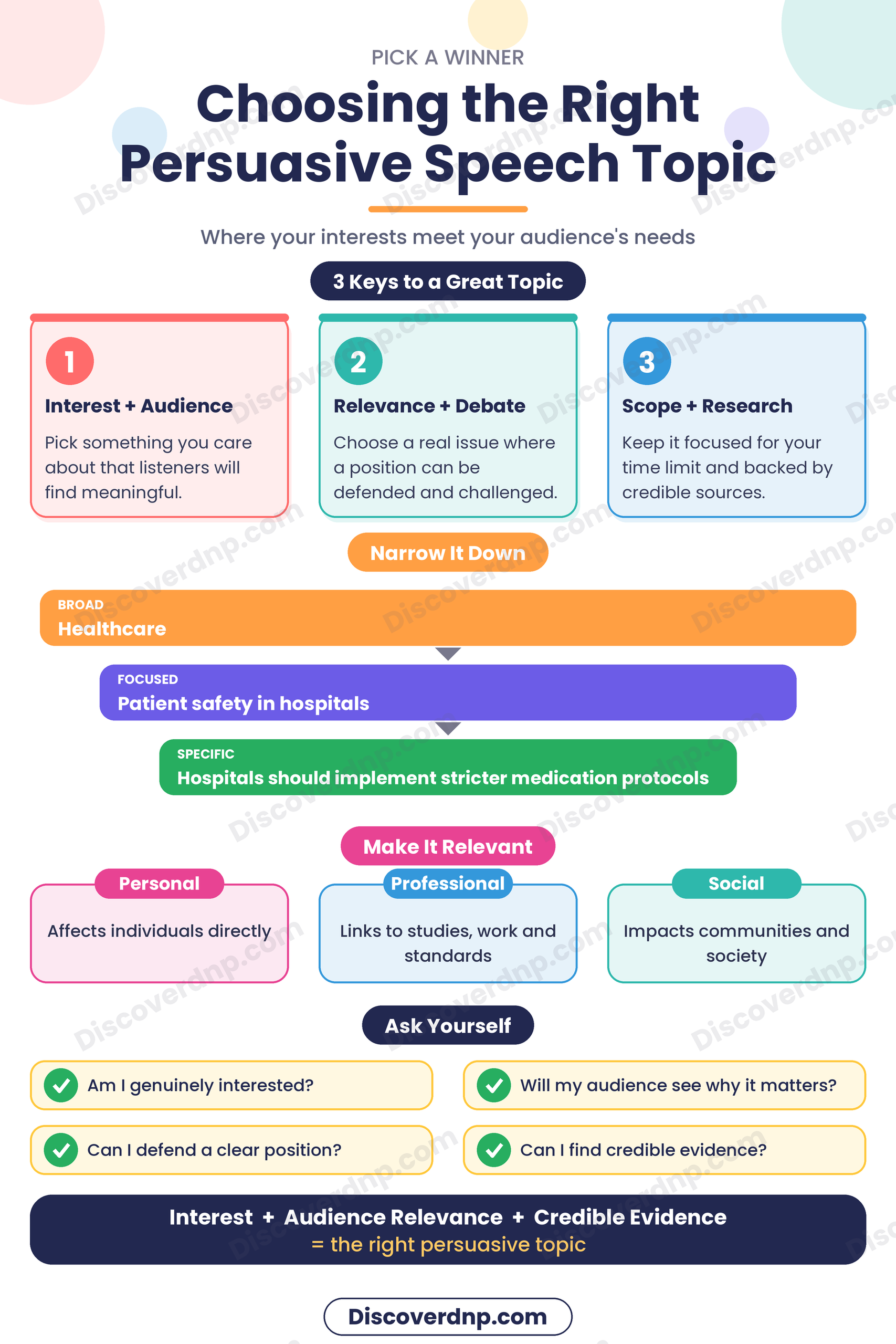
Conclusion
Delivering an effective persuasive speech requires more than presenting an opinion or selecting an interesting subject. It involves choosing a focused and debatable topic, understanding the audience, developing a clear position, and supporting arguments with credible evidence and logical reasoning. Whether addressing nursing practice, patient safety, healthcare policies, education, technology, or broader social issues, a successful persuasive speech should help listeners understand why an issue matters and why a particular position deserves consideration.
The strongest persuasive speeches combine ethos, pathos, and logos to establish credibility, create an emotional connection, and present convincing arguments. Clear language, purposeful transitions, appropriate vocal expression, and confident body language further strengthen the delivery. Equally important is the ability to acknowledge opposing viewpoints, respond to reasonable objections, and avoid common mistakes such as unsupported claims, overly broad topics, and disorganized arguments.
For nursing-related subjects, persuasive speaking is particularly valuable because effective communication can encourage patient advocacy, promote evidence-based practice, support professional improvements, and influence healthcare decisions. A well-developed argument can help bring attention to issues such as safe staffing, infection prevention, patient confidentiality, mental health services, and equitable access to healthcare.
Ultimately, a successful persuasive speech should leave the audience with more than information. It should provide a compelling reason to reconsider an issue, support a position, or take meaningful action. By combining careful research, ethical persuasion, logical organization, and effective presentation skills, speakers can develop persuasive speeches that inform, influence, and contribute to positive change.
Frequently Asked Questions
1. What are some persuasive speech topics about nursing?
Good persuasive speech topics about nursing include:
- Why hospitals should maintain safe nurse-to-patient ratios.
- Why nurses should receive better mental health support.
- Why patient education should be a priority in healthcare.
- Why nurses should participate in healthcare policy decisions.
- Why continuing education is essential for nurses.
- Why hospitals should strengthen workplace violence prevention.
- Why nurses should advocate for improved patient safety.
- Why healthcare facilities should expand access to mental health services.
- Why nurses should promote vaccination and preventive care.
- Why technology should be used responsibly in nursing practice.
2. What are the top 10 nursing topics for a presentation?
Ten relevant nursing presentation topics are:
- Infection prevention and control in healthcare settings.
- Evidence-based practice in modern nursing.
- Patient safety and medication error prevention.
- The role of nurses in managing chronic diseases.
- Mental health challenges among healthcare professionals.
- Nursing responsibilities in patient education.
- Ethical issues and decision-making in nursing.
- The impact of artificial intelligence on nursing practice.
- Effective communication and patient advocacy.
- Strategies for preventing nurse burnout.
3. What are some good topics for persuasive speech?
Good persuasive speech topics address relevant issues that audiences can debate and support with credible evidence. Examples include:
- Social media platforms should have stronger privacy protections.
- Schools should teach financial literacy.
- Renewable energy should receive greater government investment.
- College education should be more affordable.
- Governments should strengthen environmental protection laws.
- Mental health services should be accessible to everyone.
- School uniforms should be optional.
- Employers should offer flexible working arrangements.
- Animal testing should be restricted.
- Public transportation should be improved to reduce pollution.
4. What are 100 good topics for a persuasive essay?
Here are 100 persuasive essay topics across different subject areas:
Nursing and Healthcare
- Hospitals should implement safer nurse-to-patient ratios.
- Mental health care should be included in routine healthcare.
- Nurses should receive better workplace protection.
- Vaccination should be promoted through public education.
- Healthcare should be affordable for everyone.
- Hospitals should improve infection prevention programs.
- Patient confidentiality should be strengthened.
- Nurses should have a greater role in healthcare policy.
- Telehealth should be expanded in underserved communities.
- Healthcare workers should receive regular mental health support.
- Medical errors should be reported transparently.
- Palliative care should be more widely available.
- Preventive healthcare should receive more funding.
- Nurses should receive mandatory continuing education.
- Healthcare facilities should improve patient discharge education.
Education and Academic Life
16. College education should be more affordable.
17. Schools should teach financial literacy.
18. Students should have access to free mental health services.
19. Online learning should be included in higher education.
20. Schools should reduce excessive homework.
21. Practical experience should be required in professional education.
22. Standardized tests should not determine academic success.
23. Universities should provide more scholarship opportunities.
24. Students should learn critical thinking from an early age.
25. Attendance policies should allow greater flexibility.
26. Schools should teach digital literacy.
27. Group projects should be graded individually.
28. Academic institutions should strengthen anti-bullying policies.
29. Libraries should receive more educational funding.
30. Career guidance should be compulsory in secondary schools.
Health and Wellness
31. Regular exercise should be part of every person’s routine.
32. Governments should tax sugary drinks.
33. Schools should provide healthier meals.
34. Mental health education should be mandatory.
35. Sleep education should be included in school curricula.
36. Fast-food advertising to children should be restricted.
37. Preventive health screenings should be more accessible.
38. Workplace wellness programs should be encouraged.
39. Substance abuse education should begin in schools.
40. Healthy eating should be promoted through public campaigns.
Technology and Social Media
41. Social media companies should strengthen privacy protections.
42. Children should have age-appropriate limits on screen time.
43. Artificial intelligence should be regulated in healthcare.
44. Schools should teach responsible internet use.
45. Cyberbullying should carry stronger consequences.
46. Social media platforms should label misleading information.
47. Digital technology should be used more widely in education.
48. Employers should respect workers’ right to disconnect.
49. Facial recognition technology should have stricter regulations.
50. Online privacy should be treated as a fundamental right.
Environment and Climate Change
51. Governments should invest more in renewable energy.
52. Plastic bags should be banned or restricted.
53. Recycling should be compulsory in public institutions.
54. Public transportation should be improved to reduce emissions.
55. Environmental education should be mandatory in schools.
56. Businesses should be held responsible for pollution.
57. Deforestation should carry stricter penalties.
58. Cities should invest in more green spaces.
59. Single-use plastics should be phased out.
60. Individuals should be encouraged to adopt sustainable lifestyles.
Society and Public Policy
61. Governments should provide more support for low-income families.
62. Public healthcare should receive increased funding.
63. Communities should invest more in youth development.
64. Gender equality should be promoted in the workplace.
65. Governments should strengthen laws against domestic violence.
66. Public libraries should offer more free community services.
67. Animal welfare laws should be strengthened.
68. Affordable housing should be a government priority.
69. Community service should be encouraged among young people.
70. Public institutions should improve accessibility for people with disabilities.
Business and Workplace Issues
71. Employers should offer paid parental leave.
72. Remote work should remain an option for suitable jobs.
73. Employees should receive a living wage.
74. Workplaces should provide paid mental health days.
75. Businesses should adopt stronger ethical practices.
76. Companies should reduce unnecessary workplace meetings.
77. Employers should invest in staff development.
78. Workplace discrimination should attract stricter penalties.
79. Employees should have greater control over flexible schedules.
80. Businesses should prioritize environmental sustainability.
Arts, Entertainment, and Sports
81. Schools should provide more funding for arts education.
82. Physical education should be compulsory in schools.
83. Professional athletes should promote healthy lifestyles.
84. Children should participate in organized sports.
85. Public funding should support local artists.
86. Violent content in children’s entertainment should be restricted.
87. Museums should offer more free admission days.
88. Schools should encourage music education.
89. Women should receive equal recognition in professional sports.
90. Sports facilities should be more accessible to local communities.
Ethics, Culture, and Contemporary Issues
91. Euthanasia should be legally permitted under strict safeguards.
92. Organ donation should be encouraged through public awareness campaigns.
93. Animal testing should be limited to essential research.
94. Governments should regulate the use of artificial intelligence.
95. Freedom of speech should be protected while addressing harmful content.
96. Cultural heritage should receive greater protection.
97. Wealthier countries should provide more support during global health emergencies.
98. Children should be taught responsible citizenship.
99. Public officials should face stronger accountability measures.
100. Scientific research should receive greater public investment.
