

MLA Format Outline: A Step-by-Step Guide, Template, and Research Paper Examples
An MLA Format Outline provides a structured framework for organizing ideas, developing a strong thesis statement, and arranging supporting evidence before drafting an essay or research paper. Following the conventions established by the Modern Language Association (MLA), an outline helps writers establish a logical sequence of ideas, distinguish main arguments from supporting details, and maintain a clear direction throughout the writing process. Rather than beginning a paper with disconnected ideas, writers can use an outline template to determine what each section should accomplish and how the information contributes to the central argument.
Creating an effective MLA Format Outline involves more than listing headings and subheadings. It requires an understanding of outline hierarchy, Roman numerals, capital letters, Arabic numerals, indentation, and spacing. These elements help distinguish major points from subordinate ideas and ensure that related information remains organized. A well-developed outline also serves as a roadmap for incorporating research findings, quotations, examples, and other supporting evidence. By identifying missing information, repeated arguments, or weak connections between ideas before drafting, writers can make the writing process more efficient and produce a more coherent paper.
An MLA outline template can be adapted to different academic assignments, including a short MLA essay, an argumentative essay, or an extended research paper. Although the basic principles of organization remain similar, the depth of the outline depends on the complexity of the topic, the scope of the assignment, and the amount of evidence required. It is also important to distinguish the structure of an outline from the formatting rules for a completed paper in MLA. Requirements involving the first page, header, page number, in-text citation, and Works Cited page apply to the finished document and should be understood alongside the principles of outline development.
Understanding how to prepare an MLA Format Outline helps writers organize academic material while maintaining consistency with MLA style. This guide examines the purpose of an outline, its numbering and indentation conventions, the development of a thesis statement, and the arrangement of main ideas and supporting evidence. It also explores MLA paper formatting, citation and attribution practices, practical outline templates, and common formatting mistakes. These principles provide a foundation for planning a well-organized research paper, presenting ideas logically, and adhering to the Modern Language Association’s documentation guidelines.
Understanding the MLA Outline and Its Purpose
An MLA Format Outline is a planning framework that organizes the main ideas, supporting details, and evidence of an academic assignment before the full paper is written. It helps establish a logical sequence for presenting information, connecting related arguments, and developing a clear central focus. Although the Modern Language Association (MLA) provides guidelines for formatting papers and documenting sources, it does not prescribe one mandatory outline format for every assignment. Writers may use different outlining methods depending on the assignment requirements, the complexity of the topic, and their instructor’s preferences.
A well-developed outline serves as a roadmap for the writing process. Instead of drafting paragraphs without a clear direction, a writer can identify the purpose of each section, determine which ideas deserve the most attention, and decide where research findings or examples will provide meaningful support. This preparation is particularly useful for a research paper that draws on multiple sources because it helps keep information connected to the central argument rather than allowing the discussion to become a collection of unrelated facts.
An MLA outline can be used for different types of academic writing, including analytical essays, argumentative papers, literature reviews, and research assignments. Its structure may range from a brief list of major points to a detailed hierarchy containing headings, subheadings, and supporting evidence. The appropriate level of detail depends on the assignment. A short essay may require only a thesis and three main points, while a longer research paper may need several levels of supporting ideas to show how the argument will develop.
It is also important to distinguish an outline from the formatting requirements of a completed MLA paper. The outline focuses primarily on the organization of ideas; the finished paper must also follow the applicable MLA formatting rules for elements such as spacing, page numbers, in-text citation, and the Works Cited page. Understanding this distinction helps writers plan their content effectively without confusing the structure of an outline with the presentation of the final document.
Role of an MLA Outline in Academic Writing
The main role of an MLA Format Outline is to turn a broad topic into a manageable, organized plan. It establishes the relationship between the thesis statement, main arguments, supporting points, and evidence before the writer begins developing full paragraphs. This makes it easier to maintain focus, recognize gaps in reasoning, and ensure that each section contributes to the paper’s overall purpose.
Several important functions explain why an outline is valuable in academic writing.
1. Establishing a clear direction for the paper
An outline helps define what the paper will discuss and how the discussion will progress. Before drafting, the writer identifies the central purpose and arranges the major points in an order that makes sense to the intended audience.
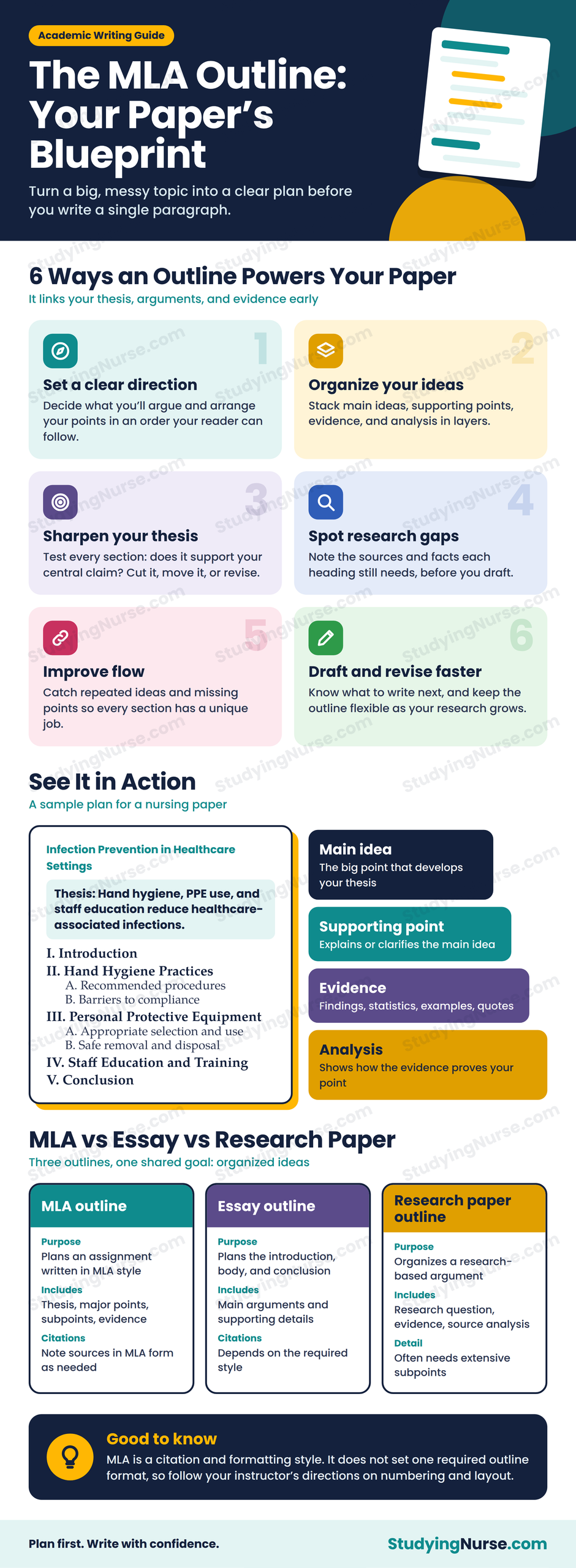
For example, a paper examining the importance of infection prevention in healthcare settings might use the following preliminary outline:
Example: Preliminary research paper outline
Working title: Infection Prevention in Healthcare Settings
Thesis statement: Consistent hand hygiene, appropriate use of personal protective equipment, and staff education help reduce the risk of healthcare-associated infections.
I. Introduction
II. Hand Hygiene Practices
A. Recommended hand hygiene procedures
B. Barriers to consistent compliance
III. Personal Protective Equipment
A. Appropriate selection and use
B. Safe removal and disposal
IV. Staff Education and Training
V. Conclusion
This preliminary MLA outline shows how a broad subject can be divided into distinct sections. Each main point addresses a different part of the thesis, while the supporting details indicate what the writer should investigate or explain within each section. The headings are illustrative organizational choices rather than a mandatory outline structure established by MLA.
2. Organizing main ideas and supporting details
Academic assignments often require the integration of definitions, explanations, examples, research findings, and critical analysis. Without a plan, these elements may appear in an unsuitable order or be repeated in different sections. An outline allows writers to group related information together and distinguish major arguments from the details that explain them.
A useful approach is to arrange information hierarchically:
- Main ideas: The principal points that develop the thesis.
- Supporting points: Explanations or smaller arguments that clarify each main idea.
- Supporting evidence: Research findings, statistics, examples, quotations, or other relevant material.
- Analysis: An explanation of how the evidence supports the argument.
For instance, a paragraph about hand hygiene might include a main claim, a finding from an authoritative infection-prevention source, and an explanation of how the finding relates to reducing infection risks. Placing these elements together in the outline helps ensure that the eventual paragraph does more than simply present information.
3. Developing and refining the thesis statement
A strong thesis statement gives the paper a central focus. The outline helps the writer test whether the proposed main points support that focus or introduce unrelated material.
Suppose the working thesis is that healthcare-associated infections can be reduced through consistent hand hygiene, appropriate protective equipment, and ongoing staff education. The outline should develop those three areas rather than drift into unrelated discussions of hospital architecture, healthcare financing, or general patient satisfaction unless those subjects directly contribute to the argument.
If a proposed section does not support the thesis, the writer can remove it, reposition it, or revise the thesis to reflect a broader purpose. This process strengthens the relationship between the paper’s central claim and its supporting evidence.
4. Identifying research needs and evidence gaps
An outline is useful for determining where additional research is necessary. Writers can note the sources, facts, or examples needed under each heading before drafting the full discussion.
For example, an outline about infection prevention might reveal that the writer has evidence about hand hygiene but lacks information about staff training or appropriate personal protective equipment. Recognizing this gap early makes research more focused and reduces the likelihood of writing unsupported claims.
Academic writing guidance from university writing centers emphasizes the value of connecting a thesis with supporting arguments and developing evidence for each major claim.
5. Improving coherence and reducing repetition
A clear outline makes it easier to see whether two sections cover the same concept, whether an important point has been omitted, or whether the sequence of ideas needs adjustment. It also helps maintain a logical progression from introductory information to detailed analysis and a conclusion.
For example, if separate sections discuss the benefits of hand hygiene using the same evidence and reasoning, the writer can combine them or assign each a distinct purpose. One section might explain correct procedures, while another examines barriers to compliance. This distinction gives each section a unique contribution.
6. Supporting efficient drafting and revision
An outline reduces the burden of deciding what to write next because the major components of the assignment have already been identified. It also provides a practical structure for revising the paper. If an argument is weak, the writer can strengthen the supporting points or gather better evidence before rewriting several paragraphs.
The outline should remain flexible throughout the writing process. New research may reveal a more convincing argument, suggest a better sequence, or show that a planned section is unnecessary. Revising the outline as understanding develops is part of effective academic writing rather than a sign that the original plan has failed.
Differences Between an MLA Outline, Essay Outline, and Research Paper
Although an MLA outline, an essay outline, and a research paper outline share the goal of organizing ideas, they serve slightly different purposes. Understanding these distinctions helps writers choose an appropriate structure for an assignment and avoid confusing the planning stage with the completed paper.
An MLA outline is a planning document arranged according to the writer’s preferred organizational system for an assignment that will be written in MLA style. An essay outline is a broader term for a plan used to organize an essay, regardless of the citation style required. A research paper outline is designed to organize a research-based discussion, including the central question or thesis, major arguments, supporting evidence, and analysis of relevant sources.
The main distinction is that MLA identifies a documentation and formatting style, whereas an outline describes how ideas are arranged before the full text is written. The Modern Language Association does not prescribe one universal outline format, so the specific numbering system and presentation should follow the instructor’s directions when an outline is required.
The following comparison highlights the differences.
| Feature | MLA outline | Essay outline | Research paper outline |
|---|---|---|---|
| Primary purpose | Organizes ideas for an assignment written in MLA style | Plans the introduction, body, and conclusion of an essay | Organizes a research-based argument and its supporting evidence |
| Main components | Thesis, major points, subpoints, and evidence as needed | Introduction, main arguments, supporting details, and conclusion | Research focus, thesis or research question, evidence, analysis, and other sections appropriate to the project |
| Citation considerations | Sources may be noted using MLA conventions when needed | Depends on the required citation style | Includes source-tracking and citation plans appropriate to the required style |
| Level of detail | Varies according to the assignment | Often follows the length and complexity of the essay | May require extensive subpoints to organize multiple sources and complex arguments |
| Final document | A planning tool for an MLA-style assignment | A planning tool for an essay | A planning tool for a research paper |
For example, consider an assignment examining how communication affects patient safety in healthcare settings.
A basic essay outline might organize the discussion into an introduction, three body paragraphs addressing communication barriers, teamwork, and patient outcomes, and a conclusion. Its primary purpose is to arrange the essay’s main ideas in a coherent sequence.
An MLA outline for the same assignment could use a thesis statement followed by Roman numerals, capital letters, and supporting points to organize the discussion. The writer might also record source details beside relevant points to prepare for MLA in-text citations and the Works Cited page. The numbering system is a common outlining convention, not a mandatory MLA requirement.
A more detailed research paper outline might organize the same subject around a research question, evidence from scholarly studies, comparisons of findings, analysis of communication failures, and implications for patient safety. Depending on the assignment, it could also include a literature review or research methods section. These components should be included when relevant rather than added automatically to every research paper.
The distinction is particularly useful when preparing a longer academic assignment. A general essay outline may be sufficient for a short discussion, while a detailed research paper outline can help manage a larger body of evidence. An MLA outline can serve either purpose when the final assignment requires MLA style.
Regardless of the format chosen, a strong outline should maintain a clear relationship between the thesis, main ideas, and supporting evidence. It should also make the sequence of the discussion easy to follow. Once the plan is complete, the writer can develop each point into coherent paragraphs and apply the appropriate formatting and citation requirements to the finished paper.
MLA Format Outline Structure and Numbering
The structure of an MLA Format Outline determines how main ideas, supporting arguments, and smaller details are arranged before a paper is written. A clear structure allows readers to recognize the relationship between different points and helps writers develop an argument in a logical sequence. Rather than presenting every idea at the same level, an outline uses a hierarchy to distinguish major sections from the information that explains or supports them.
One common approach is an alphanumeric outline, which uses Roman numerals, capital letters, Arabic numerals, and lowercase letters to organize information. Each level represents a different degree of detail. Main points appear at the highest level, while supporting ideas are placed beneath the points they develop.
It is important to understand that the Modern Language Association does not mandate one universal format for outlines. The alphanumeric system is a widely used academic convention, but an instructor may request a different outline template, a sentence outline, a topic outline, or another organizational method. The assignment instructions should therefore determine the final presentation.
A well-organized MLA Format Outline generally has three essential characteristics:
- Hierarchy: Main ideas are distinguished from supporting points and more specific details.
- Consistency: The same numbering, indentation, and writing conventions are used throughout the document.
- Logical progression: Each section contributes to the thesis statement, and the sequence helps the reader follow the argument.
For example, a research paper about communication and patient safety might begin with an introduction, develop separate sections on communication barriers, teamwork, and patient outcomes, and finish with a conclusion. Each major section could contain supporting points and evidence. This arrangement gives the writer a roadmap for drafting the paper without requiring every sentence to be written in advance.
An outline may also take one of two common forms. A topic outline uses short phrases to identify the main ideas, while a sentence outline expresses those ideas in complete sentences. Both approaches can be useful, depending on the assignment’s complexity and the writer’s needs.
A topic outline might use the phrase Barriers to effective communication, whereas a sentence outline could state, Inadequate handoff communication can contribute to misunderstandings about patient care. The topic version is concise and flexible; the sentence version makes the intended argument more explicit.
Regardless of the approach, an effective outline should make it clear which ideas are central, which details support them, and how the entire discussion relates to the paper’s purpose. The numbering system and formatting conventions help achieve this organization, but the quality of the outline ultimately depends on the clarity and relevance of its content.
Roman Numerals, Capital Letters, and Arabic Numerals
Roman numerals, capital letters, and Arabic numerals are commonly used to organize the different levels of an alphanumeric MLA outline. They help distinguish major arguments from supporting points and smaller details. When the hierarchy is applied consistently, the relationship between ideas becomes easier to understand and transfer into the completed paper.
The conventional order is:
- Roman numerals: I, II, III, IV, V
- Capital letters: A, B, C, D, E
- Arabic numerals: 1, 2, 3, 4, 5
- Lowercase letters: a, b, c, d, e
If further subdivision is needed, some outlining systems use Arabic numerals and lowercase letters in parentheses. However, these additional levels should be included only when they help clarify complex information and are consistent with the instructor’s requirements.
Each level has a distinct function.
Roman numerals identify the main points. These represent the largest divisions of the argument, such as the introduction, principal discussion sections, and conclusion. In a longer research paper, each Roman numeral may represent a major theme or section.
Capital letters identify supporting points. These divide a main point into related components. They often become the subjects of individual paragraphs or groups of paragraphs in the completed paper.
Arabic numerals identify more specific details. These may represent examples, explanations, research findings, or evidence supporting a capital-letter point.
Lowercase letters provide further detail. They can be used when an argument requires another level of subdivision, such as distinguishing two examples or explaining separate aspects of a research finding.
The following example demonstrates how these levels work together.
Example: Alphanumeric MLA research paper outline
Working title: Communication and Patient Safety in Healthcare Settings
Thesis statement: Effective communication, structured handoffs, and interprofessional collaboration support patient safety by reducing misunderstandings and improving continuity of care.
I. Introduction
A. Background on communication in healthcare
A. Background on communication in healthcare
B. Importance of patient safety
C. Thesis statement
II. Communication Barriers in Healthcare
A. Incomplete patient handoffs
1. Missing or inaccurate clinical information
2. Unclear responsibility for follow-up
B. Differences in terminology and communication practices
III. Strategies for Improving Communication
A. Structured handoff procedures
B. Interprofessional teamwork
C. Continuing staff education
IV. Conclusion
A. Summary of the main arguments
B. Restatement of the central claim
The example demonstrates the hierarchy, but the repeated label under Section I should appear only once in a finished outline. It also illustrates a useful principle: a subpoint should be more specific than the point above it, and each level should contribute to the section’s main purpose.
A traditional alphanumeric outline generally follows the same sequence of levels throughout. For example, a writer should not use capital letters for one main section’s supporting points and Arabic numerals for another section’s supporting points without a clear reason. Consistency makes the outline easier to scan and helps prevent confusion when the plan is developed into a complete paper.
Another important convention is that a level should generally contain at least two entries when it is subdivided. If a main point has an A, it should ordinarily have a B as well; if A is divided into 1, it should generally contain a 2. A single supporting item may indicate that the material belongs directly under the higher-level point instead of requiring another subdivision. This is a common outlining principle, rather than a universal MLA rule.
Indentation, Spacing, and Parallel Structure
Indentation, spacing, and parallel structure help make an MLA Format Outline readable and logically organized. These features work together: indentation shows which ideas belong together, spacing separates individual entries, and parallel structure makes related points consistent in grammatical form. When these conventions are applied carefully, the outline becomes easier to review and more useful as a guide for drafting the full research paper.
Indentation and alignment
Indentation refers to the horizontal space between the left margin and the beginning of an outline entry. In an alphanumeric outline, each successive level is usually indented farther than the level above it. This visual hierarchy helps readers distinguish major sections from their supporting points without relying on the numbering alone.
For example:
I. Communication and Patient Safety A. Communication barriers 1. Incomplete handoff information a. Missing medication details b. Unclear follow-up instructions 2. Differences in terminology B. Strategies for improvement 1. Structured handoff procedures 2. Interprofessional training
In this example, the Roman numeral is positioned at the main level, the capital-letter entries are indented beneath it, and the Arabic numerals and lowercase letters move progressively farther to the right. The exact amount of indentation can vary according to the outline template or instructor’s instructions; the important point is that the hierarchy remains visually consistent.
Proper alignment also helps prevent formatting errors. Numbering symbols should be positioned consistently, and the text following each symbol should begin at a predictable location. If an entry wraps onto a second line, the continuation should align with the text of that entry rather than with the numbering symbol. This makes longer entries easier to read.
Spacing and readability
Spacing refers to the vertical distance between lines and entries. An outline should provide enough separation for readers to distinguish one point from another while maintaining a consistent appearance throughout the page.
It is important to distinguish between the general MLA requirements for a completed paper and the formatting of an outline. MLA’s standard paper-format guidance generally calls for double-spacing, a legible font, and one-inch margins. However, the Modern Language Association does not establish a single mandatory spacing system for every outline. If an instructor requires a formal outline to be double-spaced, that instruction should be followed.
When preparing an outline, consider these practical principles:
- Maintain consistent line spacing: Use the same spacing throughout rather than switching between single and double spacing without a reason.
- Separate distinct entries clearly: Ensure that each point can be distinguished from the next.
- Avoid excessive blank lines: Too much space can make related ideas appear disconnected and lengthen the document unnecessarily.
- Check wrapped lines: Long entries should remain visually connected to their numbering or lettering labels.
- Use a readable font: If the assignment specifies Times New Roman, 12-point type, or another font requirement, apply it consistently.
Spacing settings in word-processing software can create unexpected gaps. For instance, a document may be set to double-space while also adding extra space before or after each paragraph. If the outline begins to look uneven, review the paragraph settings rather than manually inserting repeated blank lines.
Parallel structure
Parallel structure means expressing ideas of equal importance in a consistent grammatical form. It is especially useful in an MLA outline because headings and subheadings are easier to compare when they follow the same pattern. Parallel wording also helps readers recognize that entries at the same level serve similar functions.
Consider the following example of inconsistent wording:
- A. Improving handoff communication
- B. The importance of teamwork
- C. Educate healthcare staff
The entries use different grammatical forms: a gerund phrase, a noun phrase, and a verb command. Although their meanings are understandable, their structures are inconsistent.
A revised version would be:
- A. Improving handoff communication
- B. Strengthening interprofessional teamwork
- C. Educating healthcare staff
Each entry now begins with a gerund, creating a consistent pattern. Another valid approach would be to use noun phrases throughout:
- A. Handoff communication
- B. Interprofessional teamwork
- C. Staff education
The best choice depends on the purpose of the outline. A detailed argument may benefit from headings that express actions or claims, while a topic outline may use shorter noun phrases. The essential requirement is consistency among entries that perform comparable roles.
Parallel structure should also extend to supporting points. For example, under a section about communication barriers, a writer could use:
- A. Incomplete patient handoffs
- B. Unclear clinical documentation
- C. Inconsistent terminology
These points are all noun phrases identifying barriers. A later section addressing strategies could use corresponding action-based phrases:
- A. Standardizing patient handoffs
- B. Improving clinical documentation
- C. Clarifying medical terminology
This approach makes the organization easier to follow and supports a logical relationship between the problem and its potential solutions.
How indentation, spacing, and parallel structure work together
These three elements should be reviewed as parts of one formatting process. Indentation communicates the hierarchy, spacing distinguishes the entries, and parallel structure reinforces the relationship between ideas. None of them can compensate for weak organization, so the content must remain logically arranged as well.
Before completing an MLA Format Outline, check that:
- Main points and supporting details appear at the appropriate levels.
- Numbering and indentation remain consistent from beginning to end.
- Spacing makes the outline readable without creating unnecessary gaps.
- Headings at the same level follow a consistent grammatical pattern.
- Each supporting point contributes to the main idea above it.
- Repeated or unrelated entries have been revised or removed.
Following these principles produces an outline that is easier to navigate, revise, and expand into a complete academic paper. The goal is not to make the document visually complicated, but to create a clear organizational framework that supports coherent academic writing.
Developing an MLA Outline Template
Developing an MLA outline template involves transforming a research topic into a structured plan that guides the entire writing process. Rather than beginning with paragraphs immediately, the writer identifies the central purpose of the paper, establishes the main arguments, gathers relevant evidence, and arranges the material into a coherent sequence. This approach helps ensure that every section contributes to the thesis and that the discussion progresses logically from one idea to the next.
An MLA Format Outline can be prepared using a blank outline template, a word-processing document, or a simple list of headings and subheadings. The choice of tool is less important than the quality of the organization. A useful template should provide enough structure to distinguish the main ideas from their supporting points without becoming so detailed that it restricts the writer’s ability to refine the argument as research develops.
The level of detail depends on the type and scope of the assignment. A short essay may need a thesis statement, three principal arguments, and a conclusion. A longer MLA research paper may require several levels of headings, evidence from scholarly sources, counterarguments, and analysis of competing perspectives. In both cases, the outline should provide a clear roadmap for developing the paper rather than simply listing everything the writer knows about the topic.
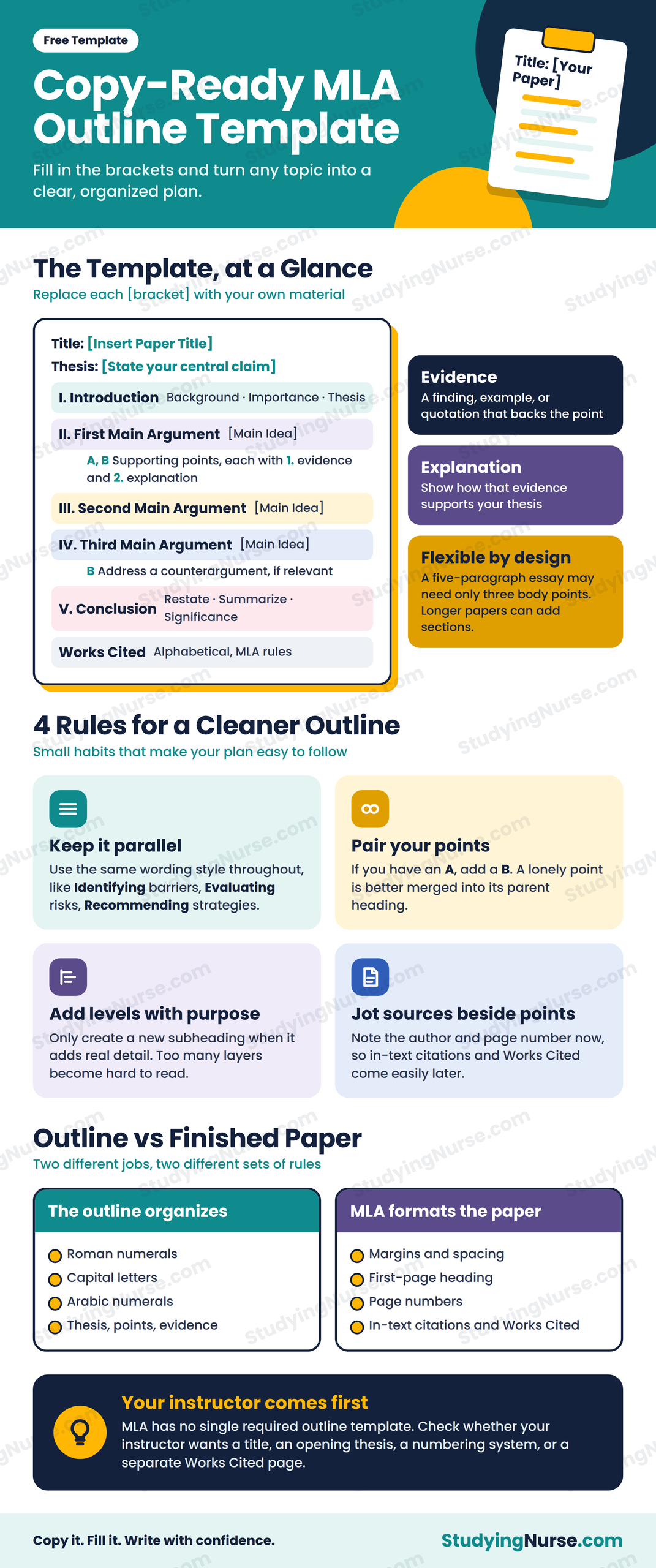
A practical way to develop an MLA outline template is to follow these steps:
- Define the topic and purpose. Identify the subject of the paper and determine whether the assignment requires explanation, analysis, comparison, or an argument.
- Develop a focused thesis statement. Establish the central claim or controlling idea that the paper will communicate.
- Identify the main arguments. Determine the principal points needed to explain or support the thesis.
- Gather supporting evidence. Locate credible research, relevant examples, and other information that supports the planned discussion.
- Group related information. Place evidence and supporting details under the appropriate main points.
- Arrange the sections logically. Organize the material so readers can follow the reasoning from the introduction through the body of the essay to the conclusion.
- Review and refine the outline. Remove repetition, identify missing evidence, and confirm that each section contributes to the paper’s purpose.
These steps are flexible rather than strictly linear. Research may reveal that an argument needs revision, that two sections should be combined, or that additional evidence is required. Revisiting the outline as the project develops helps maintain consistency between the thesis, the research findings, and the final paper.
Writing a Thesis Statement and Identifying Main Arguments
A thesis statement is the central claim or controlling idea around which an academic paper is organized. It tells readers what the paper intends to demonstrate, explain, or analyze. In an MLA outline, the thesis statement helps determine which main arguments belong in the paper and how those arguments should be developed.
A strong thesis statement is specific, relevant to the assignment, and sufficiently focused to guide the discussion. For an argumentative research paper, it should normally communicate a position that can be supported with evidence and examined through reasoning. For an explanatory or analytical essay, it may instead identify the central explanation or interpretation the paper will develop. The appropriate form depends on the assignment’s purpose.
For example, consider the broad topic of communication in healthcare settings.
A weak thesis might state:
Communication is important in healthcare.
Although this statement identifies a relevant subject, it does not establish a sufficiently specific direction for a research paper. It does not explain which aspect of communication will be examined or what the discussion intends to demonstrate.
A more focused thesis statement would be:
Standardized patient handoffs, clear clinical documentation, and interprofessional communication can improve continuity of care by reducing information gaps and supporting coordinated clinical decisions.
This version identifies a central claim and establishes three related areas for discussion. Each area can become a main point in the MLA Format Outline, giving the writer a clear structure for developing the paper.
Turning the thesis statement into main arguments
Once the thesis has been established, the next step is to identify the major arguments or ideas needed to develop it. Each main argument should contribute a distinct part of the overall explanation rather than repeat another section.
For the thesis about communication and continuity of care, the main arguments might include:
- Standardized patient handoffs help transfer essential clinical information between healthcare professionals.
- Clear clinical documentation supports accurate communication and continuity of treatment.
- Interprofessional communication helps coordinate decisions and identify potential gaps in patient care.
These points provide the foundation for the body of the paper. Each argument has a separate function, yet all three contribute to the central thesis.
An outline might present them as follows:
Example: Thesis and main arguments
Topic: Communication and continuity of care
Thesis statement: Standardized patient handoffs, clear clinical documentation, and interprofessional communication can improve continuity of care by reducing information gaps and supporting coordinated clinical decisions.
I. Standardized patient handoffs
Explain how structured information transfer supports continuity of care.
II. Clear clinical documentation
Examine how accurate records help healthcare professionals understand a patient’s care plan.
III. Interprofessional communication
Discuss how communication among members of the care team supports coordinated decisions.
The example illustrates how the thesis statement can provide a roadmap for the outline. The main arguments are not merely a list of related facts; they explain different ways in which the central claim can be developed.
Distinguishing main arguments from supporting points
Main arguments establish the principal sections of the discussion, while supporting points explain, qualify, or provide evidence for those arguments. Confusing these levels can make an outline difficult to follow.
For example, under the main argument Standardized patient handoffs, supporting points could include:
- Information that should be transferred during a handoff.
- Communication tools or structured handoff procedures.
- Common problems associated with incomplete information.
- Research evidence concerning the effectiveness of structured communication.
These supporting points are more specific than the main argument. They provide a plan for the material that will be discussed within the relevant section.
The thesis statement should also be reviewed as the outline develops. If the evidence does not support the original claim, the writer may need to narrow the thesis, adjust its wording, or reorganize the main arguments. A thesis should guide the research paper, but it should not prevent the writer from responding to credible findings that complicate the original position.
A useful test is to examine every proposed main section and ask whether it helps explain or support the thesis. If a section does not contribute meaningfully, it may be unnecessary or may belong elsewhere. This review helps produce a focused MLA outline template with a clear relationship between the central claim and the paper’s supporting arguments.
Organizing Supporting Points and Research Evidence
Supporting points and research evidence give substance to the main arguments in an MLA Format Outline. While the thesis statement establishes the paper’s central direction, supporting points explain how the argument will be developed, and evidence provides the factual or scholarly foundation for the discussion. A strong outline connects these elements so that each claim has a clear purpose and the reader can understand how the writer intends to support the central argument.
Purdue University’s Online Writing Lab emphasizes grouping related ideas, arranging them logically, and establishing the relationship between the main points and their supporting details. These principles are particularly important in research-based assignments because writers must integrate information from multiple sources without losing sight of their own argument.
Distinguishing supporting points from research evidence
Supporting points and evidence are related, but they are not interchangeable. A supporting point identifies an aspect of the main argument that needs to be explained, while evidence provides information that helps establish or substantiate that point.
For example, a research paper about communication and patient safety might contain the following outline:
Example: Organizing supporting points and evidence
II. Standardized Patient Handoffs
A. Role of structured communication in transferring patient information
Supporting detail: Explain the types of information that should be communicated during a handoff.
B. Evidence concerning handoff communication practices
Research evidence: Identify a relevant peer-reviewed study or authoritative clinical guideline.
C. Implications for continuity of care
Analysis: Explain how the evidence supports the argument about reducing information gaps.
The outline identifies what the writer intends to discuss, where research is needed, and how the evidence should contribute to the argument. Before drafting the section, the writer would locate suitable sources and verify what they actually establish. The outline should not imply that a study proves a claim unless the findings support that interpretation.
Selecting credible research sources
Research evidence should be relevant to the topic, sufficiently reliable for the assignment, and appropriate to the claim being made. For a nursing or healthcare research paper, useful sources may include peer-reviewed journal articles, systematic reviews, professional guidelines, government publications, and reports from recognized healthcare organizations.
When evaluating a source, consider the following:
- Authority: Identify the author, research team, publishing journal, or responsible organization.
- Relevance: Determine whether the source directly addresses the point being developed.
- Currency: Check the publication date, particularly when the topic involves changing clinical guidance or current practice.
- Methodology: For empirical studies, examine how the research was conducted, the sample, the limitations, and whether the conclusions are supported by the findings.
- Corroboration: Compare important claims with other credible sources when appropriate.
- Citation details: Record the author, title, publication information, page numbers where applicable, and DOI or URL needed for accurate attribution.
For example, a paper examining infection prevention should not rely on a general health blog as its main evidence for a clinical recommendation when a current professional guideline or relevant research study is available. A general source may help establish background information, but the type of evidence should match the importance and technical nature of the claim.
Recording research evidence in the outline
It is helpful to record source information while researching rather than trying to reconstruct it after the paper has been drafted. A research paper outline can include brief source notes beneath the relevant supporting point. These notes may identify a study’s findings, an important quotation, a statistic, or an idea that requires further verification.
For instance:
– Main argument: Structured handoffs support continuity of care.
- Supporting point: Handoffs transfer essential information between care providers.
- Evidence needed: A peer-reviewed study evaluating a structured handoff intervention.
- Source note: Record the author’s last name, publication year for research tracking, article title, and relevant page or section.
- Analysis: Explain how the study’s findings relate to the paper’s thesis.
The source note is a research aid, not a substitute for the citation in the completed paper. When the assignment requires MLA style, the final in-text citation and Works Cited entry should follow the applicable MLA guidelines. Writers should also distinguish their own analysis from material taken from a source.
Integrating quotations, paraphrases, and summaries
Research evidence can be incorporated in several ways, and the outline should indicate which approach is appropriate.
- Direct quotation: Records the exact wording of a source when the original language is particularly important. The quotation must be reproduced accurately and attributed appropriately.
- Paraphrase: Restates a source’s specific idea in the writer’s own words and sentence structure while preserving its meaning and acknowledging the source.
- Summary: Condenses the main ideas of a longer source into a shorter account that is relevant to the argument.
For example, if a research study examines the effectiveness of a communication intervention, an outline might note the study’s central finding in a paraphrased research note and identify the source for later citation. The finished paragraph should explain the finding and why it matters instead of merely listing the result.
Direct quotations should be used selectively. A paper that consists mainly of quotations may leave too little room for the writer’s own reasoning. In most analytical assignments, evidence is more effective when it is introduced, interpreted, and explicitly connected to the thesis. Purdue OWL’s guidance on document organization similarly emphasizes that writers should engage with their sources and explain the significance of the information they present.
Preventing repetition and unsupported claims
A useful outline does not simply accumulate facts. It assigns each piece of evidence a specific role. If the same research finding appears under several headings without a clear reason, the argument may become repetitive. If a major claim has no evidence attached to it, the writer may need additional research or a more cautious formulation.
Before finalizing this part of the MLA outline template, check that:
- Every major argument has relevant supporting points.
- Evidence is placed beneath the point it supports.
- Sources are credible and appropriate for the topic.
- The outline distinguishes factual claims from the writer’s interpretation.
- Similar supporting points have been combined or given distinct purposes.
- Research notes contain enough information to locate and cite each source later.
These checks help transform research into a coherent argument rather than a collection of disconnected findings.
Arranging Outline Sections in a Logical Sequence
Arranging outline sections in a logical sequence determines how the paper’s argument unfolds. Even when the thesis is strong and the research evidence is credible, an ineffective order can make the discussion confusing. A well-organized MLA Format Outline establishes a progression in which each section prepares the reader for the next and contributes to the paper’s overall purpose.
The most appropriate sequence depends on the subject, assignment instructions, and type of argument. Some papers move from general background to specific analysis; others follow a chronological sequence, explain a process, compare alternatives, or organize arguments by cause and effect. The goal is to choose an order that makes the relationship between ideas clear.
Choosing an organizational pattern
Several patterns can help determine how to arrange an outline.
- General to specific: Introduces a broad concept before examining particular aspects, examples, or implications.
- Chronological order: Presents events or developments according to when they occurred.
- Sequential order: Explains stages, procedures, or steps in the order they should be completed.
- Cause and effect: Examines contributing factors and their consequences.
- Problem and solution: Establishes a problem, analyzes its causes, and evaluates possible responses.
- Comparison and contrast: Organizes similarities and differences between two or more subjects.
- Argument-based order: Presents claims and evidence in a sequence designed to develop and support a central position.
These patterns are not mutually exclusive. A paper may begin with background information, examine causes and consequences, and conclude with potential solutions. The writer should select the pattern that best suits the purpose rather than force every assignment into the same outline template.
Applying logical order to a research paper
Consider a paper examining barriers to effective communication in healthcare and strategies for improving patient safety. An outline that begins with proposed solutions before explaining the problem may leave readers without enough context. A more effective sequence would establish the context, identify the barriers, examine their implications, and then discuss strategies.
A possible MLA research paper outline could be arranged as follows:
Example: Logical sequence for a research paper
I. Introduction and Thesis Statement
Introduce the topic, establish its relevance, and state the central argument.
II. Communication Practices in Healthcare
Explain the context and the role of communication in coordinating care.
III. Barriers to Effective Communication
Examine incomplete handoffs, unclear documentation, and other relevant obstacles.
IV. Implications for Patient Safety
Analyze the relationship between communication failures and potential risks to care.
V. Strategies for Improving Communication
Discuss evidence-supported approaches to addressing the identified barriers.
VI. Conclusion
Synthesize the main findings and reinforce the thesis.
This example follows a progression from context to problem, implications, and potential solutions. Each section has a distinct purpose, and the order helps readers understand why the proposed strategies matter. The specific headings are illustrative; a real assignment may require a different structure or a more detailed methodology section.
Maintaining continuity between sections
A logical sequence should create connections between sections rather than treat them as isolated blocks of information. One way to achieve this is to examine the relationship between the final point in one section and the first point in the next.
For example, a discussion of communication barriers can lead into an examination of patient safety implications because the second section explains why the identified barriers matter. That analysis can then prepare the reader for a section on improvement strategies.
The outline can record these relationships in short notes, especially when the paper is lengthy. These notes do not necessarily appear as headings in the finished paper; they serve as reminders of how the reasoning should develop.
Balancing the depth of each section
Logical organization also involves deciding how much space each section deserves. A major argument that is central to the thesis may require several supporting points, while a minor background detail may need only a brief explanation. Giving every heading the same number of subpoints can create an artificial structure that does not reflect the importance of the material.
For a short essay, each main point may correspond to one body paragraph. In a longer research paper, a main point may require several paragraphs, each addressing a separate aspect of the argument. The outline should therefore reflect the assignment’s scope rather than impose a fixed number of paragraphs on every section.
Reviewing the sequence before drafting
Before beginning the full paper, review the outline from beginning to end and consider the following questions:
- Does the introduction establish enough context for the thesis?
- Does each main section develop a distinct part of the central argument?
- Are definitions and background information presented before they are needed for more complex analysis?
- Does the evidence appear where it can most effectively support the argument?
- Are cause-and-effect relationships, comparisons, or procedural steps presented in an understandable order?
- Does each section prepare the reader for the next?
- Does the conclusion follow from the arguments and evidence already discussed?
If the sequence feels disjointed, move sections, combine overlapping points, or add a missing connection. This revision is easier at the outline stage than after several pages have been drafted.
A well-developed MLA Format Outline provides a clear plan for the entire research paper: the thesis establishes the direction, supporting points develop the argument, research evidence substantiates the claims, and the sequence guides the reader through the discussion. When these elements work together, the outline becomes a practical tool for producing focused, coherent, and properly supported academic writing.
MLA Paper Format: Headings, Headers, and Page Numbers
Formatting a completed paper in MLA style involves arranging the document so that its content is readable, consistent, and easy to navigate. Although an MLA Format Outline focuses on organizing ideas before drafting, the finished paper must follow the applicable MLA formatting rules for elements such as the first page, title, header, page number, margins, spacing, and headings. Understanding these requirements helps writers distinguish the structure of an outline from the presentation of the final research paper.
The Modern Language Association’s MLA Handbook, currently in its ninth edition, provides guidance on formatting academic papers and documenting sources. Standard MLA paper formatting generally uses one-inch margins, a legible font, double-spacing throughout the text, and a consistent page header containing the writer’s last name and page number. Instructors may establish additional requirements, so assignment instructions should always be checked before submitting a paper.
Several elements work together to create a properly formatted MLA paper:
- First-page layout: Presents the writer’s identifying information, the instructor’s name, course details, date, and paper title when required by the standard student-paper format.
- Header and page number: Identifies the writer and indicates the page’s position in the document.
- Headings and subheadings: Divide a longer paper into meaningful sections and help readers follow the progression of the argument.
- Spacing and margins: Create a consistent layout and make the document easier to read.
- Title formatting: Distinguishes the paper’s title from the identifying information and body of the essay.
These features should be applied consistently, whether the paper is a short essay or an extended MLA research paper. However, the presence and complexity of particular elements depend on the assignment. A short essay may need only a first-page heading and title, while a longer research paper may benefit from multiple levels of headings.
It is also important to distinguish an outline’s numbering hierarchy from the headings used in a finished paper. Roman numerals, capital letters, and Arabic numerals are common conventions for organizing an alphanumeric outline. They are not automatically required as section labels in the completed MLA paper. A finished paper typically uses headings appropriate to its structure, following MLA guidance and any additional instructions from the instructor.
First-Page Layout and Paper Title
The first page establishes the basic presentation of an MLA paper. In the standard student-paper format, the upper-left corner contains the writer’s name, the instructor’s name, the course information, and the date. The paper’s title follows these details and appears centered above the beginning of the essay. This arrangement identifies the assignment and separates its administrative information from the main discussion.
The first page usually does not require a separate title page unless the instructor or institution specifically requests one. For a standard MLA student paper, the identifying information and title appear on the first page itself.
The standard first-page elements
The first-page heading commonly contains four lines:
- The writer’s full name.
- The name of the instructor.
- The course name or number.
- The date, formatted according to the instructor’s preferred convention and the applicable MLA guidance.
For example, a paper might begin as follows:
Jordan Smith Professor Taylor NURS 310: Evidence-Based Practice 21 October 2026
The Role of Evidence-Based Practice in Nursing
Evidence-based practice connects the best available research with clinical expertise and patient preferences. Examining how healthcare professionals evaluate evidence can clarify its role in improving care decisions and supporting consistent clinical practice.
This is an illustrative example of the first-page layout. In a real document, the heading and body should use the required font and double-spacing, and the title should be centered without unnecessary bolding, underlining, or decorative formatting.
Positioning and spacing
The identifying information normally begins at the left margin, with each item on its own line. The title follows after the heading, using the same double-spacing as the rest of the paper. The first paragraph begins below the title, and the first line of the paragraph is typically indented by half an inch.
The paper should use one-inch margins on all sides unless the assignment specifies otherwise. A consistent font should be used throughout the document; Times New Roman in 12-point type is a familiar choice, although MLA permits other legible fonts. The font type and size should remain consistent in the title, heading, and body unless a specific element requires different treatment under the applicable instructions.
Formatting the title
The title should communicate the subject of the paper clearly and appear centered. In standard MLA formatting, the title is generally presented in regular typeface rather than bold, underlined, or italicized solely for emphasis. Italics and quotation marks may be appropriate when the title contains the title of another work, depending on the type of work being referenced.
For example:
- Correct general presentation: The Role of Evidence-Based Practice in Nursing — centered in regular type, without italics applied to the entire title.
- Avoid decorative formatting such as large display fonts, colored text, or unnecessary bolding.
- Use title capitalization consistently with MLA guidance.
- Do not add a period at the end of the title unless the title itself requires punctuation.
The title should also match the paper’s actual focus. If the thesis examines how evidence-based practice influences clinical decision-making, a title that refers only to general nursing education may be too broad or misleading.
When a separate title page is required
A separate title page is not normally necessary for a standard MLA student paper. However, an instructor may require one for a particular assignment, institutional submission, or formal research project. In that case, follow the specified title-page instructions rather than assuming that every MLA paper must include one.
The main principle is to avoid adding unnecessary formatting elements. The first page should identify the assignment clearly while allowing the reader to move naturally from the paper’s title into its introduction.
MLA Header and Page Number Placement
The MLA header identifies the writer and displays the page number throughout the paper. In standard MLA formatting, the header appears in the upper-right corner, approximately one-half inch from the top edge of the page. It contains the writer’s last name, followed by a space and the page number, with the entire entry aligned to the right margin.
For example, if the writer’s last name is Smith, the header on the first page would normally appear as:
Smith 1
Illustration of the upper-right MLA header
The next page would display Smith 2, followed by Smith 3 on the third page, continuing consecutively throughout the document. Arabic numerals (1, 2, 3, and so on) are used for page numbering rather than Roman numerals. The header normally continues through the Works Cited section, including any additional pages needed for the source list.
Important rules for the MLA header and page number include:
- Position: Place the header in the upper-right corner, one-half inch from the top of the page and flush with the right margin.
- Author’s last name: Use the last name shown in the paper’s identifying information. Do not substitute the paper title or the instructor’s name.
- Page numbering: Number pages consecutively using Arabic numerals.
- Spacing: Separate the author’s last name and page number with a single space.
- Consistency: Maintain the same header placement and formatting throughout the paper.
- First page: Include the page number on the first page unless the instructor directs otherwise.
These requirements help maintain a consistent layout across a multi-page MLA research paper. If the assignment requires a separate title page, the first page of the essay is normally numbered 1 rather than treating the title page as the first numbered page. Follow the instructor’s specific directions when they differ from the standard format.
How to insert the header in a word processor
In Microsoft Word or Google Docs, use the header function rather than typing the last name and page number manually on each page. Insert an automatic page-number field and place it after the author’s last name. This approach ensures that the page number updates when the document grows, shrinks, or is rearranged.
For example, if a new paragraph moves content onto an additional page, an automatic page-number field updates the numbering without requiring the writer to edit each header. Manually typed numbers can become inaccurate after revisions and should therefore be avoided.
The header is also different from the first-page heading. The first-page heading contains the writer’s name, instructor’s name, course information, and date, while the running header contains only the writer’s last name and page number. Both may appear on the first page, but they serve separate purposes and occupy different positions.
Heading and Subheading Formatting
Headings and subheadings organize the body of an MLA paper into sections that readers can follow. They are particularly useful in longer research papers that examine several arguments, explain a complex subject, or discuss multiple themes. Appropriate headings help readers identify the purpose of each section and understand how the discussion is organized.
The MLA Style Center explains that headings should reflect the structure of the paper, remain consistent in appearance, and be used in proportion to the document’s complexity. Short essays may not need internal headings, while longer papers can benefit from several levels. Headings should not be added merely to make a paper appear more structured when the content does not require them.
Distinguishing the paper title from section headings
The paper title identifies the subject of the entire assignment and is generally centered on the first page. Internal headings identify individual sections within the body of the essay. Subheadings divide those sections into smaller, related topics.
For example, a research paper about infection prevention might use the following structure:
Infection Prevention in Healthcare Settings
Hand Hygiene Practices
Explains hand hygiene procedures and their role in infection prevention.
Personal Protective Equipment
Examines appropriate selection, use, and removal of protective equipment.
Staff Education and Compliance
Discusses education, implementation barriers, and adherence to infection-prevention practices.
The title represents the entire paper, whereas the internal headings identify the main subjects addressed in the discussion. A subheading might further divide Hand Hygiene Practices into Recommended Procedures and Barriers to Compliance if the section requires that level of detail.
Establishing heading levels
A longer MLA research paper may use several levels of headings. The most important principle is that each level should be visually distinguishable from the levels below it. A higher-level heading may be bold, while a subordinate heading may use italics or regular type, provided the distinction is clear and consistent.
A writer might establish a system such as:
- Level 1: Bold, left-aligned heading.
- Level 2: Italicized, left-aligned heading.
- Level 3: Regular type, left-aligned heading, distinguished consistently from the preceding levels.
This is an illustrative system, not a universal set of mandatory MLA styles. The MLA Style Center advises writers to establish a consistent hierarchy, use formatting to communicate prominence, and avoid unnecessary complexity. It also generally recommends placing internal headings flush with the left margin rather than centering them.
Whatever style is chosen, headings at the same level should use the same font treatment, capitalization, and alignment. If a writer uses bold for one main heading, the other main headings should also be bold. Subheadings should follow a distinct, consistently applied style.
Using headings without disrupting the paper’s flow
Headings should describe the content that follows and help readers understand the progression of the argument. They should be concise, specific, and relevant to the thesis. A heading such as Barriers to Effective Communication is more informative than a vague label such as Other Information because it identifies the subject of the section.
Consider these practical guidelines:
- Use headings when they improve navigation through a longer or more complex paper.
- Avoid creating a separate heading for every short paragraph.
- Ensure that the discussion beneath each heading develops the subject identified by that heading.
- Keep heading styles consistent across the document.
- Avoid excessive numbering or lettering unless it is appropriate for the discipline or required by the assignment.
- Place enough explanatory text beneath a heading to justify the section rather than allowing headings to replace a developed discussion.
A heading should normally be followed by relevant text. For example, a section titled Barriers to Effective Communication should explain the barriers, examine their significance, and support its claims with appropriate evidence. It should not merely introduce another heading without developing the topic, unless the document’s structure and purpose justify that arrangement.
Distinguishing outline headings from headings in the completed paper
An MLA outline and a finished MLA paper organize information differently. An outline may use Roman numerals, capital letters, and Arabic numerals to show the relationship between ideas. The completed paper, however, does not automatically need to retain that numbering system. Internal headings are generally organized through wording and consistent visual formatting, unless the instructor requires numbered sections.
For instance, an outline might list III. Barriers to Effective Communication, followed by A. Incomplete Handoffs. In the finished paper, the writer could use Barriers to Effective Communication as a section heading and Incomplete Handoffs as a subheading without retaining the Roman numeral and capital letter.
This distinction is important because an outline is a planning document, whereas the completed paper is designed to present the argument clearly to its audience. Both need logical organization, but the formatting choices should suit the purpose of each document.
When preparing an MLA paper, the first-page layout, header, page number, and heading hierarchy should work together to create a consistent document. Correct formatting does not replace strong academic writing, but it makes the paper easier to navigate and helps present the research in a clear, professional manner.
MLA Citation and Works Cited Guidelines
An MLA Format Outline should account for how research sources will be documented in the completed paper. Accurate citation is an essential part of academic writing because it allows readers to distinguish the writer’s original analysis from information drawn from books, scholarly articles, websites, reports, and other sources. Although an outline is primarily a planning document, recording citation details while researching makes it easier to incorporate evidence correctly when drafting the essay or research paper.
The Modern Language Association (MLA) establishes documentation guidelines that connect in-text citations with a separate Works Cited page. In-text citations direct readers to the source of a quotation, paraphrase, or summary, while Works Cited entries provide the publication information needed to identify and locate the sources. These two elements work together: a source cited in the paper should generally have a corresponding Works Cited entry, and each entry should relate to material cited in the text.
Citation planning is particularly useful when developing an MLA Format Outline that includes several main arguments, supporting details, and research findings. Instead of collecting quotations and adding references at the end of the writing process, a writer can identify the source supporting each major point as the outline develops. This approach helps reveal gaps in the evidence, prevents accidental omission of attribution, and makes the transition from outline to complete paper more organized.
For example, an outline about preventing hospital-acquired infections might include a section on hand hygiene, another on personal protective equipment, and a third on staff education. Each section could be supported by a different scholarly article, clinical guideline, or public health report. Recording the author, title, publication details, and relevant page number beside each research note helps the writer connect evidence to the correct argument and prepare accurate MLA citations later.
It is also important to distinguish citation conventions from the outline’s numbering system. Roman numerals, capital letters, and Arabic numerals organize the outline’s hierarchy; they do not replace in-text citations or the documentation requirements of MLA style. Similarly, the bibliography-like source notes used during research are not necessarily a finished Works Cited page. The final paper must follow the relevant MLA formatting rules and any additional instructions provided by the instructor.
In-Text Citations and Quotation Attribution
In-text citations identify the source of information within the body of an essay or research paper. Under the standard MLA author-page system, a citation usually includes the author’s last name and the relevant page number, when page numbers are available. The citation directs readers to the corresponding entry on the Works Cited page, where they can find fuller publication details.
A typical parenthetical citation appears at the end of a sentence, before the final punctuation mark:
Effective communication between healthcare professionals can support safer patient care (Johnson 42).
In this illustrative example, “Johnson” identifies the author and “42” identifies the page containing the relevant information. The example is a format demonstration, not a reference to a verified publication. MLA citations generally do not place a comma between the author’s last name and the page number, and the abbreviation p. is not normally used for a single page number.
When the author’s name appears naturally in the sentence, it does not need to be repeated in the parenthesis:
Johnson explains that clear communication can reduce misunderstandings during patient handoffs (42).
This approach keeps the writing readable while maintaining proper attribution. If the source does not have page numbers, do not invent them. Many webpages and other unpaginated sources can be cited using the author’s name alone, when an author is identified and that information is available. If no author is listed, use an appropriate shortened version of the source title, following MLA guidance. The citation should correspond clearly to the beginning of the relevant Works Cited entry.
In an MLA Format Outline, citation planning can be incorporated directly into the supporting points. For example:
Illustrative MLA outline with source attribution
I. The importance of accurate patient handoffs
A. Incomplete information can create gaps in continuity of care.
1. Summarize findings from a scholarly article on communication failures (Johnson 42).
2. Compare those findings with a relevant clinical safety guideline.
B. Standardized handoff procedures can help organize patient information.
1. Paraphrase evidence from a second source (Williams 118).
The author names, page numbers, and source details are illustrative placeholders. Replace them with information from sources actually consulted.
This method helps the writer remember which source supports each claim. It also makes it easier to identify arguments that need stronger evidence before drafting begins.
Using direct quotations correctly
A direct quotation reproduces a source’s exact wording. When using direct quotes, place the borrowed words inside quotation marks and provide the appropriate citation. The quotation should be introduced or explained so that it contributes to the writer’s argument rather than appearing as an isolated statement.
For example:
Johnson describes communication as “a central component of coordinated care” (42).
The quoted phrase is illustrative rather than a verified quotation from an actual source. In a submitted paper, quotation marks must enclose the exact wording from the source, and the citation must identify the correct location where that wording appears. Changing a few words while keeping the original sentence structure does not turn a quotation into a proper paraphrase.
Short quotations can be incorporated into a paragraph, while longer quotations may need to be formatted as block quotations under MLA guidelines. In general, prose quotations that run more than four lines of the writer’s text are formatted as block quotations. The block is indented from the left margin, remains double-spaced, and does not use quotation marks around the entire passage. The parenthetical citation follows the quotation’s closing punctuation. Poetry and drama have different conventions for determining when a block quotation is appropriate.
A quotation should be selected because its exact wording matters, such as when analyzing a definition, interpreting a policy statement, or discussing a distinctive claim. For routine explanations, a well-written paraphrase may integrate evidence more naturally.
Paraphrasing and summarizing research
Paraphrasing means restating a source’s specific idea in the writer’s own wording and sentence structure. Summarizing means condensing a larger passage, argument, or study into its most relevant points. Neither method removes the need for attribution. Even when no direct words are copied, the underlying idea still belongs to the source.
For example, imagine that a scholarly article reports that structured communication tools help clinicians share essential information during shift changes. A suitable paraphrase would explain that standardized handoff methods can help healthcare professionals communicate important patient details consistently, followed by a citation to the source. Simply replacing a few original words with synonyms while preserving the source’s sentence structure would be too close to the original.
In an MLA Format Outline, a research note should make clear whether the information is a direct quotation, a paraphrase, or the writer’s own interpretation. Labeling notes as “direct quote,” “paraphrase,” or “my analysis” can reduce the risk of confusing source material with original writing. For direct quotations, record the exact wording and its page number or other available locator at the time of research. This is safer than trying to reconstruct the quotation later.
Citing sources with multiple authors or no named author
The exact in-text citation depends on the source’s authorship and available publication information. For a work by two authors, MLA generally includes both last names, such as (Johnson and Williams 42). For a work by three or more authors, the citation generally uses the first author’s last name followed by et al., such as (Johnson et al. 42). The corresponding Works Cited entry follows the relevant rules for listing authors.
When a source has no identified author, cite a shortened form of its title if appropriate. A short work, such as a webpage or article, is generally placed in quotation marks when its title is used in the citation; a self-contained work, such as a book, is generally italicized. The shortened title should match the way the source is listed in Works Cited so that readers can locate it without confusion.
Do not add a URL, publication year, or database name to an ordinary author-page citation merely because those details appear in the Works Cited entry. MLA’s usual in-text system emphasizes the author and a relevant page or other locator when available. Source types differ, however, so consult the current MLA guidelines when a work has unusual authorship, no page numbers, or a specialized format.
Abbreviations and Brackets in Research Notes
Abbreviations and brackets can help writers record, organize, and interpret research material efficiently while preparing an MLA Format Outline. However, they serve different purposes. Abbreviations shorten words or phrases according to accepted conventions, while square brackets allow a writer to clarify or modify quoted material without misleading the reader about what the original source says.
Using these elements carefully is important when collecting information from scholarly articles, books, clinical guidelines, and online publications. Research notes often contain shortened terms, page references, brief summaries, and copied quotations. Without a consistent system, it can become difficult to distinguish the writer’s own observations from a source’s exact wording or to reconstruct the information accurately when preparing the final paper.
Using abbreviations in MLA research and citations
An abbreviation is a shortened form of a word or phrase. Common examples include e.g. for “for example,” i.e. for “that is,” and et al. for “and others.” MLA style provides conventions for abbreviations in academic writing and citations, including the treatment of publisher names, months, scholarly terms, and other bibliographic details. The appropriate form depends on the context; writers should not abbreviate every term simply to save space.
When preparing research notes for an MLA Format Outline, abbreviations can make information easier to scan. For example, a note might read:
- Source: scholarly article on patient safety.
- Main idea: standardized handoff procedures may improve communication.
- Evidence: relevant finding on p. 42.
- Application: use this evidence in the section discussing continuity of care.
These are planning notes, not finished academic prose. When developing the body of the essay, the writer should convert shorthand into complete sentences, explain the evidence, and provide the required citation. Abbreviations that are appropriate in notes may be unsuitable in the final paper.
In formal writing, use an abbreviation only when it is recognizable, appropriate, and consistent with the relevant convention. For example, et al. is commonly used in MLA in-text citations for works with three or more authors. Publisher names in Works Cited entries may also use accepted shortened forms, such as UP for University Press, where MLA conventions permit it. Do not arbitrarily shorten a publisher’s name or change the spelling of a source title to make a citation shorter.
Medical and nursing-related papers require additional care because abbreviations may have specialized meanings. An abbreviation that is familiar in clinical practice may be unclear to readers outside that setting. In an academic paper, spell out an unfamiliar term at first mention and provide its abbreviation in parentheses if it will be used repeatedly, unless the assignment or discipline-specific instructions require another approach. This is particularly useful when discussing clinical documentation, patient assessment, infection prevention, or evidence-based practice.
For example:
Electronic health records (EHRs) allow healthcare professionals to document and access patient information.
After defining the abbreviation, the writer can use EHRs consistently throughout the paper. This improves readability without compromising clarity. The same principle applies when planning an outline: write out important concepts clearly enough that the notes remain understandable when returning to them later.
Using brackets to clarify quotations
Square brackets are used to insert a clarification, identify a referent, or make a limited grammatical adjustment within quoted material. They help readers recognize that the inserted words were supplied by the writer rather than appearing in precisely that form in the original source.
Suppose a source contains the sentence:
The intervention improved adherence among participants.
If the surrounding discussion makes it necessary to identify the intervention, a writer might quote the sentence as follows:
The authors reported that “[t]he intervention improved adherence among participants.”
The lowercase first letter inside brackets indicates an adjustment to the original capitalization to fit the sentence structure. This change should preserve the source’s meaning. If the writer instead needs to identify an unclear subject, a carefully justified clarification may be inserted in brackets, provided it is accurate and does not distort the original statement.
Brackets can also clarify a pronoun when a quotation is separated from its original context. For instance:
The report states that “[the standardized handoff tool] improved the consistency of communication.”
This is acceptable only if the inserted wording accurately identifies what the original passage refers to. Brackets should not be used to make a source appear to support a conclusion that its authors did not reach.
Distinguishing brackets from parentheses and quotation marks
Parentheses and brackets are not interchangeable. Parentheses commonly enclose MLA in-text citations, such as (Johnson 42), while square brackets generally signal an editorial insertion within quoted text. Quotation marks identify the words reproduced directly from a source. These punctuation marks perform separate functions and should be applied consistently.
When preparing research notes, it is useful to preserve a source’s exact wording inside quotation marks and keep personal comments outside the quotation. For example:
- Direct quotation: “The intervention improved adherence” (Johnson 42).
- Paraphrase: The study reported better adherence following the intervention (Johnson 42).
- Personal analysis: This finding may support the discussion of patient education, but the study’s limitations should also be considered.
The examples are illustrative, and the citation details should be replaced with those of a source actually consulted.
This separation is particularly valuable when using an MLA outline template to organize research from several sources. It allows the writer to identify which statements require attribution, which points represent a summary, and which observations are original analysis. It also reduces the likelihood of accidentally presenting a source’s wording as original writing.
Recording source details accurately during research
Before adding a research finding to an outline, record the information needed to locate the source again. Depending on the source, this may include the author’s name, title, publication or website, publication date, page range, DOI, URL, and the specific page or section supporting the point. Not every source contains all these elements, but collecting the available information early makes the final citation process more reliable.
A practical research note might look like this:
Example of an organized research note
Outline section: II. Evidence-based strategies for improving patient communication
Source author: Record the author’s name as published.
Main finding: Summarize the relevant finding in your own words.
Page or locator: Record the exact page number or other available locator.
Direct quotation: Copy the precise wording only if it may be quoted in the paper.
My analysis: Explain how the evidence supports or challenges the thesis statement.
Publication details: Record the title, journal or publisher, date, and DOI or URL where applicable.
An annotated bibliography may be useful when an assignment requires a summary and evaluation of each source. However, it is different from an ordinary Works Cited page: an annotated bibliography includes explanatory notes about the sources, whereas a standard Works Cited page lists the publication information for works cited in the paper.
A consistent research-note system makes the MLA Format Outline more useful as a planning document. It helps the writer organize main ideas, identify supporting evidence, and prepare citations without interrupting the writing process to search repeatedly for missing source information.
Works Cited Entries and Plagiarism Prevention
The Works Cited page is a central component of a completed MLA research paper. It provides the publication details for sources cited in the text, allowing readers to identify and locate the original material. An MLA Format Outline can help prepare for this stage by recording sources as research is gathered and connecting each source to the argument it supports.
MLA’s current documentation approach uses a flexible template of core elements rather than a completely separate set of rules for every possible source type. The nine core elements are author, title of source, title of container, other contributors, version, number, publisher, publication date, and location. Not every source has all nine elements, so writers include the elements that apply and arrange them in the prescribed order.
Formatting the Works Cited page
The Works Cited page generally begins on a separate page at the end of the paper. It follows the same page margins and running header conventions as the rest of the document. Center the words Works Cited at the top of the page; do not place them in quotation marks, italics, or boldface. The entries themselves should be double-spaced, with no additional blank lines between them, and arranged alphabetically by the first element of each entry, usually the author’s last name.
Use a hanging indent for each entry: the first line begins at the left margin, while subsequent lines are indented by half an inch. This format makes the beginning of each citation easy to locate. Entries normally end with a period, and online sources should include an appropriate DOI or URL when required by the source and the applicable MLA guidelines.
For example, a book citation using the MLA core-element approach follows this general pattern:
Author’s Last Name, First Name. Title of Book. Publisher, Year.
A journal article generally follows a pattern such as:
Author’s Last Name, First Name. “Title of Article.” Title of Journal, vol. number, no. number, Year, pp. page range. DOI or URL.
These are templates rather than complete references. Use the publication details of the actual source and adjust the entry to reflect the source’s format. A webpage, an article within an online journal, a chapter in an edited book, and a report issued by an organization may require different elements.
Understanding containers and publication details
A container is the larger work or platform in which a source appears. For example, a journal article is a source, while the journal containing it is the first container. A chapter may appear within an edited book, and an online article may appear on a website. Some sources have more than one container, such as an article accessed through a database. The writer should identify the actual publication context rather than automatically treating every search engine, library catalog, or intermediary database as a container.
When recording sources for an MLA Format Outline, preserve the details needed to identify the specific work. Do not confuse the article title with the journal title, the publisher with the website, or the original publication with the platform through which the material was accessed. These distinctions affect italics, quotation marks, punctuation, and the order of information in the Works Cited entry.
Illustrative Works Cited entries
The following examples demonstrate the basic structure of common source types. The names and publication details are fictional placeholders and should not be used as real references.
- Book: Carter, Emily. Foundations of Patient Safety. Academic Press, 2024.
- Journal article: Carter, Emily, and Daniel Lee. “Communication Practices in Clinical Settings.” Journal of Healthcare Studies, vol. 12, no. 2, 2024, pp. 35–48.
- Webpage: Carter, Emily. “Improving Communication in Healthcare.” Healthcare Learning Resources, 14 Mar. 2024, www.example.org/communication.
In a real MLA paper, check the source itself for accurate spelling, authorship, title, publication information, page range, and DOI or URL. Do not rely exclusively on a citation generator, since automated tools may omit core elements, misidentify containers, or introduce punctuation and capitalization errors. Citation generators can assist with the initial formatting, but the writer remains responsible for verifying that every entry adheres to MLA guidelines.
Matching in-text citations to Works Cited entries
The citation in the body of the paper must guide the reader to the corresponding Works Cited entry. If the in-text citation begins with an author’s last name, the entry should normally be listed under that author. If no author is available and the citation uses a shortened title, the entry should begin with the title or another appropriate identifying element.
For instance, an in-text citation such as (Carter 41) should lead the reader to the relevant entry under Carter, assuming the source has page numbers and the author is the identifying element. A source without page numbers should not be assigned an invented page number merely to make the citation resemble a book citation. This matching system allows readers to verify quotations, review supporting evidence, and consult the original work.
Before submitting a paper, check both directions:
- Every source cited in the text should have a corresponding Works Cited entry.
- Every Works Cited entry should normally correspond to a source cited in the paper.
- The author’s name or title used in the in-text citation should match the first element of the corresponding entry.
- Page numbers and other locators should be accurate and should appear only when the source provides them.
- Quotations, paraphrases, and summaries should all receive appropriate attribution.
A source list assembled during the outline stage may contain material that is later removed from the final paper. Review the list during revision so that the Works Cited page reflects the sources actually cited in the completed work.
Preventing plagiarism through proper attribution
Plagiarism occurs when a writer presents another person’s words, ideas, findings, or other intellectual contributions as their own without appropriate acknowledgment. It can occur through direct copying, close paraphrasing, using another person’s interpretation without credit, or incorporating source material into a paper without clearly identifying its origin. Citation is therefore not simply a formatting requirement; it is a way of acknowledging intellectual contributions and allowing readers to verify the evidence behind an argument.
An MLA Format Outline can help prevent plagiarism before the first draft is written. When a source is added to the outline, record its publication details and label the associated research note as a quotation, paraphrase, summary, or original analysis. This makes it easier to recognize which material needs an in-text citation and reduces the risk of accidentally copying source language into the final paper.
Consider the following distinctions:
| Research method | Appropriate practice |
|---|---|
| Direct quotation | Preserve the source’s exact wording, use quotation marks or block-quotation formatting as appropriate, and cite the source. |
| Paraphrase | Restate the idea in genuinely original wording and sentence structure, then cite the source. |
| Summary | Condense the source’s relevant argument or findings into your own words and cite the source. |
| Original analysis | Explain your own interpretation, while citing any evidence or borrowed ideas on which that interpretation relies. |
Changing a few words, rearranging a sentence, or replacing terms with synonyms does not necessarily produce an acceptable paraphrase. A proper paraphrase demonstrates understanding of the source and expresses its relevant meaning independently while still giving credit to the original author.
Writers should also avoid treating a citation as permission to distort evidence. The surrounding explanation must represent the source fairly, quotations must retain their intended meaning, and research findings should not be presented as stronger or more conclusive than the original study supports. In nursing-related academic writing, this matters because inaccurate representation of clinical evidence can undermine the quality of an assignment and mislead readers about the strength of a recommendation.
A final citation check before submission
Before completing the MLA paper, review the outline and draft together. Confirm that each major argument has suitable supporting evidence, that all quotations and paraphrases are attributed, and that each citation corresponds to the correct Works Cited entry. Check the punctuation, italics, quotation marks, abbreviations, author names, page numbers, publication dates, and DOI or URL details. Then ensure that the Works Cited page follows the required alphabetical order, double-spacing, and hanging-indent format.
Citation tools and writing guides can support this process, but they do not replace careful source verification. The Purdue Online Writing Lab and the official MLA Style Center provide guidance on in-text citations, core elements, and Works Cited formatting.
A carefully documented MLA Format Outline provides a reliable bridge between research and writing. By connecting each main point to credible evidence, keeping accurate research notes, and planning citations from the beginning, writers can produce a clearer, more credible paper while reducing the risk of citation errors and plagiarism.
MLA Outline Templates and Examples
An effective MLA Format Outline turns a research topic into a clear, organized plan for an essay or research paper. Rather than beginning with complete paragraphs, the writer identifies the central argument, divides the discussion into major sections, and arranges supporting points beneath the appropriate headings. This structure makes it easier to see how the main ideas relate to one another, where additional evidence is needed, and whether the paper follows a logical progression.
Although the Modern Language Association (MLA) provides guidelines for formatting academic papers and documenting sources, it does not require every writer to use one universal outline template. The exact structure may vary according to the assignment, the instructor’s directions, the complexity of the topic, and the type of paper being prepared. A short argumentative essay may need only an introduction, a few body sections, and a conclusion, while a research paper may require a more detailed hierarchy of arguments, evidence, counterarguments, and implications.
A practical MLA Format Outline typically uses Roman numerals for major sections, capital letters for supporting points, Arabic numerals for more specific details, and lowercase letters for further subdivisions. These levels help writers distinguish main ideas from supporting details. The outline should also use consistent indentation, parallel wording, and a logical sequence. When research is involved, brief source notes or provisional in-text citations can be included to show where evidence will support the argument.
The following templates and examples demonstrate how to prepare an outline for different academic assignments. They can be adapted to humanities, health sciences, nursing, and other academic subjects while retaining a clear hierarchy and a plan for incorporating credible evidence.
Copy-Ready MLA Outline Template
A copy-ready MLA outline template provides a reusable framework for planning an essay or research paper. It allows the writer to insert a topic, develop a thesis statement, arrange main arguments, and identify supporting evidence before writing the full draft. The template can be adjusted to suit an argumentative essay, an explanatory paper, a literature review, or a research-based assignment.
Before using a template, distinguish between the outline’s organizational structure and the formatting of the completed MLA paper. Roman numerals and capital letters organize the outline; MLA page formatting governs features such as margins, spacing, the first-page heading, page numbers, in-text citations, and the Works Cited page. An instructor may request a particular outline format, so assignment-specific directions should take priority over a generic example.
The following template uses a conventional alphanumeric outline. Replace the bracketed prompts with material relevant to the assignment.
Title: [Insert the Paper Title]

Thesis Statement: [State the central argument or main claim of the paper.]

I. Introduction
   A. Introduce the topic and provide relevant background.
   B. Explain the importance of the topic.
   C. Present the thesis statement.

II. First Main Argument: [Insert Main Idea]
   A. Explain the first supporting point.
      1. Present relevant evidence or an example.
      2. Explain how the evidence supports the argument.
   B. Explain the second supporting point.
      1. Include research findings or a quotation.
      2. Interpret the evidence and connect it to the thesis.

III. Second Main Argument: [Insert Main Idea]
   A. Introduce the next major point.
      1. Provide supporting evidence.
      2. Explain the significance of the evidence.
   B. Discuss an additional supporting point.
      1. Present an example or explanation.
      2. Connect the point to the central argument.

IV. Third Main Argument: [Insert Main Idea]
   A. Develop another important aspect of the topic.
      1. Include relevant facts or research findings.
      2. Explain how they support the thesis.
   B. Address a counterargument or alternative perspective, if relevant.
      1. Present the opposing view fairly.
      2. Evaluate the evidence and respond to the objection.

V. Conclusion
   A. Restate the thesis in light of the discussion.
   B. Summarize the main arguments.
   C. Explain the broader significance of the findings.

Works Cited
   A. List sources cited in the paper.
   B. Arrange entries alphabetically.
   C. Apply MLA citation and hanging-indent rules.
This MLA outline template can be shortened or expanded depending on the assignment. For example, a five-paragraph essay may need only three main body points, whereas a longer research paper may require additional sections and multiple levels of supporting details.
The outline should maintain parallel structure. If the major sections use noun phrases, keep the wording of the other major sections consistent. If they use action-oriented phrases, apply the same approach throughout. For example, “Identifying Communication Barriers,” “Evaluating Patient Safety Risks,” and “Recommending Improvement Strategies” form a more consistent sequence than a list mixing phrases with unrelated questions and complete sentences.
Use subheadings only when they add meaningful detail. An outline with many levels can become difficult to follow if every small observation receives its own Roman numeral, capital letter, or Arabic numeral. Each major point should have a clear purpose, and a subdivision should generally have a corresponding partner. If an outline contains an A-level point, it should ordinarily contain a B-level point as well; otherwise, consider combining the isolated point with its parent heading.
The source information may be recorded beside supporting points as a planning aid. For example, an outline can identify the author and page number for a quotation or note the title of a clinical guideline that supports a particular claim. These notes help the writer prepare in-text citations and the Works Cited page later. They should not be confused with the final formatting of the paper.
For an outline submitted separately from the essay, confirm whether the instructor expects a title, a thesis statement at the beginning, a particular numbering system, or a separate Works Cited page. MLA does not impose one universal outline template, so the assignment instructions determine the exact requirements. The official MLA Style Center explains that writers should follow the instructor’s directions for outline format, while resources such as Purdue OWL provide guidance on the formatting of the completed paper.
MLA Essay Outline Example
An MLA essay outline example demonstrates how a general template can be adapted to a focused argument. An essay outline should do more than list topics; it should show how the introduction establishes the issue, how each body paragraph develops a supporting point, and how the conclusion brings the discussion together.
Consider an argumentative essay on the role of effective communication in healthcare. This topic works well for an example because it allows the writer to develop a clear thesis, organize three supporting arguments, and consider a potential counterargument. The same structure can be adapted to other academic topics, including patient education, clinical teamwork, healthcare technology, and professional responsibility.
Essay topic: Why Effective Communication Is Essential in Healthcare
Thesis statement: Effective communication is essential in healthcare because it supports patient safety, strengthens collaboration among healthcare professionals, and improves patients’ understanding of their care.
The thesis statement establishes the essay’s central claim and previews the three main arguments. Each major section of the MLA Format Outline corresponds to one of those arguments, creating a roadmap for the body of the essay.
Title: Why Effective Communication Is Essential in Healthcare

Thesis Statement: Effective communication is essential in healthcare
because it supports patient safety, strengthens collaboration among
healthcare professionals, and improves patients' understanding of their care.

I. Introduction
   A. Introduce communication as an essential part of healthcare.
   B. Explain why clear information exchange matters in clinical settings.
   C. Present the thesis statement.

II. Effective Communication Supports Patient Safety
   A. Explain how accurate information exchange helps prevent errors.
      1. Discuss the importance of communicating patient information clearly.
      2. Provide a relevant example of a medication-related misunderstanding.
   B. Explain the value of structured handoff procedures.
      1. Describe how standardized communication organizes essential details.
      2. Identify research evidence supporting safer handoffs.

III. Communication Strengthens Healthcare Team Collaboration
   A. Explain how shared information supports coordinated care.
      1. Discuss communication between nurses, physicians, and other professionals.
      2. Illustrate how teamwork supports continuity of care.
   B. Identify barriers to effective collaboration.
      1. Discuss unclear instructions or incomplete documentation.
      2. Explain how communication protocols can address these barriers.

IV. Communication Improves Patient Understanding
   A. Explain the importance of clear patient education.
      1. Discuss the use of plain language when explaining treatment.
      2. Explain how teach-back can help assess understanding.
   B. Discuss respectful, patient-centered communication.
      1. Consider language, health literacy, and cultural differences.
      2. Explain how patients can be encouraged to ask questions.

V. Counterargument and Response
   A. Acknowledge that time pressures can limit detailed communication.
   B. Explain why concise, structured communication can still be effective.
   C. Show how appropriate communication practices can be incorporated
      into routine clinical work.

VI. Conclusion
   A. Restate the thesis in light of the supporting arguments.
   B. Summarize the relationship between communication, teamwork,
      patient safety, and patient understanding.
   C. Emphasize the importance of consistent communication practices.

Works Cited
   A. Include the sources actually cited in the essay.
   B. Arrange entries alphabetically and apply MLA formatting.
The outline illustrates how a thesis statement guides the organization of an essay. Section II focuses on patient safety, Section III examines collaboration, and Section IV discusses patient understanding. Each section contributes a different reason supporting the central claim rather than repeating the same argument in different words.
How to develop the outline into an essay
The introduction should establish the topic and lead naturally to the thesis statement. It does not need to include every detail that will appear later. Its purpose is to prepare readers for the argument and explain the direction of the discussion.
Each body section should then develop one major point. The first body paragraph might explain how incomplete communication can lead to errors, while the next might discuss standardized handoff procedures. The writer should support claims with credible evidence, interpret that evidence, and explain how it relates to the thesis. Simply inserting a quotation or statistic does not complete the argument; the writer must explain why the information matters.
For example, if a scholarly source reports an association between standardized handoff procedures and improved communication, the writer should describe the finding accurately, cite the source, and explain how it supports the relevant argument. The writer should not claim that a study proves a reduction in every type of clinical error unless the study actually establishes that conclusion.
The counterargument section is optional for some essays, but it is useful when the assignment expects critical analysis. Acknowledging that clinical staff face time pressures demonstrates that the issue is not entirely straightforward. The writer can then evaluate practical responses, such as concise handoff tools and standardized communication protocols, rather than dismissing the opposing perspective.
The conclusion should synthesize the essay’s main points without introducing an entirely new argument. It should demonstrate how the supporting sections collectively reinforce the thesis. This organization helps create a well-developed essay instead of a sequence of disconnected observations.
Maintaining MLA formatting in the completed essay
The outline’s Roman numerals and lettered subsections are planning devices; they do not automatically become the headings in the finished essay. The completed paper should follow the relevant MLA guidelines for the first-page heading, title, margins, font, double-spacing, paragraph indentation, page numbering, citations, and Works Cited entries. Internal headings may be used when they improve readability, but their appearance should remain consistent throughout the paper.
The example is also adaptable. A writer preparing an explanatory essay could replace the argumentative thesis with a statement describing what the essay will explain. A compare-and-contrast essay might organize the body around similarities and differences, while a literary analysis could use sections focused on themes, characterization, imagery, or narrative technique. The central principle remains the same: the outline should reflect the purpose of the assignment and make the relationship between the thesis and supporting points clear.
MLA Research Paper Outline Example for Nursing Assignments
An MLA research paper outline for a nursing assignment requires careful organization of the research question, the central argument, the supporting evidence, and the implications of the findings. Compared with a short essay outline, a research paper outline often needs more detail because it must show how information from multiple sources will be integrated into a coherent discussion.
Although MLA style is frequently associated with the humanities, an instructor may require it for an interdisciplinary or nursing-related assignment. In that situation, the writer should follow the specified citation style rather than assuming that all nursing assignments must use APA. The discipline, course, publication, or instructor determines which documentation style is required.
The following example uses the topic of patient education and medication adherence. It is an illustrative academic outline, not a completed clinical review or a claim that any particular intervention has been proven effective in every setting. In a real paper, clinical statements should be supported by appropriate research and authoritative healthcare guidance.
Research topic: The Role of Patient Education in Supporting Medication Adherence
Research question: How can patient education strategies support medication adherence among adults managing chronic conditions?
Working thesis statement: Clear, individualized patient education can support medication adherence by improving understanding of treatment instructions, helping patients address barriers to following their care plans, and encouraging communication between patients and healthcare professionals.
This thesis statement establishes the main direction of the paper without suggesting that education alone can resolve every barrier to adherence. Medication-taking behavior can also be influenced by cost, access to treatment, adverse effects, health literacy, regimen complexity, and other personal or systemic factors. The research paper should examine these factors when supported by the available evidence.
Title: The Role of Patient Education in Supporting Medication Adherence

Research Question:
How can patient education strategies support medication adherence
among adults managing chronic conditions?

Thesis Statement:
Clear, individualized patient education can support medication adherence
by improving understanding of treatment instructions, helping patients
address barriers to following their care plans, and encouraging
communication between patients and healthcare professionals.

I. Introduction
   A. Introduce medication adherence as a healthcare concern.
   B. Explain the importance of understanding prescribed treatment.
   C. Identify the population and scope of the discussion.
   D. Present the research question and thesis statement.

II. Understanding Medication Adherence
   A. Define medication adherence using an authoritative source.
   B. Distinguish adherence from related concepts where appropriate.
   C. Explain why adherence matters in chronic disease management.
      1. Identify relevant health and care outcomes.
      2. Discuss the limitations of generalizing across conditions.
   D. Examine the scope and limitations of available research.

III. Barriers to Medication Adherence
   A. Discuss patient-level barriers.
      1. Limited understanding of instructions.
      2. Concerns about adverse effects.
      3. Difficulty remembering complex regimens.
   B. Discuss practical and systemic barriers.
      1. Medication cost and access.
      2. Communication and language barriers.
      3. Complexity of treatment plans.
   C. Evaluate how barriers differ between individuals and settings.
   D. Support the discussion with credible research findings.

IV. Patient Education Strategies
   A. Explain clear, individualized medication instructions.
      1. Discuss plain-language explanations.
      2. Identify information patients need about prescribed medicines.
   B. Examine teach-back as a method of checking understanding.
      1. Explain how patients can restate instructions in their own words.
      2. Discuss the importance of correcting misunderstandings respectfully.
   C. Consider written instructions and educational resources.
      1. Explain how written materials can reinforce verbal guidance.
      2. Consider language, accessibility, and health literacy.
   D. Examine follow-up communication and opportunities for questions.
   E. Compare evidence on different educational approaches.

V. Nursing Responsibilities in Patient Education
   A. Assess the patient's understanding and learning needs.
   B. Communicate medication instructions within professional scope.
   C. Encourage questions and shared decision-making.
   D. Identify concerns that require referral or collaboration.
   E. Document education and relevant follow-up according to policy.
   F. Support each recommendation with appropriate evidence or guidance.

VI. Evaluating the Evidence and Its Limitations
   A. Compare findings from relevant studies and clinical guidelines.
   B. Examine differences in study design and patient populations.
   C. Identify limitations, conflicting findings, or evidence gaps.
   D. Distinguish association from causation where relevant.
   E. Explain how the evidence informs the research question.

VII. Discussion and Implications for Practice
   A. Synthesize findings related to patient education.
   B. Explain how education may address identified barriers.
   C. Discuss practical considerations for implementation.
   D. Identify areas where further evidence is needed.
   E. Avoid recommendations that exceed the strength of the evidence.

VIII. Conclusion
   A. Answer the research question using the evidence reviewed.
   B. Summarize the main findings and their significance.
   C. Reaffirm the thesis in light of the discussion.
   D. Identify reasonable implications for patient education.

Works Cited
   A. Include all sources cited in the paper.
   B. Verify author names, titles, publication details, and locators.
   C. Arrange entries alphabetically using MLA conventions.
Developing each section with credible evidence
The introduction should explain the significance of medication adherence and establish the scope of the research. It should also make clear whether the paper focuses on a particular chronic condition, patient population, or educational strategy. A narrowly defined research question helps prevent the discussion from expanding into unrelated topics.
The section on understanding medication adherence establishes the terminology used in the paper. The writer should consult reliable clinical guidance and scholarly literature rather than relying solely on general websites. Defining the concept carefully also helps distinguish adherence from related ideas, such as treatment persistence, which concerns how long a person continues treatment.
The discussion of barriers should consider both individual circumstances and wider healthcare factors. A patient may misunderstand medication instructions, experience adverse effects, face financial barriers, or find a treatment schedule difficult to manage. These explanations are not interchangeable, and the research paper should avoid assuming that every instance of missed medication reflects a lack of knowledge or motivation. Evidence should be used to explain which barriers are relevant to the selected population.
The patient education section should evaluate the strategies identified in the research. For instance, the writer might examine plain-language instructions, teach-back, written educational materials, and follow-up communication. Each strategy should be described accurately, supported by appropriate sources, and evaluated in relation to the research question. The outline should leave room for findings that differ from the writer’s initial expectations.
The nursing responsibilities section should focus on the role of nurses in assessing understanding, explaining prescribed care within their professional scope, identifying barriers, and communicating relevant concerns to the healthcare team. Recommendations should reflect professional standards and local policies. An outline should not turn a general research discussion into individualized medication advice for a particular patient.
The section evaluating evidence is especially important in a research paper. Different studies may use different measures of adherence, patient populations, follow-up periods, and educational interventions. The writer should compare the findings rather than treating all studies as equally strong or directly comparable. A well-developed research paper explains not only what the sources report but also how the strength and limitations of the evidence affect the conclusions.
Planning citations and research notes
Because the nursing example depends on research evidence, the MLA Format Outline should identify the source supporting each major clinical claim. A practical planning note might look like this:
Example research note for a nursing assignment
Outline section: IV. Patient Education Strategies
Claim to investigate: Teach-back may help identify misunderstandings about treatment instructions.
Evidence needed: A suitable peer-reviewed study, systematic review, or authoritative clinical guideline.
Source details: Record the actual author, publication title, date, journal or publisher, and DOI or URL.
Analysis: Explain what the source demonstrates, the population studied, and any limitations.
Citation plan: Insert the appropriate MLA in-text citation once the source and relevant locator have been verified.
This is a research-planning example, not evidence that a particular outcome has been established. The writer must locate and evaluate the actual source before making the claim in the finished paper.
The same method can be applied to every major section. A research paper outline should make it possible to see which arguments already have adequate evidence, which claims require further investigation, and where the paper needs to compare different perspectives. It also helps prevent an overreliance on a single article or the repetition of the same finding in multiple sections.
Organizing the completed paper in MLA style
Once the outline is developed, use it as a guide for drafting the full research paper. Convert each main point into a coherent section or group of paragraphs, maintain logical transitions, and explain how each piece of evidence supports the thesis. Do not simply copy the outline’s short phrases into the final essay without developing the reasoning behind them.
The completed paper should follow the MLA requirements specified for the assignment. These generally include double-spacing, one-inch margins, a legible font, consistent paragraph indentation, an appropriate first-page heading and title, page numbering, accurate in-text citations, and a Works Cited page. The precise presentation of headings should be consistent, and the outline’s alphanumeric labels do not need to appear in the finished paper unless the assignment specifically calls for numbered sections.
For nursing assignments, one final check is particularly useful: make sure that the evidence supports the exact strength of each clinical claim. Distinguish a study’s findings from the writer’s interpretation, acknowledge limitations, and avoid presenting a possible benefit as a guaranteed result. This improves the paper’s academic credibility while keeping the research discussion responsible and evidence-based.
An MLA research paper outline is most effective when it connects the research question, thesis statement, main arguments, and supporting evidence into one coherent plan. Whether the assignment is a short essay or a more detailed nursing research paper, a clear template helps organize the writing process, identify gaps before drafting, and prepare a paper that follows the required MLA citation and formatting conventions.
Common MLA Formatting Mistakes
Preparing an MLA Format Outline requires more than arranging ideas under Roman numerals and capital letters. Writers must also ensure that the outline has a clear hierarchy, the supporting points relate to the thesis statement, and research evidence is recorded accurately. Small mistakes involving numbering, indentation, parallel structure, citations, or the Works Cited page can make an otherwise well-developed paper difficult to follow and may reduce its academic credibility.
Some mistakes arise from confusing the outline with the completed MLA paper. An outline is primarily a planning document, so its exact presentation may depend on the instructor’s requirements. A finished research paper, however, must follow the relevant MLA formatting and documentation conventions. For example, an alphanumeric outline may use Roman numerals to identify major sections, but those numerals do not automatically become numbered headings in the completed essay.
Another common problem is treating formatting as separate from content. A paper may have correct margins, font, and page numbers but still lack a strong argument or adequate supporting evidence. Likewise, a well-organized outline may be weakened by an unclear thesis, unsupported claims, inaccurate quotations, or missing in-text citations. Effective academic writing therefore requires both structural consistency and careful attention to the development of ideas.
Reviewing common errors before drafting can make the writing process more efficient. A well-prepared MLA Format Outline helps writers identify gaps in their reasoning, avoid unnecessary repetition, connect each major point to the central argument, and plan where credible sources will be used. The following mistakes are especially important to recognize when preparing an outline, essay, or research paper.
Numbering, Indentation, and Structural Errors
Numbering and indentation help readers understand the relationship between major arguments and supporting details. In a conventional alphanumeric MLA Format Outline, Roman numerals identify the highest level, capital letters identify the next level, Arabic numerals identify more specific points, and lowercase letters may be used for further subdivisions. Although this is a common organizational system, MLA does not require every writer to use one universal outline structure. The instructor’s directions should determine the required format.
1. Using numbering levels inconsistently
One of the most frequent outline errors is changing the numbering sequence or using the wrong symbol for a particular level. For example, a writer might begin with Roman numerals, switch to Arabic numerals for the next major section, and then use capital letters for a heading that should be at the same level as the preceding heading. Such inconsistencies make it difficult to distinguish the main arguments from their supporting points.
An inconsistent outline might look like this:
I. Introduction
   A. Background to the topic
   B. Thesis statement

1. Importance of patient communication
   1. Patient safety
   2. Care coordination

III. Conclusion
The second major section is numbered with an Arabic numeral rather than a Roman numeral, and its subdivisions repeat the Arabic numbering instead of using the next level in the hierarchy.
A more consistent version would be:
I. Introduction
   A. Background to the topic
   B. Thesis statement

II. Importance of Patient Communication
   A. Patient safety
      1. Accurate exchange of information
      2. Prevention of misunderstandings
   B. Care coordination
      1. Communication among professionals
      2. Continuity of care

III. Conclusion
This revision makes the relationship between the main sections and their supporting details easier to identify. When using an MLA outline template, writers should check that each level follows the selected numbering system throughout the document.
2. Indenting headings and supporting points incorrectly
Indentation provides a visual guide to the outline’s structure. Main sections should begin at the same horizontal position, while their supporting points should be indented consistently. More specific details should be indented further to show that they belong to the point immediately above them.
For example, a point about preventing medication errors should appear beneath the larger section discussing patient safety, rather than at the same level as the main heading. If every line begins at the left margin, readers may struggle to determine which details support which arguments.
Incorrect indentation can also occur when writers use a mixture of tabs and spaces or repeatedly adjust individual lines by eye. The result may look uneven when the document is opened on another device or edited in a different word processor. Using the paragraph indentation or list-formatting tools in Word or Google Docs helps maintain consistent spacing.
It is also important to distinguish indentation in an outline from indentation in the finished MLA paper. An outline uses progressively indented levels to communicate hierarchy. In the body of a typical MLA paper, the first line of each paragraph is usually indented one-half inch, but paragraphs are not indented progressively according to the outline’s Roman numerals or letters. A Works Cited entry follows its own rule: the first line begins at the left margin, and subsequent lines use a hanging indent.
3. Creating an unbalanced outline hierarchy
A structural mistake occurs when an outline introduces a subdivision without developing a corresponding second point at that level. In a conventional alphanumeric outline, a heading labeled A would normally be followed by a B heading, and a point labeled 1 would normally have a corresponding point 2. A single isolated subdivision may indicate that the writer has divided the material unnecessarily or has not completed the organization.
For example:
II. Patient Education
   A. Explaining medication instructions
      1. Using plain language
If the writer has no second supporting detail, the outline may be clearer without the additional level:
II. Patient Education
   A. Explaining medication instructions in plain language
However, an outline should not be expanded with weak or irrelevant material simply to create matching subdivisions. The purpose of a balanced hierarchy is to clarify the logic of the discussion, not to force every section to contain an identical number of points.
4. Writing vague or repetitive headings
Headings such as “More Information,” “Other Issues,” or “Additional Points” do not tell the writer what the section is intended to accomplish. Similarly, repeating the same idea under different headings can create unnecessary overlap between sections and make the finished paper repetitive.
For example, an outline about communication in healthcare might contain separate major headings called “The Importance of Communication,” “Why Communication Matters,” and “Benefits of Communication.” Unless each heading addresses a genuinely different aspect of the topic, the sections are likely to repeat similar information.
More precise headings could distinguish the actual arguments:
- Communication and Patient Safety
- Interprofessional Collaboration
- Patient Education and Understanding
These headings identify different dimensions of the topic and provide a clearer roadmap for the paper. When reviewing an MLA Format Outline, check whether each heading contributes a distinct idea and whether the supporting points remain within that heading’s scope.
5. Failing to maintain parallel structure
Parallel structure means presenting items at the same level in a consistent grammatical form. If one main heading begins with a verb, the other main headings should generally follow the same pattern. If the headings use noun phrases, maintain that form where practical.
An inconsistent sequence might look like this:
- I. Identifying Barriers to Patient Communication
- II. The Effect of Communication on Safety
- III. How Nurses Can Improve Communication
A more parallel version would be:
- I. Identifying Barriers to Patient Communication
- II. Evaluating Communication-Related Safety Risks
- III. Developing Strategies to Improve Communication
The revised headings begin with action-oriented forms and establish a more consistent pattern. Parallel structure helps writers compare sections more easily and supports a logical progression from identifying a problem to evaluating its effects and considering responses.
6. Confusing the outline format with MLA paper formatting
An MLA Format Outline and a completed MLA paper serve different purposes. The outline organizes the argument, whereas the final paper presents the argument in developed paragraphs with appropriate citations and formatting.
A writer might incorrectly assume that the Roman numerals and capital letters used in the outline must appear in the body of the essay. Unless the instructor specifically requests numbered sections, the finished paper generally does not need to reproduce the outline’s alphanumeric structure. Instead, it should use paragraphs and, where useful, consistently formatted headings.
Other common mistakes include using inconsistent font sizes, leaving uneven spaces between outline levels, or assuming that the title and first-page heading must be arranged exactly like a Works Cited page. The completed MLA paper generally uses one-inch margins, double-spacing, a readable font, and a consistent page header with the writer’s last name and an Arabic page number. However, the exact presentation of a separately submitted outline may be determined by the assignment.
To avoid these errors, check the instructor’s requirements before formatting the document. Then review the outline from beginning to end, confirming that the numbering sequence is consistent, indentation reflects the hierarchy, headings are clear, and each supporting point contributes to the thesis.
Thesis, Citation, and Works Cited Errors
The thesis statement, in-text citations, and Works Cited page are closely connected. The thesis gives the paper its central direction, the citations identify the evidence used to develop the argument, and the Works Cited page provides the publication information needed to locate the sources. Errors in any of these areas can weaken the paper’s reasoning, make claims difficult to verify, or create problems with academic integrity.
An MLA Format Outline should therefore be reviewed for both logical development and documentation accuracy. Writers should check that the thesis is specific enough to guide the discussion, that each major argument contributes to the thesis, and that evidence is attributed to the correct source. They should also ensure that the completed paper’s citations correspond to the Works Cited entries.
1. Writing a weak, vague, or overly broad thesis statement
A thesis statement should communicate the paper’s main claim or controlling idea. One common mistake is writing a statement that identifies only a general topic without explaining what the paper will argue, examine, or demonstrate.
For example, this statement is too broad:
Patient education is important in healthcare.
Although the statement identifies a relevant subject, it does not establish a specific argument or indicate how the paper will develop the topic. The resulting outline may contain disconnected sections about communication, treatment, patient safety, and nursing responsibilities without a clear relationship between them.
A more focused thesis would be:
Individualized patient education can support medication adherence by improving understanding of treatment instructions, helping patients identify practical barriers, and encouraging communication with healthcare professionals.
This version establishes a clear direction and identifies three areas that can become the major sections of the MLA Format Outline. Each section should develop one aspect of the thesis, and the supporting details should explain, illustrate, or evaluate that aspect.
A thesis can also be weak when it merely announces the paper’s subject:
This paper will discuss communication in healthcare.
A stronger version makes a substantive claim:
Structured communication practices can improve the consistency of information exchange during patient handoffs and help healthcare teams identify important care needs.
The revised statement provides a more useful roadmap because it establishes an argument that can be developed and evaluated with evidence.
Writers should also avoid making a thesis so broad that the assignment cannot reasonably address every part of it. A paper about all causes of medication nonadherence across every patient population would require a much larger scope than a short essay. Narrowing the population, context, or central question helps make the research manageable.
2. Including a thesis statement that does not match the outline
Another mistake occurs when the thesis promises one discussion but the outline develops a different one. For example, a thesis may focus on patient safety, but the main sections may concentrate almost entirely on staff satisfaction and hospital technology. These topics might be related to healthcare communication, yet they do not necessarily develop the stated argument.
To identify this problem, compare the thesis with each major heading and ask three questions:
- Does this section directly support, explain, or evaluate the thesis?
- Does it contribute a distinct argument rather than repeat another section?
- Is there sufficient evidence to develop the point?
If a section does not contribute meaningfully to the thesis, revise it, relocate it, or remove it. If an important element of the thesis has no corresponding section, the outline may need another main argument or a more focused thesis.
For instance, if the thesis promises to examine patient education, medication costs, and treatment complexity, the outline should address all three factors or revise the thesis to reflect the narrower discussion. The finished paper should not claim to cover an issue that its body paragraphs barely examine.
A useful practice is to write the thesis statement before completing the outline and then review it again after organizing the research. Evidence may reveal that the original claim is too broad, insufficiently supported, or inconsistent with the findings. Revising the thesis in response to credible research is a normal part of academic writing, not a sign of failure.
3. Making unsupported claims or using weak evidence
An outline can appear logically organized while relying on assertions that have not been established. Statements such as “all patients misunderstand medication instructions” or “every communication failure results in a medical error” are overly absolute and require evidence that may not exist.
In research-based writing, claims should reflect the strength and limitations of the available evidence. A source may demonstrate an association without proving causation, or it may report findings from a particular population that cannot be generalized to every clinical setting.
For example, an outline might contain this point:
– II. Patient Education Improves Medication Adherence
- A. Teach-back guarantees that patients follow treatment instructions.
The wording overstates what an educational strategy can accomplish. A more defensible point would be:
– II. Patient Education and Medication Adherence
- A. Examine whether teach-back improves patients’ understanding of treatment instructions.
- B. Evaluate the evidence linking improved understanding with adherence-related outcomes.
The revised outline invites an evidence-based analysis rather than assuming a result before examining the research. It also allows the writer to discuss mixed findings or limitations.
To avoid unsupported claims, use credible scholarly sources and authoritative guidance appropriate to the topic. Check the publication, research methods, population, findings, and limitations before incorporating a result into the argument. In nursing assignments, this is particularly important when discussing clinical practices, patient outcomes, or professional recommendations.
4. Citing a source incorrectly or omitting an in-text citation
In MLA style, a source should be acknowledged whenever the paper uses material that requires attribution, including direct quotations, paraphrases, and summaries. A common mistake is to include a source in the Works Cited page but omit the citation where its information appears in the paper. Another is to cite a source without including a corresponding entry in Works Cited.
For example, consider the following sentence:
Clear communication can support coordination between healthcare professionals.
If this statement summarizes a specific study or source, the writer should provide an appropriate citation. For a fictional source with an author named Carter and a relevant page number of 41, the citation could appear as (Carter 41). If Carter is already named in the sentence, the parenthetical citation would generally contain the page number alone: (41).
The author and page number here are illustrative, not a verified reference.
MLA generally follows the author-page method when the source provides the necessary information. The source details in the text must correspond to the beginning of the relevant Works Cited entry. If a source does not provide page numbers, do not invent them. Follow MLA guidance for the source’s available identifying information instead.
A useful way to prevent omissions is to record provisional citations while developing the MLA Format Outline. When a supporting point is drawn from a particular article, record the source details beside the note rather than waiting until the final draft. This makes it easier to identify which claims require attribution and to verify the source before submission.
5. Misusing quotations, paraphrases, or quotation marks
A direct quotation must reproduce the source’s wording accurately and use the appropriate quotation format. A paraphrase must express the source’s idea in genuinely new wording and sentence structure. In both cases, the source needs appropriate attribution.
One common mistake is to change only a few words from a source and present the sentence as an original paraphrase. Another is to use quotation marks around a sentence that does not match the source exactly. These errors can misrepresent the original work and create plagiarism concerns.
For example, suppose a source explains that structured handoff procedures help clinicians communicate important patient information. A writer should not simply replace a few nouns and verbs in the source sentence while retaining its original structure. Instead, the writer should understand the idea, explain it independently, and cite the source.
When recording research notes, mark copied wording clearly as a direct quotation. Keep personal comments separate from the quoted material, and record the relevant page number or other locator immediately. This makes it less likely that borrowed language will be mistaken for original writing during drafting.
Writers should also avoid quotations that appear without explanation. After presenting a quotation, explain its significance and connect it to the thesis or the paragraph’s main point. Evidence should contribute to the argument rather than replace the writer’s own analysis.
6. Formatting the Works Cited page incorrectly
The Works Cited page provides the full publication details for sources cited in the paper. Common mistakes include arranging entries in the wrong order, using inconsistent punctuation, omitting required information, formatting titles incorrectly, and failing to use a hanging indent.
Under MLA’s core-element approach, entries generally organize available information such as the author, title of source, title of container, other contributors, version, number, publisher, publication date, and location. Not every source has all these elements, and the appropriate details depend on the source type.
For example, a journal article may require the article title, journal title, volume and issue numbers, publication date, page range, and DOI or URL where appropriate. A book entry follows a different pattern. Writers should not use one generic template for every source or add publication details that cannot be verified.
The Works Cited page should generally:
- Begin on a separate page at the end of the paper.
- Use the heading Works Cited, centered and formatted consistently with MLA conventions.
- List entries alphabetically by the first element of each entry.
- Use double-spacing throughout.
- Apply a hanging indent to entries that extend beyond one line.
- Use quotation marks or italics for titles according to the type of work.
- Include accurate publication information and an appropriate DOI or URL when applicable.
An additional error is using Bibliography as the heading when the assignment specifically requires Works Cited. In MLA, Works Cited lists the sources cited in the paper. A bibliography may include additional works consulted but not cited, depending on the assignment and documentation style.
7. Failing to match in-text citations with Works Cited entries
In-text citations and Works Cited entries must work together. If the paper uses an author’s last name in a citation, readers should be able to locate the corresponding entry under that name. If the source has no named author and the writer uses a shortened title, that title should lead to the appropriate entry.
For example, if a paper cites (Carter 41), but the Works Cited page contains no entry beginning with Carter, readers may be unable to identify the source. The same problem occurs when a citation refers to a title that does not match the source entry or when the writer has accidentally used a different author’s page number.
A cross-check should be completed in both directions:
- Review every in-text citation and locate its corresponding Works Cited entry.
- Review every Works Cited entry and confirm that the source is cited in the paper.
- Verify that names, titles, page numbers, and other source details are accurate.
- Confirm that the in-text citation points to the correct work when multiple sources by the same author are used.
This final check is especially important in a longer research paper, where sources may be introduced in the outline, removed during revision, or replaced with stronger evidence. The Works Cited page should reflect the sources actually cited in the final version.
8. Relying on citation generators without checking the results
Citation generators can help prepare a first draft of a citation, but their output may contain incorrect capitalization, missing publication details, misplaced punctuation, or an inaccurate identification of the source type. A webpage may be mistaken for an entire website, a database may be treated incorrectly as a container, or the author’s name may be entered in the wrong order.
The best practice is to verify the source itself and compare the generated citation with an authoritative MLA guide. Purdue OWL offers explanations and examples for in-text citations, source documentation, and Works Cited formatting. The official MLA Style Center provides additional guidance for questions that require interpretation of MLA conventions.
Do not assume that a citation is correct simply because a tool has labeled it “MLA.” Check whether the source details are accurate, whether the entry contains the required elements, and whether the formatting is consistent with the rest of the paper.
9. Overlooking plagiarism during revision
Plagiarism is not limited to copying an entire paragraph without attribution. It can also occur when a writer uses another person’s ideas without acknowledgment, paraphrases too closely, reproduces a quotation without quotation marks, or presents research findings as original conclusions.
A common reason for accidental plagiarism is poor research-note management. A writer may copy sentences into a document, return to them several days later, and forget which wording came from a source. Keeping direct quotations, paraphrases, and personal analysis clearly separated helps prevent this problem.
During revision, check each paragraph that uses research material. Ask whether the claim comes from a source, whether the wording is original or quoted, and whether the citation provides enough information for readers to locate the source. Also ensure that the explanation represents the source fairly rather than taking a statement out of context.
Proper attribution strengthens academic credibility because it acknowledges the work of other writers and allows readers to verify the basis for the argument. It also helps distinguish evidence from interpretation, an important practice in research-based nursing assignments.
10. Skipping the final formatting and proofreading check
Even a well-developed outline can lead to a paper with avoidable errors if the completed document is not reviewed. Last-minute changes may introduce inconsistent headings, incorrect page numbers, missing citations, or spacing problems. A source may also be removed from a paragraph without being removed from the Works Cited page.
Before submission, review the document systematically:
- Outline structure: Confirm that numbering, indentation, and heading levels remain consistent.
- Argument: Ensure that the thesis is specific and that each major section supports it.
- Evidence: Check that claims are supported by credible and relevant sources.
- Citations: Verify all quotations, paraphrases, summaries, and source locators.
- Works Cited: Confirm alphabetical order, complete details, hanging indents, and matching in-text citations.
- Paper formatting: Check the font, margins, double-spacing, first-page heading, title, and page-number placement against the assignment requirements.
- Final proofreading: Correct spelling, grammar, punctuation, and inconsistent terminology.
These checks should be performed on the completed paper, not only on the original outline. The outline helps organize ideas and plan citations, but the final document must be reviewed after the writing and revision stages because changes to the argument can affect both structure and documentation.
Avoiding these common MLA formatting mistakes improves the clarity, consistency, and credibility of academic writing. A strong MLA Format Outline provides a logical framework, a well-developed thesis statement guides the discussion, and accurate citations connect the writer’s claims to reliable evidence. When these elements are checked together, the finished essay or research paper is more likely to present a coherent argument and meet the instructor’s MLA requirements.
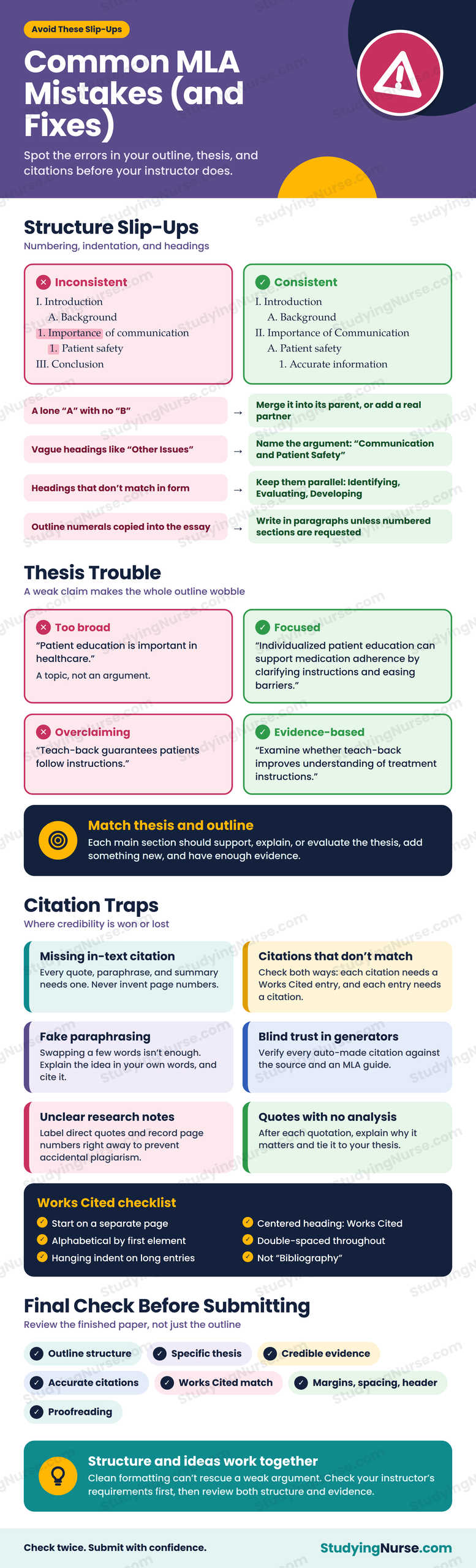
Conclusion
An effective MLA Format Outline provides a clear roadmap for organizing ideas, developing a strong thesis statement, and arranging supporting evidence into a logical sequence. By using consistent numbering, indentation, and parallel structure, writers can distinguish main arguments from supporting details and identify gaps before drafting the full paper. A well-developed outline also helps maintain focus, reduce repetition, and ensure that each section contributes to the paper’s central purpose.
Understanding MLA formatting rules, in-text citations, and Works Cited guidelines is equally important for producing credible academic writing. Accurate attribution allows readers to verify research findings, acknowledges the contributions of other authors, and helps prevent plagiarism. Whether preparing a short essay or an extensive nursing research paper, writers should ensure that their outline reflects the assignment requirements and that the completed document follows the appropriate MLA conventions.
Ultimately, mastering the MLA Format Outline involves combining effective organization with critical thinking, careful research, and consistent documentation. By using an appropriate outline template, evaluating supporting evidence, and checking formatting and citation details before submission, writers can develop clear, coherent, and academically sound papers.
Frequently Asked Questions
How do I write an outline for a research paper in MLA format?
Start with a clear thesis statement, then organize your main arguments using Roman numerals (I, II, III), supporting points using capital letters (A, B, C), and additional details using Arabic numerals (1, 2, 3). Arrange the sections logically, include relevant research evidence, and follow your instructor’s requirements for indentation and spacing.
What are the MLA style and format for research papers?
MLA style, established by the Modern Language Association, provides guidelines for academic writing, paper presentation, and source documentation. A typical MLA research paper uses one-inch margins, a readable 12-point font, double spacing, a first-page heading, a centered title, in-text citations using the author-page system, and a Works Cited page.
Can I find an MLA paper template in Word?
Yes. Microsoft Word may offer MLA paper templates through its template gallery. You can also create your own document by setting the margins, font, spacing, first-page heading, and running header according to MLA guidelines. Check the template carefully because available templates may not reflect the latest MLA requirements.
What are 5 key formatting rules for MLA format?
- Margins: Use one-inch margins on all sides.
- Font: Use a readable font, commonly 12-point Times New Roman, unless your instructor specifies otherwise.
- Spacing: Double-space the entire paper, including the Works Cited page.
- Heading and title: Include your name, instructor’s name, course, and date on the first page; center the title.
- Page numbers and citations: Place your last name and page number in the upper-right header, and cite borrowed information using MLA in-text citations with a corresponding Works Cited entry.
