

How to Write an Explanatory Essay: A Comprehensive Guide to Explanatory Writing, Essay Topics, and Examples
An explanatory essay is a fundamental form of academic writing that helps readers understand a particular topic, process, or concept through clear explanations, relevant examples, and reliable information. Unlike an argumentative or persuasive essay, which seeks to influence the reader’s opinion, an explanatory essay focuses on presenting information objectively and showing how or why something happens. For example, an essay explaining the causes of medication errors, the stages of wound healing, or the role of evidence-based practice presents facts and explains their significance rather than attempting to convince readers to support a particular position. The purpose is to make information accessible, logically organized, and easy to understand.
Learning how to write an explanatory essay requires more than gathering facts and arranging them into paragraphs. Effective explanatory writing involves selecting a suitable essay topic, understanding the assignment prompt, identifying the main idea, and developing a clear thesis statement that establishes the essay’s focus. The writer must then organize supporting details, examples, and credible evidence into a logical sequence that allows readers to follow the explanation. Each body paragraph should develop a specific point that contributes to the overall discussion, while transitions help connect ideas and maintain coherence throughout the essay.
The explanatory essay writing process typically involves several interconnected stages, each contributing to the quality of the final piece of writing:
- Topic selection and research: Choose a focused topic, interpret the prompt, and gather accurate information from credible sources.
- Planning and outlining: Create an essay outline that identifies the introduction, main points, supporting evidence, body paragraphs, and conclusion.
- Drafting: Develop the outline into a complete essay with a clear thesis statement, well-organized explanations, and appropriate examples.
- Revision and editing: Evaluate the accuracy, completeness, organization, and clarity of the discussion, making changes where necessary.
- Proofreading and referencing: Correct grammatical errors, check formatting, cite sources appropriately, and ensure that borrowed ideas are acknowledged to prevent plagiarism.
A well-written explanatory essay generally follows a recognizable structure consisting of an introduction, a body, and a conclusion. The introduction establishes the topic and provides the background information readers need to understand the discussion. The body develops the explanation through organized paragraphs, with each paragraph focusing on a distinct main point supported by relevant facts, examples, or research findings. The conclusion brings the discussion together by summarizing the central ideas and reinforcing the purpose of the explanation. Although this structure provides a reliable foundation, the length and organization of an essay may vary according to the assignment requirements, the complexity of the subject, and the amount of evidence needed.
Understanding how to write an explanatory essay also means recognizing the importance of objectivity, clarity, and credible evidence. Writers should distinguish established facts from personal opinions, explain unfamiliar concepts in accessible language, and avoid unsupported generalizations. In academic settings, these practices strengthen the quality of the discussion and demonstrate an ability to communicate information responsibly. In nursing and healthcare, for instance, explaining a clinical procedure or the factors contributing to a patient’s condition requires accurate terminology, evidence-based information, and a logical presentation that makes the subject understandable to the intended audience.
Developing these skills strengthens academic writing, research, critical thinking, and professional communication. By understanding the purpose of an explanatory essay, choosing an appropriate topic, following the correct format, supporting explanations with reliable evidence, and refining the final draft, writers can produce work that is informative, coherent, and academically sound.
Understanding the Explanatory Essay: Definition, Purpose, and Types
Definition and Purpose of Explanatory Essay Writing
An explanatory essay is a type of academic writing that presents information about a particular topic and explains it in a clear, logical, and objective manner. Its primary purpose is to help readers understand a subject by examining its characteristics, causes, processes, functions, or significance. Rather than attempting to persuade readers to accept a particular opinion, the writer provides relevant facts, supporting details, examples, and credible evidence to develop a meaningful explanation.
Learning how to write an explanatory essay begins with understanding the difference between simply presenting information and explaining what that information means. For instance, stating that medication errors occur in healthcare settings provides a basic fact. An explanatory essay goes further by examining the factors that contribute to these errors, such as communication failures, incorrect dosage calculations, interruptions during medication administration, and inadequate patient identification procedures. It then explains how these factors contribute to the problem, using relevant evidence to help readers understand the subject.
A well-developed explanatory essay answers questions such as how does something work?, why does a particular event occur?, what are the main characteristics of a concept?, and what factors contribute to a specific outcome? The exact focus depends on the assignment prompt and the topic selected. Some essays explain a sequence of events, while others examine relationships between causes and effects or clarify unfamiliar concepts.
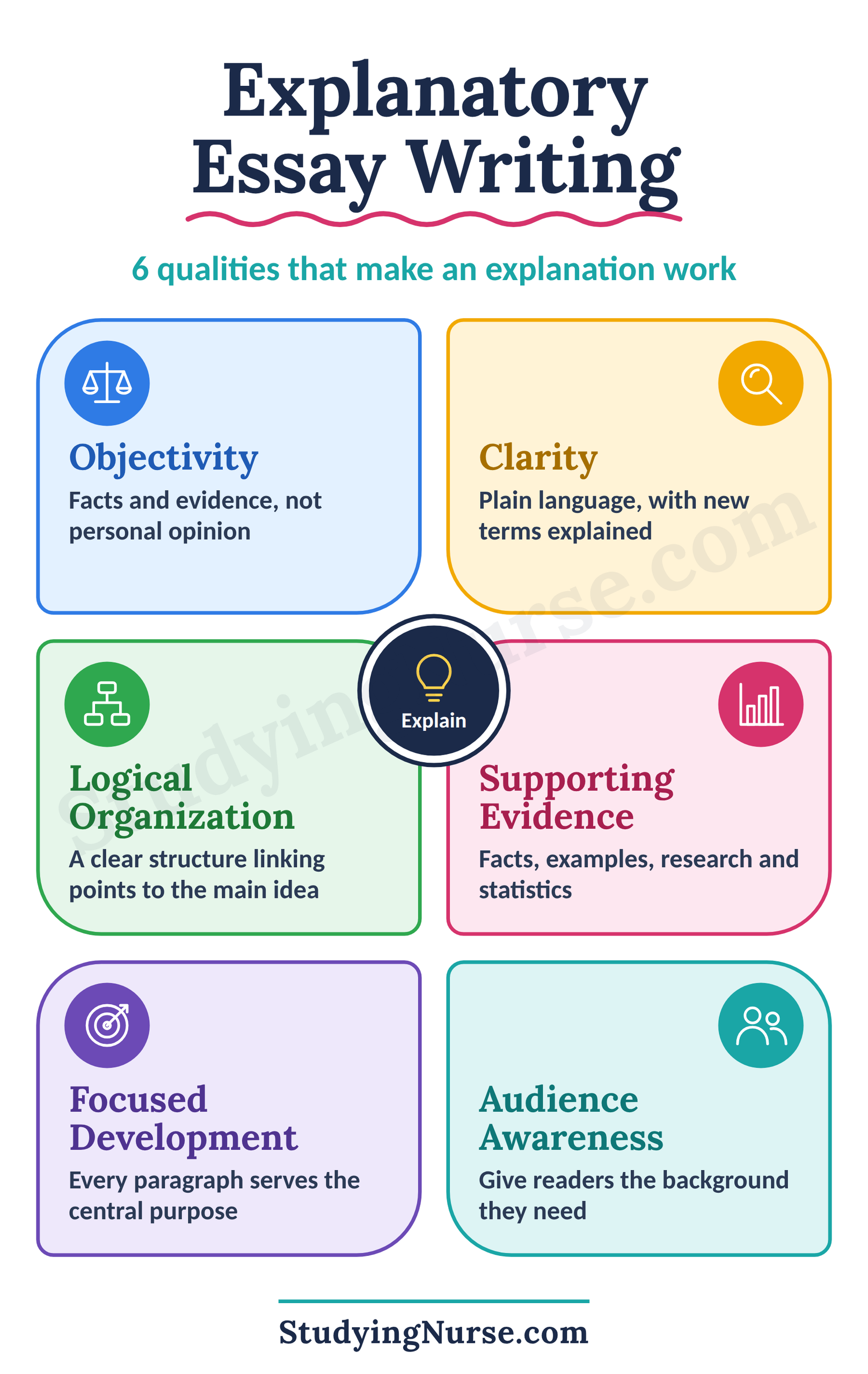
The central characteristics of explanatory essay writing include the following:
- Objectivity: The writer focuses on factual information, credible evidence, and reasoned explanations rather than personal opinions or unsupported judgments.
- Clarity: Ideas are expressed in understandable language, with unfamiliar terms explained when necessary.
- Logical organization: Information follows a clear structure so that readers can understand how individual points relate to the main idea.
- Supporting evidence: Facts, examples, research findings, statistics, and relevant illustrations help clarify and substantiate the explanation.
- Focused development: Every paragraph contributes to the essay’s central purpose instead of introducing unrelated information.
- Audience awareness: The writer considers what readers already know and provides sufficient background information to make the explanation meaningful.
These characteristics distinguish an effective explanatory essay from a piece of writing that merely lists facts. Information becomes useful when the writer establishes relationships between ideas, explains relevant details, and demonstrates how the evidence contributes to a fuller understanding of the topic.
For example, consider an essay topic about the importance of hand hygiene in healthcare. A basic description might identify handwashing as a practice used to maintain cleanliness. An explanatory essay would examine how hand hygiene reduces the transfer of microorganisms, describe the circumstances in which healthcare workers should perform it, and explain its role in preventing healthcare-associated infections. The explanation would draw on reliable infection-prevention guidance rather than personal beliefs about cleanliness.
The same principle applies to nonclinical subjects. An essay explaining how inflation affects household purchasing power could describe rising prices, changes in the value of money, and their effects on the cost of everyday goods. Similarly, an essay examining how social media influences communication could explain the mechanisms through which digital platforms facilitate interaction, information sharing, and the rapid spread of messages.
The main purpose of an explanatory essay is to increase understanding. To achieve this, the writer must identify the central question, select relevant information, arrange the main points in a sensible order, and explain the connections between them. A clear thesis statement establishes the scope of the discussion, while each body paragraph develops a particular aspect of the explanation. Supporting evidence strengthens the discussion, and a concluding paragraph brings the central ideas together.
An explanatory essay does not necessarily avoid every interpretation or analytical statement. Writers often need to interpret evidence to explain why a process works or why a particular outcome occurs. The important distinction is that these interpretations should be reasonable, supported by evidence, and consistent with the essay’s explanatory purpose rather than used to pressure readers into accepting an unsupported position.
Types of Explanatory Essays and Academic Examples
An explanatory essay can take several forms depending on the question being addressed, the subject being examined, and the way information needs to be presented. Some essays explain why an event occurs, others describe how a process works, while others clarify a concept or examine similarities and differences between related subjects. Understanding these approaches makes it easier to select an appropriate essay topic and determine which information belongs in each paragraph.
The different forms of explanatory writing are not always separate, rigid categories. A single essay may use more than one approach to develop its explanation. For example, an essay about pressure injuries may define the condition, explain the factors that contribute to tissue damage, describe how the injuries develop, and compare different stages. The most appropriate approach depends on the essay’s central purpose and the requirements of the assignment.
Common approaches include the following.
1. Cause-and-effect explanatory essay
A cause-and-effect essay explains why something happens, what factors contribute to an event, or what consequences follow from a particular action or condition. The writer identifies relevant causes and effects and explains the relationships between them rather than simply listing them.
For example, an essay titled How Sleep Deprivation Affects Nursing Performance could examine how inadequate sleep influences attention, memory, decision-making, and reaction time. Each body paragraph would explore a particular effect and explain the relationship between insufficient sleep and performance, drawing on credible research where appropriate.
Other possible topics include:
- Factors contributing to medication errors in healthcare settings.
- Causes and consequences of hospital-acquired infections.
- How dehydration affects normal physiological functioning.
- The relationship between stress and academic performance.
- How inadequate staffing can affect the quality of patient care.
A strong cause-and-effect essay distinguishes between an established causal relationship and a mere association. If research shows that two factors are related, the writer should not automatically claim that one directly causes the other. Accurate explanations require careful interpretation of the available evidence.
2. Process or how-it-works explanatory essay
A process essay explains how something happens or how a procedure is carried out. It presents information in a logical sequence so readers can understand the stages involved, the purpose of each stage, and how the individual steps relate to one another.
For instance, an essay titled How the Body Regulates Blood Glucose Levels could explain the roles of insulin, glucagon, the pancreas, and the liver in maintaining glucose homeostasis. Rather than merely naming these components, the writer would explain how they interact under different physiological conditions.
Other examples include:
- How wound healing progresses through its main phases.
- How the body responds to an infection.
- How an autoclave uses pressurized steam to sterilize appropriate equipment.
- How blood circulates through the heart and lungs.
- How the immune system recognizes and responds to pathogens.
A process essay should explain relationships between stages, not simply provide instructions. When the topic concerns a clinical procedure, accuracy is particularly important. Any practical instructions should be consistent with current professional guidance, and the essay should distinguish general educational explanations from instructions that require supervised clinical training.
3. Definition or concept-based explanatory essay
A definition-based essay examines the meaning of a term, concept, condition, or phenomenon in greater depth than a brief dictionary definition. It identifies the defining characteristics of the subject, clarifies relevant terminology, and explains why the concept matters.
For example, an essay titled Understanding Evidence-Based Practice in Nursing could define evidence-based practice and explain how research evidence, clinical expertise, and patient preferences inform healthcare decisions. It could also clarify how evidence-based practice differs from relying solely on personal experience or customary routines.
Other suitable topics include:
- Understanding patient autonomy in healthcare.
- The meaning of therapeutic communication.
- The concept of health literacy.
- Understanding social determinants of health.
- The role of informed consent in clinical practice.
This approach is particularly useful when a topic involves specialized terminology or a concept that readers may interpret differently. An effective definition essay establishes the meaning of the central term and then develops that meaning through characteristics, examples, distinctions, and relevant evidence.
4. Classification or categorization explanatory essay
A classification essay organizes a broad subject into meaningful categories. It explains the characteristics that distinguish each category and shows how the categories relate to the larger subject.
For example, an essay about The Different Types of Wound Dressings could group dressings according to their properties, such as moisture retention, absorption, or suitability for particular wound characteristics. The discussion would explain what distinguishes each category and why those differences matter.
Other examples include:
- Classifying types of healthcare-associated infections.
- Explaining the different levels of nursing education and practice.
- Categorizing common approaches to pain management.
- Examining types of learning strategies.
- Classifying communication barriers in healthcare.
The categories should follow a clear organizing principle. Mixing unrelated criteria can make an essay confusing; for instance, classifying dressings partly by material, partly by price, and partly by manufacturer may create overlapping groups. A consistent basis for classification makes the explanation more useful.
5. Comparison-and-contrast explanatory essay
A comparison-and-contrast essay explains the similarities and differences between two or more subjects. The purpose is to help readers understand each subject more clearly by examining them according to consistent criteria.
For example, an essay comparing CPAP and BiPAP could explain how each form of noninvasive respiratory support works, how their pressure delivery differs, and why clinical indications and patient circumstances influence their use. The discussion should rely on appropriate clinical sources and avoid suggesting that one option is universally better than the other.
Other possible topics include:
- Crystalloids versus colloids in fluid therapy.
- Type 1 diabetes versus type 2 diabetes.
- Acute pain versus chronic pain.
- Qualitative versus quantitative research.
- Online learning versus face-to-face instruction.
A useful comparison does more than identify surface-level differences. It explains the significance of those differences and gives readers a clear basis for understanding the subjects. The essay may organize each subject separately or compare them point by point, depending on the complexity of the topic.
6. Problem-and-solution explanatory essay
A problem-and-solution essay explains a problem, the circumstances contributing to it, its consequences, and the approaches used to address it. Unlike a persuasive essay, its primary purpose can remain explanatory: helping readers understand the nature of the problem and how different responses work.
For example, an essay about Preventing Falls Among Hospitalized Patients could explain factors associated with falls, including impaired mobility, medication effects, environmental hazards, and confusion. It could then describe prevention measures, such as individualized risk assessment, appropriate assistance with mobility, and environmental safety practices, supported by relevant evidence.
Other examples include:
- Explaining approaches to reducing healthcare-associated infections.
- Understanding strategies for addressing health literacy barriers.
- Examining methods for improving communication during patient handoffs.
- Explaining interventions used to reduce medication-administration errors.
When discussing potential solutions, the writer should explain their purpose, application, and limitations. Recommendations should not be presented as equally effective unless reliable evidence supports that conclusion.
Choosing the right type for an essay assignment
The assignment prompt often indicates which explanatory approach is most suitable. Words such as explain, describe how, identify the causes, compare, classify, and discuss the effects provide clues about the expected approach.
Before beginning the writing process, consider these questions:
- What needs to be explained? Identify the central concept, event, process, or relationship.
- What does the prompt require? Determine whether the task emphasizes causes, stages, categories, comparisons, or solutions.
- What evidence is available? Choose an approach that can be developed using credible and relevant information.
- What will help readers understand the subject? Select the structure that presents the explanation most clearly.
The approaches can also be combined when a topic requires more than one type of explanation. An essay about pressure injuries, for example, may begin with a definition, explain the causes of tissue damage, classify the stages, and describe prevention methods. However, these elements should work together to answer one central question rather than turn the essay into an unfocused collection of facts.
Explanatory, Expository, Argumentative, and Informative Essays Compared
Academic writing includes several essay types, each designed to achieve a particular purpose. Although explanatory, expository, argumentative, and informative essays may share similar structures, they differ in their primary objectives, the way evidence is used, and the relationship the writer establishes with the reader.
Understanding these differences is important when interpreting an assignment prompt. A writer may have accurate information and a well-organized essay but still fail to meet the assignment requirements if the discussion explains a topic when the task actually requires an argument, or presents a personal position when the assignment calls for an objective explanation.
The distinction is not always absolute. In many academic writing resources, explanatory essay and expository essay are used interchangeably, while informative essay often refers to a closely related form of expository writing. Purdue University’s Online Writing Lab identifies exposition, description, narration, and argumentation as common approaches to essay writing.
The following comparison highlights their main differences.
| Essay type | Primary purpose | Typical approach | Example topic |
|---|---|---|---|
| Explanatory essay | To clarify how or why something happens or what a concept means | Presents an objective, logically developed explanation | How the body regulates blood glucose |
| Expository essay | To examine and present information about a subject | Uses definitions, examples, comparisons, or cause-and-effect analysis | The functions of the endocrine system |
| Informative essay | To increase the reader’s knowledge of a subject | Presents relevant facts, background information, and explanations | Common types of diabetes |
| Argumentative essay | To establish and defend a position | Develops a claim supported by evidence and responds to opposing views | Whether hospitals should implement mandatory nurse-to-patient staffing ratios |
| Persuasive essay | To influence the reader’s beliefs, attitudes, or actions | Uses evidence, reasoning, and sometimes emotional appeals | Why healthcare facilities should strengthen infection-prevention policies |
Explanatory essay versus expository essay
These two terms frequently overlap. Both forms of writing aim to develop understanding through organized information and explanation. Depending on the institution, instructor, or assignment rubric, an explanatory essay may be treated as a specific form of expository writing, or the terms may be used interchangeably.
For example, an essay explaining how antibiotic resistance develops may describe how microorganisms acquire resistance, how inappropriate antibiotic use contributes to the problem, and why resistance complicates treatment. Whether the assignment is labeled explanatory or expository, the writer’s central responsibility is to present a clear, evidence-based account.
The important consideration is the assignment’s actual requirements rather than the label alone. If a prompt asks for an explanation of a process, the discussion should focus on how that process works instead of attempting to persuade the reader to support a policy.
Explanatory essay versus informative essay
An informative essay primarily seeks to increase knowledge about a subject by presenting relevant facts, background information, and important details. An explanatory essay places particular emphasis on making relationships, mechanisms, or meanings understandable.
Consider an essay about hypertension. An informative essay might introduce its definition, prevalence, risk factors, symptoms, and treatment options. An explanatory essay might concentrate on how increased vascular resistance and other physiological mechanisms contribute to elevated blood pressure.
The difference is mainly one of emphasis. An informative essay can contain detailed explanations, and an explanatory essay necessarily provides information. Both require accuracy, logical organization, and appropriate supporting evidence.
Explanatory essay versus argumentative essay
The primary distinction lies in the purpose of the writing. An explanatory essay seeks to help readers understand a topic, whereas an argumentative essay seeks to establish that a particular claim or position is justified.
For example:
- Explanatory topic: How nurse-to-patient ratios influence patient care.
- Argumentative topic: Why hospitals should adopt legally mandated nurse-to-patient ratios.
The explanatory version would examine relevant relationships, research findings, and factors that affect patient care. The argumentative version would advance a defensible position, use evidence to support that position, consider counterarguments, and explain why the proposed conclusion is justified.
An explanatory essay may reach conclusions based on evidence, but it does not need to advocate a policy or prove that one disputed position should prevail. An argumentative essay, by contrast, requires a clear claim that can be examined, challenged, and defended.
Explanatory essay versus persuasive essay
An explanatory essay and a persuasive essay may address the same subject, but they approach it differently. Persuasive writing attempts to influence what readers think, believe, or do. It may combine factual evidence with appeals to values, consequences, credibility, or emotions.
For example, an explanatory essay about hand hygiene would describe how proper hand hygiene interrupts the transmission of microorganisms and reduces infection risks. A persuasive essay on the same subject might argue that every healthcare facility should adopt stricter hand-hygiene monitoring and encourage readers to support that policy.
Persuasive writing does not necessarily rely on emotion or exclude objective evidence. Strong persuasive essays use credible evidence and sound reasoning, but their central goal is to convince the audience. Explanatory writing uses evidence primarily to clarify the subject.
How to identify the required essay type
When an assignment uses unfamiliar terminology, examine its action words and expected outcome before deciding how to organize the essay.
- If you are asked to explain, clarify how or why something occurs.
- If you are asked to inform, present the relevant facts and background needed to understand the subject.
- If you are asked to compare and contrast, examine similarities and differences according to consistent criteria.
- If you are asked to argue or defend, develop a position and justify it with evidence.
- If you are asked to persuade, build a reasoned case intended to influence the reader’s judgment or actions.
These verbs are useful indicators, although the full prompt and marking criteria should guide the final decision. For instance, the word discuss can require explanation, evaluation, or argument depending on the context.
A well-written explanatory essay therefore begins with a clear understanding of the task. Once the purpose is established, the writer can select a suitable topic, develop a focused thesis statement, choose an appropriate organizational approach, and present supporting evidence in a way that strengthens understanding without confusing explanation with persuasion.
Choosing Explanatory Essay Topics and Analyzing Prompts
Selecting a suitable topic is one of the most important stages of the essay writing process because it determines the direction, depth, and relevance of the discussion. A strong topic provides enough material to explain a concept thoroughly without making the assignment so broad that the writer can only offer superficial information. Before beginning to write an explanatory essay, it is necessary to identify a subject that can be explored objectively, supported with credible evidence, and developed within the assignment’s requirements.
Topic selection and prompt analysis are closely connected. The topic establishes what the essay will address, while the prompt clarifies what the writer must explain about that subject. For example, the broad subject of patient safety could lead to several different essays, depending on whether the assignment asks for an explanation of medication errors, the effects of communication failures, or the role of infection prevention. Each possibility requires a different focus, supporting evidence, and organizational approach.
The process of choosing explanatory essay topics therefore involves generating ideas, evaluating their suitability, narrowing the subject, and interpreting the assignment instructions. Purdue University’s Online Writing Lab recommends narrowing broad research subjects to manageable areas and considering factors such as subtopics, populations, and time periods.
These principles also help writers develop focused explanatory essays that provide meaningful information instead of attempting to cover an entire field in a limited space.
Brainstorming Explanatory Essay Topics and Ideas for Students
Brainstorming is the initial process of generating possible subjects and identifying aspects that could form the basis of an explanatory essay. At this stage, the objective is to explore possibilities rather than settle immediately on a final topic. Writers can draw ideas from academic subjects, everyday experiences, professional practices, current issues, scientific developments, and questions about how or why particular events occur.
A useful starting point is to identify subjects that naturally invite explanation. These may involve a process, a cause-and-effect relationship, a classification, a concept, or a comparison. For example, someone interested in healthcare might consider how the immune system responds to infection, why pressure injuries develop, or how communication affects patient safety. Each subject provides opportunities to explain relationships and present evidence in a structured way.
Purdue OWL recommends brainstorming, freewriting, asking questions, and recording initial thoughts as useful prewriting strategies. These approaches help writers discover promising directions before committing to a particular subject.
1. Use brainstorming techniques to generate essay ideas
Different brainstorming methods can help identify a suitable essay topic, especially when the assignment allows considerable freedom.
- Freewriting: Write continuously for several minutes about a subject without stopping to correct grammar or organize every thought. For example, writing freely about patient safety might generate ideas about medication administration, communication, infection control, patient identification, and clinical documentation.
- Mind mapping: Place a broad subject in the center of a page and connect it to related ideas. A mind map about human physiology could branch into circulation, respiration, digestion, immunity, and fluid balance, with each branch producing narrower topics.
- Question-based brainstorming: Ask what, how, why, when, and under what circumstances something occurs. For example, the question “Why do pressure injuries develop?” could lead to an examination of prolonged pressure, tissue tolerance, impaired mobility, and other contributing factors.
- Listing and grouping: Record as many possible topics as possible, then organize them into related categories. A list about healthcare technology might include electronic health records, telehealth, clinical decision-support systems, and remote patient monitoring.
- Preliminary reading: Consult textbooks, scholarly articles, academic databases, and reputable professional organizations to identify subjects that are relevant, researchable, and sufficiently focused.
These techniques do not need to be used separately. A writer might begin with freewriting, create a mind map, and then conduct preliminary research to identify the most promising idea.
For example, brainstorming around the general subject of infection prevention might produce the following possibilities:
From a broad subject to possible essay ideas
Broad subject: Infection prevention in healthcare
• How hand hygiene interrupts the transmission of microorganisms
• Why healthcare-associated infections develop
• How sterilization differs from disinfection
• The role of personal protective equipment in infection prevention
• How antibiotic resistance develops and spreads
Each idea focuses on a different aspect of the same general subject. This makes it easier to identify a specific question, determine which sources are needed, and develop an explanation that remains within a manageable scope.
2. Explore different categories of explanatory essay topics
When generating explanatory essay topics, it helps to consider the different ways a subject can be examined. This prevents the brainstorming process from becoming limited to familiar or overly general themes.
The following examples illustrate possible directions, including topics relevant to nursing, science, education, and everyday life.
| Topic category | Example essay topics | Main explanatory focus |
|---|---|---|
| Cause and effect | How sleep deprivation affects concentration; factors contributing to medication errors | Relationships between causes and outcomes |
| Processes | How the body regulates blood glucose; how steam sterilization works | Stages, mechanisms, and functions |
| Concepts and definitions | Understanding evidence-based practice; the meaning of health literacy | Characteristics and significance of a concept |
| Classification | Types of wound dressings; categories of healthcare-associated infections | Differences between related groups |
| Comparison and contrast | CPAP versus BiPAP; qualitative versus quantitative research | Similarities, differences, and their significance |
| Social and behavioral issues | How social media influences communication; factors affecting health-seeking behavior | Patterns, contributing factors, and consequences |
| Technology | How electronic health records support clinical documentation; how telehealth consultations work | Functions, processes, and practical applications |
| Everyday phenomena | How inflation affects household budgets; how sleep influences memory | Mechanisms and effects in daily life |
These categories are starting points rather than rigid classifications. A single essay may combine several approaches when doing so helps explain the subject more effectively.
3. Generate concise explanatory essay topics by asking focused questions
A broad subject can become more manageable when converted into a question that identifies exactly what needs to be explained. This technique helps transform general essay ideas into specific, researchable directions.
For example:
- Broad subject: Medication safety.
- More focused question: How do interruptions during medication administration contribute to errors?
- Potential essay topic: How Interruptions Contribute to Medication Administration Errors.
Another example:
- Broad subject: Human immunity.
- More focused question: How does the immune system respond when a pathogen enters the body?
- Potential essay topic: How the Immune System Responds to Infection.
A third example:
- Broad subject: Academic writing.
- More focused question: How does an essay outline help organize an explanation?
- Potential essay topic: The Role of Essay Outlines in Organizing Academic Writing.
This approach is useful because it identifies the relationship or process that the essay will examine. Instead of trying to cover everything about medication safety, immunity, or academic writing, the writer can concentrate on a specific aspect and explain it in sufficient depth.
4. Evaluate the quality of potential essay ideas
Not every interesting subject is suitable for an academic assignment. Before selecting a topic, consider whether it can be explained clearly, supported by reliable information, and developed within the available word count.
A practical evaluation should consider the following:
- Relevance: Does the topic match the assignment requirements and the subject being studied?
- Researchability: Are credible sources available to explain the topic accurately?
- Manageable scope: Can the subject be covered adequately within the required length?
- Explanatory potential: Does the topic allow the writer to explain how, why, or what something is, rather than simply list facts?
- Audience suitability: Will the explanation provide useful information at the intended audience’s level of knowledge?
- Availability of evidence: Can important statements be supported with reliable research, data, examples, or authoritative guidance?
The Texas A&M University Writing Center similarly recommends considering assignment requirements, personal interest, available scholarly research, and the appropriate scope when selecting a topic.
For example, Human Anatomy is a broad subject with many possible directions. It would be difficult to explain the entire subject in a short essay. A more suitable topic might be How the Diaphragm Contributes to Normal Breathing. This narrower subject has a clear explanatory focus and can be developed through a discussion of the diaphragm’s movement, pressure changes, and the mechanics of inhalation and exhalation.
The purpose of brainstorming is not to produce the longest possible list of essay ideas. It is to identify a subject that offers enough relevant material for a clear, coherent, and well-supported explanation.
Selecting a Focused Essay Topic and Interpreting the Prompt
After generating possible topics, the next step is to select one that fits the assignment and interpret the prompt accurately. These are related but distinct tasks. Choosing a topic establishes the subject, whereas analyzing the prompt determines the kind of explanation required, the boundaries of the discussion, and the expectations the finished essay must satisfy.
A writer might select pressure injuries as an essay topic, for example, but the assignment could ask for an explanation of their causes, stages, prevention, or treatment. Although these areas are related, each requires a different central focus. An essay that discusses all four in equal detail may fail to address the assignment adequately if the prompt specifically asks how pressure injuries develop.
1. Narrow a broad subject into a focused topic
A focused topic identifies a manageable aspect of a larger subject. It should be sufficiently specific to guide research and paragraph development while leaving enough room for meaningful explanation.
One practical method is to narrow a subject using the following dimensions:
- Subtopic: Focus on one aspect of a broader field.
- Population: Identify a relevant group, when appropriate.
- Setting: Limit the discussion to a particular environment or context.
- Time period: Examine a defined period when the topic involves historical or changing developments.
- Process or relationship: Concentrate on a specific mechanism, sequence, or relationship.
For instance, consider the following progression:
| Stage | Example |
|---|---|
| Broad subject | Patient safety |
| Narrower subject | Medication safety |
| Focused subject | Factors contributing to medication administration errors |
| More specific essay topic | How communication failures contribute to medication administration errors during patient handoffs |
The final topic gives the essay a clearer direction. It identifies a particular factor and a specific clinical context, making it easier to determine which information is relevant.
However, narrowing a topic too much can also create difficulties. If the subject is highly specialized and little credible information is available, the writer may struggle to develop a comprehensive explanation. A suitable essay topic balances specificity with the availability of evidence.
2. Read the prompt carefully and identify its requirements
An assignment prompt may contain several instructions within a few sentences. Reading it carefully helps prevent the writer from overlooking the required focus, format, length, or evidence standards.
When analyzing a prompt, identify:
- The action word: What must the writer do?
- The subject: What specific topic must be addressed?
- The scope: Which aspects must be included or excluded?
- The audience and purpose: Who is expected to read the essay, and what should they understand?
- The assignment requirements: Are there word limits, source requirements, formatting rules, or prescribed sections?
Action words are especially important because they indicate how the essay should be developed. The University of Massachusetts Boston Writing Center explains that instruction words such as “explain” and “analyze” influence how a writer should approach and structure an assignment.
The following examples illustrate how different prompts about the same subject lead to different explanatory approaches.
| Assignment prompt | What the writer should focus on |
|---|---|
| Explain how wound healing occurs. | The stages and biological mechanisms involved in wound healing |
| Explain the factors that contribute to pressure injuries. | Risk factors and how they contribute to tissue damage |
| Compare and contrast primary and secondary wound healing. | Similarities, differences, and the significance of each process |
| Describe the classification of pressure injuries. | The relevant categories and their defining characteristics |
| Explain how hand hygiene reduces infection transmission. | The mechanisms through which hand hygiene interrupts transmission |
Notice that each prompt identifies a different task. The writer should not automatically use the same essay structure for all of them simply because they address related healthcare subjects.
3. Distinguish the topic from the prompt and the thesis statement
These three elements serve different functions in essay writing.
- Topic: The general subject being discussed.
- Prompt: The instruction that defines what the assignment requires.
- Thesis statement: The sentence that expresses the central focus of the particular essay.
Consider an assignment about medication errors:
- Topic: Medication administration errors.
- Prompt: Explain how communication failures can contribute to medication administration errors in healthcare settings.
- Possible thesis statement: Communication failures can contribute to medication administration errors when important patient information, medication instructions, or changes in treatment are not accurately transferred between healthcare professionals.
The topic identifies the subject, the prompt establishes the task, and the thesis statement provides a focused direction for the explanation.
The thesis should be developed in response to the prompt rather than chosen independently of it. This ensures that the body paragraphs address the required subject and that the supporting evidence contributes to the central explanation. A thesis statement for an explanatory essay does not need to advocate a controversial position; it should establish what the essay will explain and, where appropriate, identify its main dimensions.
4. Interpret action words in the assignment
Certain instruction words appear frequently in academic assignments. Understanding their meaning helps determine what information belongs in the essay.
| Instruction word | Expected approach |
|---|---|
| Explain | Clarify what something is, how it works, or why it occurs |
| Describe | Present the relevant characteristics, features, or stages |
| Compare | Identify meaningful similarities |
| Contrast | Explain meaningful differences |
| Classify | Organize a subject into categories and explain their distinguishing features |
| Analyze | Examine components or relationships and explain their significance |
| Discuss | Address the specified subject in sufficient depth, following the context and requirements of the assignment |
| Summarize | Present the principal ideas concisely without reproducing every detail |
Some prompts combine several instructions. For example, “Describe the stages of wound healing and explain the factors that may delay recovery” requires both a description of the stages and an explanation of factors affecting the process. The essay should allocate sufficient space to both tasks rather than focusing exclusively on one.
If an instruction is unclear, consulting the assignment rubric or asking the instructor for clarification is preferable to guessing. This is particularly important when the prompt uses terminology that may have a specific meaning within a discipline.
5. Confirm that the selected topic can meet the assignment requirements
Before committing to the final essay topic, conduct a brief preliminary check. This does not require completing all the research; it involves determining whether the proposed explanation is feasible.
Ask the following questions:
- Can the topic be explained objectively rather than relying mainly on personal opinions?
- Can I identify the main points needed to answer the prompt?
- Are credible sources available to support the explanation?
- Is the topic sufficiently focused for the required word count?
- Can the information be arranged in a logical order?
- Does the proposed focus address every major requirement in the prompt?
For a clinical topic, sources might include peer-reviewed research, relevant professional guidelines, authoritative healthcare organizations, and appropriate academic textbooks. The sources should be suitable for the specific claims being made, and clinical information should be checked for currency and accuracy.
For example, an essay about how dehydration affects the body could be organized around changes in fluid balance, the body’s compensatory responses, and possible effects on organ function. Before proceeding, the writer should confirm that reliable sources explain these mechanisms and that the proposed scope is manageable.
This preliminary evaluation can reveal when a topic needs to be narrowed, broadened, or reframed. It also helps prevent a common problem in academic writing: selecting an appealing subject and only later discovering that the available evidence does not adequately answer the assignment question.
Choosing a suitable essay topic and interpreting the prompt correctly establishes the foundation for the rest of the writing process. Once the subject, task, and scope are clear, the writer can develop an appropriate thesis statement, organize the main points, and create an essay outline that supports a focused and coherent explanation.
Explanatory Essay Format and Outline Development
Understanding the explanatory essay format is an important step in learning how to write an explanatory essay that presents information clearly, accurately, and logically. A well-organized essay helps readers understand a particular topic without becoming confused by unrelated details or poorly connected ideas. Although the content varies according to the subject and assignment prompt, most explanatory essays follow a familiar structure consisting of an introduction, body paragraphs, and a conclusion. Each part serves a distinct purpose and contributes to the overall explanation.
Before beginning the first draft, it is helpful to create an essay outline that identifies the main idea, supporting points, relevant evidence, and the order in which information will appear. Planning the structure in advance makes essay writing more manageable because the writer can identify gaps in the explanation before developing complete paragraphs. It also helps maintain focus, prevent repetition, and ensure that each section contributes to the essay’s purpose.
The appropriate explanatory essay format depends on the assignment requirements, the complexity of the topic, and the amount of information needed to explain it. A short assignment may follow a five-paragraph essay structure, while a longer academic paper may require additional body paragraphs to address several related aspects of the subject. Regardless of length, an effective explanatory essay should have a clear organizational pattern, sufficient supporting details, and a logical progression from the introduction to the conclusion.
The Introduction, Body Paragraphs, and Conclusion
The standard explanatory essay format contains three major components: the introduction, the body, and the conclusion. These parts work together to introduce the subject, explain its essential features, and reinforce the central information presented. Knowing how to write an explanatory essay involves understanding what each component should accomplish rather than simply arranging paragraphs in a particular order.
The introduction: Presenting the topic and establishing the main idea
The introductory paragraph introduces the essay topic and gives readers the background information they need to understand the explanation. It should establish the subject, provide relevant context, and lead naturally to a clear thesis statement. The opening should be engaging enough to maintain the reader’s attention while remaining relevant to the purpose of explanatory writing.
An effective introduction generally includes three elements:
- An opening statement: This introduces the subject through a relevant fact, observation, brief example, or question. The opening should relate directly to the topic instead of relying on a dramatic statement that contributes little to the explanation.
- Background information: This provides context, defines an unfamiliar concept, or clarifies why the topic matters. The amount of background information should reflect the reader’s likely familiarity with the subject.
- A thesis statement: This identifies the main point of the essay and establishes the central explanation that the body paragraphs will develop.
For example, an explanatory essay about the importance of hand hygiene in healthcare settings might begin with an observation about how healthcare workers interact with patients, medical equipment, and shared clinical environments. It could then explain that microorganisms may be transferred through contaminated hands and that proper hand hygiene helps interrupt this transmission. The thesis statement could read:
Hand hygiene helps reduce the spread of healthcare-associated infections by removing or inactivating microorganisms, interrupting transmission pathways, and supporting safer patient care.
This thesis gives the essay a clear direction. It identifies the main idea and previews three related points that can be explained in the body paragraphs. The writer can then organize the discussion around how hand hygiene works, how microorganisms spread, and how proper hygiene practices contribute to infection prevention.
When learning how to write an explanatory essay, it is important to distinguish between an introduction that merely announces a topic and one that establishes a clear focus. For instance, the statement “This essay is about hand hygiene” identifies the subject but does not communicate what the essay will explain. A more effective thesis specifies the relationship or process the essay will examine.
The introduction should also remain proportionate to the assignment. A short essay may need only a few sentences to introduce its topic and thesis, while a more complex academic essay may require additional context or definitions. Excessive background information can delay the explanation, whereas too little context may leave readers uncertain about the subject. The objective is to provide enough information for readers to follow the discussion without including every detail at the beginning.
The body paragraphs: Developing the explanation with organized details
The body is the main part of an explanatory essay. It expands on the thesis by presenting the information, reasoning, examples, and evidence readers need to understand the subject. Each body paragraph should address a distinct aspect of the main point, and the paragraphs should follow a logical order.
A useful body paragraph usually contains four elements:
- Topic sentence: Introduces the paragraph’s main point and connects it to the thesis statement.
- Explanation: Clarifies the idea introduced in the topic sentence, including how or why something occurs.
- Supporting details and evidence: Provides relevant facts, examples, research findings, definitions, or illustrations that make the explanation credible.
- Concluding or linking sentence: Reinforces the paragraph’s main point or creates a transition to the next idea.
These elements do not have to appear as four separate sentences. A paragraph may contain several sentences of explanation and evidence, particularly when the topic is complex. The important consideration is that every sentence contributes to the paragraph’s purpose.
Consider the following example of a body paragraph for an explanatory essay about hand hygiene:
One way hand hygiene helps prevent healthcare-associated infections is by reducing the transfer of microorganisms between people and surfaces. During patient care, healthcare workers may come into contact with body fluids, contaminated equipment, or frequently touched objects. If hands are not cleaned appropriately, microorganisms can be transferred to another patient or to a surface that others touch. Performing hand hygiene at the appropriate moments helps interrupt this chain of transmission. For this reason, hand hygiene is an essential component of routine infection prevention practices.
The topic sentence introduces the paragraph’s main point. The following sentences explain how microorganisms may move between people and surfaces, while the final sentence connects the explanation to the broader purpose of infection prevention. Rather than simply claiming that hand hygiene is important, the paragraph explains the mechanism behind its importance.
When deciding how to write an explanatory essay, writers should ensure that body paragraphs do more than repeat the thesis statement. Each paragraph should contribute new information or develop an important part of the explanation. If several paragraphs make essentially the same point, the essay may feel repetitive. Conversely, if a paragraph introduces an unrelated idea, it may weaken the essay’s focus.
The order of body paragraphs should also reflect the nature of the subject. Different explanatory essay topics may require different organizational patterns:
- Chronological order: Explain events or developments in the sequence in which they occur.
- Sequential or process order: Present the steps involved in completing a task or understanding a process.
- Cause-and-effect order: Explain the factors that produce an outcome and the consequences that follow.
- General-to-specific order: Introduce a broad concept before examining its individual components or examples.
- Comparison-and-contrast order: Explain similarities and differences between two or more related subjects.
For example, an essay explaining how a wound heals may follow a sequence of healing phases, while an essay examining the causes of medication errors may organize its body paragraphs around contributing factors such as communication problems, workload, and medication-handling procedures. The organizational pattern should help readers understand the explanation rather than force every topic into the same structure.
The number of body paragraphs depends on the assignment and the complexity of the topic. A five-paragraph essay commonly includes three body paragraphs, each addressing a major supporting point. However, three paragraphs are not mandatory for every explanatory essay. A short topic may require fewer, while a comprehensive discussion may need several additional paragraphs to explain different processes, causes, examples, or implications. The writer should provide enough space to explain the topic thoroughly without adding unnecessary material.
The conclusion: Reinforcing the explanation
The concluding paragraph brings the explanatory essay to a meaningful close. It reminds readers of the central idea, synthesizes the most important points, and reinforces the explanation developed throughout the body. It should not introduce a major new argument or an entirely new topic that requires further discussion.
A strong conclusion typically performs three functions:
- Restates the thesis in fresh language: It returns to the essay’s main point without copying the original thesis statement word for word.
- Synthesizes the main points: It shows how the supporting explanations fit together to provide a fuller understanding of the topic.
- Provides a closing statement: It leaves readers with a clear final understanding of the subject’s significance or practical relevance.
For example, an explanatory essay about hand hygiene might conclude as follows:
Hand hygiene is a fundamental part of infection prevention because it reduces the transfer of microorganisms during healthcare activities. By cleaning their hands at appropriate moments and following recommended procedures, healthcare workers help interrupt transmission pathways and protect patients from avoidable exposure. Consistent hand hygiene practices therefore support safer clinical environments and form an important part of routine patient care.
This conclusion summarizes the explanation without introducing a new topic. It connects the central idea to the supporting points and reinforces the practical significance of the discussion.
When learning how to write an explanatory essay, writers should avoid conclusions that simply repeat the introduction or end abruptly after the last body paragraph. A conclusion should bring the discussion together rather than reproduce a list of earlier statements. It should also avoid exaggerated claims or personal opinions that have not been established through the explanation.
For instance, the sentence “Everyone who fails to wash their hands is careless and puts every patient at risk” is overly judgmental and makes a sweeping claim. An objective alternative would explain that inconsistent hand hygiene can increase opportunities for microorganism transmission. The revised statement is more appropriate for explanatory writing because it focuses on the relationship being explained instead of criticizing individuals.
The length of the conclusion should be appropriate to the essay. In a short assignment, a few well-developed sentences may be sufficient. A longer academic essay may need a more detailed synthesis of its central points. In both cases, the goal is to conclude the explanation clearly and concisely.
How the three parts work together
The introduction, body paragraphs, and conclusion should function as parts of one connected piece of writing. The introduction establishes what the essay will explain, the body develops the explanation with supporting details, and the conclusion brings the main ideas together.
For example, if the essay topic is how sleep affects learning, the introduction might identify the relationship between sleep and cognitive functioning. The body paragraphs could explain how sleep supports memory consolidation, influences attention, and affects the ability to process new information. The conclusion would then synthesize these points to explain why sleep is relevant to learning and memory.
This relationship between the parts is essential to a coherent explanatory essay. A thesis statement that promises to explain three causes should be supported by body paragraphs that address those causes. A conclusion should then synthesize what those paragraphs have established. If the body discusses unrelated ideas or fails to address the thesis, the essay’s structure becomes difficult to follow.
Learning how to write an explanatory essay therefore involves more than knowing the names of its parts. It requires aligning the introduction, body paragraphs, and conclusion so that each part supports the same central purpose.
Creating an Explanatory Essay Outline with Main Points and Supporting Evidence
Creating an explanatory essay outline is an important planning stage in the writing process because it provides a framework for organizing information before drafting complete paragraphs. An outline identifies the central idea, the main points that support it, and the evidence needed to explain each point. It also establishes the order in which information will appear, helping writers develop a coherent essay that informs readers without unnecessary repetition or unrelated details.
When learning how to write an explanatory essay, it is helpful to view the outline as a guide rather than a finished piece of writing. The outline does not need to contain every sentence that will appear in the final essay. Instead, it should provide enough information to show what each section will explain, how the main points relate to one another, and which supporting details will make the explanation clear and credible.
A well-developed explanatory essay outline can also reveal weaknesses before the first draft is written. For example, a writer may discover that two planned body paragraphs cover the same idea, that an important part of the topic has been overlooked, or that a main point lacks adequate evidence. Identifying these problems during planning makes revision easier and helps ensure that the finished essay addresses the assignment prompt effectively.
Identifying the central idea and main points
The first step in creating an explanatory essay outline is to establish the specific subject the essay will explain. The central idea should emerge from the assignment prompt and reflect the purpose of the writing. Once the topic is clear, the writer can identify the major points needed to explain it.
A useful approach is to turn the essay topic into a focused question. For example, a broad topic such as sleep and academic performance could become the question, How does sleep influence learning and academic performance? This question provides a clearer direction because it asks the writer to explain a relationship rather than simply describe a subject.
The next step is to identify the main points that answer the question. For this example, the outline might include:
- How sleep supports memory consolidation.
- How insufficient sleep affects attention and concentration.
- How sleep patterns influence learning and daily performance.
Each point contributes a different part of the explanation. Together, they provide a framework for developing the body of the essay.
The main points should be sufficiently distinct to avoid repetition. If two points explain nearly identical aspects of a topic, they may be combined into one stronger section. If a point contains several unrelated ideas, it may need to be divided into smaller, more manageable parts.
Writers should also distinguish between the central idea and the supporting points. The central idea establishes what the entire essay aims to explain, while the main points divide that explanation into logical sections. Supporting details then provide the facts, examples, and reasoning needed to develop each section.
For example, an explanatory essay about medication errors may have a central idea concerning the factors that contribute to errors in healthcare settings. Its main points might address communication failures, workload pressures, and problems with medication administration procedures. Supporting details could include relevant research findings, realistic clinical scenarios, or documented examples that illustrate each factor.
This structure helps writers move from a broad subject to a clear explanation. It also makes it easier to determine whether every body paragraph serves a necessary purpose.
Arranging main points in a logical order
After identifying the main points, the next step is to decide how they should be arranged. An effective explanatory essay presents information in an order that readers can follow easily. The most suitable order depends on the type of explanation, the complexity of the topic, and the relationship between the ideas.
Several organizational approaches can help structure an explanatory essay outline.
- Chronological organization: Arrange events according to when they occur. This approach is useful for explaining historical developments, the progression of an event, or changes over time.
- Sequential organization: Present steps in the order in which they must be completed. This is suitable for topics that explain a procedure or process, such as how medical equipment is prepared for use.
- Cause-and-effect organization: Begin with contributing factors and explain their outcomes, or introduce an outcome and examine its causes. This structure works well for topics involving relationships between events or conditions.
- Classification organization: Divide a broad subject into categories and explain the characteristics of each category.
- Comparison-and-contrast organization: Examine similarities and differences between related concepts, methods, systems, or conditions.
- General-to-specific organization: Introduce a broad principle before examining individual features, examples, or applications.
For instance, an essay explaining how an autoclave sterilizes reusable instruments would benefit from a sequential outline that follows the process from preparation and loading through the sterilization cycle and completion checks. An essay examining factors that contribute to pressure injuries might instead use a classification or cause-and-effect structure to explain relevant risk factors and their consequences.
The chosen order should make the explanation easier to understand. A writer should avoid arranging points merely because they were discovered first during research. Instead, the outline should reflect how the information fits together and what readers need to understand first.
Developing supporting details and selecting evidence
Main points provide the framework of the essay, but supporting details give the explanation depth and credibility. Each major point should have enough relevant information to show what it means, how it works, or why it matters. Without these details, the essay may contain broad statements that inform readers very little.
Supporting evidence can take several forms, depending on the topic and assignment requirements:
- Facts and verified information: Establish relevant details about the subject.
- Research findings: Provide evidence from credible scholarly studies, professional organizations, or authoritative publications.
- Examples: Demonstrate how an idea applies in a particular situation.
- Definitions: Clarify specialized terms or concepts that readers may not know.
- Statistics: Illustrate the scale, frequency, or distribution of a phenomenon when reliable data are available.
- Explanations of processes or relationships: Show how an event occurs or why one factor may influence another.
- Comparisons: Help readers understand a concept by relating it to something familiar or distinguishing it from a similar concept.
The evidence selected should directly support the point being explained. Including a statistic or quotation simply because it appears relevant to the general topic does not necessarily strengthen the essay. The writer must explain what the evidence demonstrates and how it contributes to the central explanation.
Consider an explanatory essay about the relationship between inadequate sleep and concentration. A main point might state that insufficient sleep can interfere with attention. Supporting details could include findings from a credible sleep research source, an explanation of the role of sleep in cognitive functioning, and an example of how reduced alertness can make it harder to follow complex instructions. The writer should then explain how these details support the main point.
The outline does not need to contain the complete discussion of every piece of evidence. Brief notes identifying the source, finding, or example may be enough during planning. However, the writer should record source details so that information can be accurately cited when developing the first draft.
It is also important to distinguish between evidence and explanation. Evidence provides information that supports a claim, while explanation helps readers understand the significance of that information. A paragraph that presents several research findings without interpreting them may be difficult to follow. An effective explanatory essay connects evidence to the main idea through clear reasoning.
When planning academic writing, writers should evaluate sources for credibility, relevance, accuracy, and currency. A peer-reviewed study or an authoritative professional guideline may be appropriate for a healthcare topic, while a reliable historical source may be more suitable for an essay about a historical event. The best source depends on the question being answered and the standards of the assignment.
Using a clear outline format
An explanatory essay outline may be written in a formal hierarchical format, a numbered list, or a simple planning table. The most important consideration is whether the outline clearly identifies the introduction, main points, supporting details, and conclusion.
A conventional outline uses Roman numerals for major sections, capital letters for supporting points, and Arabic numerals for additional details. This format makes the relationship between ideas visible and allows the writer to expand or reorganize the discussion before drafting.
The following example demonstrates how to write an explanatory essay outline using the topic How Sleep Affects Learning and Academic Performance.
Sample Explanatory Essay Outline
Essay topic: How Sleep Affects Learning and Academic Performance
I. Introduction
- Opening: Sleep is an important part of normal cognitive functioning.
- Background information: Sleep influences attention, memory, and the ability to process information.
- Thesis statement: Sleep supports learning and academic performance by helping consolidate memories, maintain attention, and support cognitive functioning.
II. Body Paragraph One: Sleep and Memory Consolidation
- Main point: Sleep contributes to the retention and organization of newly learned information.
- Supporting detail: Research on sleep and memory can explain how information acquired during waking hours is processed during sleep.
- Example: A person reviewing unfamiliar terminology may benefit from adequate sleep as part of the learning process.
- Explanation: Memory consolidation helps explain the relationship between sleep and retaining information over time.
III. Body Paragraph Two: Sleep and Attention
- Main point: Insufficient sleep can impair alertness and concentration.
- Supporting detail: Credible research on sleep deprivation and cognitive performance.
- Example: A tired reader may find it harder to follow complex instructions or identify important details.
- Explanation: Reduced attention can interfere with the effective processing of new information.
IV. Body Paragraph Three: Sleep and Cognitive Performance
- Main point: Sleep supports cognitive functions involved in reasoning, learning, and problem-solving.
- Supporting detail: Research explaining the effects of sleep on cognitive performance.
- Example: Complex tasks may require sustained attention and the ability to integrate several pieces of information.
- Explanation: Adequate sleep supports functions that contribute to effective learning and task performance.
V. Conclusion
- Restate the thesis in fresh language.
- Synthesize the relationship between sleep, memory, attention, and cognitive functioning.
- Closing statement: Understanding the role of sleep helps explain why rest is an important part of maintaining cognitive performance.
This sample outline demonstrates how the main points and supporting details can be arranged before the essay is written. Each body paragraph has a specific responsibility, and the supporting notes indicate what the writer needs to research and explain. The example is a planning framework rather than a complete essay; the writer would still need to verify the research, develop the explanations, and provide citations where required.
The same approach can be applied to many explanatory essay topics. An essay about the stages of wound healing might use a sequential outline, while one about the differences between two healthcare delivery systems could use a comparison-and-contrast structure. The format should reflect the demands of the topic rather than follow a rigid template.
Adapting the outline to the length and requirements of the assignment
Not every explanatory essay requires the same amount of planning. A short classroom assignment may need only a thesis statement and three main points, while a longer academic paper may require multiple levels of headings, several sources for each major section, and a more detailed explanation of relationships between ideas.
A five-paragraph essay is a common introductory format because it provides a manageable structure: one introductory paragraph, three body paragraphs, and one concluding paragraph. It can be useful when the topic can be explained adequately through three major points. However, the five-paragraph format should not be treated as a universal requirement. Some topics require only two substantial body paragraphs, while others need considerably more space to provide a complete explanation.
For example, an essay explaining a simple everyday process may be sufficiently clear in a short format. A comprehensive essay explaining the causes, clinical implications, and prevention of a healthcare problem may require additional body paragraphs so that each aspect receives appropriate attention. Forcing the second topic into three body paragraphs could make the explanation crowded or leave important details underdeveloped.
Writers should therefore use the assignment instructions to determine the required length, formatting style, source expectations, and organizational structure. The outline should reflect these requirements while preserving a logical progression of ideas.
Checking the outline before drafting
Before turning an outline into a complete essay, review it to ensure that the planned discussion is focused, adequately supported, and logically organized. This review can prevent common problems that become harder to correct after several paragraphs have been written.
Use the following checklist:
- Does the thesis statement answer the assignment prompt and identify the main explanation?
- Does each main point contribute directly to the thesis?
- Are the main points distinct rather than repetitive?
- Are the supporting details relevant to the point they are intended to explain?
- Have credible sources been identified for factual or research-based claims?
- Are the ideas arranged in an order that readers can follow?
- Does the outline allow enough space to explain complex ideas?
- Does the planned conclusion bring together the main points without introducing an unrelated subject?
- Does the structure comply with the assignment’s length and formatting requirements?
If a main point lacks supporting evidence, the writer may need to conduct additional research. If two sections overlap, reorganizing or combining them may improve the outline. If the essay seems to move abruptly between ideas, a different sequence may provide a more natural progression.
Learning how to write an explanatory essay becomes more manageable when the writer treats outlining as an active part of the writing process rather than a formality. A strong outline connects the thesis statement to the body paragraphs, identifies the evidence needed to support each explanation, and establishes a clear route from the introduction to the conclusion. With this framework in place, drafting becomes more focused, and the finished essay is more likely to present information in a clear, coherent, and informative way.
Writing an Explanatory Essay: Thesis, Paragraphs, and Evidence
Writing an explanatory essay requires more than presenting information about a particular topic. The writer must organize ideas into a clear explanation, establish a central focus, develop each paragraph around a specific main point, and support important statements with reliable evidence. An effective explanatory essay helps readers understand a subject, process, event, concept, or relationship by presenting information in a logical and objective manner.
The thesis statement, topic sentences, supporting details, and transitions work together to create this structure. The thesis establishes what the essay aims to explain, while topic sentences guide individual paragraphs. Facts, examples, research findings, and other forms of supporting evidence make explanations more convincing and understandable. Logical organization ensures that readers can follow the discussion without becoming confused by unrelated ideas or sudden changes in direction.
When learning how to write an explanatory essay, it is useful to distinguish between explaining a point and merely mentioning it. For example, a writer who states that hand hygiene prevents the spread of infection has introduced an important idea. However, a more complete explanation describes how microorganisms can move between people and surfaces, how hand hygiene interrupts transmission, and why appropriate technique and timing matter. The second approach gives readers a clearer understanding of the subject.
Explanatory essay writing also requires attention to the audience, assignment prompt, and available evidence. A general essay about infection prevention may introduce the concept, whereas an academic essay may need to explain specific transmission pathways and support its claims with credible research. The depth of the discussion should match the assignment’s purpose and the readers’ existing knowledge.
The following principles help writers develop an explanatory essay that is focused, well-supported, and easy to follow.
Developing a Clear Thesis Statement and Topic Sentences
A thesis statement is the central statement that communicates the main idea and scope of an explanatory essay. It tells readers what the essay will explain and establishes a direction for the discussion. Although a thesis statement is often placed near the end of the introductory paragraph, its exact position can depend on the assignment requirements and the type of academic writing.
In an explanatory essay, the thesis should clarify the subject without attempting to persuade readers to accept a personal opinion. Its purpose is to identify the explanation the essay will develop, not to announce which side the writer intends to defend. This distinction is particularly important when explaining scientific processes, health conditions, historical events, academic concepts, or social issues.
For example, consider the broad topic of sleep deprivation. A weak thesis might state:
Sleep deprivation is an important issue.
This statement introduces the topic but does not explain what the essay will discuss. Readers cannot tell whether the essay will examine causes, consequences, prevention, or treatment.
A more effective thesis would be:
Sleep deprivation affects physical health, cognitive performance, and emotional regulation by disrupting normal physiological and psychological processes.
This version establishes a clear explanatory focus and identifies three areas that can be developed in the body paragraphs. It gives the writer a practical framework for organizing the essay without claiming that readers must adopt a particular opinion.
Characteristics of an effective explanatory thesis
A strong thesis statement should be specific, clear, manageable, and consistent with the assignment prompt.
- Specificity: The thesis identifies the particular topic or aspect of a topic that the essay will explain. A statement about the effects of sleep deprivation on concentration is more focused than one about sleep in general.
- Clarity: The statement uses direct language and communicates the main idea without unnecessary words or vague expressions.
- Manageable scope: The thesis addresses an amount of material that can be adequately explained within the required word count. A short essay cannot thoroughly cover every cause, consequence, treatment, and social implication of a complex disease.
- Explanatory purpose: The statement indicates what readers will learn about the topic rather than simply expressing a personal preference.
- Alignment with the prompt: The thesis answers the assignment question and respects its limits. A prompt asking how a process works should not lead to an essay focused mainly on whether that process is beneficial.
- Supportability: The thesis makes a claim or establishes a focus that can be developed with relevant information, examples, and credible sources.
A thesis statement should also avoid promising more than the essay can deliver. For example, the statement “This essay explains everything about diabetes” is too broad because diabetes includes numerous types, mechanisms, risk factors, complications, and treatment approaches. A more manageable version would be: “Diabetes affects blood glucose regulation through changes in insulin production or response, with consequences that vary according to the type and management of the condition.” This thesis provides a clearer direction for an explanatory essay about the basic mechanisms of diabetes.
Developing a thesis statement step by step
Developing a thesis statement is part of the writing process. Writers can move from a general subject to a focused explanation by asking a series of questions.
- Identify the subject. Determine the main topic specified in the assignment. For example, the topic may be medication errors.
- Identify the explanatory purpose. Decide what the reader needs to understand. The essay may explain how medication errors occur, what factors contribute to them, or how they affect patient safety.
- Narrow the focus. Select an aspect that can be adequately discussed within the available space. An essay about every possible medication error may become too broad, while one examining common factors that contribute to medication errors in clinical settings offers a more manageable focus.
- Identify the main points. Determine the major ideas needed to explain the topic. These might include communication failures, interruptions, confusing medication instructions, and weaknesses in medication-administration systems.
- Combine the ideas into a clear statement. Create a sentence that communicates the essay’s central explanatory purpose and provides a foundation for the body paragraphs.
- Check the thesis against the prompt. Confirm that the statement answers the question and that each part can be supported with relevant evidence.
For example, a focused thesis could be:
Medication errors can occur through communication failures, medication-selection problems, and interruptions during administration, making accurate documentation and systematic safety checks important parts of prevention.
This thesis introduces several related factors and connects them to the broader subject of medication safety. The body paragraphs can then explain each factor and show how it contributes to the occurrence or prevention of errors.
The thesis does not need to list every detail that will appear in the essay. Instead, it should provide a central direction that allows the writer to develop the explanation without becoming repetitive or introducing unrelated material.
Understanding topic sentences and their role in body paragraphs
A topic sentence introduces the main point of an individual body paragraph. While the thesis governs the explanatory essay as a whole, a topic sentence establishes the focus of one section of the discussion. Each body paragraph should contribute to the overall explanation while developing a distinct point.
A useful way to understand the relationship is to consider the thesis as the essay’s central direction and topic sentences as the smaller steps that help readers follow that direction.
For example, if the thesis explains how medication errors occur through communication failures, medication-selection problems, and interruptions, the body paragraphs might begin with these topic sentences:
- Communication failures: Incomplete or unclear communication can contribute to medication errors when essential information about a prescription, dosage, or patient condition is misunderstood.
- Medication-selection problems: Confusing drug names, similar packaging, and incorrect product selection can increase the risk of administering the wrong medication.
- Interruptions during administration: Interruptions can disrupt a nurse’s concentration during medication preparation and administration, increasing the possibility of missed checks or other errors.
Each sentence introduces one specific point and gives readers an idea of what the paragraph will explain. The paragraphs should then develop those points using evidence, examples, and reasoning rather than repeating the topic sentence in different words.
An effective topic sentence should generally be directly related to the thesis, sufficiently specific to guide the paragraph, and broad enough to accommodate the supporting details that follow. A topic sentence that is too broad may lead to an unfocused paragraph, while one that is excessively narrow may leave little room for meaningful explanation.
Compare these examples:
| Weak topic sentence | More effective topic sentence |
|---|---|
| Hand hygiene is important. | Appropriate hand hygiene interrupts the transmission of microorganisms between people, equipment, and surrounding surfaces. |
| Sleep affects people. | Insufficient sleep can impair attention and working memory, making tasks that require sustained concentration more difficult. |
| Medication errors are bad. | Incorrect medication selection can expose patients to an unintended drug, dosage, or formulation. |
The stronger examples identify a specific relationship that can be explained and supported. They also avoid vague language and help the writer maintain a clear direction.
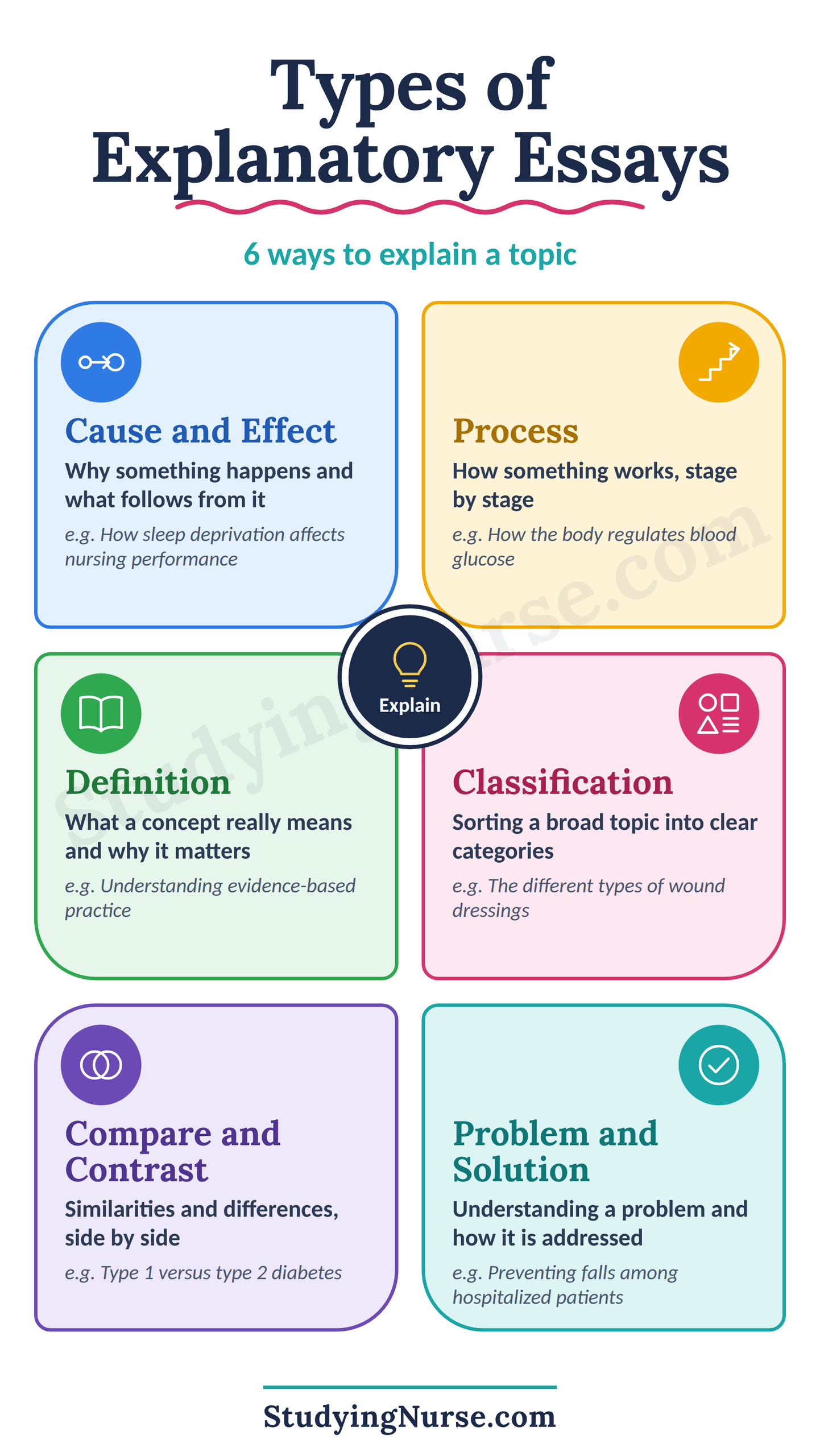
Keeping thesis statements and topic sentences aligned
An explanatory essay can have a well-written thesis and several strong paragraphs but still feel disorganized if those elements do not connect. Every major body paragraph should contribute to the thesis, and every topic sentence should accurately represent the paragraph that follows.
A practical way to check alignment is to review the thesis and topic sentences together before completing the first draft. If the thesis identifies three main areas, the writer should be able to identify where those areas are explained. If a body paragraph introduces an issue that does not contribute to the thesis, the writer should consider whether the information is necessary, whether the thesis needs refinement, or whether the paragraph belongs elsewhere.
For example, an essay explaining how dehydration affects the body might include paragraphs on fluid loss, changes in circulation, and the effects of dehydration on kidney function. A lengthy paragraph about the history of bottled water would not fit the same explanatory direction unless the assignment specifically required that context.
This alignment prevents the essay from becoming a collection of loosely related facts. It also makes the writing more concise because every paragraph has a clear purpose.
Topic sentences do not always need to appear as the first sentence of a paragraph. Depending on the style and complexity of the discussion, a paragraph may begin with brief context before presenting its main point. However, placing the topic sentence near the beginning is often helpful because it allows readers to identify the paragraph’s focus quickly.
The goal is not to follow a rigid formula but to make the relationship between the thesis, topic sentences, and supporting details easy to recognize.
Supporting Explanations with Facts, Examples, and Credible Evidence
A clear thesis and well-structured topic sentences establish the direction of an explanatory essay, but they do not complete the explanation. The writer must provide sufficient supporting details to help readers understand why a statement is accurate, how a process occurs, or what factors contribute to an outcome.
Supporting evidence can include verified facts, statistics, research findings, expert explanations, examples, definitions, historical records, and descriptions of processes. The appropriate evidence depends on the topic and the question being answered. A scientific explanation may rely heavily on peer-reviewed studies and clinical guidelines, while an essay about a historical event may require primary documents and reputable historical scholarship.
The central principle is that evidence should clarify and substantiate the explanation rather than simply make the essay appear more academic. Every statistic, example, or quotation should serve a recognizable purpose.
Understanding the difference between claims, evidence, and explanation
A well-developed body paragraph usually combines three elements:
- Main point or claim: The statement the paragraph intends to explain.
- Supporting evidence: The information that helps establish or illustrate the point.
- Explanation or interpretation: The writer’s discussion of how the evidence relates to the main point and why it matters to the essay.
For instance, consider a paragraph about the relationship between sleep and cognitive performance.
Main point: Insufficient sleep can impair attention and memory.
Supporting evidence: Research on sleep and cognitive performance examines how sleep restriction affects alertness, learning, and memory-related processes.
Explanation: These findings help explain why a person who has not slept adequately may struggle to maintain concentration, retain new information, or complete tasks that require sustained attention.
The evidence provides a basis for the discussion, while the explanation connects that information to the paragraph’s purpose. Without the final element, a writer may list research findings without showing how they answer the essay question.
This distinction is especially important in academic writing. Quoting a source does not automatically make a paragraph effective. Writers need to interpret the information in their own words and demonstrate how it contributes to the overall explanation.
Using facts and research findings
Facts are statements that can be checked against reliable information. Depending on the subject, they may describe established scientific principles, documented events, measurable outcomes, or verified characteristics of a process.
When writing an explanatory essay, factual statements should be accurate and relevant. For example, an essay about blood glucose regulation may explain the roles of insulin and glucagon in maintaining glucose levels. An essay about infection prevention may discuss how hand hygiene helps reduce the transfer of microorganisms. These explanations should be based on appropriate scientific or clinical sources rather than assumptions or unsupported generalizations.
Research findings are particularly useful when the essay discusses relationships that cannot be established through simple observation alone. For example, an essay examining factors associated with medication errors may use a peer-reviewed study to discuss interruptions, workload, communication practices, or system design. The writer should explain what the research actually found and avoid claiming that a study proves more than its design or results support.
When using numerical information, writers should provide enough context for readers to interpret it. A statistic without a clear population, timeframe, measurement, or source can be misleading. If a study examines a particular hospital or group of participants, its results should not automatically be presented as representative of every healthcare setting.
Writers should also distinguish between association and causation. If a study finds that two factors occur together, this does not necessarily establish that one directly causes the other. A careful explanatory essay represents the strength and limits of the evidence accurately.
Selecting credible sources
The quality of an explanation depends partly on the reliability of its sources. A writer should assess whether the source is authoritative, relevant, current enough for the topic, and transparent about how its information was obtained.
Useful sources for academic explanatory writing include:
- Peer-reviewed scholarly articles: These can provide original research, systematic reviews, and detailed analysis of a particular question.
- Government and public health agencies: These are useful for official statistics, health guidance, surveillance information, and established public health recommendations.
- Professional organizations: Relevant clinical, scientific, and academic organizations may publish practice guidance, standards, and educational resources.
- Academic textbooks and reference works: These can provide foundational definitions and explanations of established concepts.
- University writing centers and library guides: These can help writers understand essay structure, research methods, source evaluation, and citation requirements.
- Primary sources: Original records, documents, datasets, or research reports can be valuable when the essay requires direct evidence about an event or finding.
The most suitable source depends on the specific subject. For a nursing-related explanation, a current clinical guideline or peer-reviewed health study is generally more appropriate for clinical claims than an unsourced blog post. For an essay about the history of nursing, historical documents and scholarly historical research may be more relevant.
A credible source should not be accepted uncritically simply because it appears on a professional website. Writers should consider the author’s qualifications, the publication date, the evidence supporting the claims, potential conflicts of interest, and whether other reliable sources corroborate the information.
It is also important to match the source to the claim. A general health education page may explain a basic concept well, but a complex claim about treatment effectiveness may require a systematic review, clinical guideline, or original research study.
Incorporating examples to make explanations clearer
Examples help readers connect abstract information to recognizable situations. They can illustrate a process, clarify a technical concept, demonstrate how a principle works, or show how different factors interact.
For example, an essay explaining the importance of accurate clinical documentation might state that documentation creates a record of patient assessments, interventions, and responses to care. It could then illustrate the point with a hypothetical scenario:
A nurse records a patient’s pain assessment, the intervention provided, and the patient’s response after treatment. This record helps the next clinician understand what has occurred and determine what follow-up may be needed.
The example makes the purpose of documentation easier to understand because it connects a general principle to a practical situation. It should not, however, be treated as scientific proof that documentation always prevents errors. It illustrates the principle; additional evidence may be needed to establish broader claims about patient safety.
Examples can be drawn from everyday life, academic settings, clinical practice, historical events, or carefully constructed hypothetical situations. When a real case is used, the writer should verify the details and cite the source. When a hypothetical case is used, it should be identified as illustrative rather than presented as a documented event.
Examples are most useful when they directly support the paragraph’s main point. Too many examples can distract readers from the explanation, particularly when they repeat the same idea. One well-chosen example, followed by a clear interpretation, may be more effective than several unrelated scenarios.
Explaining processes with evidence and detail
Some explanatory essay topics require the writer to show how something happens. In these cases, supporting details should be arranged in an order that reflects the process being explained.
For example, an essay about how the body responds to dehydration could explain that fluid loss reduces the body’s available water, that physiological mechanisms respond to changes in fluid balance, and that more severe dehydration can compromise circulation and organ function. The precise sequence and terminology should be checked against reliable physiology sources, particularly if the discussion includes clinical mechanisms.
A process explanation should avoid skipping essential stages or assuming that readers already understand technical terms. If a concept is unfamiliar, a brief definition can help. Each stage should connect logically to the next so that readers understand not only what happens but also why the sequence matters.
Evidence is also important when explaining causes and consequences. An essay may identify a factor associated with an outcome, but the writer should support the relationship with appropriate sources and describe the mechanism where the evidence permits. If the relationship is complex or varies according to circumstances, the explanation should acknowledge that complexity instead of presenting an oversimplified rule.
Paraphrasing, quotations, and citations
Evidence should be incorporated into an explanatory essay in a way that preserves the source’s meaning and respects academic integrity. Writers can paraphrase, summarize, or quote source material, depending on the purpose of the passage and the assignment requirements.
Paraphrasing means restating a specific idea in original wording while preserving its meaning. Effective paraphrasing requires more than changing a few words or rearranging a sentence. The writer should understand the original passage, express the idea independently, and cite the source when the idea or information comes from that source.
Summarizing involves condensing the main points of a longer source into a shorter account. It is useful when explaining the overall findings of a study or describing the main argument of a report.
Direct quotations reproduce the exact words of a source. They are appropriate when the original wording is particularly significant, but they should be used selectively. An explanatory essay that relies too heavily on quotations may give insufficient attention to the writer’s own explanation.
Citations identify the source of borrowed ideas, research findings, statistics, and other material that readers may need to verify. The required citation format depends on the assignment. Health sciences assignments may use AMA or APA style, for example, while other courses may require a different system. Writers should follow the instructor’s directions and apply the chosen style consistently.
A paragraph should not consist of a quotation followed by another quotation without interpretation. Instead, introduce the source where appropriate, present the evidence accurately, explain its significance, and connect it to the paragraph’s main point. This method allows the essay to remain an organized explanation rather than a sequence of borrowed statements.
An example of a developed explanatory body paragraph
The following sample demonstrates how a topic sentence, evidence, explanation, and a practical example can work together. It is an illustrative model rather than a substitute for research citations in a submitted academic assignment.
Topic sentence: Interruptions during medication administration can increase the risk of mistakes by disrupting attention and established checking procedures.
Supporting explanation: Medication administration requires the healthcare professional to interpret the order, confirm the patient’s identity, select the correct medication and dose, and complete the required checks. An interruption during these activities can divide attention and make it harder to maintain a consistent sequence of actions.
Example: For instance, if a nurse is interrupted while preparing medication and then resumes the task without confirming which checks have already been completed, there may be a risk of repeating or missing a step.
Connection to the main point: This example illustrates how a disruption in attention can interfere with a structured process. A complete academic paragraph should support broader claims about the frequency or effects of interruptions with credible research and explain how the findings relate to medication safety.
The paragraph is effective because the example illustrates the main point and the final sentence explains its relevance. In a formal explanatory essay, the writer would add suitable citations for any research-based claims and ensure that the evidence accurately represents the available literature.
Maintaining Objectivity and Logical Flow in Explanatory Writing
An effective explanatory essay presents information in a fair, accurate, and organized manner. Its purpose is to help readers understand a topic rather than pressure them to agree with the writer’s personal opinions. Maintaining objectivity and logical flow allows the writer to explain complex information clearly, acknowledge relevant limitations, and connect supporting details to the essay’s central idea.
Objectivity does not mean that a writer must avoid interpretation or present every possible viewpoint as equally credible. Instead, it means that explanations should be guided by evidence, accurate reasoning, and appropriate acknowledgment of uncertainty. Logical flow ensures that the information is arranged in a sequence readers can understand, with each paragraph contributing to the overall explanation. Purdue OWL similarly emphasizes paragraph unity, coherence, adequate development, and transitions as important elements of effective writing.
Maintaining an objective tone
An objective tone relies on factual language, precise descriptions, and evidence-based explanations. Writers should avoid making unsupported judgments, exaggerating findings, or using emotional language to influence how readers interpret a topic.
For example, consider these two statements:
- Subjective: Nurses who fail to follow hand hygiene procedures are careless and do not care about their patients.
- Objective: Failure to follow recommended hand hygiene procedures can increase opportunities for microorganism transmission and compromise infection prevention efforts.
The first statement makes a broad judgment about people’s attitudes and intentions. A failure to follow a procedure may have several contributing factors, including inadequate access to supplies, workflow demands, knowledge gaps, or individual noncompliance. Without evidence, the writer cannot assume that every person who misses a hand hygiene step does not care about patients.
The second statement focuses on the potential consequences of the behavior. It provides a clearer foundation for an explanatory essay because the writer can investigate relevant risk factors and explain how hand hygiene contributes to infection prevention.
An objective tone is especially important when discussing healthcare, education, public policy, and other subjects where readers may have different experiences or beliefs. The writer should explain what the evidence indicates, distinguish established facts from interpretations, and avoid presenting personal opinions as proven conclusions.
Distinguishing facts from opinions and interpretations
Facts, opinions, and interpretations play different roles in writing.
- Facts are statements that can be checked against reliable evidence, such as a documented event, a verified measurement, or an established scientific finding.
- Opinions express personal judgments, preferences, or beliefs.
- Interpretations explain the meaning or significance of information, often by connecting evidence to a broader concept.
An explanatory essay may include interpretation because the writer must explain what evidence means in the context of the topic. However, interpretations should be reasonable and supported by the information presented.
For example, a writer discussing sleep deprivation might report a research finding about reduced attention following restricted sleep. The writer could then explain that reduced attention may make activities requiring sustained concentration more difficult. That interpretation connects the evidence to a practical consequence.
However, the writer should not conclude that every person who sleeps poorly will make a clinical error. Such a statement would overgeneralize the evidence and ignore other factors that affect performance.
Careful wording helps maintain objectivity. Expressions such as may contribute to, is associated with, can increase the risk of, and the findings suggest can be useful when they accurately reflect the strength of the evidence. These phrases should not be used to create unnecessary uncertainty around well-established facts; their purpose is to describe the evidence precisely.
Avoiding exaggeration and unsupported generalizations
An explanatory essay should not make claims that extend beyond the available evidence. Generalizations such as everyone, always, never, and the only reason may be inaccurate when a topic involves several contributing factors or exceptions.
For instance, the statement “All medication errors occur because nurses fail to pay attention” oversimplifies a complex issue. Medication errors may involve communication problems, confusing packaging, prescribing issues, interruptions, inadequate systems, or other circumstances. A credible explanation should distinguish among these possible contributors rather than attributing every incident to a single cause.
A more appropriate statement would be:
Medication errors can arise from individual actions and system-level factors, including communication failures, interruptions, and weaknesses in medication-management procedures.
This sentence provides a broader and more balanced starting point. The essay can then examine each factor using credible research and explain how the factors may interact.
Writers should also avoid confusing correlation with causation. If two events occur together, that does not automatically mean one caused the other. To explain a cause-and-effect relationship, the writer should look for evidence that supports the proposed connection and acknowledge alternative explanations where relevant.
Objectivity also requires representing sources fairly. If credible studies produce different findings, the writer should not ignore the less convenient results simply because they complicate the explanation. Instead, the essay can identify differences in study design, populations, settings, or methods that may help explain the variation.
Purdue OWL’s guidance on research and evidence recommends evaluating sources for reliability, accuracy, author expertise, publication date, purpose, and potential bias. These considerations help writers avoid relying on evidence that does not adequately support their claims.
Maintaining a logical sequence of ideas
Logical flow refers to the way information progresses from one idea to the next. Even accurate information can be difficult to understand when it is presented in a confusing order. A well-organized explanatory essay arranges its ideas according to the relationship between them and the purpose of the discussion.
Several organizational patterns can help writers achieve this:
- Chronological order: Present events or stages in the order in which they occur. This is useful when explaining a historical development or a clinical process that follows a sequence.
- Cause-and-effect order: Explain contributing factors before examining their consequences, or establish an outcome before discussing its causes when that arrangement better suits the prompt.
- General-to-specific order: Introduce a broad concept before discussing particular examples, mechanisms, or applications.
- Problem-to-explanation order: Identify a phenomenon or problem, explain the factors involved, and then discuss how those factors influence the outcome.
- Compare-and-contrast order: Organize information around shared characteristics and differences when explaining how two processes, conditions, or concepts relate.
The best pattern depends on the essay topic and assignment prompt. A writer explaining how a disease develops may use a sequence of physiological changes, while an essay about the differences between two nursing roles may organize the body paragraphs around education, responsibilities, and scope of practice.
Consider an explanatory essay about dehydration. A confusing arrangement might discuss the signs of dehydration, shift to fluid intake, describe kidney function, and then return to the initial symptoms without showing how the ideas connect. A more logical sequence could introduce the concept of fluid imbalance, explain how fluid loss occurs, describe the body’s responses, and then discuss possible effects when the imbalance becomes severe.
This sequence helps readers build understanding progressively. Each section establishes information that prepares them for the next part of the explanation.
The same principle applies within individual paragraphs. A topic sentence introduces the main point, supporting details develop it, and the explanation connects those details to the paragraph’s purpose. If a sentence introduces an unrelated issue, the writer should consider moving it to another paragraph or removing it.
Using transitions to connect sentences and paragraphs
Transitions are words, phrases, or sentences that show how ideas relate to one another. They help readers recognize whether the next point adds information, introduces an example, identifies a cause, describes a consequence, or presents a contrast.
Common transitions include:
| Purpose | Examples of transitions |
|---|---|
| Adding information | Furthermore, in addition, also |
| Showing cause or consequence | Therefore, as a result, consequently |
| Giving an example | For example, for instance, specifically |
| Explaining a sequence | First, next, subsequently, finally |
| Showing contrast | However, in contrast, whereas |
| Clarifying an idea | In other words, more specifically, that is |
| Emphasizing a relationship | Similarly, likewise, in the same way |
Transitions should reflect the actual relationship between ideas. For example, therefore suggests a logical consequence, while however signals a contrast. Using either word when the ideas do not have that relationship can confuse readers.
Consider this example:
Sleep supports several cognitive functions. In addition, inadequate sleep can impair attention and memory. As a result, people experiencing sleep deprivation may find tasks requiring sustained concentration more difficult.
The transitions connect related ideas and make the progression easier to follow.
However, transitions cannot compensate for weak organization. Adding furthermore to the beginning of an unrelated sentence does not make the sentence relevant. Writers should first establish a meaningful relationship between ideas and then use transitions to make that relationship clear.
Transition sentences can also connect entire paragraphs. Suppose one paragraph explains how inadequate sleep affects attention, while the next discusses memory. The second paragraph could begin by referring to the broader effect of sleep on cognitive performance before introducing memory as a related function. This creates continuity without repeating the entire previous paragraph.
Good explanatory writing also varies its transitions rather than beginning every paragraph with firstly, secondly, or moreover. Sometimes the relationship between ideas is clear without a transition word, and a direct topic sentence is more effective.
Keeping paragraphs unified and coherent
Paragraph unity means that every sentence contributes to the paragraph’s main point. Coherence means that the sentences are arranged and connected so that the discussion is understandable.
These qualities work together. A paragraph may contain relevant information but still lack coherence if the writer jumps between ideas without explaining their relationship. Conversely, sentences may be connected smoothly but lack unity if they discuss several unrelated topics.
For example, a paragraph explaining the role of insulin in blood glucose regulation should focus on that process. A brief definition of insulin may be useful, as may an explanation of how insulin helps cells take up glucose. However, a lengthy discussion of diabetes screening policies would probably require a separate paragraph because it addresses a different aspect of the subject.
To improve paragraph unity and coherence, writers should:
- Identify the paragraph’s main point before adding supporting details.
- Ensure that each sentence develops, illustrates, qualifies, or explains that point.
- Arrange the sentences in an order that makes the reasoning easy to follow.
- Use consistent terminology so that readers can identify the subject being discussed.
- Introduce technical terms when necessary and explain unfamiliar concepts.
- Remove repetitive statements and information that does not contribute to the explanation.
- Use transitions where they clarify the relationship between sentences or paragraphs.
Paragraph length should reflect the complexity of the idea rather than a fixed number of sentences. A straightforward point may need only a few well-developed sentences, while a complex mechanism may require a longer discussion. If a paragraph contains several substantial points, dividing it into smaller, focused paragraphs may improve readability.
Balancing objectivity with clarity and accessibility
Objectivity should not make an explanatory essay unnecessarily complicated. Writers sometimes assume that academic writing must contain long sentences, dense terminology, and highly technical language. In reality, a clear and concise explanation is often more effective than a complicated one.
Technical vocabulary is appropriate when it communicates a precise meaning, but unfamiliar terms should be defined when readers may not know them. For example, an essay about hypoxia could briefly explain that hypoxia refers to inadequate oxygen availability at the tissue level before discussing its physiological consequences.
Similarly, a writer should avoid unexplained abbreviations, unnecessarily elaborate sentence structures, and repeated phrases that do not add meaning. A useful test is to ask whether a reader unfamiliar with the topic could understand the explanation without having to guess what key terms mean.
Clarity also requires acknowledging when a process is more complex than a simple explanation suggests. A writer may present the main mechanism first and then explain important exceptions or variations. This approach gives readers a foundation before introducing additional complexity.
When writing for an academic audience, the explanation should provide enough detail to demonstrate understanding without overwhelming readers with information that does not serve the prompt. The writer’s goal is to inform readers accurately and efficiently, not to include every fact discovered during research.
Reviewing objectivity and logical flow in an explanatory essay
After drafting, writers should review the essay for both accuracy and organization. This review is different from proofreading for spelling and punctuation because it examines the quality of the explanation itself.
The following questions can guide the review:
- Does the thesis statement clearly establish what the essay aims to explain?
- Does each topic sentence contribute to the central purpose?
- Are factual claims supported by credible evidence where necessary?
- Have opinions been distinguished from verified facts and evidence-based interpretations?
- Does the essay avoid unsupported generalizations and exaggerated claims?
- Are causes, effects, examples, and stages presented in an understandable order?
- Does each paragraph focus on a clear main point?
- Do transitions accurately express the relationships between ideas?
- Are technical terms explained where necessary?
- Have conflicting findings or important limitations been represented fairly?
- Does every paragraph help readers understand the particular topic?
Reading the essay aloud can also reveal abrupt changes in thought, repeated information, or sentences that are difficult to follow. Another useful method is to write a brief summary of each paragraph in the margin or a separate list. If the summaries do not form a logical progression, the writer may need to rearrange or revise the discussion.
A successful explanatory essay brings together a clear thesis, focused topic sentences, credible supporting evidence, objective language, and a logical sequence of ideas. These elements allow the writer to present information in a way that is accurate, coherent, and accessible. When each paragraph contributes to the central explanation, the finished piece of writing becomes more than a collection of facts: it becomes a structured account that helps readers understand how a particular topic works, why an event occurs, or how different ideas are connected.
The Explanatory Essay Writing Process
Writing an explanatory essay is a structured process that takes a writer from an initial idea to a clear, well-organized, and carefully reviewed piece of writing. Although the finished essay may appear straightforward, producing an effective explanation involves several stages, including researching the topic, planning the main points
, developing supporting details, writing the first draft, and revising the content for accuracy and clarity. Each stage serves a distinct purpose, and completing them in a thoughtful order can make essay writing more efficient and effective.
When learning how to write an explanatory essay, it is helpful to understand that writing is not simply a matter of putting sentences on a page. Research helps establish what information is accurate, planning determines how that information will be organized, drafting turns the plan into a connected discussion, and revision improves the quality of the explanation. These stages may overlap, and writers often return to an earlier stage when they discover missing information or realize that an idea needs a different approach.
For example, a writer preparing an essay about the causes and effects of dehydration may initially plan to discuss fluid loss, physiological responses, and possible complications. During research, the writer may discover that the effects differ according to the severity of dehydration and the person’s circumstances. The outline may then need adjustment before the first draft is complete. This flexibility is a normal part of the writing process rather than evidence of poor planning.
An effective explanatory essay combines accurate information with a logical structure and clear language. The following stages help writers move from a broad subject to a focused explanation that informs readers without unnecessary repetition or unsupported claims.
Researching and Planning Before Writing
Researching and planning provide the foundation for an explanatory essay. Before writing the first paragraph, the writer needs to understand the assignment, identify the information required to explain the topic, locate credible sources, and organize the main points. Skipping these steps can lead to an essay that contains interesting facts but fails to answer the prompt or explain the subject in sufficient depth.
Research does not mean collecting as much information as possible. It means finding the information that directly supports the purpose of the essay. Similarly, planning is not simply creating a list of headings; it involves deciding which ideas readers need to understand first, how those ideas relate to one another, and what evidence will support each main point.
Understanding the assignment and defining the research purpose
The first step is to examine the essay prompt carefully. The prompt establishes the subject, the expected type of explanation, and any specific requirements that determine the direction of the writing.
For example, consider these two explanatory essay prompts:
- Explain the factors that contribute to medication errors in healthcare settings.
- Explain how accurate medication administration procedures help reduce medication errors.
Both prompts address medication safety, but they require different discussions. The first focuses on contributing factors, such as communication problems, interruptions, confusing medication labels, and weaknesses in safety systems. The second focuses on procedures and their role in reducing risk.
A writer who treats these prompts as interchangeable may spend too much time discussing general medication safety without adequately answering the assigned question.
Before beginning research, identify the following:
- The main topic: What subject must the essay explain?
- The purpose: Is the task to explain causes, effects, stages, functions, differences, or relationships?
- The scope: Which aspects of the topic must be included, and which fall outside the assignment?
- The audience: What background knowledge can readers reasonably be expected to have?
- The requirements: What word count, source requirements, citation style, or formatting rules must be followed?
Understanding these elements helps the writer establish a clear research direction. It also prevents unnecessary work because the writer can prioritize information that directly addresses the assignment rather than collecting details that will never appear in the final essay.
Conducting focused and effective research
Once the purpose is clear, the next step is to gather information from credible sources. Research supports the factual foundation of an explanatory essay, especially when the subject involves scientific mechanisms, healthcare practices, historical developments, or other topics where accuracy matters.
Useful research sources include peer-reviewed journal articles, academic books, professional publications, government reports, official guidelines, and reputable educational resources. The most appropriate source depends on the topic. A clinical explanation may require current professional guidance and scholarly research, whereas a historical explanation may depend on original documents and established historical scholarship.
A focused research process can follow these steps:
- Identify key concepts and search terms. Break the topic into smaller concepts that can be investigated separately. For an essay about dehydration, possible search terms include fluid balance, causes of dehydration, physiological responses to fluid loss, and complications of severe dehydration.
- Search reliable databases and reference sources. Use academic databases, library resources, and authoritative websites rather than relying exclusively on general search results or social media posts.
- Review source relevance. Read titles, abstracts, summaries, and relevant sections to determine whether each source addresses the essay’s research purpose.
- Evaluate credibility. Examine the author’s qualifications, publication date, evidence, research methods where applicable, and the source’s purpose.
- Record useful information. Note the main findings, relevant examples, page numbers where needed, and full citation details.
- Compare information across sources. Determine whether credible sources support the same explanation, offer different interpretations, or identify limitations that need to be acknowledged.
- Stop when the explanation is adequately supported. Continue researching when important questions remain unanswered, but avoid collecting material that adds little to the essay’s purpose.
For instance, a writer researching dehydration might use an academic physiology textbook to understand fluid balance, a reputable health agency to review general clinical information, and scholarly literature to investigate a specific physiological mechanism. Each source contributes something different, and the writer should select information based on its relevance rather than the number of sources collected.
Research should also be proportionate to the assignment. A short explanatory essay on a familiar concept may need only a few strong sources, while a longer academic discussion may require a broader review of the literature. The goal is not to cite every available publication but to build an accurate and sufficiently detailed explanation.
Taking research notes and organizing information
Effective note-taking helps transform research into original writing. Instead of copying entire passages into a document, writers should record the main idea, the relevant evidence, and how the information contributes to the essay.
A useful research note might include:
| Research element | Example for an essay on dehydration |
|---|---|
| Main idea | Dehydration occurs when fluid loss exceeds fluid intake or replacement. |
| Supporting detail | Fluid loss can occur through sweating, vomiting, diarrhea, or increased urine output. |
| Relevance to the essay | Explains several mechanisms that can lead to fluid imbalance. |
| Source details | Author or organization, publication title, date, page or section, and citation information. |
| Questions to investigate | How do the body’s responses differ according to the severity of fluid loss? |
This method helps the writer distinguish the source’s information from their own explanation. It also reduces the risk of accidental plagiarism, particularly when several sources discuss similar ideas.
When taking notes, writers should clearly identify direct quotations by using quotation marks and recording the relevant page or location. Paraphrased ideas also need source details because changing the wording does not remove the obligation to acknowledge the original source.
Organizing notes by theme is usually more useful than arranging them in the order in which they were discovered. A writer researching medication errors, for example, could group information under communication failures, medication-selection problems, interruptions, and safety procedures. These categories can later become the main points of the explanatory essay.
This approach makes it easier to compare evidence, identify gaps, and create a logical outline without repeatedly searching through unorganized notes.
Creating a research plan and determining what readers need to know
A research plan identifies the questions the essay must answer. It helps the writer move from a broad topic to a manageable set of explanatory objectives.
Suppose the assigned topic is how dehydration affects the human body. Before drafting, the writer might identify these questions:
- What is dehydration?
- What circumstances can cause fluid loss?
- How does the body respond to changes in fluid balance?
- How can significant fluid loss affect circulation and organ function?
- Which factors influence the severity of its effects?
The questions create a roadmap for research. They also help the writer identify missing information. If the research explains the causes of dehydration but says little about the body’s physiological responses, further investigation is needed before the discussion can be considered complete.
Not every research question needs a separate paragraph. Several related questions may be answered together, depending on the scope and format of the assignment. The purpose is to ensure that the essential parts of the explanation are covered in a logical order.
The writer should also consider the audience’s prior knowledge. An essay for general readers may need to define technical terms and explain basic physiology, whereas a more specialized academic essay may be able to use established terminology with less introductory detail. Even in advanced academic writing, however, complex mechanisms should be explained rather than merely named.
Planning the essay with an outline
After research, the writer can create an explanatory essay outline. The outline organizes the thesis, main points, and supporting evidence before the full draft is written.
A common format for a short explanatory essay includes an introduction, several body paragraphs, and a conclusion. A five-paragraph essay is one familiar model, usually consisting of an introduction, three body paragraphs, and a conclusion. However, this format is not mandatory for every assignment. Longer or more complex topics may require additional paragraphs to explain the evidence adequately.
For example, an outline for an essay about dehydration might look like this:
Working title: How Dehydration Affects the Human Body
– Introduction
- Define dehydration and establish the topic’s importance.
- Provide brief background information.
- Present a thesis identifying the main aspects of the explanation.
– Body paragraph 1: Causes of dehydration
- Explain how fluid loss or inadequate replacement can lead to dehydration.
- Discuss relevant examples, such as vomiting, diarrhea, sweating, or insufficient fluid intake.
- Support important claims with credible health information.
– Body paragraph 2: Physiological responses
- Explain how the body responds to changes in fluid balance.
- Describe relevant regulatory mechanisms using accurate scientific terminology.
- Connect the mechanisms to the essay’s main explanation.
– Body paragraph 3: Effects of dehydration
- Explain possible effects on circulation, physical function, and organ performance.
- Distinguish mild effects from those associated with more severe fluid loss.
- Support the discussion with reliable evidence.
– Conclusion
- Summarize the main relationships explained in the essay.
- Reinforce the central explanation without introducing a new major topic.
The outline establishes the sequence of the discussion and indicates which evidence is needed for each point. It also makes it easier to identify repetition before drafting begins. If the same supporting detail appears under two headings without a clear reason, the writer can decide where it fits best.
A useful outline should be detailed enough to guide writing but flexible enough to accommodate new findings. It is a planning tool, not a rigid contract. If further research reveals that two points belong together or that an important explanation is missing, the writer can revise the outline.
Planning the use of evidence
Research and outlining should work together. Every major point that depends on factual information should have appropriate supporting evidence identified before or during drafting.
For example, if a body paragraph explains how a physiological mechanism regulates fluid balance, the writer should identify a suitable source for that mechanism. If another paragraph discusses the prevalence of a condition, the writer should look for an authoritative statistic that specifies the relevant population and period.
A simple planning table can help:
| Main point | Evidence needed | Purpose |
|---|---|---|
| Dehydration can result from excessive fluid loss. | Reliable clinical or physiological information about fluid loss. | Establish the causes. |
| The body responds to changes in fluid balance. | A textbook or scholarly source explaining regulatory mechanisms. | Explain how the body responds. |
| Severe dehydration can affect organ function. | Credible clinical evidence about complications and severity. | Explain the consequences. |
This process reduces the temptation to make unsupported statements simply because they sound plausible. It also helps the writer determine whether enough information is available to explain the topic adequately.
Research and planning are complete enough to begin drafting when the writer understands the prompt, has a workable thesis, can identify the main points, and has located appropriate evidence for the key claims. Further research may still be necessary, but the writer now has a clear direction for the essay.
Writing the First Draft and Connecting Ideas with Transitions
The first draft is where research and planning become a complete piece of writing. The writer develops the outline into paragraphs, introduces the thesis, explains each main point, incorporates supporting evidence, and connects the discussion from beginning to end.
The first draft should prioritize the completeness and clarity of the explanation rather than perfection in every sentence. Writers who attempt to polish every phrase while drafting may lose their train of thought or spend too much time on minor wording decisions before the main argument of the explanation has been developed.
When learning how to write an explanatory essay, it is helpful to treat the first draft as a working version. Its purpose is to establish the full explanation so that the writer can later identify gaps, reorganize ideas, and improve the language.
Turning the outline into an introduction
The introduction establishes the subject and prepares readers to understand the explanation. It commonly includes background information, a clear introduction to the specific topic, and a thesis statement that identifies the essay’s central focus.
The introduction should provide enough context for readers to understand why the topic matters without attempting to explain every detail before the body begins.
For example, an essay about dehydration might begin by explaining that the body depends on an appropriate balance of water and electrolytes to support normal physiological functions. It could then introduce dehydration as a condition that develops when fluid losses exceed replacement and conclude the introductory paragraph with a thesis outlining the causes, physiological responses, and possible consequences of fluid loss.
This structure gives readers a clear understanding of what the essay will cover. It also creates a natural transition into the first body paragraph, which may begin by examining the causes of dehydration.
A writer should avoid opening with an overly broad statement that could apply to almost any subject, such as “Health is very important in everyone’s life.” Such statements consume space without providing meaningful background information. A more focused introduction gives readers information directly relevant to the topic.
The thesis should also match the actual scope of the draft. If the outline changes during writing, the writer may need to adjust the thesis later so that it accurately represents the completed discussion.
Developing the body paragraphs
The body is where the explanatory essay provides its main information. Each paragraph should develop a specific point that contributes to the thesis, using a clear topic sentence, supporting details, relevant evidence, and an explanation of how the information fits the subject.
A practical paragraph structure includes the following elements:
- Topic sentence: Introduce the paragraph’s main point.
- Explanation: Describe the concept, process, cause, effect, or relationship in greater detail.
- Supporting evidence: Incorporate relevant facts, research findings, examples, or other credible information.
- Interpretation: Explain how the evidence supports the paragraph’s main point.
- Connection: Link the point to the thesis or prepare readers for the next part of the discussion when appropriate.
Not every paragraph must follow this sequence mechanically. Some explanations require a definition before the main point, while others benefit from an example before the evidence is discussed. The essential requirement is that the paragraph should develop one coherent idea.
For example, consider a paragraph explaining how inadequate fluid intake may contribute to dehydration:
Inadequate fluid intake can contribute to dehydration when the amount of water consumed is insufficient to replace the body’s ongoing fluid losses. Water is continually lost through processes such as urination, sweating, and breathing, while additional losses may occur during vomiting or diarrhea. When fluid replacement does not keep pace with these losses, the body’s fluid balance can become disrupted. The extent of the resulting effects depends on the amount and duration of fluid loss, as well as individual circumstances.
This sample begins with a topic sentence, explains the mechanism, provides examples, and clarifies the relationship between fluid replacement and fluid balance. In a formal academic essay, claims that require specialized evidence should be supported with appropriate citations.
The writer should also avoid treating every fact as a separate point. Several closely related details can be integrated into one paragraph when they support the same explanation. This makes the essay read as a connected discussion rather than a list of facts.
Integrating evidence without interrupting the explanation
Evidence should be incorporated naturally into the writer’s own discussion. The writer may introduce a research finding, paraphrase an expert explanation, or use a relevant example. The evidence should then be interpreted so that readers understand its significance.
For example, a paragraph about the effects of insufficient sleep could introduce a finding from a peer-reviewed study on attention or memory. The writer would explain what the study investigated, accurately describe the relevant result, and connect that result to the essay’s explanation of cognitive performance.
The paragraph should not simply insert a quotation and move to a different topic. The writer needs to explain why the source is relevant and how it contributes to the main point.
The first draft should also preserve citation details as research is incorporated. Waiting until the end to reconstruct citations can make it difficult to identify the original source of a paraphrased statement or statistic. Recording sources as the draft develops supports academic integrity and makes the later citation review more manageable.
Connecting ideas with transitions
Transitions help create continuity between sentences and paragraphs. They signal relationships such as addition, contrast, sequence, clarification, cause, and consequence. Appropriate transitions make an explanatory essay easier to follow because readers can recognize how one point relates to the next.
For example, an essay explaining a physiological process may use first or initially to introduce an early stage, next to describe a subsequent change, and as a result to explain a consequence. An essay comparing two concepts may use similarly and in contrast to identify relationships between them.
The following examples illustrate how transitions can improve the flow of a discussion:
- Addition: “Fluid loss can occur during everyday activities. In addition, vomiting and diarrhea can increase the amount of fluid the body loses.”
- Cause and consequence: “When fluid losses exceed replacement, fluid balance may be disrupted. As a result, the body may activate mechanisms that help conserve water.”
- Clarification: “The process involves several physiological responses. In other words, the body adjusts its functions to help maintain fluid balance.”
- Contrast: “Mild dehydration may produce limited symptoms. However, more severe fluid loss can have more serious physiological consequences.”
- Sequence: “The process begins with fluid loss. Subsequently, regulatory mechanisms respond to changes in the body’s fluid status.”
Transitions should be selected according to meaning rather than added automatically to every sentence. If the connection between two sentences is already clear, a transition may be unnecessary. Excessive use of words such as moreover, furthermore, and therefore can make the prose sound mechanical.
Writers should also distinguish transitions between sentences from transitions between paragraphs. A paragraph-level transition may briefly connect the previous point to the next one. For example, after explaining the causes of dehydration, the following paragraph might begin by explaining how the body responds when fluid balance changes. This creates a natural progression from causes to physiological responses.
Maintaining momentum while drafting
A common difficulty in essay writing is becoming stuck on individual sentences. Writers may repeatedly revise the introduction, search for the perfect word, or reorganize the same paragraph without completing the draft.
One way to address this problem is to draft according to the outline, leaving difficult passages for later review. If a source or detail is missing, the writer can make a clear note to verify it rather than inventing information or abandoning the entire draft.
For example, a writer might mark a sentence with a reminder such as “Find a current source explaining this mechanism” and continue developing the next section. The claim should then be verified before the essay is finalized.
Other useful drafting practices include:
- Work through the main points in the planned order, unless a better sequence becomes apparent.
- Write a complete explanation of each point before focusing on stylistic refinement.
- Use temporary headings or notes to maintain organization while drafting.
- Include examples where they clarify a concept, but avoid adding examples that do not advance the explanation.
- Mark repeated ideas for later review instead of stopping to perfect every paragraph.
- Revisit the thesis if the developing essay reveals that the original focus was too broad or inaccurate.
The first draft does not need to be flawless. It needs to contain a sufficiently complete explanation that can be reviewed and improved. Once the draft exists in full, the writer can evaluate the relationships between sections more effectively than when working with isolated paragraphs.
Revising Content, Organization, and Clarity
Revision is the stage in which the writer examines the draft’s substance and structure to determine whether it explains the topic effectively. It is different from proofreading, which focuses mainly on surface-level issues such as spelling, punctuation, grammar, and formatting. Revision asks whether the essay answers the prompt, develops its main points adequately, uses evidence appropriately, and presents ideas in a logical order.
A draft may contain accurate information and grammatically correct sentences yet still require substantial revision. For example, an essay might devote several paragraphs to defining dehydration but provide only a brief explanation of its physiological effects, even though those effects are central to the thesis. The writer would need to improve the balance and development of the content rather than merely correct individual sentences.
Revision is therefore a process of evaluating the effectiveness of the explanation and making changes that improve its meaning, structure, and readability.
Reviewing content and completeness
The first revision task is to determine whether the essay answers the assignment prompt. Writers should compare the completed draft with the original requirements and assess whether the central questions have been addressed.
Useful questions include:
- Does the essay explain the specific topic identified in the prompt?
- Does the thesis accurately represent the discussion?
- Are all the major points necessary to understand the topic included?
- Are important claims explained sufficiently, or are they merely mentioned?
- Is there credible evidence for factual claims that require support?
- Are examples relevant and clearly connected to the explanation?
- Are there unsupported statements, inaccurate details, or claims that extend beyond the evidence?
- Does any section contain information that is interesting but unnecessary?
Consider an explanatory essay about medication errors. If the thesis identifies communication failures, medication-selection problems, and interruptions, the writer should check whether each factor receives enough explanation. A paragraph that simply names interruptions without describing how they can disrupt medication-administration procedures is underdeveloped.
Revision might involve adding a clearer mechanism, incorporating a relevant research finding, or providing an illustrative example. It may also involve removing an unrelated paragraph about general hospital management if that material does not contribute to the essay’s stated purpose.
The writer should not add detail merely to make the essay longer. Additional information is useful only when it improves the reader’s understanding or supports an essential point.
Improving organization and paragraph structure
After evaluating the content, the writer should examine the order of the ideas. An explanatory essay should progress in a way that allows readers to understand the subject without unnecessary backtracking.
A useful technique is to summarize the purpose of each paragraph in a short sentence. For example, a draft about dehydration might have paragraph summaries such as:
- Defines dehydration and establishes the essay’s focus.
- Explains common causes of fluid loss.
- Describes the body’s responses to changes in fluid balance.
- Explains possible physiological consequences.
- Summarizes the relationships discussed.
If the paragraph summaries form a logical sequence, the overall organization is probably sound. If the discussion jumps from consequences back to causes and then repeats the physiological mechanism, the writer may need to rearrange the paragraphs.
Organization can be improved by:
- Moving paragraphs into a more logical sequence.
- Combining paragraphs that repeat the same main point.
- Separating paragraphs that contain multiple unrelated ideas.
- Moving background information to the point where readers need it.
- Expanding a major point that receives insufficient attention.
- Removing details that interrupt the explanation without adding value.
- Ensuring that the introduction prepares readers for the actual discussion and that the conclusion reflects what the essay has explained.
Paragraph order should follow the logic of the subject rather than an arbitrary rule. A process explanation may require chronological order, while a cause-and-effect essay may begin with a phenomenon and then examine its contributing factors. The best arrangement is the one that makes the relationship between the ideas easiest to understand.
Strengthening explanations and supporting evidence
During revision, writers should identify places where the essay assumes that readers understand a relationship without explaining it.
For instance, a sentence such as “Dehydration affects circulation” identifies a relationship but does not explain it. A stronger discussion would describe, with appropriate physiological support, how significant fluid loss can reduce circulating volume and how this may affect blood pressure and tissue perfusion, depending on severity and the individual’s condition.
The aim is to explain the mechanism or reasoning behind an important statement. A reader should be able to understand not only what happens but also how or why it happens, to the extent required by the assignment.
Revision should also examine whether the evidence is relevant and accurately represented. Writers should check that statistics are used in the correct context, that research findings are not exaggerated, and that examples genuinely illustrate the point being discussed.
If two credible sources appear to disagree, the writer may need to investigate their methods, populations, publication dates, or definitions before deciding how to represent the findings. Simply removing evidence that complicates the explanation can lead to a misleading account.
Where the draft contains unsupported claims, the writer has several options: locate appropriate evidence, qualify the statement to reflect what is known, or remove the claim if it cannot be justified. Inventing a citation or presenting an assumption as an established fact is never an acceptable solution.
Improving clarity and conciseness
Clarity refers to how easily readers can understand the writer’s meaning. Conciseness means expressing that meaning without unnecessary words or repetition. Both qualities are important in an explanatory essay because the goal is to inform readers efficiently without sacrificing necessary detail.
Writers can improve clarity by replacing vague expressions with specific descriptions, defining unfamiliar terminology, shortening unnecessarily complicated sentences, and removing phrases that repeat an earlier point.
For example:
Wordy: “It is important to note that the reason why inadequate fluid intake can contribute to dehydration is because the body continues to lose water through various normal and abnormal processes.”
Clearer: “Inadequate fluid intake can cause dehydration when it fails to replace water lost through normal bodily processes or illness.”
The revised sentence expresses the relationship more directly while retaining the essential meaning.
Conciseness does not mean reducing every paragraph to its shortest possible form. A complex concept may require several sentences, a definition, and an example to be explained accurately. Removing essential details simply to shorten the essay can make the explanation incomplete.
The writer should instead look for unnecessary repetition. If three consecutive sentences state that sleep deprivation reduces concentration without adding new evidence or explanation, the passage can be revised so that each sentence serves a distinct purpose.
Technical language should also be reviewed. Specialized terms are appropriate when they improve precision, but a term that readers may not recognize should be defined or explained. Similarly, abbreviations should be introduced clearly and used consistently.
Checking coherence and transitions during revision
A draft may contain well-developed paragraphs but still feel disjointed if the connections between them are weak. During revision, writers should examine whether each paragraph follows naturally from the previous one and whether transitions accurately reflect the relationship between ideas.
For example, an essay might explain the causes of dehydration and then move directly to a discussion of severe complications. Readers may understand both sections individually but benefit from a paragraph explaining the body’s physiological responses between them. Adding that connection makes the explanation more complete.
Transitions should also be checked for accuracy. The word therefore implies that the preceding information supports a consequence, while in contrast indicates a difference. If the relationship is not present, the transition should be changed or removed.
Writers can also improve coherence by maintaining consistent terms for the same concept. Switching repeatedly between several labels without explaining whether they mean the same thing may confuse readers. Consistency is particularly important in scientific and healthcare writing, where related terms may have different technical meanings.
Reading the essay aloud can reveal awkward transitions, abrupt changes in subject, and sentences that are difficult to process. Another method is to read only the first sentence of each paragraph. If those sentences do not form a coherent outline of the explanation, the paragraph order or topic sentences may need revision.
Revising the introduction and conclusion
The introduction and conclusion should be reviewed after the main body has been developed. This is because the first draft may evolve as the writer researches, organizes, and explains the subject.
The introduction should establish the topic, provide relevant background information, and present a thesis that accurately reflects the finished essay. If the body now covers a different focus from the original plan, the thesis should be revised accordingly.
The conclusion should synthesize the explanation rather than introduce an entirely new major point. It should bring together the main ideas and reinforce what readers should understand about the topic. Repeating the thesis word for word or listing every paragraph in the same language may make the ending feel mechanical.
For example, a conclusion to an essay about dehydration might bring together the relationship between fluid loss, physiological responses, and possible consequences. It should not suddenly introduce an unrelated discussion of hospital budgeting unless that subject has been developed in the body and is relevant to the prompt.
The introduction and conclusion should complement each other. The introduction establishes the explanatory direction, and the conclusion brings the discussion to a coherent close.
Using feedback and conducting a final revision review
Feedback from an instructor, peer, editor, or writing tutor can help reveal problems that the writer may overlook. Because writers are familiar with their own ideas, they sometimes assume that a connection is obvious when it has not been explained clearly enough for another reader.
When reviewing feedback, focus first on recurring or substantive concerns. If a reader repeatedly asks how one point relates to another, the essay may need stronger transitions or a more complete explanation. If the feedback indicates that the essay does not answer the prompt, the writer should address that problem before spending time on minor wording changes.
A useful revision review includes the following checks:
- Purpose: The essay answers the prompt and maintains a clear explanatory focus.
- Thesis: The central statement accurately reflects the discussion.
- Content: Each major point is adequately explained.
- Evidence: Sources are credible, claims are accurate, and supporting information is relevant.
- Organization: Paragraphs appear in a logical sequence and develop distinct points.
- Coherence: Sentences and paragraphs connect naturally.
- Clarity: Technical terms, complex ideas, and causal relationships are explained appropriately.
- Conciseness: Repetition and unnecessary wording have been removed without sacrificing important details.
- Objectivity: Personal judgments and unsupported generalizations have not replaced evidence-based explanation.
- Consistency: Terminology and the essay’s overall focus remain consistent.
Revision may require several rounds. A writer might first improve the content and organization, then refine clarity and transitions, and finally review grammar, citations, and formatting. Separating these tasks helps prevent minor corrections from distracting from larger problems in the explanation.
The distinction between revision and proofreading is worth maintaining: revision improves what the essay says and how it is organized, while proofreading checks the correctness and presentation of the finished text. Both are necessary, but they serve different purposes.
The explanatory essay writing process becomes more manageable when research, planning, drafting, and revision are treated as connected stages. Research establishes the factual foundation, planning gives the information a logical structure, drafting develops the explanation, and revision ensures that the finished essay is focused, coherent, and clear. By following these stages carefully, writers can produce a piece of writing that informs readers, supports its main points with credible evidence, and explains the chosen topic in a meaningful and organized way.
Finalizing an Explanatory Essay
Finalizing an explanatory essay involves preparing the draft for submission or publication by strengthening the conclusion, checking grammar and formatting, verifying citations, and ensuring that all borrowed information is properly acknowledged. Although research, planning, drafting, and revision establish the foundation of a good essay, the final review determines whether the finished piece of writing communicates its ideas accurately, clearly, and professionally.
When learning how to write an explanatory essay, it is important to recognize that completing the first draft does not mean the writing process is finished. An essay may contain a strong thesis statement and well-developed body paragraphs but still have weaknesses such as an incomplete conclusion, inconsistent formatting, incorrect citations, grammatical errors, or unintentional plagiarism. These problems can distract readers and reduce the effectiveness of the explanation.
Finalization is therefore more than correcting spelling mistakes. It requires checking whether the essay fulfills its purpose, whether the main points are brought together effectively, and whether the presentation meets the assignment requirements. For example, an academic essay explaining how medication errors occur should not only explain contributing factors but also end with a clear synthesis of those factors, use accurate terminology, and cite research appropriately.
A systematic final review helps writers identify errors that may have been overlooked during drafting and revision. It also helps ensure that the essay follows the required explanatory essay format, maintains an objective tone, and provides readers with a reliable account of the topic.
Summarizing Main Ideas and Writing an Effective Conclusion
The conclusion is the final section of an explanatory essay. Its purpose is to bring the discussion to a coherent close by synthesizing the main ideas and reinforcing the central explanation. A strong conclusion helps readers understand how the information presented in the body paragraphs fits together and what they should take away from the discussion.
Unlike the introduction, which prepares readers for the topic, the conclusion reflects on the explanation that has been developed. It should demonstrate that the essay has fulfilled its purpose without simply repeating every paragraph or introducing an unrelated subject.
For example, an essay explaining the causes and effects of dehydration might discuss fluid loss, the body’s regulatory responses, and the consequences of severe fluid imbalance. An effective conclusion would connect these ideas to show how fluid loss can disrupt normal physiological functions. It would not need to repeat every symptom or explain an entirely new condition.
The conclusion should be consistent with the thesis statement and the evidence presented throughout the essay. If the introduction promises an explanation of three major factors, the ending should bring those factors together rather than introduce a fourth major topic that has not been discussed.
Summarizing the main ideas without repeating the entire essay
Summarizing involves identifying the most important ideas and expressing them concisely. In an explanatory essay, the conclusion should focus on the central relationships, mechanisms, causes, effects, or concepts that the body paragraphs have explained.
A summary is not a sentence-by-sentence repetition of the essay. Instead, it highlights the information readers need to retain and demonstrates how the main points contribute to the overall explanation.
Consider an essay about factors that contribute to medication errors. The body may explain communication failures, interruptions during medication administration, and problems with medication selection. A weak conclusion might list these factors again without showing their relationship.
A more effective conclusion could explain that medication errors may arise from several interacting factors, including communication problems, disruptions in attention, and weaknesses in medication-selection procedures. Recognizing these contributing factors helps explain why medication safety depends on both careful individual practice and reliable systems.
The second approach synthesizes the discussion. It brings the separate points together under a broader explanatory idea rather than simply repeating the outline.
To summarize main ideas effectively:
- Identify the central message established by the thesis statement.
- Select the major points that are essential to understanding the topic.
- Explain how those points relate to one another.
- Remove minor details, examples, and statistics that do not need to be repeated.
- Use fresh wording where possible rather than copying sentences directly from the introduction or body.
- Ensure that the summary accurately reflects the evidence and scope of the essay.
The conclusion should be proportionate to the length and complexity of the essay. A short explanatory essay may require only a few sentences, while a longer academic discussion may need a more developed synthesis. The goal is to provide sufficient closure without making the conclusion longer than necessary.
Restating the thesis in a meaningful way
An effective conclusion often revisits the thesis statement, but it should do so in a way that reflects the explanation developed in the body paragraphs.
Restating the thesis allows the writer to reinforce the essay’s central purpose and show that the discussion has answered the original prompt. However, copying the thesis word for word can make the conclusion feel repetitive, particularly when the introduction and ending are close together.
For example, consider this thesis:
Sleep deprivation can affect physical health, cognitive performance, and emotional regulation by disrupting normal physiological and psychological processes.
A conclusion might restate the idea as follows:
The effects of inadequate sleep extend beyond feeling tired. Changes in normal sleep patterns can influence attention, emotional responses, and aspects of physical functioning, demonstrating the broad role sleep plays in maintaining health and daily performance.
This conclusion returns to the central explanation but expresses it in a way that reflects the discussion. It also brings the three areas together without introducing an unrelated claim.
A restated thesis should not exaggerate what the essay has established. If the body discusses an association between sleep and cognitive performance, the conclusion should not claim that sleep deprivation is the sole cause of every concentration problem. The closing statement must remain consistent with the strength and limits of the evidence.
Writing a concluding statement that provides closure
A concluding statement brings the explanatory essay to a natural ending. It may emphasize the significance of the topic, highlight a broader implication supported by the discussion, or clarify the relationship readers should understand.
The closing sentence should emerge naturally from the essay rather than introduce a new argument, a new research question requiring extensive explanation, or an unsupported prediction.
For example, an essay about hand hygiene could conclude that consistent hand hygiene practices help interrupt microorganism transmission and form an important part of infection prevention. This statement reinforces the essay’s central explanation and provides a clear ending.
A less effective ending would suddenly introduce a lengthy discussion of hospital staffing, healthcare funding, or a separate infection-control intervention that the body paragraphs have not examined. Such information may be relevant to another essay, but it can weaken the closure of the current one.
An effective concluding statement should be:
- Relevant: It directly relates to the essay’s main purpose.
- Clear: It communicates the final idea without vague language.
- Supported: It does not go beyond what the discussion establishes.
- Concise: It provides closure without unnecessary repetition.
- Connected: It follows naturally from the preceding summary.
Writers should also avoid ending with phrases that announce the conclusion without adding meaning, such as “That is why this topic is very important.” A more informative sentence explains what the topic demonstrates and why that understanding matters.
Avoiding common conclusion mistakes
Several mistakes can weaken the final paragraph of an explanatory essay.
Repeating the introduction word for word: The conclusion should reflect the completed explanation rather than duplicate the opening paragraph. Restating the central idea in fresh language helps provide a sense of development.
Introducing new major information: New evidence or an additional explanatory point generally belongs in the body, where it can be properly developed. If a new point is essential, the writer may need to revise the body before finalizing the conclusion.
Adding personal opinions to an objective explanation: An explanatory essay aims to inform readers. The conclusion should not suddenly become a persuasive or emotional appeal unless the assignment specifically combines explanatory writing with another purpose.
Using vague closing statements: Statements such as “There are many things to learn about this subject” do not summarize the explanation or establish a clear final message.
Overgeneralizing the findings: The conclusion should not make absolute claims that the essay’s evidence cannot support. Complex subjects often involve exceptions, variations, and limitations.
Making the conclusion unnecessarily long: Repeating every example and supporting detail can make the ending feel like another body paragraph. Focus on the central message instead.
Example of an effective explanatory essay conclusion
Suppose an essay explains how accurate clinical documentation supports continuity of care. The body paragraphs discuss recording assessments, documenting interventions, and communicating changes in a patient’s condition.
A suitable conclusion could read:
Accurate clinical documentation provides an organized record of a patient’s condition, the care delivered, and the response to interventions. By recording relevant information clearly and consistently, healthcare professionals can better understand previous actions, recognize changes, and coordinate subsequent care. Documentation therefore serves as an important communication tool that supports continuity and informed clinical decision-making.
This conclusion summarizes the main ideas, explains their relationship, and ends with a broader point directly supported by the discussion. It does not introduce a new topic or rely on unsupported personal judgment.
When finalizing an explanatory essay, the writer should ensure that the conclusion leaves readers with a clear understanding of the subject. It should answer the implicit question, What does the information presented in this essay help readers understand? A well-developed answer provides closure while reinforcing the purpose of the entire piece of writing.
Proofreading Grammar, Formatting, and Citations
Proofreading is the final language-level review of an explanatory essay. It involves checking grammar, spelling, punctuation, sentence structure, word choice, formatting, and citations to ensure that the finished piece of writing meets academic standards. While revision improves the content and organization of an essay, proofreading focuses on correcting errors that may interfere with readability, accuracy, and presentation.
A well-researched essay can lose clarity if it contains incomplete sentences, inconsistent terminology, misplaced punctuation, or incorrectly formatted references. For example, an essay explaining a clinical process may use accurate scientific information but become difficult to follow if the writer switches between tenses unnecessarily or uses abbreviations without defining them.
Proofreading is especially important in academic writing because small language errors can change the meaning of a sentence. In healthcare-related writing, confusing terms or poorly structured sentences may also misrepresent a process or clinical concept. A careful final review helps ensure that the explanation remains accurate, professional, and easy to understand.
Checking grammar, spelling, and punctuation
The first proofreading task is to examine the essay for grammatical and mechanical errors. These include subject-verb agreement, verb tense, pronoun use, sentence fragments, run-on sentences, spelling mistakes, and incorrect punctuation.
For example:
- Incorrect: “The physiological effects of dehydration varies according to its severity.”
- Correct: “The physiological effects of dehydration vary according to its severity.”
The subject, effects, is plural, so the verb must also be plural.
Another example involves sentence structure:
- Incorrect: “The patient lost fluid rapidly, the body could not maintain normal fluid balance.”
- Correct: “The patient lost fluid rapidly, and the body could not maintain normal fluid balance.”
The original sentence joins two independent clauses with only a comma. Adding an appropriate conjunction corrects the problem.
Writers should also watch for sentence fragments, which are incomplete sentences presented as though they were complete thoughts. For example, “Because inadequate fluid replacement can disrupt normal physiological functions.” is incomplete because the dependent clause does not communicate a complete thought on its own.
A corrected version might read: “Inadequate fluid replacement can disrupt normal physiological functions because the body continues to lose water through several processes.”
Punctuation also affects meaning. Commas help separate introductory phrases, identify items in lists, and clarify sentence structure. Apostrophes distinguish possession from plural forms, while periods and semicolons help separate complete ideas appropriately.
During proofreading, it is useful to review one type of error at a time. A writer might first check verb agreement, then sentence boundaries, and then punctuation. This focused approach can make it easier to identify recurring problems than attempting to detect every possible error simultaneously.
Improving sentence structure and word choice
Clear sentence structure helps readers understand the relationships between ideas. Explanatory writing often includes technical information, definitions, and descriptions of processes, so sentences should be direct enough to communicate these relationships without oversimplifying the subject.
For example:
Less clear: “The condition, which is characterized by a reduction in the amount of fluid in the body, can, in cases where fluid loss is substantial, lead to changes in physiological functioning.”
Clearer: “Severe fluid loss can cause dehydration and disrupt normal physiological functioning.”
The revised sentence is shorter and more direct. However, if the essay needs to distinguish dehydration from other changes in fluid balance, the writer should retain the necessary clinical precision rather than shortening the sentence at the expense of accuracy.
Writers should look for:
- Unnecessarily long sentences containing several unrelated ideas.
- Repeated words or phrases that add no new information.
- Vague expressions that obscure the main point.
- Informal language that does not suit the academic setting.
- Inconsistent use of technical terms and abbreviations.
- Excessive use of passive constructions when the subject or action would be clearer in active voice.
- Unnecessary filler phrases, such as “it is important to note that” when the sentence can state the point directly.
Passive voice is not inherently incorrect. It may be appropriate when the process or result matters more than the person performing the action. For example, “The specimen was examined under a microscope” may be suitable when describing a laboratory procedure. The objective is to choose sentence structures that communicate the intended meaning clearly.
Writers should also avoid using complicated vocabulary merely to make an essay sound academic. The best word is the one that expresses the intended meaning accurately. A clear explanation is more effective than a sentence filled with unnecessary jargon.
Checking consistency and academic tone
Consistency helps an explanatory essay appear organized and professional. Writers should use terminology, abbreviations, capitalization, and verb tense consistently throughout the discussion.
For example, if an essay introduces blood pressure (BP) as an abbreviation, it should use that abbreviation consistently where appropriate and avoid switching between several unexplained alternatives. If a term has a specific technical meaning, the writer should ensure that it is used correctly each time it appears.
Verb tense should reflect the nature of the discussion. Present tense is commonly used to explain established facts and general processes, such as “Insulin helps regulate blood glucose levels.” Past tense is appropriate when describing a completed experiment or a specific historical event, such as “The researchers collected data over six months.” A discussion of research findings may use either tense depending on the citation style and sentence structure.
Academic tone should remain objective and precise. Expressions that rely on exaggeration, casual language, or unsupported judgments should be revised. For example, “This absolutely proves that the treatment works for everyone” is inappropriate if the cited study examined only a specific group of participants.
A more careful statement would be: “The findings suggest that the treatment may be beneficial for the population examined, although additional evidence may be needed to establish its effectiveness in other groups.”
This wording represents the evidence more accurately and avoids making a broader claim than the research supports.
Checking explanatory essay format and presentation
Formatting determines how the essay appears on the page and how easily readers can navigate it. The required explanatory essay format may vary by institution, instructor, or publication, so writers should follow the assignment instructions rather than assume that every essay must use the same layout.
Common formatting requirements include:
- A clear and appropriate essay title.
- An introduction, organized body paragraphs, and a conclusion.
- Consistent font, font size, margins, and line spacing, according to the required style.
- Appropriate paragraph indentation or spacing.
- Page numbers where required.
- Correct heading levels when headings are permitted.
- A properly formatted reference list or bibliography.
- Consistent citation style throughout the essay.
Some assignments require a conventional essay without headings, while others allow headings to organize longer discussions. The writer should not add headings merely for appearance if the instructor has requested continuous prose.
The same principle applies to paragraph length. Paragraphs should be long enough to develop their main points but not so long that readers struggle to identify the central idea. A five-paragraph essay may be appropriate for a short assignment, but a longer explanatory essay may require more body paragraphs to explain complex material adequately.
Writers should also check the title and introductory paragraph for alignment. The title should accurately represent the subject, and the essay should deliver the explanation promised by the introduction. If the assignment requires a particular word count, the writer should verify that the final draft meets the requirement.
Verifying citations and reference formatting
Citations allow readers to identify the sources supporting information in an explanatory essay. They are essential when using research findings, statistics, quotations, paraphrased ideas, and other material obtained from external sources.
Proofreading citations requires more than checking whether a reference list exists. Writers should verify that every source cited in the text is represented in the reference list when the selected style requires it, and that the information in each reference is accurate.
For example, a citation review may involve checking:
- The author’s name or organizational author.
- The publication year or date, where required.
- The article or book title.
- The journal title, volume, issue, page range, or article number, where applicable.
- The digital object identifier (DOI) or URL, when required.
- The placement and formatting of in-text citations.
- The order and punctuation of reference-list entries.
The required details depend on the citation style. APA, AMA, MLA, and other systems have different conventions, so writers should not combine elements from several styles in the same essay.
For instance, a health sciences assignment may require AMA citation format, which commonly uses numbered citations linked to a numbered reference list. Another assignment may require APA style, which generally uses author-date citations. The writer should follow the specified system and consult an authoritative style guide when uncertain.
Citation generators can help format references, but their output should be checked. They may omit publication details, misidentify authors, capitalize titles incorrectly, or produce incomplete information. A generated citation should not be assumed accurate simply because it looks professional.
The writer should also verify that the cited source actually supports the statement associated with it. A reference can be formatted perfectly and still be unsuitable if it does not support the claim. Checking both source accuracy and citation formatting strengthens the reliability of the finished essay.
A final citation review should be completed alongside the plagiarism check, since the two tasks are closely related but serve different purposes. Correct referencing acknowledges sources, while the plagiarism review examines whether borrowed material has been represented appropriately.
Preventing Plagiarism Through Proper Paraphrasing and Referencing
Plagiarism occurs when a writer presents another person’s words, ideas, research, or other intellectual contributions as their own without appropriate acknowledgment. It can involve copying text directly, paraphrasing too closely, using someone else’s argument without citation, or presenting research findings without identifying their source.
Preventing plagiarism is an essential part of academic writing because an explanatory essay often relies on information gathered from textbooks, journal articles, official reports, and other publications. The writer must use this information to develop an original explanation while giving credit to the sources that contributed to it.
Proper referencing does not prevent a writer from using existing knowledge. Instead, it allows the writer to incorporate that knowledge transparently and demonstrate how the explanation is supported by credible information.
For example, an essay explaining how sleep affects cognitive performance may draw on findings from several scholarly studies. The writer can summarize those findings, compare relevant results, and explain their significance in original prose. However, the research findings must still be cited because changing the wording does not make the underlying information the writer’s own discovery.
Understanding different forms of plagiarism
Plagiarism can occur in several ways, and writers should understand the differences to avoid accidental misuse of sources.
Direct plagiarism occurs when a writer copies another source’s wording without quotation marks or appropriate attribution. For example, copying a paragraph from a journal article into an explanatory essay and presenting it as original writing is direct plagiarism.
Inadequate paraphrasing occurs when a writer changes only a few words, rearranges a sentence, or substitutes synonyms while retaining the original source’s sentence structure and expression. A citation may still be required, and superficial wording changes do not make the paraphrase sufficiently original.
Uncited ideas or findings occur when a writer uses another person’s explanation, theory, research result, or distinctive interpretation without acknowledgment. Plagiarism is not limited to copying exact words; ideas and findings also need attribution when they are derived from a source.
Patchwriting involves combining phrases or sentence structures from one or more sources with minor changes. This can happen when a writer relies too heavily on the original text instead of fully understanding the material and explaining it independently.
Self-plagiarism may occur when a writer reuses substantial portions of their own previously submitted or published work without appropriate disclosure or permission where required. Institutional policies differ, so writers should not assume that submitting the same work for multiple assignments is acceptable.
Plagiarism may be intentional or unintentional. A writer might deliberately copy text, but plagiarism can also occur through poor note-taking, incomplete citations, or misunderstanding how paraphrasing works. Regardless of intent, the final essay should accurately distinguish the writer’s own contribution from information obtained elsewhere.
Paraphrasing sources effectively
Paraphrasing is one of the most useful skills in explanatory essay writing. It allows the writer to present a source’s idea in original wording and integrate it into the discussion without relying excessively on direct quotations.
An effective paraphrase preserves the source’s meaning while using a genuinely independent sentence structure and expression. It should also retain important qualifications and limitations. A paraphrase that changes the meaning of a study is not acceptable simply because the wording is different.
A practical paraphrasing process involves the following steps:
- Read the original passage carefully. Identify the main idea and any essential qualifications or relationships.
- Make sure you understand it. If the concept is unfamiliar, consult additional reliable sources until the meaning is clear.
- Set the original wording aside. Try to explain the idea from your understanding rather than copying the sentence structure.
- Write the explanation in your own words. Use language appropriate to the essay and the intended audience.
- Compare your version with the original. Check that the meaning remains accurate and that the wording and structure are genuinely independent.
- Add the required citation. A paraphrase still requires attribution because the underlying idea or finding came from another source.
Consider this illustrative example.
Original source wording:
“Interruptions during complex tasks may disrupt attention and increase the likelihood of errors.”
Weak paraphrase:
“Interruptions during difficult tasks can disturb attention and raise the chance of mistakes.”
This version changes several words but closely follows the original sentence structure and phrasing.
More independent paraphrase:
“When a task requires sustained concentration, an unexpected disruption may make it harder to maintain the correct sequence of actions, potentially increasing the risk of an error.”
The second version explains the concept using a different sentence structure and develops the mechanism more clearly. If this idea is drawn from a source, it still needs a citation. The example illustrates paraphrasing technique; it is not a quotation from a verified publication.
Writers should avoid relying on synonym replacement as their main paraphrasing method. The goal is to understand the idea and communicate it independently, not to disguise the original wording.
Knowing when to summarize, paraphrase, or quote
Paraphrasing is not the only way to incorporate sources. Writers can also summarize or quote, depending on the purpose of the passage.
- Paraphrasing is appropriate when a specific idea or finding needs to be explained in the context of the essay.
- Summarizing is useful when presenting the main findings or central argument of a longer source in a condensed form.
- Direct quotation is appropriate when the exact wording is important, such as when analyzing a definition, a formal statement, or language whose wording must be examined precisely.
For example, a writer explaining a clinical concept may paraphrase a textbook’s description and then explain the concept in greater detail. A writer discussing the overall findings of a systematic review may summarize the review’s main conclusions. A direct quotation may be useful when the exact wording of an official definition is required by the assignment.
Quotations should be used selectively. An explanatory essay made up largely of copied passages may not demonstrate the writer’s own understanding of the subject. Even when sources are cited correctly, the writer must still explain the information and connect it to the essay’s main points.
Whenever a direct quotation is used, the writer should reproduce the wording accurately, use quotation marks or the required block-quotation format, and provide the appropriate citation. Page numbers or other location details should be included when required by the citation style.
Referencing sources correctly
Referencing acknowledges the sources used to develop the essay and allows readers to locate the original material. It also helps distinguish established knowledge, source-derived findings, and the writer’s own explanation.
Most academic citation systems use some form of in-text citation and a corresponding reference list, although the exact conventions differ. Some styles use author-date citations, while others use numbered citations or notes.
The writer should identify which citation style the assignment requires before drafting the references. Using one style consistently is more important than combining formatting rules from several systems.
Sources generally need to be cited when the writer:
- Uses a direct quotation.
- Paraphrases a source’s explanation or argument.
- Summarizes the findings of a study or report.
- Includes statistics, research results, or specialized factual claims obtained from a source.
- Refers to another author’s theory, model, or distinctive interpretation.
- Uses an image, table, figure, or other material that requires attribution.
Common knowledge may not require a citation, depending on the context and the expectations of the assignment. However, what counts as common knowledge can vary by audience and discipline. When a statement is specialized, disputed, recent, or important to the essay’s reasoning, finding and citing a credible source is usually the safer approach.
Writers should not add a citation simply because a source discusses the same broad subject. The source must support the particular statement being made. If a report explains the prevalence of a condition but does not address its causes, it should not be cited as evidence for a claim about those causes.
Keeping accurate source records throughout the writing process
One of the simplest ways to prevent plagiarism is to record source details during research instead of trying to reconstruct them at the end.
When taking notes, clearly distinguish between:
- Exact quotations copied from a source.
- Paraphrased ideas.
- The writer’s own interpretations or questions.
- Full bibliographic information needed for the reference list.
For example, a research note might include a study’s title, author, year, key finding, relevant page number, and a short explanation of how the finding could support a paragraph. If the note contains the source’s exact wording, it should be marked clearly as a quotation.
This practice prevents copied phrases from accidentally appearing in the first draft without quotation marks. It also makes it easier to verify the accuracy of citations during final proofreading.
Writers should retain enough information to retrieve each source. Saving a DOI, a stable link, a library record, or the publication details can be more reliable than keeping only a browser tab or an incomplete title.
Citation management software and reference generators may assist with organizing sources, but writers remain responsible for verifying the information. Automated tools can make errors, particularly when metadata is missing or a webpage is incorrectly identified as a journal article.
Avoiding accidental plagiarism when using multiple sources
An explanatory essay often brings together information from several publications. Combining that information requires care because different sources may describe similar ideas using related terminology.
For example, several articles about infection prevention may discuss hand hygiene, microorganism transmission, and contamination. If the writer copies phrases from each source and combines them into one paragraph, the result may still constitute patchwriting even if citations appear at the end.
A better approach is to identify the main idea shared by the sources, determine where their findings agree or differ, and write an independent explanation. Each source should then be cited where its information contributes to the discussion.
When multiple sources support the same claim, the writer should follow the citation style’s rules for citing multiple references. When sources make different claims, the writer should represent those differences accurately rather than blending them into a statement that none of the sources supports.
It is also important to distinguish the writer’s own analysis from source-derived information. The writer may explain why a finding matters or how several findings relate to the essay’s thesis, but the underlying research results must still be attributed to their original sources.
Using plagiarism checkers responsibly
Plagiarism-detection software can help identify passages that resemble material in other documents. It may highlight direct copying, repeated phrases, or wording that requires closer inspection. However, a similarity score does not by itself establish whether plagiarism has occurred.
An explanatory essay may contain matching text because it uses properly quoted material, standard technical terminology, required headings, reference entries, or commonly used phrases. Conversely, a low similarity score does not guarantee that all source-derived ideas have been cited correctly.
Writers should therefore review flagged passages individually. They should determine whether the wording is properly quoted, whether a paraphrase is sufficiently independent, and whether the source has been acknowledged. Any necessary changes should preserve the accuracy of the explanation.
A similarity checker should be treated as one review tool rather than a replacement for good research practices, accurate note-taking, proper paraphrasing, and consistent referencing. Writers should also follow institutional policies concerning the use of such tools and the handling of unpublished academic work.
Maintaining academic integrity in the finished essay
Preventing plagiarism is part of producing a trustworthy explanatory essay. Academic integrity requires the writer to represent sources accurately, acknowledge contributions from others, avoid fabricated references, and ensure that the finished work reflects genuine understanding.
Before submitting the essay, writers should check that every quotation is marked appropriately, every paraphrased idea is cited, every reference can be verified, and the reference list follows the required style. They should also confirm that no citation has been attached to a claim the source does not support.
An effective final review can include these questions:
- Have all borrowed ideas and research findings been acknowledged?
- Are direct quotations reproduced accurately and formatted correctly?
- Are paraphrases expressed in genuinely original wording while preserving the source’s meaning?
- Does each citation correspond to a real and relevant source?
- Are the reference-list entries complete and consistent?
- Have any previously submitted passages been reused in accordance with the applicable academic rules?
- Does the essay explain the information in the writer’s own voice rather than relying too heavily on quotations?
A strong explanatory essay balances original explanation with credible evidence. The writer does not need to discover entirely new information, but must demonstrate an independent understanding of the topic and explain the material in a coherent, properly referenced way.
Finalizing an explanatory essay therefore involves more than making the text look finished. An effective conclusion brings the main ideas together, proofreading corrects language and presentation errors, and careful paraphrasing and referencing protect academic integrity. When these tasks are completed systematically, the final essay is more likely to be clear, accurate, professional, and useful to its readers.
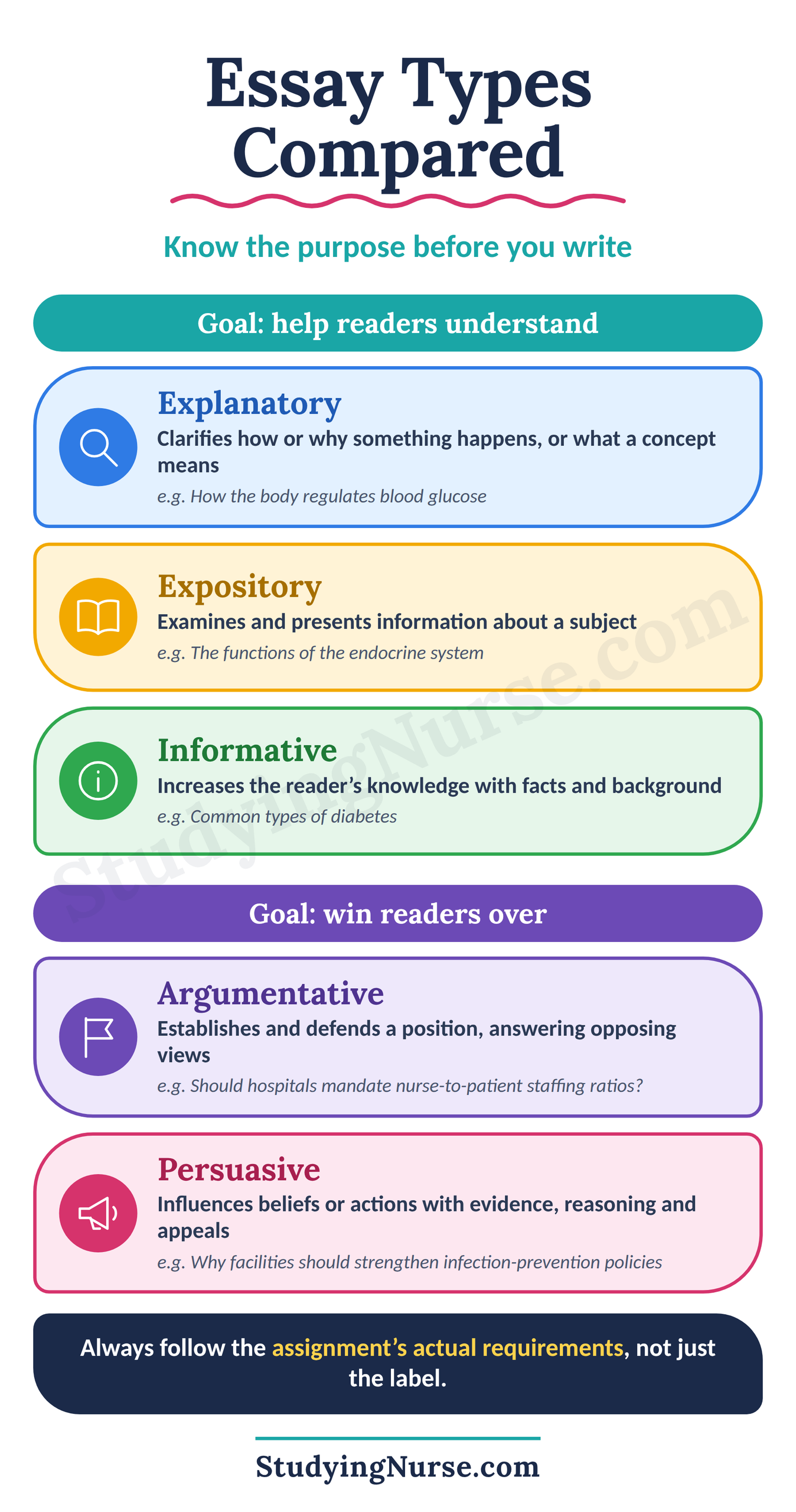
Conclusion
Writing an effective explanatory essay requires more than presenting facts; it involves organizing information logically, developing a clear thesis statement, supporting main points with credible evidence, and explaining a topic in a way readers can easily understand. From choosing a focused essay topic and analyzing the prompt to creating an outline, drafting body paragraphs, and proofreading the final piece, each stage of the writing process contributes to a clear, informative, and well-structured essay. Maintaining objectivity, using appropriate transitions, acknowledging sources, and avoiding plagiarism also strengthen the quality and credibility of explanatory writing.
Whether explaining a clinical procedure, examining a scientific concept, or exploring a broader academic issue, the same principles apply: focus on the main idea, provide relevant supporting details, and present information in a logical order without relying on unsupported claims or personal opinions. With consistent practice and careful revision, writers can develop the skills needed to produce an effective explanatory essay that informs readers, answers the central question, and leaves them with a clearer understanding of the topic.
Frequently Asked Questions
1. How do you write an explanatory essay step by step?
To write an explanatory essay, follow these steps:
- Choose a topic: Select a clear, manageable subject to explain.
- Analyze the prompt: Identify exactly what the essay requires you to explain.
- Research the topic: Gather accurate information from credible sources.
- Create a thesis statement: State the main idea or central explanation.
- Develop an outline: Organize the introduction, body paragraphs, and conclusion.
- Write the first draft: Explain each main point using facts, examples, and supporting evidence.
- Revise and proofread: Improve clarity, organization, grammar, and citations before submitting the essay.
2. Can you give me an example of an explanatory essay?
Topic: The Importance of Hand Hygiene in Healthcare
Hand hygiene is an essential practice in healthcare because it helps prevent the spread of infectious microorganisms. Healthcare workers frequently come into contact with patients, medical equipment, and potentially contaminated surfaces, making proper hand cleaning an important infection prevention measure.
Washing hands with soap and water or using an appropriate alcohol-based hand rub reduces the transfer of microorganisms between patients and healthcare environments. For example, cleaning hands before patient contact and after exposure to body fluids helps reduce the risk of healthcare-associated infections. Proper hand hygiene also protects healthcare workers and supports a safer environment for patients, visitors, and staff.
In conclusion, hand hygiene is a simple but important component of infection prevention. Consistent adherence to recommended hand hygiene practices helps reduce the transmission of infections and improves patient safety.
3. What are some good topics for an explanatory essay?
Good explanatory essay topics focus on a subject that can be explained clearly using facts, examples, and credible evidence.
- How antibiotic resistance develops
- How sleep deprivation affects concentration
- Why hand hygiene prevents infections
- How the human immune system responds to infection
- How diabetes affects blood glucose levels
- Why medication errors occur in healthcare
- How stress affects physical and mental performance
- How vaccines stimulate immune protection
- How electronic health records improve patient care
- Why effective communication matters in healthcare
- How climate change affects public health
- How social media influences health information
- How the water cycle works
- How renewable energy reduces dependence on fossil fuels
- Why regular physical activity supports overall health
4. What is an example of an essay format?
A common explanatory essay format follows the introduction, body paragraphs, and conclusion structure.
| Essay section | Purpose | What to include |
|---|---|---|
| Introduction | Introduce the topic | Background information and thesis statement |
| Body paragraph 1 | Explain the first main point | Topic sentence, facts, examples, and explanation |
| Body paragraph 2 | Explain the second main point | Supporting evidence and relevant details |
| Body paragraph 3 | Explain the third main point | Additional explanation and examples |
| Conclusion | Bring the discussion together | Summary of main ideas and a concluding statement |
This structure is commonly called the five-paragraph essay format. However, longer or more complex explanatory essays may require additional body paragraphs, depending on the topic and assignment requirements.
