

How to Write an Editorial: A Complete Guide to Editorial Writing for Nursing Students
Editorial writing is an important form of communication that enables individuals to examine current issues, express informed opinions, and influence how readers understand matters affecting society. It provides a platform for discussing issues that require public attention, challenging existing practices, and advocating for meaningful change. In nursing and healthcare, editorial writing is particularly valuable because the profession constantly encounters clinical, ethical, social, and policy-related challenges that influence healthcare delivery and patient outcomes. Topics such as nurse staffing shortages, patient safety, healthcare inequalities, professional burnout, nursing education, and the ethical responsibilities of healthcare providers offer opportunities for thoughtful discussion and professional debate. Unlike purely informational writing, an editorial goes beyond presenting facts by taking a definite position on an issue, examining different perspectives, and using credible evidence to persuade readers to consider a particular viewpoint.
A well-written editorial combines research, critical thinking, logical reasoning, and persuasive communication to present an informed opinion. Rather than relying solely on personal beliefs or emotional statements, the writer examines the issue, identifies relevant evidence, considers opposing arguments, and develops a position supported by reliable information. This balance between opinion and evidence is essential because the purpose of an editorial is not simply to express agreement or disagreement but to help readers understand why a particular issue matters and what can be done about it. Whether published in a newspaper, magazine, academic journal, professional publication, or online platform, an effective editorial should demonstrate a sound understanding of its subject, maintain credibility, and communicate its arguments in a clear, organized, and engaging manner.
In nursing, editorial writing contributes to professional communication, advocacy, and the advancement of evidence-based practice. It allows nurses and other healthcare professionals to examine issues affecting their work, question practices that may compromise patient care, and contribute informed perspectives to discussions about healthcare improvement. For example, an editorial examining the relationship between nurse staffing levels and patient safety could explore how inadequate staffing affects nursing workloads, increases the risk of missed care, contributes to professional burnout, and influences patient outcomes. The writer could support the position with research findings, clinical evidence, professional recommendations, and examples from healthcare settings. Similarly, an editorial addressing healthcare inequalities could examine barriers to accessing medical services, their effects on vulnerable populations, and possible interventions for improving the availability and quality of care. Such discussions demonstrate how editorial writing can move beyond individual opinions to encourage informed debate and highlight opportunities for professional and institutional improvement.
Effective editorial writing requires a systematic approach that ensures the writer’s position is relevant, well-supported, and communicated persuasively. Several elements contribute to the development of a strong editorial:
- A clear viewpoint: The writer must establish a definite position on the issue and communicate the central opinion they want readers to understand.
- Thorough research: Relevant facts, statistics, scholarly articles, professional guidelines, and other credible sources provide the foundation for developing an informed argument.
- Logical argument development: Supporting points should be arranged coherently, with each argument contributing to the overall position rather than introducing unrelated ideas.
- Consideration of opposing perspectives: Examining different sides of an issue strengthens the discussion by demonstrating fairness, critical thinking, and an understanding of the subject’s complexity.
- Persuasive communication: Appropriate language, convincing explanations, relevant examples, and well-supported recommendations help readers understand and evaluate the writer’s position.
- Accuracy and professional responsibility: Claims should be verifiable, sources should be represented fairly, and the discussion should maintain appropriate ethical and professional standards.
These elements are particularly important when addressing healthcare issues because editorial arguments can influence professional discussions, public understanding, and attitudes toward healthcare policies and practices. An editorial that advocates for improved infection prevention measures, for instance, should draw on established infection control evidence rather than relying on assumptions or unsupported claims. Similarly, discussions about patient rights, nursing responsibilities, or healthcare resource allocation require careful consideration of ethical principles, clinical evidence, and the potential consequences of different viewpoints.
Understanding how to develop a strong editorial therefore involves more than learning how to express an opinion. It requires the ability to identify meaningful issues, investigate them thoroughly, distinguish reliable evidence from unsupported claims, construct persuasive arguments, and communicate conclusions effectively. This guide explores the essential principles of editorial writing, beginning with the meaning and characteristics of an editorial and its differences from other forms of academic writing. It also examines how to select relevant editorial topics, conduct research, develop a central argument, organize the different components of an editorial, and refine the final piece through effective writing and revision. A practical nursing editorial example further illustrates how these principles can be applied when discussing issues affecting professional practice, healthcare delivery, and patient well-being.
Understanding Editorial Writing
Editorial writing is an important form of communication that combines informed opinion, critical analysis, research, and persuasive reasoning to examine issues that deserve attention. It allows writers to move beyond simply reporting information and instead interpret events, evaluate existing practices, question decisions, and advocate for particular positions. Whether published in a newspaper, magazine, academic journal, professional publication, or online platform, an editorial provides an opportunity to discuss topical issues, influence public opinion, and encourage readers to think critically about matters affecting their communities and society. In nursing and healthcare, this form of writing is particularly relevant because clinical practice, healthcare policies, professional responsibilities, and patient outcomes are influenced by decisions and challenges that often require thoughtful examination and debate.
Unlike ordinary informational writing, which primarily aims to communicate facts, editorial writing presents a specific viewpoint supported by evidence and logical arguments. The writer is expected to understand the issue, identify its significance, examine different sides of the issue, and explain why a particular position deserves consideration. For example, an editorial discussing nurse staffing shortages should do more than state that healthcare facilities experience inadequate staffing. It should examine the factors contributing to the problem, explain how staffing levels influence nurses’ workloads and patient safety, consider possible institutional and policy responses, and support its recommendations with credible research. This combination of opinion and evidence distinguishes a well-developed editorial from an unsupported personal statement.
Editorials also serve different purposes depending on the subject, publication, and intended audience. Some explain complicated issues, while others criticize policies, defend professional interests, recognize positive developments, or persuade readers to support specific changes. In academic and professional settings, they can introduce emerging concerns, stimulate discussion about research findings, and encourage improvements in professional practice. In nursing publications, editorials are particularly useful for informing readers, challenging established perspectives, introducing new ideas, and encouraging responses to issues affecting the profession.
Understanding editorial writing therefore requires recognizing that an effective opinion is not simply a personal preference. It is a carefully considered position developed through subject knowledge, research, logical reasoning, and responsible communication. The following sections examine the meaning and defining characteristics of an editorial, how it differs from other academic writing formats, and why it is particularly valuable in nursing.
Definition and Characteristics of an Editorial
An editorial is an opinion-based article that expresses a clear position on a current, relevant, or controversial issue and uses facts, evidence, analysis, and persuasive reasoning to influence how readers understand or respond to that issue. In traditional journalism, an editorial usually represents the official viewpoint of a newspaper or magazine’s editorial board rather than the personal opinion of an individual reporter. It is often written by the editor, a member of the editorial team, or an assigned editorial writer and may appear without an individual author’s byline. However, in academic and professional publications, editorials may also be written by journal editors, invited experts, researchers, or experienced professionals who offer informed perspectives on matters affecting their fields.
The meaning of an editorial can vary slightly depending on the publication in which it appears. In a newspaper, it commonly represents the publication’s institutional position on a public issue, policy, event, or decision. In a scholarly nursing journal, an editorial may present an expert viewpoint on an emerging healthcare concern, discuss the implications of newly published research, highlight developments in nursing practice, or encourage professional debate. For example, a nursing journal might publish an editorial examining the implications of artificial intelligence in clinical decision-making, discussing its potential benefits, ethical concerns, and implications for nurses’ professional responsibilities.
It is important to understand that an editorial is not simply an article in which the writer expresses what they personally believe. A strong editorial establishes a defensible viewpoint and demonstrates why that position is reasonable through relevant evidence and thoughtful analysis. Although the writer is entitled to express an opinion, the arguments should be grounded in accurate information rather than assumptions, exaggerated claims, or emotional reactions. This is particularly important when discussing healthcare issues because inaccurate statements can misrepresent clinical evidence, professional standards, or the experiences of patients and healthcare providers.
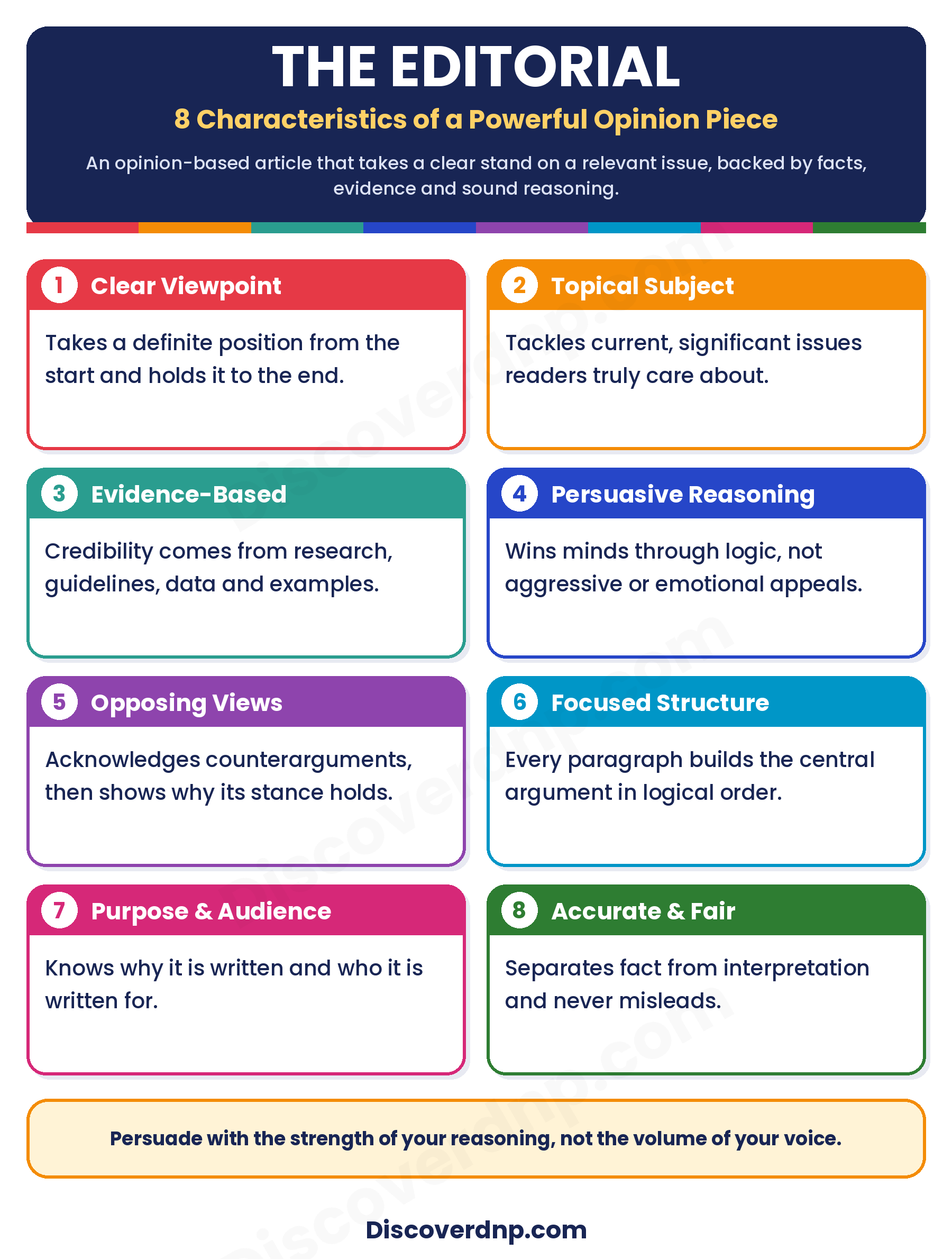
Key characteristics of an editorial
Several characteristics distinguish an editorial from other forms of writing:
1. A clear and definite viewpoint: An editorial takes a position on a particular issue rather than discussing the subject without reaching a meaningful conclusion. The writer should make the central opinion recognizable from the beginning and maintain it throughout the discussion. For example, an editorial addressing nurse burnout might argue that healthcare institutions should implement comprehensive workplace well-being programmes rather than treating burnout solely as an individual nurse’s responsibility.
2. A relevant and topical subject: Editorials generally address issues that are current, significant, controversial, or important to a particular audience. These may include changes in healthcare policies, professional challenges, ethical concerns, social developments, or emerging clinical practices. A good editorial topic gives readers a reason to pay attention because the issue has practical implications for their lives, work, or communities.
3. Evidence-based arguments: Although an editorial expresses an opinion, its credibility depends on the quality of the information used to support that opinion. Writers may draw on scholarly research, clinical guidelines, official reports, statistics, expert commentary, and relevant examples. For instance, an editorial arguing for improved nurse-to-patient staffing levels should provide evidence connecting staffing conditions with patient safety, quality of care, and nursing workloads.
4. Persuasive language and reasoning: Editorial writing aims to influence how readers think about an issue. Writers achieve this through logical explanations, relevant examples, carefully selected language, and arguments that demonstrate the importance of their position. Persuasion should come from the strength of the reasoning rather than aggressive language or unsupported emotional appeals.
5. Consideration of opposing viewpoints: A credible editorial recognizes that complex issues may have more than one reasonable interpretation. The writer should acknowledge relevant counterarguments and explain why their own position remains convincing. For example, an editorial advocating increased healthcare staffing expenditure could acknowledge concerns about institutional budgets while explaining the potential long-term consequences of inadequate staffing for patient outcomes, staff retention, and healthcare costs.
6. A focused and organized structure: An editorial should present its ideas in a logical sequence, allowing readers to follow the discussion from the introduction of the issue to the supporting arguments and final position. Each paragraph should contribute to the central argument instead of introducing unrelated information. This organization makes the editorial easier to understand and strengthens its persuasive impact.
7. A defined purpose and intended audience: Every editorial should have a reason for being written and a particular readership in mind. Some editorials seek to explain an issue, others challenge an existing policy, and some encourage readers or decision-makers to support a specific change. Understanding the intended audience helps determine the level of technical detail, examples, language, and recommendations appropriate for the discussion.
8. Accuracy, fairness, and credibility: An editorial should represent information honestly, distinguish established facts from personal interpretations, and avoid misleading readers. Writers should use reliable sources, provide appropriate references when required, and avoid misrepresenting opposing positions. In professional and academic publications, ethical writing is particularly important because readers may use the information to inform their understanding of professional issues and practice.
Example of an editorial
Consider the following editorial topic: Healthcare Institutions Should Prioritize Nurse Well-Being to Improve Patient Safety.
A writer addressing this subject might establish the position that nurse well-being should be treated as an essential component of healthcare quality rather than merely an individual responsibility. The editorial could examine how excessive workloads, inadequate staffing, insufficient workplace support, and prolonged occupational stress affect nurses and the care they provide.
To support this viewpoint, the writer could:
- Present research findings on nurse burnout, occupational stress, and patient safety.
- Explain how fatigue and excessive workloads may contribute to communication difficulties, missed nursing care, and medication errors.
- Acknowledge institutional concerns about the financial resources required to improve staffing and workplace conditions.
- Explain why investing in nurse well-being may contribute to better staff retention, safer working environments, and improved quality of care.
- Recommend practical interventions, such as adequate staffing, access to psychological support, manageable workloads, and supportive leadership.
This example demonstrates how an editorial develops a clear opinion while using research, professional knowledge, and logical reasoning to support its position. It also illustrates the difference between simply identifying a problem and presenting a persuasive argument about why a particular response is necessary.
Editorials vs. Essays and Research Papers
Editorials, essays, and research papers are all forms of written communication used to explore ideas, discuss issues, and present information. However, they differ in their primary purposes, approaches to evidence, organization, and the roles they expect writers to assume. Understanding these differences is important because the three formats may address similar subjects while requiring different writing techniques. For example, nurse burnout could be examined in an editorial advocating for improved workplace conditions, an essay exploring the causes and consequences of occupational stress, or a research paper investigating the relationship between nurse burnout and patient safety.
The main distinction is that an editorial aims to communicate and defend a particular viewpoint, an essay develops and explores ideas in response to a subject or question, while a research paper investigates a specific problem using a systematic approach to gathering and analyzing information.
1. Editorial vs. essay
An editorial is generally more directly persuasive than a conventional academic essay. It takes a definite position on an issue and uses evidence and reasoning to encourage readers to consider or support that position. An essay, on the other hand, is a broader form of academic writing that may explain, analyze, compare, contrast, interpret, or evaluate a subject. Although persuasive essays also defend a particular argument, not every essay is intended to influence public opinion or advocate for a specific change.
For instance, consider the subject of mandatory vaccination among healthcare workers.
- Editorial: An editorial might argue that healthcare institutions should maintain evidence-based vaccination policies to protect patients and healthcare personnel. The writer would support this position using relevant research, professional guidelines, and arguments about infection prevention and patient safety.
- Essay: An essay on the same subject might examine the benefits, limitations, ethical considerations, and challenges associated with mandatory vaccination. Depending on the assignment, it could present a balanced analysis without necessarily advocating for one particular policy.
Another important difference concerns the intended audience and writing style. Editorials are often written for a broad readership, including healthcare professionals, policymakers, patients, and members of the public. Consequently, writers should explain technical concepts clearly and use language that makes the issue accessible. Academic essays are more commonly written for instructors, researchers, or other academic audiences and may require more formal theoretical discussion, extensive referencing, and detailed analysis.
2. Editorial vs. research paper
A research paper is an academic document that investigates a defined research question or problem using an organized methodology. Depending on the type of study, it may involve collecting original data, analyzing existing datasets, reviewing published literature systematically, or evaluating evidence using established research methods. Its primary purpose is to contribute to knowledge by presenting findings, examining relationships, testing hypotheses, or answering specific research questions.
An editorial does not normally follow this investigative process. Instead, it draws on existing knowledge, research findings, professional experience, and relevant evidence to develop an argument about an issue. Its purpose is to interpret, evaluate, or respond to information rather than present an original research investigation.
For example, consider the relationship between nurse staffing levels and patient outcomes:
- Research paper: A researcher might conduct a quantitative study examining whether nurse-to-patient ratios are associated with hospital-acquired infections, medication errors, patient mortality, or other clinical outcomes. The paper would describe the research question, methodology, sample, data collection procedures, statistical analysis, results, and conclusions.
- Editorial: An editorial might use findings from existing staffing studies to argue that healthcare institutions should adopt safer nurse staffing policies. It would interpret the available evidence, discuss the implications for nursing practice, acknowledge financial or administrative challenges, and recommend improvements.
Research papers generally require more extensive methodological detail and formal documentation of the research process. Editorials are usually more concise and focus on the writer’s interpretation of an issue. However, this does not mean that editorials can disregard academic standards. Scholarly editorials should use accurate information, cite relevant research where appropriate, and distinguish evidence-based conclusions from personal opinions.
3. Key differences between editorials, essays, and research papers
The following comparison highlights the main distinctions:
| Feature | Editorial | Essay | Research paper |
|---|---|---|---|
| Primary purpose | Persuade readers or influence their understanding of an issue | Explain, explore, analyze, or argue a subject | Investigate a research question and contribute knowledge |
| Main approach | Presents a clear viewpoint supported by evidence | Develops ideas through explanation and analysis | Uses systematic investigation and evidence analysis |
| Writer’s position | Usually takes a definite position | May be neutral, analytical, reflective, or persuasive | Interprets findings based on the research evidence |
| Evidence | Uses relevant facts, research, examples, and expert opinions | Uses sources appropriate to the assignment | Uses data, scholarly literature, and documented research findings |
| Structure | Introduction, supporting arguments, counterarguments, and conclusion | Introduction, organized body paragraphs, and conclusion | Abstract, introduction, methodology, results, discussion, and conclusion, depending on the research type |
| Audience | General readers, professionals, policymakers, or a publication’s readership | Academic or general readers, depending on the assignment | Researchers, academics, professionals, and other interested readers |
| Expected outcome | Encourage reflection, agreement, debate, or action | Demonstrate understanding and develop an informed discussion | Answer a research question or address a knowledge gap |
It is also important to distinguish an editorial from other opinion-based publications. In traditional journalism, an editorial usually represents the collective position of a newspaper’s editorial board, whereas an opinion column or guest opinion piece generally represents the personal viewpoint of its named author. In academic journals, the term editorial is also used for expert commentary written by journal editors or invited contributors. The exact conventions therefore depend on the publication and assignment requirements.
These distinctions are useful when deciding which format is appropriate for a particular assignment. If the objective is to advocate for improved patient safety policies using existing evidence, an editorial may be suitable. If the task requires examining several dimensions of a healthcare issue, an analytical essay may be more appropriate. If the assignment requires collecting and analyzing data to answer a specific question, a research paper is the better choice. Selecting the correct format ensures that the writing approach, evidence, and organization match the intended purpose.
Importance of Editorial Writing in Nursing
Editorial writing plays an important role in nursing because it provides a means of examining professional issues, communicating informed perspectives, advocating for improvements, and contributing to discussions that shape healthcare practice. Nursing is a constantly evolving profession influenced by clinical research, technological developments, ethical responsibilities, healthcare policies, workforce conditions, and changing patient needs. These developments frequently raise questions about the quality, safety, accessibility, and organization of healthcare services. Editorials provide an opportunity to evaluate such issues, explain their implications, and encourage constructive responses from healthcare professionals, institutional leaders, policymakers, and the wider public.
Unlike informal discussions or unsupported personal opinions, professional editorial writing requires arguments to be grounded in relevant evidence and presented in a structured manner. This makes it particularly useful for examining complex nursing concerns that may have clinical, ethical, organizational, and social implications. Its importance can be understood through several contributions to the nursing profession.
1. Promoting professional advocacy and influencing healthcare policies
Nurses work closely with patients, families, and communities and frequently encounter challenges that affect the quality and accessibility of healthcare. Editorial writing allows these experiences to be translated into informed discussions about professional needs, healthcare policies, and opportunities for improvement.
For example, an editorial addressing nursing shortages could examine how inadequate staffing affects workload distribution, continuity of care, nurse retention, and patient safety. Rather than simply criticizing healthcare institutions, the writer could use workforce reports, research findings, and professional recommendations to advocate for sustainable staffing policies.
Editorials addressing policy-related issues may also:
- Highlight gaps in existing healthcare policies and their implications for clinical practice.
- Explain why particular policy changes are necessary to protect patients and healthcare workers.
- Encourage institutional leaders and policymakers to consider evidence-based recommendations.
- Give visibility to professional concerns that may receive insufficient attention in public discussions.
Through this form of communication, nurses can contribute informed perspectives to conversations about healthcare priorities and professional development.
2. Strengthening critical thinking and evidence-based reasoning
Nursing decisions require the ability to interpret information, evaluate evidence, identify problems, and consider the consequences of different interventions. Editorial writing reinforces these abilities because writers must examine an issue carefully before deciding which position to defend.
Developing an editorial involves more than finding information that supports an existing opinion. Writers must assess the quality of their sources, distinguish established findings from assumptions, compare different interpretations, and determine whether the evidence genuinely supports their conclusions.
For example, when examining whether electronic health records improve patient safety, a writer should consider several factors:
- How electronic documentation affects the accuracy and accessibility of patient information.
- Whether digital systems reduce or introduce opportunities for documentation errors.
- How technology influences communication between healthcare professionals.
- Whether inadequate training, technical failures, or workflow interruptions affect clinical efficiency.
- What research findings demonstrate about the relationship between electronic documentation and patient outcomes.
Examining these factors encourages a more informed viewpoint than simply arguing that technology is either beneficial or harmful. It also strengthens the ability to evaluate clinical literature and apply evidence appropriately when discussing professional issues.
3. Encouraging ethical reflection and professional accountability
Nursing involves frequent ethical decisions concerning patient autonomy, confidentiality, informed consent, dignity, fairness, and the responsible use of healthcare resources. These issues may not always have straightforward solutions because different ethical principles, professional obligations, and patient interests can sometimes conflict.
Editorial writing provides a platform for examining such dilemmas and encouraging discussion about responsible professional conduct. It allows writers to explore the ethical implications of clinical decisions, evaluate existing practices, and explain why certain professional standards should be maintained.
For example, an editorial discussing patient confidentiality in digital healthcare could examine the risks associated with unauthorized access to electronic health records, inappropriate sharing of patient information, and the use of personal devices for clinical communication. The writer could discuss the responsibilities of healthcare professionals in protecting sensitive information and advocate for stronger privacy safeguards, appropriate staff training, and compliance with relevant regulations.
Such discussions reinforce the importance of professional accountability by encouraging healthcare workers to evaluate how their actions affect patients, colleagues, and public trust in the nursing profession.
4. Raising awareness of nursing and patient safety issues
Many challenges affecting healthcare delivery require attention beyond the clinical environment in which they occur. Editorials can bring these concerns to a wider audience by explaining their causes, consequences, and possible solutions.
Common nursing and healthcare issues that may be explored through editorial writing include:
- Nurse burnout and workplace stress: Examining how excessive workloads, inadequate staffing, and insufficient organizational support affect nurses’ well-being and their ability to provide safe care.
- Patient safety and quality improvement: Discussing preventable medical errors, infection prevention, medication safety, and the importance of standardized clinical procedures.
- Healthcare inequalities: Highlighting barriers that prevent disadvantaged populations from accessing timely and appropriate healthcare services.
- Nursing shortages: Exploring workforce distribution, recruitment challenges, retention strategies, and the implications of inadequate staffing.
- Technology in healthcare: Evaluating the benefits and limitations of artificial intelligence, telehealth, electronic health records, and other digital innovations.
- Ethical challenges: Examining patient rights, end-of-life decisions, confidentiality, informed consent, and professional responsibilities.
By discussing these issues in an accessible and evidence-based manner, editorials can help readers recognize problems that may otherwise receive limited attention.
5. Supporting professional communication and knowledge sharing
Nursing depends on effective communication among healthcare professionals, patients, families, researchers, educators, and policymakers. Editorial writing contributes to this communication by providing a structured way to share professional viewpoints and interpret developments affecting the field.
In academic nursing publications, editorials may discuss emerging research findings, identify gaps in professional knowledge, comment on developments in clinical practice, or highlight important themes in a particular journal issue. They can also introduce questions that encourage further research and discussion.
For example, an editorial examining the integration of artificial intelligence into nursing practice could discuss how decision-support systems may assist clinical assessment while also considering concerns about algorithmic bias, data privacy, professional judgment, and accountability. Such a discussion can help healthcare professionals understand the opportunities and limitations of new technologies without presenting innovation as automatically beneficial.
6. Encouraging constructive debate and improvements in nursing practice
Not every issue in nursing has one universally accepted solution. Healthcare professionals may disagree about staffing models, resource allocation, clinical guidelines, technological adoption, professional education, and approaches to patient care. Editorial writing provides a constructive way to examine these differences and explain the reasoning behind competing viewpoints.
For instance, an editorial discussing the introduction of mandatory continuing professional development programmes could consider arguments that such programmes improve clinical competence and support lifelong learning. It could also acknowledge concerns about training costs, time constraints, and unequal access to professional development opportunities. By examining these perspectives, the writer can present a reasoned position on how continuing education requirements should be implemented effectively.
This kind of discussion is valuable because it encourages professionals to question established practices, consider alternative approaches, and evaluate whether current systems adequately meet patient and workforce needs. Editorials may also propose recommendations that institutions and professional organizations can consider when planning improvements.
7. Developing professional writing and communication skills
The ability to communicate a well-supported argument is valuable throughout nursing education and professional practice. Editorial writing helps develop several transferable skills, including:
- Research literacy: Identifying scholarly sources, evaluating evidence, and using reliable information to support professional discussions.
- Critical analysis: Examining complex problems, recognizing assumptions, and comparing different viewpoints.
- Argument development: Organizing ideas logically and explaining why particular conclusions are supported by available evidence.
- Professional communication: Presenting complex clinical and healthcare issues in clear, accurate, and appropriate language.
- Ethical reasoning: Considering professional responsibilities, patient interests, and the broader consequences of healthcare decisions.
These abilities extend beyond academic assignments. They can support nurses when preparing professional reports, participating in policy discussions, contributing to scholarly publications, developing quality improvement proposals, and communicating recommendations to healthcare leadership.
Editorial writing is therefore more than an academic exercise or a journalistic activity. It is a valuable professional communication tool that enables nurses to examine issues affecting their field, contribute informed opinions, challenge practices that require improvement, and advocate for better healthcare outcomes. When grounded in credible research, ethical reasoning, and a clear understanding of nursing practice, editorials can strengthen professional dialogue and encourage meaningful improvements in the delivery of patient care.
Choosing a Relevant Editorial Topic
Choosing a relevant topic is one of the most important stages of editorial writing because the subject determines the direction, depth, and effectiveness of the entire piece. Even a well-structured editorial may fail to persuade readers if it addresses an issue that is outdated, too broad, poorly understood, or unrelated to the audience’s interests. A strong editorial topic should raise an important question, encourage critical thinking, and provide an opportunity to present a clear viewpoint supported by credible evidence.
In nursing and healthcare, potential topics are numerous because the profession is closely connected to patient safety, public health, healthcare policy, professional ethics, workforce conditions, technology, and the quality of care. However, not every issue automatically makes a good editorial. The writer must identify a subject that deserves attention, understand why it matters, and determine whether a persuasive argument can be developed around it.
When selecting an editorial topic, consider three essential questions:
- Does the issue matter? The subject should have practical significance for patients, nurses, healthcare organizations, policymakers, or the wider community.
- Can a clear position be developed? The writer should be able to express an informed opinion rather than simply describe a situation.
- Can the position be supported? There should be enough reliable research, professional guidance, examples, or relevant data to support the argument.
For example, nurse burnout is a relevant healthcare issue, but it is initially quite broad. A more focused editorial topic could be why healthcare organizations should introduce stronger measures to prevent nurse burnout and protect patient safety. This version identifies a specific concern and suggests a position that can be defended through evidence and persuasive reasoning.
The following considerations help writers identify current issues, evaluate potential subjects, and narrow broad ideas into focused editorial topics.
Identifying Current Nursing and Healthcare Issues
A relevant editorial often begins with an issue that is receiving attention in healthcare or affecting the everyday experiences of patients and professionals. Current issues provide opportunities to discuss challenges, question existing practices, evaluate proposed solutions, and persuade readers to reconsider their opinions. Since editorial writing is often connected to public discussion, choosing a topical subject can make the piece more meaningful and engaging.
Nursing and healthcare issues may emerge from changes in clinical practice, new research findings, public health developments, professional debates, institutional policies, or experiences within healthcare facilities. A writer should pay attention to these developments and consider whether they raise questions that deserve further discussion.
1. Healthcare workforce challenges
Workforce concerns are among the most relevant subjects for nursing editorials because staffing levels, working conditions, and professional support can influence both nurses and patients. Issues such as nursing shortages, excessive workloads, long shifts, workplace violence, inadequate staffing ratios, and nurse burnout can form the basis of a persuasive opinion piece.
For example, a writer could explore whether hospitals should establish safer nurse-to-patient staffing levels. The editorial might argue that excessive patient assignments increase workload, contribute to fatigue, limit the time available for individual patients, and create conditions in which important aspects of care may be overlooked. Research on staffing and patient outcomes could provide evidence to support the argument.
Other possible topics include:
- Whether healthcare facilities should provide formal psychological support for nurses experiencing burnout.
- The need for stronger workplace protections against violence and harassment.
- Whether mandatory rest periods should be introduced for nurses working extended shifts.
- The importance of improving recruitment and retention strategies to address nursing shortages.
- Whether newly qualified nurses receive sufficient supervision and mentorship.
2. Patient safety and quality of care
Patient safety is another important area for editorial writing because preventable harm can result from weaknesses in clinical systems, communication, staffing, infection prevention, and medication management. These concerns allow writers to examine professional responsibilities and institutional practices while advocating for improvements.
For instance, an editorial could argue that healthcare facilities should strengthen medication safety procedures to reduce administration errors. The discussion might consider common contributing factors, including interruptions, inadequate communication, unclear prescriptions, insufficient staffing, and weaknesses in medication reconciliation. The writer could then persuade readers that improving safety requires both individual accountability and reliable organizational systems.
Other potential subjects include:
- Preventing hospital-acquired infections through consistent infection control practices.
- Improving communication during patient handovers.
- Reducing medication errors through standardized procedures.
- Strengthening patient identification practices before treatment and medication administration.
- Promoting a workplace culture in which healthcare professionals can report errors and near misses without inappropriate blame.
- Improving the recognition and escalation of early signs of patient deterioration.
A strong editorial on patient safety should avoid placing responsibility entirely on individual nurses when broader organizational factors may contribute to the problem. Examining these different sides of an issue helps produce a fairer and more convincing argument.
3. Nursing ethics and professional responsibilities
Ethical challenges provide opportunities to discuss the values and principles that guide nursing practice. Nurses regularly encounter situations involving patient autonomy, confidentiality, informed consent, dignity, professional boundaries, and equitable treatment. These subjects can generate thoughtful editorials because they often involve competing responsibilities and difficult decisions.
For example, a writer could examine whether healthcare professionals should receive additional training on protecting patient confidentiality when using digital communication platforms. The editorial might explain how improper sharing of patient information can compromise privacy and professional trust. It could argue that healthcare organizations should provide clear policies, practical training, and appropriate safeguards for handling electronic health information.
Other possible editorial topics include:
- Protecting patient autonomy when treatment decisions conflict with professional recommendations.
- Addressing discrimination and unequal treatment in healthcare settings.
- Maintaining confidentiality when discussing patient cases for educational purposes.
- Supporting nurses who report unethical or unsafe clinical practices.
- Balancing family involvement with a patient’s right to make independent healthcare decisions.
- Promoting dignity and respect when caring for patients with disabilities or chronic illnesses.
These topics require careful research and balanced reasoning. A good editorial should explain the ethical principles involved rather than relying only on personal beliefs or emotional reactions.
4. Public health and disease prevention
Public health issues are particularly suitable for editorials because they affect individuals, families, healthcare systems, and entire communities. They also provide opportunities to discuss prevention, health education, access to services, and government responsibility.
For example, an editorial could argue that community health programs should place greater emphasis on early screening and prevention of hypertension. The writer might explain the risks associated with uncontrolled high blood pressure, barriers to screening, and the importance of accessible community-based services. Evidence from public health research could strengthen the argument that early detection should be prioritized.
Other relevant topics include:
- Improving vaccination awareness and access.
- Addressing misinformation about infectious diseases.
- Expanding maternal and child health services.
- Strengthening mental health awareness and access to treatment.
- Improving access to sexual and reproductive health education.
- Promoting early detection and prevention of noncommunicable diseases.
- Addressing barriers to healthcare in rural and underserved communities.
Public health editorials should consider the needs of the population being discussed. For instance, an argument about vaccination access should examine practical barriers such as service availability, cost, transportation, health literacy, and public confidence.
5. Healthcare technology and digital transformation
Advances in healthcare technology create new opportunities and challenges for nurses and other healthcare professionals. Electronic health records, telehealth, artificial intelligence, remote patient monitoring, and automated clinical systems can influence how care is delivered and how health information is managed.
These developments are useful editorial subjects because they raise questions about effectiveness, accessibility, safety, privacy, and professional responsibility.
For example, a writer could examine whether telehealth should be expanded to improve access to nursing consultations in underserved communities. The editorial might argue that remote services can reduce travel barriers and support follow-up care, while also acknowledging limitations such as unreliable internet access, digital literacy challenges, and the inability to perform certain physical assessments remotely.
Other possible topics include:
- The benefits and limitations of artificial intelligence in clinical decision-making.
- Protecting patient privacy in electronic health record systems.
- The role of remote monitoring in managing chronic diseases.
- Whether nursing education should include more digital health training.
- The risks of relying too heavily on automated clinical alerts.
- Improving access to telehealth in rural communities.
When addressing technology, the writer should avoid assuming that every new development is automatically beneficial. An effective editorial considers both potential advantages and possible risks before defending a position.
6. Nursing education and professional development
Nursing education is another productive area because the quality of preparation, clinical experience, and continuing professional development can influence professional competence and patient care. Editorials can examine whether educational systems adequately prepare nurses for the demands of modern healthcare.
For example, an editorial could argue that nursing programs should provide more structured clinical simulation opportunities. The writer might explain how simulation allows learners to practise clinical decision-making, communication, emergency response, and technical skills in a controlled environment before applying them in actual patient care.
Other potential topics include:
- Whether nursing curricula should include more training in evidence-based practice.
- The importance of mentorship during the transition from education to professional practice.
- Improving access to continuing education for practicing nurses.
- The role of simulation in developing clinical competence.
- Whether nursing programs provide adequate preparation for mental health care.
- Addressing the challenges associated with limited clinical placement opportunities.
These subjects allow writers to connect educational policies with professional readiness and the broader quality of healthcare delivery.
7. Healthcare access, affordability, and inequality
Access to healthcare remains an important editorial subject because individuals and communities do not always have equal opportunities to obtain timely and appropriate services. Financial limitations, geographical barriers, shortages of healthcare professionals, disability-related barriers, and social inequalities can affect the ability to receive care.
An editorial might argue that healthcare systems should strengthen primary healthcare services to reduce delays in accessing essential treatment. The discussion could examine how accessible primary care supports prevention, early diagnosis, continuity of care, and the management of chronic conditions.
Other possible subjects include:
- Improving access to maternal healthcare in rural communities.
- Reducing financial barriers to essential medicines.
- Addressing unequal access to mental health services.
- Expanding healthcare services for people with disabilities.
- Improving access to emergency care in remote areas.
- Reducing discrimination in healthcare delivery.
When researching these subjects, writers should consider the experiences of affected populations and avoid making broad claims about communities without sufficient evidence.
Where to find relevant editorial topics
Writers do not need to depend on personal observations alone when identifying a subject. Several information sources can help reveal emerging issues and provide a foundation for researching an editorial topic.
- Professional nursing organizations: Publications, policy statements, and professional updates can highlight concerns involving nursing practice, workforce conditions, education, and patient safety.
- Government health agencies: Public health reports, policy announcements, disease surveillance information, and healthcare statistics can reveal important developments.
- Scholarly journals: Nursing and medical research can identify gaps in clinical practice, emerging challenges, and areas requiring further investigation.
- Healthcare news publications: Reputable newspapers and healthcare magazines can help writers identify issues attracting public attention.
- Hospital and healthcare reports: Quality improvement reports, patient safety information, and workforce assessments may reveal challenges affecting healthcare organizations.
- Professional conferences and discussions: Presentations and debates can introduce new perspectives on clinical practice and healthcare policy.
- Community experiences: Concerns raised by patients, caregivers, and healthcare workers can help writers recognize issues that deserve broader attention, provided the information is handled responsibly and patient confidentiality is protected.
For example, a writer interested in patient safety might encounter a report discussing medication errors, a scholarly article examining contributing factors, and a professional guideline describing recommended safety practices. These sources can help establish whether the issue is significant and whether there is sufficient evidence to support an editorial argument.
The main objective is to identify a subject that is both relevant and suitable for persuasive discussion. A topic should not be selected merely because it is popular or controversial. The writer must also be able to investigate it accurately, understand its implications, and develop a defensible viewpoint.
Characteristics of a Good and Controversial Editorial Topic
Not every interesting subject is appropriate for editorial writing. A good editorial topic should provide enough substance for analysis, encourage meaningful discussion, and allow the writer to develop an informed position. It should also be relevant to the intended audience and supported by reliable information.
A controversial topic can be particularly engaging because it involves disagreement, competing values, or different interpretations of an issue. However, controversy alone does not make an editorial effective. The writer must approach the subject fairly, examine the available evidence, and explain why one position is more convincing than another.
The following characteristics help distinguish a strong editorial topic from a subject that may be too general, weak, or difficult to defend.
1. Relevance and significance
A good editorial topic addresses an issue that has meaningful consequences for individuals, healthcare professionals, organizations, or society. The subject should be important enough to justify discussion and should connect with the concerns or interests of the intended audience.
For example, the importance of nursing is a broad subject with general relevance, but it does not identify a specific problem or argument. In comparison, why healthcare facilities should improve staffing levels to protect patient safety addresses a practical concern with implications for nurses, patients, and healthcare administrators.
A relevant topic may focus on:
- A current challenge affecting nursing practice.
- A policy that influences patient care.
- An ethical concern requiring professional attention.
- A public health problem affecting communities.
- A change in technology or clinical practice.
- An educational issue influencing professional competence.
Relevance also depends on the publication and its readers. A school newspaper may be interested in an editorial about improving access to mental health support for students, while a professional nursing magazine may be more suited to a discussion of staffing policies or clinical accountability.
2. A clear opportunity to express an opinion
Editorial writing requires more than describing an issue. The subject should allow the writer to establish a definite viewpoint and support it with logical reasoning.
For example, nurse burnout is a topic, but it does not yet communicate an argument. A more suitable editorial position would be that healthcare organizations should make nurse well-being a formal patient safety priority. This gives the writer a clear position to defend.
A useful way to evaluate a potential topic is to ask:
- Is there a specific question or problem to address?
- Can I identify a position on the issue?
- Can I explain why this position matters?
- Are there reasonable arguments that could challenge my viewpoint?
- Can I provide evidence to support my opinion?
If the subject only encourages a descriptive summary, it may be better suited to an informational essay or report than an editorial.
3. Availability of credible supporting evidence
A strong editorial topic should be researchable. Writers need reliable information to establish the background of an issue, demonstrate its importance, and support the claims made throughout the body of the editorial.
Evidence may include:
- Findings from peer-reviewed nursing and medical research.
- Reports from recognized health agencies.
- Professional guidelines and policy documents.
- Healthcare statistics and official reports.
- Expert commentary from qualified professionals.
- Documented examples of clinical or organizational challenges.
For example, an editorial arguing for better infection prevention practices should be supported by evidence about healthcare-associated infections, relevant risk factors, and established prevention measures. Personal observations may help explain why the issue matters, but they should not replace credible research.
The writer should also consider whether the evidence is current enough for the subject. A discussion of an established ethical principle may rely on foundational professional guidance, whereas an editorial about a recently introduced healthcare technology may require more recent research and policy information.
4. Potential for debate and different perspectives
A particularly effective editorial topic often involves more than one reasonable viewpoint. This creates an opportunity to examine the sides of an issue, address disagreements, and persuade readers through balanced reasoning.
For example, the use of artificial intelligence in nursing practice may produce different opinions. Supporters may argue that AI tools can improve efficiency, assist with clinical decisions, and identify patterns in patient data. Critics may raise concerns about privacy, inaccurate recommendations, algorithmic bias, and excessive dependence on automated systems.
An editorial could take the position that AI should be introduced into nursing practice only when appropriate safeguards, professional oversight, and staff training are in place. This viewpoint acknowledges the potential benefits while addressing legitimate concerns.
Other topics that allow meaningful debate include:
- Whether hospitals should introduce mandatory nurse-to-patient staffing ratios.
- Whether telehealth should become a standard option for routine follow-up care.
- Whether nursing programs should increase the use of simulation in clinical education.
- Whether healthcare professionals should be required to receive regular workplace violence prevention training.
- Whether electronic documentation improves patient care or creates excessive administrative demands.
The presence of disagreement makes a subject suitable for persuasive discussion, but the writer should not create artificial conflict or misrepresent opposing opinions simply to make the editorial more dramatic.
5. A manageable scope
A good editorial topic should be broad enough to provide sufficient material for discussion but narrow enough to be addressed within the available word limit. Subjects that cover too many issues can become difficult to organize and may weaken the central argument.
For instance, problems in healthcare is too broad because it could include staffing, affordability, technology, ethics, public health, education, and many other concerns. A more manageable subject would be the role of nurse staffing levels in reducing medication administration errors.
A focused topic helps the writer:
- Identify the main problem.
- Establish a clear thesis.
- Select relevant supporting evidence.
- Organize arguments logically.
- Address the most important opposing viewpoints.
- Develop a conclusion that follows naturally from the discussion.
This does not mean that an editorial should ignore the wider context. Rather, background information should be included only when it helps explain the specific issue being discussed.
6. Timeliness and topical interest
An editorial often becomes more engaging when it addresses an issue that readers are currently discussing or experiencing. A topical subject can connect the writer’s argument to recent developments, professional debates, policy changes, or emerging healthcare concerns.
For example, changes in digital health systems may create an opportunity to discuss the responsibilities of nurses when documenting and protecting electronic patient information. Similarly, a recent public health concern may provide a reason to examine the importance of vaccination education or community disease prevention.
However, writers should distinguish between temporary popularity and lasting significance. A subject may attract attention for a short period without offering enough substance for a meaningful editorial. A good topic should have a clear connection to a broader concern, even when it is prompted by a recent event.
7. Practical importance and potential for improvement
Strong editorial topics often point toward a problem that can be addressed through changes in policy, professional behavior, education, resource allocation, or organizational practice. This gives the editorial a constructive purpose beyond expressing dissatisfaction.
For example, an editorial about poor communication during patient handovers could argue for standardized handover procedures, appropriate documentation, and staff training. The discussion would identify the problem, explain its consequences, and recommend practical improvements.
A topic is especially useful when the writer can answer the question: What should change, and who has the ability or responsibility to make that change?
Potential solutions should be realistic and related to the problem. An editorial about nursing shortages, for example, may discuss improved retention, supportive working environments, professional development, and recruitment strategies rather than presenting a simplistic solution to a complex workforce challenge.
Examples of strong nursing and healthcare editorial topics
The following examples illustrate how a general subject can be developed into a more persuasive editorial topic.
| General subject | More focused editorial topic |
|---|---|
| Nurse burnout | Why healthcare organizations should prioritize nurse well-being to improve patient safety |
| Medication errors | Why hospitals should strengthen medication safety systems and reduce preventable errors |
| Healthcare technology | Why artificial intelligence in nursing requires professional oversight |
| Nursing education | Why simulation-based learning should be expanded in nursing programs |
| Patient confidentiality | Why healthcare facilities must strengthen the protection of electronic patient information |
| Hospital infections | Why consistent infection prevention practices should be a priority in every healthcare facility |
| Rural healthcare | Why community-based nursing services should be expanded in underserved areas |
| Workplace violence | Why healthcare organizations must do more to protect nurses from workplace violence |
| Mental health | Why mental health screening and support should be integrated into routine healthcare |
| Patient communication | Why effective nurse-patient communication should be treated as a patient safety priority |
These topics provide a clear subject for discussion and suggest a position that can be supported through research. They also allow writers to explore opposing views without losing focus.
A controversial editorial should be thoughtful rather than provocative for its own sake. Its strength comes from the quality of its reasoning, the credibility of its evidence, and its ability to engage readers in a meaningful discussion.
Narrowing a Broad Issue into a Focused Subject
Many writers begin with a general area of interest but struggle to turn it into a specific editorial topic. This is common because healthcare issues are often interconnected. For example, nursing shortages may involve education, recruitment, staff retention, working conditions, migration, funding, leadership, and patient safety. Attempting to discuss all these dimensions in one editorial can make the argument unfocused.
Narrowing a topic involves moving from a broad subject to a particular problem, population, setting, or proposed solution. The goal is to establish a manageable focus that allows the writer to develop a clear thesis and provide sufficient evidence.
1. Begin with a broad area of interest
Start by identifying a general subject that is relevant to nursing, healthcare, or the intended audience. It may come from professional experience, a research article, a current healthcare discussion, or a concern observed in clinical practice.
Examples of broad areas include:
- Nursing shortages.
- Patient safety.
- Healthcare technology.
- Mental health.
- Infection prevention.
- Nursing education.
- Maternal healthcare.
- Professional ethics.
- Healthcare affordability.
At this stage, the writer does not need to have a complete argument. The purpose is to identify an area that offers enough possibilities for further investigation.
2. Identify a specific problem within the broad subject
Once the general subject has been selected, consider the particular challenge or question that deserves attention. A broad topic often contains several smaller issues, so identifying one central concern makes the editorial easier to develop.
For example, the broad subject nursing shortages may involve:
- High nurse turnover.
- Limited nursing education opportunities.
- Unequal distribution of nurses between urban and rural facilities.
- Poor working conditions.
- Inadequate professional development.
- Excessive workloads and burnout.
Instead of attempting to address all these issues, the writer could focus on the relationship between poor working conditions and nurse retention.
Similarly, the broad subject patient safety could be narrowed to medication errors, communication failures, infection prevention, patient identification, or delayed recognition of clinical deterioration.
3. Define the population or setting
A topic becomes more focused when the writer identifies the group of people or healthcare environment affected by the issue. This helps determine which evidence is relevant and whose experiences should be considered.
For example, improving mental health services is a broad topic. It can be narrowed by identifying a particular population or setting:
- Mental health support for nurses working in emergency departments.
- Access to mental health services for adolescents.
- Psychological support for patients with chronic illnesses.
- Mental health screening in primary healthcare facilities.
- Support services for healthcare workers experiencing occupational stress.
The setting can also make a difference. An editorial about infection prevention in intensive care units may require different evidence and recommendations from one discussing infection prevention in community clinics.
Writers should avoid narrowing a topic so much that reliable information becomes difficult to find. The chosen population and setting should provide a useful focus while leaving enough room for meaningful discussion.
4. Establish the central question
A focused editorial topic should be built around a question that can be answered through a clear argument. Asking a specific question helps the writer identify what needs to be investigated and what position the editorial will defend.
For example:
- Broad subject: Nurse burnout.
- More specific problem: High levels of occupational stress among nurses.
- Central question: Should healthcare organizations introduce formal burnout prevention programs for nurses?
- Possible position: Healthcare organizations should establish structured burnout prevention programs because supporting nurses’ well-being can strengthen workforce retention and contribute to safer patient care.
Another example:
- Broad subject: Healthcare technology.
- More specific problem: The growing use of artificial intelligence in clinical settings.
- Central question: Should nurses receive mandatory training before using AI-supported clinical tools?
- Possible position: Nurses should receive appropriate training because they need to understand the capabilities, limitations, and risks of AI-generated recommendations before incorporating them into clinical decisions.
A well-defined question gives the editorial direction and helps prevent unrelated arguments from entering the discussion.
5. Decide what position the editorial will defend
After identifying the central question, the writer should determine the main viewpoint. The position does not need to be extreme, but it should be clear enough for readers to understand what the editorial is advocating.
Consider the following progression:
- General subject: Patient handovers.
- Focused issue: Communication failures during shift changes.
- Central question: Should healthcare facilities adopt standardized handover procedures?
- Editorial position: Healthcare facilities should use structured handover procedures to improve communication, support continuity of care, and reduce preventable information gaps.
This position gives the writer a specific argument to support. It also creates opportunities to discuss possible objections, such as concerns about additional documentation or the time required to complete structured handovers.
The writer should avoid choosing a position before examining the available evidence. Researching the topic may reveal that the original assumption needs to be modified or that a more balanced viewpoint is appropriate.
6. Limit the number of main arguments
A focused editorial does not need to discuss every possible consequence of an issue. Instead, it should identify a small number of strong arguments that directly support the thesis.
For example, an editorial advocating for improved nurse staffing could organize its argument around three central points:
- Patient safety: Appropriate staffing can help nurses provide timely assessments, administer treatments, monitor patients, and respond to changes in clinical condition.
- Nurse well-being: More manageable workloads may help reduce occupational stress and support professional retention.
- Quality and continuity of care: Adequate staffing can give nurses more opportunity to communicate with patients, educate families, and coordinate care.
Each point can be developed with relevant evidence and examples. Limiting the argument in this way helps maintain coherence and prevents the editorial from becoming a general discussion of every problem in the nursing profession.
7. Assess whether the topic is researchable and manageable
Before finalizing the subject, determine whether sufficient credible information is available and whether the issue can be discussed within the required length. A topic may be important but unsuitable if it requires extensive technical explanation, involves too many unrelated policy questions, or has very limited reliable evidence.
Consider the following questions:
- Can I find credible research and professional guidance on this issue?
- Is there enough evidence to support the position I want to defend?
- Can I explain the issue without requiring excessive background information?
- Can I address at least one reasonable opposing viewpoint?
- Can I develop a meaningful conclusion or recommendation?
- Is the subject appropriate for the publication and its intended readers?
For example, the future of healthcare technology may be too broad for a short editorial. However, why nurses should receive training on the safe use of AI-supported clinical decision tools is more manageable. It identifies a specific professional concern, provides a clear direction for research, and allows the writer to discuss benefits, risks, and practical recommendations.
8. Formulate a focused editorial title and working thesis
Once the subject has been narrowed, create a working title and thesis statement. The title should communicate the central issue clearly, while the thesis should state the position the editorial intends to defend.
For example:
- Broad topic: Patient safety.
- Focused subject: Preventing medication administration errors in hospitals.
- Possible title: Why Hospitals Must Strengthen Medication Safety Practices.
- Working thesis: Hospitals should strengthen medication safety systems through standardized procedures, effective communication, and ongoing staff training to reduce preventable medication administration errors.
The thesis gives the editorial a central argument. Each section of the body should contribute to explaining, supporting, or defending that position.
The title may be revised during the writing process as the argument becomes more precise. However, the final title should accurately represent the content rather than promise a discussion that the editorial does not deliver.
Example of narrowing a broad nursing issue
The following example demonstrates how a general area of interest can be developed into a focused editorial subject.
| Stage | Example |
|---|---|
| Broad area | Nurse well-being |
| Specific issue | Occupational burnout among hospital nurses |
| Contributing concern | Heavy workloads, inadequate staffing, and limited organizational support |
| Central question | Should hospitals make nurse burnout prevention a formal workforce and patient safety priority? |
| Editorial position | Hospitals should introduce structured measures to prevent nurse burnout because supporting nurses’ well-being can improve workforce stability and contribute to safer patient care. |
| Focused title | Why Nurse Well-Being Must Become a Healthcare Priority |
This progression demonstrates why narrowing a topic is essential. The original subject, nurse well-being, could lead to a broad discussion of physical health, mental health, workplace relationships, professional development, and personal lifestyle. The focused subject identifies occupational burnout in hospital settings and establishes an argument about organizational responsibility.
The writer can then research contributing factors, examine the relationship between burnout and patient care, consider the responsibilities of healthcare leaders, and recommend practical interventions. This produces a more coherent editorial than attempting to address every aspect of nurse well-being.
A useful principle is to move from a general subject to a specific problem, from the problem to a central question, and from the question to a defensible position. This approach helps writers select an editorial topic that is relevant, researchable, and suitable for persuasive discussion. It also creates a strong foundation for the next stage of editorial writing: researching the issue and building an argument supported by credible evidence.
Researching and Building Your Editorial Argument
After selecting a relevant editorial topic, the next stage is researching the issue and developing a convincing argument. Editorial writing is based on more than personal beliefs or individual experiences. Although an editorial expresses a particular viewpoint, that viewpoint should be informed by accurate information, credible research, logical reasoning, and a clear understanding of the issue. Research helps the writer establish the facts, understand the causes and consequences of a problem, evaluate possible solutions, and determine which position can be defended most effectively.
A strong editorial argument should explain not only what the writer believes but also why readers should consider that position reasonable. This requires examining the available evidence, identifying different sides of an issue, and organizing supporting points into a coherent line of reasoning. For example, an editorial advocating for improved nurse staffing should not simply claim that hospitals need more nurses. It should explain how staffing levels influence workload, patient monitoring, medication administration, communication, and the quality of care. It should also consider concerns such as recruitment costs, workforce availability, and budget limitations.
Researching and building an editorial argument therefore involves three closely connected activities: finding trustworthy sources, examining different perspectives, and developing a clear thesis supported by relevant arguments. Each activity strengthens the editorial’s credibility and helps the writer persuade readers through evidence rather than unsupported assertions.
Finding Credible and Evidence-Based Sources
Credible sources are essential to effective editorial writing because they provide the information needed to explain an issue and support the writer’s position. A persuasive editorial should distinguish between established facts, research findings, professional recommendations, and personal opinions. Without reliable evidence, even a strongly expressed viewpoint may appear biased, misleading, or poorly informed.
Research should begin with a clear understanding of what the writer needs to establish. This may include the scale of a problem, its contributing factors, its effects on patients or healthcare professionals, existing policies, and the effectiveness of proposed interventions. The writer should then identify sources that directly address these questions.
For example, when writing an editorial arguing that healthcare facilities should improve infection prevention practices, the writer may need evidence about healthcare-associated infections, common transmission routes, hand hygiene compliance, the effectiveness of infection prevention interventions, and the responsibilities of healthcare organizations. Gathering information from several reliable sources helps create a more complete understanding of the subject.
1. Scholarly and peer-reviewed journal articles
Scholarly journals are valuable sources for editorial research because they publish studies, reviews, clinical investigations, and professional discussions that contribute to knowledge in nursing and healthcare. Peer-reviewed articles are evaluated by experts before publication, which provides an important level of quality control.
Relevant research may include:
- Original research studies: These present findings from investigations involving patients, healthcare professionals, clinical practices, or healthcare organizations.
- Systematic reviews: These examine findings from multiple studies using a structured approach to answer a particular research question.
- Meta-analyses: These statistically combine results from several studies when the available data and research methods permit.
- Qualitative studies: These explore experiences, perceptions, attitudes, and challenges, such as nurses’ experiences of workplace stress.
- Clinical and professional reviews: These summarize current knowledge about particular healthcare conditions, interventions, or professional practices.
For example, an editorial about nurse burnout may draw on a systematic review examining occupational stress among nurses, a qualitative study exploring workplace experiences, and an observational study investigating associations between staffing conditions and patient outcomes. These sources provide different forms of evidence that can help the writer develop a more informed argument.
However, the writer should not assume that every published study is equally reliable. Research should be assessed according to its methodology, sample size, setting, limitations, relevance, and consistency with other findings. A small study conducted in one healthcare facility may provide useful insight, but its findings may not automatically apply to every hospital or healthcare system.
2. Government and public health agencies
Government health departments and recognized public health agencies provide information about disease patterns, healthcare policies, health system performance, public health priorities, and population health outcomes. Their reports can be particularly useful when an editorial discusses issues affecting communities or the organization of healthcare services.
For example, an editorial on maternal healthcare access may require information about maternal mortality, antenatal care attendance, skilled birth attendance, emergency obstetric services, and geographical barriers to care. Official reports and public health statistics can help establish the scale of the problem and explain why it deserves attention.
Useful sources may include:
- National ministries or departments of health.
- National public health institutes.
- National statistical agencies.
- The World Health Organization.
- The United Nations Children’s Fund.
- Other recognized international and regional health organizations.
When using government or international reports, writers should identify the publication date, geographical coverage, definitions, and methods used to collect the data. This is particularly important when comparing healthcare statistics between countries or regions because differences in data collection and reporting can affect interpretation.
3. Professional nursing organizations and regulatory bodies
Professional nursing organizations and regulatory bodies can provide authoritative information about nursing standards, professional responsibilities, ethical expectations, clinical practice, and workforce development. Their publications are especially relevant when an editorial addresses professional conduct, nursing education, patient advocacy, or healthcare policy.
For example, an editorial arguing for stronger protections against workplace violence should consider professional guidance on staff safety, reporting procedures, institutional responsibilities, and the prevention of violence in healthcare environments.
Sources may include:
- National nursing associations.
- Nursing and midwifery councils.
- Professional regulatory authorities.
- Organizations responsible for nursing education standards.
- Healthcare accreditation and quality improvement organizations.
These materials help writers understand the standards expected of nurses and healthcare institutions. They can also provide a basis for evaluating whether existing practices are consistent with professional expectations.
4. Clinical guidelines and evidence-based practice recommendations
Clinical guidelines provide recommendations intended to support safe and effective healthcare decisions. They are often developed through the evaluation of research evidence, professional expertise, and consideration of patient needs.
Such guidelines are useful when an editorial addresses clinical procedures, patient safety, infection prevention, medication administration, chronic disease management, or other aspects of healthcare delivery.
For example, an editorial advocating improved hand hygiene practices may refer to established infection prevention recommendations. The writer can then discuss why consistent implementation matters, what barriers may prevent compliance, and what healthcare organizations can do to support better practice.
It is important to distinguish between a clinical recommendation and proof that a particular intervention will produce the same result in every setting. Guidelines should be considered alongside the population, healthcare environment, available resources, and circumstances to which they apply.
5. Reputable newspapers, magazines, and healthcare publications
Newspapers and magazines can help writers identify current developments, public debates, policy changes, and professional concerns. They are useful for understanding how an issue is being discussed outside academic research and for identifying questions that may deserve further investigation.
For example, a healthcare news report about a hospital introducing an electronic patient record system may prompt an editorial about the benefits and challenges of digital documentation in nursing practice.
However, news reporting should not automatically be treated as scientific evidence. A newspaper article may describe a study, interview an expert, or report an incident, but the writer should consult the original research or official report whenever possible before making technical or clinical claims.
A useful approach is to use reputable journalism to identify a topical editorial subject and scholarly or official sources to verify the facts supporting the argument.
6. Expert interviews and professional commentary
Expert opinions can help explain complex subjects and provide practical insight into healthcare challenges. Interviews with qualified nurses, clinical educators, healthcare administrators, researchers, and other relevant professionals may help writers understand how a policy or practice affects real healthcare environments.
For instance, an editorial about the transition from nursing education to professional practice could benefit from insights provided by experienced nurses and clinical educators. Their perspectives may reveal challenges involving supervision, confidence, clinical decision-making, and workplace support.
Expert commentary should be evaluated according to the person’s relevant qualifications and experience. A professional’s opinion can provide valuable context, but it should not replace research evidence when the editorial makes claims about clinical effectiveness or patient outcomes.
Evaluating the credibility of sources
Finding information is only one part of research. Writers must also determine whether the information is trustworthy, accurate, relevant, and appropriate for the argument. A source may appear authoritative but still contain outdated information, limited evidence, or conclusions that do not directly apply to the subject.
Several factors should be considered when evaluating a source:
- Authority: Who produced the information? Is the author a qualified researcher, healthcare professional, recognized organization, or relevant subject expert?
- Accuracy: Are the claims supported by evidence, references, appropriate methods, or verifiable data?
- Currency: When was the information published or updated? Is it recent enough for the issue being discussed?
- Relevance: Does the source directly address the editorial topic, population, setting, or argument?
- Objectivity: Does the source acknowledge limitations and alternative explanations, or does it appear to promote a particular interest without adequate evidence?
- Research quality: If the source presents a study, are the methods appropriate, the sample sufficiently described, and the conclusions consistent with the findings?
- Consistency: Do other credible sources report similar findings, or is the claim based on an isolated result?
For example, suppose a writer finds an online article claiming that reducing nurses’ working hours automatically eliminates medication errors. Before using this statement, the writer should investigate the evidence behind it. Research may indicate that fatigue and excessive workloads are associated with safety concerns, but the relationship between working hours and medication errors may be influenced by staffing levels, patient complexity, supervision, and organizational systems. The editorial should reflect what the evidence actually demonstrates rather than exaggerating a finding.
Using evidence accurately and responsibly
Once credible sources have been identified, the writer must use their findings correctly. Evidence should strengthen the argument without being distorted, taken out of context, or presented as more conclusive than it is.
There are several ways to incorporate research into an editorial:
- Statistics: Numerical information can demonstrate the scale or frequency of an issue. For example, reliable workforce data may help explain the extent of nursing shortages in a particular region.
- Research findings: Study results can support claims about relationships between clinical practices and patient outcomes.
- Professional recommendations: Guidelines can demonstrate what recognized organizations recommend for safe and effective practice.
- Documented examples: Realistic, properly verified examples can help readers understand how an issue affects patients and healthcare professionals.
- Expert explanations: Professional commentary can clarify technical or policy-related issues.
Consider an editorial about improving patient handover practices. The writer could use research on communication failures, professional guidance on structured handovers, and evidence about continuity of care. These sources would support an argument for standardized communication procedures.
The writer should also distinguish between association and causation. If a study finds that higher nurse workloads are associated with poorer patient outcomes, it does not necessarily prove that workload alone caused those outcomes. Other factors may contribute. Accurate editorial writing acknowledges such limitations while explaining why the findings remain relevant.
Similarly, research should not be selectively used to support a preferred opinion while ignoring credible evidence that challenges it. A writer who wants to persuade readers must demonstrate that the argument has been developed through careful investigation rather than through the selective use of convenient facts.
Organizing research before drafting
Research can become difficult to manage when information comes from several articles, reports, and professional documents. Organizing findings before writing helps prevent repetition, unsupported claims, and confusion between different sources.
A simple research table can be useful:
| Research area | Information to collect | Purpose in the editorial |
|---|---|---|
| Background | Definition, context, and history of the issue | Introduces the subject |
| Scale of the problem | Relevant statistics and documented trends | Establishes significance |
| Causes | Contributing clinical, social, or organizational factors | Explains why the issue occurs |
| Consequences | Effects on patients, nurses, and healthcare systems | Demonstrates why action matters |
| Existing responses | Current policies, guidelines, and interventions | Evaluates what is already being done |
| Alternative perspectives | Concerns, limitations, and opposing arguments | Strengthens balance and credibility |
| Possible solutions | Evidence-based recommendations | Supports the editorial’s proposed action |
For example, when researching nurse burnout, the writer could organize information under causes, effects on professional well-being, potential patient safety implications, existing organizational interventions, and barriers to implementing prevention programs. This makes it easier to identify the strongest supporting evidence and determine which information belongs in the body of the editorial.
Research notes should also include enough details to identify the original source later. Even when the final editorial is intended for a publication that does not use formal academic citations, accurate source tracking helps the writer verify claims and avoid accidental misrepresentation.
Examining Different Perspectives on the Issue
A convincing editorial should demonstrate that the writer understands the issue beyond their personal viewpoint. Most important nursing and healthcare concerns involve different interests, responsibilities, and priorities. Nurses, patients, healthcare administrators, policymakers, professional organizations, and families may interpret the same issue differently because they experience its effects from different positions.
Examining these perspectives helps the writer develop a balanced argument, identify potential objections, and explain why the chosen position is reasonable. It also prevents editorial writing from becoming one-sided or emotionally driven. Although an editorial should communicate a definite opinion, acknowledging alternative viewpoints does not weaken the argument. When handled properly, it strengthens the writer’s credibility and makes the final position more persuasive.
For example, an editorial advocating for improved nurse-to-patient staffing ratios should consider the perspectives of nurses who experience heavy workloads, patients who require timely and attentive care, hospital administrators responsible for managing budgets, and policymakers responsible for healthcare workforce planning. Understanding these positions helps the writer develop a more realistic argument and propose solutions that address the actual challenges involved.
1. Identify the major stakeholders
The first step in examining different perspectives is identifying the people and organizations affected by the issue. Stakeholders are individuals or groups who experience the consequences of a problem, influence decisions about it, or have a responsibility to address it.
In nursing and healthcare, stakeholders may include:
- Patients: They are directly affected by the quality, accessibility, safety, and affordability of healthcare services. Their perspectives may reveal concerns about waiting times, communication, treatment decisions, privacy, and continuity of care.
- Nurses: They provide direct patient care and may experience the practical effects of staffing policies, workplace conditions, professional regulations, and changes in clinical practice.
- Healthcare administrators: They are responsible for managing healthcare facilities, allocating resources, maintaining service standards, and addressing workforce and operational challenges.
- Policymakers: They influence healthcare legislation, funding, workforce planning, public health priorities, and the organization of healthcare systems.
- Other healthcare professionals: Physicians, pharmacists, therapists, laboratory professionals, and other practitioners may have relevant perspectives on issues involving multidisciplinary care and patient safety.
- Families and caregivers: They may be affected by decisions concerning treatment, discharge planning, access to services, patient support, and long-term care.
- Professional organizations and regulatory bodies: These groups help establish professional expectations, advocate for nursing interests, and influence standards of practice.
Identifying stakeholders helps the writer understand who should be considered when developing an editorial argument. For example, an editorial about expanding telehealth services should not focus exclusively on the convenience of remote consultations. It should also consider patients with limited internet access, nurses responsible for remote assessment, healthcare organizations providing the technology, and individuals whose conditions require physical examination.
2. Understand the arguments supporting different positions
After identifying the stakeholders, examine the reasons they may support or oppose a particular proposal. The aim is to understand the logic behind each position rather than simply labeling one side as correct and the other as incorrect.
Consider the debate surrounding mandatory nurse-to-patient staffing ratios.
Supporters may argue that:
- Appropriate staffing allows nurses to provide more individualized attention.
- Manageable workloads support timely assessment and intervention.
- Excessive patient assignments may increase fatigue and contribute to missed nursing care.
- Better working conditions may improve job satisfaction and staff retention.
- Staffing standards can establish clearer accountability for healthcare organizations.
Those who raise concerns about mandatory ratios may argue that:
- Healthcare facilities have different patient populations and levels of clinical complexity.
- Fixed ratios may not account for changes in patient acuity or unexpected emergencies.
- Hospitals experiencing workforce shortages may struggle to meet rigid staffing requirements.
- Recruiting additional nurses can create financial and operational challenges.
- Rural and smaller healthcare facilities may have fewer staffing resources than large hospitals.
Examining these arguments helps the writer identify the strongest aspects of each position. The editorial may still support mandatory staffing standards, but it should explain how the policy could account for differences in patient needs and healthcare resources.
This approach is more persuasive than simply stating that administrators who oppose staffing requirements do not care about patient safety. A good editorial responds to the actual concerns raised and explains why its recommended approach remains appropriate.
3. Distinguish facts from opinions and assumptions
Different perspectives should be examined carefully because people may present beliefs, experiences, or assumptions as though they were established facts. Editorial writers must distinguish between verifiable information and personal interpretations.
For example:
- Fact: A hospital has a documented shortage of nursing personnel according to its workforce report.
- Opinion: The hospital’s staffing policy is unfair to nurses.
- Assumption: Hiring additional nurses will automatically solve every patient safety problem.
The first statement can be verified through an official report. The second expresses a judgment that requires explanation and supporting reasoning. The third makes a prediction that should be examined against evidence and other relevant factors.
Personal experiences can help explain why an issue matters, but they should not be used to represent the experiences of every patient or healthcare professional. A nurse may have experienced poor communication during a shift handover, for example, but this single experience does not establish that all hospitals have ineffective handover systems.
Research helps determine whether an individual observation reflects a wider problem. It also allows writers to identify exceptions, conflicting findings, and circumstances that may influence the issue.
4. Examine the advantages and disadvantages of proposed solutions
Different perspectives become particularly important when an editorial recommends a specific action. Most healthcare interventions have potential benefits, limitations, costs, and implementation challenges. A persuasive editorial should explain these factors instead of presenting a proposed solution as though it has no disadvantages.
For example, consider an editorial advocating for the wider use of electronic health records.
Potential advantages include:
- Improved access to patient information across authorized healthcare teams.
- More organized clinical documentation.
- Better continuity of care when patients move between services.
- Easier retrieval of relevant medical information.
- Opportunities to reduce certain documentation and communication problems.
However, possible limitations include:
- Initial implementation and maintenance costs.
- Staff training requirements.
- Technical failures and system downtime.
- Risks involving unauthorized access to patient information.
- Increased documentation demands if systems are poorly designed.
A writer supporting electronic health records could acknowledge these concerns while arguing that appropriate investment, training, cybersecurity measures, and technical support can help address them. This demonstrates that the writer has considered the practical realities of the proposal.
5. Consider ethical, cultural, and social implications
Healthcare issues often involve values and experiences that extend beyond clinical outcomes. Examining different perspectives requires attention to ethical responsibilities, cultural expectations, financial circumstances, health literacy, disability, and social inequalities.
For example, an editorial advocating for improved maternal healthcare should consider the experiences of women living in rural communities, families with limited financial resources, healthcare professionals providing maternity services, and policymakers responsible for maternal health programs.
A recommendation that appears practical in an urban hospital may be difficult to implement in a remote community where transportation, staffing, equipment, or emergency referral services are limited.
Similarly, an editorial about patient autonomy should consider the rights of patients to make informed decisions, the professional responsibility to explain treatment options, and the role of family members when patients need support. Cultural expectations may influence how families participate in healthcare decisions, but these expectations should be considered alongside the patient’s rights and applicable professional standards.
Understanding these implications helps the writer avoid generalizations and develop recommendations that are more inclusive and realistic.
6. Identify the strongest counterarguments
A counterargument is a reasonable objection or alternative position that challenges the writer’s central viewpoint. Identifying counterarguments during research helps the writer prepare responses before drafting the editorial.
For example, an editorial may argue that nursing programs should increase clinical simulation training. A possible counterargument is that simulation equipment, trained instructors, and dedicated laboratory facilities require substantial investment. Some may also argue that simulation cannot fully reproduce the complexity of actual patient care.
The writer can respond by explaining that simulation is not intended to replace clinical placements. Rather, it can provide additional opportunities to practise technical skills, communication, emergency responses, and clinical decision-making before or alongside supervised patient care. The argument becomes stronger when the writer acknowledges the limitations and explains how simulation can complement other educational approaches.
A useful way to assess a counterargument is to ask:
- Is the opposing position based on a genuine concern?
- Is it supported by credible evidence or practical experience?
- Does it identify a limitation in the proposed solution?
- Can the concern be addressed through additional safeguards or modifications?
- Does the opposing position reveal an important factor missing from the original argument?
Not every opposing claim deserves equal attention. Unsupported allegations, inaccurate information, and arguments unrelated to the central issue should not distract from the editorial’s main purpose. The writer should concentrate on reasonable objections that readers are likely to consider important.
7. Avoid false balance and misrepresentation
Balanced editorial writing does not mean treating every opinion as equally credible. Some viewpoints may be supported by substantial research and professional guidance, while others may rely on misinformation, outdated assumptions, or isolated experiences.
For example, when discussing the importance of infection prevention, an editorial should not present established infection control recommendations and unsupported claims as though they have equal scientific standing. The writer can acknowledge that healthcare professionals may disagree about the most practical implementation methods without creating doubt about well-established safety principles.
Writers should also avoid misrepresenting an opposing argument. This happens when someone presents an exaggerated or simplified version of another person’s position to make it easier to criticize.
Suppose an editorial supports expanded telehealth services. It would be unfair to claim that everyone who questions telehealth wants patients to have no access to modern healthcare. Critics may instead be concerned about digital exclusion, patient privacy, assessment limitations, or the suitability of remote consultations for particular conditions.
Accurately describing these concerns makes the editorial more credible and allows the writer to respond to the strongest version of the opposing argument.
8. Use different perspectives to improve the final recommendation
The purpose of examining different viewpoints is not simply to list disagreements. The information should help refine the editorial’s argument and produce a recommendation that considers the realities of the issue.
For example, an editorial supporting improved nurse staffing could initially recommend that every hospital introduce a fixed staffing ratio. After examining different perspectives, the writer may recognize that patient acuity, emergency admissions, facility size, and workforce availability also influence staffing needs.
The final position could therefore advocate for safe staffing standards that combine minimum staffing requirements with patient acuity assessments, appropriate workforce planning, and regular monitoring of care quality.
This revised argument is more comprehensive because it acknowledges practical concerns while maintaining the central position that safe staffing should be a healthcare priority.
A useful comparison table can help organize the findings:
| Perspective | Main concern | How it informs the editorial |
|---|---|---|
| Nurses | Workload, fatigue, and ability to provide safe care | Establishes the professional impact of staffing conditions |
| Patients | Timely attention, safety, and quality of care | Explains why staffing matters to patient outcomes |
| Administrators | Financial resources and workforce availability | Identifies implementation challenges |
| Policymakers | Healthcare standards and equitable service delivery | Establishes the role of policy and oversight |
| Professional organizations | Nursing standards and professional well-being | Provides guidance for appropriate recommendations |
By considering these perspectives, the writer can produce an editorial that is firm in its position but fair in its treatment of the issue. This balance is especially important in nursing, where professional decisions may affect patient rights, clinical outcomes, healthcare resources, and public trust.
Developing a Clear Thesis and Supporting Arguments
After researching the topic and examining different perspectives, the writer should develop a clear thesis statement. The thesis is the central claim or position that guides the editorial. It tells readers what the writer believes about the issue and establishes the direction of the discussion.
A strong thesis is essential because it prevents the editorial from becoming a collection of unrelated opinions and facts. It provides a central point to which every major argument, example, and recommendation should connect. Without a clear thesis, the body of the editorial may move between different concerns without developing a convincing position.
For example, consider the broad subject of patient safety. A weak editorial may simply discuss medication errors, communication problems, staffing shortages, and infection prevention without establishing a relationship between these subjects. A more focused editorial could defend the position that healthcare facilities should strengthen medication safety systems through standardized procedures, staff training, and improved communication to reduce preventable medication errors. This thesis identifies the issue, communicates a position, and indicates the main areas that the editorial will examine.
1. Understand the purpose of a thesis statement
A thesis statement provides the foundation for the editorial argument. It performs several important functions:
- Establishes the viewpoint: It communicates the position the writer intends to defend.
- Defines the scope: It identifies the particular issue being addressed and prevents the discussion from becoming too broad.
- Guides the body of the editorial: It helps determine which arguments, evidence, and examples should be included.
- Creates consistency: It ensures that different paragraphs contribute to the same central message.
- Prepares readers: It gives readers an understanding of the direction of the editorial and the position they can expect the writer to support.
For example, an editorial about mental health services could use the following thesis:
Healthcare facilities should integrate accessible mental health support into routine primary healthcare because early identification, appropriate referral, and continued support can help address unmet mental health needs.
This statement communicates a clear position and identifies three areas that can be developed in the body: early identification, referral, and continued support.
A thesis should not merely announce the topic. It should make a claim about the topic that can be explained and defended.
2. Make the thesis specific and focused
A thesis that is too general may leave readers uncertain about the editorial’s main argument. It should identify a particular issue and express a position that can be supported within the available word limit.
Compare the following examples:
| Weak thesis statement | Stronger thesis statement |
|---|---|
| Nursing shortages are a serious problem. | Healthcare organizations should strengthen nurse recruitment and retention strategies to address staffing shortages and support safe patient care. |
| Technology is changing healthcare. | Healthcare facilities should introduce AI-supported clinical tools with appropriate training and professional oversight to protect patient safety. |
| Patient education is important. | Nurses should provide structured discharge education to improve patients’ understanding of treatment plans and support continuity of care. |
| Infection prevention matters. | Healthcare facilities should strengthen infection prevention training and monitoring to reduce preventable healthcare-associated infections. |
The stronger statements do more than identify a subject. They establish what should happen, why the issue deserves attention, or what position the writer intends to defend.
Specificity also makes research more efficient. When the thesis identifies a clear concern, the writer can search for evidence that directly supports the argument instead of collecting large amounts of unrelated information.
3. Ensure the thesis is arguable
An editorial thesis should express a position that readers can reasonably examine, question, or debate. A statement that simply presents an established fact may not provide enough opportunity for persuasive discussion.
For example:
- Factual statement: Nurses administer medications as part of their professional responsibilities.
- General opinion: Medication safety is important in hospitals.
- Arguable thesis: Hospitals should require regular medication safety training and standardized administration procedures to reduce preventable medication errors.
The third statement presents a position that can be supported through research and professional recommendations. It also allows the writer to consider questions about training frequency, staffing resources, institutional accountability, and implementation.
An arguable thesis does not need to be controversial for its own sake. It should make a meaningful claim that can be defended through evidence and logical reasoning.
4. Develop supporting arguments that directly defend the thesis
Once the thesis has been established, the writer should identify the main arguments that will support it. These arguments form the foundation of the body of the editorial. Each should contribute a distinct reason why the central position is reasonable.
For example, consider the thesis:
Healthcare organizations should prioritize nurse well-being because supportive working conditions contribute to workforce stability, professional performance, and safer patient care.
The writer could develop three main arguments:
Argument 1: Supporting nurse well-being can improve workforce retention.
Nurses who experience excessive workloads, inadequate organizational support, and persistent occupational stress may become dissatisfied with their working conditions. This can contribute to intentions to leave their positions or the profession. An editorial could argue that healthcare organizations should introduce supportive management practices, mentorship, appropriate staffing, and professional development opportunities to strengthen retention.
Argument 2: Reducing excessive workloads can support nurses’ ability to provide attentive care.
Nursing involves continuous assessment, medication administration, patient education, documentation, communication, and coordination of care. When nurses are responsible for more tasks and patients than they can reasonably manage, the risk of missed or delayed care may increase. Research on workload, staffing, fatigue, and patient safety can help support this argument.
Argument 3: Organizational support strengthens the quality of the healthcare environment.
A workplace that promotes psychological safety, effective leadership, professional respect, and access to appropriate resources can help nurses communicate concerns and participate in quality improvement. An editorial could argue that supporting nurses should be treated as part of a broader commitment to patient safety rather than as an optional employee benefit.
These arguments are related, but they address different aspects of the thesis. Organizing them separately helps the editorial develop progressively without repeating the same point in every paragraph.
5. Support each argument with credible evidence
A supporting argument becomes more persuasive when it is accompanied by reliable evidence. Writers should avoid making claims that depend entirely on personal conviction, particularly when discussing clinical practice, patient outcomes, or healthcare policy.
A useful approach is to combine a claim, evidence, explanation, and connection to the thesis.
- Claim: State the specific point being made.
- Evidence: Present relevant research findings, statistics, professional recommendations, or verified examples.
- Explanation: Interpret the evidence and explain why it matters.
- Connection: Show how the point supports the central thesis.
For example, in an editorial advocating for stronger patient handover procedures:
- Claim: Inadequate communication during handovers can threaten continuity of care.
- Evidence: Research and patient safety reports have identified communication failures as an important contributor to preventable healthcare incidents.
- Explanation: When essential information about medications, allergies, clinical changes, pending investigations, or treatment plans is omitted, the incoming healthcare team may not have the information needed to make appropriate decisions.
- Connection: Standardized handover procedures can help organize essential information and strengthen communication between healthcare professionals.
This approach prevents the editorial from simply inserting statistics or research findings without explaining their significance. Evidence should always be interpreted in relation to the argument it is intended to support.
6. Use logical reasoning to connect the evidence to the argument
Research findings do not automatically persuade readers. The writer must explain how the evidence supports the conclusion being presented. Logical reasoning connects facts, examples, and professional recommendations to the editorial’s central position.
Several forms of reasoning can be useful:
- Cause-and-effect reasoning: Explains how one factor may contribute to another. For example, inadequate staffing may increase workload, which can contribute to fatigue and difficulties completing nursing responsibilities on time.
- Comparison: Examines similarities and differences between two approaches. For instance, an editorial may compare traditional patient education with structured discharge education to explain the value of standardized teaching.
- Problem-and-solution reasoning: Identifies a concern, explains its consequences, and presents a practical response. An editorial about medication errors may recommend improved medication reconciliation, staff training, and safer documentation procedures.
- Evidence-based generalization: Uses findings from relevant studies or reports to identify a broader pattern while acknowledging the limits of the available evidence.
- Ethical reasoning: Evaluates an issue using professional principles such as autonomy, beneficence, nonmaleficence, justice, and confidentiality.
Writers should avoid logical fallacies, which are errors in reasoning that weaken an argument. Common examples include:
- Hasty generalization: Drawing a broad conclusion from one or two isolated experiences.
- False cause: Assuming that one event caused another without sufficient evidence.
- Either-or reasoning: Presenting only two choices when several alternatives may exist.
- Personal attack: Criticizing the character or motives of someone who disagrees rather than addressing their argument.
- Appeal to popularity: Assuming that a position is correct simply because many people support it.
For example, claiming that every hospital with high nurse workloads provides unsafe care would be an overgeneralization. A stronger argument would explain that excessive workloads can create conditions associated with safety risks, while acknowledging that patient acuity, staffing arrangements, organizational support, and other factors also influence care quality.
7. Incorporate examples to make arguments understandable
Examples help readers understand how an issue affects actual healthcare practice. They can translate complex research findings or policy discussions into situations that are easier to recognize and evaluate.
For example, an editorial about patient confidentiality could explain a situation in which a healthcare professional discusses identifiable patient information in a public area. The example illustrates how careless communication can expose private information and damage patient trust.
Similarly, an editorial about medication safety could describe a hypothetical situation in which a patient receives an incorrect medication because an allergy was not clearly communicated during a handover. This example can help readers understand why accurate documentation and structured communication matter.
Examples should be realistic and relevant. If they are based on actual patients or clinical experiences, confidentiality must be protected. Identifying information should not be included without appropriate authorization. Hypothetical examples should also be presented clearly as illustrations rather than as documented research findings.
8. Address counterarguments and explain why the thesis remains convincing
A strong editorial does not ignore objections. It acknowledges reasonable opposing positions and explains why the central argument remains persuasive despite those concerns.
For example, an editorial supporting increased investment in nursing education may face the objection that expanding training programs requires additional funding, qualified instructors, clinical placement opportunities, and educational infrastructure.
The writer could acknowledge these challenges and explain that expansion should be accompanied by appropriate investment, quality assurance, clinical supervision, and workforce planning. This response recognizes the practical concerns without abandoning the central position that improving nursing education is important.
A useful structure is:
- Introduce the opposing viewpoint fairly.
- Explain why some readers may support it.
- Evaluate the evidence or reasoning behind the objection.
- Present a response supported by research or logical explanation.
- Reconnect the response to the editorial’s thesis.
For example:
Although expanding clinical simulation programs requires investment in equipment and trained instructors, these costs should be considered alongside the potential benefits of structured skills practice and improved clinical preparation. Simulation should complement supervised clinical experience rather than replace it, allowing nursing programs to strengthen practical learning while maintaining real-world patient care exposure.
This type of response is more convincing than dismissing financial concerns or pretending that implementation is effortless.
9. Organize supporting arguments in a logical sequence
The order of arguments influences how readers understand and respond to the editorial. Supporting points should be arranged so that each paragraph contributes to the development of the central position.
Common approaches include:
- From general to specific: Introduce the broader significance of the issue before discussing particular consequences and recommendations.
- From problem to solution: Explain the problem, demonstrate its effects, and then present appropriate interventions.
- From strongest to weakest argument: Begin with the most compelling reason and use the remaining points to reinforce the position.
- From immediate to long-term effects: Discuss the direct consequences first, followed by wider implications for healthcare systems and communities.
For example, an editorial about improving infection prevention could follow this sequence:
- Explain why healthcare-associated infections remain an important patient safety concern.
- Discuss factors that may contribute to infection transmission in healthcare settings.
- Explain how inadequate infection prevention can affect patients and healthcare organizations.
- Present evidence supporting consistent infection prevention practices.
- Address challenges such as resource limitations, training needs, and staff compliance.
- Recommend practical measures for strengthening prevention and monitoring.
This progression gives the editorial a clear direction. It also helps ensure that each paragraph develops a new aspect of the argument instead of repeating information already presented.
10. Maintain a consistent connection between the thesis and every supporting point
During drafting, writers should evaluate whether each paragraph contributes directly to the central position. An editorial may contain interesting information that does not necessarily help defend the thesis. Including too many unrelated details can weaken the overall message and make it difficult for readers to follow the argument.
For example, an editorial arguing that hospitals should strengthen patient handover procedures may briefly discuss the history of nursing documentation. However, an extended discussion of unrelated historical developments would distract from the central concern unless it helps explain the need for improved communication.
A useful test is to ask: How does this paragraph help support my opinion? If the connection is unclear, the information may need to be shortened, repositioned, or removed.
The writer should also check whether the conclusion follows from the evidence and arguments presented. Recommendations should be realistic and consistent with the discussion rather than introducing entirely new claims at the end.
Example of a developed editorial thesis and supporting arguments
The following example brings together the main elements involved in developing an editorial argument.
Editorial topic
Improving patient safety through effective nurse-patient communication
Thesis statement
Healthcare facilities should strengthen nurse-patient communication through staff training, adequate time for patient education, and structured communication practices because effective communication supports patient understanding, treatment adherence, and safer care.
Supporting argument 1: Patient understanding
Clear communication helps patients understand their conditions, treatment options, medications, and follow-up instructions. Nurses should use language that patients can understand and provide opportunities for questions.
Supporting argument 2: Treatment adherence
Patients who understand their care plans may be better prepared to follow medication instructions, attend appointments, and participate in self-care. Healthcare professionals should assess understanding rather than assume that information has been understood simply because it has been provided.
Supporting argument 3: Patient safety
Effective communication helps nurses identify concerns, clarify instructions, and coordinate care with other healthcare professionals. Structured communication procedures can also reduce information gaps during transitions between care settings.
Counterargument
Some healthcare facilities may argue that heavy workloads and limited staffing make it difficult to provide extended communication and patient education during every encounter.
Response
Although time and staffing limitations are genuine challenges, healthcare organizations can improve communication through staff development, appropriate workload planning, clear educational materials, and structured patient information procedures.
Proposed conclusion
Improving nurse-patient communication should be treated as an essential part of quality healthcare. Healthcare organizations should provide the training, resources, and working conditions needed to make clear and respectful communication a consistent feature of patient care.
This example demonstrates how a broad healthcare concern can be developed into a clear thesis, supported by distinct arguments, and strengthened through consideration of an opposing viewpoint. The arguments are connected to the same central position, and the recommendation follows from the issues discussed.
A well-developed editorial argument combines a clear thesis, credible evidence, logical reasoning, relevant examples, and thoughtful consideration of opposing perspectives. These elements help the writer move beyond simply expressing an opinion and create an editorial that informs readers, encourages critical thinking, and persuades them to consider a particular position.
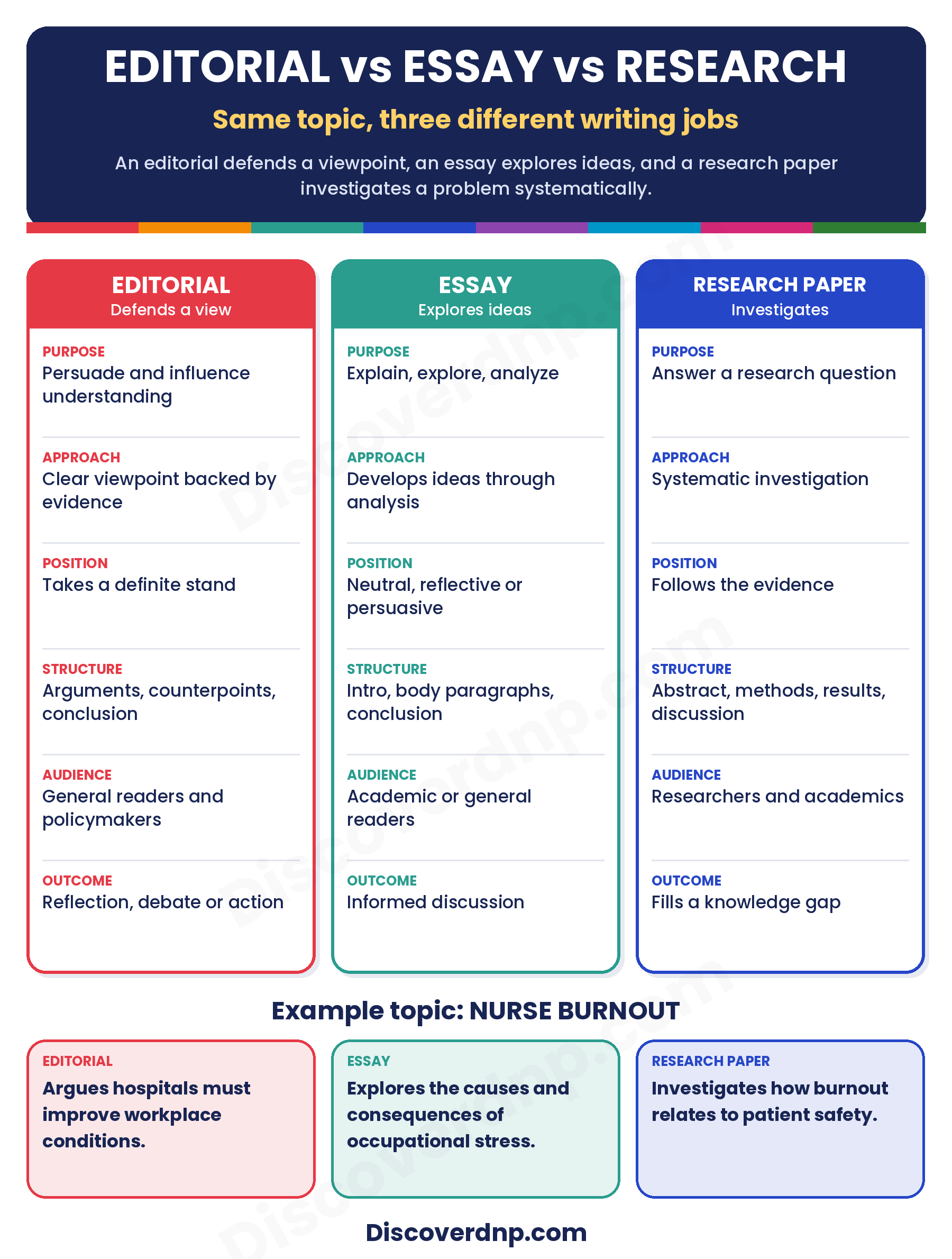
Editorial Structure and Essential Components
A well-written editorial requires more than a relevant topic and a convincing opinion. It must also have a clear structure that guides readers from an understanding of the issue to the writer’s position and the reasons supporting it. Editorial structure determines how information is introduced, how arguments are developed, how opposing viewpoints are addressed, and how the discussion reaches a meaningful conclusion.
Although editorial formats may vary depending on the publication, audience, and purpose, most effective editorials contain four essential components: an introduction that establishes the issue, body paragraphs that develop the central argument, counterarguments and rebuttals that demonstrate balanced reasoning, and a conclusion that reinforces the position and encourages appropriate action.
Each component has a specific purpose, but they should work together to create a unified editorial piece. For example, an editorial about improving nurse staffing should begin by explaining the staffing concern and its relevance to patient care. The body should develop arguments about workload, patient safety, and workforce retention, using credible evidence to support each point. The writer should then acknowledge concerns about recruitment costs and workforce availability before responding with practical recommendations. The conclusion should reinforce the importance of safe staffing and encourage healthcare organizations or policymakers to take appropriate measures.
Understanding these components helps writers organize their ideas, avoid unnecessary repetition, and ensure that every paragraph contributes to the central message.
Introduction and Background of the Issue
The introduction is the opening section of an editorial. Its primary purpose is to capture the reader’s attention, introduce the subject, establish the background, and communicate the writer’s central position. A strong introduction helps readers understand what the editorial is about and why the issue deserves their attention.
Unlike the introduction of a purely informational essay, an editorial introduction should do more than announce a topic. It should establish the problem or debate and prepare readers for the argument that follows. Since editorial writing aims to influence how readers understand or respond to an issue, the opening should create interest while providing enough context for the central viewpoint to make sense.
For example, an editorial about nurse burnout could begin by describing the growing demands placed on nurses in healthcare facilities. It might explain how excessive workloads, long shifts, emotional stress, and inadequate organizational support can affect professional well-being and the delivery of patient care. The introduction could then establish the writer’s position that healthcare organizations should treat nurse well-being as an essential component of patient safety.
A good introduction does not need to explain every aspect of the issue. Its purpose is to provide a clear starting point and encourage readers to continue.
1. Begin with an engaging opening statement
The opening sentence or paragraph should attract attention and encourage readers to consider the subject. An editorial can begin in several ways, depending on the nature of the issue and the intended audience.
Common approaches include:
- A relevant statistic: A verified statistic can immediately demonstrate the scale or seriousness of a problem. For example, an editorial about nursing shortages may begin with reliable workforce data showing a significant gap between healthcare staffing needs and available nursing personnel.
- A thought-provoking question: A question can encourage readers to reflect on an issue before the writer presents an argument. For example, Can healthcare facilities provide consistently safe patient care when nurses are expected to manage workloads that exceed available staffing resources?
- A brief scenario: A realistic situation can help readers understand the practical consequences of an issue. An editorial about patient handovers might begin with a scenario in which essential information about a patient’s allergies or medication changes is not communicated to the incoming care team.
- A recent development: A current policy change, healthcare announcement, or professional debate can establish why an issue is topical and deserves discussion.
- A direct statement: A strong opening claim can immediately communicate the importance of the subject. For example, Patient safety should never depend on whether a healthcare facility has enough time or personnel to provide essential nursing care.
The opening should be relevant to the editorial’s main argument. Writers should avoid using dramatic statements, exaggerated claims, or unrelated stories simply to attract attention. A compelling introduction should establish credibility from the beginning.
2. Introduce the editorial topic clearly
After attracting attention, the writer should identify the specific issue being discussed. Readers should not have to guess the subject or interpret vague statements to understand the purpose of the editorial.
For example, an editorial titled Why Healthcare Facilities Must Strengthen Infection Prevention Practices should introduce the concern of healthcare-associated infections and explain their relevance to patient safety. The writer may briefly mention how infections can increase treatment demands, prolong hospitalization, and create additional risks for vulnerable patients.
A clear introduction identifies the central concern without moving into a detailed explanation of every contributing factor. The more extensive discussion should appear in the body of the editorial.
When introducing the topic, consider explaining:
- What the issue is.
- Who is affected by it.
- Where or in what circumstances it occurs.
- Why it is important.
- What makes it worthy of discussion at the present time.
For instance, an editorial about limited access to maternal healthcare could identify the difficulties experienced by women in underserved communities, including geographical barriers, financial limitations, and inadequate availability of skilled maternity services. This gives readers a foundation for understanding the argument.
3. Provide sufficient background information
Background information helps readers understand the circumstances surrounding the issue. It may include relevant definitions, historical developments, current practices, policy information, statistics, or explanations of contributing factors.
The amount of background required depends on how familiar the intended audience is with the subject. A professional nursing publication may require less explanation of routine clinical concepts than a general newspaper or magazine addressing readers from different backgrounds.
For example, when discussing medication administration errors, the writer may briefly explain that these errors can occur during prescribing, dispensing, preparation, administration, or monitoring. The introduction might also mention that medication safety depends on several interconnected factors, including accurate documentation, effective communication, appropriate staffing, and adherence to established procedures.
However, background information should remain focused. An editorial is not a textbook chapter or a research paper, so the introduction should not become an extended explanation of the entire subject.
A useful approach is to provide only the information readers need to understand the problem and appreciate the writer’s position.
4. Explain why the issue matters
The introduction should establish the significance of the subject. This is particularly important when discussing a problem that may appear technical, specialized, or unrelated to the everyday experiences of some readers.
In nursing and healthcare, the significance of an issue may involve:
- Patient safety and clinical outcomes.
- Access to essential healthcare services.
- Professional well-being and working conditions.
- Healthcare costs and resource allocation.
- Ethical responsibilities and patient rights.
- Public health and community welfare.
- The quality and continuity of care.
For example, an editorial about patient confidentiality could explain that protecting personal health information is not merely an administrative responsibility. It is also essential to maintaining patient trust, respecting individual privacy, and preserving professional integrity.
The writer should make the connection between the subject and its consequences clear. Readers are more likely to engage with an editorial when they understand why the issue deserves attention.
5. Establish the central position or thesis statement
The thesis statement is one of the most important elements of the introduction. It communicates the writer’s main opinion and provides direction for the entire editorial.
A thesis should be clear, specific, and arguable. It should identify the position being defended rather than simply repeat the topic.
For example:
- Topic: Nurse burnout.
- Weak thesis: Nurse burnout is a major problem in healthcare.
- Stronger thesis: Healthcare organizations should introduce structured burnout prevention programs because supporting nurses’ well-being can strengthen workforce retention and contribute to safer patient care.
The stronger statement provides a clear viewpoint and identifies the reasoning that will guide the body paragraphs.
Other examples include:
- Nursing programs should expand simulation-based learning to strengthen clinical preparation and improve opportunities for practical skills development.
- Healthcare facilities should improve patient handover procedures through standardized communication practices to strengthen continuity and safety.
- Public health programs should prioritize community-based health education to improve awareness and prevention of noncommunicable diseases.
The thesis should appear early enough for readers to understand the editorial’s position. It may be expressed in one sentence or developed through a short concluding paragraph of the introduction, depending on the publication’s style.
6. Connect the introduction to the body of the editorial
The introduction should prepare readers for the arguments that follow. This can be achieved by briefly indicating the main areas the editorial will examine.
For example, an editorial arguing for improved nurse staffing may end its introduction by identifying the relationship between staffing levels, patient safety, professional well-being, and workforce retention.
This gives readers a general idea of the discussion without listing every supporting detail.
A well-constructed introduction should therefore move logically through the following progression:
- Capture attention with a relevant opening.
- Introduce the specific editorial topic.
- Provide necessary background information.
- Explain why the issue matters.
- Present the central thesis or viewpoint.
- Prepare readers for the supporting arguments.
Example of an editorial introduction
Safe patient care depends on more than the knowledge and commitment of individual nurses. It also requires healthcare facilities to provide working conditions that allow nursing professionals to meet patients’ needs effectively. However, excessive workloads, inadequate staffing, and limited organizational support can place considerable pressure on nurses and create challenges for the delivery of quality care. These concerns make nurse well-being an important issue for healthcare leaders, policymakers, and the wider community. Healthcare organizations should therefore prioritize nurse well-being through appropriate staffing, supportive leadership, and accessible workplace resources because protecting nurses’ health and professional capacity is closely connected to maintaining safe and effective patient care.
This example introduces the subject, explains its relevance, identifies contributing concerns, and establishes a clear thesis. It also provides a natural transition into the body of the editorial, where the writer can develop each supporting argument.
Body Paragraphs and Supporting Evidence
The body is the main section of an editorial. It contains the arguments, explanations, examples, and evidence that support the writer’s thesis. While the introduction establishes the issue and communicates the central position, the body explains why that position is reasonable and why readers should consider accepting it.
A well-developed body should not simply repeat the writer’s opinion in different words. Each paragraph should contribute a distinct point, supported by logical reasoning and relevant evidence. The arguments should be arranged in a sequence that helps readers understand the issue and follow the progression of the writer’s reasoning.
For example, an editorial arguing that healthcare facilities should strengthen patient education may develop its body around three main arguments: patient education improves understanding of health conditions, supports adherence to treatment plans, and encourages individuals to participate actively in their care. Each argument should be explained and supported with appropriate research, professional recommendations, or practical examples.
1. Organize the body around the main supporting arguments
Before drafting the body, identify the strongest reasons supporting the thesis. These reasons will form the foundation of the main paragraphs.
Most short editorials can be organized around two to four substantial supporting arguments, depending on the word limit and complexity of the issue. Longer editorials may include additional points, but every paragraph should remain relevant to the central position.
Consider the thesis:
Healthcare facilities should strengthen infection prevention practices through staff training, adequate resources, and regular monitoring to reduce preventable healthcare-associated infections.
The body could be organized into the following arguments:
- Argument 1: Infection prevention protects patient safety. Explain how healthcare-associated infections can increase complications, prolong hospitalization, and create additional treatment demands.
- Argument 2: Staff education improves adherence to prevention procedures. Discuss the importance of training in hand hygiene, personal protective equipment, environmental cleaning, and appropriate infection control practices.
- Argument 3: Healthcare organizations must provide adequate resources. Explain why staff cannot consistently implement infection prevention measures without access to essential supplies, equipment, and organizational support.
- Argument 4: Monitoring and accountability strengthen compliance. Discuss the role of audits, feedback, surveillance, and quality improvement activities in identifying gaps and improving practice.
This structure gives the editorial a clear direction. Each argument develops a different aspect of the thesis while contributing to the same central message.
2. Develop one main idea in each paragraph
Each body paragraph should focus on one central idea. This helps maintain clarity and prevents multiple unrelated arguments from competing for attention.
A paragraph about nurse burnout, for example, should not attempt to discuss workplace violence, medication errors, nursing education, and healthcare affordability all at once. These issues may be related to the wider healthcare environment, but they require separate explanations if they are important to the editorial’s central argument.
A useful paragraph structure includes:
- Topic sentence: Introduces the main point of the paragraph.
- Explanation: Clarifies the point and explains its relevance.
- Supporting evidence: Provides research findings, statistics, professional recommendations, or relevant examples.
- Analysis: Explains what the evidence means and why it supports the argument.
- Link to the thesis: Connects the paragraph’s main idea to the editorial’s overall position.
For example:
Appropriate nurse staffing is essential for maintaining patient safety because it influences the amount of time nurses can devote to individual patients. When nursing professionals are responsible for excessive patient assignments, they may experience difficulties completing assessments, administering medications, monitoring clinical changes, and providing timely patient education. Research examining nurse staffing and patient outcomes can help demonstrate the relationship between workload and the quality of care. These findings support the need for healthcare organizations to assess staffing requirements according to patient needs, clinical complexity, and available nursing resources.
This paragraph introduces a clear argument, explains its significance, identifies the type of evidence needed, and connects the discussion to the broader position.
3. Use topic sentences to guide readers
A topic sentence usually appears near the beginning of a body paragraph and communicates the main idea being developed. It acts as a guide, helping readers understand how the paragraph contributes to the editorial.
Examples include:
- Inadequate nurse staffing can create conditions that compromise the timely delivery of patient care.
- Effective discharge education helps patients understand their treatment responsibilities after leaving healthcare facilities.
- Protecting patient confidentiality is essential for maintaining professional trust and respecting individual rights.
- Structured clinical simulation provides opportunities to strengthen practical nursing skills in a controlled learning environment.
Topic sentences should be specific enough to establish an argument but broad enough to allow the paragraph to develop through explanation and evidence.
Writers should avoid vague openings such as There are many problems in healthcare or Another important issue is nursing. These statements do not communicate a clear point and may make the editorial feel repetitive.
4. Provide evidence to support every important claim
Supporting evidence is what distinguishes a well-researched editorial from an unsupported opinion piece. Evidence helps readers evaluate the strength of the writer’s position and understand why the argument deserves consideration.
Depending on the topic, evidence may include:
- Findings from peer-reviewed nursing and medical studies.
- Statistics from government and public health agencies.
- Professional standards and clinical guidelines.
- Reports from healthcare organizations.
- Expert explanations and documented examples.
- Relevant policy documents and healthcare assessments.
For instance, an editorial about improving maternal healthcare could use official statistics on maternal health outcomes, research examining barriers to antenatal care, and professional recommendations concerning skilled maternity services.
However, evidence should be directly relevant to the claim being made. A statistic about general healthcare spending may not adequately support an argument about the effectiveness of a particular nursing intervention unless the writer explains the connection.
It is also important to distinguish between strong evidence and anecdotal information. A personal story can illustrate the experience of a patient or nurse, but it should not be used as the only basis for a broad claim about healthcare systems.
5. Explain the significance of the evidence
One common weakness in editorial writing is presenting research findings without explaining their meaning. Evidence should not be included merely to make the article appear academic. The writer must show readers how the information supports the argument.
Consider the following example:
Research has identified an association between excessive nursing workloads and patient safety concerns.
This statement provides a general research-based claim, but it requires further explanation. The writer should discuss how workload may affect the time available for assessments, monitoring, communication, medication administration, and documentation. The discussion should also acknowledge that patient outcomes are influenced by several interacting factors.
A more developed explanation could be:
Research linking nursing workload with patient safety concerns highlights the importance of appropriate workforce planning. When nurses are responsible for more patients and competing clinical tasks, maintaining consistent observation, timely intervention, and effective communication may become more challenging. Although staffing is not the only factor influencing patient outcomes, healthcare organizations should consider workload as an important component of their patient safety strategies.
This approach interprets the evidence and explains its relevance without making an exaggerated claim.
6. Use examples to make complex arguments understandable
Examples help readers connect abstract concepts with practical situations. This is especially useful in nursing editorials because many healthcare issues involve clinical procedures, institutional policies, and professional responsibilities that may be unfamiliar to general audiences.
For example, an editorial about the importance of accurate patient documentation could explain a hypothetical situation in which a patient’s allergy information is not updated in the medical record. A healthcare professional relying on incomplete information may make a decision without being aware of a relevant risk. This example illustrates why documentation must be accurate, accessible, and regularly reviewed.
Other examples include:
- A patient who misunderstands medication instructions because discharge education was rushed.
- A nurse who struggles to recognize early deterioration because excessive workload limits opportunities for frequent assessment.
- A rural patient who misses follow-up care because transportation and access to healthcare services are limited.
- A healthcare worker who faces difficulty following infection prevention procedures because essential supplies are unavailable.
Examples should be relevant, realistic, and ethically appropriate. Writers should protect patient confidentiality and avoid presenting hypothetical scenarios as though they are verified clinical incidents.
7. Maintain logical progression between paragraphs
The body of the editorial should follow a logical sequence. Readers should be able to understand how one argument relates to the next and how the discussion develops the central thesis.
For example, an editorial advocating for improved nursing education could follow this progression:
- Explain why nursing education is important for professional competence.
- Discuss gaps in practical clinical preparation.
- Examine the role of simulation and supervised clinical experience.
- Explain the importance of mentorship and continuing professional development.
- Address the challenges of implementing educational improvements.
This progression moves from the general importance of education to specific areas requiring attention and possible solutions.
Transitions can help connect paragraphs and show relationships between ideas. Useful transitional expressions include:
- Furthermore.
- In addition.
- More importantly.
- Similarly.
- In contrast.
- For this reason.
- Consequently.
- Beyond these concerns.
- Another important consideration.
Transitions should be used naturally. Repeating the same expressions at the beginning of every paragraph can make the writing mechanical.
8. Balance persuasive language with professional reasoning
Editorial writing is persuasive, but it should not depend on emotional language alone. The writer should use confident, direct, and engaging language while maintaining accuracy and fairness.
For example, instead of writing:
Hospitals that fail to provide enough nurses are completely irresponsible and do not care about patients.
A more professional argument would be:
Healthcare organizations have a responsibility to assess staffing needs carefully and provide sufficient nursing resources to support safe patient care.
The second statement communicates a firm position without making unsupported accusations about the motives of healthcare administrators.
Persuasive language may emphasize the importance of patient safety, professional accountability, equitable healthcare access, or institutional responsibility. However, strong wording should always be supported by evidence and logical explanation.
9. Avoid repetition and unrelated information
Every paragraph should introduce or develop a meaningful point. Repeating the thesis without adding new reasoning weakens the body and reduces the editorial’s impact.
For example, an editorial about nurse burnout should not use several consecutive paragraphs to state that nurses experience stress. Instead, it should develop distinct aspects of the issue, such as contributing workplace conditions, consequences for professional well-being, potential patient safety implications, and evidence-based organizational responses.
Similarly, information that does not directly support the thesis should be removed or shortened. The body should remain focused on the issue rather than becoming a general discussion of nursing or healthcare.
10. Connect the final body paragraph to the conclusion
The last body paragraph should complete the development of the main arguments and prepare readers for the conclusion. It may discuss the most practical recommendations, the responsibilities of relevant stakeholders, or the broader implications of the issue.
For example, the final body paragraph of an editorial about patient safety might emphasize that improving safety requires more than individual vigilance. It may involve staff training, adequate resources, supportive leadership, effective reporting systems, and continuous quality improvement.
This creates a natural transition into the conclusion, where the writer can reinforce the central position and encourage action.
Counterarguments and Rebuttals
Counterarguments and rebuttals are important components of persuasive editorial writing because they demonstrate that the writer has considered different sides of an issue. A counterargument presents an opposing viewpoint or a reasonable objection to the writer’s position, while a rebuttal responds to that objection by explaining why the original argument remains convincing or why a proposed alternative is more appropriate.
Including counterarguments does not mean abandoning the central opinion. Instead, it shows that the writer understands the complexity of the subject and is prepared to address concerns that readers may have. An editorial that ignores every opposing viewpoint may appear biased or incomplete, particularly when discussing controversial healthcare policies or professional issues.
For example, an editorial may argue that hospitals should introduce minimum nurse staffing standards. Supporters may emphasize patient safety, workload management, and professional well-being. However, opponents may raise concerns about the availability of qualified nurses, implementation costs, and differences in patient acuity. A convincing editorial should acknowledge these concerns and explain how staffing policies can be designed to address them.
1. Understand the difference between a counterargument and a rebuttal
Although closely related, counterarguments and rebuttals serve different purposes.
- Counterargument: Presents a reasonable opposing position or identifies a weakness, limitation, or concern relating to the writer’s thesis.
- Rebuttal: Responds to the opposing position by challenging its reasoning, providing additional evidence, clarifying a misunderstanding, or explaining why the writer’s position remains stronger.
Consider an editorial advocating for increased clinical simulation in nursing education.
Main argument: Nursing programs should expand simulation-based learning to provide more opportunities for practical skills development.
Counterargument: Simulation laboratories require expensive equipment, trained instructors, and additional educational resources. Some critics may also argue that simulated experiences cannot fully reproduce the complexity of caring for actual patients.
Rebuttal: Although these limitations are important, simulation is not intended to replace clinical placements. It can complement supervised patient care by allowing learners to practise procedures, communication, clinical decision-making, and emergency responses in a controlled environment. With appropriate planning, simulation can strengthen practical preparation while maintaining real clinical experience as an essential part of nursing education.
The counterargument identifies legitimate concerns, while the rebuttal explains why those concerns do not necessarily invalidate the proposed approach.
2. Identify reasonable opposing viewpoints
Counterarguments should be based on genuine disagreements or practical concerns rather than positions invented to make the writer’s opinion appear stronger.
When researching an editorial topic, consider what a knowledgeable reader might question about the thesis or proposed solution.
For example, an editorial advocating for expanded telehealth services may encounter several objections:
- Some patients do not have reliable internet access or suitable digital devices.
- Remote consultations may be unsuitable for conditions requiring physical examination.
- Older adults or individuals with limited digital literacy may need additional assistance.
- Healthcare organizations may face costs involving technology, training, and data protection.
- Technical failures may interrupt communication and continuity of care.
These concerns are relevant because they identify practical limitations that could affect the success of telehealth programs.
The writer should examine the strongest objections, particularly those supported by evidence or professional experience. This helps produce a more thoughtful editorial than one that simply dismisses disagreement.
3. Present the opposing viewpoint fairly
A counterargument should accurately represent the position being challenged. Misrepresenting opposing opinions weakens credibility and may cause readers who hold those views to reject the editorial.
For example, consider the statement:
People who oppose mandatory staffing ratios do not care about nurses or patient safety.
This is an unfair characterization. Those who question mandatory ratios may support safe staffing but believe that fixed requirements do not adequately account for patient acuity, workforce availability, or differences between healthcare facilities.
A fairer presentation would be:
Although minimum nurse staffing ratios may strengthen accountability and protect patients, some healthcare administrators argue that fixed requirements can be difficult to implement in facilities facing workforce shortages or significant variations in patient needs.
This acknowledges the opposing concern without suggesting that every person holding that position has the same motives.
Fair representation is particularly important when writing about ethical disagreements, healthcare policies, professional regulations, and controversial public health issues.
4. Respond to counterarguments using evidence and reasoning
A rebuttal should do more than repeat the original thesis. It must explain why the opposing argument is incomplete, less persuasive, or manageable through appropriate changes.
Several approaches can be used.
- Challenge unsupported claims: Explain when an opposing argument is based on assumptions rather than credible evidence.
- Provide additional evidence: Use research or professional guidance to demonstrate why the original position remains reasonable.
- Identify overlooked factors: Explain aspects of the issue that the opposing argument does not adequately consider.
- Acknowledge limitations while defending the proposal: Recognize genuine challenges and explain how they can be addressed.
- Suggest a more practical approach: Modify the recommendation to account for legitimate concerns without abandoning its main purpose.
For example, an editorial may argue that healthcare organizations should introduce regular training to improve infection prevention compliance.
A counterargument might be that additional training increases staff workload and takes time away from patient care.
A possible rebuttal would be:
Although regular training requires time and organizational resources, infection prevention education should be considered an investment in patient safety. Healthcare facilities can reduce disruption by integrating training into scheduled professional development, using practical learning sessions, and providing ongoing feedback. These measures can help reinforce safe practices while allowing staff to maintain their clinical responsibilities.
This rebuttal acknowledges the concern and provides a practical response.
5. Distinguish between strong and weak rebuttals
A strong rebuttal addresses the actual objection and provides a reasoned explanation. A weak rebuttal simply dismisses disagreement or uses emotional language without evidence.
For example:
| Weak rebuttal | Stronger rebuttal |
|---|---|
| Staffing costs should not matter because patient safety is more important. | Although staffing improvements require financial investment, healthcare organizations should assess these costs alongside the potential consequences of inadequate staffing, including workforce instability and patient safety risks. |
| Anyone who disagrees with telehealth does not understand modern healthcare. | Telehealth offers opportunities to improve access, but its implementation should account for digital exclusion, clinical limitations, and patient privacy. |
| Simulation training is obviously better than traditional teaching. | Simulation can strengthen practical learning by providing structured opportunities to practise clinical skills, but it should complement rather than replace supervised clinical experience. |
| Hospitals should always use electronic records because they are more efficient. | Electronic records can improve information access and documentation, provided healthcare facilities address training requirements, system reliability, and data security. |
The stronger responses demonstrate critical thinking and professional judgment. They also avoid exaggerated claims that could undermine the editorial’s credibility.
6. Place counterarguments strategically
Counterarguments may be included in different parts of an editorial, depending on the complexity of the subject and the writer’s preferred structure.
Common approaches include:
- After the main supporting arguments: The writer first establishes the central position and then examines objections before responding to them.
- Within the relevant body paragraph: An opposing viewpoint is introduced immediately after the argument it challenges.
- In a separate paragraph before the conclusion: This approach works well when the editorial needs to examine one major objection in greater detail.
For example, an editorial about expanding rural healthcare services might first explain the problem of limited access, discuss the benefits of community-based nursing, and then address concerns about funding, staffing, and infrastructure. The writer could follow with a response explaining how phased implementation, workforce incentives, and collaboration with local services may help overcome these challenges.
Counterarguments should not interrupt the flow of every paragraph. The writer should include those that are most relevant to the thesis and likely to influence readers’ understanding of the issue.
7. Avoid giving opposing arguments more attention than the central position
Although fairness is important, the editorial should remain focused on the writer’s thesis. Spending too much time explaining opposing views can make the central argument difficult to identify.
For a short editorial, one or two significant counterarguments may be sufficient. A longer editorial may examine several objections, particularly when the issue involves complex clinical, financial, ethical, or policy considerations.
The amount of attention given to an opposing viewpoint should depend on its importance and the strength of the evidence behind it. Minor objections should not dominate the discussion at the expense of the main arguments.
8. Use counterarguments to refine the recommendation
Examining opposing views can reveal that the original thesis needs to be clarified or that a proposed solution requires modification.
For example, an editorial may initially argue that all healthcare facilities should adopt identical staffing ratios. After considering concerns about patient acuity, facility size, and workforce availability, the writer may develop a more nuanced position advocating for minimum staffing safeguards combined with patient acuity assessments and regular workforce reviews.
This adjustment does not necessarily weaken the argument. It can make the editorial more realistic and easier to defend because the writer has considered how the recommendation would work in different healthcare environments.
Example of a counterargument and rebuttal in an editorial
Editorial position: Healthcare organizations should provide structured mental health support for nurses.
Counterargument: Some healthcare administrators may argue that introducing formal mental health support programs requires additional funding, specialist personnel, and time away from clinical responsibilities. Facilities with limited budgets may find it difficult to prioritize these services alongside other operational demands.
Rebuttal: Although financial and staffing limitations must be considered, supporting nurses’ mental health is an important part of maintaining a sustainable healthcare workforce. Healthcare organizations can begin with practical measures such as confidential counseling referrals, peer support programs, manager training, and clear procedures for accessing professional assistance. These measures can be adapted to available resources and expanded as organizational capacity improves. Treating mental health support as part of workforce planning may also help address problems that contribute to absenteeism, dissatisfaction, and staff turnover.
This example demonstrates how a writer can recognize implementation challenges while maintaining a clear position. It also shows why rebuttals should offer reasoning and practical responses rather than simply rejecting the opposing viewpoint.
Conclusion and Call to Action
The conclusion is the final major component of an editorial. It brings the discussion together, reinforces the writer’s central position, and leaves readers with a clear understanding of why the issue matters. While the introduction establishes the topic and the body develops the supporting arguments, the conclusion reminds readers of the main message and explains what should happen next.
An effective conclusion should not introduce an entirely new argument or repeat the entire editorial word for word. Instead, it should synthesize the most important points, emphasize the significance of the issue, and provide a strong closing statement. Depending on the purpose of the editorial, it may also include a call to action that encourages readers, healthcare professionals, institutions, or policymakers to take specific steps.
For example, an editorial about improving nurse staffing could conclude by emphasizing that safe patient care depends on appropriate workforce planning, supportive working conditions, and institutional accountability. It could then encourage healthcare administrators to review staffing policies, assess patient needs, and invest in strategies that support nursing personnel.
1. Restate the central argument in fresh language
The conclusion should reinforce the thesis without copying the introduction exactly. Restating the main position reminds readers what the editorial has been arguing and gives the discussion a sense of completion.
For example, if the thesis states:
Healthcare organizations should prioritize nurse well-being through appropriate staffing, supportive leadership, and accessible workplace resources because protecting nurses’ health and professional capacity is closely connected to maintaining safe and effective patient care.
The conclusion might express the same position as follows:
Creating a healthier nursing workforce requires healthcare organizations to move beyond recognizing workplace stress as an individual challenge and address the conditions that contribute to it. Appropriate staffing, supportive leadership, and accessible professional resources should become essential parts of institutional efforts to protect both nurses and patients.
The second statement reinforces the original position while presenting it in a broader and more reflective way.
2. Summarize the most important supporting arguments
A conclusion should bring together the central points developed in the body. This helps readers remember the strongest reasons supporting the editorial’s viewpoint.
For example, an editorial advocating improved patient education may summarize that clear communication helps patients understand their conditions, supports informed decision-making, and encourages appropriate participation in treatment and self-care.
The summary should focus on the main ideas rather than repeating every statistic, example, or supporting detail. A concise synthesis is more effective than a lengthy repetition of the body paragraphs.
A useful approach is to identify the two or three arguments that most strongly support the thesis and explain how they connect to the wider issue.
3. Emphasize the significance of the issue
The conclusion should remind readers why the subject deserves attention. This may involve emphasizing the consequences of inaction, the benefits of improvement, or the wider implications for healthcare professionals, patients, and communities.
For example, an editorial about medication safety could explain that preventable medication errors can affect patient health, increase treatment demands, and undermine confidence in healthcare services. Strengthening medication safety practices is therefore not merely an administrative responsibility but an important part of protecting patients.
The writer should avoid introducing alarming consequences that were not established in the body. The closing emphasis should follow logically from the evidence and arguments already presented.
4. Include a clear call to action
A call to action is a statement that encourages readers or relevant stakeholders to respond to the issue. It transforms the editorial from a discussion of what is wrong into an argument about what should be done.
The appropriate call to action depends on the editorial’s subject, audience, and purpose.
For example:
- For healthcare administrators: Review staffing policies, provide appropriate resources, and establish systems for monitoring patient safety.
- For policymakers: Develop and strengthen healthcare policies that improve access, workforce planning, and the quality of services.
- For nursing professionals: Participate in professional development, advocate for safe practices, and report concerns through appropriate channels.
- For nursing educators: Strengthen practical training, promote evidence-based learning, and provide adequate clinical supervision.
- For patients and communities: Participate in health education, seek reliable information, and communicate concerns about healthcare access and treatment.
- For professional organizations: Advocate for appropriate standards, support research, and promote policies that strengthen nursing practice.
A call to action should identify a realistic response rather than simply telling readers to care about the issue.
For example, instead of ending an editorial about patient safety with Everyone must do more to protect patients, the writer could state:
Healthcare leaders should review existing patient safety procedures, strengthen staff training, and establish reliable systems for reporting and learning from clinical errors.
The second statement is more effective because it identifies specific actions and the stakeholders responsible for implementing them.
5. Make recommendations practical and achievable
A strong editorial conclusion should avoid recommendations that sound impressive but are too general or unrealistic to implement. Practical recommendations are more persuasive because they demonstrate that the writer has considered how change could occur.
For example, an editorial advocating better access to mental health services might recommend:
- Integrating basic mental health screening into appropriate primary healthcare services.
- Improving referral pathways to qualified mental health professionals.
- Providing continuing education for healthcare workers.
- Expanding community-based mental health awareness programs.
- Strengthening access to confidential counseling and support services.
The recommendations should be connected to the arguments developed in the body. If the editorial discusses limited access to rural healthcare, its call to action should address relevant barriers such as service availability, workforce distribution, transportation, or affordability.
A conclusion should also recognize when responsibility is shared. Improving patient safety, for instance, may require coordinated action from nurses, healthcare administrators, policymakers, professional organizations, and patients.
6. End with a memorable closing statement
The final sentence should leave readers with a clear and meaningful impression of the editorial’s central message. It may reinforce the writer’s position, emphasize professional responsibility, highlight the importance of change, or encourage reflection.
Examples include:
- Protecting patients begins with building healthcare environments in which nurses have the resources, support, and working conditions needed to provide safe care.
- Patient confidentiality should remain a fundamental professional responsibility in every healthcare setting, regardless of how quickly technology changes.
- Investing in nursing education is an investment in the competence, confidence, and quality of the future healthcare workforce.
- Access to essential healthcare should not depend on where a person lives or their ability to overcome avoidable financial and geographical barriers.
A memorable closing statement should be strong but not exaggerated. It should reinforce the editorial’s message rather than introduce an unrelated slogan or emotional appeal.
7. Avoid common weaknesses in editorial conclusions
Several mistakes can reduce the effectiveness of the closing section:
- Introducing new arguments: Major claims should be developed in the body rather than appearing for the first time in the conclusion.
- Repeating the introduction word for word: The conclusion should reinforce the thesis using fresh language and a broader perspective.
- Adding excessive detail: Repeating every example and research finding makes the ending unnecessarily long.
- Using vague recommendations: Statements such as something must be done do not explain what action is needed.
- Making unrealistic demands: Recommendations should consider the resources, responsibilities, and circumstances relevant to the issue.
- Ending abruptly: The conclusion should provide a clear sense of closure rather than stopping immediately after the final supporting argument.
- Using unsupported emotional claims: Strong closing language should remain consistent with the evidence presented throughout the editorial.
Example of an editorial conclusion
Improving nurse well-being is an essential part of building a safer and more sustainable healthcare system. Excessive workloads, inadequate staffing, and limited workplace support can affect nurses’ professional well-being and create challenges for the delivery of quality patient care. Addressing these concerns requires healthcare organizations to recognize the relationship between workforce conditions and patient safety rather than treating burnout as an individual responsibility. Healthcare leaders should prioritize appropriate staffing, supportive management, access to professional resources, and effective workplace policies. Protecting nurses is not separate from protecting patients; it is an important part of creating healthcare environments where both can thrive.
This conclusion restates the central position, synthesizes the main concerns, identifies the responsibility of healthcare organizations, and ends with a clear statement that reinforces the editorial’s purpose.
How the essential components work together
The introduction, body, counterarguments, rebuttals, and conclusion should form one connected line of reasoning. Each component should prepare readers for the next and contribute to the same central message.
| Editorial component | Main purpose | What it should contain |
|---|---|---|
| Introduction and background | Introduce the issue and establish the writer’s position | Engaging opening, context, significance, and thesis |
| Body paragraphs | Develop and support the central argument | Topic sentences, explanations, evidence, examples, and analysis |
| Counterarguments and rebuttals | Demonstrate balanced reasoning and respond to objections | Fair presentation of opposing views and evidence-based responses |
| Conclusion and call to action | Reinforce the position and encourage appropriate action | Summary of key arguments, significance, recommendations, and closing statement |
For example, an editorial about strengthening patient handover procedures would introduce communication failures as a patient safety concern, develop arguments about continuity of care and information accuracy, acknowledge challenges involving time and staff workload, and respond by recommending practical standardized procedures. Its conclusion would reinforce the importance of effective communication and encourage healthcare organizations to strengthen handover practices.
A clear structure makes editorial writing easier to follow and more persuasive. When the introduction establishes a meaningful issue, the body provides credible evidence, counterarguments are addressed fairly, and the conclusion offers a practical direction, the editorial becomes a coherent and purposeful opinion piece. These components also help ensure that the writer’s viewpoint is not merely expressed but carefully developed, explained, and supported throughout the entire discussion.
Writing and Refining Your Editorial
Writing an effective editorial involves more than expressing a personal opinion about an important issue. It requires organizing ideas, developing convincing arguments, selecting appropriate language, and presenting information in a way that encourages readers to consider a particular viewpoint. After choosing a relevant editorial topic and conducting research, the next stage is transforming the collected information into a well-structured and persuasive editorial piece.
The writing process generally begins with an outline that establishes the direction of the discussion. The writer then develops a first draft, using evidence and logical reasoning to support the central argument. Once the main ideas have been presented, attention shifts to persuasive language, professional tone, revision, and editing. Each stage contributes to the editorial’s overall quality, readability, and credibility.
In nursing and healthcare, careful editorial writing is especially important because the subjects often involve patient safety, professional ethics, healthcare policies, and decisions that affect individuals and communities. For example, an editorial advocating for better nurse staffing should not rely solely on emotional statements about nurses being overworked. It should explain how staffing levels influence workload, clinical judgment, patient monitoring, and quality of care while using credible evidence to support its position.
A good editorial should be engaging without being sensational, persuasive without being misleading, and opinion-based without disregarding facts. The following practices help writers develop a coherent argument and produce an editorial that communicates its message effectively.
Creating an Editorial Outline and First Draft
An editorial outline provides a framework for organizing the main ideas before writing the complete article. It helps the writer determine what information belongs in the introduction, how supporting arguments should be arranged in the body of the editorial, where opposing viewpoints should be addressed, and how the conclusion should reinforce the central message.
Without an outline, editorial writing can become repetitive, disorganized, or overly focused on background information. Writers may introduce several arguments without explaining their relationship to the thesis, or they may include evidence that does not directly support their position. An outline reduces these problems by establishing a logical sequence for the discussion.
1. Establish the central purpose and position
Before creating an outline, determine what the editorial is intended to accomplish. Some editorials seek to persuade readers to support a particular policy, while others criticize an existing practice, encourage professional reflection, or recommend improvements to a social or healthcare problem.
The writer should identify the main issue, the intended audience, and the position they want readers to understand or consider. This position should be expressed in a clear thesis statement that guides the entire writing process.
For example, consider the editorial topic of nurse well-being and patient safety. A writer may establish the following purpose:
- Topic: Nurse well-being and patient safety.
- Purpose: To persuade healthcare administrators to introduce stronger workplace support systems for nurses.
- Central position: Healthcare organizations should prioritize nurse well-being because safe working conditions, manageable workloads, and adequate organizational support contribute to better patient care.
- Target audience: Healthcare administrators, nursing leaders, policymakers, and nursing professionals.
This preparation prevents the editorial from becoming a general discussion of workplace stress. Instead, it directs attention toward a specific problem and a practical position.
2. Arrange the editorial into its main components
After establishing the thesis, divide the editorial into its essential sections. Each section should have a specific purpose and contribute to the development of the overall argument.
A basic editorial outline may include the following:
| Editorial component | Information to include | Purpose |
|---|---|---|
| Introduction | Opening statement, background, significance of the issue, and thesis | Introduces the subject and establishes the writer’s position |
| First body paragraph | First major supporting argument and relevant evidence | Begins developing the central argument |
| Second body paragraph | Additional supporting argument, explanation, and examples | Strengthens the writer’s position |
| Third body paragraph | Further supporting argument or practical implications | Demonstrates the broader significance of the issue |
| Counterargument and rebuttal | An opposing viewpoint and a reasoned response | Demonstrates fairness and strengthens credibility |
| Conclusion | Restatement of the central position, summary of main ideas, and call to action | Reinforces the message and encourages a response |
The number of body paragraphs depends on the complexity of the editorial, the intended word count, and the amount of evidence available. A short newspaper editorial may contain only a few paragraphs, while a more detailed healthcare opinion piece may require several sections to explain the issue adequately.
3. Develop supporting points under each section
Once the main structure is established, identify the specific points that will be discussed in each paragraph. These points should be distinct rather than repeating the same argument in different words.
For example, an editorial supporting improved nurse well-being could organize its body around three arguments:
- Workforce retention: Excessive workloads, inadequate support, and burnout can contribute to nurses leaving their positions, increasing staffing difficulties.
- Patient safety: Fatigue and excessive demands can affect concentration, communication, clinical judgment, and the ability to monitor patients effectively.
- Organizational responsibility: Healthcare institutions should provide adequate staffing, supportive leadership, access to mental health resources, and opportunities for professional development.
This organization gives each paragraph a separate responsibility. It also makes it easier to select evidence that directly supports the relevant point.
A useful approach is to write a brief topic sentence for each planned paragraph. These sentences act as reminders of what the paragraph should establish. For instance, a paragraph about patient safety might begin with the statement:
Supporting nurse well-being is an important patient safety measure because exhausted and overburdened healthcare professionals may struggle to maintain the level of attention required for consistent clinical care.
The writer can then identify the research findings, professional examples, and explanations needed to develop that argument.
4. Organize evidence and examples before drafting
Research should be arranged according to the arguments it supports. Rather than placing all collected information into the editorial, select the most relevant findings and decide where each one belongs.
For example, research concerning nursing burnout may support an argument about workforce retention, while evidence connecting fatigue with clinical performance may be more appropriate in a paragraph about patient safety.
An evidence organization table can help:
| Main argument | Evidence or information required | How it supports the thesis |
|---|---|---|
| Nurse well-being affects retention | Research on burnout, job satisfaction, and intention to leave | Explains how workplace conditions influence workforce stability |
| Fatigue may affect patient safety | Evidence concerning fatigue, concentration, errors, and clinical performance | Connects staff working conditions with the quality and safety of care |
| Organizational support is necessary | Evidence on staffing policies, leadership, wellness programs, and workplace interventions | Supports recommendations for institutional action |
The writer should also record the publication details of sources while researching to avoid losing track of where information originated. Statistics should be presented in context, and findings should not be exaggerated beyond what the research demonstrates.
5. Write the first draft without focusing excessively on perfection
Once the outline and supporting evidence are ready, begin developing the complete editorial. The first draft should focus on expressing the main ideas in a logical sequence rather than achieving perfect wording immediately.
Start with an introduction that establishes the issue and communicates the thesis. Develop each supporting argument in its own paragraph, incorporating evidence and explanations. Include relevant opposing viewpoints where appropriate, and conclude by reinforcing the position and recommending a practical response.
For example, a first-draft paragraph about nurse staffing might read:
Inadequate nurse staffing creates challenges for both healthcare professionals and patients. When nurses are responsible for more patients than they can safely manage, they may have less time for assessments, medication administration, patient education, and ongoing monitoring. These pressures can affect the consistency of care and increase the likelihood that important changes in a patient’s condition will go unnoticed. Healthcare organizations should therefore examine staffing practices and establish workload expectations that support safe nursing care.
This paragraph introduces a specific concern, explains its potential consequences, and connects the discussion to a recommendation. During later revision, the writer can strengthen the wording, incorporate relevant research, and clarify any claims that require additional evidence.
6. Maintain focus throughout the first draft
An editorial should remain centered on its main argument. Although background information and related examples can help readers understand the issue, unnecessary details may weaken the discussion.
For example, an editorial about preventing medication errors should not spend several paragraphs discussing every type of nursing workplace challenge. It should concentrate on factors directly connected to medication safety, such as interruptions, communication failures, medication reconciliation, staff workload, and institutional safety procedures.
During drafting, consider the following questions:
- Does each paragraph contribute to the central argument?
- Are the supporting points clearly connected to the thesis?
- Have the main ideas been presented in a logical order?
- Is there sufficient evidence to support important claims?
- Have different sides of the issue been considered fairly?
- Does the discussion remain appropriate for the intended audience?
- Does the conclusion follow naturally from the arguments presented?
Creating an outline and first draft gives editorial writing direction and structure. It also makes revision more manageable because the writer can identify weaknesses in the argument before concentrating on individual sentences.
Using Persuasive Language and Professional Tone
Persuasive language is an essential feature of editorial writing because the writer is attempting to influence how readers understand an issue or respond to a proposed solution. Unlike purely descriptive writing, which mainly explains information, an editorial presents a particular viewpoint and uses evidence, reasoning, and carefully selected language to encourage readers to consider that position.
However, effective persuasion does not depend on exaggerated statements, aggressive wording, or emotional pressure. A good editorial combines clear reasoning with language that makes the issue meaningful to its audience. In nursing and healthcare, maintaining a professional tone is particularly important because editorial arguments may involve clinical practice, ethical responsibilities, patient experiences, and institutional policies.
1. Use clear and direct language
The language used in an editorial should communicate the writer’s position without making readers struggle to understand the message. Complex terminology, unnecessarily long sentences, and vague expressions can weaken an otherwise strong argument.
For example, consider the following statements:
- Unclear: The current operational arrangements within healthcare institutions may create circumstances that are potentially unfavorable to the optimal execution of professional nursing responsibilities.
- Clearer: Poor working conditions can prevent nurses from consistently delivering safe and effective care.
The second statement communicates the concern more directly. It also allows the writer to develop the argument using specific examples and evidence.
Clear language is particularly important when writing for a variety of audiences. A healthcare editorial may be read by nurses, administrators, policymakers, patients, and members of the public. Although some readers may understand specialized medical terminology, others may not. Technical terms should therefore be explained when they are necessary to the discussion.
2. Use evidence-based statements to strengthen persuasion
Persuasive writing becomes more credible when opinions are supported by reliable evidence. A writer should not assume that a statement becomes convincing simply because it is expressed confidently.
For example:
- Weak statement: Nurses are always overworked, and this makes it impossible for them to provide quality care.
- Stronger statement: Excessive workloads and inadequate staffing can limit the time nurses have for patient assessments, communication, and ongoing monitoring, creating challenges for care quality and safety.
The stronger statement avoids an unsupported absolute claim and identifies specific ways that workload may affect nursing practice.
When research findings are available, they should be incorporated accurately. For example, a writer discussing hospital-acquired infections may refer to evidence concerning hand hygiene compliance, infection prevention procedures, staffing conditions, or implementation of safety protocols. The editorial should explain how the evidence supports the argument rather than simply inserting statistics without interpretation.
Evidence-based persuasion is particularly important when addressing controversial issues. It demonstrates that the writer has considered the available information and developed an informed opinion rather than relying exclusively on personal beliefs.
3. Appeal to logic, credibility, and emotion
Effective editorial writing can use three complementary forms of persuasion: logical reasoning, credibility, and emotional connection.
- Logical appeal: This involves using facts, research findings, examples, and cause-and-effect reasoning to demonstrate why an argument is reasonable. For instance, an editorial supporting better medication safety procedures may explain how standardized medication reconciliation can help identify discrepancies between prescribed and existing medications.
- Credibility appeal: This involves demonstrating knowledge, fairness, and responsible use of evidence. Writers can strengthen credibility by relying on established research, acknowledging limitations, representing opposing views accurately, and avoiding claims beyond their expertise.
- Emotional appeal: This involves helping readers understand the human significance of an issue. A discussion of maternal healthcare access, for example, may describe how delayed access to appropriate care can affect pregnant women and their families. Such examples can make the issue more meaningful without replacing factual evidence.
These appeals work best when balanced. An editorial that relies only on statistics may seem disconnected from the experiences of affected individuals, while one that depends entirely on emotional stories may lack sufficient evidence to support its conclusions.
For example, an editorial about patient safety can combine research on preventable medication errors with an anonymized clinical scenario illustrating how a communication failure may affect a patient’s treatment. The research establishes the broader concern, while the scenario helps readers appreciate its practical consequences.
4. Choose persuasive words without exaggeration
Word choice influences how readers interpret an editorial. Strong verbs and precise expressions can make an argument more compelling, while vague or exaggerated language can undermine credibility.
Consider the difference between these expressions:
| Less effective wording | More effective wording |
|---|---|
| Things should be done about nurse shortages. | Healthcare organizations should introduce practical measures to address nurse shortages. |
| Patient safety is very important. | Patient safety must remain a central priority in healthcare delivery. |
| Hospitals are doing a terrible job of supporting nurses. | Some healthcare institutions need stronger systems for supporting nursing staff. |
| This problem is extremely bad for everyone. | This problem can affect nurses, patients, and the wider healthcare system. |
| People need to understand the issue. | Healthcare leaders and policymakers should recognize the consequences of the issue and respond appropriately. |
Persuasive words such as essential, significant, urgent, responsible, prevent, strengthen, improve, and prioritize can help communicate the importance of an argument. Nevertheless, the writer should select language that accurately reflects the evidence.
Avoid words such as always, never, completely, and everyone when the available evidence does not justify such broad statements. Absolute claims are particularly problematic in healthcare because clinical outcomes and workplace experiences can vary across populations and settings.
5. Use rhetorical questions and thought-provoking statements selectively
Rhetorical questions can encourage readers to reflect on an issue without requiring a direct response. They are particularly useful in introductions and transitions where the writer wants to emphasize the importance of a concern.
For example:
How can healthcare institutions consistently prioritize patient safety while overlooking the working conditions of the professionals responsible for delivering care?
This question encourages readers to consider the relationship between nurse well-being and patient outcomes. It also introduces the editorial’s central argument.
Thought-provoking statements can serve a similar purpose:
Patient safety is not determined only by clinical equipment and treatment protocols; it is also influenced by the conditions under which healthcare professionals work.
Such statements can help readers recognize a broader dimension of an issue. However, rhetorical questions should not replace evidence or logical explanation. Using too many questions may make an editorial sound like a speech rather than a carefully developed opinion piece.
6. Maintain a professional and respectful tone
A professional tone demonstrates that the writer takes the subject seriously and respects readers who may hold different opinions. This is especially important when discussing controversial healthcare issues, institutional failures, professional disagreements, or ethical dilemmas.
A professional editorial should:
- Criticize policies, practices, or decisions rather than personally attacking individuals.
- Use respectful language when discussing opposing viewpoints.
- Avoid insults, sarcasm, discriminatory expressions, and inflammatory descriptions.
- Distinguish personal opinions from established facts.
- Recognize uncertainty when evidence is limited or conflicting.
- Avoid assigning blame without adequate information.
- Use clinical and professional terminology accurately.
- Protect patient confidentiality when referring to clinical experiences.
For example, when criticizing a hospital’s response to nursing shortages, the writer should avoid statements such as:
Hospital administrators do not care about nurses or patients.
This statement assumes motives and makes a broad accusation that may be difficult to support.
A more professional alternative would be:
Healthcare administrators should evaluate whether existing staffing policies adequately address nurses’ workloads and the safety needs of patients.
The revised statement focuses on institutional responsibility and proposes an area for improvement without making an unsupported personal accusation.
7. Adapt the language to the intended audience and publication
Editorial writing should consider who will read the article and where it will appear. The language, level of technical detail, and style may differ between a school newspaper, a professional nursing publication, a healthcare magazine, and a general newspaper.
For example:
- General newspaper: An editorial about rising healthcare costs should use accessible language and explain technical concepts that may be unfamiliar to the public.
- Professional nursing publication: An editorial about evidence-based practice may include more specialized terminology and detailed discussion of clinical guidelines.
- School newspaper: An editorial about nursing education may use a straightforward style that encourages discussion among students, educators, and the wider academic community.
- Healthcare magazine: An editorial about digital health technology may combine professional explanations with practical examples of how technology affects patients and healthcare workers.
Adapting the language does not mean changing the central position to please a particular audience. It means presenting the argument in a way that readers can understand and evaluate.
8. Use transitions to maintain a smooth flow
Transitions connect sentences and paragraphs, helping readers follow the development of an argument. Without appropriate transitions, an editorial may appear to contain disconnected observations rather than a coherent discussion.
Useful transitional expressions include:
- To introduce another argument: Furthermore, additionally, another important consideration is.
- To explain cause and effect: Consequently, as a result, therefore, this can lead to.
- To introduce contrasting viewpoints: However, nevertheless, although, on the other hand.
- To provide examples: For instance, for example, in clinical practice.
- To emphasize significance: More importantly, notably, of particular concern.
- To introduce a conclusion: For these reasons, in view of these concerns, therefore.
For example:
Inadequate staffing can increase the workload placed on individual nurses. Furthermore, prolonged periods of excessive workload may contribute to fatigue and burnout, creating additional challenges for workforce retention.
The transition furthermore connects the second argument to the first while showing that the discussion is progressing.
Transitions should be used naturally rather than inserted into every paragraph. The relationship between ideas should determine which expression is appropriate.
Revising and Editing for Clarity and Accuracy
The first draft of an editorial is rarely ready for publication. Even when the writer has conducted thorough research and developed strong arguments, the initial version may contain unnecessary repetition, unclear sentences, weak transitions, unsupported claims, or grammatical errors.
Revision and editing help transform the initial draft into a coherent, accurate, and persuasive editorial. Although these activities are related, they serve different purposes. Revision focuses on improving the content, organization, reasoning, and overall effectiveness of the editorial, while editing concentrates on improving sentence construction, grammar, punctuation, spelling, and consistency.
Both stages are necessary because an editorial can contain valuable ideas but still fail to persuade readers if the arguments are poorly organized or the writing is difficult to understand.
1. Review the editorial’s central argument
The first stage of revision is evaluating whether the editorial communicates a clear and consistent position. The writer should reread the complete draft and determine whether the thesis is adequately developed throughout the discussion.
Ask the following questions:
- Is the central position clear in the introduction?
- Does every major paragraph contribute to the main argument?
- Are the supporting points sufficiently developed?
- Does the conclusion reflect the position established in the introduction?
- Has the editorial maintained a consistent viewpoint?
- Are any sections unrelated to the main issue?
For example, an editorial may begin by arguing that healthcare institutions should improve nurse well-being to strengthen patient safety. However, the body may gradually shift into a general discussion of nursing salaries, educational requirements, and career advancement without explaining how these subjects relate to the thesis.
During revision, the writer should either connect these points to the central argument or remove them if they distract from the discussion.
2. Improve the organization and flow of ideas
A well-written editorial should present arguments in a logical sequence. Readers should be able to understand how one point connects to the next and why each section is necessary.
During revision, examine the introduction, body paragraphs, counterarguments, and conclusion as a complete structure.
For example, an editorial about reducing medication errors might organize its arguments as follows:
- Introduce the frequency and significance of medication errors as a patient safety concern.
- Explain how communication failures and medication reconciliation problems contribute to medication discrepancies.
- Discuss the importance of standardized medication administration procedures.
- Examine the role of technology, staff training, and institutional safety policies.
- Address concerns about implementation costs or increased staff workload.
- Recommend practical measures for improving medication safety.
This progression moves from identifying the problem to explaining its causes, examining possible solutions, and recommending action.
Revision may also involve combining paragraphs that discuss similar ideas, dividing paragraphs that contain too many unrelated points, or moving information to a more appropriate section.
3. Check the strength and relevance of supporting evidence
Every important factual claim should be supported by appropriate information. Writers should examine whether the research, statistics, examples, and professional observations included in the editorial genuinely support the argument.
For instance, if an editorial argues that nurse burnout affects patient safety, evidence about burnout alone may not be sufficient to establish every aspect of the relationship. The writer should also consider research examining fatigue, clinical performance, patient outcomes, communication, or other relevant factors.
When reviewing evidence, consider:
- Relevance: Does the information directly support the argument being made?
- Credibility: Does the source come from a reliable and appropriate publication or organization?
- Accuracy: Have statistics, research findings, and quotations been represented correctly?
- Currency: Is the information recent enough for the subject being discussed?
- Context: Have the population, setting, and limitations of the research been considered?
- Interpretation: Does the explanation accurately reflect what the evidence demonstrates?
For example, if a study examines nurse burnout in a particular hospital setting, the writer should not automatically present its findings as representative of every healthcare institution. The discussion should recognize the study’s context and avoid generalizations that extend beyond the available evidence.
The writer should also distinguish between correlation and causation. If two factors are associated, that does not necessarily establish that one directly causes the other. Careful interpretation protects the editorial’s credibility.
4. Remove unnecessary repetition and irrelevant information
Repetition can make an editorial longer without making its argument stronger. Although some repetition is useful when reinforcing the thesis, repeatedly expressing the same idea in slightly different words can frustrate readers.
For example:
Burnout affects nurses because they experience stress at work. Nurses who experience workplace stress may develop burnout, and this burnout can make their working conditions stressful.
The paragraph repeats the relationship between stress and burnout without adding meaningful information.
A more effective version would be:
Prolonged workplace stress can contribute to nurse burnout, affecting job satisfaction, professional performance, and workforce retention.
The revised statement communicates the idea more efficiently and allows the writer to develop additional arguments elsewhere.
During revision, remove:
- Repeated explanations of the same point.
- Background information that does not help readers understand the issue.
- Examples that do not strengthen the argument.
- Excessive definitions of familiar terms.
- Unnecessary quotations that could be explained more effectively in the writer’s own words.
- Sentences that introduce ideas without developing or connecting them to the thesis.
Concise writing does not mean removing important explanations. The aim is to eliminate unnecessary material while preserving the information readers need to understand the argument.
5. Strengthen weak arguments and address gaps in reasoning
An editorial may contain a clear thesis but still fail to persuade if its supporting arguments are incomplete. Revision should identify statements that require additional explanation, evidence, or qualification.
For example:
Hospitals should introduce electronic medication administration systems because technology prevents all medication errors.
This argument is weak because it assumes that technology can eliminate every medication error. It also ignores problems such as incorrect data entry, system failures, inadequate training, and errors in clinical judgment.
A stronger version would be:
Electronic medication administration systems can support medication safety by improving documentation, strengthening identification procedures, and providing alerts for certain prescribing or administration risks. However, their effectiveness depends on appropriate implementation, staff training, and continued clinical judgment.
The revised argument is more balanced and realistic. It acknowledges the benefits of technology while recognizing its limitations.
Writers should also revisit counterarguments to determine whether opposing positions have been represented fairly. A strong editorial does not need to agree with every opposing viewpoint, but it should explain why the writer’s position remains reasonable despite those concerns.
6. Edit sentences for clarity and readability
After improving the overall argument and organization, review individual sentences. The objective is to make the editorial easy to read while preserving its intended meaning.
Look for:
- Overly long sentences containing several unrelated ideas.
- Vague expressions that do not communicate a specific point.
- Unnecessary technical terminology.
- Repeated words and phrases.
- Passive constructions that make responsibility unclear.
- Ambiguous pronouns and references.
- Wordy expressions that can be simplified.
For example:
- Wordy: Due to the fact that nurses are often required to work for extended periods of time, they may experience difficulties in relation to maintaining adequate levels of concentration.
- Clearer: Extended working hours can make it difficult for nurses to maintain concentration.
The revised sentence communicates the same general idea more directly.
Sentence variety is also important. A mixture of shorter and longer sentences creates a natural rhythm and prevents the editorial from sounding monotonous. Short sentences can emphasize important points, while longer sentences can explain relationships between complex ideas.
7. Check grammar, spelling, punctuation, and consistency
Proofreading is the final stage of preparing an editorial. It focuses on correcting technical writing errors that may distract readers or reduce the professionalism of the article.
The writer should check:
- Subject-verb agreement.
- Correct verb tenses.
- Proper sentence construction.
- Correct use of commas, periods, apostrophes, and semicolons.
- Consistent capitalization.
- Correct spelling of medical and nursing terminology.
- Appropriate use of abbreviations.
- Consistent formatting of headings and paragraphs.
- Accurate presentation of names, dates, statistics, and professional titles.
For example, a sentence such as The nurses provides essential patient care contains a subject-verb agreement error. The correct version is The nurses provide essential patient care.
Consistency in terminology is also important. If the editorial uses the term healthcare professionals in one section and health workers in another, the writer should ensure that the terms are being used appropriately and do not create confusion about the population being discussed.
For healthcare topics, special attention should be given to clinical terms, medication names, disease classifications, and professional designations. Incorrect terminology can undermine the accuracy of an otherwise well-written editorial.
8. Verify factual accuracy and ethical responsibility
Editorial writing should distinguish clearly between established facts, research findings, professional interpretations, and personal opinions. This is especially important when discussing sensitive issues such as medical errors, patient complaints, professional misconduct, or healthcare institutional performance.
Before publication, verify that:
- Statistics have not been altered or taken out of context.
- Clinical claims are consistent with available evidence.
- Quotations accurately represent the original statements.
- Research findings have not been exaggerated.
- Patient identities and confidential information are protected.
- Allegations about individuals or institutions are supported by reliable information.
- Recommendations do not present personal opinions as universally accepted clinical standards.
For example, a writer discussing a medication error should not include identifiable patient information or confidential hospital details merely to make the editorial more compelling. A hypothetical or appropriately anonymized example can explain the issue without compromising privacy.
Ethical accuracy also requires acknowledging limitations. If research on a particular intervention is still developing, the editorial should communicate that uncertainty instead of presenting the intervention as a proven solution.
9. Seek feedback and conduct a final review
Another useful part of the revision process is obtaining feedback from someone who can evaluate the editorial objectively. A peer, educator, editor, or professional with relevant subject knowledge may identify weaknesses that the writer has overlooked.
Feedback can help determine whether:
- The main argument is easy to identify.
- The introduction creates sufficient interest.
- The evidence supports the conclusions.
- The discussion considers opposing viewpoints fairly.
- The language is appropriate for the intended readers.
- The recommendations are practical and relevant.
- The editorial maintains a professional tone.
For a nursing editorial, a knowledgeable reviewer may also identify inaccurate clinical explanations, inappropriate generalizations, or recommendations that do not reflect the realities of healthcare practice.
The writer should evaluate feedback carefully rather than accepting every suggestion automatically. Changes should improve the accuracy, clarity, and effectiveness of the editorial while preserving its central purpose.
A final read-through should be conducted after all revisions have been made. Reading the article aloud can help identify awkward sentences, repeated expressions, missing transitions, and sections that do not flow naturally. It is also useful to review the title, introduction, and conclusion together to ensure that they communicate a consistent message.
10. Use a final editorial review checklist
Before submitting or publishing an editorial, use a checklist to confirm that the essential writing requirements have been met.
- The editorial addresses a relevant and clearly defined topic.
- The introduction provides adequate background and establishes a clear thesis.
- The body of the editorial contains logically organized arguments.
- Each major argument is explained and supported by relevant evidence.
- Research findings and statistics are presented accurately.
- Different perspectives have been considered fairly.
- Counterarguments are addressed with logical rebuttals.
- Persuasive language is used appropriately without exaggeration.
- The tone is professional, respectful, and suitable for the audience.
- The conclusion reinforces the central position and provides a meaningful call to action.
- Unnecessary repetition and irrelevant information have been removed.
- Grammar, spelling, punctuation, and sentence structure have been checked.
- Confidentiality, factual accuracy, and ethical responsibilities have been respected.
Revision and editing are essential to producing a strong editorial because they ensure that the writer’s ideas are not only persuasive but also accurate, organized, and easy to understand. A carefully refined editorial communicates its viewpoint with confidence while giving readers sufficient evidence and reasoning to evaluate the issue. In healthcare and nursing, this level of care helps ensure that opinion-based writing contributes constructively to professional discussion, public awareness, and meaningful improvements in practice.
Editorial Writing Example for Nursing Students
Understanding the principles of editorial writing becomes easier when they are applied to a practical healthcare issue. A well-developed example demonstrates how to select a relevant editorial topic, establish a clear viewpoint, incorporate research-based arguments, address opposing perspectives, and encourage readers to consider meaningful action.
Nursing and healthcare provide numerous opportunities for editorial writing because professional practice involves issues that affect patients, healthcare workers, institutions, and society. Topics such as nurse staffing, patient safety, workplace violence, professional burnout, healthcare inequalities, infection prevention, and access to quality care can generate important discussions. These subjects allow writers to combine professional knowledge with critical thinking, evidence-based reasoning, and persuasive communication.
A nursing editorial should not simply describe a healthcare problem. It should explain why the issue matters, establish a position, support that position with relevant evidence, and recommend an appropriate response. For example, an editorial about medication errors may argue for stronger medication safety systems, while one about healthcare inequalities may advocate for policies that improve access to essential services.
The following example focuses on nurse well-being and patient safety. It demonstrates how an editorial can connect the working conditions of nursing professionals with the quality of care patients receive. It also illustrates how to develop a persuasive argument without relying on unsupported claims or emotional language alone.
Sample Topic: Supporting Nurse Well-Being to Improve Patient Safety
Editorial topic: Supporting Nurse Well-Being to Improve Patient Safety
Nurse well-being is an important healthcare issue because nurses play a central role in patient assessment, medication administration, treatment coordination, health education, and ongoing monitoring. Their ability to perform these responsibilities depends not only on professional knowledge and clinical competence but also on the working conditions and organizational support available to them.
In many healthcare settings, nurses face demanding workloads, staff shortages, long working hours, workplace violence, emotional stress, and limited opportunities for rest and professional development. These challenges can contribute to physical exhaustion, psychological distress, burnout, and reduced job satisfaction. When such conditions persist, they may affect workforce stability and create difficulties for healthcare institutions attempting to maintain consistent standards of patient care.
This topic is suitable for editorial writing because it addresses a significant concern affecting both healthcare professionals and patients. It also allows writers to develop a clear argument about institutional responsibility, workplace conditions, and patient safety.
Central viewpoint: Healthcare organizations should make nurse well-being a priority because adequately supported nurses are better positioned to provide safe, attentive, and effective patient care.
The editorial can develop this position through several supporting arguments:
1. Nurse well-being influences the quality of patient care
Nurses are responsible for observing patients, identifying changes in their conditions, administering medications, implementing treatment plans, and communicating important clinical information. These responsibilities require concentration, sound judgment, and consistent attention to detail.
Excessive workloads and prolonged fatigue can make it more difficult to maintain these demands. For example, a nurse responsible for several patients with complex healthcare needs may have limited time to complete assessments, provide patient education, document care, and respond to emerging clinical concerns. Although professional training and individual responsibility remain important, workplace conditions can influence how effectively these responsibilities are carried out.
An editorial can use this argument to demonstrate that supporting nurses is not merely an employment benefit. It is also part of creating an environment in which patient safety can be maintained.
2. Burnout and workplace stress can contribute to workforce instability
Nursing involves physical, intellectual, and emotional demands. Nurses may experience distress when caring for critically ill patients, managing difficult clinical situations, witnessing patient suffering, or working under conditions where available resources are insufficient for the demands of care.
When workplace stress is prolonged and organizational support is inadequate, nurses may experience burnout, reduced job satisfaction, and a greater intention to leave their positions. High staff turnover can create additional pressure on remaining employees, increase recruitment and training demands, and disrupt continuity of care.
This argument supports the position that healthcare institutions should introduce effective measures to improve working conditions, strengthen professional support, and promote workforce retention.
3. Healthcare organizations have a responsibility to support nursing professionals
Although nurses have individual responsibilities for maintaining their professional competence and personal well-being, employers also have an important role in creating safe and supportive working environments.
Healthcare organizations can support nurse well-being through:
- Appropriate staffing: Establishing staffing arrangements that consider patient acuity, workload, and the complexity of care required.
- Reasonable working hours: Developing schedules that allow adequate rest and reduce excessive consecutive shifts.
- Supportive leadership: Encouraging open communication, professional respect, mentorship, and constructive responses to workplace concerns.
- Mental health support: Providing access to confidential counseling, employee assistance programs, and appropriate psychological support.
- Workplace safety: Implementing policies to prevent harassment, bullying, discrimination, and violence against healthcare workers.
- Professional development: Supporting continuing education, clinical supervision, and opportunities for career advancement.
These measures can help create conditions in which nurses are better equipped to fulfill their responsibilities while maintaining their own health and professional satisfaction.
4. Supporting nurse well-being should be viewed as a patient safety investment
Some healthcare institutions may view additional staffing, employee support programs, and workplace improvements as operational expenses. However, an editorial can argue that these measures should also be considered investments in patient safety and healthcare quality.
For example, improving staffing arrangements may help nurses allocate sufficient time to patient assessments, medication administration, documentation, and communication. Similarly, providing effective supervision and professional development can strengthen clinical confidence and promote consistent practice.
The argument should recognize that no single workplace intervention can eliminate every patient safety concern. Instead, nurse well-being should form part of a broader institutional strategy that includes adequate resources, evidence-based procedures, effective leadership, and continuous quality improvement.
Possible counterargument: Healthcare organizations already face financial pressures, and implementing additional staffing arrangements or comprehensive employee support programs may increase operational costs.
Possible rebuttal: Although these interventions require resources, failing to address poor working conditions can also carry substantial costs through staff turnover, recruitment demands, absenteeism, and disruptions to care. Institutions should therefore evaluate nurse well-being initiatives according to their potential contribution to workforce stability, patient safety, and long-term healthcare performance.
Possible thesis statement:
Healthcare organizations should prioritize nurse well-being through appropriate staffing, supportive leadership, safe working conditions, and access to mental health resources because the welfare of nursing professionals is closely connected to the quality, consistency, and safety of patient care.
This thesis gives the writer a clear direction and establishes the arguments that will be developed throughout the editorial.
Complete Sample Nursing Editorial
The following sample demonstrates how the topic, thesis, supporting arguments, counterargument, and recommendations can be combined into a complete editorial. It uses a professional and persuasive tone appropriate for a nursing publication, healthcare magazine, or school newspaper.
Supporting Nurse Well-Being Is Essential to Improving Patient Safety
Nurses are among the most important contributors to healthcare delivery. From monitoring patients and administering medications to coordinating treatment and providing health education, their responsibilities influence nearly every stage of the patient care process. However, while healthcare institutions frequently emphasize the importance of patient safety, the working conditions of the professionals responsible for maintaining it do not always receive sufficient attention. Nurse well-being should be recognized as a fundamental component of safe and effective healthcare rather than an issue that can be addressed only when workplace problems become severe.
Across healthcare settings, nursing professionals may encounter excessive workloads, inadequate staffing, long working hours, workplace violence, emotional exhaustion, and limited access to organizational support. These challenges can affect their physical and psychological well-being while creating conditions that make consistent patient care more difficult. Although nurses are expected to maintain professional standards regardless of workplace pressures, healthcare organizations must recognize that clinical performance is influenced by the environments in which care is delivered. For this reason, supporting nurse well-being should be a priority for every institution committed to improving patient safety.
One of the strongest reasons to prioritize nurse well-being is its relationship with the quality of patient care. Nursing requires continuous attention, effective communication, accurate clinical judgment, and the ability to recognize changes in a patient’s condition. Nurses must often manage several responsibilities simultaneously, including medication administration, patient assessments, documentation, treatment coordination, and communication with other healthcare professionals. When staffing levels are inadequate or workloads become excessive, completing these responsibilities consistently can become more challenging.
Consider a nurse working in a busy hospital unit where several patients require close monitoring, medication administration, and frequent clinical assessments. If the nurse has insufficient time to complete these responsibilities, important observations may be delayed, patient education may receive less attention, and communication between members of the healthcare team may become more difficult. Such circumstances do not mean that every busy shift results in unsafe care. However, they demonstrate why healthcare institutions should examine how staffing arrangements and workload expectations affect nurses’ ability to perform their duties safely.
Nurse burnout presents another important concern. Nursing involves more than physical tasks; it also requires emotional involvement, professional judgment, and the ability to respond appropriately to stressful situations. Caring for critically ill patients, supporting families experiencing distress, managing emergencies, and dealing with difficult workplace interactions can place considerable demands on nursing professionals. When these pressures occur alongside inadequate rest, insufficient staffing, and limited organizational support, they may contribute to prolonged stress and burnout.
Burnout can affect professional satisfaction, motivation, and an individual’s intention to remain in the nursing workforce. When experienced nurses leave their positions, healthcare institutions may lose valuable clinical knowledge, practical experience, and mentorship capacity. Their departure can also increase pressure on remaining staff, creating additional challenges for recruitment, training, and continuity of care. Addressing nurse well-being is therefore important not only for individual employees but also for maintaining a stable and capable healthcare workforce.
Healthcare organizations have a responsibility to establish working environments that support nurses in fulfilling their professional obligations. Appropriate staffing is one of the most important considerations. Staffing decisions should account for patient acuity, the complexity of treatment, the availability of support personnel, and the workload required to deliver safe care. A staffing approach that considers only the number of patients assigned to a nurse may overlook important differences in patient needs and the intensity of nursing interventions required.
In addition to appropriate staffing, healthcare institutions should promote reasonable working schedules and adequate opportunities for rest. Prolonged working hours and insufficient recovery time can contribute to fatigue, which may affect concentration and the ability to maintain consistent performance. Managers should therefore evaluate scheduling practices, monitor excessive workloads, and establish procedures that allow nurses to raise concerns when working conditions become unsafe.
Supportive leadership is equally important. Nurses should be able to communicate workplace challenges without fear of retaliation or humiliation. Nursing managers and healthcare administrators should encourage professional collaboration, listen to staff concerns, and respond constructively to reports of unsafe working conditions. A supportive workplace also promotes mentorship, recognition, professional development, and respectful relationships between members of the healthcare team. These measures can strengthen professional confidence and help create an environment in which nurses feel valued and supported.
Mental health resources should also form part of institutional well-being strategies. Nurses may experience emotional distress after difficult clinical events, exposure to patient suffering, workplace conflict, or repeated experiences of high-pressure care. Confidential counseling, employee assistance programs, peer support, and access to appropriate psychological services can help nurses manage these challenges. However, such programs should complement rather than replace improvements to working conditions. Offering counseling while leaving excessive workloads and unsafe staffing arrangements unaddressed does not adequately resolve the underlying problems.
Some healthcare administrators may argue that improving nurse well-being requires substantial financial resources, particularly in institutions already experiencing budget limitations. Recruiting additional staff, introducing employee support programs, and improving workplace facilities may involve significant expenditure. These concerns deserve consideration because healthcare organizations must manage limited resources while maintaining essential services. Nevertheless, the financial implications of addressing workplace conditions should be considered alongside the potential costs of neglecting them.
High staff turnover, recruitment expenses, absenteeism, reduced workforce stability, and disruptions to patient care can also place pressure on healthcare budgets. In addition, an institution that struggles to retain experienced nurses may face difficulties maintaining clinical continuity and supporting the professional development of newer staff. Investing in nurse well-being should therefore be evaluated as part of a broader strategy for strengthening healthcare quality, workforce sustainability, and patient safety. It is not a guaranteed solution to every clinical problem, but it is an important component of a responsible healthcare system.
Nurses also have a role in promoting their own well-being through professional self-awareness, appropriate use of available support services, healthy coping strategies, and communication with supervisors when workplace demands become difficult to manage. Professional organizations and nursing leaders can contribute by advocating for safe staffing policies, stronger workplace protections, continuing education, and improved access to mental health resources. However, individual resilience should not be used as a substitute for institutional responsibility. Nurses cannot be expected to compensate indefinitely for inadequate staffing, unsafe working conditions, or insufficient organizational support.
Healthcare institutions must recognize that patient safety and nurse well-being are closely connected priorities. Administrators should regularly assess staffing arrangements, evaluate workplace conditions, strengthen support systems, and involve nursing professionals in decisions that affect their practice. Policymakers and professional nursing organizations should also encourage standards and policies that promote safe working environments and protect the welfare of healthcare workers.
A healthcare system cannot consistently pursue high-quality patient care while overlooking the conditions experienced by the professionals delivering it. Supporting nurses through appropriate staffing, reasonable working schedules, respectful leadership, workplace safety, and accessible mental health services is both a professional responsibility and a practical approach to improving healthcare delivery. Nurse well-being should not be treated as an optional benefit or an individual concern; it must be recognized as an essential part of patient safety. By investing in the people who provide care, healthcare organizations can strengthen their workforce, promote professional practice, and create safer environments for patients and healthcare professionals alike.
Common Editorial Writing Mistakes to Avoid
Effective editorial writing requires more than selecting an interesting topic and expressing a strong opinion. A good editorial must present a clear viewpoint, support its arguments with credible evidence, consider different perspectives, and communicate its message in a professional and engaging manner. Even when a writer has valuable knowledge about an issue, certain mistakes can weaken the argument, reduce credibility, and make it difficult to persuade readers.
Editorial writing is particularly important in nursing and healthcare because it often addresses sensitive subjects involving patient safety, professional responsibilities, healthcare policies, ethics, and public health. Inaccurate statements, exaggerated claims, or poorly supported recommendations can mislead readers and weaken meaningful discussions about healthcare improvement.
Understanding common mistakes helps writers produce editorials that are accurate, logically organized, persuasive, and appropriate for their intended audiences. The following are some of the most important problems to recognize and avoid when writing an editorial.
1. Choosing a topic that is too broad
One common mistake is selecting an editorial topic that covers too many issues to be discussed adequately within the available word count. Broad topics may provide several interesting discussion points, but they can make it difficult to establish a focused argument.
For example, a topic such as The Problems Facing Healthcare Today covers an enormous range of issues, including staffing shortages, healthcare costs, medical technology, patient safety, professional ethics, public health, and access to treatment. Attempting to discuss all these concerns in one editorial may result in a superficial discussion without a clear central position.
A more effective approach is to narrow the subject to a specific issue, population, setting, or proposed solution.
- Too broad: The Challenges Facing Nursing.
- More focused: The Effects of Nurse Burnout on Patient Safety in Hospital Settings.
- More focused: Why Healthcare Institutions Should Strengthen Workplace Violence Prevention for Nurses.
A focused editorial topic allows the writer to research the issue more thoroughly, develop relevant supporting arguments, and present practical recommendations. It also makes it easier for readers to understand the purpose of the editorial.
2. Expressing an opinion without sufficient evidence
An editorial is an opinion-based form of writing, but this does not mean that personal beliefs should replace facts and research. A common mistake is making strong statements without providing reliable information to support them.
For example:
Hospitals that have fewer nurses always provide poor-quality care.
This statement is overly broad and does not account for differences in patient needs, staffing arrangements, available resources, or other factors influencing healthcare quality. It also presents a conclusion without sufficient evidence.
A stronger version would be:
Inadequate nurse staffing can increase workload pressures, limit the time available for patient monitoring, and create challenges for maintaining consistent standards of care. Healthcare institutions should therefore evaluate staffing arrangements in relation to patient acuity and the complexity of nursing responsibilities.
The revised statement presents a more defensible argument and identifies specific reasons supporting the writer’s position.
To avoid this mistake, writers should use credible research, professional guidelines, relevant statistics, and carefully selected examples. Every important factual claim should have an appropriate basis. Personal experiences may help illustrate an issue, but they should not be treated as proof that the same situation applies to every healthcare setting.
3. Failing to establish a clear thesis statement
A good editorial needs a central argument that tells readers what the writer believes and what the discussion intends to establish. Without a clear thesis, the editorial may become a collection of observations rather than a persuasive opinion piece.
For example, an editorial discussing nurse burnout may describe long working hours, emotional stress, staff shortages, and workplace conflict without explaining what action should be taken or what position the writer supports.
A weak thesis might state:
Nurse burnout is a serious problem in healthcare.
Although this identifies an important issue, it does not communicate a specific position.
A stronger thesis would be:
Healthcare organizations should prioritize nurse well-being through appropriate staffing, supportive leadership, and accessible mental health services because these measures can strengthen workforce stability and support patient safety.
The stronger statement establishes a clear viewpoint and provides direction for the body of the editorial.
Before drafting, writers should be able to summarize their central argument in one or two sentences. If the thesis is unclear, the editorial will likely lack direction and may become repetitive.
4. Including too many unrelated ideas
Another common problem is introducing several subjects that do not contribute directly to the central argument. Although related issues may provide useful background, including every possible point can distract readers and weaken the overall message.
For example, an editorial about preventing medication errors may discuss staffing levels, professional salaries, nursing education, healthcare technology, hospital construction, and general healthcare financing without explaining how these issues relate to medication safety.
Some of these subjects may be relevant, but they should only be included when they strengthen the main argument.
A better approach is to organize the editorial around a few distinct supporting points. For medication safety, these might include:
- Improving medication reconciliation and documentation.
- Strengthening communication during patient handovers.
- Providing regular training on safe medication administration.
- Introducing appropriate technological safeguards.
- Encouraging a workplace culture that supports reporting and learning from errors.
Each point contributes directly to the central argument. This makes the editorial easier to follow and prevents the discussion from becoming unnecessarily broad.
5. Ignoring opposing viewpoints
Editorial writing involves taking a position, but this does not mean that writers should disregard arguments that challenge their opinions. Ignoring opposing perspectives can make an editorial appear one-sided, poorly researched, or unwilling to engage with the complexity of an issue.
For example, an editorial advocating for improved nurse-to-patient staffing ratios may argue that lower patient assignments can support closer monitoring and more attentive care. However, healthcare administrators may raise concerns about staff availability, recruitment difficulties, and financial limitations.
A weak editorial might simply dismiss these concerns without explanation.
A stronger editorial would acknowledge the challenges while explaining why they do not remove the need for safe staffing practices. It might recommend workforce planning, recruitment strategies, improved retention, and staffing approaches that account for patient acuity.
Considering opposing viewpoints does not require the writer to abandon their position. Instead, it demonstrates that the argument has been developed after examining different sides of the issue.
A good editorial should represent opposing arguments fairly, respond to them using evidence and logical reasoning, and explain why the proposed position remains reasonable.
6. Using emotional language instead of logical reasoning
Emotional appeal can make an editorial engaging, especially when discussing issues that affect patients, families, and healthcare professionals. However, relying entirely on emotional language without sufficient evidence can weaken the writer’s credibility.
For example:
It is absolutely heartbreaking and unacceptable that nurses are forced to endure terrible conditions while hospitals continue to ignore their suffering.
Although the statement expresses concern, it does not explain the nature of the problem or provide evidence for the accusations.
A more effective version would be:
Unsafe workloads, inadequate rest, and insufficient workplace support can contribute to nurse fatigue and burnout. Healthcare administrators should examine these conditions and introduce practical measures to protect nursing professionals and maintain safe patient care.
The second statement maintains a persuasive position while emphasizing specific concerns and possible solutions.
Writers should balance emotional appeal with logical reasoning and credibility. A patient story or professional example can help readers appreciate the human consequences of a healthcare issue, but the argument should also be supported by reliable information.
7. Exaggerating facts and making unsupported generalizations
Exaggeration can make an editorial sound dramatic, but it often damages its credibility. Statements that use absolute language without adequate evidence may misrepresent the issue or create misleading impressions.
Common examples include:
- All nurses experience burnout.
- Every medication error is caused by inadequate staffing.
- Technology always improves patient safety.
- No healthcare institution provides adequate support to nurses.
- All patients receive poor care when hospitals experience staff shortages.
Such statements overlook differences in healthcare environments, patient conditions, institutional resources, and professional experiences.
A more accurate approach is to use appropriately qualified language, such as may contribute to, can increase the risk of, is associated with, in some healthcare settings, or can create challenges for.
For instance:
Excessive workloads may contribute to fatigue and burnout among nursing professionals, particularly when adequate staffing and organizational support are lacking.
This statement communicates the concern without suggesting that every nurse experiences the same outcome.
Accurate language is especially important in healthcare editorial writing because readers may interpret professional statements as established clinical facts.
8. Overloading the editorial with statistics and quotations
Research is essential for supporting an editorial argument, but including too many statistics, quotations, and research findings can make the article difficult to read. A writer may collect extensive information and feel compelled to include most of it, even when some findings do not contribute directly to the thesis.
For example, an editorial about patient safety may contain several paragraphs listing statistics about medication errors, hospital admissions, infection rates, staffing levels, and healthcare expenditure without explaining how the information supports the central position.
The result may resemble a research report rather than a persuasive editorial.
Instead, select the most relevant evidence and explain its significance. Each statistic or quotation should help readers understand the issue, strengthen a supporting argument, or demonstrate why a recommendation is necessary.
A useful approach is to introduce evidence, interpret it, and connect it to the thesis.
For example:
Research examining medication administration errors can help identify weaknesses in existing safety procedures. Such findings are important because they demonstrate why healthcare institutions should strengthen medication reconciliation, staff training, and communication systems rather than relying solely on individual vigilance.
The writer does not simply present information; they explain why it matters.
9. Using an inappropriate or overly aggressive tone
An editorial should be persuasive, but it should not sound insulting, disrespectful, or unnecessarily confrontational. Attacking individuals or institutions without sufficient evidence can distract from the issue and reduce the professionalism of the article.
For example:
Hospital administrators are incompetent because they continue to allow nurses to work under impossible conditions.
This statement makes a personal attack rather than presenting a constructive argument about institutional practices.
A more professional alternative would be:
Healthcare administrators should review existing workload policies and staffing arrangements to determine whether they adequately support nurses and protect patient safety.
The revised statement identifies an area requiring improvement without relying on personal insults.
Professional tone is particularly important when discussing controversial nursing and healthcare topics. Writers should criticize policies, practices, and decisions rather than make unsupported accusations about individuals’ intentions or character.
10. Writing an introduction that fails to engage readers
The introduction establishes the direction of the editorial and influences whether readers want to continue. A weak introduction may begin with an overly general statement, provide too much background information, or fail to communicate why the issue matters.
For example:
Healthcare is an important part of society. Many people work in healthcare, and there are several challenges in this sector.
This opening is too general and does not establish a compelling editorial topic.
A stronger introduction might state:
Patient safety depends not only on medical equipment, treatment protocols, and clinical expertise but also on the working conditions of healthcare professionals. When nurses face excessive workloads and inadequate organizational support, their ability to provide consistent care may be affected. Healthcare institutions must therefore recognize nurse well-being as an essential component of patient safety.
The improved opening introduces the issue, explains its significance, and establishes a clear viewpoint.
Writers can use relevant statistics, thought-provoking questions, brief scenarios, recent developments, or direct statements to attract attention. However, the opening should remain closely connected to the editorial’s main argument.
11. Developing body paragraphs without adequate explanation
A common editorial writing mistake is presenting several claims without explaining how they support the central position. A paragraph may contain a topic sentence and a statistic, but readers still need to understand the relationship between the evidence and the writer’s argument.
For example:
Nurse burnout is a major concern. Many nurses experience stress, and some leave their jobs. Hospitals should do something about this problem.
Although the paragraph identifies a concern, it provides little explanation of the underlying issues or the actions required.
A stronger paragraph would explain how workplace pressures can contribute to burnout, how workforce departures affect staffing stability, and why healthcare institutions should introduce appropriate support systems.
Each body paragraph should generally contain:
- A clear topic sentence: Introduces the main point.
- An explanation: Develops the argument and provides necessary context.
- Supporting evidence: Presents research, facts, examples, or professional observations.
- Analysis: Explains why the evidence matters.
- A connection to the thesis: Shows how the paragraph strengthens the editorial’s central position.
This structure helps writers avoid superficial arguments and ensures that the body of the editorial develops the discussion meaningfully.
12. Repeating the same argument in different words
Repetition can weaken an editorial by making the discussion unnecessarily long and reducing the impact of important points. Although reinforcing the thesis is useful, each paragraph should introduce a distinct contribution to the argument.
For example, an editorial about nurse well-being might repeatedly state that nurses are tired, nurses experience stress, and nurses need better working conditions without exploring the specific causes or consequences.
Instead, organize the discussion around different dimensions of the issue:
- How excessive workloads affect clinical responsibilities.
- How prolonged workplace stress can contribute to burnout.
- How burnout and poor working conditions may affect workforce retention.
- How healthcare institutions can improve staffing, leadership, and employee support.
This approach develops the argument progressively rather than restating the same concern.
During revision, identify paragraphs that communicate nearly identical ideas. Combine them where appropriate or replace repeated statements with additional evidence, analysis, or practical recommendations.
13. Using complex language and unnecessary jargon
Writers sometimes assume that an editorial sounds more professional when it contains complicated vocabulary and extensive technical terminology. However, unnecessary jargon can make the article difficult to understand, particularly when the intended audience includes members of the public or readers from different professional backgrounds.
For example:
The implementation of multifactorial institutional interventions is imperative for the optimization of interprofessional operational efficiencies and the mitigation of adverse clinical outcomes.
A clearer alternative would be:
Healthcare institutions should introduce coordinated workplace improvements to strengthen teamwork and reduce preventable patient safety risks.
The second statement communicates the same general idea in a more accessible manner.
Technical language is appropriate when it is necessary to explain a clinical or professional concept. However, writers should define unfamiliar terms and avoid using complex expressions merely to make the editorial appear sophisticated.
The goal of editorial writing is effective communication, not demonstrating how many specialized words the writer can use.
14. Failing to provide practical recommendations or a call to action
An editorial should do more than identify a problem. It should encourage readers to consider what can be done to address it. A conclusion that simply repeats the existence of a problem without proposing a response may leave readers with little direction.
For example, an editorial about workplace violence against nurses may explain its effects on professional well-being and patient care but conclude without identifying any possible improvements.
A stronger conclusion could recommend that healthcare institutions strengthen reporting procedures, introduce workplace violence prevention training, improve security arrangements, and provide support for affected employees.
Recommendations should be realistic and appropriate to the issue. Depending on the editorial topic, the intended action may involve healthcare administrators, policymakers, professional nursing organizations, educators, individual practitioners, or the wider public.
A clear call to action helps transform an opinion into a constructive contribution to professional discussion.
15. Writing a conclusion that introduces new arguments
The conclusion should reinforce the central message rather than introduce major issues that have not been discussed in the body. Adding new evidence or unrelated arguments at the end can make the editorial feel incomplete and disrupt its logical structure.
For example, an editorial about nurse staffing should not suddenly introduce a lengthy discussion of medical insurance reforms in its final paragraph unless that issue has been developed earlier and is directly relevant.
An effective conclusion should:
- Restate the central viewpoint using fresh language.
- Summarize the most important supporting arguments.
- Emphasize why the issue matters.
- Present a practical recommendation or call to action.
- End with a clear and memorable statement.
For instance:
Improving nurse well-being requires more than encouraging individual resilience. Healthcare institutions must address workload pressures, strengthen workplace support, and establish conditions that enable nurses to provide safe and consistent care. Protecting the professionals responsible for patient care is an important step toward strengthening the healthcare system as a whole.
This conclusion reinforces the editorial’s main position and ends with a clear message.
16. Failing to revise and proofread the editorial
Another mistake is submitting an editorial immediately after completing the first draft. Even a well-researched opinion piece may contain grammatical errors, awkward sentences, weak transitions, inconsistent terminology, or unsupported statements.
Revision and proofreading are necessary to ensure that the final article communicates its message accurately and professionally.
Writers should review the editorial at several levels:
- Content review: Confirm that the argument is clear, relevant, and adequately supported.
- Structural review: Check that the introduction, body paragraphs, counterarguments, and conclusion follow a logical sequence.
- Language review: Remove unnecessary repetition, simplify unclear expressions, and strengthen weak sentences.
- Accuracy review: Verify statistics, clinical information, quotations, and research findings.
- Proofreading: Correct spelling, punctuation, grammar, and formatting errors.
For nursing topics, factual accuracy deserves particular attention. An editorial discussing medication safety, infection prevention, clinical procedures, or patient rights should use appropriate terminology and avoid presenting misleading healthcare information.
Reading the article aloud, using a proofreading checklist, or asking another person to review the draft can help identify problems that may have been overlooked.
17. Neglecting the intended audience and publication requirements
Editorial writing should be adapted to the audience and publication where the article will appear. A newspaper editorial intended for the general public may require simpler explanations and fewer technical details than an editorial written for a professional nursing journal.
Ignoring the intended audience can make the article either too technical or too basic.
For example, an editorial about evidence-based practice written for nursing professionals may discuss clinical guidelines, research appraisal, and implementation barriers. The same topic presented in a general newspaper should explain these concepts in accessible language and focus more directly on their relevance to patients and healthcare services.
Writers should also follow publication requirements concerning word count, formatting, submission procedures, referencing, and editorial style. An otherwise excellent editorial may be unsuitable for publication if it does not meet the publisher’s instructions.
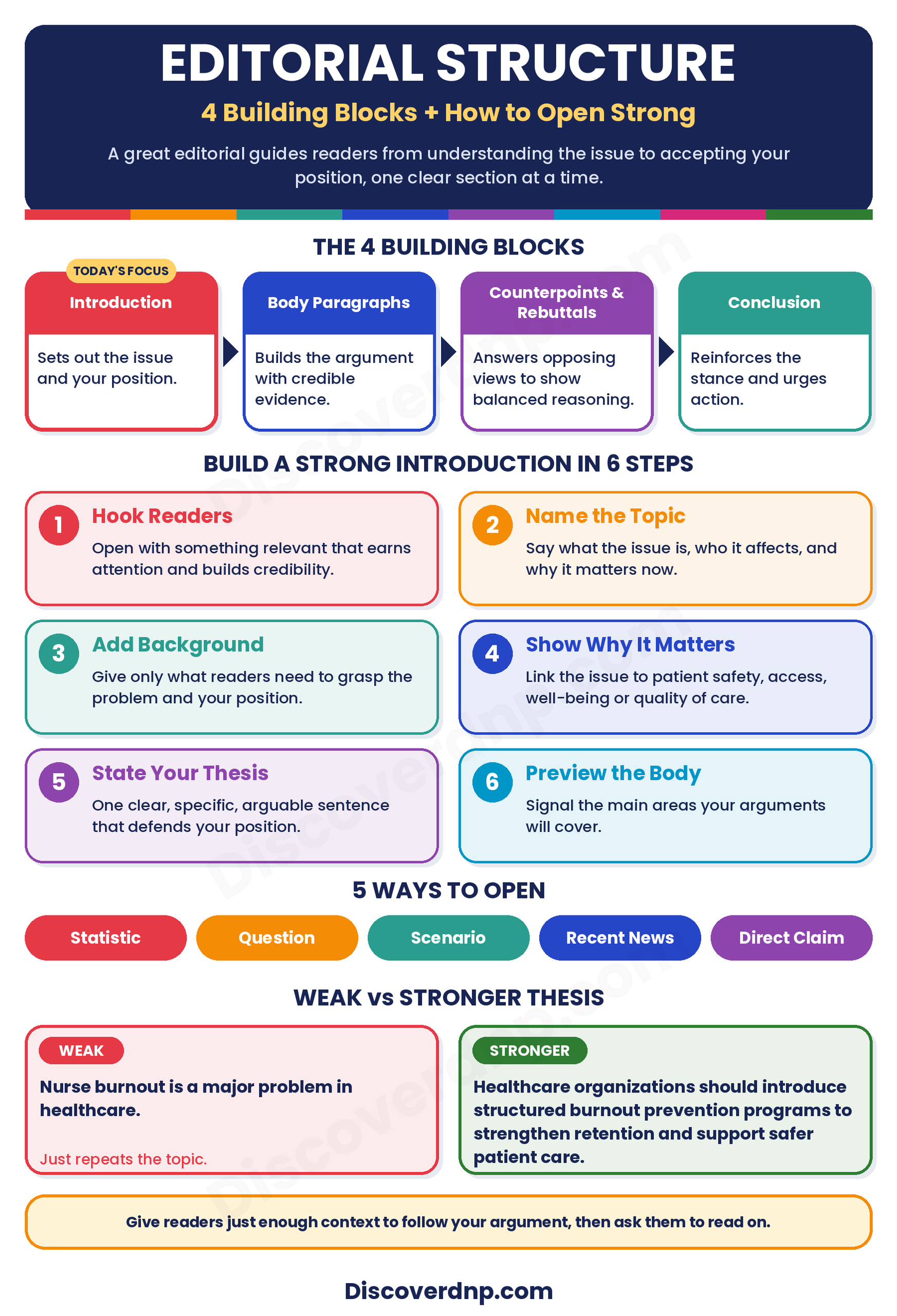
Conclusion
Editorial writing is a powerful way to communicate informed opinions, examine important issues, and encourage meaningful change. Whether addressing nursing practice, patient safety, healthcare policies, professional ethics, or public health concerns, an effective editorial goes beyond expressing personal beliefs. It combines a clear viewpoint with credible research, logical reasoning, persuasive language, and practical recommendations to help readers understand why an issue matters and consider possible solutions.
Learning how to write an editorial involves several interconnected stages, from selecting a relevant topic and researching different perspectives to developing a strong thesis, organizing supporting arguments, addressing counterarguments, and refining the final draft. Each stage contributes to the credibility and effectiveness of the editorial. Equally important is the ability to maintain a professional tone, distinguish facts from opinions, avoid unsupported generalizations, and present opposing viewpoints fairly.
In nursing and healthcare, editorial writing provides an opportunity to advocate for better working conditions, safer patient care, ethical practice, equitable healthcare access, and stronger professional standards. It allows nursing professionals to contribute their perspectives to discussions that influence healthcare decisions and public understanding. A well-developed editorial can bring attention to overlooked concerns, challenge ineffective practices, and encourage healthcare institutions and policymakers to consider evidence-based improvements.
Ultimately, a successful editorial is not measured only by how strongly it expresses an opinion but by how effectively it supports that opinion and engages its readers. By combining thorough research, critical thinking, clear communication, and responsible persuasion, writers can produce editorials that inform, challenge assumptions, and inspire constructive action. These skills make editorial writing a valuable form of professional communication and an important tool for contributing to the continued improvement of nursing and healthcare.
Frequently Asked Questions
1. How do you write an editorial? Can you provide an example?
To write an editorial, select a relevant topic, research the issue, establish a clear thesis, and develop supporting arguments using credible evidence. Include opposing viewpoints where appropriate and conclude with a practical recommendation or call to action.
Example: An editorial titled “Supporting Nurse Well-Being Is Essential to Improving Patient Safety” could argue that healthcare institutions should provide adequate staffing, reasonable working hours, and mental health support to improve nurses’ working conditions and promote safer patient care.
2. What are some good nursing writing topics?
Good nursing writing topics include:
- The importance of patient safety in nursing practice.
- Preventing medication administration errors.
- The effects of nurse burnout on healthcare delivery.
- The role of nurses in infection prevention.
- Ethical challenges in nursing practice.
- The importance of evidence-based nursing.
- Strategies for improving nurse-patient communication.
- The impact of technology on nursing care.
- Addressing workplace violence against nurses.
- Improving access to quality maternal healthcare.
3. What are some good editorial topics?
Good editorial topics address relevant issues that encourage discussion, critical thinking, and different viewpoints. Examples include:
- Should healthcare be affordable for everyone?
- Why mental health education should be prioritized.
- Should hospitals introduce stricter nurse staffing policies?
- The importance of vaccination in disease prevention.
- Should social media platforms regulate health misinformation?
- The impact of artificial intelligence on healthcare.
- Why schools should provide comprehensive health education.
- Should healthcare workers receive better workplace protection?
- The importance of equal access to healthcare services.
- Should environmental protection be a public health priority?
4. How do you prepare an editorial?
Prepare an editorial by following these steps:
- Choose a relevant topic: Select a current issue that allows you to develop a clear opinion.
- Research the subject: Gather credible facts, statistics, expert opinions, and relevant examples.
- Establish your thesis: State the main position you want to communicate.
- Create an outline: Organize the introduction, supporting arguments, counterarguments, and conclusion.
- Write the first draft: Develop each argument using logical explanations and supporting evidence.
- Use persuasive language: Maintain a clear, engaging, and professional tone.
- Revise and proofread: Correct errors, remove repetition, strengthen arguments, and verify factual accuracy.
- Conclude with a call to action: Reinforce your viewpoint and encourage readers to consider or support meaningful change.
