

Evaluative Essay Example: A Complete Guide to Writing an Evaluation Essay
An evaluation essay is a form of academic writing that involves examining a particular subject, assessing its quality or effectiveness, and presenting a reasoned judgment based on clearly established criteria. Unlike descriptive writing, which primarily explains or summarizes information, an evaluation essay requires the writer to investigate different aspects of a subject, determine how well it meets specific expectations, and justify the resulting conclusions with relevant evidence. The subject may be a healthcare intervention, an educational program, a clinical procedure, a research article, a literary work, a product, or a service. Regardless of the subject, the central purpose is to establish its value, identify its strengths and weaknesses, and determine whether it achieves its intended objectives. Effective evaluative writing therefore combines careful observation, critical thinking, objective assessment, and logical reasoning to produce a judgment that readers can understand and independently consider.
A well-developed evaluation essay goes beyond expressing whether something is good or bad. It requires a systematic approach in which the writer establishes appropriate evaluation criteria and applies them consistently throughout the discussion. These criteria serve as standards against which the subject is examined, helping distinguish meaningful findings from unsupported personal opinions. For example, when evaluating a patient education program, the writer might consider several factors:
- Accuracy of information: Whether the educational materials provide medically accurate, current, and evidence-based information.
- Accessibility and clarity: Whether the information is presented in language that patients with different educational backgrounds and health literacy levels can understand.
- Effectiveness: Whether the program improves patients’ knowledge, encourages appropriate health behaviors, and supports treatment adherence.
- Practical application: Whether patients can apply the information when making decisions about medication use, symptom monitoring, and disease management.
- Overall value: Whether the benefits of the program justify the resources required to develop and implement it.
Examining these dimensions provides a more comprehensive understanding of the subject than relying on a general impression. It also demonstrates how an evaluation argument develops through the relationship between established criteria, supporting evidence, critical analysis, and an overall judgment. A strong thesis statement communicates the writer’s central assessment, while individual body paragraphs examine specific criteria and explain how the available evidence supports the conclusions. This makes the evaluation essay both analytical and persuasive, as readers are presented with the reasoning behind the judgment rather than being expected to accept an unsupported opinion.
The importance of evaluation extends across academic, professional, and clinical environments, particularly in healthcare, where the quality and effectiveness of decisions can influence patient safety and health outcomes. Evaluating a clinical intervention, for instance, involves more than determining whether it produces a desirable result. It may require examining its clinical effectiveness, safety, cost, feasibility, patient acceptability, and consistency with established healthcare guidelines. Similarly, an assessment of a hospital’s infection prevention program might consider staff compliance with hand hygiene protocols, the availability of personal protective equipment, the effectiveness of staff training, and changes in healthcare-associated infection rates. These considerations illustrate how evaluation involves comparing actual performance with established expectations and using credible evidence to determine whether a particular approach delivers meaningful results.
Developing a comprehensive evaluation essay involves several interconnected stages, each contributing to the quality and credibility of the final paper. The process generally includes:
- Selecting an appropriate subject: Choosing a specific topic that can be examined meaningfully within the available scope and supported by sufficient information.
- Establishing evaluation criteria: Identifying the standards that will determine how the subject’s quality, effectiveness, or overall value is assessed.
- Conducting research: Gathering relevant information from credible academic publications, scholarly articles, professional guidelines, and other reliable sources.
- Developing a thesis statement: Formulating a clear position that communicates the overall judgment and identifies the most important reasons supporting it.
- Organizing the discussion: Arranging the evaluation criteria, evidence, and analysis into a logical essay structure.
- Presenting evidence-based judgments: Examining each criterion, explaining the significance of the findings, and acknowledging relevant strengths, weaknesses, and limitations.
- Drawing a conclusion: Bringing the findings together to establish an overall assessment that is consistent with the evidence presented throughout the paper.
Each stage contributes to a structured evaluation that is coherent, balanced, and defensible. Writers must also maintain an objective tone, distinguish between factual observations and personal interpretations, and acknowledge counterarguments where relevant. These practices strengthen the credibility of the discussion and help ensure that the final judgment reflects a comprehensive assessment rather than an isolated observation.
Understanding these principles provides a foundation for producing an effective evaluation essay and recognizing the qualities that distinguish strong evaluative writing. A well-developed evaluation essay example demonstrates how a writer can move beyond summarizing a subject to examine it systematically, apply relevant standards, interpret supporting evidence, and justify a conclusion through logical reasoning. The following discussion explores the evaluation essay definition, its purpose, characteristics, and essential elements before examining how to select suitable topics, organize an appropriate essay format, establish evaluation criteria, and develop a convincing evaluation argument. It also presents a practical evaluation essay example and explains the writing techniques involved in producing a balanced, evidence-based assessment.
Understanding the Evaluation Essay
An evaluation essay is an analytical form of academic writing that examines a particular subject, assesses its quality or effectiveness, and establishes its overall value using clearly defined standards. The subject may be a product, service, healthcare intervention, educational program, research study, literary work, professional practice, or public policy. Regardless of the subject, the writer’s responsibility is to move beyond describing what something is or how it works and determine how well it performs in relation to its intended purpose. This requires identifying relevant evaluation criteria, gathering reliable information, examining different aspects of the subject, and using the findings to develop a logical and defensible judgment.
Unlike writing that relies primarily on personal impressions, evaluative writing combines informed opinions with supporting evidence and critical reasoning. A writer may conclude that a particular program is effective, that a clinical intervention has important limitations, or that a research article provides valuable insights despite methodological weaknesses. However, such conclusions must be explained rather than simply asserted. Readers should be able to understand what standards were applied, what evidence informed the assessment, and why the writer reached a particular conclusion. The quality of an evaluation therefore depends not only on the judgment itself but also on the reasoning and evidence used to establish it.
For example, consider an evaluation of a hospital’s patient education program designed to improve medication adherence among individuals with chronic illnesses. A descriptive discussion might explain the program’s objectives, the educational materials provided, and the activities patients are expected to complete. An evaluation essay, however, would examine whether the program achieves its intended outcomes. The writer might assess the accuracy of the educational content, the suitability of the teaching methods, patients’ ability to understand medication instructions, and measurable improvements in adherence. If the program provides accurate information but does not adequately address language barriers or patients’ health literacy needs, the evaluation would recognize its educational strengths while identifying limitations that affect its effectiveness.
The central purpose of this type of writing is to establish an informed assessment that helps readers understand the strengths, weaknesses, significance, and overall value of the subject being examined. It is particularly useful in academic and professional environments because it develops the ability to distinguish between what is presented and how successfully it meets established expectations. In healthcare, for instance, evaluating a nursing intervention requires consideration of clinical outcomes, patient safety, available research, feasibility, and the needs of the population receiving care. This makes the evaluation essay a valuable means of developing analytical reasoning and evidence-based decision-making.
Evaluation Essay Definition and Purpose
An evaluation essay is a structured piece of writing in which an author examines a subject against a defined set of criteria to determine its quality, effectiveness, usefulness, or overall worth. It presents a central judgment and supports that judgment through relevant examples, research findings, observations, and logical explanations. The term evaluation refers to the process of determining the value or performance of something, while an evaluative essay communicates the results of that process through an organized academic argument.
A useful evaluation essay definition must therefore include three closely related components:
1. The subject being evaluated: This is the person, product, service, idea, process, intervention, or other phenomenon under consideration. The subject should be clearly identified so readers understand what the discussion focuses on. For example, a writer may evaluate the effectiveness of a hospital’s fall prevention program rather than discuss patient safety in healthcare generally.
2. The evaluation criteria: These are the standards used to assess the subject. They establish what constitutes acceptable, effective, successful, or valuable performance. When evaluating a fall prevention program, appropriate criteria might include the effectiveness of risk assessment, staff adherence to prevention protocols, patient education, and changes in fall rates.
3. The overall judgment: This is the writer’s conclusion about the subject based on the evidence examined against the selected criteria. It may be positive, negative, or mixed. For example, a fall prevention program may demonstrate strong staff compliance and improved patient education but still have limitations in identifying high-risk patients.
These components work together to distinguish an evaluation essay from a general discussion or descriptive paper. Identifying a subject without establishing criteria leaves readers uncertain about the standards being applied. Similarly, presenting criteria without examining relevant evidence makes it difficult to determine whether the subject meets those standards. An overall judgment connects the findings and communicates what they mean.
The purpose of an evaluation essay
The purpose of an evaluation essay extends beyond expressing approval or disapproval of a particular subject. It provides a systematic way of examining performance, interpreting evidence, identifying areas of strength and weakness, and determining whether something fulfills its intended purpose. Depending on the assignment and subject, the writer may have several objectives.
1. Assessing quality and effectiveness
One of the primary purposes is to determine how well a subject performs in relation to its intended objectives. This involves examining whether the subject meets established expectations and identifying the factors that contribute to its success or limitations.
For example, an evaluation of a nursing simulation program might examine whether the simulation exercises provide realistic clinical scenarios, encourage effective communication, strengthen clinical decision-making, and prepare participants for practical patient care. The assessment would consider whether the program achieves its educational objectives rather than simply describing the equipment or activities used during training.
2. Identifying strengths and weaknesses
An evaluation provides an opportunity to examine both the positive and negative aspects of a subject. Rather than presenting a one-sided argument, the writer considers what works well, what needs improvement, and how these factors influence overall performance.
For instance, an evaluation of an electronic health record (EHR) system might identify improved documentation accuracy, easier access to patient information, and better coordination between healthcare professionals as strengths. However, the same system might have limitations involving technical interruptions, complicated navigation, or the additional documentation time required from nurses. Considering both perspectives produces a more balanced assessment.
3. Determining value and suitability
An evaluation essay can also establish whether a particular subject is appropriate for a specific purpose, population, or situation. Something may perform well in one environment but be less effective in another because of differences in resources, accessibility, expectations, or user needs.
For example, a mobile health application may provide useful medication reminders and health education for patients who have reliable smartphone access. However, its suitability may be limited among individuals with poor internet connectivity, limited digital literacy, or visual impairments. An evaluation should therefore consider not only the application’s features but also the circumstances in which it is expected to be used.
4. Supporting informed decisions
Evaluative writing helps readers make decisions by presenting an organized assessment of available information. It can help determine whether a product is worth purchasing, whether a teaching method should be adopted, whether a healthcare intervention should be continued, or whether an existing policy requires improvement.
In a healthcare setting, evaluating different approaches to pressure injury prevention may help identify which interventions are most appropriate for patients with particular risk factors. The writer can examine clinical effectiveness, available research, implementation requirements, and patient outcomes before reaching a conclusion.
5. Encouraging critical thinking and evidence-based reasoning
Another important purpose is to develop the ability to question information, examine assumptions, compare findings, and reach conclusions supported by credible sources. Instead of accepting a claim because it appears convincing, the writer investigates the evidence behind it and determines whether it adequately supports the claim.
For example, a healthcare product may be advertised as improving patient monitoring. An effective evaluation would examine its accuracy, reliability, ease of use, safety, and evidence from appropriate studies rather than accepting promotional statements as proof of effectiveness.
In academic writing, these objectives make evaluation more than an exercise in personal opinion. It becomes a process of reasoned assessment in which the writer establishes a position, explains the standards used, and demonstrates why the conclusion is justified. The University of Nevada, Reno’s Writing and Speaking Center similarly emphasizes the importance of establishing criteria, presenting a judgment, and supporting that judgment with evidence in an evaluation essay.
Characteristics and Key Elements of Evaluative Writing
Evaluative writing has distinct characteristics that separate it from other forms of academic discussion. Although it may include description, explanation, comparison, and argument, its central focus is on assessing the quality, effectiveness, or value of a subject. The writer must establish a clear position, apply relevant standards, examine supporting information, and explain how the findings contribute to the final judgment. These elements ensure that the discussion is systematic, balanced, and convincing.
An effective evaluation essay does not simply list positive and negative observations. It explains the significance of those observations and connects them to the standards used to assess the subject. For instance, stating that a hospital’s discharge education program provides useful information is only an observation. A stronger evaluation would examine whether patients understand the instructions, whether the information addresses their individual healthcare needs, and whether the education contributes to safer transitions from hospital to home.
Several characteristics define effective evaluative writing.
1. A clear and specific subject of evaluation
Every evaluation begins with a subject that readers can identify and understand. The subject may be broad initially, but the writer should narrow it to a manageable focus that allows meaningful examination.
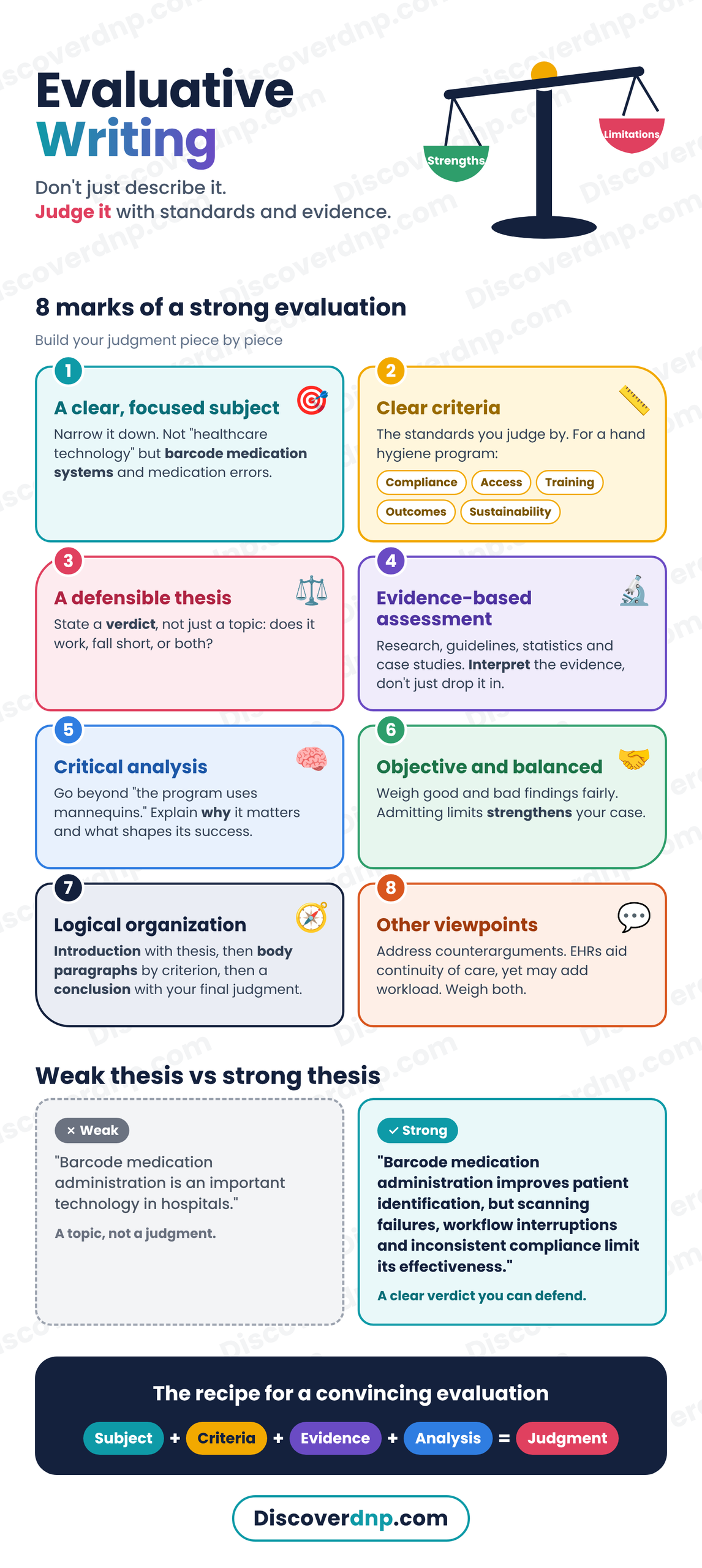
For example, evaluating healthcare technology as a whole would be too broad for a typical academic essay. A more specific subject might be the effectiveness of barcode medication administration systems in reducing medication administration errors in hospitals. This narrower focus provides a clearer direction for the discussion and makes it easier to identify appropriate evaluation criteria.
A clearly defined subject also helps prevent irrelevant information from taking over the discussion. Background information should explain what the subject is, how it works, and why it deserves evaluation without turning the paper into a general descriptive account.
2. Clearly established evaluation criteria
Evaluation criteria are the standards against which the subject is assessed. They determine what the writer considers important when deciding whether something is effective, successful, reliable, appropriate, or valuable.
The criteria should be relevant to the subject, sufficiently specific, and appropriate to the intended purpose of the evaluation. They should also be consistent throughout the discussion so that the final judgment reflects the same standards introduced earlier.
Consider an evaluation of a hospital’s hand hygiene program. Possible criteria include:
- Compliance: Whether healthcare professionals follow recommended hand hygiene procedures at appropriate moments during patient care.
- Accessibility: Whether handwashing facilities, alcohol-based hand rubs, and other necessary supplies are readily available.
- Staff education: Whether healthcare workers receive adequate training on hand hygiene practices and infection prevention.
- Clinical outcomes: Whether the program contributes to reducing healthcare-associated infections.
- Sustainability: Whether the hospital can maintain the program through continued training, monitoring, and resource allocation.
Each criterion addresses a different aspect of the program. Together, they provide a more meaningful basis for determining its overall effectiveness than relying on a single observation.
3. A defensible thesis statement and overall judgment
An evaluation essay requires a central position that communicates the writer’s assessment of the subject. This position is expressed through a thesis statement, which establishes the overall judgment and provides direction for the discussion.
A strong evaluative thesis statement should do more than identify the subject. It should indicate whether the subject performs well, has significant limitations, or demonstrates a combination of strengths and weaknesses. It should also provide a basis for the criteria examined in the body of the essay.
For example:
Although the hospital’s barcode medication administration system improves patient identification and reduces transcription-related errors, its effectiveness is limited by occasional scanning failures, workflow interruptions, and inconsistent staff compliance.
This thesis communicates a balanced judgment. It recognizes the system’s benefits while acknowledging limitations that influence its overall performance. The subsequent paragraphs can examine each of these aspects using relevant evidence.
A weak thesis, by comparison, might state:
Barcode medication administration is an important technology in hospitals.
Although this statement introduces the subject, it does not establish an evaluative position. It does not explain what is being assessed or what conclusion the writer intends to defend.
4. Evidence-based assessment
A defining characteristic of evaluative writing is that judgments must be supported by relevant information. Evidence gives credibility to the writer’s conclusions and allows readers to understand why particular strengths or weaknesses matter.
Depending on the subject, supporting evidence may include:
- Findings from peer-reviewed research and scholarly publications.
- Clinical guidelines and professional recommendations.
- Statistical information and measurable outcomes.
- Direct observations or documented experiences.
- Relevant examples and case studies.
- Expert opinions from qualified professionals.
- Comparisons with recognized standards or established alternatives.
For example, when evaluating a pressure injury prevention protocol, a writer might use research findings on repositioning schedules, skin assessment practices, support surfaces, and documented pressure injury rates. The evidence should be relevant to the criterion being discussed and sufficiently reliable to justify the resulting assessment.
Evidence should also be interpreted rather than simply inserted into a paragraph. If a study reports a reduction in pressure injuries following the introduction of a prevention protocol, the writer should explain what that finding suggests about the intervention’s effectiveness. It is also important to consider factors such as study design, sample size, patient characteristics, and whether other interventions may have contributed to the reported improvement.
The University of Waterloo’s Writing and Communication Centre emphasizes that critical analysis involves combining an informed opinion with evidence and an explanation of the reasoning behind that opinion. This distinction is important because evidence alone does not automatically establish a convincing evaluation; the writer must explain its relevance to the judgment.
5. Critical analysis rather than simple description
Evaluative writing requires the writer to examine information, interpret findings, identify relationships, and determine the significance of different observations. This is what distinguishes critical analysis from simply summarizing or describing a subject.
Consider an evaluation of a nursing education program that uses simulation-based learning.
A descriptive statement might read:
The program uses high-fidelity mannequins to teach clinical assessment and emergency response skills.
An analytical evaluation would go further:
The use of high-fidelity mannequins allows participants to practice clinical assessment and emergency response in a controlled environment. This can strengthen their ability to recognize changes in patient condition and respond to simulated emergencies. However, the educational value of the approach also depends on the realism of the scenarios, the quality of instructor feedback, and opportunities for reflection after each exercise.
The second example examines how the program works, why its features matter, and what factors influence its effectiveness. It therefore provides a more meaningful assessment.
6. Objectivity and balanced judgment
An effective evaluation should maintain an objective tone, even when the writer has a strong personal position. Objectivity does not mean avoiding conclusions or refusing to express an opinion. Instead, it means ensuring that judgments are based on appropriate standards and credible evidence rather than personal preferences, assumptions, or emotional reactions.
A balanced evaluation considers both favorable and unfavorable findings. It also recognizes that a subject may perform well in some areas while falling short in others.
For instance, an evaluation of a hospital’s telehealth service might recognize that virtual consultations improve access to healthcare for patients in remote locations. At the same time, it should consider limitations involving internet access, physical examination requirements, digital literacy, and patient privacy.
Acknowledging these limitations does not weaken the evaluation. It demonstrates that the writer has considered the subject comprehensively rather than selecting only information that supports a preferred conclusion.
7. Logical organization and coherence
An evaluation essay should present information in a sequence that allows readers to follow the reasoning behind the overall judgment. Each paragraph should address a particular aspect of the subject and contribute to the central evaluation argument.
A well-organized discussion generally includes:
- An introduction that presents the subject, provides relevant background, and establishes the thesis statement.
- Body paragraphs that examine individual evaluation criteria and present supporting evidence.
- A conclusion that brings the findings together and communicates the final judgment.
Each body paragraph should have a clear topic sentence, relevant supporting details, and an explanation connecting the evidence to the criterion being examined. This organization prevents the discussion from becoming a collection of unrelated observations.
8. Consideration of limitations and alternative perspectives
A comprehensive evaluation recognizes that different readers may interpret the subject differently or place varying levels of importance on particular criteria. The writer should therefore consider relevant limitations, alternative explanations, and counterarguments.
For example, an evaluation of electronic health records might conclude that they improve information accessibility and support continuity of care. However, some healthcare professionals may argue that documentation requirements increase administrative workloads and reduce time available for direct patient interaction. A balanced discussion should consider these concerns and determine how they affect the overall assessment.
Recognizing alternative perspectives is particularly important when evaluating subjects that involve competing priorities, such as patient safety, healthcare costs, staff workload, and accessibility.
Key elements of an effective evaluation essay
Although the characteristics above describe the qualities of evaluative writing, several essential elements must work together to produce a complete evaluation essay.
| Key element | Role in the evaluation |
|---|---|
| Subject | Identifies the product, service, process, idea, or intervention being assessed. |
| Background information | Provides context that helps readers understand the subject. |
| Evaluation criteria | Establishes the standards used to assess quality or effectiveness. |
| Thesis statement | Communicates the writer’s central judgment. |
| Supporting evidence | Provides reliable information that justifies the assessment. |
| Critical analysis | Explains the significance of the evidence in relation to each criterion. |
| Counterarguments | Recognizes relevant alternative perspectives and limitations. |
| Overall judgment | Brings the findings together to establish the subject’s overall value. |
These elements are interconnected. The subject determines what needs to be assessed, the criteria establish the standards, and the evidence provides the basis for examining performance. Critical analysis explains how the findings relate to those standards, while the thesis and overall judgment communicate the conclusion.
For example, an evaluation of a patient fall prevention program might establish the following relationship:
- Subject: A hospital’s patient fall prevention program.
- Criterion: Effectiveness in reducing patient falls.
- Evidence: Hospital incident reports, patient safety data, and relevant research findings.
- Analysis: Whether reported fall rates changed after the program was introduced and whether other factors may have influenced the results.
- Judgment: The program demonstrates measurable benefits, although its effectiveness depends on consistent implementation and staff adherence to prevention procedures.
This relationship between criteria, evidence, analysis, and judgment forms the foundation of a convincing evaluation argument. When these elements are developed consistently, the resulting paper becomes more than a collection of opinions; it becomes a reasoned assessment that readers can examine and understand.
Evaluation Essay vs. Other Academic Essays
An evaluation essay shares several features with other forms of academic writing, including the use of a thesis statement, supporting evidence, organized paragraphs, and a logical conclusion. However, its primary purpose is different: it seeks to determine the quality, effectiveness, suitability, or value of a particular subject using established criteria. Other academic essays may focus on explaining information, describing experiences, analyzing ideas, or persuading readers to accept a particular position.
Understanding these differences is important because the type of essay determines how information should be selected, organized, and presented. A writer who is asked to evaluate a healthcare intervention, for example, should not spend the entire paper explaining how the intervention works. Instead, the discussion should examine whether it achieves its intended objectives and how effectively it performs when measured against relevant standards.
The following comparisons highlight the distinctions between an evaluation essay and other common academic essay types.
1. Evaluation Essay vs. Descriptive Essay
A descriptive essay focuses on presenting detailed information about a person, place, object, experience, or phenomenon. Its purpose is to help readers develop a clear understanding of the subject through explanations, observations, and descriptive details. It may use sensory language, examples, and factual information to communicate what something looks like, how it operates, or what characteristics it possesses.
An evaluation essay, on the other hand, examines the subject’s quality or performance. Rather than simply describing its features, the writer determines whether those features contribute to its effectiveness or value.
For example, when writing about a hospital’s patient monitoring system:
- A descriptive essay might explain the system’s components, how vital signs are displayed, how alarms function, and how healthcare professionals use the information.
- An evaluation essay would examine the accuracy of the readings, reliability of the alarms, ease of operation, and usefulness in supporting clinical decisions.
The main difference is that descriptive writing answers questions such as What is it? and What does it do?, while evaluative writing addresses How well does it perform? and Is it effective?
2. Evaluation Essay vs. Argumentative Essay
An argumentative essay aims to establish and defend a particular position on an issue. The writer presents a claim, develops supporting arguments, examines opposing viewpoints, and uses evidence to persuade readers that the position is reasonable.
An evaluation essay also presents a central argument, but that argument focuses on the value or effectiveness of a specific subject. Instead of simply defending a position, the writer must establish appropriate criteria and use them to assess the subject systematically.
For example, consider the topic of mandatory vaccination policies in healthcare facilities.
- An argumentative essay might defend the position that healthcare workers should be required to receive certain vaccinations to protect patients and reduce the risk of disease transmission.
- An evaluation essay might examine an existing vaccination policy by assessing its effectiveness in reducing workplace infections, its implementation costs, its accessibility, and its influence on patient and staff safety.
Although both essay types require evidence and logical reasoning, the evaluation essay places greater emphasis on applying standards to determine the subject’s overall performance. The argumentative essay focuses more directly on persuading readers to accept a particular position.
3. Evaluation Essay vs. Analytical Essay
An analytical essay examines a subject by breaking it into smaller components to understand how those components function, relate to one another, and contribute to the overall meaning or outcome. It focuses on interpreting information, identifying relationships, examining patterns, and explaining why particular features are significant.
An evaluation essay uses many of the same analytical techniques but takes the additional step of making a judgment about the subject’s quality or effectiveness.
For example, when examining a research article about infection prevention:
- An analytical essay might examine the study’s research question, methodology, sample characteristics, data collection procedures, and relationship between the findings and the research objectives.
- An evaluation essay would use these findings to assess the study’s methodological quality, reliability, relevance to clinical practice, and contribution to infection prevention knowledge.
The distinction is that analysis helps explain how and why something works, whereas evaluation determines how well it works or how valuable it is according to established standards.
In practice, the two approaches often overlap. A convincing evaluation requires sufficient analysis because the writer must understand the subject before reaching a defensible judgment.
4. Evaluation Essay vs. Compare-and-Contrast Essay
A compare-and-contrast essay examines the similarities and differences between two or more subjects. Its purpose is to help readers understand how the subjects relate to one another and what distinguishes them. The writer may organize the discussion according to shared characteristics or examine each subject separately before comparing their features.
An evaluation essay may also involve comparing subjects, particularly when determining which product, intervention, service, or approach performs better. However, comparison alone does not constitute evaluation. The writer must establish standards and use them to determine the relative quality or suitability of the subjects.
For example, an essay comparing two patient education methods might examine printed educational materials and digital learning applications.
- A compare-and-contrast essay would discuss their similarities and differences in accessibility, presentation, cost, and delivery.
- An evaluation essay would assess which method is more effective for improving patient understanding, supporting treatment adherence, and accommodating individuals with different health literacy levels.
The important distinction is that a compare-and-contrast essay identifies similarities and differences, while an evaluation essay uses relevant standards to determine the significance and value of the findings.
5. Evaluation Essay vs. Expository Essay
An expository essay is designed to explain a topic, concept, process, or issue using clear and factual information. Its primary objective is to inform readers and improve their understanding of a particular subject. It generally avoids taking a strong personal position and instead focuses on presenting information in a logical and organized manner.
An evaluation essay goes beyond explanation by examining the subject against specific criteria and reaching a reasoned conclusion.
For instance, when discussing evidence-based practice in nursing:
- An expository essay might explain the meaning of evidence-based practice, its three main components, its importance in healthcare, and how nurses apply research findings in clinical decision-making.
- An evaluation essay might assess the effectiveness of an evidence-based practice initiative in a particular healthcare facility by examining staff participation, the quality of available research, implementation barriers, and patient outcomes.
The expository approach explains the subject, while the evaluative approach determines how successfully it achieves a particular purpose.
Summary of the differences
| Type of essay | Primary purpose | Main focus |
|---|---|---|
| Evaluation essay | Assess the quality, effectiveness, or value of a subject. | Criteria, evidence, critical analysis, and judgment. |
| Descriptive essay | Provide a detailed account of a subject. | Features, characteristics, and observations. |
| Argumentative essay | Persuade readers to accept a particular position. | Claims, supporting arguments, and counterarguments. |
| Analytical essay | Examine a subject by breaking it into components. | Relationships, patterns, interpretation, and meaning. |
| Compare-and-contrast essay | Identify similarities and differences between subjects. | Shared characteristics and distinctions. |
| Expository essay | Explain a subject using factual information. | Definitions, explanations, and relevant details. |
Although these essay types have different objectives, they are not entirely separate in practice. An evaluation essay may incorporate descriptive information to introduce its subject, analytical reasoning to examine its components, comparison to assess alternatives, and argumentative techniques to defend its conclusions. However, these approaches should support the central purpose of evaluation rather than replace it.
A useful way to distinguish them is to consider the question each essay is designed to answer: descriptive writing explains what something is, expository writing explains how or why something happens, analytical writing examines how its components relate, argumentative writing defends a position, and evaluative writing determines how well something meets established standards. Recognizing these distinctions helps writers select the appropriate approach and maintain a clear focus throughout their academic work.
Choosing an Evaluation Essay Topic
Choosing an appropriate subject is one of the most important stages of writing an effective evaluation essay because it determines the direction, scope, and depth of the entire discussion. The subject selected must provide enough material for meaningful examination while allowing the writer to establish clear evaluation criteria and reach a reasonable conclusion. A topic that is too broad may lead to a superficial discussion in which several issues are introduced without sufficient analysis, whereas an overly narrow topic may not provide enough information to support a comprehensive evaluation. The goal is to identify a subject that can be examined systematically, researched using credible sources, and assessed against standards that are relevant to its intended purpose.
An evaluation essay topic may focus on a product, service, educational approach, healthcare intervention, research study, professional practice, public policy, or institutional program. The choice depends on the assignment requirements, the writer’s interests, the availability of reliable information, and the intended focus of the assessment. For example, evaluating healthcare technology may involve examining the accuracy, reliability, safety, and usability of a medical device. Similarly, evaluating a nursing intervention may require considering its effectiveness, patient acceptability, clinical relevance, and feasibility in different healthcare environments.
Selecting a suitable topic also requires understanding the difference between a subject and an evaluation question. The subject identifies what will be examined, while the evaluation question establishes what the writer intends to determine about it. Consider the following examples:
- Subject: Patient education programs.
- Evaluation focus: How effectively do patient education programs improve medication adherence among individuals with chronic illnesses?
- Subject: Nursing simulation training.
- Evaluation focus: How effectively does simulation-based training prepare nurses to recognize and respond to clinical emergencies?
- Subject: Electronic health records.
- Evaluation focus: How well do electronic health records support accurate documentation, communication, and continuity of patient care?
These examples demonstrate how a general subject can be developed into a focused essay topic with a clear evaluative purpose. A well-selected topic makes it easier to establish a thesis statement, identify appropriate evaluation criteria, organize supporting evidence, and develop a coherent evaluation argument.
Selecting a Suitable Subject for Evaluation
A suitable subject for an evaluation essay should be specific enough to examine in detail, relevant to the intended audience, and capable of being assessed using identifiable standards. It should also provide opportunities for critical analysis rather than requiring the writer to simply describe features or summarize existing information. Before settling on an essay topic, it is useful to consider what is being evaluated, why the assessment matters, what standards will be applied, and whether sufficient evidence is available to support the discussion.
The following considerations can help guide the selection process.
1. Choose a subject that has a clear purpose or function
An effective evaluation usually begins with a subject that has an identifiable purpose, objective, or intended outcome. Understanding what the subject is designed to achieve provides a foundation for determining how successfully it performs.
For example, a hospital falls prevention program is intended to reduce the occurrence of patient falls and related injuries. This purpose provides a basis for assessing the program’s effectiveness through criteria such as risk assessment accuracy, staff adherence to prevention protocols, patient education, and changes in reported fall rates.
Similarly, when evaluating a patient monitoring device, the writer should understand its intended clinical function before assessing its accuracy, reliability, ease of use, and contribution to patient safety.
A subject with a clearly defined purpose is generally easier to evaluate because the writer can compare its actual performance with its intended objectives.
2. Select a topic that is specific and manageable
The scope of an evaluation essay should be appropriate to the required length and level of detail. Broad subjects often introduce too many possible evaluation criteria, making it difficult to develop a focused discussion. Narrowing the subject helps the writer concentrate on the most important dimensions of performance.
For example:
| Broad subject | More focused evaluation essay topic |
|---|---|
| Healthcare technology | Evaluating the effectiveness of electronic health records in improving nursing documentation. |
| Patient safety | Assessing the effectiveness of hospital fall prevention programs among older adults. |
| Nursing education | Evaluating simulation-based learning in developing clinical decision-making skills. |
| Infection prevention | Assessing the effectiveness of hand hygiene programs in reducing healthcare-associated infections. |
| Patient communication | Evaluating teach-back methods for improving patient understanding of discharge instructions. |
The more focused topics provide a clearer direction for research and analysis. They also make it easier to establish a manageable set of criteria rather than attempting to evaluate every possible aspect of a broad subject.
3. Identify clear and measurable evaluation criteria
A subject may be interesting, but it will not necessarily produce a strong evaluation essay if there are no meaningful standards against which it can be assessed. Before choosing a topic, consider whether its quality, performance, effectiveness, or suitability can be examined using identifiable criteria.
For instance, an evaluation of a pulse oximeter could consider:
- Accuracy of oxygen saturation measurements.
- Reliability under different monitoring conditions.
- Ease of operation and interpretation.
- Comfort and suitability for different patients.
- Limitations associated with peripheral perfusion, movement, and other factors.
These criteria provide different perspectives on the device’s performance. They also help the writer avoid making broad claims based on a single characteristic.
Not every criterion needs to be expressed numerically. Some subjects are assessed using qualitative standards such as accessibility, clarity, ethical suitability, patient satisfaction, or quality of communication. What matters is that the standards are sufficiently clear to guide the assessment and justify the resulting judgment.
4. Consider the availability of credible sources and supporting evidence
Research availability is another important consideration when selecting an evaluation essay topic. A subject may be relevant and interesting, but if there is insufficient reliable information to support the discussion, it may be difficult to develop a comprehensive assessment.
Before settling on a topic, explore whether relevant information is available through:
- Peer-reviewed journal articles and systematic reviews.
- Academic textbooks and scholarly publications.
- Professional nursing and healthcare organizations.
- Government health agencies and clinical guidelines.
- Research reports and institutional publications.
- Relevant clinical studies and documented outcomes.
For example, an evaluation of evidence-based pressure injury prevention practices can draw on clinical guidelines, nursing research, and studies examining patient outcomes. These sources provide information that can be compared with established prevention standards.
Writers should also distinguish between credible research and promotional information. A manufacturer’s description of a medical device may explain its features, but independent clinical research is generally more appropriate for assessing its accuracy, reliability, and clinical usefulness. Using multiple credible sources helps reduce bias and strengthens the evaluation argument.
5. Choose a subject that allows balanced assessment
A strong evaluation essay should provide opportunities to examine both strengths and limitations. Subjects that can only be discussed through unsupported praise or criticism may produce a one-sided paper with limited analytical depth.
For example, an evaluation of telehealth services might identify several advantages:
- Improved access to healthcare for people in remote areas.
- Reduced travel requirements for certain consultations.
- Greater convenience for patients with mobility limitations.
- Opportunities for follow-up and chronic disease monitoring.
However, the assessment should also consider limitations such as unreliable internet connectivity, technological barriers, privacy concerns, and situations in which physical examination is necessary.
Examining both perspectives allows the writer to determine whether the benefits outweigh the limitations and under what circumstances the service is most appropriate. A balanced assessment does not require giving equal attention to every positive and negative point; it requires giving each finding appropriate consideration based on its significance and supporting evidence.
6. Consider personal familiarity and subject knowledge
Having some background knowledge of a subject can make research and analysis easier. Familiarity helps the writer understand relevant terminology, identify important issues, and recognize which evaluation criteria are most appropriate.
For example, someone familiar with nursing practice may find it easier to evaluate a medication administration protocol because they understand the importance of patient identification, dosage accuracy, medication documentation, and monitoring for adverse reactions.
However, familiarity should not replace research or objective assessment. Personal experience can help identify questions worth investigating, but the final judgment should be based on credible information and established standards. Writers should also remain open to findings that differ from their initial expectations.
7. Define the intended audience and purpose of the evaluation
The audience influences the level of detail, terminology, and evidence required in an evaluation essay. A paper intended for healthcare professionals may require more technical discussion of clinical outcomes, implementation standards, and research findings. A paper intended for a general audience may need additional explanations of medical concepts and simpler terminology.
The purpose of the assignment also matters. Some evaluation essay topics require assessing the effectiveness of an intervention, while others focus on comparing alternatives, examining quality, or determining whether a service meets particular expectations.
For instance, an evaluation of a hospital discharge process could focus on its ability to prevent medication errors, improve communication, reduce avoidable readmissions, or support continuity of care. Each focus would require a different set of evaluation criteria.
Once the subject, purpose, audience, and criteria have been identified, the writer can develop a focused evaluation question and begin preparing an appropriate essay outline.
8. Ensure the topic allows a meaningful conclusion
Before settling on a subject, consider whether the available information will allow you to reach a clear and defensible overall judgment. An evaluation essay should not end with a conclusion that merely repeats observations or states that the subject has both advantages and disadvantages. It should explain what the findings reveal about its quality, effectiveness, or suitability.
For example, an evaluation of a hospital’s electronic medication administration system might examine whether it improves medication safety, reduces documentation errors, and supports timely administration. If the available research shows improvements in medication documentation but identifies persistent challenges involving system usability and staff training, the writer can develop a qualified judgment about its effectiveness.
A useful topic should therefore allow you to answer questions such as:
- Does the subject achieve its intended objectives?
- What are its most important strengths?
- What limitations affect its performance?
- How does it compare with relevant standards or alternatives?
- Under what circumstances is it most appropriate?
- What improvements could make it more effective?
Considering these questions before beginning the essay helps establish a clear direction and prevents the discussion from becoming a general description of the subject.
Evaluation Essay Topics for Nursing Students
Nursing and healthcare provide numerous opportunities for evaluative writing because clinical practice, patient care, medical technology, professional education, and healthcare policies involve decisions that can be assessed against established standards. These subjects are particularly suitable because they often have identifiable objectives, measurable outcomes, professional guidelines, and scholarly research that can support a comprehensive evaluation.
An evaluation essay in nursing may examine the effectiveness of a clinical intervention, the quality of a healthcare service, the suitability of a medical device, or the contribution of an educational approach to professional development. For example, evaluating a patient safety initiative may involve examining whether it reduces preventable errors, improves communication, and promotes adherence to clinical protocols.
When selecting nursing-related evaluation essay topics, it is useful to consider different areas of the profession. The following categories provide ideas that can be developed into focused academic assessments.
1. Patient Safety and Quality of Care
Patient safety is an important area of nursing practice because healthcare interventions and institutional procedures are intended to prevent avoidable harm and improve patient outcomes. Evaluation topics in this category can examine whether particular safety measures achieve their objectives, how consistently they are implemented, and what factors influence their effectiveness.
Possible topics include:
- Evaluating the effectiveness of hospital fall prevention programs in reducing patient injuries.
- Assessing the effectiveness of medication administration safety protocols in preventing medication errors.
- Evaluating the role of patient identification procedures in improving healthcare safety.
- Assessing the effectiveness of pressure injury prevention interventions among hospitalized patients.
- Evaluating the impact of nursing documentation practices on patient safety.
- Assessing the effectiveness of surgical safety checklists in preventing procedural complications.
- Evaluating the role of incident reporting systems in improving hospital patient safety.
- Assessing the effectiveness of nurse-to-nurse handoff communication in reducing clinical errors.
For example, an essay evaluating hospital fall prevention programs could examine several criteria, including the accuracy of fall risk assessments, the consistency of patient monitoring, staff compliance with prevention protocols, and changes in reported fall rates. The writer could also consider whether the interventions are suitable for older adults, patients with mobility limitations, and individuals experiencing confusion or medication-related dizziness.
The Agency for Healthcare Research and Quality’s Fall TIPS toolkit provides a useful research starting point because it combines patient-specific fall risk assessment with tailored prevention plans. Its reported implementation outcomes can help inform an evaluation of structured fall prevention approaches.
2. Nursing Interventions and Clinical Practice
Clinical nursing interventions are another useful area for evaluation because they involve specific actions intended to prevent complications, manage symptoms, promote recovery, and improve patient well-being. An evaluation can examine whether an intervention achieves its intended clinical outcomes, whether it is appropriate for a particular patient population, and what limitations may affect its application.
Possible topics include:
- Evaluating the effectiveness of early patient mobilization in preventing postoperative complications.
- Assessing the impact of nursing interventions on pain management among postoperative patients.
- Evaluating the effectiveness of pressure injury prevention strategies in intensive care units.
- Assessing the effectiveness of patient education in improving diabetes self-management.
- Evaluating the role of nursing interventions in preventing catheter-associated urinary tract infections.
- Assessing the effectiveness of oral care interventions in preventing ventilator-associated pneumonia.
- Evaluating the effectiveness of nonpharmacological interventions in managing anxiety among hospitalized patients.
- Assessing the role of structured nursing assessment in identifying early signs of patient deterioration.
For instance, an evaluation of early mobilization after surgery could examine whether the intervention improves mobility, reduces complications associated with prolonged bed rest, supports respiratory function, and shortens recovery time. The assessment should also consider patient-specific factors, such as surgical restrictions, pain levels, hemodynamic stability, and the availability of assistance.
Such topics encourage the writer to connect nursing actions with clinical outcomes rather than simply describe how a procedure is performed.
3. Nursing Education and Professional Development
Nursing education provides a wide range of opportunities for evaluative writing because different teaching approaches, learning resources, assessment methods, and professional development programs are designed to improve knowledge and clinical competence.
An evaluation in this area may examine how effectively an educational method prepares learners for clinical responsibilities, whether a particular teaching strategy improves knowledge retention, or how well a professional development initiative addresses the learning needs of healthcare personnel.
Possible topics include:
- Evaluating the effectiveness of simulation-based learning in nursing education.
- Assessing the role of clinical placements in developing practical nursing skills.
- Evaluating the effectiveness of problem-based learning in developing clinical reasoning.
- Assessing the usefulness of online learning platforms in nursing education.
- Evaluating the effectiveness of case-based learning in teaching clinical decision-making.
- Assessing the impact of nursing mentorship programs on professional development.
- Evaluating the effectiveness of peer learning in developing clinical competencies.
- Assessing the role of continuing professional development in improving nursing practice.
For example, an evaluation of simulation-based learning could examine the realism of clinical scenarios, the availability of appropriate equipment, the quality of instructor feedback, and improvements in clinical knowledge and practical skills.
Research can provide useful supporting evidence for this topic. A 2024 systematic review and meta-analysis published in Nurse Education Today examined 16 trials involving scenario-based simulation courses and reported improvements in nursing knowledge, clinical practice skills, and learning confidence. However, an effective evaluation should also consider differences between study settings, intervention designs, and the outcomes measured rather than assuming that every simulation program produces identical results.
4. Healthcare Technology and Medical Equipment
Medical devices and healthcare technologies influence how patient information is collected, clinical conditions are monitored, and healthcare services are delivered. Their effectiveness can be assessed using criteria such as accuracy, reliability, safety, usability, accessibility, and contribution to clinical decision-making.
Possible topics include:
- Evaluating the effectiveness of electronic health records in improving nursing documentation.
- Assessing the accuracy and reliability of pulse oximeters in clinical monitoring.
- Evaluating the usefulness of portable fetal Doppler devices in obstetric assessment.
- Assessing the effectiveness of automated blood pressure monitors in clinical practice.
- Evaluating the role of infusion pumps in improving medication administration safety.
- Assessing the usefulness of bedside patient monitoring systems in detecting clinical deterioration.
- Evaluating the effectiveness of telehealth technologies in improving access to healthcare.
- Assessing the role of barcode medication administration systems in reducing medication errors.
For example, an evaluation of pulse oximeters could examine measurement accuracy, ease of use, reliability under different patient conditions, and the limitations associated with factors such as poor peripheral perfusion, movement, and certain skin pigmentation-related measurement biases. The writer would need to distinguish between device performance under controlled conditions and its reliability in real clinical environments.
This category is particularly useful because it allows the writer to assess not only the technical features of a device but also its practical value in patient care.
5. Nursing Ethics and Professional Practice
Ethical principles and professional standards influence how nurses communicate with patients, protect confidential information, obtain consent, and make clinical decisions. Evaluative writing in this area can examine how effectively professional practices uphold patient rights, promote accountability, and support ethical healthcare delivery.
Possible topics include:
- Evaluating the effectiveness of informed consent procedures in protecting patient autonomy.
- Assessing the role of patient confidentiality policies in maintaining healthcare privacy.
- Evaluating the effectiveness of ethical decision-making frameworks in nursing practice.
- Assessing the impact of professional nursing codes of conduct on clinical accountability.
- Evaluating the effectiveness of communication strategies in supporting culturally sensitive care.
- Assessing the role of patient advocacy in protecting vulnerable populations.
- Evaluating the effectiveness of ethical training programs in preparing nurses for clinical dilemmas.
- Assessing the importance of shared decision-making in improving patient-centered care.
For example, an evaluation of informed consent procedures could examine whether patients receive understandable information, have sufficient opportunities to ask questions, understand the risks and benefits of proposed interventions, and make decisions voluntarily. The assessment could also consider language barriers, cognitive limitations, and the availability of interpretation services.
6. Healthcare Policies and Public Health Programs
Healthcare policies and public health initiatives are designed to address population health needs, improve access to services, prevent disease, and promote healthier communities. These subjects can be evaluated by examining their implementation, reach, effectiveness, resource requirements, and measurable health outcomes.
Possible topics include:
- Evaluating the effectiveness of childhood immunization programs in preventing infectious diseases.
- Assessing the impact of maternal health programs on antenatal care attendance.
- Evaluating the effectiveness of community health education in preventing noncommunicable diseases.
- Assessing the role of school-based health programs in promoting adolescent health.
- Evaluating the effectiveness of public health campaigns in improving awareness of HIV prevention.
- Assessing the effectiveness of malaria prevention programs in reducing disease transmission.
- Evaluating the impact of community-based hypertension screening initiatives.
- Assessing the effectiveness of breastfeeding promotion programs in supporting maternal and infant health.
For instance, an evaluation of a childhood immunization program might examine vaccination coverage, accessibility of immunization services, community awareness, vaccine availability, and changes in disease incidence. The writer should distinguish between the program’s intended objectives and the actual outcomes demonstrated by available data.
7. Patient Communication and Health Education
Communication and education are essential components of nursing practice because patients need accurate, understandable information to participate in healthcare decisions and manage their conditions. Evaluation topics in this category can examine whether particular communication approaches improve understanding, encourage adherence, and support informed decision-making.
Possible topics include:
- Evaluating the effectiveness of the teach-back method in improving patient understanding.
- Assessing the role of therapeutic communication in reducing patient anxiety.
- Evaluating the effectiveness of discharge education in preventing hospital readmissions.
- Assessing the impact of culturally appropriate patient education materials on health literacy.
- Evaluating the effectiveness of nurse-led diabetes education programs.
- Assessing the usefulness of visual aids in explaining medication instructions.
- Evaluating the role of patient counseling in improving treatment adherence.
- Assessing the effectiveness of communication strategies in supporting patients with chronic illnesses.
For example, an evaluation of the teach-back method could examine whether asking patients to explain instructions in their own words improves understanding of medication schedules, follow-up appointments, and warning signs that require medical attention. Other criteria might include the time required to implement the method, its suitability for different patient populations, and the need for additional staff training.
8. Nursing Leadership and Healthcare Management
Leadership and management influence staffing, teamwork, resource allocation, workplace communication, and the quality of healthcare delivery. Evaluation topics in this category can examine how leadership approaches and organizational practices affect nursing performance and patient care.
Possible topics include:
- Evaluating the effectiveness of transformational leadership in nursing management.
- Assessing the impact of nurse staffing levels on patient outcomes.
- Evaluating the effectiveness of nurse mentorship programs in improving staff retention.
- Assessing the role of teamwork in promoting patient safety.
- Evaluating the effectiveness of conflict resolution strategies in nursing teams.
- Assessing the impact of workplace communication on nursing performance.
- Evaluating the effectiveness of staff scheduling practices in reducing nurse fatigue.
- Assessing the role of leadership development programs in improving nursing management.
For instance, an evaluation of nurse staffing practices might examine patient-to-nurse ratios, workload distribution, staff fatigue, missed nursing care, and patient outcomes. The writer could assess whether staffing arrangements provide sufficient personnel to meet patient needs while considering the financial and operational limitations faced by healthcare facilities.
9. Mental Health and Patient Well-Being
Mental health and psychological well-being offer additional subjects for evaluative writing. Nursing interventions in this area can be assessed based on accessibility, therapeutic effectiveness, patient satisfaction, continuity of care, and suitability for different populations.
Possible topics include:
- Evaluating the effectiveness of cognitive behavioral therapy in managing anxiety disorders.
- Assessing the role of nursing interventions in supporting patients with depression.
- Evaluating the effectiveness of mental health awareness programs in reducing stigma.
- Assessing the impact of therapeutic communication on patients receiving psychiatric care.
- Evaluating the effectiveness of mindfulness-based interventions in managing stress.
- Assessing the usefulness of peer support programs for individuals living with chronic mental health conditions.
- Evaluating the effectiveness of suicide prevention strategies in healthcare facilities.
- Assessing the role of family involvement in supporting mental health recovery.
For example, an evaluation of a mental health awareness program could examine whether it improves knowledge about mental health conditions, encourages individuals to seek professional support, reduces misconceptions, and provides accessible information about available services.
10. Maternal, Child Health, and Community Nursing
Maternal and child health and community nursing involve interventions designed to improve health outcomes across different stages of life. These subjects can be evaluated by examining service accessibility, quality of care, patient education, preventive practices, and measurable outcomes.
Possible topics include:
- Evaluating the effectiveness of antenatal education programs in preparing expectant mothers for childbirth.
- Assessing the impact of breastfeeding education on exclusive breastfeeding practices.
- Evaluating the effectiveness of postpartum home visits in supporting maternal recovery.
- Assessing the role of growth monitoring programs in identifying childhood nutritional problems.
- Evaluating the effectiveness of community-based prenatal care services.
- Assessing the impact of childhood nutrition education on healthy feeding practices.
- Evaluating the effectiveness of newborn screening programs in identifying congenital conditions.
- Assessing the role of family planning education in promoting informed reproductive health decisions.
For example, an evaluation of antenatal education programs might examine the accuracy of information provided, the accessibility of classes, the inclusion of birth preparedness guidance, and improvements in maternal knowledge about pregnancy warning signs and newborn care.
How to narrow nursing evaluation essay topics into focused titles
The topics above provide starting points, but a general subject should be refined before it becomes the focus of a full evaluation paper. A useful approach is to identify the specific intervention or practice, determine the population or setting being examined, and establish the main outcome or quality being assessed.
Consider the following examples:
| General subject | Focused evaluation essay topic |
|---|---|
| Patient education | Evaluating the effectiveness of the teach-back method in improving medication understanding among older adults. |
| Nursing simulation | Assessing the effectiveness of high-fidelity simulation in developing emergency response skills in nursing education. |
| Infection prevention | Evaluating the effectiveness of hospital hand hygiene programs in reducing healthcare-associated infections. |
| Patient safety | Assessing the effectiveness of fall risk assessment protocols in preventing inpatient falls. |
| Healthcare technology | Evaluating the usefulness of electronic health records in improving nursing documentation and continuity of care. |
| Maternal health | Assessing the effectiveness of antenatal education in improving birth preparedness among expectant mothers. |
A focused title makes it easier to determine the subject’s intended purpose and select relevant criteria. It also helps the writer avoid including too many unrelated issues in the same paper.
When evaluating simulation-based nursing education, for example, the writer could focus specifically on its contribution to clinical decision-making rather than attempting to assess every aspect of nursing education. This creates room for a more detailed discussion of scenario realism, instructor feedback, clinical reasoning, practical competency, and the transfer of learning into clinical settings.
Research findings can also help refine the topic. A systematic review published in 2024 examined simulation-based learning and clinical decision-making among undergraduate nursing students, providing a scholarly foundation for exploring this particular educational outcome.
The most suitable topic is therefore not necessarily the most complicated or controversial one. It is the subject that offers a clear purpose, relevant evaluation criteria, sufficient credible evidence, and enough depth to support a balanced conclusion. Once these elements are established, the writer can proceed to develop an evaluation essay outline that connects the introduction, evaluation criteria, supporting evidence, and overall judgment.
Evaluation Essay Structure and Format
The structure and format of an evaluation essay determine how effectively the writer communicates an assessment and guides readers through the reasoning behind the final judgment. A well-organized paper presents the subject clearly, establishes the standards used to assess it, examines relevant evidence, and brings the findings together in a logical conclusion. Each part serves a distinct purpose, but all sections must contribute to the same central evaluation argument. This consistency helps readers understand not only what is being evaluated but also how the writer arrived at the overall judgment.
Although the exact format may vary depending on the assignment, academic discipline, and subject under consideration, most evaluation essays follow a conventional structure consisting of three main parts:
- Introduction: Presents the subject, provides relevant background information, establishes the purpose of the evaluation, and introduces the thesis statement.
- Body paragraphs: Examine the subject using established evaluation criteria, with each paragraph developing a particular aspect of the assessment through supporting evidence and critical analysis.
- Conclusion: Summarizes the main findings, reinforces the overall judgment, and may offer recommendations based on the evaluation.
This arrangement provides a logical progression from introducing the subject to examining its performance and determining its value. For example, an evaluation essay examining the effectiveness of a hospital’s infection prevention program would begin by explaining the program’s purpose and establishing a central judgment. The body would then assess specific criteria, such as staff compliance with hand hygiene procedures, availability of protective equipment, staff education, and infection rates. The conclusion would bring these findings together to determine how effectively the program supports infection prevention and whether improvements are necessary.
Understanding the function of each section is important because an evaluation essay requires more than the presentation of information. Every paragraph should contribute to the assessment, and the evidence should connect directly to the criteria established in the introduction. The following components explain how to organize the different parts of an evaluation essay and maintain a consistent line of reasoning throughout the paper.
Introduction and Thesis Statement
The introduction is the opening section of an evaluation essay. Its primary responsibility is to present the subject, establish the context for the assessment, and communicate the writer’s central position. It prepares readers to understand what will be evaluated, why the subject matters, and which aspects will receive attention in the discussion.
A strong introductory paragraph should provide enough background information to establish the relevance of the subject without explaining every detail that belongs in the body of the essay. It should also avoid making unsupported judgments before the evaluation criteria and evidence have been introduced. Instead, the introduction establishes a clear direction for the assessment and prepares readers for the analysis that follows.
A well-developed introduction generally contains the following elements:
1. An engaging opening statement
The first sentence introduces the broader issue or context surrounding the subject. It should establish relevance and encourage readers to consider why the subject deserves evaluation. The opening may refer to a professional concern, an academic issue, a practical challenge, or an important development related to the topic.
For example, an evaluation essay examining electronic health records might begin with:
Accurate and accessible patient information is essential to safe healthcare delivery, making electronic health records an important component of modern clinical practice.
This opening establishes the importance of the subject without making an immediate judgment about whether electronic health records are effective.
2. Presentation of the subject
After introducing the broader issue, the writer should identify the specific subject being evaluated. This may involve naming a particular intervention, program, product, service, policy, research article, or professional practice.
For example:
Electronic health records have become widely used in healthcare facilities to support patient documentation, information sharing, medication management, and continuity of care.
This sentence identifies the subject and provides a brief explanation of its purpose. It also gives readers sufficient context to understand the direction of the evaluation.
The subject should be presented precisely. If the essay focuses on the effectiveness of electronic health records in nursing documentation, the introduction should not suggest that the entire healthcare technology system is being evaluated. A clearly defined subject helps maintain focus throughout the paper.
3. Relevant background information
Background information provides additional context that helps readers understand the circumstances surrounding the subject. Depending on the topic, it may explain how a program operates, why a particular intervention was introduced, what problem it addresses, or which population it serves.
For instance, an evaluation of a hospital fall prevention program might explain that hospitalized patients, particularly older adults and individuals with impaired mobility, may experience falls that lead to injuries, prolonged hospital stays, and additional healthcare costs.
The background should establish why the program is important and provide a foundation for the evaluation. However, detailed explanations of the program’s implementation, performance, and individual criteria should be reserved for the body of the essay.
4. Purpose and scope of the evaluation
The introduction should make the purpose of the assessment clear. This involves explaining what the writer intends to determine and identifying the major aspects of the subject that will be examined.
For example:
This evaluation examines the effectiveness of the hospital’s fall prevention program by considering the accuracy of risk assessments, staff compliance with prevention procedures, patient education, and changes in reported fall rates.
This statement establishes the scope of the paper and identifies the main evaluation criteria. It also helps readers understand which aspects of the subject will receive attention and which areas fall outside the discussion.
5. A clear thesis statement
The thesis statement is one of the most important elements of an evaluation essay because it communicates the writer’s overall position. It should provide a specific, defensible judgment about the subject and indicate the main reasons supporting that judgment.
An effective evaluative thesis statement should:
- Identify the subject being assessed.
- Communicate a clear overall judgment.
- Reflect the evaluation criteria that will be examined.
- Establish a direction for the body paragraphs.
- Be sufficiently specific to guide the discussion.
Consider the following example:
Although the hospital’s fall prevention program has improved patient risk assessment and staff awareness, its overall effectiveness remains limited by inconsistent implementation, inadequate patient education, and insufficient monitoring of high-risk individuals.
This thesis communicates a balanced judgment. It acknowledges the program’s strengths while identifying weaknesses that influence its performance. Each issue can then be examined in a separate body paragraph using relevant research, clinical guidelines, or documented hospital outcomes.
A less effective thesis would be:
Hospital fall prevention programs are important for patient safety.
Although the statement identifies a relevant issue, it does not evaluate the program or establish a position that can be defended through evidence.
Example of a complete introductory paragraph
Consider how the elements can be combined when evaluating a hospital fall prevention program:
Patient falls remain an important patient safety concern in healthcare facilities, particularly among older adults and individuals with impaired mobility, cognitive difficulties, or other clinical risk factors. Hospital fall prevention programs are designed to identify patients at increased risk and introduce interventions that reduce the likelihood of preventable injuries. These programs commonly involve structured risk assessments, environmental modifications, patient education, mobility assistance, and regular monitoring by healthcare professionals. However, the effectiveness of a prevention program depends not only on the availability of these interventions but also on how consistently they are implemented and adapted to individual patient needs. Although structured fall prevention programs can improve risk identification and strengthen staff awareness, their overall effectiveness depends on consistent protocol adherence, appropriate patient education, and continuous monitoring of high-risk individuals.
This example moves from the broader patient safety issue to the specific program, provides relevant background, and establishes a clear evaluative position. The thesis also creates a logical foundation for examining the program’s individual criteria in the main body.
Body Paragraphs and Evaluation Criteria
The body of an evaluation essay is where the writer examines the subject in detail and develops the central argument through individual evaluation criteria. While the introduction establishes what is being assessed and communicates the overall judgment, the body provides the reasoning and evidence needed to justify that position. It is generally the most substantial part of the paper because it contains the detailed assessment of the subject’s quality, effectiveness, strengths, weaknesses, and limitations.
Each body paragraph should focus on a particular criterion or closely related aspect of the subject. This approach prevents the discussion from becoming a collection of unrelated observations and ensures that every paragraph contributes to the overall evaluation. The number of body paragraphs depends on the complexity of the subject, the required essay length, and the number of criteria necessary to provide a meaningful assessment. A relatively straightforward topic may require three main criteria, while a more complex subject may need additional paragraphs to examine its different dimensions.
For example, an evaluation essay examining the effectiveness of a hospital’s infection prevention program might organize the main body around the following criteria:
- Staff compliance with infection prevention protocols: Examining whether healthcare professionals consistently follow recommended infection prevention procedures, including hand hygiene and the appropriate use of personal protective equipment.
- Availability of infection prevention resources: Assessing whether the healthcare facility provides adequate handwashing facilities, disinfectants, protective equipment, and other essential supplies.
- Effectiveness of staff education and training: Determining whether healthcare professionals receive appropriate training and understand the procedures required to prevent infection transmission.
- Impact on patient outcomes: Examining whether the program contributes to reducing healthcare-associated infections and improving patient safety.
Each criterion provides a different perspective on the program’s performance. Examining them separately allows the writer to develop a more comprehensive assessment without allowing one aspect to dominate the entire discussion.
Organizing individual body paragraphs
A well-developed body paragraph should contain a clear main idea, supporting information, and an explanation of how the information contributes to the evaluation. Although paragraph organization may vary depending on the subject and assignment requirements, the following structure provides a useful approach.
1. Topic sentence introducing the evaluation criterion
The topic sentence establishes the specific aspect of the subject being evaluated. It should connect to the thesis statement while making the paragraph’s main focus clear.
For example:
One important measure of the infection prevention program’s effectiveness is the extent to which healthcare professionals comply with established hand hygiene protocols.
This sentence identifies staff compliance as the criterion being examined. Readers can immediately understand what the paragraph will assess.
2. Explanation of the criterion and its relevance
After introducing the criterion, explain why it matters and how it relates to the subject’s intended purpose. This helps readers understand why the selected standard is appropriate.
For instance, hand hygiene is an important component of infection prevention because healthcare professionals frequently interact with patients, medical equipment, and potentially contaminated surfaces. Consistent hand hygiene practices help reduce opportunities for microorganisms to spread between patients, healthcare workers, and the surrounding environment.
This explanation establishes the relevance of the criterion before presenting evidence.
3. Supporting evidence and specific examples
The next part of the paragraph should introduce information that helps determine how well the subject performs against the selected criterion. Evidence may include research findings, clinical guidelines, statistical information, documented observations, or relevant examples.
For example, the writer might refer to the World Health Organization’s recommendations on hand hygiene in healthcare settings and research examining compliance among healthcare professionals.
Evidence should be directly relevant to the claim being evaluated. A paragraph examining hand hygiene compliance should not rely primarily on research about unrelated infection prevention measures.
4. Critical analysis and interpretation
Presenting evidence is not enough. The writer must explain what the findings mean and how they relate to the evaluation criterion.
For example, if research indicates that hand hygiene compliance improves following staff training and regular monitoring, the writer should explain how this finding reflects the program’s effectiveness. The discussion might also consider whether improvements are maintained over time, whether compliance differs between departments, and whether the facility has adequate resources to support consistent practice.
This interpretation is what transforms a paragraph from a simple presentation of information into a meaningful evaluation.
5. A judgment connected to the overall thesis
The paragraph should establish what the evidence reveals about the subject’s performance against the criterion. This judgment should be consistent with the overall position established in the introduction.
For example:
These findings suggest that the program has established an effective foundation for promoting hand hygiene, although inconsistent compliance among some healthcare workers indicates the need for continued supervision, education, and performance monitoring.
This statement connects the paragraph’s findings to the broader evaluation and prepares readers for the next criterion.
Example of a developed evaluation body paragraph
Consider the following example, which evaluates staff compliance with hand hygiene procedures:
Staff compliance with hand hygiene protocols is an important indicator of the effectiveness of a hospital’s infection prevention program. Healthcare professionals frequently interact with patients, medical equipment, and potentially contaminated surfaces, creating opportunities for microorganisms to spread within clinical environments. Consistent hand hygiene helps reduce this risk and supports the prevention of healthcare-associated infections. The World Health Organization recommends specific hand hygiene practices at critical moments during patient care, emphasizing their importance in reducing infection transmission. However, the effectiveness of a hospital’s program depends on more than the availability of handwashing facilities and alcohol-based hand rubs. Healthcare workers must understand the recommended procedures and apply them consistently, even during periods of high workload. If compliance is inconsistent, the program may fail to achieve its intended objectives despite having appropriate policies in place. Therefore, while establishing hand hygiene protocols is an important achievement, regular monitoring, staff education, and adequate resource availability remain necessary for maintaining effective infection prevention practices.
Notice how the paragraph introduces one criterion, explains its importance, incorporates an authoritative standard, examines the factors influencing performance, and arrives at a reasoned judgment.
How to organize multiple evaluation criteria
There are different ways to arrange the body of an evaluation essay. The most appropriate approach depends on the subject and the relationship between the criteria.
- Criterion-by-criterion organization: Each body paragraph examines one evaluation criterion independently. This is useful when assessing several distinct characteristics of a product, program, service, or intervention.
- Strengths-and-weaknesses organization: The discussion examines the subject’s positive and negative aspects in separate sections or related paragraphs. This approach is useful when the assessment requires a balanced examination of benefits and limitations.
- Priority-based organization: Criteria are arranged according to their importance, beginning with the most significant consideration and moving toward less influential aspects. This is useful when some characteristics have a greater impact on the subject’s overall effectiveness.
- Comparative organization: The writer evaluates the subject in relation to alternatives or established standards. This approach is particularly useful when determining whether one intervention, product, or approach performs better than another.
Regardless of the organizational approach, the body should follow a logical progression. Each paragraph should contribute a distinct point, avoid unnecessary repetition, and maintain a clear connection with the thesis statement.
Purdue University’s Online Writing Lab emphasizes paragraph unity, coherence, clear topic sentences, and adequate development through evidence and examples. These principles are particularly useful when organizing the body of an evaluation essay because they help ensure that each paragraph develops one meaningful point.
Evidence, Critical Analysis, and Overall Judgment
Evidence and critical analysis are central to the credibility of an evaluation essay. While the introduction communicates the writer’s position and the body organizes the assessment around individual criteria, evidence provides the information needed to justify the discussion. Critical analysis explains the significance of that information, while the overall judgment brings the findings together to establish the subject’s quality, effectiveness, or value.
An evaluation that relies primarily on personal impressions may lack credibility because readers have little reason to accept the writer’s conclusions. Similarly, presenting statistics, research findings, or expert opinions without explaining their relevance does not produce a complete assessment. Effective evaluative writing requires a relationship between the evidence presented, the criterion being examined, and the conclusion drawn from the findings.
Using supporting evidence effectively
Supporting evidence refers to the factual information, research findings, examples, observations, and professional recommendations used to justify an evaluation. The type of evidence required depends on the subject and the standards being applied.
For academic and healthcare-related topics, particularly useful sources include:
- Peer-reviewed journal articles: These provide research findings that can help assess the effectiveness, reliability, or outcomes of a particular intervention.
- Systematic reviews and meta-analyses: These synthesize findings from multiple studies and can provide a broader understanding of the available evidence.
- Clinical practice guidelines: These establish professional recommendations that can be used to assess whether healthcare practices align with accepted standards.
- Government and professional organization publications: Organizations such as the World Health Organization, Centers for Disease Control and Prevention, and national healthcare agencies provide authoritative information on clinical practices and public health.
- Statistical reports and institutional data: These may provide measurable information about performance, service delivery, patient outcomes, or program effectiveness.
- Case studies and documented examples: These can illustrate how a subject performs in a particular setting or under specific circumstances.
For example, when evaluating the effectiveness of a diabetes education program, a writer might use clinical research examining changes in patients’ diabetes knowledge, medication adherence, blood glucose management, and self-care practices. These findings can then be assessed against the program’s intended objectives.
However, the writer should consider the quality and relevance of each source. A study involving a small population in a specialized healthcare setting may not necessarily represent the experiences of patients in other environments. Similarly, a manufacturer’s claim about a medical device should not be treated as equivalent to independent clinical evidence.
Connecting evidence to evaluation criteria
Evidence becomes more useful when it is directly connected to the standards established for the assessment. Each criterion should have supporting information that demonstrates how well the subject performs in that particular area.
Consider an evaluation of an electronic health record system using three criteria:
| Evaluation criterion | Possible supporting evidence | What the writer assesses |
|---|---|---|
| Documentation accuracy | Research findings on documentation errors and completeness | Whether the system supports accurate and consistent patient records. |
| Accessibility of patient information | Evidence on information retrieval and authorized access | Whether healthcare professionals can obtain relevant patient information efficiently. |
| Ease of use | User feedback, usability studies, and workflow observations | Whether the system is practical for healthcare professionals during routine clinical activities. |
This arrangement demonstrates how each criterion requires evidence that addresses a specific aspect of the subject. It also prevents the writer from using the same general information to support unrelated claims.
For example, research showing that electronic health records improve access to patient information may support a judgment about information availability. However, it does not automatically establish that the system is easy to use or that it reduces documentation errors. Each claim needs appropriate supporting information.
Distinguishing evidence from interpretation
One of the most important aspects of critical analysis is recognizing the difference between presenting evidence and interpreting it.
Consider the following example when evaluating a patient education program:
Research indicates that patients who receive structured discharge education demonstrate better understanding of their medication instructions.
This statement presents a research-based finding. However, it does not fully explain what the finding means for the program being evaluated.
A more developed discussion would state:
Improved understanding of medication instructions suggests that structured discharge education can strengthen patients’ ability to follow prescribed treatment plans. This is particularly important for individuals managing multiple medications or chronic conditions. However, improved knowledge does not necessarily guarantee medication adherence, since factors such as medication affordability, adverse effects, and access to follow-up care may influence patients’ ability to follow treatment recommendations.
The second example interprets the finding, explains its significance, and acknowledges factors that may limit its implications. This is the type of reasoning that gives an evaluation essay analytical depth.
A useful approach is to consider three questions whenever evidence is introduced:
- What does the evidence show? Identify the finding, observation, or information relevant to the criterion.
- Why is the evidence important? Explain what the finding reveals about the subject’s performance or effectiveness.
- How does it influence the judgment? Connect the interpretation to the overall evaluation and the thesis statement.
These questions help prevent paragraphs from becoming collections of quotations, statistics, and summaries without meaningful interpretation.
Maintaining balance and considering counterarguments
An effective evaluation should recognize that a subject may perform well in certain areas while demonstrating limitations in others. A balanced assessment considers relevant counterarguments and alternative explanations rather than selecting only information that supports the writer’s preferred position.
For example, an evaluation of telehealth services may identify improved accessibility, reduced travel requirements, and greater convenience for patients who need routine follow-up consultations. However, the same service may be less suitable for patients who require physical examinations, have limited digital literacy, or lack reliable internet access.
A comprehensive discussion should therefore consider:
- Whether the identified benefits are supported by credible evidence.
- Whether the limitations significantly affect the subject’s effectiveness.
- Whether the weaknesses are inherent to the subject or result from implementation challenges.
- Whether alternative approaches may address some of the identified limitations.
- Whether the subject remains valuable despite its weaknesses.
Considering these factors makes the assessment more credible and helps readers understand the circumstances under which the subject performs well or poorly.
Developing the overall judgment
The overall judgment is the central conclusion reached after examining the subject against all the established evaluation criteria. It should reflect the combined findings rather than relying on one particularly favorable or unfavorable observation.
A subject may perform exceptionally well against one criterion but poorly against another. The writer must therefore consider the relative importance of each criterion when determining the final assessment.
For example, consider an evaluation of a hospital’s infection prevention program:
| Criterion | Evaluation finding | Implication |
|---|---|---|
| Staff compliance | Hand hygiene practices are generally followed, although compliance varies between departments. | Indicates progress but highlights inconsistent implementation. |
| Resource availability | Handwashing facilities and protective equipment are readily accessible in most clinical areas. | Supports the practical implementation of infection prevention measures. |
| Staff education | Regular training is provided, but refresher sessions are inconsistent. | Indicates a need for continued professional development. |
| Patient outcomes | Infection rates have improved, although some preventable infections continue to occur. | Suggests benefits while demonstrating opportunities for improvement. |
Based on these findings, the writer might reach the following overall judgment:
The hospital’s infection prevention program provides an effective foundation for reducing infection risks through accessible resources, established protocols, and staff education. However, variations in staff compliance and inconsistent refresher training limit its overall effectiveness. Continued monitoring, targeted education, and improved accountability are necessary to strengthen implementation and sustain better patient safety outcomes.
This conclusion does not treat the program as either completely successful or entirely ineffective. Instead, it weighs the findings and establishes a judgment that reflects its demonstrated strengths and limitations.
The overall judgment should also remain consistent with the thesis statement introduced at the beginning of the essay. If the thesis argues that a program is effective but has implementation challenges, the body should provide evidence supporting both parts of that position.
Conclusion and Final Recommendations
The conclusion is the final section of an evaluation essay. Its purpose is to bring the assessment together, reinforce the central judgment, and leave readers with a clear understanding of what the findings reveal about the subject. Rather than introducing an entirely new argument or repeating the body paragraph discussions word for word, the conclusion synthesizes the most important findings and explains their combined significance.
A well-developed conclusion should demonstrate how the evidence examined throughout the paper supports the overall judgment. It should also provide a sense of closure by explaining whether the subject meets its intended purpose, where it performs well, and what limitations influence its overall value.
A typical evaluation essay conclusion contains three important elements.
1. Restating the thesis statement
The conclusion should begin by revisiting the central argument in fresh language. This reminds readers of the writer’s overall position without simply copying the introductory thesis statement.
For example, if the original thesis states:
Although the hospital’s fall prevention program has improved risk identification and staff awareness, its overall effectiveness remains limited by inconsistent implementation and inadequate patient education.
The conclusion could restate this position as follows:
The assessment demonstrates that the hospital’s fall prevention program has made meaningful contributions to patient safety, particularly through improved risk identification and staff awareness. Nevertheless, weaknesses in protocol implementation and patient education continue to affect its ability to prevent falls consistently.
The revised statement communicates the same central judgment while reflecting the findings discussed throughout the essay.
2. Summarizing the main evaluation findings
After restating the thesis, the writer should summarize the most important findings from the body of the essay. The purpose is to demonstrate how the different criteria contribute to the overall assessment.
For example, an evaluation of a hospital fall prevention program might summarize the following:
- Risk assessment procedures help identify patients who require additional monitoring and preventive interventions.
- Staff awareness and adherence to prevention protocols influence how consistently protective measures are implemented.
- Patient education contributes to awareness of fall risks and encourages cooperation with safety recommendations.
- Regular monitoring and outcome evaluation help identify gaps in the program and areas requiring improvement.
The summary should focus on the findings that have the greatest influence on the final judgment. It should not introduce new criteria or repeat every supporting detail discussed in the main body.
3. Providing recommendations or a final insight
Depending on the assignment, the conclusion may include recommendations based on the findings. These should address the weaknesses identified during the evaluation and remain relevant to the subject’s intended purpose.
For instance, an evaluation of a hospital’s fall prevention program might recommend:
- Providing regular staff training on fall risk assessment and prevention procedures.
- Strengthening patient education, particularly for individuals with mobility limitations or cognitive difficulties.
- Improving the consistency of monitoring and documentation.
- Reviewing incident reports to identify recurring causes of patient falls.
- Using patient-specific interventions rather than relying on a single prevention approach for all individuals.
Recommendations should be realistic and supported by the assessment. If the evaluation identifies inconsistent staff compliance as a major limitation, recommending additional staff education and monitoring would be more appropriate than suggesting an unrelated technological intervention.
Not every evaluation essay requires an extensive list of recommendations. Some assignments may simply require a final judgment about whether the subject is effective, suitable, or valuable. The conclusion should therefore follow the specific requirements of the assignment rather than introducing recommendations that do not contribute to its purpose.
Example of a complete evaluation essay conclusion
Consider the following conclusion for an essay evaluating a hospital’s fall prevention program:
The evaluation demonstrates that the hospital’s fall prevention program plays an important role in reducing patient safety risks by promoting structured risk assessments, staff awareness, and preventive interventions. However, its effectiveness depends on consistent implementation, appropriate patient education, and continuous monitoring of individuals at increased risk. While the program provides a useful framework for preventing avoidable falls, variations in staff compliance and gaps in patient-specific interventions can limit its impact. Strengthening staff training, improving documentation, and regularly reviewing fall-related incidents would help address these weaknesses and support more effective prevention practices. A successful fall prevention strategy requires more than established protocols; it depends on the consistent application of evidence-based measures that respond to individual patient needs.
This conclusion restates the central judgment, brings together the important findings, and provides recommendations that follow logically from the assessment.
Additional considerations when formatting the final evaluation paper
Beyond the organization of the introduction, body, and conclusion, writers should pay attention to the presentation requirements specified in their academic assignments. The required formatting style may vary depending on the institution, discipline, and instructor.
Common considerations include:
- Title: Provide a clear title that identifies the subject being evaluated.
- Paragraph organization: Use separate paragraphs for distinct criteria and major evaluation points.
- Transitions: Connect paragraphs using appropriate transitional expressions so the discussion flows logically.
- In-text citations: Acknowledge research findings, quotations, statistics, and ideas obtained from external sources.
- Reference list or works cited: Include the sources used in the paper according to the required referencing style.
- Formatting consistency: Follow the specified requirements for margins, spacing, font, headings, page numbering, and citation style.
For example, an assignment requiring APA 7th edition formatting should follow the relevant APA requirements for in-text citations and the reference list. An assignment requiring MLA or another referencing system should follow that system instead. These presentation requirements do not change the central evaluation argument, but they help ensure that the paper meets academic expectations.
The distinction between content structure and document formatting is important. The structure determines how the assessment is developed and organized, while formatting governs how the completed paper is presented. Both contribute to the clarity, readability, and academic quality of the final evaluation.
A coherent evaluation essay therefore maintains a clear relationship between its introduction, body paragraphs, evidence, and conclusion. The introduction establishes the subject and overall judgment, the body examines the criteria through supporting evidence and critical analysis, and the conclusion synthesizes the findings into a defensible assessment. When these components work together, the writer can communicate not only what the subject does but also how effectively it fulfills its intended purpose.
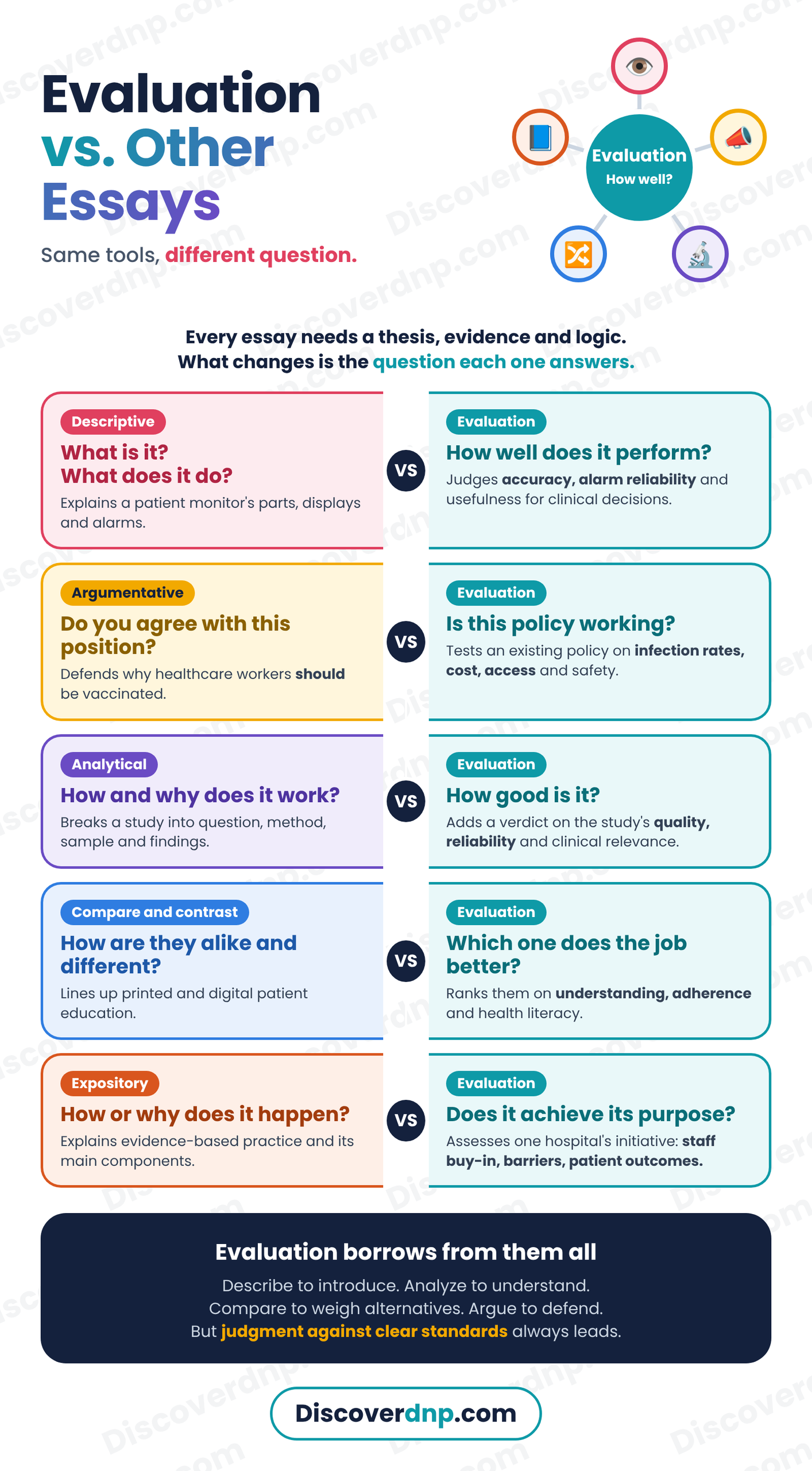
How to Write an Evaluation Essay
Writing an effective evaluation essay involves more than describing a subject or stating whether something is good or bad. The process requires a systematic examination of the subject, the establishment of clear evaluation criteria, the collection of reliable supporting evidence, and the development of a reasoned judgment. Each stage contributes to an evaluation argument that readers can understand, assess, and trust.
An evaluation essay should follow a logical process so that the final judgment is based on consistent standards rather than personal preference. For example, when evaluating a hospital’s patient education program, a writer should not simply claim that the program is effective because patients appear satisfied. The evaluation should consider measurable factors such as the accuracy of the information, accessibility of educational materials, patient understanding, cultural appropriateness, and the program’s influence on health behaviors.
The following steps provide a practical writing guide, from establishing evaluation criteria to preparing a polished final draft.
Establish Evaluation Criteria
Evaluation criteria are the standards or benchmarks used to determine the quality, effectiveness, value, or suitability of a subject. They form the foundation of an evaluation essay because they explain what the writer will examine and how the final judgment will be reached. Without clearly defined criteria, an evaluation can become a collection of personal opinions rather than a structured, evidence-based assessment.
Before beginning to write an evaluation essay, identify the specific qualities that matter when judging the selected subject. These qualities should relate directly to the purpose of the evaluation and provide a reasonable basis for comparison or assessment. For example, an essay evaluating a hospital’s fall prevention program may examine staff compliance, patient risk assessment, availability of safety equipment, patient education, and the program’s effect on fall rates.
A useful set of criteria should be relevant, clear, consistent, and measurable wherever possible. Each criterion should address an important aspect of the subject and help answer the central evaluation question.
When selecting criteria, consider the following qualities:
- Relevance: Each criterion should relate directly to the subject and the purpose of the evaluation. For instance, when assessing a patient education program, the accuracy of its medical information is relevant, whereas the appearance of the hospital building may not be.
- Clarity: Criteria should be specific enough for readers to understand what is being assessed. Instead of using a vague standard such as “good communication,” consider measurable aspects such as clarity of instructions, responsiveness to patient questions, and use of understandable language.
- Consistency: Apply the same standards throughout the essay. If you assess two patient education programs based on accessibility, accuracy, and patient understanding, use those same criteria for both.
- Measurability: Where possible, select criteria that can be assessed through observable findings, research results, statistics, or documented performance. Not every quality can be measured numerically, but it should be possible to explain how the writer reached a judgment.
- Balance: Include criteria that allow the subject’s strengths and limitations to be considered. Selecting only favorable standards can produce an overly positive evaluation, while focusing exclusively on weaknesses can result in an unfair judgment.
A practical way to establish evaluation criteria is to begin with the central question the essay intends to answer. Consider what would make the subject successful, effective, appropriate, or valuable. The answers can then be organized into a set of criteria.
For example, suppose the selected topic is the effectiveness of a hospital fall prevention program. The writer could establish the following criteria:
| Evaluation criterion | What the writer should examine |
|---|---|
| Risk assessment | Whether patients are assessed for fall risk during admission and when their condition changes |
| Staff compliance | Whether healthcare professionals consistently follow recommended fall prevention procedures |
| Safety resources | Whether appropriate equipment, such as bed alarms, nonslip footwear, and assistive devices, is available |
| Patient education | Whether patients and families understand fall risks and prevention measures |
| Patient outcomes | Whether the program is associated with fewer falls and fall-related injuries |
These criteria provide a clear direction for the evaluation. Rather than discussing fall prevention in general, the writer can examine how well the program performs in each area and determine which aspects require improvement.
It is also important to distinguish between a criterion and the evidence used to assess it. A criterion is the standard against which the subject is judged, while evidence is the information that demonstrates how well the subject meets that standard. For example, staff compliance may be a criterion, while audit reports documenting adherence to fall prevention protocols may provide the supporting evidence.
Once the criteria have been established, they should guide the essay outline, research, and thesis statement. The evaluative thesis statement should communicate the overall judgment and, where appropriate, identify the most important standards supporting that judgment. For example:
Although the hospital’s fall prevention program has improved patient risk assessment and staff awareness, inconsistent compliance with safety procedures and limited availability of assistive equipment reduce its overall effectiveness.
This thesis presents a qualified judgment rather than an unsupported declaration that the program is either good or bad. It also gives the writer a clear framework for organizing the main body of the essay.
Research the Subject and Gather Supporting Evidence
After establishing the evaluation criteria, the next step is to research the subject and collect reliable information that can support the assessment. Research helps the writer move beyond assumptions and personal impressions by providing factual details, documented findings, and expert perspectives. An evaluation essay requires evidence because readers need to understand why the writer has reached a particular judgment.
The research process should focus on information that directly addresses the established criteria. Collecting large amounts of unrelated information can make the essay unnecessarily lengthy and distract from its central purpose. Instead, identify what information is needed to assess each aspect of the subject and search for sources that provide relevant answers.
Identify the information needed for each criterion
Begin by reviewing the criteria and developing research questions for each one. These questions help narrow the search and make it easier to identify useful sources.
For example, when evaluating a hospital’s patient education program, the writer might ask:
- Accuracy: Does the educational material reflect current clinical guidelines and established medical knowledge?
- Accessibility: Is the information available in languages and formats that patients can understand?
- Patient understanding: Do patients demonstrate improved knowledge after receiving the education?
- Practical application: Can patients apply the information when managing their health outside the hospital?
- Effectiveness: Does the program contribute to better health behaviors or other relevant patient outcomes?
These questions provide a practical research direction. They also help the writer avoid collecting information simply because it relates to the general topic.
Use credible and relevant sources
The quality of an evaluation depends partly on the quality of the information used to support it. A writer should prioritize sources that are reliable, accurate, relevant, and appropriate for the subject. Purdue University’s Online Writing Lab recommends considering an author’s qualifications, the publication date, the purpose of a source, its supporting evidence, and whether its information can be verified elsewhere.
Depending on the subject, useful sources may include:
- Peer-reviewed journal articles: These provide research findings, clinical observations, and scholarly analysis. They are particularly useful when evaluating healthcare interventions, nursing practices, educational programs, and medical technologies.
- Systematic reviews and meta-analyses: These summarize findings from multiple studies and can help establish whether a particular intervention has demonstrated consistent benefits or limitations.
- Government publications: Reports from public health agencies and regulatory bodies may provide statistics, guidelines, policy information, and performance standards.
- Professional organization guidelines: Publications from recognized professional associations can help establish accepted standards of practice and evaluate whether a program or intervention aligns with professional recommendations.
- Books and academic textbooks: These can provide theoretical explanations, established concepts, and background information needed to understand the subject.
- Primary research and original documents: Surveys, interviews, experiments, institutional reports, and original data may provide direct information about the subject being evaluated.
For nursing and healthcare topics, sources from reputable medical journals, government health agencies, recognized healthcare organizations, and professional nursing bodies are particularly useful. For example, an evaluation of a medication administration technology system may require research on medication errors, clinical workflow, staff training, and patient safety outcomes.
The writer should also consider whether a source is current enough for the subject. Recent evidence is especially important when assessing medical equipment, clinical procedures, healthcare technologies, and treatment recommendations because standards and available research may change. However, older publications may still be appropriate when discussing historical developments or foundational theories.
Assess the credibility of the information
Not every source that appears in a search result is suitable for academic essay writing. Websites, blogs, advertisements, and opinion pieces may contain useful information, but their claims should be examined carefully before they are included as supporting evidence.
Consider the following questions when assessing a source:
- Who produced the information? Determine whether the author has relevant qualifications or whether the publication comes from a recognized institution.
- What evidence supports the claims? Look for research findings, documented observations, citations, statistics, or other verifiable information.
- When was the information published? Check whether the publication date is appropriate for the subject and whether newer evidence has become available.
- What is the purpose of the source? Consider whether it aims to inform, educate, persuade, advertise, or promote a particular product or position.
- Is the information consistent with other credible sources? Cross-check important claims rather than relying on a single publication.
- Does the source address the actual evaluation question? A publication may be credible but still have limited relevance to the specific criterion being assessed.
For instance, a manufacturer’s website may provide technical information about a hospital monitoring device, including its functions and specifications. However, the manufacturer’s claims about the device’s effectiveness should be examined alongside independent research and clinical evaluations. This helps prevent promotional material from becoming the main basis of the writer’s judgment.
Gather different forms of supporting evidence
Evidence can take several forms, depending on the subject and the evaluation criteria. A strong evaluation essay may combine different types of information to provide a more comprehensive assessment.
| Type of evidence | How it supports an evaluation |
|---|---|
| Statistical data | Shows measurable outcomes, trends, rates, and differences |
| Research findings | Provides evidence from studies examining the subject |
| Expert opinions | Offers informed professional perspectives and interpretations |
| Direct observations | Describes documented features or performance in a particular setting |
| Case studies | Illustrates how the subject operates in a real-world situation |
| Patient or user feedback | Provides information about satisfaction, accessibility, and practical experiences |
| Comparative evidence | Helps assess how the subject performs against alternatives or established standards |
For example, when evaluating a patient education program, statistical data may show how many patients completed the sessions, research findings may demonstrate improvements in health knowledge, and patient feedback may reveal whether the materials were understandable. Each type of evidence contributes a different perspective.
However, evidence should not be included merely to make the essay appear more academic. Every statistic, quotation, research finding, or example should contribute to the evaluation by supporting or challenging a particular criterion.
Organize research findings according to the evaluation criteria
Once the research has been collected, organize it so that each finding can be connected to the appropriate criterion. A research table can help prevent information from becoming scattered and make it easier to identify gaps.
For example:
| Criterion | Information collected | Possible interpretation |
|---|---|---|
| Accuracy | Educational materials follow current clinical recommendations | The program performs well in providing reliable information |
| Accessibility | Materials are available only in one language | Patients who speak other languages may experience barriers |
| Patient understanding | Assessment results show improved knowledge after education | The program appears effective in improving understanding |
| Practical application | Follow-up reports show inconsistent adherence to recommendations | Additional support may be necessary to help patients apply what they learn |
This approach makes the research process more organized and helps the writer recognize patterns in the evidence. It may also reveal that some criteria have stronger supporting information than others. If a major criterion lacks sufficient evidence, additional research may be necessary before reaching a conclusion.
It is equally important to record publication details while researching. Keep track of authors, titles, publication dates, journal names, page numbers, and other relevant information required by the selected citation style. Proper documentation makes it easier to prepare the reference list or works cited section and reduces the risk of accidental plagiarism.
Interpret the evidence rather than simply reporting it
Collecting research is only one part of the process. An evaluation essay must also explain what the evidence means and how it affects the assessment. A paragraph that merely reports statistics or summarizes an article does not provide sufficient critical analysis.
For example:
Research finding: A hospital report indicates that patient falls decreased after the introduction of a fall prevention program.
Evaluation: The reduction in falls suggests that the program may be contributing to improved patient safety. However, the finding should be interpreted alongside other factors, such as changes in patient characteristics, staffing levels, and the implementation of additional safety measures. Without considering these factors, it may be difficult to attribute the improvement entirely to the program.
The second explanation demonstrates how evidence can be interpreted within the context of an evaluation. It recognizes the significance of the finding while considering possible limitations.
The Purdue OWL also emphasizes that credible research should be examined for accuracy, sufficient evidence, relevance, and possible bias rather than accepted without question.
Develop a Clear and Defensible Evaluation Argument
After researching the subject, the writer must develop a clear evaluation argument that communicates the overall judgment and explains why that judgment is reasonable. An evaluation argument is the central line of reasoning that connects the subject, evaluation criteria, supporting evidence, and final conclusion.
A defensible argument does not simply announce that a subject is excellent, ineffective, useful, or unsuitable. It explains the standards used to reach that judgment and demonstrates how the available evidence supports the assessment. Readers should be able to follow the reasoning and understand how the writer moved from the evidence to the conclusion.
Develop a focused evaluative thesis statement
The thesis statement is the central claim of the evaluation essay. It should identify the subject being assessed and communicate the writer’s overall judgment. Depending on the topic, it may also indicate the main criteria that support the evaluation.
A weak thesis statement might read:
The hospital’s patient education program is good and helps patients.
This statement is too general because it does not explain what makes the program good or how its effectiveness will be assessed.
A stronger evaluative thesis statement would be:
The hospital’s patient education program is effective in improving patient knowledge because it provides clinically accurate information and encourages active participation, although limited language accessibility reduces its usefulness for some patients.
This version is more defensible because it communicates a specific judgment, identifies supporting qualities, and acknowledges a limitation. It also gives the writer a clear direction for the main body of the essay.
A useful approach is to construct the thesis by answering three questions:
- What subject is being evaluated?
- What is the overall judgment about its quality, effectiveness, or value?
- Which criteria or findings provide the strongest support for that judgment?
The answers can then be combined into one focused statement. The thesis should be broad enough to guide the entire essay but specific enough to establish a meaningful evaluation argument.
Connect every major claim to a criterion
Each major point in the body of the essay should relate to one of the established evaluation criteria. This creates a logical connection between the thesis statement and the supporting paragraphs.
For instance, an evaluation of a hospital patient education program might develop the following argument:
- The program is effective in providing accurate health information because its materials are based on recognized clinical recommendations.
- Its use of visual aids and demonstrations improves accessibility for patients who have difficulty understanding technical medical language.
- Patient feedback suggests that the program improves understanding, although follow-up assessments indicate that some patients struggle to apply the information independently.
- Limited availability of translated materials reduces the program’s suitability for patients who do not speak the primary language used in the hospital.
Each point evaluates a different aspect of the program. Together, they build a balanced judgment about its overall performance.
The writer should avoid introducing claims that are unrelated to the criteria or do not contribute to the thesis. For example, discussing the history of the hospital in several paragraphs may not be useful unless the institution’s history directly affects the program being evaluated.
Use a claim, evidence, and reasoning approach
A clear evaluation argument can be developed by combining three essential elements:
- Claim: State the judgment about a particular aspect of the subject.
- Evidence: Provide relevant research findings, examples, statistics, observations, or expert information that support the claim.
- Reasoning: Explain how the evidence supports the judgment and why the finding matters in relation to the evaluation criterion.
Consider the following example:
Claim: The hospital’s fall prevention program demonstrates a weakness in staff compliance.
Evidence: Internal audit reports indicate that some patient safety checks are not consistently documented during nursing shifts.
Reasoning: Inconsistent documentation makes it difficult to verify whether recommended safety measures are being implemented. It may also create gaps in communication between healthcare professionals, reducing the reliability of the program.
This structure prevents the writer from making unsupported statements. It also helps readers understand the connection between the evidence and the overall judgment.
The reasoning component is particularly important. Evidence does not always speak for itself, and readers should not be expected to determine how every statistic or research finding relates to the writer’s argument. The writer must explain the significance of the information and connect it to the relevant criterion.
Balance strengths and weaknesses
A credible evaluation should recognize both favorable and unfavorable findings when they are relevant. This does not mean that every evaluation must give equal attention to positive and negative aspects. Rather, the amount of attention given to each finding should reflect its importance and the strength of the available evidence.
For example, an evaluation of an electronic health record system might identify the following strengths:
- It improves access to patient information across authorized healthcare departments.
- It supports more organized documentation.
- It can improve communication between healthcare professionals.
- It may reduce certain documentation and information retrieval problems.
However, the same system may have limitations:
- Staff may require extensive training before using it efficiently.
- Technical interruptions can disrupt clinical workflows.
- Poorly designed interfaces may increase documentation difficulties.
- Implementation and maintenance may involve substantial costs.
A balanced evaluation would consider how these strengths and weaknesses affect the system’s overall value. It might conclude that the technology offers significant benefits for patient information management but requires ongoing staff training and technical support to achieve its full potential.
The writer should also consider relevant counterarguments. A counterargument is an alternative perspective or finding that challenges the main evaluation claim. For example, some healthcare professionals may report that an electronic documentation system increases their workload, while others may emphasize its benefits for information accuracy and accessibility.
Addressing these different perspectives demonstrates that the writer has considered the subject from more than one angle. However, counterarguments should be assessed using the same standards as the main argument rather than included simply to make the essay appear balanced.
Avoid unsupported personal opinions and exaggerated judgments
An evaluation essay may include the writer’s judgment, but that judgment should be grounded in credible evidence and clearly stated criteria. Statements such as “this is the best program,” “the service is terrible,” or “the device is completely useless” are weak when they are not supported by specific findings.
A more objective approach replaces emotional or absolute language with precise, qualified statements.
| Unsupported judgment | More defensible evaluation |
|---|---|
| The training program is excellent. | The training program effectively improves clinical knowledge through structured instruction and practical demonstrations. |
| The monitoring device is useless. | The device has limited usefulness in settings where technical support and compatible accessories are unavailable. |
| The hospital’s communication is terrible. | Communication between departments is inconsistent, particularly during patient handovers. |
| The patient education materials are perfect. | The materials provide accurate information, although some sections may be difficult for patients with limited health literacy to understand. |
This distinction helps maintain an objective tone. It also makes the writer’s reasoning more persuasive because the judgment is connected to identifiable qualities rather than personal feelings.
Ensure the overall judgment follows from the evidence
The final evaluation should be consistent with the findings discussed throughout the essay. A writer should not present an overwhelmingly positive assessment in the thesis and then provide evidence showing that the subject has serious, unresolved weaknesses without explaining the contradiction.
The overall judgment should reflect the relative importance of the criteria, the quality of the evidence, and the significance of the identified strengths and limitations.
For example, a hospital fall prevention program may perform well in patient risk assessment and education but poorly in staff compliance and equipment availability. The writer could conclude that the program has a useful foundation but requires improvements in implementation before it can be considered fully effective.
This is a more meaningful conclusion than simply labeling the program successful or unsuccessful. It recognizes that evaluation often involves weighing different aspects of performance rather than arriving at an absolute judgment.
Draft, Revise, and Proofread the Essay
Once the criteria, research findings, and evaluation argument are established, the next step is to draft the essay. Drafting involves turning the research and outline into connected paragraphs that communicate the assessment in a clear and logical manner. However, the first draft should not be treated as the final version. Effective essay writing requires revision, editing, and proofreading to improve the quality of the argument and ensure that the finished paper is accurate and coherent.
Prepare an evaluation essay outline before drafting
An essay outline provides a framework for organizing the main ideas before writing complete paragraphs. It helps the writer decide what information belongs in each section, how the criteria will be assessed, and how the supporting evidence will contribute to the overall judgment.
A basic evaluation essay outline may look like this:
| Essay section | Main content |
|---|---|
| Introduction | Present the subject, provide relevant background information, explain the purpose of the evaluation, and state the thesis |
| Body paragraph 1 | Evaluate the subject using the first criterion and provide supporting evidence |
| Body paragraph 2 | Assess the second criterion and explain its significance |
| Body paragraph 3 | Examine another important criterion, including relevant strengths or limitations |
| Body paragraph 4 | Discuss additional findings or relevant counterarguments, where necessary |
| Conclusion | Restate the overall judgment, summarize the most important findings, and provide recommendations where appropriate |
The exact number of body paragraphs depends on the complexity of the subject and the number of criteria. A simple restaurant review may require only a few criteria, while an evaluation of a hospital intervention may require a more extensive discussion.
The outline should also indicate which sources will support each major point. This helps ensure that the body of the essay is adequately supported rather than relying on general statements.
Write the first draft
When drafting, follow the outline while allowing enough flexibility to develop important ideas. The introduction should present the subject and establish the central judgment. The body should evaluate the subject criterion by criterion, using evidence and critical analysis to support each point. The conclusion should bring the findings together and communicate the final assessment.
Each body paragraph should focus on one main idea. A useful approach is to begin with a topic sentence that identifies the criterion being evaluated, followed by an explanation, supporting evidence, and analysis.
For example, a paragraph assessing the accessibility of a patient education program might begin:
The accessibility of the hospital’s patient education program is limited by the lack of materials in languages commonly spoken by its patient population.
The paragraph can then explain why language accessibility matters, provide evidence about the available educational materials, and discuss how the limitation may affect patient understanding and participation. It should conclude by linking the finding to the program’s overall effectiveness.
This approach helps maintain paragraph unity and prevents the writer from discussing several unrelated criteria in the same paragraph.
During drafting, use transitions to show relationships between ideas. Words and phrases such as in addition, however, in contrast, similarly, and as a result can help readers follow the progression of the evaluation. Transitions should reflect the actual relationship between points rather than being added mechanically.
The first draft should prioritize developing the argument and including the necessary evidence. Minor wording and punctuation issues can be corrected during later stages.
Revise the content and organization
Revision involves examining the essay as a whole to determine whether its argument, evidence, structure, and overall message are effective. It is more extensive than correcting spelling or punctuation. A writer may need to reorganize paragraphs, clarify the thesis, add missing evidence, remove irrelevant information, or reconsider an evaluation that is not adequately supported.
Purdue University’s writing guidance recommends reviewing the main point, purpose, audience, supporting evidence, organization, and clarity when revising a paper.
The following questions can guide the revision process:
- Thesis statement: Does the thesis clearly identify the subject and communicate an overall judgment?
- Evaluation criteria: Are the criteria relevant to the subject and applied consistently?
- Supporting evidence: Does each major claim have sufficient evidence?
- Critical analysis: Does the essay explain the significance of the evidence rather than simply summarize research?
- Balance: Have important strengths, weaknesses, and alternative perspectives been considered?
- Organization: Does each paragraph contribute to the main argument, and do the ideas progress logically?
- Conclusion: Does the final judgment reflect the evidence presented in the body of the essay?
- Relevance: Are all paragraphs connected to the purpose of the evaluation?
For example, a writer may discover during revision that the essay contains several paragraphs describing how a hospital’s fall prevention program was introduced but provides little information about whether the program reduced falls. The revision should shift attention toward evidence of effectiveness, such as fall rates, compliance records, and patient safety outcomes.
Similarly, if the essay concludes that a program is effective but does not address evidence of poor patient participation, the writer may need to revise the argument, include the missing findings, or explain why the limitation does not outweigh the program’s other benefits.
Reading the draft after taking a short break can also help identify unclear arguments and unnecessary repetition. Looking at the paper from the reader’s perspective makes it easier to recognize where additional explanation or evidence is needed.
Edit for clarity, consistency, and academic tone
Editing focuses on improving the language and presentation of the essay after the major content and organizational issues have been addressed. The aim is to make the writing precise, readable, and consistent.
Pay attention to the following areas:
- Sentence clarity: Rewrite sentences that are too long, vague, or difficult to follow. Each sentence should communicate a clear idea.
- Word choice: Use precise academic language when discussing criteria, findings, and judgments. Avoid informal expressions, exaggerated descriptions, and unnecessary jargon.
- Consistency: Use terminology consistently throughout the essay. For example, if the subject is referred to as a patient education program, avoid switching between several different labels that may confuse the reader.
- Repetition: Remove sentences that repeat the same idea without adding further explanation or evidence.
- Paragraph development: Check that each paragraph has a clear main idea and enough supporting details to develop it.
- Transitions: Ensure that the movement between paragraphs and major points is logical.
- Objective tone: Replace unsupported personal expressions with evidence-based assessments.
The writer should also check that the language accurately reflects the strength of the evidence. If a study suggests that an intervention may improve patient outcomes, it is inappropriate to claim that it always produces better outcomes. Words such as suggests, indicates, demonstrates, and may contribute to can help communicate the level of certainty appropriately.
Check citations and references
An evaluation essay that uses external research must acknowledge the original sources. Proper citation allows readers to identify where information originated, verify important claims, and distinguish the writer’s analysis from the work of other authors.
Review the required citation style, such as APA, MLA, or Chicago, and make sure it is applied consistently. Depending on the required format, check:
- Whether quotations and paraphrased information have appropriate in-text citations.
- Whether statistics and research findings are attributed to their original sources.
- Whether every source cited in the essay appears in the reference list or works cited section.
- Whether the reference entries contain the required publication details.
- Whether quotations reproduce the original wording accurately and use quotation marks where required.
Paraphrasing does not remove the need for citation. Even when an idea is expressed in the writer’s own words, the original source must still be acknowledged.
The writer should also avoid relying too heavily on direct quotations. Paraphrasing and summarizing research findings often make it easier to maintain a consistent academic voice while allowing room for critical analysis.
Proofread the final draft
Proofreading is the final stage of preparing the essay. It involves checking the completed document for errors that may have remained after revision and editing. These errors may include spelling mistakes, punctuation problems, grammatical inconsistencies, missing words, formatting issues, and incorrect citations.
A useful proofreading approach is to review the essay in several passes rather than attempting to identify every problem at once.
- First pass—grammar and sentence construction: Check subject-verb agreement, verb tense, sentence fragments, run-on sentences, and awkward phrasing.
- Second pass—spelling and punctuation: Look for misspelled words, misplaced commas, missing full stops, and inconsistent capitalization.
- Third pass—paragraph structure: Confirm that every paragraph has a clear topic sentence, sufficient development, and a logical connection to the main argument.
- Fourth pass—formatting and citations: Check headings, spacing, page numbers, font requirements, in-text citations, and the reference list.
- Final pass—overall readability: Read the essay aloud or review it slowly to identify sentences that sound unclear, repetitive, or incomplete.
Purdue OWL recommends reading a paper aloud and examining paragraph construction to identify awkward wording and underdeveloped ideas.
Use a final evaluation essay checklist
Before submitting the paper, the writer can use a checklist to determine whether the essay meets its purpose and the required academic standards.
- The essay has a clear and relevant subject.
- The introduction provides sufficient background information.
- The thesis statement communicates a specific overall judgment.
- The evaluation criteria are clear, relevant, and consistently applied.
- Each body paragraph focuses on a specific aspect of the subject.
- Major claims are supported by credible evidence.
- The writer explains how the evidence supports each judgment.
- Relevant strengths, weaknesses, and counterarguments are considered.
- The conclusion reflects the findings discussed in the essay.
- All external sources are properly cited.
- The writing is clear, objective, and logically organized.
- Grammar, spelling, punctuation, and formatting have been checked.
Following these steps helps transform research and initial ideas into a coherent evaluation paper. A strong final draft should do more than describe the subject or repeat what other authors have said. It should demonstrate how the subject performs against clearly stated criteria, explain the significance of the available evidence, and provide a reasonable overall judgment.
The writing process is also iterative. New research may require the writer to adjust a criterion, revise the thesis, or reconsider an earlier conclusion. Returning to earlier stages when necessary helps ensure that the final evaluation remains accurate, balanced, and defensible.
Evaluation Essay Example
A practical evaluation essay example helps demonstrate how the principles of evaluative writing work together in a complete academic paper. Although understanding the definition, structure, criteria, and research process is important, seeing these elements applied to one subject makes it easier to understand how to develop a clear evaluation argument.
An effective evaluation essay example should do more than describe a subject or list its advantages and disadvantages. It should introduce a specific subject, establish clear evaluation criteria, present relevant evidence, analyze the findings, and provide a justified overall judgment. The reader should be able to identify what is being evaluated, the standards used to assess it, and the reasons behind the writer’s conclusion.
For this section, the example focuses on a hospital patient education program. This subject is relevant to healthcare because patient education influences how individuals understand their conditions, participate in treatment decisions, follow care instructions, and manage their health after discharge. It also provides several meaningful criteria for evaluation, including accuracy, accessibility, patient understanding, practical application, and effectiveness.
The sample illustrates how an evaluation essay can combine objective assessment with a defensible judgment. It also shows how the introduction, thesis statement, body paragraphs, supporting evidence, and conclusion contribute to a unified piece of writing.
Example Topic and Thesis Statement
The first step in developing an evaluation essay example is selecting a subject that can be assessed using clear and relevant standards. A suitable topic should have identifiable qualities, sufficient information for research, and enough complexity to support a meaningful judgment. It should also be specific enough to prevent the essay from becoming a general discussion of an entire field.
For this sample, the selected topic is:
Topic: Evaluating the Effectiveness of a Hospital Patient Education Program
A hospital patient education program is a structured initiative designed to help patients understand their health conditions, treatment plans, medications, preventive measures, and self-care responsibilities. Such programs may involve individual consultations, printed educational materials, demonstrations, videos, group sessions, discharge instructions, and digital learning resources.
The subject is suitable for an evaluation essay because its effectiveness can be assessed from several perspectives. For example, a program may provide accurate medical information but fail to communicate it in language that patients understand. Another program may offer accessible educational materials but provide insufficient follow-up to determine whether patients can apply the information at home. These differences make it possible to examine both strengths and weaknesses rather than relying on a simple positive or negative judgment.
Establishing the evaluation criteria
Before developing the thesis statement, the writer should identify the standards that will guide the assessment. The criteria should reflect the main qualities that determine whether the program achieves its intended purpose.
For this example, the evaluation will focus on five criteria:
- Accuracy of information: Whether the educational content reflects reliable medical knowledge and current clinical recommendations.
- Accessibility of materials: Whether patients can obtain and understand the information regardless of language, literacy level, disability, or preferred learning method.
- Patient understanding: Whether the program helps patients develop a clear understanding of their conditions, medications, and treatment instructions.
- Practical application: Whether patients can use the information to make informed decisions and carry out appropriate self-care activities.
- Overall effectiveness: Whether the program achieves its educational objectives and contributes to better patient participation and health management.
These evaluation criteria provide a consistent basis for assessing the program. They also prevent the essay from becoming a general description of patient education in healthcare.
Developing the evaluation question
An evaluation question helps establish the direction of the paper. It identifies the central issue the writer intends to investigate and determines what the research should address.
For this topic, the evaluation question could be:
How effective is the hospital’s patient education program in providing accurate, accessible, and practical health information that improves patient understanding and supports self-care?
This question is focused because it identifies the subject, its intended purpose, and the main aspects that will be assessed. It also encourages the writer to consider measurable outcomes and practical limitations rather than simply expressing an opinion about the program.
Formulating the thesis statement
The thesis statement presents the central judgment of the evaluation essay. It should communicate the writer’s position and indicate the main reasons supporting that assessment. A strong evaluative thesis statement is specific, balanced, and supported by criteria that can be examined throughout the body of the essay.
A weak thesis statement might read:
The hospital’s patient education program is good and helps patients learn about their health.
Although this statement identifies a positive opinion, it does not explain what makes the program effective or which standards support the judgment. It also fails to acknowledge that the program may have limitations.
A stronger thesis statement would be:
The hospital’s patient education program is generally effective because it provides clinically accurate information, improves patient understanding, and encourages participation in self-care; however, limited language accessibility and inconsistent follow-up reduce its ability to meet the needs of all patients.
This thesis is more effective for several reasons:
- It identifies the subject: The hospital’s patient education program is clearly stated.
- It communicates an overall judgment: The program is described as generally effective rather than completely successful or unsuccessful.
- It establishes supporting criteria: Accuracy, patient understanding, and participation in self-care are identified as important strengths.
- It acknowledges limitations: Language accessibility and follow-up are recognized as areas requiring improvement.
- It provides direction: The body paragraphs can be organized around the criteria and findings introduced in the thesis.
A thesis statement should not promise more than the essay can demonstrate. If the writer intends to evaluate only the accuracy, accessibility, and effectiveness of educational materials, the thesis should not make broad claims about improved hospital-wide patient outcomes unless sufficient evidence is available.
The selected topic and thesis therefore provide a clear foundation for the complete evaluation essay sample below.
Complete Evaluation Essay Sample
The following sample demonstrates how the selected topic, evaluation criteria, thesis statement, supporting evidence, and overall judgment can be combined into a complete academic paper. It uses a formal, objective tone and organizes the discussion around the five established criteria.
The sample is illustrative rather than a report of findings from a particular hospital. It does not invent patient survey results or clinical statistics. Instead, it uses recognized patient education principles and guidance from the Agency for Healthcare Research and Quality (AHRQ) to demonstrate how evidence can support an evaluation.Evaluating the Effectiveness of a Hospital Patient Education Program
Introduction
Patient education is an important part of healthcare because it helps individuals understand their medical conditions, treatment options, medications, and responsibilities in managing their health. Hospitals use different educational approaches, including printed materials, one-on-one consultations, demonstrations, videos, and discharge instructions, to help patients make informed decisions and participate in their care. However, the availability of educational resources does not automatically mean that patients understand or can apply the information they receive. The effectiveness of a patient education program therefore depends on the quality of its content, accessibility, communication methods, and ability to support practical self-care.
A hospital patient education program can be evaluated using several criteria, including the accuracy of its information, accessibility of educational materials, improvement in patient understanding, practical application of instructions, and achievement of its educational objectives. The Agency for Healthcare Research and Quality (AHRQ) emphasizes that healthcare organizations should make information easier to understand and use by simplifying communication, confirming patient understanding, and supporting individuals in managing their health. These principles provide useful standards for assessing the quality of a patient education initiative. Although a hospital patient education program can improve health knowledge and encourage patient participation through accurate information and structured communication, limitations in language accessibility and follow-up can reduce its effectiveness in supporting the needs of all patients.
Accuracy of Educational Information
The accuracy of educational information is one of the most important criteria when evaluating a hospital patient education program. Patients rely on healthcare professionals and educational materials to understand diagnoses, medication instructions, treatment procedures, warning signs, and recommended lifestyle changes. If the information is inaccurate, outdated, or incomplete, patients may misunderstand their conditions or make decisions that negatively affect their health.
An effective program should use information consistent with current clinical recommendations and recognized healthcare standards. Educational materials should also be reviewed periodically to ensure that they reflect changes in medical knowledge and treatment practices. For example, a hospital providing diabetes education should explain blood glucose monitoring, medication use, nutrition, physical activity, and the recognition of hypoglycemia using medically accurate and appropriate guidance.
The use of standardized educational resources and professional review can improve the reliability of patient information. Nurses, physicians, pharmacists, dietitians, and other qualified healthcare professionals can contribute to developing and reviewing materials within their areas of expertise. This collaborative approach reduces the likelihood of conflicting instructions and helps ensure that educational content is appropriate for the patient’s treatment plan.
Nevertheless, accuracy alone does not guarantee effective education. Even medically correct information may have limited value if it is presented using complex terminology that patients cannot understand. Therefore, the program performs well when its content is both clinically reliable and communicated in a clear, practical manner.
Accessibility of Educational Materials
Accessibility determines whether patients can obtain, understand, and use the educational resources provided by the hospital. A program may contain excellent information but remain ineffective for individuals who cannot read the materials comfortably, do not understand the language used, have visual or hearing impairments, or lack access to digital resources.
A comprehensive patient education program should offer information in formats that accommodate different communication and learning needs. These may include plain-language handouts, diagrams, demonstrations, videos, translated materials, large-print documents, and verbal explanations. Healthcare professionals should also consider cultural beliefs, literacy levels, age-related needs, and physical limitations when selecting educational approaches.
The AHRQ Health Literacy Universal Precautions Toolkit recommends simplifying healthcare communication and making information easier for patients to find, understand, and use. Its guidance also addresses language differences, understandable written materials, and effective use of health education resources.
For example, a patient who speaks a language different from the one used in the hospital may struggle to understand discharge instructions written only in English. Providing translated materials and access to qualified language assistance can reduce this communication barrier. Similarly, a patient with limited vision may benefit from large-print instructions or verbal explanations.
Despite these possible improvements, accessibility can be difficult to maintain when hospitals have limited resources, insufficient translation services, or inadequate staff training. A program that relies heavily on printed materials or digital platforms may not serve every patient equally. Therefore, its overall effectiveness depends on whether the hospital can provide appropriate alternatives for different patient needs.
Improvement in Patient Understanding
Another important criterion is whether the program helps patients understand the information they receive. Providing educational materials or delivering verbal instructions does not necessarily demonstrate that learning has occurred. Patients may appear to understand a healthcare professional’s explanation while remaining uncertain about medication schedules, treatment procedures, or recommended lifestyle changes.
An effective educational program should use communication strategies that allow healthcare professionals to confirm understanding. One useful approach is the teach-back method, in which patients explain important information in their own words. This helps identify misunderstandings and gives healthcare professionals an opportunity to clarify instructions before the patient leaves the hospital.
AHRQ identifies teach-back as an evidence-based health literacy intervention that can support patient engagement, safety, and understanding. It recommends using the approach to confirm whether patients understand information about medications, diagnoses, follow-up testing, and treatment plans.
For example, after explaining how a patient should administer insulin, a nurse may ask the patient to describe the prescribed administration schedule and demonstrate the relevant steps. If the patient cannot explain or demonstrate the process correctly, the nurse can provide additional instruction. This is more informative than simply asking whether the patient understands.
The use of diagrams, demonstrations, repetition, and opportunities for questions can further improve the learning process. However, the program’s success should be assessed through evidence of patient understanding rather than the number of educational sessions conducted or handouts distributed.
Consequently, a patient education program demonstrates greater value when it incorporates methods for assessing comprehension and responding to identified learning needs. Without these methods, healthcare professionals may overestimate how much information patients have understood.
Practical Application of Educational Information
Patient education should enable individuals to use what they have learned in their everyday lives. Understanding a medical condition is important, but the information becomes more useful when patients can apply it to medication management, symptom monitoring, dietary choices, wound care, physical activity, and other aspects of self-care.
A program should therefore include practical instruction that reflects the patient’s health condition and individual circumstances. For example, a patient recovering from surgery may need to understand wound care, pain management, medication schedules, physical activity restrictions, and symptoms that require medical attention. Providing a written discharge document without demonstrating important procedures may leave the patient uncertain about how to carry out the instructions at home.
Demonstrations and return demonstrations can help assess practical skills. A nurse teaching a patient how to use an inhaler, for instance, can demonstrate the correct technique and then ask the patient to repeat the procedure. This allows the healthcare professional to identify mistakes and provide immediate correction. AHRQ’s guidance on patient education supports the use of demonstrations, teach-back, and follow-up to reinforce important information.
The practical value of education also depends on whether patients have the resources and support needed to follow recommendations. A patient may understand a prescribed dietary plan but struggle to follow it because of financial limitations, food availability, cultural preferences, or other social circumstances. Similarly, an individual may understand medication instructions but experience difficulty obtaining the prescribed medicines.
These factors show that education should not be evaluated solely by what patients know. The assessment should also consider whether the information is realistic, relevant, and applicable to their circumstances. A program that combines instruction with individualized action plans, appropriate referrals, and follow-up support is better positioned to help patients translate knowledge into self-care practices.
Overall Effectiveness of the Program
The overall effectiveness of a patient education program depends on how well its different components work together to achieve the intended educational objectives. Accuracy, accessibility, patient understanding, and practical application are interconnected. A program may perform well in one area but remain limited if other essential components are neglected.
For example, a hospital may provide clinically accurate information and distribute educational materials to every patient. However, if the materials are difficult to understand and no process exists for confirming comprehension, the program may not achieve its intended purpose. Similarly, an educational session may improve a patient’s understanding of a condition but have limited practical value if the patient lacks the resources needed to follow the recommended care plan.
The hospital should therefore assess its program using appropriate indicators. These may include patient comprehension assessments, feedback about educational materials, documented use of teach-back, completion of follow-up activities, and evidence that patients can demonstrate important self-care skills. Where appropriate, the hospital may also examine relevant health outcomes, while recognizing that these can be influenced by factors beyond the educational program itself.
The AHRQ toolkit provides a framework for improving communication, educational materials, patient self-management, and organizational support. It emphasizes that effective health education involves more than distributing information; healthcare organizations must also help patients understand and use it.
Based on these criteria, a hospital patient education program can be considered a valuable component of quality healthcare when it provides accurate information, accommodates different learning needs, confirms patient understanding, and supports practical self-care. However, its effectiveness is reduced when language barriers, inadequate follow-up, and limited individual support prevent patients from benefiting fully from the available resources.
Conclusion
A hospital patient education program plays an important role in helping individuals understand their health conditions and participate in their care. Its effectiveness should be evaluated through clearly defined criteria rather than the availability of educational materials alone. Accuracy, accessibility, patient understanding, practical application, and achievement of educational objectives provide a useful basis for assessing its overall quality.
The evaluation demonstrates that accurate information and structured communication can strengthen patient education, particularly when healthcare professionals use approaches such as teach-back and practical demonstrations. However, language barriers, differences in health literacy, and insufficient follow-up can limit the benefits of an otherwise well-designed program. Hospitals should therefore improve the accessibility of educational materials, provide individualized instruction, train staff in effective communication, and establish methods for assessing patient comprehension. By addressing these areas, healthcare organizations can make patient education more meaningful and better support informed decision-making and self-management.
Breakdown of the Example’s Main Components
The complete sample demonstrates how the different elements of an evaluation essay work together to produce a coherent and evidence-based assessment. Understanding the purpose of each component makes it easier to apply the same approach when writing about other subjects, including healthcare interventions, nursing technologies, academic programs, professional services, policies, and everyday products.
1. The topic establishes the subject and scope of the evaluation
The title, Evaluating the Effectiveness of a Hospital Patient Education Program, identifies the subject and indicates what the essay intends to assess.
A well-defined topic is important because it determines the scope of the discussion. Rather than examining every aspect of patient education in healthcare, the sample focuses on one hospital program and its ability to provide useful information and support patient self-care.
The topic also establishes the central evaluation question: Does the program achieve its intended educational purpose?
A broad topic such as Patient Education in Healthcare might lead to a descriptive discussion of teaching methods, communication strategies, and the responsibilities of healthcare professionals. In contrast, the selected topic requires the writer to make a judgment about the quality and effectiveness of a specific subject.
2. The introduction provides context and presents the thesis statement
The introductory paragraph performs several functions. It introduces patient education, explains why it matters in healthcare, establishes the need to assess program effectiveness, and presents the evaluation criteria.
The background information helps the reader understand the subject before encountering the writer’s judgment. It also establishes the purpose of the evaluation by explaining that providing educational materials does not necessarily mean patients understand or can apply the information.
The final part of the introduction contains the thesis statement:
Although a hospital patient education program can improve health knowledge and encourage patient participation through accurate information and structured communication, limitations in language accessibility and follow-up can reduce its effectiveness in supporting the needs of all patients.
This statement provides the direction for the entire paper. It identifies the overall judgment and previews the main strengths and limitations that will be examined in the body paragraphs.
A strong introduction should avoid presenting too much detailed evidence. Its primary purpose is to introduce the subject, establish the context, and prepare the reader for the evaluation argument.
3. The evaluation criteria organize the main body
The body of the sample is organized around five criteria:
| Evaluation criterion | Main focus of the discussion | Judgment being developed |
|---|---|---|
| Accuracy of information | Reliability and clinical relevance of educational content | Accurate information is essential for safe and informed decisions |
| Accessibility | Availability and suitability of educational resources | Different patient needs must be accommodated |
| Patient understanding | Whether patients comprehend the information provided | Understanding should be confirmed rather than assumed |
| Practical application | Whether patients can use the information in everyday care | Education should support realistic self-management |
| Overall effectiveness | Whether the program achieves its educational objectives | The program’s success depends on the combined performance of its components |
Each criterion receives a separate discussion so that the reader can follow the assessment without confusion. This approach also demonstrates how a set of criteria can provide a consistent framework for judging a subject.
The criteria should not be selected arbitrarily. They must relate to the purpose of the evaluation and reflect the qualities that matter most when determining whether the subject is successful.
4. The body paragraphs present claims and supporting evidence
Each main body paragraph focuses on one aspect of the program. It begins with a topic sentence, explains the criterion, presents relevant information, and discusses the significance of the findings.
For example, the paragraph on patient understanding explains why simply distributing educational materials is insufficient. It then introduces the teach-back method and uses AHRQ guidance to demonstrate how healthcare professionals can confirm whether patients understand important instructions.
This paragraph contains several important elements:
- Topic sentence: Identifies patient understanding as an important evaluation criterion.
- Explanation: Describes why understanding matters when assessing educational effectiveness.
- Supporting evidence: Refers to recognized guidance on the teach-back method.
- Example: Shows how a nurse can ask a patient to explain insulin administration instructions.
- Critical analysis: Explains why confirming comprehension is more useful than assuming that a patient understands.
- Evaluation: Concludes that the program is stronger when it includes methods for assessing and addressing learning needs.
This structure can be adapted to almost any evaluation essay. For instance, when evaluating a nursing simulation program, a body paragraph might assess the realism of clinical scenarios, provide research evidence about simulation-based learning, and explain how the quality of practical training affects the program’s educational value.
5. The essay balances strengths and limitations
A strong evaluation does not focus exclusively on favorable or unfavorable findings. The sample recognizes that a hospital patient education program may provide accurate information and improve patient understanding while still experiencing limitations related to language accessibility and follow-up.
This balance makes the overall judgment more credible. It also prevents the essay from becoming a promotional description of the subject or an unnecessarily negative review.
For example, the availability of translated educational materials may improve accessibility, but translation alone may not address every learning need. Patients may still require verbal explanations, demonstrations, opportunities to ask questions, or assistance from qualified interpreters.
Considering these limitations helps the writer develop a more comprehensive analysis and explain how different aspects of the subject influence its overall value.
6. The conclusion brings the findings together
The conclusion summarizes the most important findings and restates the overall judgment without introducing an entirely new argument.
In the sample, the conclusion recognizes the value of patient education while emphasizing that its effectiveness depends on accuracy, accessibility, comprehension, and practical application. It also identifies areas for improvement, including individualized instruction, staff training, and follow-up.
A conclusion should not merely repeat every body paragraph word for word. Instead, it should synthesize the main points and explain what they collectively reveal about the subject.
When appropriate, the writer may include recommendations based on the evaluation. These recommendations should follow logically from the identified weaknesses. For example, if limited language accessibility is a major concern, the writer may recommend translated materials and appropriate language assistance.
7. The sources strengthen the credibility of the evaluation
The sample uses AHRQ guidance to support its discussion of health literacy, teach-back, accessible educational materials, and patient communication. These sources provide recognized standards against which the program can be assessed.
The use of credible sources is important because an evaluation essay should distinguish between an informed judgment and an unsupported personal opinion. Research findings, professional recommendations, and documented evidence allow the writer to explain why a particular feature is considered effective or inadequate.
The writer should also make sure that the evidence is relevant to the criterion being assessed. For instance, a source explaining the importance of teach-back is useful when discussing patient understanding, but it may not provide sufficient evidence about the financial cost of implementing a hospital education program.
Every source should therefore have a clear purpose within the argument. The writer should explain what the information demonstrates rather than simply inserting quotations or research findings into the paragraph.
Applying the same approach to other evaluation essay topics
The patient education program provides one example of how to organize an evaluative paper, but the same writing approach can be applied to many other subjects. The criteria will change according to the topic, but the basic process remains consistent.
| Possible evaluation essay topic | Suitable evaluation criteria | Example of an overall judgment |
|---|---|---|
| Effectiveness of a nursing simulation program | Realism, learning outcomes, instructor feedback, accessibility, cost | The program provides valuable practical learning opportunities but requires adequate equipment and structured feedback |
| Quality of a hospital electronic health record system | Usability, data accuracy, accessibility, security, workflow efficiency | The system improves information management but may create workflow difficulties without sufficient training |
| Effectiveness of a patient fall prevention intervention | Risk assessment, staff compliance, safety resources, patient participation, fall outcomes | The intervention has potential to improve safety but depends on consistent implementation |
| Quality of an online nursing education course | Content accuracy, instructional design, interaction, assessment, accessibility | The course offers flexible learning but may provide insufficient practical experience |
| Effectiveness of a hospital discharge planning process | Communication, medication education, follow-up, coordination, patient readiness | The process supports continuity of care but requires stronger communication and follow-up arrangements |
| Quality of a restaurant’s customer service | Staff responsiveness, communication, waiting time, problem resolution, consistency | The restaurant provides friendly service but needs to improve response times during busy periods |
These examples demonstrate that an evaluation essay does not have to focus exclusively on healthcare. A restaurant review, academic course assessment, technology evaluation, or service review can follow the same structure, provided the writer establishes appropriate criteria and supports the judgment with relevant evidence.
The central lesson from this evaluation essay example is that a strong paper connects every major claim to a clearly stated standard. The introduction establishes the purpose and thesis, the body examines the subject against relevant criteria, and the conclusion brings the findings together into a defensible overall judgment. When these components work together, the result is a focused, balanced, and credible evaluation rather than a simple description or personal review.
Tips for Writing an Effective Evaluation Essay
Writing an effective evaluation essay requires more than selecting a subject, identifying evaluation criteria, and presenting supporting information. The writer must also ensure that the assessment is fair, consistent, and convincing. Even when a subject has several obvious strengths or weaknesses, the final judgment should reflect a careful examination of the available evidence rather than personal preferences or assumptions.
An effective evaluative essay allows readers to understand not only what the writer thinks about a subject but also why that judgment is reasonable. This requires maintaining an objective tone, applying the same standards throughout the discussion, and using credible evidence to support each major claim. These practices are important whether the essay evaluates a nursing intervention, hospital policy, healthcare technology, academic program, restaurant, or other subject.
For example, when assessing the effectiveness of a hospital fall prevention program, a writer should not conclude that the program is successful simply because it includes safety posters, staff training, and patient education. The evaluation should consider whether these measures are implemented consistently, whether they address the relevant risks, and whether available findings demonstrate improvements in patient safety.
The following tips help strengthen the quality of an evaluation essay and make its overall judgment more credible and defensible.
Maintain Objectivity and Avoid Unsupported Opinions
Objectivity is essential in evaluative writing because it helps ensure that the writer’s judgment is based on relevant standards and reliable information rather than personal feelings, preferences, or preconceived beliefs. An evaluation essay may communicate a clear opinion about the subject, but that opinion should be supported by evidence and explained through logical reasoning.
Maintaining objectivity does not mean avoiding judgment or refusing to identify weaknesses. Instead, it means assessing the subject fairly, recognizing relevant strengths and limitations, and avoiding conclusions that go beyond what the available information can establish.
For example, a writer evaluating a hospital’s electronic health record system may personally prefer paper-based documentation. However, this preference should not determine the overall assessment. The evaluation should examine relevant factors such as documentation accuracy, accessibility of patient information, system usability, data security, and effects on clinical workflow. If the evidence shows that the system improves information access but creates difficulties for staff who have received insufficient training, the essay should acknowledge both findings.
Distinguish personal opinions from evidence-based judgments
A personal opinion expresses what someone believes or prefers, while an evidence-based judgment explains an assessment using established criteria and supporting information. Both may appear in ordinary discussions, but an academic evaluation requires the writer to demonstrate why a particular judgment is justified.
Consider the difference between the following statements:
| Unsupported personal opinion | Objective, evidence-based assessment |
|---|---|
| The hospital’s patient education program is terrible. | The program has limited effectiveness because its educational materials are not consistently available in languages understood by the patient population. |
| The electronic health record system is the best technology for hospitals. | The system offers advantages in information accessibility and documentation organization, although its effectiveness depends on usability, staff training, and technical support. |
| The nursing course is boring and poorly designed. | The course provides limited opportunities for practical application because most learning activities rely on lectures and written assessments. |
| The restaurant provides excellent food. | The restaurant performs well in food quality and presentation, although inconsistent service times affect the overall dining experience. |
The revised statements are stronger because they identify specific qualities that can be examined. They also provide a basis for further discussion and supporting evidence.
When writing an evaluation essay, avoid relying on expressions such as I think, I feel, I believe, or in my opinion when they simply introduce an unsupported judgment. Instead, state the assessment directly and explain the reasoning behind it.
For instance, rather than writing:
I think the hospital’s fall prevention program is very effective because it seems to keep patients safe.
A more appropriate statement would be:
The hospital’s fall prevention program demonstrates several effective safety practices, particularly through routine risk assessments and patient education. However, its overall effectiveness should also be assessed using staff compliance records and patient fall outcomes.
The second statement maintains an objective tone while still communicating a clear evaluation.
Recognize and minimize personal bias
Bias occurs when personal beliefs, experiences, expectations, or preferences influence how information is selected, interpreted, or presented. It can affect an evaluation even when the writer does not intentionally favor one conclusion.
For example, a nurse who has had positive experiences with a particular patient monitoring device may be inclined to emphasize its advantages while overlooking problems reported by other healthcare professionals. Similarly, a writer who dislikes online learning may focus mainly on the limitations of a nursing education platform and disregard evidence showing that it supports flexible access to learning materials.
To reduce bias, the writer should:
- Examine personal assumptions: Identify existing beliefs about the subject before beginning the evaluation. Consider whether those beliefs are influencing the selection or interpretation of evidence.
- Consider multiple perspectives: Review different experiences, research findings, and professional opinions rather than relying on sources that support only one position.
- Use consistent criteria: Assess the subject using standards established before reaching the final judgment.
- Acknowledge limitations: Recognize weaknesses in the available research, differences between study populations, and circumstances that may affect the findings.
- Avoid selective reporting: Include relevant evidence even when it challenges the writer’s initial position.
- Separate facts from interpretations: Make it clear when a statement reports a research finding and when it presents the writer’s analysis of that finding.
These practices help produce a fairer and more comprehensive analysis. They also make the essay more persuasive because readers can see that the writer has considered information that may not support the preferred conclusion.
Use neutral and precise language
The language used in an evaluation essay can influence how readers perceive the subject. Emotional, exaggerated, or vague expressions may make the assessment appear subjective, even when the writer has collected relevant evidence.
For example, describing a hospital’s discharge process as a complete disaster does not explain which aspects are ineffective. A more precise assessment would identify the specific problem, such as incomplete medication instructions, poor communication between departments, or insufficient follow-up arrangements.
Prefer language that communicates the strength and limitations of the evidence accurately. Useful expressions include:
- The findings suggest that…
- The available evidence indicates that…
- The program demonstrates strengths in…
- The results raise concerns about…
- The intervention appears effective in…
- A significant limitation is…
- The evidence provides limited support for…
- The overall effectiveness depends on…
These expressions help avoid exaggerated conclusions. They are particularly useful when the evidence is mixed or when the available research does not establish a definite cause-and-effect relationship.
For example, if a study reports an association between a patient education intervention and improved medication adherence, the writer should not automatically claim that the intervention caused the improvement. Other factors, such as medication availability, family support, and follow-up care, may also influence adherence. A more careful evaluation would explain that the findings suggest a possible contribution from the educational intervention while recognizing other influences.
Acknowledge limitations and alternative explanations
Objectivity also involves recognizing that evidence may have limitations. A research study may involve a small sample, a short observation period, a specific patient population, or conditions that differ from those in the setting being evaluated. These limitations should be considered before using the findings to make broad claims.
For example, an evaluation of a hospital’s hand hygiene program may identify improved compliance during a short observation period. However, the writer should consider whether the observations reflect routine practice over a longer period, whether all departments were assessed, and whether the improvement was maintained.
Acknowledging such limitations does not weaken an evaluation. It demonstrates that the writer understands the boundaries of the evidence and is not making conclusions that the research cannot support.
The same principle applies when considering alternative explanations. If patient outcomes improve after a new nursing intervention is introduced, the improvement may also be influenced by changes in staffing, patient characteristics, additional training, or other safety initiatives. A comprehensive analysis should avoid attributing every improvement to a single intervention without adequate evidence.
Maintain a professional and balanced tone
An effective evaluation essay should remain respectful and analytical, even when the subject performs poorly. Criticism should focus on identifiable features, decisions, processes, or outcomes rather than attacking individuals or organizations.
For example, instead of writing that the nurses are careless and do not follow safety procedures, the writer could state:
The available compliance records indicate inconsistent implementation of recommended safety procedures, suggesting a need for additional staff training, clearer protocols, and stronger monitoring.
This approach identifies a problem without making an unsupported judgment about individual professionals. It also creates room for constructive recommendations.
Maintaining a balanced tone is particularly important in nursing and healthcare topics because clinical outcomes are influenced by multiple factors, including organizational resources, staffing, patient conditions, communication, and institutional policies. An evaluation should consider these circumstances before assigning responsibility or making broad conclusions.
Apply Consistent Standards When Evaluating
Consistency is essential when writing an evaluation essay because it ensures that the subject is assessed fairly and systematically. The writer should apply the same evaluation criteria throughout the paper rather than changing the standards depending on whether a particular finding supports the preferred judgment.
Inconsistent evaluation can weaken an otherwise well-researched essay. For example, a writer assessing two hospital patient education programs might criticize the first program for lacking translated materials but ignore the same limitation in the second. Such an approach creates an unfair comparison and makes the overall judgment less credible.
Applying consistent standards means using clearly defined criteria, examining comparable information, and interpreting findings according to the same expectations. It also means ensuring that each criterion is relevant to the subject and that the standards do not change simply to favor one conclusion.
Establish clear criteria before making judgments
One of the best ways to maintain consistency is to establish the evaluation criteria before examining the subject in detail. This reduces the likelihood of selecting standards based on the findings or changing the assessment to support an existing opinion.
For example, when evaluating a hospital’s electronic health record system, the writer may establish the following criteria:
- Usability: How easy is the system for healthcare professionals to navigate and operate?
- Accuracy: Does the system support complete, accurate, and organized patient documentation?
- Accessibility: Can authorized healthcare professionals retrieve relevant patient information when needed?
- Security: Does the system have appropriate safeguards for protecting confidential patient information?
- Workflow efficiency: Does the system support clinical processes without creating unnecessary delays or administrative difficulties?
These criteria should remain the foundation of the evaluation from the introduction through the conclusion. If usability is an important standard, it should be assessed using relevant evidence rather than being emphasized only when discussing favorable findings.
The writer should also define what each criterion means in the context of the selected subject. For example, usability may involve navigation, clarity of the interface, ease of entering information, and the time required to complete routine documentation. Defining the criterion makes it easier to apply the same standard across different departments, users, or systems.
Use the same standards when comparing subjects
When an evaluation essay involves comparing two or more subjects, the writer should assess them using equivalent criteria. This is particularly important when evaluating healthcare interventions, educational programs, medical devices, policies, or professional services.
Consider an essay comparing two patient education programs. The writer might assess both programs according to:
- Accuracy of educational content.
- Accessibility of learning materials.
- Opportunities for patient participation.
- Methods of assessing patient understanding.
- Availability of follow-up support.
A comparison table can help organize the assessment:
| Evaluation criterion | Program A | Program B |
|---|---|---|
| Accuracy of information | Uses professionally reviewed educational materials | Uses materials developed from recognized clinical recommendations |
| Accessibility | Provides printed materials in one language | Provides printed materials, translated resources, and visual aids |
| Patient participation | Relies mainly on lectures and handouts | Includes demonstrations and opportunities for questions |
| Assessment of understanding | Uses informal verbal questions | Incorporates teach-back and practical demonstrations |
| Follow-up support | Provides limited post-discharge contact | Includes scheduled follow-up and additional educational support |
The table allows the writer to examine both programs using the same standards. It also helps identify differences that might not be obvious from a general description.
However, consistent evaluation does not mean assuming that both subjects must receive equal scores or have the same strengths and weaknesses. One program may perform better in accessibility, while another may offer stronger follow-up support. The writer should report these differences accurately and explain their significance.
For example, Program B may appear more comprehensive because it uses multiple communication methods and provides follow-up support. However, the writer should also consider whether its additional resources are sustainable and whether the available evidence demonstrates better patient understanding. A fair judgment should reflect the findings rather than the number of features each program offers.
Apply criteria according to their importance
Not every evaluation criterion carries equal importance. Some qualities may be essential to determining whether a subject fulfills its purpose, while others may have a secondary influence on its overall value.
For example, when evaluating a hospital medication administration system, patient safety and medication accuracy should carry greater weight than the visual appearance of the software interface. Although usability matters, a system that looks attractive but frequently produces documentation errors cannot be considered highly effective.
Similarly, when assessing a nursing education program, the quality of clinical preparation and achievement of learning outcomes may be more important than the appearance of the learning platform.
The writer should therefore consider the relative importance of each criterion when developing the overall judgment. A useful approach is to distinguish between:
- Essential criteria: Qualities that must be present for the subject to fulfill its main purpose.
- Important supporting criteria: Qualities that strengthen the subject’s performance or improve its usefulness.
- Additional considerations: Features that contribute to the experience but may not determine overall effectiveness.
For example, an evaluation of a hospital fall prevention program might prioritize patient risk assessment, implementation of safety interventions, and fall-related outcomes. The appearance of patient safety posters may be relevant to communication but should not outweigh evidence about whether the program actually supports safer care.
This distinction helps prevent minor features from receiving more attention than important performance indicators.
Use comparable evidence and avoid selective interpretation
Consistent evaluation also requires the writer to use evidence that is appropriate for each criterion. When comparing different subjects, the evidence should be sufficiently comparable to support a reasonable judgment.
For example, comparing the effectiveness of two nursing interventions using findings from studies conducted with very different patient populations may produce misleading conclusions. Differences in age, health conditions, staffing, clinical settings, or observation periods may influence the results.
The writer should therefore consider whether the evidence measures the same outcomes under reasonably similar conditions. Where the evidence is not directly comparable, this limitation should be acknowledged.
Selective interpretation is another problem to avoid. This occurs when a writer emphasizes findings that support a preferred judgment while ignoring information that challenges it.
Suppose an evaluation of a hospital’s hand hygiene program identifies increased compliance in one department but little improvement in another. Reporting only the favorable result would give readers an incomplete picture. A more consistent evaluation would discuss both findings and consider possible explanations, such as differences in staff training, availability of hand hygiene supplies, or monitoring practices.
Purdue OWL recommends examining whether sources present balanced information, provide sufficient evidence, and acknowledge alternative viewpoints rather than relying on one-sided or unsupported claims.
Maintain consistency in terminology and interpretation
The writer should also use terminology consistently throughout the evaluation essay. Changing the meaning of important terms can confuse readers and make the assessment difficult to follow.
For example, if the essay uses patient understanding to refer to a patient’s ability to explain health instructions accurately, it should not later use the same term to mean general satisfaction with the educational session. These are related but different outcomes and should be evaluated separately.
Similarly, the writer should distinguish between:
- Effectiveness: The extent to which the subject achieves its intended objectives.
- Efficiency: How well the subject uses time, money, staff, or other resources to achieve those objectives.
- Accessibility: How easily the intended users can obtain and use the subject.
- Quality: The degree to which the subject meets relevant standards or expectations.
- Satisfaction: How users perceive or experience the subject.
These concepts may overlap, but they should not be treated as interchangeable. A hospital program may be efficient because it delivers education using limited resources but still be ineffective if patients do not understand the information. Likewise, patients may report high satisfaction with a service even when measurable outcomes reveal important limitations.
Using precise and consistent terminology helps the reader understand exactly what is being evaluated.
Ensure the conclusion reflects the same standards used in the body
Consistency should continue into the conclusion. The overall judgment must follow from the criteria and evidence discussed in the main body of the essay.
For example, if a writer evaluates a hospital’s patient education program based on accuracy, accessibility, patient understanding, and practical application, the conclusion should address the combined significance of these areas. It should not introduce an unrelated standard, such as the hospital’s architectural design, or make a broad claim about improved patient outcomes when those outcomes were not examined.
A reasonable conclusion might state:
The hospital’s patient education program provides a valuable foundation for improving patient knowledge through accurate information and structured instruction. However, limitations in language accessibility and follow-up support reduce its ability to meet the needs of every patient. Improving these areas would strengthen the program’s overall effectiveness.
This judgment is consistent with the established criteria and reflects the strengths and limitations examined throughout the paper.
Use Evidence to Justify Your Judgments
Supporting evidence is one of the most important elements of an effective evaluation essay. It gives the writer a factual basis for assessing the subject and allows readers to understand why a particular judgment has been reached. Without adequate evidence, an evaluation may appear to be a personal review rather than a reasoned academic assessment.
Evidence can include research findings, statistics, professional guidelines, expert opinions, direct observations, documented experiences, and relevant examples. The appropriate type depends on the subject and the evaluation criteria. For instance, a paper assessing a hospital infection prevention program may require clinical research, infection surveillance reports, and compliance records, while an essay evaluating a restaurant may rely on direct observations, customer feedback, and relevant service standards.
The purpose of supporting evidence is not simply to make the essay longer or create an impression of academic authority. Each piece of information should help establish whether the subject meets the stated criteria and how its performance influences the overall judgment.
Select credible and relevant evidence
The quality of an evaluation depends heavily on the credibility and relevance of the sources used. A writer should prioritize information from reliable publications and sources that have appropriate expertise in the subject being examined.
Useful sources may include:
- Peer-reviewed academic journals.
- Systematic reviews and meta-analyses.
- Government reports and official statistics.
- Professional organization guidelines.
- Academic books and textbooks.
- Institutional performance reports.
- Original research, surveys, and documented observations.
For healthcare-related topics, research from recognized medical journals, government health agencies, professional nursing organizations, and established healthcare institutions can provide useful evidence.
However, credibility alone is not enough. A source must also be relevant to the specific evaluation question. An article about the general benefits of patient education may provide useful background information, but it may not directly establish whether a particular hospital program improves medication adherence.
When assessing sources, consider the author’s expertise, publication date, purpose, supporting references, and the quality of the information presented. Purdue OWL emphasizes that reliable evidence should be accurate, trustworthy, and appropriate for the research purpose. It also recommends examining whether a source provides an objective account or promotes a particular viewpoint.
For example, a manufacturer’s website may provide useful technical specifications for a patient monitoring device. However, claims about its clinical effectiveness should be examined alongside independent research rather than accepted solely because they appear in promotional material.
Match each piece of evidence to a specific criterion
Evidence is most useful when it directly supports the criterion being evaluated. A common weakness in evaluation essay writing is including information that relates to the general topic but does not help establish the writer’s judgment.
Suppose the essay examines the effectiveness of a hospital fall prevention program. The writer may have identified five criteria:
| Criterion | Appropriate supporting evidence |
|---|---|
| Risk assessment | Patient assessment records, screening procedures, and compliance audits |
| Staff compliance | Staff observation reports and documentation audits |
| Availability of safety resources | Equipment inventories and reports on access to assistive devices |
| Patient education | Educational materials, patient comprehension assessments, and feedback |
| Patient outcomes | Fall rates, injury reports, and relevant outcome comparisons |
Each type of evidence answers a different question. Patient assessment records may show whether risk screening occurs, while outcome reports may indicate whether the intervention is associated with changes in fall rates.
The writer should avoid using one piece of evidence to support claims that it cannot establish. For example, the fact that nurses received fall prevention training does not automatically demonstrate that the training reduced patient falls. It shows that an educational activity occurred, but further evidence is needed to assess its effect on clinical practice and patient outcomes.
This distinction is important because evidence should support the actual judgment being made, not merely demonstrate that an activity or feature exists.
Explain the significance of the evidence
Evidence should always be accompanied by analysis. Simply inserting a quotation, statistic, or research finding into a paragraph does not demonstrate critical thinking. The writer must explain what the information means and how it relates to the evaluation criteria.
A useful approach is to follow three steps:
- Present the evidence: Introduce the research finding, statistic, example, or observation.
- Interpret the evidence: Explain what the information reveals about the subject.
- Connect it to the judgment: Show how the finding supports or challenges the overall evaluation.
Consider the following example:
Evidence: A hospital audit identifies inconsistent documentation of patient fall risk assessments.
Interpretation: This finding suggests that the risk assessment process may not be implemented consistently across all patient care areas.
Evaluation: Because accurate risk identification helps healthcare professionals determine appropriate safety measures, inconsistent assessment documentation represents a weakness in the program’s implementation.
The completed paragraph could read:
Consistent patient risk assessment is an important requirement of an effective fall prevention program. However, audit findings indicating inconsistent documentation suggest that the assessment process may not be implemented uniformly across all patient care areas. This limitation can make it more difficult for healthcare professionals to identify patients who require additional precautions and coordinate appropriate safety interventions. Therefore, the program’s effectiveness may be reduced by weaknesses in assessment compliance, even when appropriate fall prevention policies are available.
The paragraph does more than report an audit finding. It explains why the finding matters and how it influences the assessment.
This approach also helps maintain a clear distinction between the original information supplied by a source and the writer’s own critical analysis. University research guidance similarly emphasizes that evidence should be explained and connected to the argument rather than simply inserted into a paper without interpretation.
Use a combination of evidence types
Different forms of evidence can strengthen an evaluation by providing complementary perspectives. Depending on the subject, the writer may combine quantitative findings with qualitative information.
- Quantitative evidence: Includes numerical findings such as rates, percentages, scores, costs, and measured outcomes. It is useful when assessing performance, frequency, effectiveness, or differences between groups.
- Qualitative evidence: Includes interviews, observations, patient experiences, and descriptions of professional practice. It helps explain why a subject performs in a particular way or how people experience it.
- Comparative evidence: Shows how a subject performs in relation to alternatives, established standards, or previous results.
- Documentary evidence: Includes policies, guidelines, reports, training materials, and official records that demonstrate what procedures or expectations are in place.
- Expert evidence: Includes informed professional perspectives that help interpret complex findings and establish appropriate standards.
For example, an evaluation of a patient discharge education program could use quantitative data to examine the percentage of patients who complete education sessions, qualitative feedback to understand their experiences, and follow-up records to assess whether patients can explain their medication instructions.
Combining these sources may provide a more comprehensive assessment than relying on a single type of information. However, the writer should consider the limitations of each source. Patient satisfaction, for example, can provide useful information about the experience of receiving education, but it does not independently prove that the patient understood or correctly applied the instructions.
Use statistics accurately and provide context
Statistics can make an evaluation essay more persuasive, but they must be interpreted carefully. A number without context may create a misleading impression, particularly when the writer does not explain how the data were collected or what they represent.
When using statistics, consider:
- The population or group from which the data were collected.
- The period covered by the findings.
- The sample size and research setting.
- The measurement used to produce the result.
- Whether the findings are being compared with an appropriate baseline or reference.
- Whether other factors may have influenced the results.
For example, stating that a hospital’s fall rate decreased after the introduction of a new safety program may suggest improvement. However, the writer should consider whether the number of patients, patient characteristics, reporting practices, or other safety interventions changed during the same period.
Similarly, a percentage should be accompanied by enough information for readers to understand what it measures. A statement that 80% of patients completed an education session is different from a statement that 80% understood and could apply the information. Completion and comprehension are separate outcomes.
Avoid presenting statistics as proof of a conclusion when they only indicate a possible relationship. Accurate interpretation helps maintain the credibility of the evaluation argument.
Integrate quotations, paraphrases, and summaries appropriately
Research evidence can be incorporated into an essay through direct quotations, paraphrasing, and summarizing. Each method has a different purpose.
- Direct quotations reproduce the exact words of a source. They are most useful when the original wording is particularly important or when discussing a specific definition.
- Paraphrasing communicates a particular idea from a source using the writer’s own wording and sentence structure.
- Summarizing presents the main ideas of a longer source in a shorter form.
In most evaluation essays, paraphrasing and summarizing are useful because they allow the writer to integrate research into the argument while maintaining a consistent academic voice. Direct quotations should be used selectively rather than allowing the source material to dominate the discussion.
For example, when discussing patient health literacy, the writer may summarize a professional guideline’s recommendations about using plain language and confirming patient understanding. The writer can then explain how these recommendations provide standards for evaluating a hospital’s educational materials.
Regardless of the method used, the original source must be acknowledged through the required citation style. Paraphrasing does not eliminate the need to cite the information.
Use evidence that supports both strengths and weaknesses
A credible evaluation should not rely exclusively on information that confirms the writer’s initial position. Supporting evidence should be used to identify positive findings as well as limitations.
For example, an evaluation of a nursing simulation program might identify research showing that simulation provides opportunities to practice clinical skills in a controlled environment. However, the writer may also find evidence that simulation requires substantial resources, appropriate equipment, and trained instructors.
A balanced discussion could state:
The nursing simulation program offers valuable opportunities for practicing clinical skills and developing confidence in a controlled learning environment. However, its effectiveness may be limited when equipment is insufficient or instructors cannot provide adequate feedback. Therefore, the quality of the program depends not only on the availability of simulation activities but also on the resources and instructional support used to deliver them.
This judgment recognizes the program’s strengths while explaining the conditions that may limit its effectiveness.
The writer should also consider evidence that challenges the main thesis. If the findings suggest that a program is less effective than initially expected, the thesis or overall judgment may need to be revised. An evaluation should follow the evidence rather than force the evidence to support a predetermined conclusion.
Avoid using evidence without analysis or proper attribution
Several common mistakes can weaken the use of supporting evidence:
- Including statistics without explaining what they demonstrate.
- Quoting sources without connecting them to the evaluation criteria.
- Relying on personal anecdotes to make broad claims about an entire population.
- Using outdated research when newer evidence is necessary.
- Treating promotional statements as independent proof of effectiveness.
- Ignoring findings that challenge the writer’s preferred judgment.
- Presenting another author’s interpretation as the writer’s own.
- Making causal claims when the evidence only demonstrates an association.
For example, one patient’s positive experience with a hospital’s discharge process may illustrate how the service can work well, but it cannot establish that the process is effective for every patient. A broader evaluation would require additional evidence, such as patient feedback from different groups, documentation audits, and follow-up findings
The writer should also provide accurate in-text citations and a complete reference list or works cited section according to the required academic format. This allows readers to trace the information and assess the credibility of the sources independently.
Connect the evidence to the overall judgment
The final purpose of supporting evidence is to help establish a defensible overall judgment. Each major finding should contribute to the evaluation rather than remain an isolated observation.
For example, an evaluation of a hospital patient education program may identify the following findings:
- Educational materials contain accurate and clinically relevant information.
- Some materials are not available in languages understood by all patients.
- Teach-back helps healthcare professionals identify gaps in patient comprehension.
- Limited follow-up makes it difficult to determine whether patients consistently apply the information at home.
When these findings are considered together, the writer may conclude that the program has a strong educational foundation but requires improvements in accessibility and follow-up support.
The conclusion is more convincing because it reflects the combined evidence rather than relying on one favorable feature or isolated weakness.
A useful final test is to ask whether a reader could trace each major judgment back to a relevant criterion and supporting information. If a claim cannot be supported in this way, it may need further research, more precise wording, or removal from the essay.
An effective evaluation essay therefore combines objective language, consistent standards, and credible evidence. These elements help the writer develop a fair and persuasive assessment, avoid unsupported opinions, and demonstrate why the final judgment is reasonable. Whether evaluating a healthcare program, academic course, medical device, or everyday service, the strongest evaluative writing makes the connection between criteria, evidence, analysis, and judgment clear throughout the paper
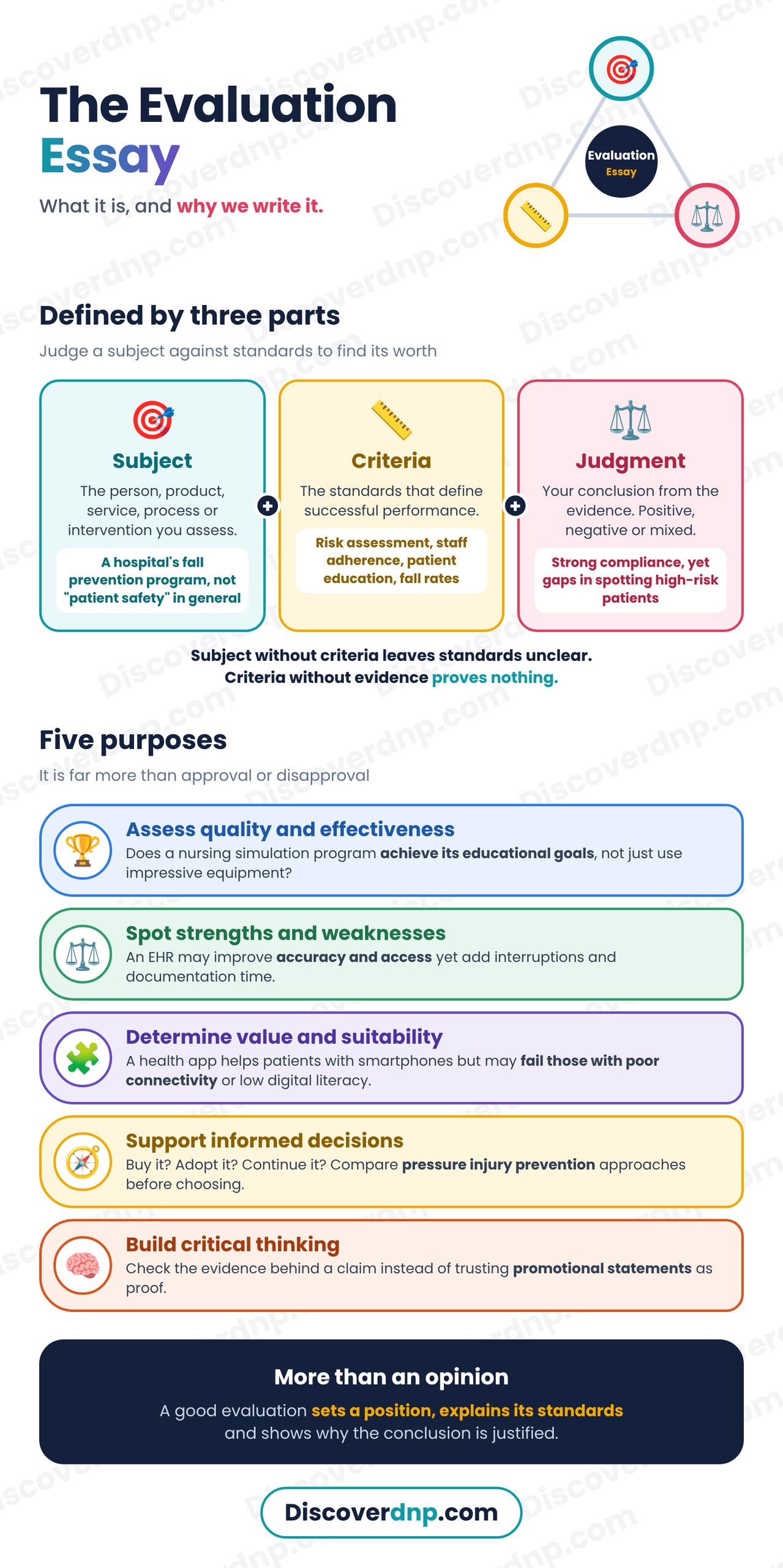
Conclusion
Writing an effective evaluation essay requires more than describing a subject or expressing whether it is good or bad. It involves examining its quality, effectiveness, and overall value against clearly established criteria and using credible evidence to justify the resulting judgment. From selecting a suitable topic and developing a focused thesis statement to organizing body paragraphs, conducting research, and revising the final draft, every stage contributes to a balanced and convincing evaluation.
The most important aspect of evaluative writing is the ability to connect established standards with meaningful evidence and critical analysis. A strong essay recognizes both strengths and limitations, maintains an objective tone, and ensures that its conclusions reflect the findings presented throughout the discussion. Whether assessing a nursing intervention, healthcare technology, educational program, or professional service, the writer should avoid unsupported opinions and explain precisely why the subject meets or falls short of the stated criteria.
An effective evaluation essay should leave readers with more than a general impression of the subject. It should provide a well-reasoned overall judgment that helps them understand its performance, recognize areas for improvement, and make informed decisions. By applying consistent evaluation criteria, selecting credible sources, and presenting a clear evaluation argument, writers can produce thoughtful, evidence-based essays that demonstrate strong analytical and academic writing skills.
Frequently Asked Questions
How do I write an evaluation essay?
To write an evaluation essay, choose a subject, establish clear evaluation criteria, and research it using credible sources. Develop a thesis statement that presents your overall judgment, then organize the body paragraphs around the criteria. Support each assessment with relevant evidence, discuss strengths and weaknesses, and conclude by summarizing your findings.
Can you give me an example of an evaluation?
An example is evaluating a hospital patient education program. You could assess its effectiveness based on the accuracy of its health information, accessibility of educational materials, improvement in patient understanding, and usefulness in supporting self-care. Your conclusion would explain whether the program meets these criteria and identify areas for improvement.
How to write a short evaluation?
To write a short evaluation:
- Introduce the subject and state what you are assessing.
- Identify two or three relevant evaluation criteria.
- Discuss the subject’s strengths and weaknesses using specific evidence.
- Provide an overall judgment based on your findings.
- End with a brief conclusion or recommendation.
What are good evaluation essay topics?
Good evaluation essay topics are specific, relevant, and can be assessed using clear criteria. Examples include:
- The effectiveness of hand hygiene practices in hospitals.
- The quality of online nursing education programs.
- The usefulness of electronic health records in patient care.
- The effectiveness of patient discharge education.
- The quality of communication between nurses and patients.
- The impact of nurse staffing levels on patient safety.
- The effectiveness of hospital infection prevention programs.
- The value of simulation-based clinical training.
- The effectiveness of telehealth services.
- The quality of patient waiting time management in healthcare facilities.
