

Nursing Student Resume: A Complete Resume Guide, Template, and Examples for New Nurses
A nursing student resume is an essential document for communicating nursing education, clinical experience, relevant skills, and professional qualifications to potential employers. Similar to clinical documentation, which provides an organized account of a patient’s condition, treatment, and progress, a well-prepared resume presents an applicant’s background in a clear and structured manner. For individuals preparing to enter professional nursing practice, creating a resume can be challenging, particularly when formal work experience is limited and clinical rotations, academic achievements, and transferable skills must demonstrate readiness for employment.
An effective nursing student resume connects educational preparation with the practical responsibilities of patient care. It highlights nursing education, clinical rotations, certifications, relevant work experience, and the hard and soft skills necessary for safe, effective nursing practice. The choice of resume format determines how this information is organized, while concise descriptions and relevant examples help a hiring manager understand an applicant’s capabilities. Clinical experience can demonstrate familiarity with healthcare environments, patient communication, infection prevention, documentation, and teamwork, provided these responsibilities are described accurately and within the applicant’s level of training.
Developing a professional resume also involves understanding how employers evaluate applications. Contact information, education, nursing skills, certifications, and relevant experience should be presented in a logical order that makes important qualifications easy to identify. A professional summary or resume objective can communicate career goals and relevant strengths, while carefully selected keywords help align the resume with a specific nursing job description. Clear formatting and compatibility with an applicant tracking system (ATS) are also important considerations, particularly when applications are submitted through online recruitment platforms. Where appropriate, a cover letter can provide additional context about an applicant’s interests, preparation, and suitability for a particular nursing position.
A comprehensive nursing student resume guide therefore considers both the content and presentation of the document. It includes resume examples and templates for different career stages, explains how to organize essential resume sections, and demonstrates how to describe clinical rotations, patient care responsibilities, certifications, and transferable skills. It also examines how to tailor a resume to employer requirements, use resume-building tools effectively, and identify common mistakes that may weaken an application. By understanding these principles, applicants can develop an accurate, professional resume that communicates their qualifications clearly and reflects their readiness to contribute to safe, evidence-based nursing care.
Nursing Student Resume Examples and Templates
A well-organized nursing student resume presents an applicant’s nursing education, clinical preparation, relevant skills, and professional qualifications in a format that healthcare employers can evaluate efficiently. The structure and content should reflect the applicant’s current stage of training, the experience they can demonstrate, and the requirements of the nursing position they are pursuing. Someone applying for a nurse externship, for example, may emphasize completed coursework, supervised clinical rotations, and foundational patient care skills, while a nursing graduate applying for a first registered nurse position may give greater attention to clinical placements, licensure status, certifications, and relevant employment.
A nursing student resume template provides a consistent framework for arranging this information. It helps organize resume sections, maintain readable formatting, and ensure that essential details are not overlooked. However, a template is a starting point rather than a finished resume. Each applicant must adapt it to their qualifications and the job description, removing irrelevant sections and adding details that demonstrate suitability for the role.
Effective student resumes should also distinguish between education, supervised clinical experience, and paid work experience. These categories may all demonstrate valuable preparation, but they are not interchangeable. Clinical rotations completed as part of a nursing program should be identified as educational placements, while employment should reflect actual job responsibilities. This distinction helps a hiring manager understand the applicant’s level of experience without overstating independence or clinical competence.
A useful nursing student resume example should therefore demonstrate more than an attractive layout. It should show how to select relevant information, describe experience accurately, and connect nursing education with the responsibilities of the intended position. The following examples and templates illustrate how to approach a resume for a new graduate and adapt its structure to different career stages.
Nursing Student Resume Example for a New Grad
A new graduate nurse may have limited paid nursing work experience, but that does not mean the resume must be sparse. Nursing education, clinical rotations, certifications, previous employment, volunteer work, and transferable skills can all contribute to a strong professional resume when they are relevant to the position.
The key is to prioritize evidence of preparation for professional nursing practice. Rather than relying on general statements such as “hardworking nursing graduate” or “good communication skills,” the applicant should describe specific training, responsibilities, and accomplishments that demonstrate those qualities.
For example, a graduate who completed supervised medical-surgical and community health rotations can identify those placements, summarize relevant learning experiences, and describe the patient care activities they performed within their authorized scope of practice. Any experience involving patient assessment, documentation, infection prevention, health education, or collaboration with the healthcare team should be included only when it accurately reflects the graduate’s actual training.
Nursing Student Resume Example
The following nursing student resume example illustrates how a new graduate can present qualifications without claiming professional experience they have not yet acquired. The details are fictional and should be replaced with the applicant’s actual education, clinical placements, skills, and certification status.
JORDAN TAYLOR
Texax, USA | jordan.taylor@email.com | +231 700 000 000
PROFESSIONAL SUMMARY
Recent nursing graduate with supervised clinical experience in medical-surgical nursing, maternal and newborn care, pediatrics, and community health. Knowledge of patient assessment, infection prevention, clinical documentation, patient education, and interdisciplinary collaboration. Committed to safe, compassionate, evidence-based care and continued professional development.
EDUCATION
Bachelor of Science in Nursing
Example University,New York, USA
Graduation: June 2026
Relevant coursework: Medical-Surgical Nursing, Pharmacology, Maternal and Child Health, Community Health Nursing, and Mental Health Nursing.
CLINICAL EXPERIENCE
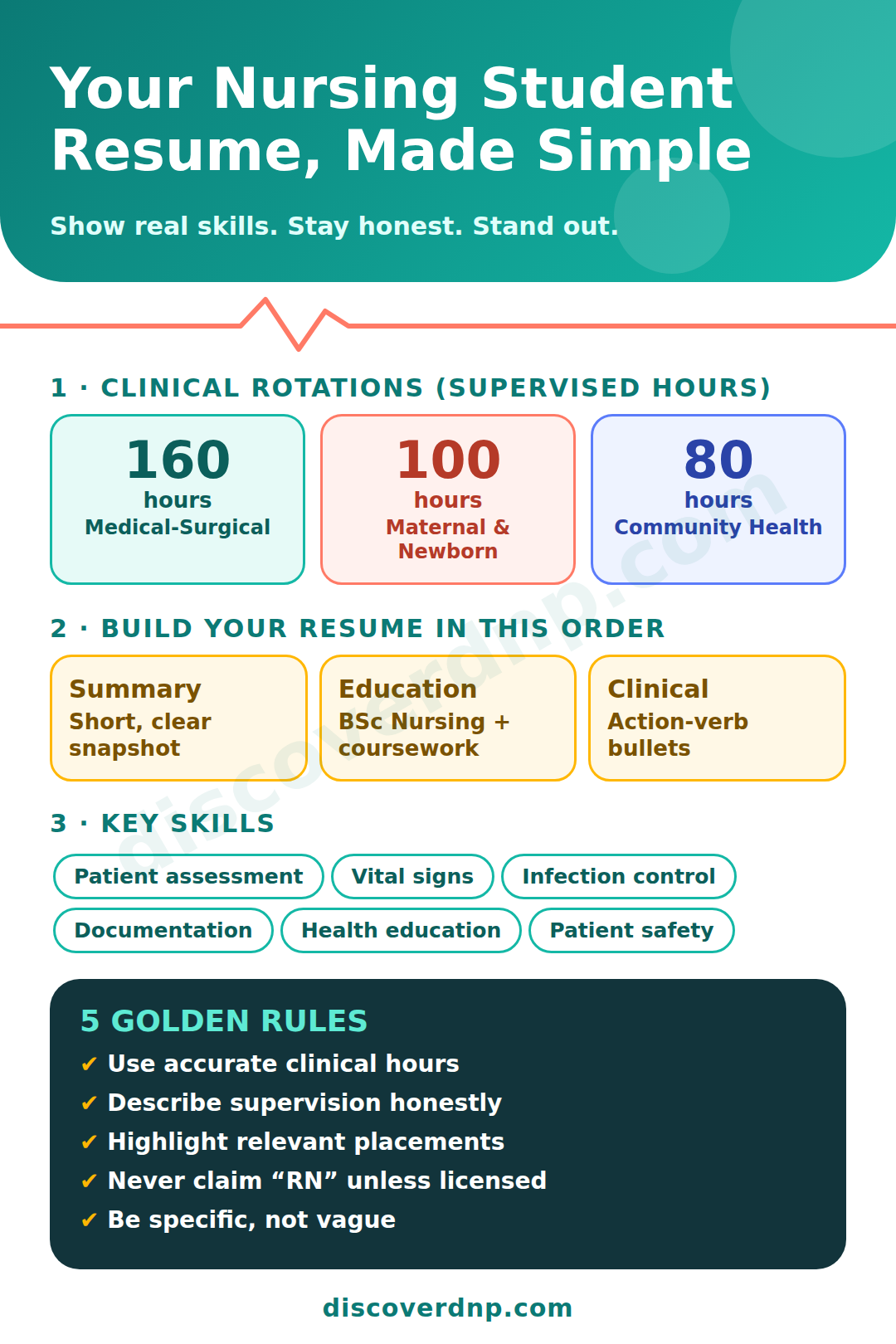
Medical-Surgical Nursing Rotation
Example Teaching Hospital | 160 supervised hours
- Participated in patient assessments and monitored vital signs under the supervision of qualified nursing staff.
- Practiced infection prevention, safe patient handling, and accurate clinical documentation.
- Contributed to individualized patient care planning and health education within the student scope of practice.
Maternal and Newborn Nursing Rotation
Example Maternity Centre | 100 supervised hours
- Participated in maternal assessments and newborn care activities under clinical supervision.
- Reinforced approved health education concerning maternal recovery, newborn care, and breastfeeding.
- Observed changes in patient condition and promptly communicated concerns to the supervising nurse.
Community Health Nursing Rotation
Example Community Health Centre | 80 supervised hours
- Participated in community health education and preventive healthcare activities.
- Supported health promotion initiatives and communicated health information respectfully to diverse populations.
NURSING SKILLS
- Patient assessment and vital signs monitoring
- Infection prevention and control
- Clinical documentation
- Patient communication and health education
- Teamwork and time management
- Patient safety and confidentiality
CERTIFICATIONS AND TRAINING
- Basic Life Support (BLS) — include only if currently certified.
- Additional relevant training — include the actual course, provider, and completion date.
VOLUNTEER EXPERIENCE
Community Health Volunteer
Example Community Organization | January–March 2026
- Assisted with community health awareness activities.
- Supported health education and community engagement under the direction of the organizing team.
This resume example places education and supervised clinical experience prominently because these are often the strongest sources of relevant evidence for a new graduate. It also uses action-oriented bullet points to explain what the applicant did, rather than relying on broad claims about being compassionate or hardworking. University career guidance similarly recommends clearly separating education, clinical experience, employment, and certifications, while describing responsibilities with specific action verbs.
Several details deserve particular attention when adapting this resume example:
- Use accurate clinical hours. Include the actual number of supervised hours completed, where useful and permitted. Do not estimate or inflate them.
- Describe supervision honestly. A nursing student should distinguish between observing, assisting with, and performing a procedure under supervision. Do not imply independent responsibility for care when that was not the case.
- Prioritize relevant placements. A graduate applying to a medical-surgical unit should give greater attention to relevant clinical rotations than to unrelated activities.
- Represent qualifications accurately. Include the correct nursing degree, registration or licensure status, and certifications. Do not use the registered nurse title or imply authorization to practice independently unless legally entitled to do so.
- Keep the language specific. “Participated in patient assessments under supervision” is more informative than “helped patients,” provided it accurately describes the experience.
A nursing student resume example is most useful when it demonstrates how to present real qualifications, not when it encourages every applicant to copy identical statements. The final resume should reflect the individual’s actual clinical experience, education, and readiness for the particular nursing job.
Nursing Student Resume Template for Different Career Stages
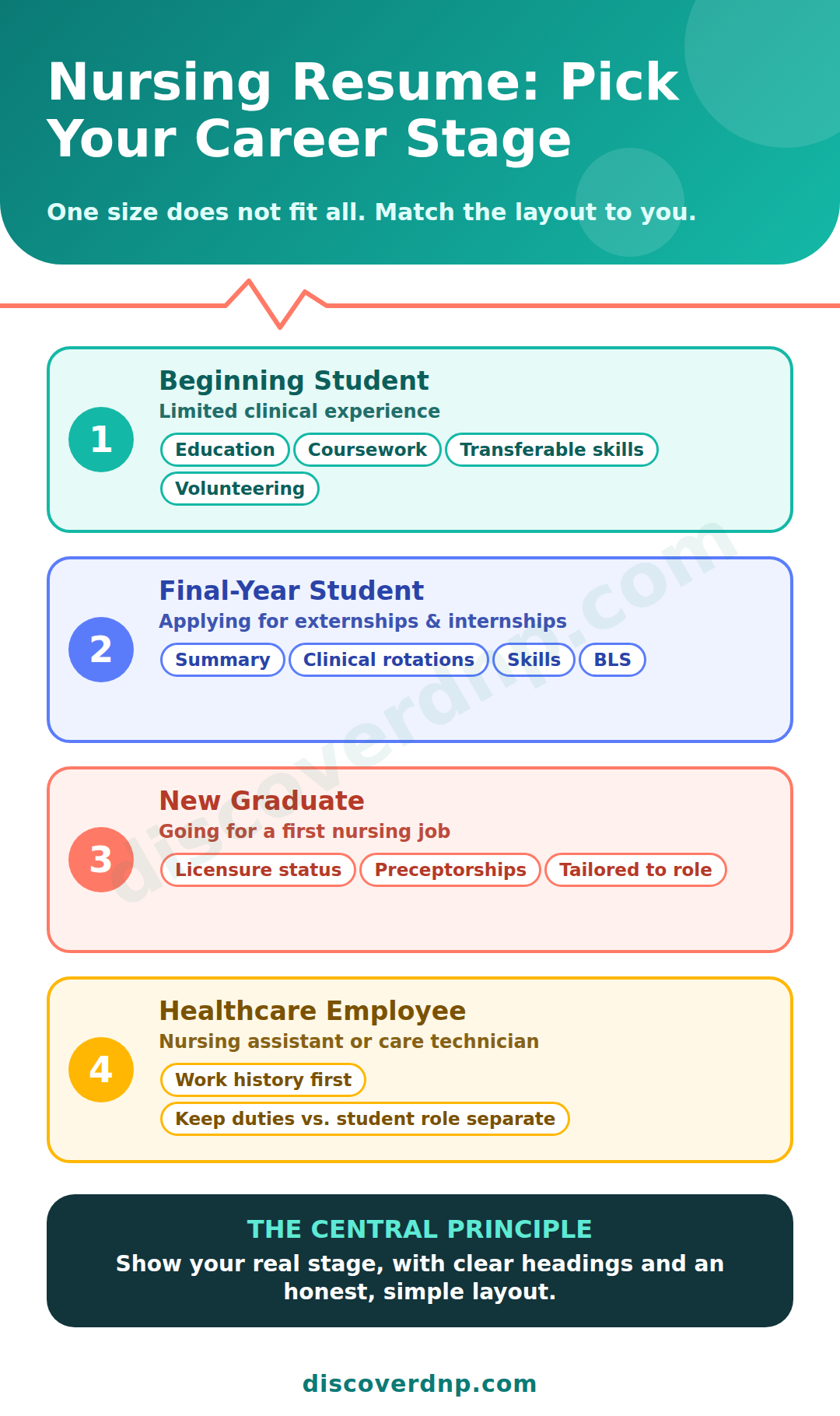
A nursing student resume template should reflect the applicant’s current level of education, experience, and professional preparation. The information that matters most for someone beginning nursing school may differ considerably from what an employer expects from a final-year nursing student or a new graduate seeking a first registered nurse position.
Rather than using one fixed template for every application, select a structure that gives the most relevant qualifications appropriate prominence.
1. Beginning nursing student with limited clinical experience
Someone in the early stages of nursing education may not have completed extensive clinical rotations. In this situation, the resume can emphasize education, relevant coursework, transferable skills, previous employment, volunteer work, and any applicable certifications.
A suitable structure is:
- Contact information
- Education and expected graduation date
- Relevant coursework or academic projects
- Transferable skills
- Previous work experience
- Volunteer activities and relevant certifications
For example, a nursing student with previous experience in customer service may demonstrate communication, conflict resolution, teamwork, and professional conduct. These are transferable skills that can support future nursing responsibilities, although they do not replace clinical competence or formal nursing qualifications.
2. Final-year nursing student with clinical rotations
A student approaching graduation may have more substantial clinical experience across several healthcare settings. The resume should therefore make completed clinical rotations easy to identify, especially when applying for nurse externships, internships, graduate transition programs, or other entry-level opportunities.
A suitable structure is:
- Contact information
- Professional summary or resume objective
- Nursing education and expected graduation date
- Clinical experience and selected rotations
- Nursing skills
- Certifications and relevant training
- Employment, leadership, or volunteer experience
Clinical placements should identify the specialty, healthcare setting, and relevant responsibilities. If appropriate, include supervised clinical hours and experience with specific patient populations. University of Pennsylvania nursing career resources provide sample resumes that demonstrate ways to present clinical rotations alongside education, certifications, leadership, and community involvement.
3. New graduate applying for a first nursing job
A new graduate should focus on demonstrating readiness for entry-level practice. The resume may highlight completed nursing education, registration or licensure status, clinical placements, relevant certifications, and employment that demonstrates patient-facing experience or transferable skills.
A suitable structure is:
- Contact information and accurate licensure status
- Professional summary
- Nursing education
- Clinical experience, including relevant preceptorships
- Certifications and nursing skills
- Relevant employment and volunteer experience
- Academic projects or leadership, where applicable
A graduate applying to a pediatric nursing position, for example, may give greater prominence to pediatric and maternal-child health rotations. Someone applying to an emergency department graduate program may emphasize relevant emergency care exposure, patient assessment, teamwork, and Basic Life Support certification, if held and required.
The resume must not imply that a graduate is licensed when registration is still pending. State the actual status according to the applicable regulatory requirements and employer instructions. Guidance for new graduate nurses likewise emphasizes education, clinical experience, and relevant qualifications when paid nursing experience is limited.
4. Applicant with previous healthcare employment
Someone who has worked as a nursing assistant, patient care assistant, healthcare technician, or another relevant healthcare professional may benefit from giving employment experience greater prominence. The resume should distinguish the duties performed in the previous position from responsibilities undertaken during supervised nursing education.
For example, previous employment may demonstrate experience communicating with patients, supporting daily living activities, maintaining records, following infection prevention procedures, or working within a multidisciplinary team. The relevance of each responsibility depends on the actual role and the job being pursued.
A suitable structure is:
- Contact information
- Professional summary
- Nursing education and licensure status
- Relevant healthcare employment
- Clinical rotations and preceptorships
- Certifications and relevant skills
- Additional work or volunteer experience
These career-stage templates are flexible rather than mandatory. An applicant should adjust the section order according to the nursing position, the employer’s instructions, and the strongest evidence available. A simple, consistent layout with clear headings and readable text is generally preferable to an elaborate design that makes qualifications difficult to locate.
The central principle is to make the resume reflect the applicant’s actual stage of professional development. A strong nursing student resume does not need to imitate the work history of an experienced nurse. It needs to present education, clinical preparation, relevant skills, and professional qualifications accurately so that the hiring manager can assess the applicant’s suitability for the role.
Choosing the Best Nursing Student Resume Format
Choosing the right nursing student resume format is an important part of presenting nursing education, clinical experience, relevant skills, and professional qualifications effectively. A resume should help a hiring manager identify an applicant’s preparation for a nursing position without having to search through unrelated information or navigate a confusing layout. The most suitable format depends on the applicant’s career stage, previous work experience, clinical rotations, and the requirements of the nursing job.
For someone entering the nursing field, a resume may need to emphasize education and supervised clinical experience rather than an extensive work history. A final-year nursing student, for example, can highlight completed clinical placements, relevant coursework, certifications, and transferable skills. A new graduate applying for a first registered nurse position may place greater emphasis on a final clinical practicum, relevant healthcare employment, and registration or licensure status.
A professional resume format should achieve three main objectives:
- Make qualifications easy to identify: Education, clinical experience, certifications, and relevant skills should be organized under clear headings.
- Present information in a logical order: The most relevant qualifications should appear near the top of the resume, where they are easy to locate.
- Maintain readability and consistency: Appropriate spacing, a professional font, concise descriptions, and consistent formatting help employers review the document efficiently.
Career guidance from nursing schools supports this approach. The University of Pennsylvania’s nursing career resources provide sample resumes that demonstrate how students can organize clinical rotations, education, certifications, leadership, research, and other relevant experiences. Saint Mary’s University of Minnesota also provides an applicant tracking system (ATS)-friendly nursing student resume template using a clean, single-column layout. These examples demonstrate that effective resume writing depends on clear organization and relevant content rather than decorative design.
Resume Layout, Length, and Organization
The layout determines how information is arranged on the page, while the resume format determines how education, experience, and other qualifications are prioritized. Both influence how easily a recruiter can understand an applicant’s background.
For most nursing students and new graduates, a simple, reverse-chronological or combination format is a practical starting point. The choice should reflect the applicant’s experience rather than a desire to make a limited work history appear more extensive.
1. Reverse-chronological resume format
A reverse-chronological resume lists relevant experiences from the most recent to the oldest. It is useful when an applicant has a clear progression through nursing education, clinical placements, healthcare employment, or volunteer activities.
For example, a final-year nursing student might list a recent medical-surgical rotation before an earlier community health placement. A graduate who has worked as a healthcare assistant may list the most recent relevant employment first.
This format helps a hiring manager understand what the applicant has done recently and how their preparation has developed. It is particularly useful when the experience directly relates to the advertised nursing position.
2. Combination resume format
A combination resume brings relevant skills and qualifications into prominence while retaining a chronological account of education and experience. It can be useful for someone who has developed transferable skills through previous employment, volunteer work, and nursing education but has limited paid nursing experience.
For example, an applicant with previous healthcare support experience might begin with a concise professional summary and a focused skills section, followed by nursing education, clinical rotations, and employment history. This allows the resume to demonstrate relevant capabilities without obscuring the chronology of the applicant’s background.
3. Functional resume format
A functional resume organizes information primarily around skills rather than employment history. Although it may appear attractive to someone with little work experience, it is not always the strongest choice for a nursing student resume. Healthcare employers need to understand where skills were developed and whether experience came from employment, academic preparation, or supervised clinical practice.
A skills-focused section can still be useful, but it should complement clearly identified education and experience rather than replace them. A transparent presentation is especially important when describing clinical competencies, patient care activities, and responsibilities undertaken during training.
For most applicants, a reverse-chronological or combination format provides a useful balance between readability and context. The University of Pennsylvania’s sample resumes illustrate several ways to organize nursing qualifications, while California State University, Fresno’s career guidance recommends straightforward, readable formatting and chronological presentation for nursing applications.
Choosing an appropriate resume length
A nursing student resume should be long enough to communicate relevant qualifications but concise enough to keep the reader focused on information that supports the application. There is no universal page limit for every nursing resume, but one page is often sufficient for a nursing student or new graduate with limited professional experience. A second page may be justified when the applicant has substantial relevant employment, additional qualifications, research, leadership experience, or other information directly related to the position.
Career guidance from Seton Hall University recommends a one-page resume for most nursing applicants while allowing additional space when a graduate has substantial experience. The University of Illinois Chicago similarly advises nursing students and new graduates to keep their resumes concise and tailor the content to each position.
When deciding how much information to include, consider the following:
- Early-stage nursing students: One page will generally accommodate education, relevant coursework, transferable skills, previous employment, and volunteer activities.
- Final-year nursing students: One page may be sufficient for education, clinical rotations, certifications, skills, and selected work experience.
- New graduate nurses: One page is often practical when the main qualifications are nursing education, clinical experience, licensure status, and relevant employment.
- Applicants with substantial relevant experience: A second page may be appropriate if additional clinical responsibilities, certifications, research, leadership, or professional development strengthen the application.
The objective is not to fill a predetermined number of pages. Instead, each entry should contribute useful information. An unrelated job from several years ago may require only one brief entry, while a relevant clinical placement may deserve more detail. Removing repetition and unnecessary descriptions is preferable to shrinking the font excessively or eliminating important information.
Font, margins, spacing, and visual consistency
A professional resume should be easy to read both on screen and in print. The layout does not need elaborate graphics, multiple colors, or decorative elements to look professional. Consistency and readability are more important.
Consider these formatting principles when preparing a nursing student resume template:
- Font: Use a familiar, readable font such as Arial, Calibri, or Times New Roman. A body-text size of approximately 10–12 points is a common guideline.
- Margins: Keep margins consistent, usually around 0.5–1 inch, while allowing sufficient white space.
- Headings: Use clear headings such as Education, Clinical Experience, Certifications, and Skills. Apply the same heading style throughout the document.
- Spacing: Separate sections and entries sufficiently to make the resume easy to scan, without leaving large empty areas.
- Bullet points: Use consistent bullet points to describe responsibilities, relevant activities, and achievements. Begin statements with clear action verbs where appropriate.
- Dates and locations: Present dates, institution names, healthcare facilities, and role titles consistently.
- File format: Follow the employer’s submission instructions. If a PDF is accepted, confirm that the document retains its formatting and that the text can be selected. If a particular file type is required, use that instead.
For example, if one clinical placement is listed as “Medical-Surgical Nursing Rotation | January–March 2026,” other placements should follow the same pattern. Consistent presentation makes it easier to compare experiences and understand the applicant’s training.
Designing an ATS-friendly resume
An applicant tracking system is software that employers may use to collect, organize, search, and manage job applications. Some systems also extract information from submitted resumes. An ATS-friendly resume uses straightforward formatting and recognizable section headings so that both software and human readers can interpret the information more easily.
Useful practices include:
- Use a simple, single-column layout where possible.
- Choose conventional headings, such as Education, Clinical Experience, Work Experience, Certifications, and Skills.
- Include relevant terminology from the job description when it accurately reflects your qualifications.
- Avoid placing essential information exclusively in images, decorative graphics, or complex text boxes.
- Check that your contact information and section headings remain readable after saving or uploading the file.
- Follow the employer’s application instructions rather than assuming one file format works for every recruitment system.
Saint Mary’s University of Minnesota specifically provides a single-column, ATS-friendly resume template for nursing students. California State University, Fresno also advises applicants to avoid complicated formatting that may interfere with automated resume processing.
An ATS-friendly design does not guarantee that an application will be selected or advance to an interview. Employers use different systems and screening procedures, and hiring decisions also depend on qualifications, eligibility, experience, and other criteria. The purpose of straightforward formatting is to make the applicant’s information accessible and understandable.
Essential Resume Sections and Their Order
After selecting a suitable resume format, the next step is to determine which resume sections to include and how to arrange them. The best order depends on the applicant’s qualifications and the nursing position being pursued. A resume should prioritize the strongest relevant evidence rather than follow a rigid structure that treats every section as equally important.
For most nursing students and new graduates, the following order provides a useful starting point.
1. Contact information
Place your full name and reliable contact information at the top of your resume. Include a professional email address, telephone number, and city or general location if relevant to the application. A professional online profile may also be included if it is appropriate and up to date.
Make sure your contact details are accurate. An otherwise strong resume can create difficulties if the employer cannot reach the applicant. Follow local conventions and employer requirements regarding names, locations, and professional credentials.
2. Professional summary or resume objective
A professional summary briefly presents relevant qualifications, clinical preparation, and strengths. A resume objective focuses more directly on the type of nursing position sought and the applicant’s career goals.
A nursing student with relevant clinical experience might use a summary such as:
Final-year nursing student with supervised clinical experience in medical-surgical and community health settings. Knowledge of patient assessment, infection prevention, clinical documentation, and patient education. Committed to safe, compassionate care and collaborative practice.
An applicant with very limited relevant experience may prefer a concise objective that identifies the intended role and explains how their education and transferable skills relate to it.
This section should be brief and supported by the information that follows. It should not make unsupported claims about clinical expertise or independent practice.
3. Nursing education
Education is particularly important when the applicant is still studying or has recently graduated. Include the nursing degree or program, institution, and graduation date or expected completion date. Relevant academic distinctions or coursework can be added when they strengthen the application.
For example:
- Bachelor of Science in Nursing
- Example University
- Expected graduation: June 2027
- Relevant coursework: Medical-Surgical Nursing, Pharmacology, and Community Health Nursing
Only include coursework that is relevant to the position and accurately reflects the applicant’s academic preparation. The resume should clearly distinguish a completed qualification from a program that is still in progress.
4. Clinical experience
Clinical experience is often one of the most important sections for someone seeking a first nursing job. List relevant supervised clinical rotations, preceptorships, or other approved placements, identifying the healthcare setting and specialty where appropriate.
For example:
Medical-Surgical Nursing Rotation — Example Teaching Hospital, January–March 2026
- Participated in patient assessments and vital signs monitoring under the supervision of qualified nursing staff.
- Practiced infection prevention and clinical documentation according to facility procedures.
- Contributed to patient education and communicated relevant observations to the supervising nurse.
These statements illustrate how to describe training accurately without suggesting that a student independently performed responsibilities beyond their scope.
5. Certifications and licensure status
Include relevant certifications that have actually been earned and remain valid, along with their issuing organizations or expiration dates when useful. If registration or licensure is required for the position, state the applicant’s status accurately and follow the employer’s instructions.
For example, a current Basic Life Support certification may be relevant to an entry-level nursing application. Do not list a planned course as a completed certification or imply that a graduate is authorized to practice as a registered nurse when registration is pending.
6. Nursing skills
Use this section to summarize relevant clinical and professional capabilities. Depending on actual training and experience, these may include infection prevention, vital signs monitoring, patient communication, documentation, teamwork, time management, and patient education.
Include technical skills only when the applicant has the appropriate training and can describe their level of competence honestly. A focused list of relevant skills is more useful than a long collection of generic qualities.
7. Work experience and other relevant activities
Previous employment, volunteer work, leadership, research, and academic projects can strengthen a nursing student resume when they demonstrate qualities relevant to the position. Healthcare employment may be especially useful, but non-healthcare experience can also demonstrate reliability, communication, teamwork, and professional responsibility.
Prioritize the most relevant activities and describe them in proportion to their importance. Not every applicant needs every possible section. For instance, a separate research section may be valuable for a research-focused role but unnecessary for an entry-level bedside position if the applicant has no relevant research experience.
University of Minnesota nursing career guidance identifies contact information, education, and clinical experience as core resume components, with other sections added according to the applicant’s background. The University of Maryland School of Nursing likewise recommends organizing qualifications under relevant headings and prioritizing information according to its importance to the application.
The final order should reflect the position and the applicant’s strongest qualifications. A nursing student with extensive relevant clinical placements may place Clinical Experience immediately after Education, while an applicant with substantial healthcare employment may give that experience greater prominence. The guiding principle is to make the most relevant information easy to locate without sacrificing accuracy or clarity.
Writing the Essential Sections of a Nursing Student Resume
The essential sections of a nursing student resume should communicate an applicant’s education, clinical preparation, relevant skills, and professional qualifications in a clear, organized, and credible manner. For applicants seeking their first nursing job in the United States, these sections are particularly important because employers need to understand the applicant’s educational background, clinical exposure, eligibility for the intended role, and readiness to work within the applicable scope of practice.
A well-prepared resume connects academic learning with the practical responsibilities of nursing. It identifies the nursing program completed or currently in progress, summarizes relevant clinical rotations, highlights appropriate certifications, and presents skills that align with the job description. Each section should provide distinct information rather than repeating the same qualifications in different places.
For example, a nursing student applying for a nurse extern position at a U.S. hospital may emphasize current enrollment in an accredited nursing program, supervised clinical experience, and relevant Basic Life Support (BLS) certification. A recent graduate applying for an entry-level registered nurse position may instead emphasize graduation, NCLEX-RN status, state licensure or application status, and relevant clinical placements.
The information must reflect the applicant’s actual qualifications. Completing a nursing degree does not automatically establish authorization to practice as a registered nurse in the United States. Similarly, completing a clinical rotation does not mean the applicant has independently performed every procedure encountered during training.
The following sections explain how to present contact information, nursing education, professional summaries, resume objectives, skills, certifications, and licensure status appropriately for the U.S. nursing employment context.
Contact Information and Nursing Education
Contact information and nursing education form the foundation of a nursing student resume. The first allows employers and recruiters to contact the applicant, while the second establishes the academic preparation relevant to the nursing position. Both sections should be accurate, concise, and easy to locate.
Contact information
Place contact information near the top of the resume, directly below the applicant’s name. A U.S. nursing resume typically includes:
- Full name: Use the name you use professionally and ensure it matches your application documents.
- Telephone number: Provide a reliable number where employers can reach you. Include the appropriate area code.
- Professional email address: Use a straightforward address suitable for employment correspondence.
- City and state: Include your general location, such as Phoenix, Arizona, or Houston, Texas. A full residential address is generally unnecessary.
- Professional profile: Include a LinkedIn profile or relevant professional portfolio only if it is current and supports your application.
For example:
JORDAN TAYLOR
Phoenix, AZ | (602) 555-0147 | jordan.taylor@email.com | LinkedIn: linkedin.com/in/jordantaylor
This layout provides the essential contact details without taking up excessive space. The telephone number and email address should be checked carefully because errors could prevent an employer from arranging an interview.
In the United States, applicants generally do not need to include their Social Security number, date of birth, marital status, or other sensitive personal information on a resume. A photograph is also generally unnecessary for standard nursing applications. These details do not help establish professional qualifications and may expose applicants to avoidable privacy risks.
Keep the contact information in the main document body rather than placing it exclusively in a header, footer, image, or decorative text box. A simple layout helps maintain readability across different devices and reduces potential problems when an applicant tracking system (ATS) extracts resume information.
Presenting nursing education effectively
Education is especially important when applying for a first nursing position because it demonstrates the applicant’s academic preparation for professional practice. The education section should identify the nursing degree or program, the institution, and the graduation date or expected completion date.
Depending on the applicant’s background, include:
- The official name of the degree or nursing program.
- The name of the college or university.
- The city and state of the institution, where useful.
- The graduation date or expected graduation date.
- Relevant academic distinctions, coursework, or projects when they strengthen the application.
For example, a nursing student approaching graduation might use the following entry:
Bachelor of Science in Nursing (BSN)
Example University, Phoenix, AZ
Expected Graduation: May 2027
Relevant Coursework: Medical-Surgical Nursing, Pharmacology, Maternal and Newborn Nursing, Pediatric Nursing, and Community Health Nursing.
The institution and dates above are illustrative. Applicants should use their actual school, degree title, and expected graduation date.
A graduate who has completed a Bachelor of Science in Nursing (BSN) should list the degree as awarded. Someone still enrolled should use “Expected Graduation” or “Currently Enrolled,” as appropriate, rather than implying that the qualification has already been earned.
The type of nursing program should also be clear. U.S. nursing applicants may hold an Associate Degree in Nursing (ADN), a Bachelor of Science in Nursing (BSN), or another qualifying educational credential. The relevant qualification depends on the applicant’s actual program and the requirements of the position. An employer advertising a graduate nurse role may specify an ADN or BSN, while another may require a BSN or prefer candidates pursuing one.
Relevant coursework can strengthen an early-career resume when the subjects directly relate to the advertised position. For example, an applicant pursuing a pediatric nursing opportunity may highlight pediatric nursing and child development coursework. Someone applying to a medical-surgical unit may emphasize medical-surgical nursing, pharmacology, and related clinical preparation.
However, coursework should not be presented as equivalent to professional experience or specialty certification. The education section documents academic preparation; the clinical experience section should explain where supervised practice occurred and what responsibilities the applicant undertook.
Academic honors, scholarships, research projects, and relevant distinctions may also be included when they demonstrate achievement. Select the information that contributes most to the application rather than listing every class completed during nursing school.
Professional Summary and Resume Objective
The professional summary and resume objective introduce the applicant’s qualifications and career direction. Positioned near the top of a nursing student resume, either section can help a hiring manager understand the applicant’s background before reviewing education, clinical experience, and other qualifications in detail.
Although these sections serve similar purposes, they emphasize different information. A professional summary highlights qualifications and relevant experience the applicant already possesses, while a resume objective emphasizes the position sought and how the applicant’s preparation relates to that opportunity.
For nursing students and new graduates applying for positions in the United States, the choice depends on the amount of relevant experience available and the requirements of the role. A student applying for a nurse externship may benefit from an objective that identifies their educational status and interest in supervised clinical learning. A new graduate with several completed clinical rotations may benefit from a summary that highlights relevant training, patient care experience, and professional strengths.
Writing an effective professional summary
A professional summary is a brief overview of the applicant’s most relevant qualifications. It should identify the applicant’s professional background, highlight important skills or clinical exposure, and communicate a clear connection to the intended nursing position.
An effective summary generally includes three elements:
- Professional background: Identify whether the applicant is a nursing student, recent graduate, or licensed nurse.
- Relevant qualifications: Highlight clinical rotations, nursing education, certifications, and skills that support the application.
- Professional focus: Indicate the type of nursing role or healthcare setting that aligns with the applicant’s preparation.
For example, a final-year BSN student applying for a nurse extern position at a hospital in Texas might write:
Final-year Bachelor of Science in Nursing student with supervised clinical experience in medical-surgical and community health settings. Knowledge of vital signs monitoring, infection prevention, clinical documentation, and patient education. Committed to patient safety, compassionate care, and effective collaboration with healthcare professionals.
This summary establishes the applicant’s educational status and relevant clinical preparation without implying that they are already a licensed registered nurse. It also identifies skills that can be supported by the applicant’s clinical experience.
A recent graduate applying for an entry-level registered nurse position might use a different summary:
Recent BSN graduate with supervised clinical experience in medical-surgical nursing, maternal and newborn care, and pediatrics. Familiar with patient assessment, infection prevention, clinical documentation, and interdisciplinary collaboration. Prepared to contribute to safe, evidence-based patient care in an entry-level registered nurse position. NCLEX-RN and licensure status: [Insert accurate status].
The final sentence should be adapted to the applicant’s actual circumstances. For example, a candidate who has passed the NCLEX-RN and obtained an active registered nurse license may identify the relevant state and license status when appropriate. A graduate who has not yet passed the examination or received authorization to practice must not suggest otherwise.
A professional summary should be concise and specific. Generic phrases such as “hardworking individual seeking a challenging opportunity” communicate little about the applicant’s nursing preparation. Similarly, descriptions such as “expert in critical care” are inappropriate for someone whose only exposure to critical care occurred during a limited supervised rotation.
Writing a resume objective
A resume objective focuses on the position an applicant intends to pursue and the qualifications they hope to apply in that role. It is particularly useful when the applicant is entering the nursing profession, applying for a nurse externship, or pursuing a specific graduate nursing program.
A useful objective should identify the intended position, mention relevant preparation, and connect the applicant’s goals with the responsibilities of the role.
For example, a nursing student applying for a nurse externship in a U.S. hospital might write:
Nursing student seeking a nurse extern position at a hospital in Chicago to apply classroom learning in a supervised clinical environment, strengthen patient assessment and communication skills, and contribute to safe, patient-centered care under the direction of licensed nursing professionals.
A new graduate applying for a first registered nurse position might use:
Recent nursing graduate seeking an entry-level registered nurse position in a medical-surgical unit to apply academic preparation, supervised clinical experience, and patient safety principles while developing professional competence and contributing to coordinated, evidence-based care.
These examples demonstrate how an objective can connect the applicant’s preparation to the position without exaggerating experience. They also avoid presenting employment solely as an opportunity for personal development; the applicant’s potential contribution to safe patient care remains central.
An objective should be tailored to the actual nursing job. For example, an applicant pursuing a pediatric nurse position may emphasize relevant pediatric clinical rotations and communication with children and families, provided these reflect genuine experience. Someone applying for a medical-surgical position may highlight relevant clinical placements, foundational assessment skills, and teamwork.
Choosing between a professional summary and a resume objective
The most appropriate choice depends on what the applicant needs to communicate.
| Applicant situation | Recommended approach |
|---|---|
| Early-stage nursing student with limited clinical exposure | A concise objective or brief profile |
| Final-year nursing student with relevant clinical rotations | A targeted summary or objective |
| New graduate with several completed clinical placements | A professional summary emphasizing relevant preparation |
| Applicant with previous healthcare employment | A summary highlighting relevant experience and transferable skills |
| Applicant pursuing a specific specialty or nurse externship | A targeted summary or objective aligned with the role |
Neither section is mandatory for every application. If education and clinical experience already communicate the applicant’s qualifications clearly, a separate introductory statement may not be necessary. The priority is to use the available space effectively and ensure that every claim is consistent with the rest of the resume.
Nursing Skills, Certifications, and Licenses
The skills, certifications, and licenses sections help employers evaluate an applicant’s preparation for a nursing position. Although related, they communicate different types of information.
- Skills describe abilities developed through education, clinical training, employment, or other relevant experience.
- Certifications document the completion of specific training or credentialing requirements.
- Licenses establish legal authorization to practice a regulated profession in a particular jurisdiction.
These distinctions are especially important in the United States, where nursing licensure is governed by state nursing regulatory bodies. A nursing degree, a Basic Life Support certification, and a registered nurse license represent different qualifications and should never be presented as interchangeable.
Presenting nursing skills effectively
The skills section should highlight capabilities that are relevant to the advertised position and supported by the applicant’s actual preparation. For nursing students and new graduates, this often means selecting foundational clinical skills alongside communication, teamwork, documentation, and other professional competencies.
Clinical and technical skills may include the following, where appropriate to the applicant’s training:
- Vital signs monitoring and reporting.
- Patient observation and basic assessment.
- Infection prevention and control.
- Clinical documentation and recordkeeping.
- Patient hygiene, comfort, and mobility assistance.
- Patient education and health promotion.
- Electronic health record familiarity.
- Basic life support skills, when appropriately trained.
Only include skills that accurately reflect the applicant’s experience. For example, a nursing student who has practiced patient assessment during a supervised medical-surgical rotation can identify that experience. However, the resume should not imply independent clinical responsibility when the activity was performed under supervision.
Hard skills should also be balanced with relevant soft skills. Hard skills refer to technical or practical capabilities, while soft skills include communication, teamwork, adaptability, organization, and interpersonal conduct. Both contribute to nursing practice, but generic lists of personal qualities are less persuasive than descriptions supported by examples.
Compare these two statements:
- Generic: “Excellent communication and teamwork skills.”
- More specific: “Collaborated with nursing staff and fellow students during supervised clinical rotations and communicated relevant patient observations to the supervising nurse.”
The second statement illustrates how the applicant applied those skills in a healthcare environment. It belongs in the clinical experience section, while the skills section can provide a concise summary of the same relevant capabilities.
A skills section may be organized as follows:
Clinical Skills
- Vital signs monitoring
- Infection prevention and control
- Clinical documentation
- Patient education
Professional Skills
- Interpersonal communication
- Team collaboration
- Time management
- Attention to detail
This is an example of organization, not a checklist that every applicant should copy. A candidate should select relevant skills based on their actual preparation and the requirements of the position. If the job description emphasizes patient education, infection prevention, or documentation, those skills should be easy to locate when the applicant can demonstrate them.
Including certifications and professional training
Certifications can strengthen a nursing student resume by demonstrating completion of relevant training. Their importance depends on the nursing position, employer requirements, and the applicant’s professional stage.
Examples commonly relevant to U.S. nursing applications include:
- Basic Life Support (BLS): May be required or preferred for many clinical roles. Employers may specify the accepted training provider.
- Advanced Cardiovascular Life Support (ACLS): Relevant to certain roles and clinical environments, but it should be listed only when earned and appropriate to the applicant’s qualifications.
- Pediatric Advanced Life Support (PALS): May be relevant to selected pediatric or acute care positions when required or preferred.
- First aid training: May support an application when relevant to the role and completed through an appropriate provider.
These credentials are not universally required for every nursing student or new graduate position. Applicants should review the job description and follow the employer’s requirements. A nurse extern position, for example, may require current BLS certification, while another employer may specify a particular course provider or completion deadline.
For each certification, include the relevant details:
- Full certification name.
- Issuing organization or training provider.
- Date awarded or completed.
- Expiration date, when applicable.
For example:
CERTIFICATIONS
Basic Life Support (BLS)
Provider: American Heart Association
Date awarded: March 2026
Expiration: March 2028
The dates and certification details above are illustrative. Use them only as a formatting example and replace them with the actual details of the credential held.
Applicants should distinguish a certificate of course completion from a professional certification that requires a separate examination or credentialing process. They should also avoid listing expired credentials as current or describing a planned course as a certification already earned.
When several certifications are available, prioritize those most relevant to the position. A certification required in the job description should be easy to find, while unrelated training may be omitted to keep the resume focused.
Presenting nursing licenses and registration status
Licensure is particularly important when applying for registered nurse positions in the United States. A nursing degree alone does not authorize someone to practice as a registered nurse. Applicants must meet the applicable state requirements and obtain the appropriate authorization to practice.
For an RN position, the resume should accurately reflect whether the applicant is:
- Currently enrolled in a nursing program.
- A graduate who has not yet taken the NCLEX-RN.
- A graduate who has passed the NCLEX-RN but is awaiting state licensure.
- A registered nurse holding an active license in the relevant state.
- A nurse whose license is subject to renewal or other applicable requirements.
These statuses must not be treated as interchangeable. For example, passing the NCLEX-RN does not, by itself, establish that every state licensure requirement has been completed. The applicant must follow the relevant state board of nursing’s requirements.
A nursing student applying for a nurse externship should not identify themselves as a registered nurse unless they hold the appropriate license. A graduate awaiting licensure should describe that status accurately and follow the employer’s instructions. A licensed applicant may include the RN designation and relevant state license information when appropriate.
For example:
LICENSURE
Registered Nurse (RN) — Arizona
License status: Active
License number: [Include if requested or appropriate]
This example is intended for an applicant who actually holds an active Arizona RN license. It must not be used by someone who has not obtained that license.
Licensure requirements vary by state, so applicants should consult the relevant state board of nursing and follow the employer’s application instructions. For example, candidates applying in California should consult the California Board of Registered Nursing, while those applying in Texas should refer to the Texas Board of Nursing.
Aligning skills and qualifications with the nursing job
The most effective skills, certifications, and licenses sections are tailored to the nursing position. Before submitting an application, review the job description and identify the qualifications the employer considers essential. Then highlight the requirements the applicant genuinely meets.
For example, a hospital position may emphasize infection prevention, clinical documentation, patient communication, and current BLS certification. An applicant who has completed the relevant training can list those qualifications prominently and provide supporting details in the clinical experience section.
However, tailoring must never involve claiming skills, certifications, or licenses that the applicant does not possess. Keywords are useful only when they accurately describe the applicant’s background. If a position requires an active RN license and the applicant is still awaiting licensure, the resume should not present that requirement as fulfilled.
A strong nursing student resume connects each listed qualification with appropriate evidence. Education establishes the academic foundation, clinical experience demonstrates supervised application, certifications document specific training, and licensure establishes authorization to practice when applicable. Together, these sections help employers evaluate an applicant’s preparation for the intended nursing role.
Presenting Clinical Experience on a Nursing Student Resume
Clinical experience is one of the most important components of a nursing student resume, particularly for applicants seeking their first position in a U.S. healthcare facility. Although nursing students may have limited paid nursing work experience, clinical rotations provide opportunities to apply classroom knowledge, practice nursing skills under supervision, communicate with patients, and observe how healthcare teams coordinate care. A well-written resume should make these experiences visible to a hiring manager by showing the clinical settings encountered, the populations served, the responsibilities performed, and the relevant skills developed.
When preparing this section, the goal is not simply to list hospitals or state that clinical rotations were completed. An effective nursing student resume explains what the experience involved and how it relates to the requirements of the nursing position. For example, an applicant applying for a medical-surgical nurse residency may emphasize experience with patient assessments, vital signs, mobility assistance, infection prevention, documentation, and communication with registered nurses. Someone applying for a pediatric nurse extern position may highlight supervised experience communicating with children and families, observing age-appropriate care, and supporting patient safety.
Clinical experience must always be presented accurately. Nursing students should distinguish between tasks they performed under supervision, procedures they observed, and responsibilities they have not yet been authorized or trained to perform independently. A resume should never imply that a student functioned as an independently licensed registered nurse (RN) or managed patient care beyond the scope of their education and supervision. Honest descriptions help employers understand the applicant’s preparation while demonstrating professional accountability.
Organizing Clinical Rotations by Specialty and Healthcare Setting
Clinical rotations allow nursing students to gain exposure to different patient populations, medical conditions, healthcare environments, and areas of professional nursing practice. Depending on the nursing program, these experiences may take place in acute-care hospitals, outpatient clinics, long-term care facilities, rehabilitation centers, community health programs, or other approved clinical settings. Organizing these experiences clearly helps recruiters identify the applicant’s relevant clinical exposure without having to interpret a long or unstructured list.
A nursing student resume should generally include the clinical rotation or specialty, the healthcare facility or setting, the city and state, and the dates or academic term. Where relevant, the entry can also include the approximate number of clinical hours completed, provided the figure is accurate and can be verified. If a placement was part of a nursing school’s required clinical curriculum, identify it as a student clinical experience rather than presenting it as paid employment.
A practical format for listing clinical rotations includes:
- Clinical rotation or specialty: Medical-Surgical Nursing, Pediatrics, Maternal-Newborn Nursing, Mental Health Nursing, or Community Health Nursing.
- Healthcare facility: The hospital, clinic, rehabilitation facility, or other approved placement site.
- Location: City and state in the United States.
- Dates: Month and year, semester, or another consistent date format.
- Clinical hours: Include when meaningful to the position and supported by accurate records.
- Relevant experience: Two to four concise bullet points describing applicable responsibilities, skills, or learning experiences.
The organization of clinical rotations should reflect the type of nursing job being pursued. Applicants do not need to give every rotation equal space. A rotation that closely matches the job description can receive more detail, while less relevant experiences can be summarized. This approach helps tailor your resume to the position without misrepresenting the breadth of your training.
Example: Clinical experience section for a U.S. nursing student resume
CLINICAL EXPERIENCE
Medical-Surgical Nursing Clinical Rotation
Example Medical Center | Phoenix, AZ
January 2026–March 2026
- Participated in supervised care for adult patients with acute and chronic conditions.
- Assisted with vital-sign measurement, mobility, hygiene, and activities of daily living in accordance with the assigned care plan.
- Practiced communicating changes in patient condition to the supervising nurse and reinforcing patient-safety measures.
- Observed medication administration and supported medication-safety practices under instructor or nurse supervision, as applicable to the clinical placement.
Pediatric Nursing Clinical Rotation
Example Children’s Hospital | Phoenix, AZ
October 2025–December 2025
- Participated in supervised pediatric assessments and routine care appropriate to the clinical learning objectives.
- Practiced age-appropriate communication with children and their caregivers.
- Observed family-centered care, infection-prevention measures, and strategies for promoting patient comfort and safety.
Community Health Nursing Clinical Rotation
Example Community Health Clinic | Mesa, AZ
August 2025–September 2025
- Participated in supervised health-promotion and patient-education activities.
- Observed how nurses identify community health needs and connect individuals with appropriate resources.
- Practiced communicating health information in clear, accessible language under faculty guidance.
These are illustrative examples. Replace the sample facility names, dates, locations, and duties with genuine clinical placements and activities. Do not include a responsibility unless it accurately reflects your experience.
Grouping rotations by specialty
There are two common ways to organize clinical rotations on a nursing student resume. The best choice depends on the amount of experience available and the requirements of the position.
1. List each rotation separately. This approach works well when an applicant has completed several clinical placements and wants to demonstrate experience in distinct specialties. Separate entries make it easier for a recruiter to identify exposure to medical-surgical nursing, pediatrics, obstetrics, mental health, or other areas. It is especially useful when the job description emphasizes a particular patient population or healthcare setting.
2. Group rotations under one clinical education entry. This format may be more effective when the applicant has many short placements and needs to keep the resume concise. The main entry can identify the nursing program or clinical education experience, followed by a short list of specialties and selected responsibilities.
For example:
Student Nurse Clinical Rotations
Example University School of Nursing | Chicago, IL
August 2025–May 2026
- Completed supervised clinical rotations in medical-surgical nursing, maternal-newborn care, pediatrics, mental health, and community health.
- Practiced patient communication, vital-sign measurement, infection prevention, and documentation in accordance with clinical policies and instructor guidance.
- Collaborated with clinical instructors and healthcare staff to support assigned patient-care activities and meet rotation objectives.
This grouped format can work well for a new graduate nurse or nursing student who needs to demonstrate breadth of exposure without dedicating a full subsection to every rotation. However, when applying for a specialty-specific role, separate entries may make the most relevant experience easier to find.
Selecting the most relevant healthcare settings
The setting of a clinical rotation can be just as important as its specialty. For example, experience in an acute-care hospital may be relevant to a nurse residency program, while community-based placements may be valuable for roles focused on public health, prevention, or outpatient services. Long-term care and rehabilitation experiences may demonstrate exposure to mobility support, chronic-condition management, patient dignity, and continuity of care.
Consider how each clinical placement connects with the nursing position:
- Medical-surgical units: Highlight supervised assessments, vital-sign monitoring, mobility support, infection prevention, patient education, and communication with the care team.
- Emergency departments: If included in the curriculum, describe appropriate exposure to rapid assessment, prioritization, patient safety, and team communication. Do not claim independent triage or emergency management unless qualified and authorized.
- Pediatrics: Emphasize age-appropriate communication, family involvement, comfort measures, and awareness of developmental needs.
- Maternal-newborn settings: Describe supervised exposure to maternal assessments, newborn care, patient education, and family-centered support.
- Mental health settings: Focus on therapeutic communication, respectful interactions, observation, safety awareness, and professional boundaries.
- Long-term care and rehabilitation: Highlight support for activities of daily living, mobility, fall prevention, chronic-condition care, and communication with patients and caregivers.
- Community health settings: Describe health-promotion activities, patient education, preventive care, and exposure to community resources.
Only include the settings and experiences that you have actually completed. If a nursing program has not yet provided a particular rotation, do not list it as clinical experience simply because it appears in a job description. Relevant coursework or a genuine educational activity can be included elsewhere when appropriate, but it should not be presented as hands-on clinical experience.
Including clinical hours and dates
Clinical hours can help communicate the extent of an applicant’s training, especially when a job posting requests a particular amount of clinical exposure. If you include hours, use the official total recorded by your nursing program or clinical documentation. For example, a verified entry might state, “Completed 96 supervised clinical hours in adult medical-surgical nursing.” Do not estimate hours from memory or combine overlapping placements in a way that inflates the total.
Dates should be presented consistently throughout the resume. Month and year are often sufficient for clinical rotations. If several placements occurred during one semester, the semester and year may be used when that format makes the experience easier to understand. For an ongoing rotation, use a clear label such as “January 2026–Present” only if the placement is still active.
If the clinical experience section is substantial, place it prominently—often after education for a current nursing student or recent graduate whose clinical preparation is more relevant than unrelated employment. Applicants with substantial relevant healthcare work experience may place the work experience section first if it provides stronger evidence of readiness for the role.
The guiding principle is clarity. A recruiter should be able to determine where the applicant trained, which patient populations were encountered, and how the clinical experience relates to the nursing job in a quick review.
Describing Patient Care Responsibilities and Clinical Achievements
Listing clinical rotations identifies where training occurred, but the descriptions underneath each entry show what the applicant learned and contributed. Strong bullet points explain relevant patient-care responsibilities, demonstrate professional behavior, and provide evidence of developing nursing skills. This is particularly important for a nursing student resume because the applicant may not yet have a substantial work history in a paid nursing role.
Effective descriptions use specific, accurate language rather than broad statements such as “helped nurses,” “worked with patients,” or “learned many skills.” Although these statements may be true, they do not explain the nature of the experience or why it matters to a hiring manager. A stronger bullet point identifies an activity, its clinical context, and the skill or purpose involved.
For example:
Weak: Helped care for hospital patients.
Stronger: Assisted with hygiene, mobility, and activities of daily living for assigned adult patients under the supervision of the clinical instructor and nursing staff.
The stronger version gives a clearer picture of the experience while maintaining an appropriate description of the applicant’s role. It does not suggest independent nursing practice or claim responsibility for outcomes that the applicant cannot verify.
Focus on relevant patient-care responsibilities
When deciding what to include on your resume, select responsibilities that are relevant to the nursing position and accurately reflect your training. Depending on the clinical setting and the tasks permitted by the program, these may include:
- Patient assessment and observation: Practicing focused assessments, measuring vital signs, observing symptoms, and reporting significant findings to the supervising nurse.
- Activities of daily living: Assisting with hygiene, dressing, toileting, feeding, positioning, and mobility according to the care plan and supervision requirements.
- Infection prevention: Following hand-hygiene procedures, using personal protective equipment appropriately, and applying standard precautions taught during clinical preparation.
- Patient communication and education: Practicing clear communication, listening to patient concerns, reinforcing approved education, and recognizing when a question requires referral to the supervising nurse.
- Documentation: Practicing accurate, timely documentation in accordance with facility policies and student-access requirements, with instructor or staff oversight where required.
- Patient safety: Supporting fall-prevention measures, maintaining a safe environment, respecting patient privacy, and promptly reporting safety concerns.
- Teamwork: Communicating with clinical instructors, RNs, and other healthcare professionals to support assigned care and understand the patient’s plan.
- Care coordination: Observing discharge planning, referrals, and interdisciplinary collaboration when these activities form part of the clinical learning experience.
The strongest selection depends on the job description. For a medical-surgical nurse residency, patient observation, safety, documentation, and teamwork may be especially relevant. For a pediatric role, communication with children and caregivers may deserve more emphasis. For a community health position, health education and preventive-care activities may be more appropriate.
Be precise about the level of responsibility. A student who observed wound care should write “Observed wound-care procedures” rather than “Performed wound care.” A student who assisted with care under supervision should describe the assistance accurately. Medication-related activities, assessments, documentation, and procedures should only be listed when they genuinely occurred and were permitted by the program and clinical facility.
Use action verbs and concise bullet points
Action verbs help make a professional resume more direct and readable. Useful verbs for clinical experience include assisted, observed, practiced, documented, communicated, reported, supported, reinforced, collaborated, and participated. Select the verb that accurately describes the activity. For instance, “observed” is appropriate for a procedure witnessed but not performed, while “assisted” may describe a permitted task completed under supervision.
A practical way to write each bullet point is to combine three elements:
- Action: What did you do or participate in?
- Context: Where, with whom, or for what type of patient was the activity performed?
- Purpose or relevance: What clinical skill, safety principle, or care objective did the activity support?
For example:
“Measured and recorded vital signs for assigned patients under supervision, reporting abnormal findings to the clinical instructor or supervising nurse.”
This bullet point is specific, identifies the activity, and shows awareness of the importance of reporting findings. It does not claim that the student independently diagnosed a condition or made clinical decisions outside their role.
Other examples include:
- “Practiced therapeutic communication with patients experiencing anxiety or emotional distress while maintaining respectful professional boundaries.”
- “Assisted patients with mobility and repositioning according to individualized care plans and facility safety procedures.”
- “Reinforced instructor-approved patient education on hygiene, mobility, or discharge instructions under appropriate supervision.”
- “Collaborated with the clinical instructor and assigned care team to complete learning objectives and communicate observations about patient needs.”
- “Followed hand-hygiene and personal protective equipment procedures during assigned patient-care activities.”
These bullet points can be adapted to different placements, but they should not be copied without checking that each statement matches the applicant’s actual experience. Avoid vague wording, long paragraphs, and repeated descriptions that add little new information. Two to four strong bullet points for a major rotation are usually more useful than a lengthy list of routine tasks.
Show clinical achievements without exaggerating
Clinical achievements do not have to involve awards or measurable patient outcomes. For someone entering nursing practice, an achievement may be completing a required rotation, meeting clinical learning objectives, receiving documented positive feedback, contributing to a supervised educational project, or demonstrating improvement in a specific skill. The resume should focus on verifiable evidence of learning, reliability, communication, and professional development.
Examples of appropriate achievements include:
- Completed a required medical-surgical clinical rotation and met the program’s documented learning objectives.
- Received positive written feedback from a clinical instructor for professional communication and preparedness, if this feedback was actually provided.
- Participated in a supervised patient-education activity focused on fall prevention or infection prevention.
- Completed a nursing-school quality-improvement assignment examining a patient-safety topic, clearly identifying it as an academic project rather than a clinical achievement.
- Earned recognition from the nursing program for academic performance, teamwork, or clinical preparation, if formally awarded.
If an achievement can be quantified accurately, a specific figure may strengthen the description. For example, “Completed 120 supervised clinical hours in adult medical-surgical nursing” is informative when the hours are verified. Similarly, an applicant who genuinely participated in a faculty-led educational initiative could describe the activity and its scope. Avoid inventing patient counts, claiming reductions in falls or infections without reliable evidence, or implying that an individual student’s actions caused an improvement in clinical outcomes.
Example: Turning a basic clinical description into a stronger resume bullet
Basic statement: “Worked in a rehabilitation facility.”
Improved statement: “Assisted assigned rehabilitation patients with mobility and activities of daily living under supervision, following individualized care plans and established safety precautions.”
Achievement-focused version, if accurate: “Completed a supervised rehabilitation rotation focused on mobility support, fall-prevention practices, patient dignity, and communication with the interdisciplinary care team.”
The improved statements make the clinical experience more meaningful by showing the setting, responsibilities, and relevant skills. The achievement-focused version summarizes the learning emphasis without claiming independent responsibility for patient outcomes.
Demonstrate communication, teamwork, and professionalism
Clinical experience also provides evidence of soft skills that are important in U.S. nursing practice. Employers look beyond technical familiarity to understand whether applicants can communicate respectfully, accept feedback, work collaboratively, follow policies, protect confidentiality, and recognize the limits of their knowledge. These qualities are particularly important for new graduate nurses who will continue developing their clinical judgment through orientation and supervised practice.
Rather than simply listing “teamwork” or “communication” in the clinical experience section, demonstrate these qualities through specific examples. For instance, “Communicated patient observations to the supervising nurse in a timely manner” is more informative than “Excellent communication skills.” Likewise, “Applied instructor feedback to improve assessment technique during subsequent clinical practice” provides a concrete example of coachability, if it reflects the applicant’s actual experience.
A nursing student resume can also demonstrate professionalism through accurate documentation, punctuality, preparation for clinical assignments, respect for patient preferences, and appropriate handling of confidential information. Do not include patient names, dates of birth, medical record numbers, identifiable clinical details, or other protected health information. Even when describing an interesting clinical case, keep the details de-identified and sufficiently general to protect privacy.
Match clinical descriptions to the nursing position
Before submitting a resume, compare the clinical experience section with the requirements in the job description. Identify the responsibilities and qualifications that genuinely match your training, then place the most relevant details near the top of the section. This makes it easier for the recruiter or hiring manager to recognize the connection between your experience and the position.
For example, a new graduate applying to a medical-surgical nurse residency might emphasize supervised experience with adult patients, vital signs, mobility, infection prevention, documentation, and reporting changes in condition. An applicant seeking a pediatric nurse externship might give more space to pediatric clinical exposure, age-appropriate communication, family-centered care, and safety awareness.
This process is an important part of tailoring your resume, but it does not mean repeating every keyword from the job posting. Use relevant terms only when they describe real skills or experience. If the position requires an active RN license and the applicant has not yet received one, the resume must state the actual status accurately rather than suggesting that the requirement has been met.
A well-developed clinical experience section allows a hiring manager to see how nursing education has been applied in real healthcare settings. By organizing rotations clearly, selecting relevant responsibilities, using specific bullet points, and describing achievements honestly, applicants can build a compelling nursing student resume even when paid nursing work experience is limited. The most effective presentation is not the one with the longest list of duties; it is the one that clearly demonstrates appropriate clinical preparation, a commitment to patient safety, professional growth, and readiness to continue learning in a nursing role.
Tailoring Your Nurse Resume to a Nursing Job
A strong nursing student resume should do more than summarize nursing education, clinical rotations, certifications, and work experience. It should show how those qualifications relate to the specific nursing position being pursued. Hospitals, outpatient clinics, rehabilitation facilities, long-term care organizations, and other healthcare employers may prioritize different skills depending on their patient populations, staffing needs, and clinical responsibilities. Tailoring a resume helps applicants present the most relevant qualifications clearly rather than relying on a generic document for every application.
For example, a nursing student applying for a nurse residency program in a medical-surgical unit may emphasize supervised experience with adult patients, vital-sign monitoring, patient safety, documentation, infection prevention, and communication with registered nurses. Someone applying for a pediatric nurse externship may give greater attention to pediatric clinical rotations, age-appropriate communication, family-centered care, and patient comfort. Both applicants may have completed the same nursing program, but the most relevant details will differ according to the position.
Tailoring your resume does not mean inventing qualifications or repeating every phrase in a job advertisement. It means identifying the employer’s priorities and connecting them to genuine skills and experience. U.S. career services guidance recommends reviewing each job posting, incorporating relevant keywords naturally, prioritizing matching experience, and keeping the document clear and readable.
A practical approach involves three steps: identify keywords in the job description, create an applicant tracking system (ATS)-friendly resume, and use a resume builder carefully if it helps you organize and customize the document.
Identifying Keywords in the Job Description
Keywords are words and phrases that describe the qualifications, skills, responsibilities, certifications, and experience an employer wants in an applicant. In a nursing job description, these may include clinical skills, patient-care responsibilities, nursing specialties, educational requirements, licensure, and professional competencies. Identifying these terms helps you determine what to emphasize in your nursing student resume and how to describe your qualifications in language that is relevant to the hiring manager.
For example, a U.S. hospital may advertise a new graduate nurse residency program that mentions patient assessment, evidence-based practice, interdisciplinary collaboration, patient education, electronic health records, and patient safety. A nursing graduate who has genuinely developed these skills through supervised clinical rotations, coursework, employment, or relevant projects can incorporate them into the appropriate resume sections.
Keywords can help align an application with the employer’s requirements, but they do not guarantee that a resume will pass automated screening or lead to an interview. Employers may use different screening systems, and recruiters still need to assess whether an applicant meets the actual qualifications for the position. <Cite refs={[“turn786106search0″,”turn786106search11”]}/>
How to identify the most important keywords
Start by reading the entire job description, including the position summary, responsibilities, required qualifications, preferred qualifications, and application instructions. Do not focus only on the job title. A position advertised as a new graduate registered nurse role may include requirements that differ from those for a nurse extern, patient care technician, or nursing assistant.
Look for the following categories of keywords:
1. Education and licensure requirements
These terms identify the education, licensing, or eligibility requirements for the position. Examples include:
- Bachelor of Science in Nursing (BSN) or Associate Degree in Nursing (ADN).
- Graduation from an accredited nursing program, when specified by the employer.
- Registered Nurse (RN) licensure.
- NCLEX-RN eligibility or successful examination completion, when relevant.
- An active, unrestricted state RN license, if required.
- Basic Life Support (BLS) certification or other specified credentials.
These requirements must be handled accurately. A nursing student who has not graduated should list the degree in progress and expected graduation date. A graduate who has passed the NCLEX-RN but is awaiting state licensure should state that status accurately. Passing the examination does not, by itself, establish that the person holds an active RN license. Applicants must meet the applicable state board of nursing requirements and the employer’s stated eligibility criteria.
2. Clinical and technical skills
These keywords describe activities or competencies relevant to patient care. Depending on the job, examples may include:
- Vital-sign measurement and patient observation.
- Focused nursing assessments practiced within the applicant’s training.
- Infection prevention and standard precautions.
- Patient mobility, positioning, and fall prevention.
- Electronic health record (EHR) familiarity.
- Patient education and documentation.
- Medication-safety principles learned or practiced under appropriate supervision.
- Basic patient-care procedures relevant to the placement.
Only include a skill if you can explain how you acquired or demonstrated it. For instance, if you have practiced documenting patient information in a clinical training environment, you can describe that experience accurately. Do not claim proficiency in a particular EHR platform if you have never used it.
3. Patient population and specialty terms
The job description may identify the population or clinical setting the employer serves. Examples include medical-surgical nursing, pediatrics, critical care, emergency nursing, maternal-newborn care, rehabilitation, behavioral health, and community health.
If you completed a related clinical rotation, make it easy for the employer to find. A candidate applying for a pediatric role can place pediatric clinical experience prominently, while an applicant pursuing a medical-surgical nurse residency can give greater detail to adult medical-surgical experience.
4. Communication and professional competencies
Nursing employers also value interpersonal and professional abilities. Common terms include teamwork, therapeutic communication, critical thinking, adaptability, time management, patient advocacy, accountability, and interdisciplinary collaboration.
Instead of simply listing these soft skills, demonstrate them through experience. For example, “Communicated relevant patient observations to the supervising nurse during clinical rotations” provides more evidence than the phrase “excellent communication skills.” Similarly, describing how you collaborated with clinical instructors and healthcare staff to complete assigned care activities is more meaningful than adding “team player” without supporting details.
Distinguish required qualifications from preferred qualifications
A job description often separates minimum requirements from preferred qualifications. This distinction helps you decide which details deserve the greatest emphasis.
Required qualifications may include a particular degree, eligibility for licensure, an active RN license, or a current certification. If you do not meet a required qualification, determine whether the employer accepts applicants who are graduating soon or awaiting licensure. Never suggest that you meet a requirement when you do not.
Preferred qualifications may include prior healthcare employment, familiarity with a specific patient population, experience with a particular electronic health record, or additional certifications. These qualifications may strengthen an application but are not always mandatory.
For example, a hospital may prefer applicants who have worked as nurse technicians or patient care technicians. A nursing student without that work experience can still emphasize relevant clinical rotations, volunteer work, previous customer-service employment, communication skills, and other transferable skills—provided the applicant meets the position’s required qualifications.
Example: Extracting keywords from a nursing job description
Imagine a hospital in Dallas, Texas, advertising a new graduate medical-surgical RN position. The posting states that applicants should have completed an approved nursing program, meet the hospital’s RN licensure requirements, communicate effectively, collaborate with an interdisciplinary team, and demonstrate a commitment to patient safety and evidence-based practice.
The most relevant terms might include:
- New graduate registered nurse.
- Medical-surgical nursing.
- Patient safety.
- Evidence-based practice.
- Interdisciplinary collaboration.
- Patient education.
- Clinical assessment.
- Communication.
- RN licensure.
- BLS certification, if required by the posting.
A candidate can then compare these terms with actual qualifications.
| Employer priority | Relevant resume evidence |
|---|---|
| Medical-surgical nursing | Completed a supervised medical-surgical clinical rotation |
| Patient safety | Practiced fall-prevention measures and infection-prevention procedures during clinical training |
| Interdisciplinary collaboration | Worked with clinical instructors and healthcare staff to support assigned patient-care activities |
| Patient education | Reinforced instructor-approved patient education under supervision |
| RN licensure | Listed the accurate current licensure or examination status |
| BLS certification | Listed current BLS certification only if held |
The final resume should use these terms where they truthfully describe the applicant. For example, a bullet point might state, “Completed a supervised medical-surgical clinical rotation, practicing patient observation, infection prevention, and communication of relevant findings to the assigned nurse.” This connects the candidate’s experience to several employer priorities without claiming independent RN responsibilities.
Incorporate keywords naturally throughout the resume
Keywords should appear in the sections where they make the most sense. A specialty may appear in the clinical experience section, a degree in the education section, a certification in the certifications section, and a relevant skill in the skills section. A professional summary can highlight the most important qualifications, but it should not become a dense list of unrelated terms.
For example, a resume summary for a final-semester BSN student applying to a nurse residency might read:
Final-semester Bachelor of Science in Nursing candidate with supervised medical-surgical and community health clinical experience. Familiar with patient-safety practices, vital-sign measurement, infection prevention, patient communication, and interdisciplinary teamwork. Seeking a new graduate RN residency position to build clinical judgment and contribute to safe, evidence-based patient care.
This example should be adapted to the applicant’s actual rotations and skills. If the person has not completed a community health rotation, that phrase should be removed. If the job requires an active license, the summary should not imply that the applicant already holds one when that is not the case.
Avoid keyword stuffing, which occurs when a resume repeats terms unnaturally or includes skills simply to influence screening software. A long list of nursing skills without evidence may be less persuasive than a few well-chosen keywords supported by specific examples. The goal is to help both screening software and a human reviewer understand the applicant’s suitability.
Creating an ATS-Friendly Resume
An applicant tracking system (ATS) is software that employers may use to collect applications, organize candidate information, and support recruitment workflows. Depending on the system and how the employer configures it, an ATS may help recruiters search applications, identify qualifications, or filter candidates using specified criteria. Not every employer uses the same system, and not every ATS automatically rejects resumes based on a single keyword or formatting choice.
For nursing applicants in the United States, an ATS-friendly resume should make education, clinical experience, licensure status, certifications, and relevant skills easy to identify. The document must also remain readable to the hiring manager who eventually reviews it. A resume that looks attractive but has confusing formatting may be difficult for software to interpret, while a technically simple resume can still be ineffective if it fails to communicate relevant qualifications.
Career services guidance commonly recommends clear headings, simple layouts, standard fonts, relevant keywords, and careful proofreading.
Use a clear and conventional resume format
For most nursing student resumes, a simple, single-column layout is a practical choice. It gives the content a logical reading order and makes the document easier to scan. A chronological or combination format can work well when clinical rotations, education, employment, and certifications are clearly organized.
Use familiar section headings such as:
- Professional Summary or Objective.
- Education.
- Clinical Experience.
- Work Experience.
- Nursing Skills.
- Licensure and Certifications.
- Volunteer Experience, if relevant.
These headings make the resume easier for recruiters to navigate and may help software identify the type of information in each section. Creative headings such as “My Journey” or “What I Bring to the Table” may look distinctive, but they are less precise than standard labels.
A clean format is particularly useful for applicants who have limited work experience. It allows the recruiter to find nursing education and clinical rotations without being distracted by decorative elements.
Avoid formatting that may interfere with parsing
Complex formatting can cause problems in some applicant tracking systems, especially when information is placed in text boxes, multiple columns, graphics, or headers and footers. A cautious approach is to keep the main resume content in the document body and use a consistent reading order.
For an ATS-friendly resume:
- Use a single-column layout unless the employer’s system and application instructions support another format.
- Choose a standard, readable font such as Arial, Calibri, or Times New Roman.
- Use consistent font sizes, spacing, and margins.
- Use conventional bullet points rather than decorative symbols.
- Avoid charts, skill-rating bars, icons, and graphics that contain essential information.
- Keep contact information in the main document body rather than relying on a header or footer.
- Use standard headings for education, clinical experience, skills, and certifications.
- Use consistent date formats and clear descriptions of facilities, degrees, and roles.
This does not mean every template with columns or design elements will fail. ATS platforms differ, and some can interpret complex documents successfully. However, a simple structure reduces avoidable risks and usually supports human readability as well.
Choose the correct file type
Follow the employer’s application instructions first. If the posting requests a Word document, submit the required Word format. If it requests a PDF, submit a PDF that preserves the intended layout and allows text to be selected and copied. Avoid submitting a scanned image of the resume unless the employer specifically requires it, because image-only documents may not provide extractable text for screening software.
Use a professional filename such as:
Jordan_Taylor_Nursing_Student_Resume.pdf
A clear filename helps distinguish the document from generic files such as Resume_Final2.pdf and supports a professional application process.
Before submitting, check the file by opening it on a computer or device different from the one used to create it, if possible. Confirm that the content has not shifted, bullet points remain readable, dates are visible, and no text has disappeared. Copying the resume text into a plain-text editor can also help reveal whether the information follows a sensible order, although this is only a basic check and cannot guarantee how a specific ATS will process it.
Use keywords without hiding or manipulating content
An ATS-friendly resume should be transparent and accurate. Do not place white text on a white background, add hidden keywords, repeat terms in tiny font, or copy the entire job description into the document. These tactics do not demonstrate qualifications and can undermine credibility with a recruiter.
Instead, use the job description’s relevant wording naturally. If a posting requests “electronic health record documentation” and you have genuinely practiced documentation in a clinical setting, describe that experience in your clinical bullet points. If you have used a named EHR system, identify it only when you can truthfully support that claim.
Expand an abbreviation when it improves clarity. For example, write “Basic Life Support (BLS)” at the first mention and use “BLS” where appropriate afterward. This can help a human reader understand the credential and may help systems that search for either the full term or abbreviation. Nevertheless, there is no single wording strategy that guarantees a particular screening result.
Make required qualifications easy to verify
In nursing recruitment, accuracy is especially important because employers may need to verify education, credentials, and state licensure before an applicant can begin the relevant role. List the exact degree earned or in progress, the expected graduation date when applicable, and only certifications that are current and genuinely held.
For licensure, distinguish clearly between being enrolled in a nursing program, having graduated, having scheduled or completed the NCLEX-RN, and holding an active state RN license. These are different stages. Use the terminology that reflects your actual status and follow the job posting’s instructions.
For example:
Licensure and Certifications
- Basic Life Support (BLS), American Heart Association — current through [actual expiration date].
- RN licensure — [accurate current status, if relevant to the position].
Replace the bracketed wording with your real details. Do not list a certification as current if it has expired, and do not imply active RN licensure while waiting for the state board to issue it.
Check readability as well as ATS compatibility
An ATS-friendly resume still needs to persuade a person. After formatting the document, review it as a recruiter would. Can the reader identify your nursing education, relevant clinical rotations, certifications, and strongest skills within a short review? Are the most relevant qualifications near the top? Do the bullet points provide evidence rather than relying on generic claims?
A good resume is both machine-readable and human-readable. Formatting can help the document be processed, but it cannot replace revant qualifications, accurate content, or clear examples of clinical preparation.
Using a Resume Builder Effectively
A resume builder is an online tool or software application that helps users create, format, and organize a resume. It may provide a resume template, suggested headings, editable sections, sample descriptions, spelling checks, or downloadable files. For someone preparing a first nursing student resume, a builder can be useful for structuring contact information, education, clinical experience, nursing skills, certifications, and other relevant details.
However, a resume builder should be treated as a drafting aid rather than a substitute for careful writing. Some tools encourage generic summaries, use layouts that are not ideal for every ATS, or suggest wording that does not accurately reflect an applicant’s experience. The responsibility for the final document remains with the applicant.
Select a resume builder that fits your needs
Before choosing a tool, consider how much guidance you need, whether you can edit all sections, what file types are available, and whether the finished document can be downloaded without unwanted branding or formatting restrictions. Check any cost, trial, privacy, or account requirements before entering personal information.
A useful resume builder should allow you to:
- Create a straightforward, professional resume template.
- Add or remove sections according to your experience.
- Clearly distinguish education, clinical rotations, paid work, volunteer work, and certifications.
- Edit every suggested statement so it reflects your own background.
- Download the resume in the file type requested by the employer.
- Maintain a consistent layout when you update or tailor the resume for another nursing job.
You do not need a specialized nursing resume builder to produce a strong resume. A word processor such as Microsoft Word or Google Docs can work well if you use a clean format and organize the content carefully. The most important factors are the accuracy of the information, relevance to the position, readability, and adherence to the employer’s instructions.
Prepare your information before using the builder
It is easier to create a professional resume when you gather the necessary information before selecting a template. This reduces the temptation to fill empty spaces with generic phrases or irrelevant content.
Prepare the following details:
- Contact information: Your professional name, phone number, email address, city and state, and a relevant professional profile if appropriate.
- Education: Nursing school, degree program, location, and graduation or expected graduation date.
- Clinical experience: Specialty, healthcare facility, location, dates, verified clinical hours if relevant, and accurate descriptions of supervised activities.
- Work history: Paid employment that demonstrates relevant healthcare experience or transferable skills.
- Certifications and licensure: Current credentials and an accurate description of your RN licensure status.
- Nursing skills: Clinical and interpersonal skills supported by your education, training, or experience.
- Volunteer work and achievements: Relevant community service, academic recognition, leadership, or projects that demonstrate preparation for the role.
For example, someone applying for a nurse externship may have limited paid healthcare experience but several clinical rotations, a current BLS certification, and prior customer-service employment. A resume builder can help organize these details so the applicant demonstrates both clinical preparation and transferable communication skills without presenting unrelated work as nursing employment.
Customize the template rather than relying on default wording
Many resume builders offer prewritten professional summaries, objective statements, skills lists, and bullet points. These can provide a starting point, but generic wording should be replaced with information that reflects the applicant’s actual experience and target position.
A generic statement such as “Dedicated and hardworking nursing student seeking an opportunity to grow” does not explain what the applicant offers. A more specific summary might state:
BSN candidate graduating in May 2027 with supervised clinical experience in adult medical-surgical and community health settings. Familiar with vital-sign measurement, infection-prevention practices, patient communication, and reporting relevant observations to supervising nurses. Seeking a nurse extern position to strengthen clinical skills and support safe, compassionate patient care.
This example is appropriate only if the graduation date, clinical settings, and skills are accurate. If the candidate is applying to a pediatric role and has completed a pediatric rotation, the summary can be revised to highlight that experience instead. If the candidate has not completed the named rotation, it should not appear in the summary.
The same principle applies to bullet points. A builder might suggest “Managed patient care,” but that wording could overstate the role of a nursing student. A more accurate description may be “Assisted with assigned patient-care activities under the supervision of the clinical instructor and nursing staff.” The final wording should reflect what actually occurred and the level of supervision involved.
Use the resume builder to tailor each application
A resume builder is most effective when it helps you maintain a clear master resume and create targeted versions for specific roles. Keep a complete record of your education, clinical rotations, employment, volunteer work, certifications, and achievements. For each application, select the details that are most relevant to the position and adjust the professional summary, skills, and bullet points accordingly.
For example, you might maintain separate tailored versions for:
- A medical-surgical nurse residency.
- A pediatric nurse externship.
- A community health nursing opportunity.
- A patient care technician position while completing nursing school.
These versions can share the same verified background while emphasizing different relevant experiences. Do not create contradictory details or change your licensure status to fit a posting. Tailoring means changing emphasis, not changing the facts.
If the tool offers keyword suggestions or an ATS score, treat the results as guidance rather than a guarantee. A score may reflect the tool’s own method and may not match the employer’s actual screening process. Review every suggestion manually and include only the terms that accurately describe your qualifications.
Review privacy and accuracy before downloading
Before entering information into an online resume builder, review how the service handles personal data and whether the document may be stored or used according to its privacy policy. Provide only the information needed to create the resume. In most ordinary U.S. nursing job applications, there is no need to include a Social Security number, date of birth, or other sensitive personal identifiers on the resume itself.
After generating the document, proofread it carefully. Resume builders can introduce inconsistent spacing, incorrect capitalization, awkward line breaks, or wording that does not match your experience. Check every date, institution name, degree title, certification, facility name, and contact detail. Confirm that the document uses consistent verb tense and that clinical responsibilities are described accurately.
If you use an AI-assisted resume builder, review its output especially carefully. Automated tools can suggest impressive-sounding claims, but they may also invent experience, inflate skills, or introduce inaccurate clinical language. Never allow a tool to claim that you performed a procedure, held a license, earned a certification, or achieved a patient outcome unless that statement is true and verifiable.
A resume builder can save time and improve organization, but it cannot determine which experiences best demonstrate your readiness for a nursing position without your input. Your judgment is essential when selecting relevant qualifications, protecting confidential information, and ensuring that the final resume reflects your own education and professional preparation.
Writing a Cover Letter for a Nursing Position
A cover letter is a professional document submitted alongside a nursing student resume to introduce an applicant, explain their interest in a specific nursing position, and demonstrate how their qualifications align with an employer’s needs. For nursing students and new graduate nurses, it provides an opportunity to explain how nursing education, clinical rotations, certifications, relevant employment, and transferable skills have prepared them to contribute to a healthcare team.
Writing a cover letter can be particularly challenging when applying for a first nursing job. Applicants may have limited paid nursing work experience, yet they have gained relevant knowledge through nursing school, supervised clinical practice, academic projects, volunteer work, and other professional experiences. A well-written cover letter brings these experiences together and explains their relevance to the position without exaggerating the applicant’s responsibilities or repeating every detail in the resume.
For example, a nursing student applying for a nurse extern position at a hospital in Chicago may explain how medical-surgical clinical rotations developed their familiarity with patient safety, vital-sign measurement, infection prevention, and communication with registered nurses. A recent graduate applying for a medical-surgical nurse residency in Texas may emphasize their nursing education, relevant clinical experience, commitment to evidence-based practice, and readiness to develop clinical judgment through the employer’s transition-to-practice program.
A cover letter also allows applicants to demonstrate that they understand the organization and the role. Rather than sending the same generic letter to every hospital, applicants should identify what interests them about the particular nursing position and explain how their qualifications relate to its requirements. This approach makes the application more specific and helps a hiring manager understand the connection between the applicant’s background and the employer’s priorities.
A professional cover letter should complement the resume rather than duplicate it. The resume summarizes education, experience, skills, and certifications, while the cover letter selects a few relevant examples and explains what they demonstrate. Together, these documents give recruiters a clearer picture of the applicant’s preparation, professional qualities, and suitability for a nursing role.
Cover Letter Structure for Nursing Students and New Nurses
A nursing cover letter should generally be concise, professionally formatted, and limited to one page for a typical entry-level nursing application. A standard business-letter format is appropriate, although some applicants use the same contact-information header as their resume to maintain consistency. The exact format should follow the employer’s application instructions.
Most effective cover letters contain an introductory paragraph, one or two body paragraphs, and a closing paragraph. Each part serves a different purpose, helping the reader move from understanding the applicant’s intention to evaluating their qualifications.
1. Contact information and date
Place your name and contact information at the top of the letter. Include the details an employer needs to contact you, such as your phone number, professional email address, and city and state. A LinkedIn profile may be included if it is relevant and professionally maintained.
Below your details, add the date and, when available, the hiring manager’s name, title, and organization. If you cannot identify the individual responsible for recruitment, a general greeting such as “Dear Hiring Manager” or “Dear Nursing Recruitment Team” is appropriate.
Example:
Jordan Taylor
Phoenix, AZ
(602) 555-0147
jordan.taylor@email.com
October 14, 2026
Nurse Recruitment Team
Example Medical Center
Phoenix, AZ
Dear Nurse Recruitment Team,
The names and contact details above are illustrative. Use your actual information and the correct date and employer details when preparing an application.
Avoid including unnecessary personal information, such as a Social Security number, date of birth, marital status, or unrelated personal details. The purpose of the heading is to identify the applicant and make communication straightforward.
2. Opening paragraph: Introduce yourself and identify the position
The opening paragraph should state the nursing position being pursued, the name of the healthcare organization, and a brief explanation of why the applicant is interested. It should also provide a concise introduction to the most relevant qualifications.
Avoid vague openings that could apply to any job. For example, “I am writing to apply for a nursing position at your organization” does not identify the specific role or explain the applicant’s suitability. A more effective opening names the position and immediately connects the applicant’s background to it.
Example for a nursing student:
“I am writing to apply for the Nurse Extern position at Example Medical Center in Phoenix, Arizona. As a Bachelor of Science in Nursing candidate with supervised clinical experience in adult medical-surgical care, I have developed foundational skills in patient observation, infection prevention, and communication with the nursing team. I am interested in this opportunity because it would allow me to continue developing my clinical skills while contributing to safe, patient-centered care under appropriate supervision.”
Example for a recent nursing graduate:
“I am applying for the New Graduate Registered Nurse position in the medical-surgical unit at Example Hospital in Dallas, Texas. Having completed my Bachelor of Science in Nursing and gained supervised clinical experience with adult patients, I am prepared to build on my nursing education through a structured transition-to-practice program. I am particularly interested in the opportunity to strengthen my clinical judgment, collaborate with an interdisciplinary team, and contribute to high-quality patient care.”
The second example assumes the applicant has completed the BSN. If the applicant has not graduated, the opening should identify the degree as in progress and provide the expected graduation date. Likewise, applicants should describe their NCLEX-RN and state licensure status accurately rather than implying that they are licensed when they are not.
3. Body paragraphs: Explain relevant experience and qualifications
The body of the cover letter should provide evidence that the applicant can meet important requirements of the nursing position. Rather than listing every skill, select two or three relevant qualifications and support them with examples from clinical rotations, employment, nursing coursework, volunteer work, leadership activities, or other genuine experiences.
For nursing students, clinical experience may provide the strongest evidence of readiness for an entry-level role. Although clinical rotations are not the same as independent RN employment, they can demonstrate exposure to healthcare settings, patient-care procedures, communication, safety practices, and supervised teamwork.
For example, an applicant seeking a medical-surgical nurse residency could describe a clinical rotation in which they practiced measuring vital signs, observed changes in patient condition, communicated findings to the supervising nurse, and followed infection-prevention procedures. These details are more persuasive than simply claiming to be hardworking or compassionate.
A body paragraph might read:
“During my medical-surgical clinical rotation, I participated in supervised patient-care activities involving vital-sign measurement, mobility assistance, infection prevention, and communication of relevant observations to the assigned nursing staff. These experiences reinforced the importance of accurate observation, timely reporting, and following established safety procedures. I also learned to respond constructively to instructor feedback and recognize when a clinical question required guidance from the supervising nurse.”
This paragraph demonstrates relevant preparation while maintaining appropriate boundaries around the student’s responsibilities. It does not claim independent patient management or suggest that the applicant performed tasks outside their training.
A second paragraph may address communication, teamwork, professional development, or the employer’s specific priorities. If the applicant has previous employment outside healthcare, they can explain how that experience developed relevant transferable skills. For example, customer-service work may provide evidence of listening, respectful communication, conflict resolution, and organization. However, these skills should be connected to nursing responsibilities rather than presented as a substitute for clinical qualifications.
4. Closing paragraph: Reinforce your interest and invite further contact
The closing paragraph should briefly restate the applicant’s interest, summarize the value they could bring to the role, and thank the employer for considering the application. It may also express interest in discussing the applicant’s qualifications in an interview.
Keep the closing confident but professional. Avoid exaggerated statements such as “I am unquestionably the best candidate” or promises about patient outcomes that the applicant cannot substantiate.
Example:
“Thank you for considering my application for the Nurse Extern position. I would welcome the opportunity to discuss how my nursing education, supervised clinical experience, and commitment to patient safety align with your team’s needs. I appreciate your time and consideration.”
End with a professional closing such as “Sincerely” or “Respectfully,” followed by your full name.
Example of a complete nursing student cover letter
The following example demonstrates how the sections can work together for a U.S. nurse extern application. Replace all sample details with your own information and verify that every qualification and experience described is accurate.
Jordan Taylor
Phoenix, AZ | (602) 555-0147 | jordan.taylor@email.com
October 14, 2026
Nurse Recruitment Team
Example Medical Center
Phoenix, AZ
Dear Nurse Recruitment Team,
I am writing to apply for the Nurse Extern position at Example Medical Center. As a Bachelor of Science in Nursing candidate at Example University, I have gained supervised clinical experience in adult medical-surgical care and developed a foundation in patient safety, communication, and infection prevention. I am interested in this opportunity because it would allow me to continue learning in a clinical environment while supporting the nursing team within the responsibilities permitted for a student nurse.
During my medical-surgical clinical rotation, I participated in assigned patient-care activities, including measuring vital signs, assisting with mobility and activities of daily living, and communicating relevant observations to the supervising nurse. These experiences strengthened my understanding of accurate observation, patient dignity, and the importance of following established safety procedures. I also practiced receiving feedback from my clinical instructor and applying it to subsequent learning activities.
In addition to my clinical preparation, my nursing education has reinforced the importance of teamwork, clear communication, and evidence-based practice. I understand that safe nursing care requires attention to detail, respect for patient preferences, appropriate documentation, and recognition of when guidance is needed. I would welcome the opportunity to continue developing these qualities while learning from experienced nurses at your organization.
Thank you for considering my application. I would appreciate the opportunity to discuss how my education, clinical experience, and commitment to professional development could support the Nurse Extern program. I look forward to hearing from you.
Sincerely,
Jordan Taylor
This is an illustrative template, not a claim about a real applicant or facility. The applicant should include only clinical rotations and skills they have actually completed or developed.
Formatting and proofreading the cover letter
The appearance of a cover letter should complement the nursing student resume. Use the same professional font and, where practical, the same header style. Keep paragraphs short enough to read easily, use consistent spacing, and avoid decorative elements that distract from the content.
Before submitting the letter, check the following:
- The nursing position and employer are named correctly.
- The letter explains why the applicant is interested in this particular role.
- The examples demonstrate qualifications relevant to the job description.
- The letter adds context rather than repeating the resume word for word.
- All degrees, clinical rotations, certifications, and licensure statements are accurate.
- The tone is professional, direct, and confident without exaggeration.
- Grammar, spelling, punctuation, and contact details are correct.
- The document follows the employer’s submission instructions and is generally no longer than one page.
A carefully prepared cover letter can help a nursing student or new graduate communicate readiness for a first professional opportunity, even when paid nursing work experience is limited. Its effectiveness depends on the relevance of the examples, the clarity of the writing, and the connection between the applicant’s actual qualifications and the needs of the employer.
Connecting Your Qualifications to Job Requirements
The most important purpose of a nursing cover letter is to explain how the applicant’s qualifications relate to the nursing position. Employers may receive applications from candidates with similar degrees, certifications, and clinical training. A tailored cover letter helps distinguish an applicant by demonstrating an understanding of the job requirements and providing examples of relevant preparation.
Before writing, review the job description carefully. Identify the essential qualifications, clinical responsibilities, preferred skills, and professional competencies emphasized by the employer. Then compare those requirements with your education, clinical rotations, certifications, employment history, and other experiences. Choose the strongest genuine matches and explain how they prepare you for the role.
For example, a hospital in Houston, Texas, recruiting new graduate nurses for a medical-surgical unit may emphasize patient safety, teamwork, communication, and evidence-based practice. An applicant who completed a medical-surgical rotation can connect that experience to these priorities. A nursing student applying for a pediatric nurse externship may instead highlight supervised pediatric experience, family-centered communication, and awareness of developmental needs.
The goal is to answer two questions: What does this employer need, and what evidence shows that I am prepared to contribute? A compelling cover letter answers both questions directly.
Match qualifications to the employer’s priorities
A practical way to tailor your cover letter is to create a short comparison between the job description and your own experience. This helps you select evidence before writing and prevents the letter from becoming a general description of your interest in nursing.
| Job requirement | Relevant experience to discuss |
|---|---|
| Patient safety | Clinical learning involving fall prevention, infection prevention, or reporting concerns to the supervising nurse |
| Patient communication | Supervised interactions with patients and families, therapeutic communication practice, or patient education activities |
| Teamwork | Collaboration with clinical instructors, assigned nurses, and other healthcare professionals |
| Clinical observation | Experience measuring vital signs, observing patient status, and communicating relevant findings under supervision |
| Specialty-specific preparation | A completed clinical rotation or relevant educational experience in the specialty |
| Organization and accountability | Managing nursing coursework, preparing for clinical assignments, meeting deadlines, or completing relevant work responsibilities |
| Required credentials | Accurate information about nursing education, current certifications, and actual licensure status |
This comparison is a planning tool. Not every requirement needs a separate paragraph, and applicants should not claim a skill simply because it appears in the job description. Focus on the two or three strongest connections that demonstrate relevant preparation.
Use specific examples instead of general claims
Statements such as “I have excellent communication skills,” “I am a compassionate person,” or “I work well under pressure” are common in job applications. While these qualities matter in nursing, unsupported claims provide little evidence of how an applicant developed or demonstrated them.
A stronger approach connects the quality to a real experience.
General claim: “I have strong communication skills.”
More specific example: “During clinical rotations, I practiced communicating patient observations to the supervising nurse and using respectful, clear language when interacting with patients.”
General claim: “I am committed to patient safety.”
More specific example: “My clinical training reinforced the importance of hand hygiene, appropriate use of personal protective equipment, fall-prevention measures, and prompt reporting of safety concerns.”
General claim: “I am a good team player.”
More specific example: “I collaborated with clinical instructors and assigned nursing staff to complete learning objectives, communicate observations, and support permitted patient-care activities.”
These examples are more credible because they demonstrate how the applicant’s skills and experience relate to nursing practice. They should still be adjusted to reflect the applicant’s actual responsibilities and learning experiences.
Connect transferable skills to nursing practice
Not every applicant will have paid healthcare work experience. A nursing student may have worked in retail, food service, administration, customer support, or another field before or during nursing school. These roles can provide transferable skills, particularly when the applicant explains their relevance to a nursing position.
For example, previous customer-service employment may demonstrate the ability to listen carefully, respond respectfully to concerns, communicate clearly, and remain organized during busy periods. Volunteer work may provide evidence of reliability, community engagement, and working with people from different backgrounds. Leadership in a student organization may show coordination, accountability, or collaboration.
A cover letter should not imply that these experiences replace nursing education, clinical training, or required licensure. Instead, it should explain how they complement the applicant’s professional preparation.
An example might read:
“My previous customer-service experience strengthened my ability to listen carefully, communicate respectfully, and respond professionally to individual concerns. I believe these transferable skills complement my nursing education, particularly the emphasis on patient-centered communication and respectful interactions during clinical practice.”
This connection is more effective than simply listing “communication” and “customer service” without explaining why they matter to the role.
Explain why you are interested in the particular healthcare organization
Connecting your qualifications to the job requirements also involves showing why the specific employer interests you. Research the organization’s website and the job posting to understand its services, patient populations, nursing programs, or stated care priorities. Mention a relevant feature that genuinely interests you, such as a structured nurse residency, the opportunity to work with a particular patient population, or the organization’s emphasis on patient education and quality improvement.
Avoid making unsupported claims about the hospital’s reputation or repeating broad statements such as “Your organization is the best healthcare facility in the country.” A specific, truthful explanation is more professional.
For example:
“I am particularly interested in your nurse residency program because its structured transition-to-practice approach aligns with my goal of strengthening clinical judgment, communication, and evidence-based decision-making as I enter professional nursing practice.”
Use this statement only if the employer actually offers the program described. If the organization does not have a formal residency, identify another genuine reason for applying.
Showing knowledge of the employer should not take up most of the letter. The primary focus remains what you can contribute and how your qualifications fit the position.
Address limited experience honestly
A common concern among nursing students and new graduate nurses is having little or no paid nursing work experience. A cover letter can address this situation by emphasizing the experience the applicant does have: clinical rotations, supervised patient-care activities, nursing education, relevant certifications, academic projects, volunteer work, and transferable skills.
There is no need to apologize for being a new graduate when applying for a position intended for new nurses. Instead, explain how your training has prepared you to enter the role and what you are ready to continue learning.
For example:
“Although I am beginning my professional nursing career, my nursing education and supervised clinical rotations have provided a foundation in patient safety, communication, and fundamental patient-care practices. I am prepared to build on this foundation through structured orientation, feedback from experienced nurses, and continued professional development.”
This wording communicates readiness while acknowledging that the applicant is still developing. It avoids suggesting that a new graduate already possesses the independent clinical judgment or experience of a seasoned RN.
Be precise about licensure and certifications
In U.S. nursing recruitment, a cover letter must accurately describe the applicant’s eligibility for the position. If the job requires an active RN license, an applicant who has not yet obtained that license should not imply that they meet the requirement.
Depending on the applicant’s circumstances, appropriate descriptions may include:
- “I expect to graduate with my BSN in May 2027.”
- “I completed my BSN in May 2026 and am preparing to take the NCLEX-RN.”
- “I passed the NCLEX-RN and am awaiting completion of state licensure requirements.”
- “I hold an active RN license issued by the Arizona State Board of Nursing.”
Use only the statement that accurately describes your situation. Passing the NCLEX-RN and holding an active state license are distinct statuses, and the exact requirements for practice depend on the relevant state board of nursing. Similarly, mention BLS, ACLS, PALS, or other certifications only if you hold the credential and it is relevant to the position.
If a posting requires a qualification you do not have, check whether the employer accepts candidates who are graduating soon or awaiting licensure. A well-written cover letter cannot compensate for a mandatory qualification that has not been met.
Avoid repeating the resume word for word
The cover letter and resume should work together. The resume presents information in concise sections and bullet points, while the letter explains the relevance of selected experiences. Repeating the entire clinical experience section in paragraph form wastes space and does not provide the employer with much additional insight.
For instance, the resume might list a medical-surgical clinical rotation and mention supervised vital-sign measurement, mobility assistance, and infection-prevention practices. The cover letter can select one or two of these experiences and explain how they strengthened the applicant’s understanding of patient safety, communication, and teamwork.
This approach adds context without creating inconsistencies between the two documents. Ensure that dates, degree information, certifications, clinical placements, and licensure status match across the resume, cover letter, and application form.
A strong cover letter connects the applicant’s genuine qualifications to the employer’s stated needs, uses specific examples to support key claims, and communicates a clear reason for applying. For nursing students and new graduates, this is an opportunity to show that limited paid nursing experience does not mean an absence of relevant preparation. When the letter is accurate, concise, and tailored to the position, it can help a hiring manager understand the person behind the nursing student resume and recognize the applicant’s potential to develop within the role.
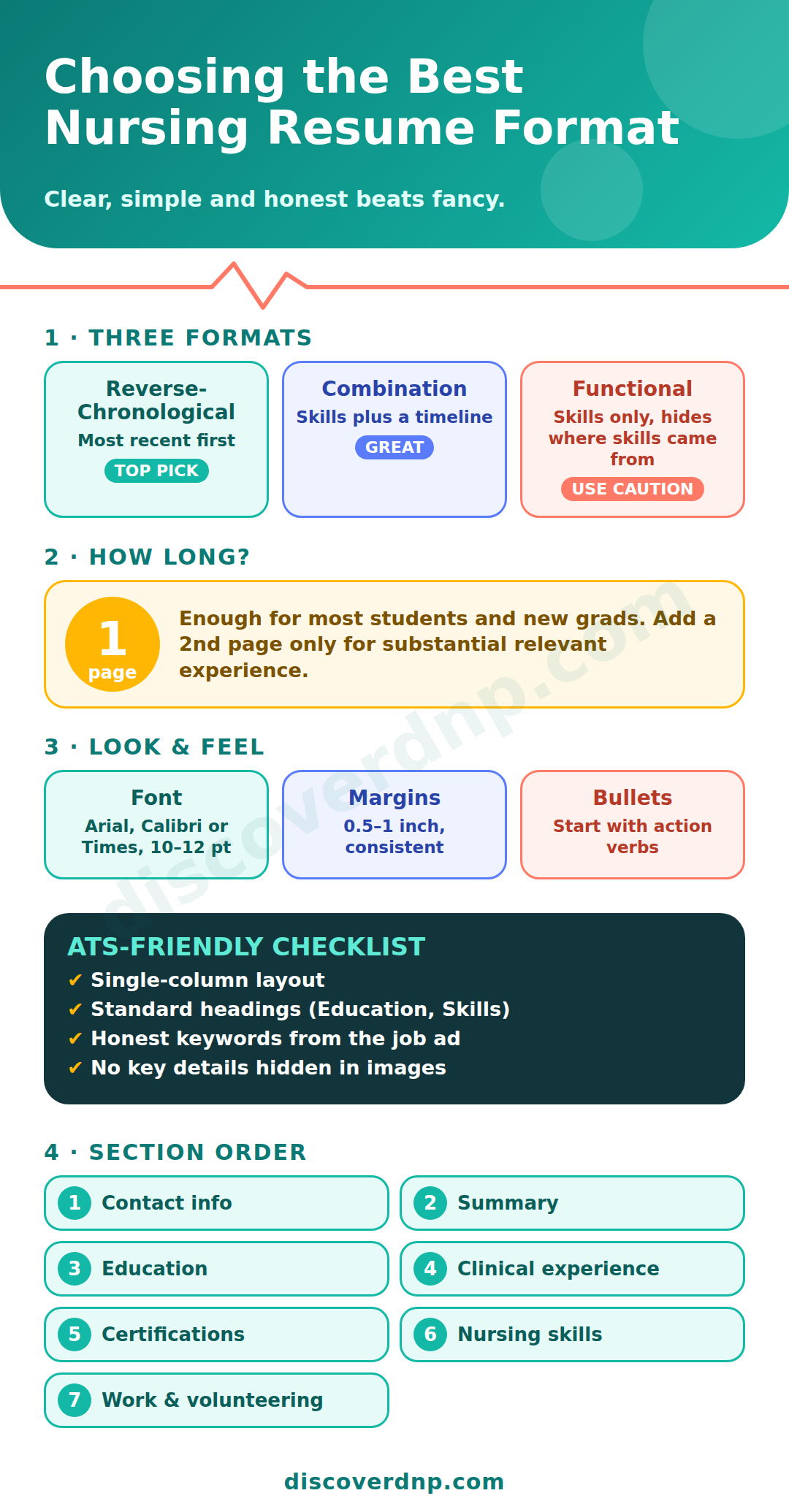
Conclusion
A strong Nursing Student Resume helps demonstrate your readiness for a nursing position by presenting your education, clinical rotations, relevant skills, certifications, work experience, and professional strengths in a clear, organized format. Even without extensive healthcare employment, you can create a compelling resume by highlighting supervised clinical experience, transferable skills, volunteer work, academic achievements, and a genuine commitment to safe, compassionate patient care.
The most effective approach is to choose a suitable resume format, organize the essential sections logically, and describe your qualifications with specific, accurate examples. Tailor your Nursing Student Resume to each job description by emphasizing relevant clinical experience and incorporating appropriate keywords naturally. Use an ATS-friendly template, verify your licensure and certification details, and ensure that every statement reflects your actual training and experience. A well-written cover letter can further connect your qualifications to the employer’s needs and explain why you are interested in the role.
Whether you are applying for a nurse externship, a clinical support position, or your first new graduate nurse residency, your resume should communicate what you have learned, what you can contribute, and where you are prepared to grow. Review your document carefully before submitting it, keep it updated as you gain experience, and adapt it as your nursing career develops. With thoughtful preparation and an effective resume template, you can present your qualifications confidently and take an important step toward beginning your professional nursing career.
Frequently Asked Questions
1. How do you write a resume as a student nurse?
Start with your contact information, nursing education, and expected graduation date. Add a professional summary or objective, supervised clinical rotations, relevant nursing skills, current certifications, employment history, and volunteer experience where applicable. Tailor your Nursing Student Resume to the job description, use concise bullet points, and accurately describe your training without overstating your clinical responsibilities.
2. What is the best format for a nursing resume?
A reverse-chronological or combination resume format is usually effective. List your most recent education, clinical experience, and relevant employment first. Use clear headings, a simple layout, and consistent formatting. For nursing students with limited work experience, placing education and clinical rotations near the top helps hiring managers identify relevant qualifications quickly.
3. What can I put in my resume as a student?
You can include:
- Education: Nursing degree, school, and expected graduation date.
- Clinical experience: Rotations, specialties, healthcare settings, and supervised responsibilities.
- Nursing skills: Vital-sign measurement, infection prevention, patient communication, and documentation, when applicable.
- Certifications: Current BLS or other relevant credentials.
- Work experience: Healthcare employment or other jobs demonstrating teamwork, communication, and reliability.
- Volunteer work: Community health activities or relevant service.
- Achievements: Academic honors, leadership roles, or relevant projects.
Paid nursing experience is not essential for a student resume. Focus on relevant preparation and transferable skills.
4. Where can I find free resume templates for nursing students?
You can explore these resources for free templates or resume-building options. Check each site’s current terms because some features or downloads may require payment.
- Microsoft Create — editable resume templates for Microsoft Word.
- Google Docs — built-in resume templates that you can edit and save.
- Canva — a range of resume designs, including free options; choose a simple, readable layout for nursing applications.
- Indeed Resume — resume-writing guidance, examples, and templates.
- University career services — career guidance and resume resources that may be available to students and the public.
Tip: Choose a clean, single-column resume template with standard headings. The best Nursing Student Resume template is one that highlights your clinical experience and education while remaining easy to read for both applicant tracking systems and recruiters.
