

How to Write a Case Study for Nursing Students: A Clear Case Study Format and Free Case Study Examples
Case studies are an important component of nursing education and clinical practice because they provide a structured way to examine patient conditions, understand clinical decisions, and apply evidence-based knowledge to real-world healthcare situations. Similar to how nursing assessments guide the identification of patient needs, case studies organize clinical information into a coherent account of a patient’s health problem, the care provided, and the outcomes observed. Beyond describing a clinical situation, case study writing encourages critical thinking, clinical reasoning, and an understanding of how nursing knowledge, professional judgment, and research evidence inform patient care.
A well-developed nursing case study brings together patient history, assessment findings, relevant literature, nursing interventions, and clinical outcomes to explain a particular health situation. Each component contributes to a clearer understanding of the case, from identifying the initial problem to evaluating the effectiveness of the care provided. Writing a case study therefore requires more than summarizing medical information. It involves examining the available evidence, identifying relationships between clinical findings and interventions, and explaining the significance of the results. A consistent case study format helps present this information logically, enabling readers to follow the patient’s clinical journey and understand the rationale behind nursing decisions. Confidentiality, accurate documentation, ethical patient representation, and appropriate academic referencing are equally important throughout the process.
Learning how to write a case study for nursing students involves understanding the assignment requirements, selecting a relevant clinical situation, collecting reliable information, and organizing the discussion around a clearly defined problem. The approach may vary depending on the purpose of the case study. An individual patient case, for example, may focus on assessment, diagnosis, treatment, nursing interventions, and evaluation, while a comparative case study may examine similarities and differences between patients or clinical situations. Regardless of the approach, effective case study writing connects clinical observations with relevant evidence, explains the reasoning behind care decisions, and identifies lessons that may inform future practice.
A comprehensive understanding of case study writing also requires attention to the way information is analyzed and communicated. Patient findings must be interpreted in context rather than presented as isolated facts, and conclusions should be supported by documented observations and credible sources. Where appropriate, measurable outcomes can help demonstrate changes in a patient’s condition, while a focused literature review can clarify how the case relates to established clinical knowledge. The discussion should remain clear and relevant, distinguishing observed outcomes from assumptions and acknowledging limitations when the available information does not support a definitive conclusion.
This article explores the principles of nursing case studies, the steps involved in preparing a case study paper, and the essential components of an effective case study format. It also examines case study templates, practical examples, clinical analysis techniques, and best practices for presenting evidence clearly, accurately, and ethically. Understanding these elements provides a systematic foundation for case study writing, helping connect clinical information with sound reasoning, evaluate the implications of nursing interventions, and demonstrate the relationship between nursing theory, research evidence, and patient care.
Understanding Case Studies in Nursing
Case studies are an important learning and research approach in nursing because they allow complex patient situations, clinical decisions, and healthcare experiences to be examined in detail. Rather than treating symptoms, diagnoses, and nursing interventions as separate pieces of information, a case study brings them together to explain how a particular clinical situation develops, how healthcare professionals respond, and what can be learned from the outcomes. This approach is especially valuable in nursing, where patient care depends not only on theoretical knowledge but also on clinical judgment, communication, ethical decision-making, and an understanding of the circumstances affecting each patient.
A nursing case study may focus on an individual patient, a group of patients, a particular health condition, or a clinical process within a healthcare setting. For example, a case involving a patient admitted with pneumonia may examine the presenting symptoms, respiratory assessment, oxygen saturation, prescribed treatment, nursing interventions, and response to care. The purpose is not simply to retell what happened but to connect the available evidence, explain the reasoning behind clinical decisions, and identify important lessons for nursing practice.
The term case study can also describe different activities. In an academic assignment, it may refer to an educational exercise in which a learner analyzes a supplied patient scenario. In research, case study research is a systematic method used to investigate a clearly defined case within its real-world context. In clinical publication, a case report may document an unusual presentation, an unexpected outcome, or a significant clinical observation. Although these forms share some features, their purposes, methods, and reporting requirements may differ. Understanding these distinctions helps establish the right approach before beginning case study writing.
Definition and Types of Case Studies in Social Science and Nursing
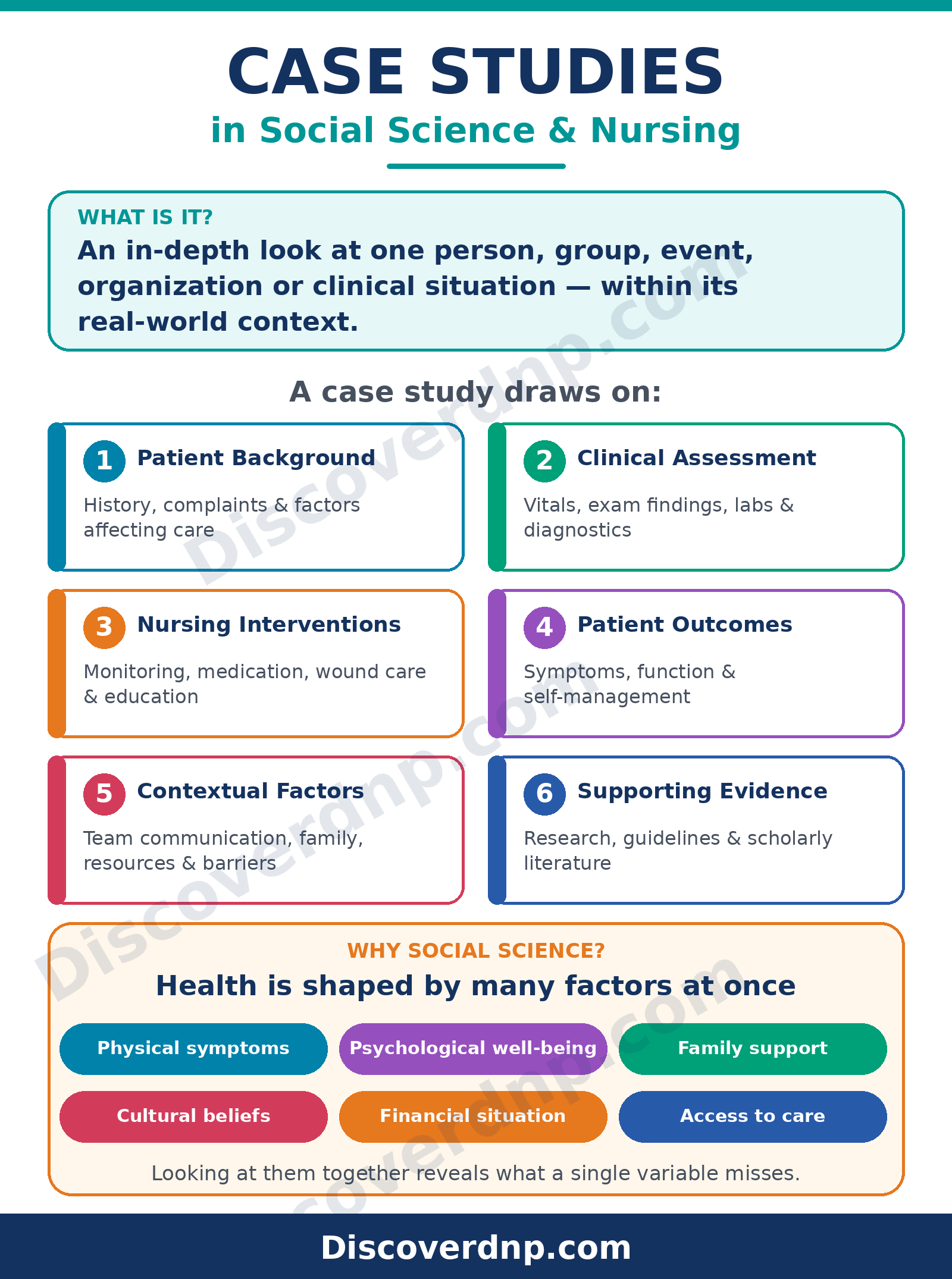
A case study is an in-depth examination of a clearly defined person, group, event, organization, clinical situation, or other unit of interest within its context. It uses relevant information from one or more sources to develop a detailed understanding of the case, its contributing factors, and its implications. In nursing, this may involve examining a patient’s health condition, the care delivered, the patient’s response to interventions, or the processes influencing care within a particular clinical environment.
Case studies are widely used in the social sciences because human behavior, decisions, and experiences are often shaped by multiple interacting factors. A person’s health, for example, may be influenced by physical symptoms, psychological well-being, family support, cultural beliefs, financial circumstances, and access to healthcare services. Examining these factors together can provide insights that might be missed when a situation is reduced to a single variable.
In nursing, a case study may draw on information such as:
- Patient background information: Relevant medical history, presenting complaints, existing conditions, and factors that may affect care.
- Clinical assessment findings: Vital signs, physical examination findings, laboratory results, diagnostic reports, and other relevant observations.
- Nursing interventions: Monitoring, medication administration as prescribed, wound care, patient education, comfort measures, and other appropriate nursing actions.
- Patient outcomes: Changes in symptoms, functional status, clinical measurements, or the patient’s ability to manage their condition.
- Contextual factors: Communication between healthcare professionals, family involvement, available resources, and barriers to treatment or recovery.
- Supporting evidence: Relevant research, clinical guidelines, and scholarly literature used to interpret the case.
Not every case study requires all these elements. The appropriate information depends on the purpose of the assignment, the research question, the available data, and the instructions provided.
For example, a case study about an older adult experiencing repeated falls may examine mobility, medication history, vision, environmental hazards, and the patient’s ability to perform daily activities. Looking at these factors together helps explain why the falls may be occurring and which nursing assessments or preventive interventions are appropriate. Simply recording that the patient fell three times would provide less useful information than examining the circumstances surrounding each incident.
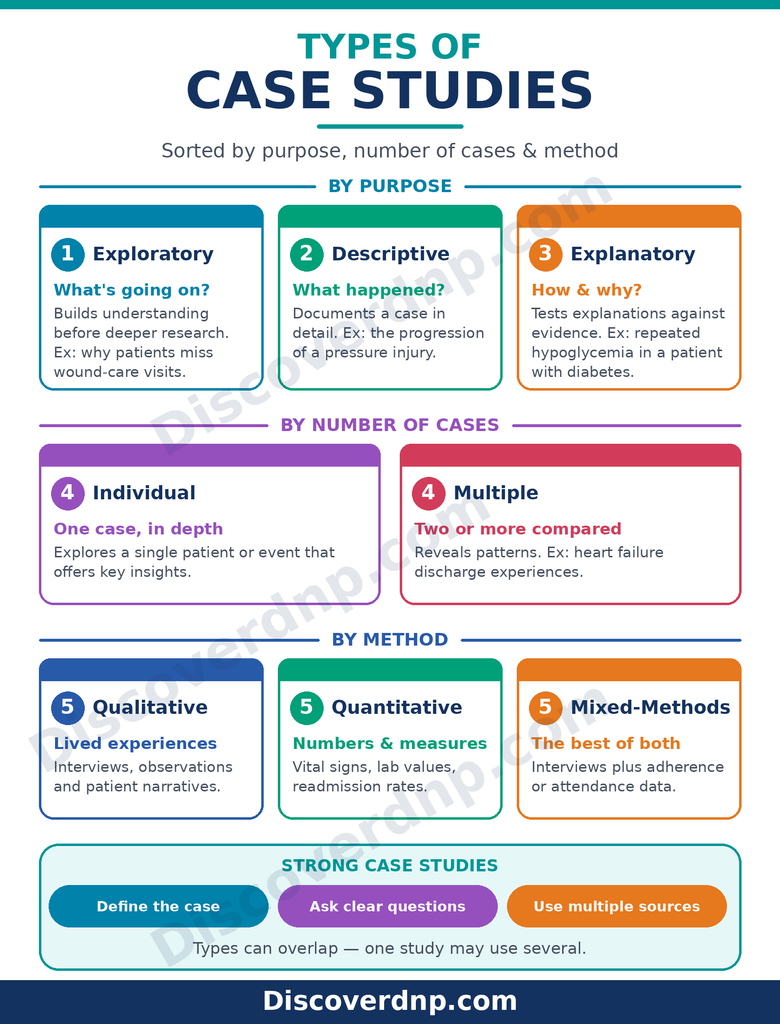
Common types of case studies
Case studies can be classified according to their purpose, the number of cases examined, and the research method used. The following types are particularly useful for understanding academic case studies and nursing research.
1. Exploratory case study
An exploratory case study investigates a situation that requires further understanding before more focused research or action can be planned. It helps identify relevant questions, possible contributing factors, and areas requiring additional investigation.
For example, a nurse manager may explore why some patients miss scheduled wound-care appointments after discharge. The case study might examine transportation difficulties, the availability of dressing supplies, patient understanding of wound-care instructions, and communication between the hospital and community services. The findings can help identify potential explanations that deserve closer examination.
2. Descriptive case study
A descriptive case study provides a detailed account of a particular patient, event, or clinical process. Its main purpose is to document what happened, the circumstances in which it occurred, and the characteristics of the case.
For instance, a descriptive nursing case study might document the progression of a pressure injury, including the initial skin assessment, risk factors, wound characteristics, nursing interventions, and subsequent changes. The description should be organized and clinically relevant rather than a collection of unrelated observations.
3. Explanatory case study
An explanatory case study examines how or why an event occurred. It focuses on relationships between circumstances, decisions, actions, and outcomes. The writer considers possible explanations and evaluates them against the available evidence rather than assuming that one factor caused the result.
For example, a case study may investigate why a patient with diabetes experienced repeated episodes of hypoglycemia during hospitalization. Relevant information could include meal timing, prescribed medication, blood glucose monitoring, changes in appetite, and communication among members of the healthcare team. The analysis should distinguish documented contributing factors from possibilities that cannot be confirmed.
4. Individual and multiple case studies
An individual case study examines one clearly defined case in depth. This approach is useful when a particular patient, event, or clinical experience offers important insights into a nursing problem.
Multiple case studies examine two or more cases to identify similarities, differences, and recurring patterns. For example, a study may compare discharge experiences among several patients with heart failure to understand differences in medication education, follow-up arrangements, and barriers to self-management. Comparing cases can reveal patterns, although the findings must be interpreted in light of differences between patients and settings.
5. Qualitative, quantitative, and mixed-methods case studies
These approaches describe the kinds of information collected and analyzed within a case study design.
- Qualitative case study: Examines experiences, perceptions, communication, behavior, or processes. Information may come from interviews, observations, clinical documents, or patient narratives. For example, interviews may explore how patients experience communication with nurses during end-of-life care.
- Quantitative case study: Uses numerical information, such as vital signs, laboratory values, readmission rates, or wound measurements, to describe patterns within the case. The exact analysis depends on the study question and design.
- Mixed-methods case study: Combines qualitative and quantitative information to develop a more complete understanding. A study of a discharge education program, for instance, could examine patient interviews alongside medication-adherence measurements or follow-up attendance.
These approaches are not necessarily mutually exclusive. A case study may use several types of evidence, and its classification depends on the overall research design and purpose. Methodological guidance by Baxter and Jack emphasizes defining the case, developing suitable research questions, identifying data sources, and using multiple sources of evidence where appropriate.
It is also important to distinguish a case study type from a case study purpose. An individual case may be descriptive, exploratory, or explanatory, while qualitative or quantitative refers to the approach used to collect and analyze information. These classifications answer different questions about how the study is structured.
For academic case studies, the instructions may specify the type of case to examine, or they may provide a clinical scenario that already defines the scope. Before beginning, clarify whether the task is primarily descriptive, analytical, comparative, or research-oriented. This decision helps determine what information to collect, which sources to consult, and how to organize the case study format.
Importance of Real-World Case Studies in Clinical Learning
Real-world case studies connect theoretical nursing knowledge with the complex situations encountered in clinical practice. Textbooks and lectures explain diseases, diagnostic procedures, pharmacology, and nursing interventions, but actual patient care requires professionals to apply this knowledge to individuals whose symptoms, medical histories, preferences, and responses to treatment may differ. Case studies provide a structured opportunity to examine these differences and understand how clinical knowledge informs patient care.
Research on nursing education has identified case-based learning as a useful approach for engaging learners in clinical reasoning and examining complex healthcare situations. Donnelly and Wiechula, for example, discuss the value of case study methodology for understanding the complexity of clinical placement, while research published in Nurse Education Today has examined how case studies are implemented in nursing education.
The importance of real-world case studies can be understood through several key benefits.
1. Developing clinical reasoning and critical thinking
Clinical reasoning involves collecting relevant information, recognizing significant findings, considering possible explanations, and determining appropriate next steps. Case studies help develop these skills by requiring the writer to examine the relationship between a patient’s presentation and the decisions made during care.
For example, consider a patient admitted with shortness of breath, a respiratory rate of 30 breaths per minute, and an oxygen saturation of 88% on room air. A superficial account might simply list these findings and state that oxygen was administered as prescribed. A more detailed case study would examine their clinical significance, the patient’s overall condition, the need for prompt assessment and escalation, the interventions undertaken by the healthcare team, and the patient’s response.
This approach encourages the writer to ask important clinical questions:
- Which findings require immediate attention?
- What additional assessment information is needed?
- Which clinical explanations are consistent with the available evidence?
- What nursing actions are appropriate within the nurse’s scope of practice?
- How should the patient’s response to interventions be evaluated?
Working through these questions helps demonstrate the reasoning behind clinical decisions rather than merely describing a sequence of events.
2. Applying theoretical knowledge to patient care
Nursing education combines theoretical concepts with practical skills. A case study shows how principles such as infection prevention, medication safety, fluid balance, pain management, and patient education apply in specific clinical situations.
For instance, a case involving a patient recovering from abdominal surgery may require the application of knowledge about wound assessment, pain evaluation, respiratory exercises, early mobilization, and prevention of postoperative complications. The writer can explain why these interventions are relevant, how they relate to the patient’s assessment findings, and which outcomes should be monitored.
This makes the case study more than a summary of nursing procedures. It demonstrates how clinical knowledge supports individualized care and why an intervention appropriate for one patient may require modification for another.
3. Strengthening evidence-based practice
Evidence-based nursing involves integrating the best available research evidence with clinical expertise and the patient’s circumstances, preferences, and needs. Case studies offer an opportunity to examine whether clinical decisions align with established evidence and to identify areas where further information may be required.
Suppose a patient with a pressure injury receives a wound-care intervention, but the wound shows limited improvement. A useful case study would examine the patient’s nutritional status, mobility, pressure-relief measures, wound characteristics, comorbidities, and the appropriateness of the treatment plan. A literature review could then be used to compare the care provided with current evidence and relevant clinical guidelines.
The aim is not to assume that an intervention failed simply because improvement was slow. Instead, the writer should interpret the available data, consider alternative explanations, and identify what the evidence supports. This promotes a more analytical approach to clinical practice.
4. Improving patient assessment and interpretation of data
A good case study demonstrates how individual assessment findings contribute to an overall understanding of the patient’s condition. Vital signs, laboratory results, medication history, symptoms, physical examination findings, and changes in functional status must be interpreted in context.
For example, a patient with dehydration may present with reduced urine output, thirst, dry mucous membranes, and changes in vital signs. A case study could examine how these findings relate to the patient’s history of fluid loss, what additional assessments are necessary, and how the patient’s response to prescribed fluid replacement is monitored.
Where appropriate, measurable indicators can help track changes over time. These might include urine output, fluid intake, blood pressure, heart rate, laboratory values, or symptom severity. However, numerical results should not be interpreted in isolation; age, underlying conditions, medications, baseline measurements, and other clinical factors may affect their significance.
5. Encouraging holistic and individualized care
Patients are influenced by more than their diagnoses. Psychological well-being, cultural beliefs, family support, health literacy, financial circumstances, and access to healthcare services can affect treatment decisions and recovery.
A case study involving a patient with poorly controlled hypertension, for example, might initially appear to focus on medication adherence. Further examination could reveal difficulties obtaining medication, limited understanding of the treatment plan, adverse effects, or challenges attending follow-up appointments. These contextual factors may help explain the patient’s experience and inform appropriate patient education or referral.
Considering the whole patient prevents the analysis from focusing exclusively on physical symptoms and supports a more complete understanding of the factors affecting care.
6. Learning from clinical decisions, complications, and outcomes
Case studies can examine successful interventions, unexpected outcomes, adverse events, and opportunities to improve care. Both positive and negative outcomes may provide valuable lessons when the case is documented accurately and analyzed objectively.
For example, a case involving a postoperative infection could explore the patient’s risk factors, the timing of symptom recognition, wound assessment, communication with the healthcare team, treatment, and subsequent progress. The discussion might identify opportunities for earlier recognition or improved discharge education without assigning blame unsupported by the evidence.
Clinical case reports can also contribute to the recognition of unusual presentations and unexpected treatment effects. The CARE reporting guidelines emphasize clear documentation of patient information, clinical findings, interventions, outcomes, follow-up, and informed consent where applicable.
7. Improving clinical communication and professional documentation
Case study writing requires information to be organized so that another reader can understand the patient’s situation and follow the clinical reasoning. This is closely related to professional nursing documentation, where clarity, accuracy, relevance, and appropriate sequencing are essential.
A concise case summary, for example, should distinguish the patient’s presenting complaint from objective assessment findings, interventions, and subsequent outcomes. It should also identify gaps in the available information rather than filling them with assumptions.
These skills are useful when preparing academic case study papers and when communicating clinical information through handovers, progress notes, referrals, and multidisciplinary discussions. A well-organized case study demonstrates how relevant information can be presented clearly without losing important clinical details.
Differences Between a Case Study, Research Paper, and Research Method
The terms case study, research paper, and research method are related, but they describe different aspects of academic work. Understanding these differences is important because the structure and expectations of a nursing assignment depend on whether the task involves analyzing a supplied patient scenario, reporting a clinical case, or conducting formal research.
A case study may be the subject of a research paper, while a research method describes how information is collected and analyzed. The terms should therefore not be treated as interchangeable.
Case study versus research paper
A case study focuses on an in-depth examination of a specific case within its context. It may be an educational exercise based on a hypothetical patient, an analysis of an actual clinical situation, or a formal research investigation.
A research paper is a broader academic document that presents an investigation, analysis, or evidence-based discussion of a defined topic. Depending on its purpose, it may involve original research, a systematic review of existing literature, or a critical analysis of published evidence. A research paper can use a case study design, but it can also use other approaches, such as surveys, experiments, cohort studies, or qualitative interviews.
Consider the following comparison.
| Feature | Case study | Research paper |
|---|---|---|
| Primary focus | A specific case or clearly bounded situation | A research question or broader academic problem |
| Scope | Usually detailed and context-specific | Varies according to the topic and study design |
| Evidence | May include patient records, observations, interviews, clinical findings, and literature | May include original data, published research, or both |
| Main purpose | To understand a case and its relevant circumstances | To investigate a question, evaluate evidence, or develop an argument |
| Structure | Depends on the assignment or case study design | Depends on the paper type, research method, and academic requirements |
| Example | Analyzing the nursing care of a patient with heart failure | Evaluating evidence on interventions that reduce heart failure readmissions |
For example, an assignment may ask for a case study of a patient experiencing acute asthma symptoms. The discussion might examine the patient’s history, assessment findings, prescribed treatment, nursing interventions, and response to care.
A separate research paper might investigate the effectiveness of asthma self-management education across several patient populations using published studies. Both assignments concern asthma, but their scope and objectives differ.
A case study paper may also include a literature review, research question, and detailed analysis. The presence of these components does not automatically make it a different type of assignment; their purpose depends on whether the task is an educational case analysis or a formal research project.
Case study versus research method
A research method is the systematic approach used to collect, organize, and analyze information to answer a research question. Methods may include interviews, observations, surveys, document analysis, clinical measurements, and statistical analysis.
Case study research is a research methodology or design that investigates a clearly defined case in depth and within its real-world context. It may combine several research methods to provide a comprehensive understanding of the situation. Baxter and Jack explain that defining the case, developing research questions, identifying data sources, and considering how different sources of evidence complement one another are important elements of case study research.
For example, a researcher investigating communication during end-of-life care in a hospital may use:
- Interviews with nurses and family members to explore experiences and perceptions.
- Observations of relevant care processes, where ethically approved and appropriate.
- Document analysis to examine policies or clinical records.
- Quantitative information, if relevant, to describe aspects of the care process.
The case study design provides the overall structure for examining the clinical situation, while interviews, observations, and document analysis are methods used to gather information. The researcher then analyzes the evidence in relation to the research question.
It is also important to distinguish a research method from a study design. A study design describes the overall plan for answering a research question, including how the case is defined, what evidence is needed, and how the investigation will be organized. Methods are the specific procedures used to obtain and analyze that evidence.
For academic assignments, this distinction matters because not every nursing case study requires original data collection. If the assignment provides a patient scenario, the task may simply involve interpreting the information supplied and supporting the discussion with credible sources. A formal case study research project, by contrast, may require an approved protocol, ethical review, systematic data collection, and a clearly documented analysis.
In clinical research involving actual patients, appropriate institutional approval, confidentiality safeguards, and informed consent requirements must be followed as applicable. Students should use only information they are authorized to access and should follow their institution’s rules for clinical assignments.
In summary, a case study describes and examines a particular case, a research paper is the academic document used to present an investigation or argument, and a research method explains how evidence is obtained and analyzed. Understanding the relationship between these concepts provides a clearer foundation for selecting the right approach and organizing a nursing case study effectively.
How to Write a Case Study Step by Step
Writing a nursing case study involves more than describing a patient’s diagnosis or listing the interventions provided during hospitalization. It requires a systematic process of selecting a relevant clinical situation, identifying the central problem, collecting accurate information, reviewing supporting evidence, and organizing the findings into a logical discussion. Each step contributes to the quality of the final case study paper and helps ensure that the analysis is clinically relevant, academically sound, and easy to follow.
A structured approach also makes case study writing more manageable. Instead of attempting to write the entire paper at once, the writer can work through clearly defined stages, checking that each stage contributes to the purpose of the assignment. The specific requirements may vary between nursing programs, clinical specialties, and research projects, but the following process provides a practical framework for preparing an effective case study.
Selecting a Patient Case and Defining the Clinical Problem
The first step in writing a case study is selecting a patient case that provides sufficient information for meaningful examination. The case should have a clear focus, a relevant clinical problem, and enough available evidence to support a detailed discussion. A complex diagnosis does not automatically make a strong case study. What matters is whether the situation offers an opportunity to examine clinical findings, nursing decisions, interventions, patient outcomes, or challenges in care.
In an academic assignment, the patient case may be supplied by an instructor, drawn from an approved clinical experience, or developed from a fictional scenario. In formal case study research, the selection process should be guided by the research question, the study design, and clearly established criteria for choosing the case.
1. Choose a clinically relevant case
A useful case study begins with a situation that has a clear educational or clinical purpose. The case may involve a common health condition that illustrates important nursing principles, an unusual clinical presentation, a complication requiring careful assessment, or a challenge in coordinating patient care.
Examples of suitable nursing case topics include:
- A patient with diabetes experiencing recurrent hypoglycemia during hospitalization.
- An older adult admitted with pneumonia who develops increasing respiratory distress.
- A patient recovering from abdominal surgery who experiences delayed wound healing.
- A patient with heart failure who has difficulty managing medications and fluid restrictions after discharge.
- A patient at risk of pressure injuries because of limited mobility and poor nutritional status.
Each of these situations provides opportunities to examine assessment findings, relevant patient history, nursing interventions, clinical reasoning, and outcomes.
For example, a case study about recurrent hypoglycemia could explore the relationship between blood glucose measurements, meal intake, medication timing, changes in the patient’s condition, and the monitoring or escalation procedures used by the healthcare team. This creates a focused basis for analysis rather than a general discussion of diabetes.
2. Define the central clinical problem
After selecting the case, identify the main issue the paper will address. The clinical problem should be specific enough to guide the discussion while allowing sufficient depth for analysis.
A broad topic such as diabetes management could lead to a lengthy description of the disease, its complications, medication classes, dietary recommendations, and long-term management. A more focused problem, such as recurrent hypoglycemia in a hospitalized patient receiving glucose-lowering medication, provides a clearer direction for examining the case.
The central problem may concern:
- An acute change in the patient’s condition.
- A difficulty in symptom management or recovery.
- A potential complication or patient safety concern.
- A challenge involving adherence, education, or continuity of care.
- An unexpected response to treatment.
- A gap between recommended care and the care documented in the case.
The writer should distinguish the patient’s medical diagnosis from the specific problem being investigated. For instance, pneumonia is a medical diagnosis, whereas worsening oxygenation in a patient with pneumonia may be the central clinical issue examined in a case study.
3. Establish the purpose and research question
The purpose explains what the case study is intended to achieve. The research question, when required, translates that purpose into a focused question that guides information collection and analysis.
For an academic nursing assignment, a suitable purpose might be to examine the assessment and management of a patient experiencing recurrent hypoglycemia. A corresponding question could be:
Which patient-related and care-related factors may have contributed to recurrent hypoglycemia, and how were these factors addressed during hospitalization?
This question identifies the issue to be explored without assuming the cause before the evidence has been examined.
Not every educational case study requires a formal research question. Some assignments provide specific learning objectives or questions that should guide the analysis instead. Follow the assignment instructions rather than adding a research framework that is not required.
4. Determine whether the case provides enough information
A compelling case should contain sufficient relevant details to support the planned discussion. Before proceeding, consider whether the available information includes the patient’s presenting problem, relevant history, assessment findings, interventions, and documented progress or outcomes.
If the case concerns delayed wound healing but contains no information about the wound’s characteristics, treatment, nutritional status, or progress, it may be difficult to develop a meaningful analysis. The writer should identify such gaps early rather than invent missing details.
A simple case-selection checklist can help:
- Is the clinical problem clearly defined?
- Is the case relevant to the assignment’s objectives?
- Is enough information available to explain the situation?
- Can the case be supported with credible clinical evidence?
- Can patient confidentiality and applicable ethical requirements be maintained?
- Is the scope manageable within the required word count?
A well-chosen case makes it easier to create a focused case study outline, identify relevant sources, and avoid unnecessary discussion of unrelated conditions.
Collecting Patient History, Assessment Findings, and Clinical Evidence
After selecting the case and defining the clinical problem, the next step is collecting the information needed to explain the patient’s condition and support a meaningful analysis. The quality of a case study depends heavily on the accuracy, relevance, and completeness of the information used. Missing assessment findings, inaccurate timelines, or unsupported assumptions can weaken the discussion and lead to conclusions that do not reflect the clinical situation.
Data collection should therefore be guided by the purpose of the case study. The objective is not to include every detail in the patient’s medical record but to gather the information necessary to understand the clinical problem, explain the care provided, and evaluate the documented outcomes. For formal case study research, the sources and procedures used to collect information should be consistent with the research question and study design. Baxter and Jack emphasize the value of using appropriate, complementary sources of evidence when investigating complex situations.
1. Collect relevant patient background information
Patient background information establishes the context in which the clinical problem developed. Depending on the case, it may include demographic information, presenting complaints, medical history, surgical history, current medications, allergies, family history, social circumstances, and relevant lifestyle factors.
The information selected should help explain the patient’s condition or influence the nursing care provided. For example, in a case study involving delayed wound healing, relevant background information might include diabetes, peripheral circulation problems, nutritional status, smoking history, mobility limitations, and previous wound complications. These details may help explain the patient’s risk factors and inform the clinical discussion.
By contrast, unrelated information that does not contribute to the central problem can usually be omitted. This keeps the case study focused and makes it easier to identify the factors that matter most.
When writing about an actual patient, include only the information you are authorized to access and use. Remove direct identifiers and avoid unnecessary combinations of personal details that could reveal the patient’s identity. A fictional or instructor-provided case should be clearly treated according to the assignment requirements.
2. Organize the clinical assessment findings
Assessment findings provide the clinical evidence needed to describe the patient’s condition. They may include subjective information reported by the patient and objective findings obtained through examination, monitoring, diagnostic testing, or other appropriate procedures.
Subjective information includes symptoms and experiences such as pain, nausea, dizziness, fatigue, or shortness of breath. Objective information may include vital signs, physical examination findings, laboratory results, imaging reports, and observed changes in the patient’s condition.
Consider a hypothetical case involving a patient admitted with suspected pneumonia. Relevant assessment information might include:
- Presenting symptoms: Cough, fever, fatigue, and shortness of breath.
- Vital signs: Temperature, respiratory rate, heart rate, blood pressure, and oxygen saturation.
- Physical assessment: Respiratory effort, breath sounds, ability to speak comfortably, and level of consciousness.
- Diagnostic findings: Relevant imaging reports, laboratory results, and other documented investigations.
- Changes over time: Whether respiratory symptoms, oxygenation, temperature, or other indicators improve or deteriorate following treatment.
The findings should be accurate and presented with appropriate context. If a measurement was taken before an intervention, make that timing clear. Similarly, distinguish between a patient’s reported symptom and a finding observed during examination.
For instance, writing that a patient reported feeling breathless is different from documenting an increased respiratory rate or reduced oxygen saturation. Both may be important, but they represent different kinds of evidence.
3. Establish a clear clinical timeline
A timeline helps organize information chronologically, making it easier to understand how the patient’s condition evolved and how clinical decisions related to subsequent events.
A timeline is particularly useful when the case includes several assessments, changes in treatment, complications, or follow-up visits. The CARE reporting guidelines recommend presenting important clinical events in a structured sequence so that readers can follow the progression of the case.
For example, a simplified timeline for a hypothetical patient with a postoperative wound complication could look like this:
| Stage | Relevant information |
|---|---|
| Admission | Patient assessed before surgery; relevant history and baseline findings documented. |
| Early postoperative period | Wound condition, pain, vital signs, and recovery monitored. |
| Subsequent assessment | New wound changes observed and reported to the appropriate clinician. |
| Intervention | Further assessment and prescribed treatment documented. |
| Follow-up | Wound condition and the patient’s response to care evaluated. |
This example illustrates the structure rather than a real patient’s clinical course. In an actual case study, the writer should use the documented sequence of events and include dates or time intervals when they are relevant and permitted.
Chronological organization also helps identify gaps. If the case describes a deterioration in the patient’s condition but provides no information about the preceding assessment or subsequent response, the writer should acknowledge that limitation rather than assume what happened.
4. Gather reliable clinical evidence
Patient information explains what happened in the case, while external clinical evidence helps establish how the findings should be interpreted. A strong case study draws on credible sources to explain relevant conditions, justify clinical reasoning, and compare the care described with accepted practice.
Useful sources include:
- Peer-reviewed nursing and medical journals.
- Current clinical practice guidelines from recognized professional organizations.
- Government health agencies and established healthcare institutions.
- Evidence-based clinical resources.
- Relevant textbooks and scholarly publications.
- Institutional policies, where appropriate and accessible.
The sources selected should be relevant to the clinical question and sufficiently current for the topic. For rapidly changing areas, such as medication recommendations or infection management, verify that the information reflects current guidance.
Suppose a case study examines pressure injury prevention in an immobile patient. Relevant evidence might address risk assessment, repositioning, skin inspection, pressure-redistributing equipment, nutrition, and individualized prevention plans. The writer can then compare these recommendations with the interventions documented in the case.
A literature review should support the analysis rather than become a collection of unrelated summaries. Each source should help explain a clinical finding, support an argument, clarify a recommended intervention, or identify an area of uncertainty.
5. Distinguish documented facts from interpretation
One of the most important aspects of collecting information is recognizing the difference between what the records establish and what the writer infers from them.
For example, if a patient’s blood glucose level improves after a prescribed intervention, the case study may report that the improvement occurred following treatment. However, the writer should not automatically claim that the intervention alone caused the improvement unless the available evidence supports that conclusion.
Similarly, if a patient develops an infection during hospitalization, the timing of the infection does not by itself establish where or how it was acquired. Additional evidence would be needed to support such a claim.
A useful approach is to separate information into three categories:
- Documented facts: What the patient reported, what clinicians observed, which tests were performed, and what interventions were recorded.
- Evidence-based interpretation: What the findings may indicate when considered alongside relevant clinical knowledge and research.
- Unresolved questions: Information that is missing, ambiguous, or insufficient to support a firm conclusion.
This distinction strengthens the credibility of the case study and reduces the risk of presenting assumptions as facts.
6. Check completeness, accuracy, and confidentiality
Before drafting, review the information to confirm that it addresses the clinical problem and is internally consistent. Check measurements, dates, medication details, intervention records, and outcomes against the authorized source material.
For a clinical case report, the CARE guidelines provide a useful reporting framework covering patient information, clinical findings, diagnostic assessment, interventions, follow-up, outcomes, and informed consent. These guidelines are intended for case reports and can inform academic writing, although an educational assignment may require a different structure.
At this stage, ask whether:
- The relevant patient history and assessment findings are available.
- Important clinical events can be placed in the correct sequence.
- Claims are supported by records or reliable literature.
- Missing information has been identified rather than invented.
- Confidential information is appropriately protected.
- The collected evidence is sufficient to support the planned analysis.
Thorough data collection makes the next stage of writing more efficient because the writer can organize the case around established information rather than repeatedly searching for missing details.
Developing a Case Study Outline and Organizing Information
Once the clinical information has been collected, the next step is developing a case study outline. The outline establishes the sequence of the discussion and ensures that each section contributes to the purpose of the paper. Without this structure, case study writing can become repetitive, with patient history, clinical findings, interventions, and analysis appearing in the wrong sections or being discussed several times.
The appropriate case study format depends on the assignment instructions. A classroom case analysis may use headings specified by the instructor, while a formal clinical case report may follow established reporting guidelines. The CARE guidelines, for instance, organize clinical reporting around patient information, findings, diagnostic assessment, interventions, outcomes, and discussion.
1. Review the assignment requirements before outlining
Begin by identifying what the assignment requires. Check the instructions for the topic, learning objectives, required headings, referencing style, word count, and assessment criteria. Determine whether the task involves a fictional patient scenario, an authorized clinical case, a literature-based analysis, or formal case study research.
These distinctions affect how the information should be presented. A case analysis based on a supplied scenario may require interpretation of existing findings rather than independent data collection. A research-oriented case study may require a more explicit explanation of the methodology and evidence sources.
The outline should follow the required structure rather than impose a generic template on every assignment.
2. Arrange the information in a logical sequence
A clear case study generally moves from the context of the case to the clinical problem, relevant findings, care provided, outcomes, and interpretation. Each section should answer a different question.
For example, a nursing case study about a patient with a diabetic foot wound could be organized as follows:
- Introduction: Briefly introduce the clinical issue and explain the purpose of the case study.
- Patient background: Present relevant history, risk factors, and the reason for seeking care.
- Clinical assessment: Describe the wound findings, relevant observations, and available diagnostic results.
- Nursing interventions: Explain the care provided and the clinical rationale for relevant interventions.
- Patient outcomes: Describe the documented response to care and any subsequent changes.
- Analysis and discussion: Interpret the findings, compare the care with relevant evidence, and identify clinical implications.
- Conclusion: Summarize the main lessons supported by the case.
This is an illustrative structure, not a mandatory format for every nursing assignment. Some assignments may combine the assessment and background sections or require a separate literature review. Follow the prescribed format when it differs from this example.
3. Assign each piece of information to the appropriate section
A useful outline prevents repetition by establishing where each detail belongs. Patient history should provide the context for the case, assessment findings should describe the clinical evidence, and the analysis should explain the significance of that evidence.
For instance, the patient’s diabetes history may be introduced in the background section. In the analysis, the writer can then explain how diabetes may affect wound healing, supported by appropriate literature, without repeating the entire medical history.
Similarly, the interventions section should describe the care documented, while the analysis should evaluate its rationale and implications. The outcome section should report what changed, whereas the discussion should consider what those changes mean and what conclusions the evidence permits.
This division creates a coherent narrative and helps ensure that the paper remains clear and concise.
4. Use a case study template as a planning tool
A case study template can help organize information before the first draft. It provides a consistent place for the key components and makes missing information easier to identify.
The following planning template can be adapted to the assignment requirements:
| Component | Information to include |
|---|---|
| Case focus | The main clinical problem and purpose of the paper. |
| Patient background | Relevant history, presenting concerns, and contextual factors. |
| Assessment findings | Subjective symptoms, objective observations, and diagnostic information. |
| Clinical interventions | Documented nursing care, other relevant treatment, and rationale where available. |
| Outcomes | Changes in the patient’s condition and relevant follow-up findings. |
| Supporting evidence | Scholarly sources and guidelines relevant to the case. |
| Analysis | Interpretation of findings, evaluation of care, and clinical implications. |
| Limitations | Missing information, uncertainties, or factors that restrict interpretation. |
| Main lessons | Conclusions supported by the case and implications for practice. |
This template is a planning aid rather than a substitute for the final paper. Some sections may not be needed, and additional components may be required by the instructor or publication guidelines.
5. Decide where tables, graphs, and other visual elements are useful
Visual elements can make complex information easier to understand when they serve a clear purpose. A timeline may help present a patient’s clinical progression, while a table can summarize serial measurements or compare interventions and outcomes.
For example, if a case study includes several blood glucose measurements over time, a table or graph may help readers identify changes more easily than a lengthy paragraph. The accompanying discussion should still explain the clinical significance of the pattern and avoid suggesting that a relationship proves causation.
Visual elements should be accurate, clearly labeled, and accompanied by units or explanatory notes where needed. Do not include graphs merely to make the paper look more sophisticated, and never create missing measurements or fabricate clinical results.
6. Allocate the word count according to the purpose of the case study
The length of a case study depends on the assignment instructions, the complexity of the case, and the depth of analysis required. There is no single word count that applies to all nursing case studies.
When a word limit is specified, allocate space according to the importance of each section. The background should provide enough information to understand the clinical problem without becoming a detailed biography. The assessment and intervention sections should include relevant facts, while the analysis should have sufficient space to explain the reasoning and connect the case with clinical evidence.
A useful principle is to give each paragraph a clear purpose. Remove information that does not help explain the case, support the analysis, or answer the assignment question. This makes the final paper easier to read without sacrificing clinical detail.
7. Check the outline before beginning the full draft
Before writing, confirm that the outline follows the assignment requirements and provides a clear path from the clinical problem to the main conclusions.
A final planning checklist should confirm that:
- The case study has a defined purpose and central clinical problem.
- Each heading addresses a distinct aspect of the case.
- Patient information, assessment findings, interventions, and outcomes are placed appropriately.
- Relevant claims can be supported with credible evidence.
- The analysis has room to interpret findings rather than merely repeat them.
- Ethical and confidentiality requirements are addressed.
- The planned discussion fits the required word count.
A well-developed outline gives the paper structure while allowing the writer to explain the case in sufficient depth. It also reduces the need for major revisions because missing evidence, repeated concepts, and gaps in the clinical narrative can be identified before the full draft is written.
When these steps are completed carefully, case study writing becomes a more systematic process: the case is clearly defined, the evidence is organized, and the final discussion can focus on explaining what the clinical situation reveals about nursing practice.
Case Study Format and Template for Nursing Assignments
A clear case study format provides a structure for presenting clinical information, explaining nursing decisions, and connecting patient outcomes with relevant evidence. Without an organized format, a paper may become a collection of observations rather than a coherent analysis of a clinical situation. The reader should be able to understand why the case is important, what happened to the patient, how the care was managed, and what conclusions can reasonably be drawn from the available information.
The appropriate format depends on the purpose of the assignment. An educational case study may follow a structure provided by an instructor, while a clinical case report intended for publication may follow established reporting guidelines. For example, the CARE (CAse REport) guidelines identify important elements of clinical case reporting, including patient information, clinical findings, diagnostic assessment, interventions, outcomes, and follow-up. These elements offer a useful reference when organizing a nursing case study, although they do not replace specific academic instructions.
For those learning how to write a case study for nursing students, the central principle is to organize information according to its purpose. Patient history establishes context, assessment findings describe the clinical situation, intervention details explain the care provided, and analysis connects the evidence with nursing practice. Each component should contribute something distinct to the paper.
Essential Components of a Nursing Case Study Format
The key components of a nursing case study vary according to the assignment, but most well-organized papers include an introduction, patient background, clinical assessment, nursing interventions, outcomes, analysis, and conclusion. Some assignments also require a literature review, a separate nursing care plan, an abstract, or a discussion of the research method.
The following components provide a practical starting point for developing a case study template.
1. Title and introduction
The title should communicate the central clinical issue without being unnecessarily long. A specific title is generally more informative than a broad heading such as A Nursing Case Study.
For example, Nursing Assessment and Management of a Patient With a Diabetic Foot Ulcer identifies the main subject and the nursing focus. The title should not disclose identifiable patient information.
The introduction provides a brief overview of the clinical issue, explains why the case is relevant, and establishes the purpose of the paper. It may introduce the health condition, identify the main problem, and indicate the aspects of nursing care that will be examined.
The introduction should remain focused. Detailed patient history, extensive clinical findings, and the full analysis belong in their respective sections rather than being repeated at the beginning.
2. Patient background and presenting problem
This section introduces the patient and explains the circumstances that led to the clinical encounter. It may include relevant medical history, presenting symptoms, existing conditions, current medications, allergies, and social factors that influence care.
Only information relevant to the case should be included. For example, in a case study about recurrent hypoglycemia, diabetes history, prescribed glucose-lowering medication, meal intake, and recent changes in health status may be important. Unrelated background details would add length without improving the analysis.
The presenting problem should be described clearly, distinguishing the patient’s reported symptoms from the findings documented during assessment.
3. Clinical assessment and diagnostic information
The assessment section presents the information used to understand the patient’s condition. Depending on the case, this may include vital signs, physical examination findings, laboratory results, imaging reports, pain assessments, functional status, and other relevant observations.
Findings should be presented accurately and in context. Include units for measurements where appropriate, explain relevant changes over time, and identify the source of important information when necessary.
For example, a case involving respiratory deterioration may require a description of respiratory rate, oxygen saturation, breathing effort, breath sounds, and the timing of any changes. The purpose is to establish what the available evidence shows, not to make unsupported diagnostic claims.
4. Nursing interventions and clinical management
This section describes the nursing care provided and other treatment details necessary to understand the patient’s clinical course. It may include monitoring, medication administration as prescribed, wound care, patient education, comfort measures, communication with the healthcare team, and escalation of concerns.
The discussion should identify what was documented and, where appropriate, explain the rationale for the intervention. It should also distinguish nursing actions from medical prescriptions or decisions made by other members of the healthcare team.
For instance, a wound-care case study may describe the assessment and documentation of the wound, the dressing care performed according to the treatment plan, pressure-relief measures, patient education, and communication about changes in wound condition.
5. Patient outcomes and follow-up
This section describes the patient’s documented response to care. Outcomes may include changes in symptoms, vital signs, laboratory measurements, wound characteristics, mobility, functional ability, or understanding of self-care instructions.
Where measurable information is available, it can help demonstrate progress. For example, serial wound measurements may show whether the wound area changed over time. However, measurements should be presented with the relevant dates and context, and improvement should not automatically be attributed to a single intervention.
If follow-up information is unavailable, state that limitation rather than inventing a result or assuming that the patient recovered.
6. Case analysis and discussion
The analysis explains what the case reveals about the clinical problem and the nursing care provided. It connects assessment findings, relevant clinical knowledge, and research evidence to evaluate the significance of the case.
This section may examine why certain interventions were appropriate, whether the documented care aligned with relevant guidelines, what factors may have influenced the outcomes, and which uncertainties remain.
For example, in a case involving delayed wound healing, the discussion might examine the relevance of circulation, blood glucose control, nutrition, pressure, and infection risk. The writer should support clinical explanations with credible sources and avoid claiming that a particular factor caused the outcome unless the evidence justifies that conclusion.
7. Conclusion and recommendations
The conclusion summarizes the most important lessons from the case and explains their relevance to nursing practice. It should reflect the analysis rather than introduce new clinical findings.
Depending on the assignment, the conclusion may identify implications for assessment, patient education, care coordination, or monitoring. Any recommendations should be proportionate to the available evidence and the scope of the case.
Not every assignment requires all these components as separate headings. If the instructor provides a different structure, use that format while ensuring that the required information is covered.
Presenting Patient Information, Nursing Interventions, and Outcomes
The way patient information is presented determines how easily readers can understand the clinical situation and follow the reasoning behind the care provided. A strong nursing case study tells a coherent clinical story, moving from the patient’s initial presentation through assessment, intervention, and evaluation. The discussion should be sufficiently detailed to explain the case but selective enough to keep attention on the central clinical problem.
The CARE guidelines emphasize a consistent narrative that includes presenting concerns, clinical findings, interventions, outcomes, and follow-up. They also recommend a timeline when it helps clarify the sequence of important clinical events.
1. Present patient information clearly and selectively
Begin with the information necessary to understand the patient’s condition. Depending on the case, this may include age range, relevant medical history, presenting symptoms, comorbidities, allergies, current medications, and circumstances affecting treatment or recovery.
Patient information should be presented in a logical sequence rather than as an unfiltered collection of medical-record entries. For example, a case study about a patient with heart failure might introduce the patient’s history of heart failure, recent symptoms, medication regimen, and reason for admission before describing the detailed assessment findings.
Consider this hypothetical example:
An older adult with a documented history of heart failure was admitted with increasing shortness of breath, lower-limb swelling, and reduced exercise tolerance. The clinical assessment identified findings requiring further evaluation of fluid status and respiratory function.
This brief description establishes the clinical context without introducing unnecessary personal information or claiming a diagnosis beyond what has been documented.
As the case develops, additional details should be introduced where they help explain the clinical findings or decisions. If medication history is relevant to the problem, discuss it in the appropriate context rather than listing every medication without explanation.
2. Present assessment findings accurately
Assessment findings should distinguish between subjective symptoms, objective observations, and diagnostic information. Include relevant measurements, dates, units, and changes over time so readers can understand the patient’s condition.
For example, a case involving suspected dehydration may include the patient’s reported fluid intake, history of vomiting or diarrhea, urine output, vital signs, laboratory results, and other documented findings. These details should be interpreted together rather than treating any single measurement as conclusive evidence.
When presenting clinical data, ensure that:
- Measurements are recorded accurately and include appropriate units.
- Relevant changes are presented in chronological order.
- Abnormal findings are described without exaggerating their significance.
- Diagnostic conclusions are attributed to the appropriate documented assessment.
- Missing or uncertain information is acknowledged.
If a table or graph would make serial measurements easier to understand, it can be included when permitted by the assignment. However, the text should still explain why the information matters to the case.
3. Explain nursing interventions and their rationale
A case study should identify the nursing interventions relevant to the clinical problem and explain their purpose. Merely stating that a nurse monitored vital signs, administered medication, or provided education does not demonstrate why these actions were appropriate.
For each important intervention, consider the following:
- Clinical indication: What patient finding or care need prompted the intervention?
- Action taken: What nursing care was provided or documented?
- Rationale: What clinical principle or evidence supports the action?
- Monitoring: What findings were assessed before, during, or after the intervention?
- Response: What changes were documented following care?
For example, in a hypothetical case involving respiratory distress, the discussion might describe the patient’s respiratory assessment, positioning for comfort when appropriate, monitoring of oxygen saturation, administration of prescribed oxygen, and escalation to the responsible clinician when indicated. The writer should explain the rationale for the actions and distinguish the nursing interventions from medical orders or decisions made by other professionals.
Interventions should reflect the actual case information. If the source scenario does not state that a particular intervention occurred, do not present it as a documented fact. You may discuss it separately as a potential consideration, provided the assignment allows this distinction and the recommendation is supported by relevant evidence.
4. Present outcomes using documented evidence
Patient outcomes describe the response to care and whether the clinical problem changed over time. They may include improvements, deterioration, complications, unchanged findings, or the absence of sufficient follow-up information.
Where possible, use measurable outcomes rather than vague statements. For example, instead of writing that a patient’s wound improved, describe the documented change in wound dimensions, tissue characteristics, drainage, pain, or other relevant indicators, with appropriate timing and context.
The same principle applies to other clinical situations:
| Clinical focus | Potential outcome measures |
|---|---|
| Respiratory condition | Oxygen saturation, respiratory rate, breathing effort, and reported breathlessness |
| Diabetes management | Blood glucose measurements, frequency of hypoglycemic episodes, and documented symptoms |
| Wound care | Wound dimensions, tissue appearance, drainage, and signs of healing |
| Mobility | Documented walking distance, transfer ability, or assistance required |
| Patient education | Demonstrated understanding, teach-back performance, or ability to explain the care plan |
These are examples of possible measures, not requirements for every case. Choose outcomes that are relevant to the clinical problem and supported by the available information.
A change following an intervention does not automatically prove that the intervention caused it. Other treatments, the natural course of the condition, and patient-related factors may contribute. The case study should therefore describe the observed response and interpret it cautiously.
5. Maintain a clear clinical narrative
Patient information, interventions, and outcomes should connect logically. Readers should understand how the patient’s initial presentation informed assessment, how findings influenced care, and how the response was evaluated.
A short timeline can be useful when the case involves several events. For instance, a postoperative case may distinguish the preoperative assessment, the initial postoperative period, the identification of a complication, subsequent treatment, and follow-up.
Avoid repeating the entire patient history every time a new intervention is discussed. Introduce relevant information once, then refer to it briefly when explaining its significance. This makes the case study paper more coherent and allows more space for meaningful analysis.
Patient confidentiality must be maintained throughout. Remove direct identifiers and assess whether combinations of details, dates, rare conditions, photographs, or other information could make the patient recognizable. Follow applicable institutional requirements for authorization, consent, and use of clinical information. Published guidance on protecting privacy in case studies emphasizes that removing a name alone may not be sufficient to prevent identification.
Citing Sources and Following Academic Requirements
Credible sources and correct academic formatting are essential to a well-prepared nursing case study. Clinical observations explain what happened in the case, while scholarly literature supports the interpretation of findings, the rationale for interventions, and the discussion of implications for practice. Appropriate referencing also allows readers to locate the original evidence and evaluate the claims made in the paper.
The precise requirements depend on the institution, instructor, and assignment type. Before writing, identify the required referencing style, formatting rules, source expectations, and submission criteria. APA Style is commonly used in nursing and other health-related academic work, but some institutions or publications may require a different style.
1. Select credible and relevant sources
Use sources that are authoritative, appropriate to the clinical topic, and sufficiently current for the claim being supported. Suitable sources may include peer-reviewed journal articles, clinical practice guidelines, government health agencies, professional organizations, and scholarly textbooks.
For example, a case study about pressure injury prevention may require clinical guidelines and research on risk assessment, pressure redistribution, nutrition, and wound management. A case involving medication safety may require current guidance on medication administration, monitoring, and adverse effects.
Evaluate each source before relying on it. Consider the author’s expertise, the publication venue, the evidence supporting the claims, the date of publication, and whether the findings apply to the case being discussed. A general health webpage may help explain a basic concept, but a current clinical guideline or relevant peer-reviewed study may provide stronger support for a specific practice recommendation.
2. Integrate evidence into the discussion
Sources should support the analysis rather than replace it. Avoid filling the paper with quotations or summarizing multiple articles without explaining their relevance to the patient.
A useful approach is to make a clinical point, support it with evidence, and then explain how that evidence relates to the case.
For example:
The patient’s limited mobility increased the importance of an individualized pressure injury prevention plan. Relevant clinical guidance can be used to discuss risk assessment, pressure redistribution, skin monitoring, and nutritional considerations. These recommendations can then be compared with the care documented in the case.
The writer should not claim that the case followed a guideline unless the available information demonstrates that the relevant actions were taken. Likewise, recommendations in the literature should not be presented as though they were interventions actually performed.
3. Apply the required citation and referencing style
If APA 7th edition is required, use its rules for in-text citations, reference entries, headings, tables, figures, and overall paper presentation. The American Psychological Association provides official guidance and reference examples for journal articles, books, government reports, webpages, and other source types.
In-text citations should appear wherever borrowed ideas, findings, statistics, or recommendations require attribution. Every source cited in the text should have a corresponding reference-list entry, and each reference-list entry should correspond to a source cited in the paper, subject to the rules of the required style.
For example, a paraphrase of a scholarly article in APA style generally uses the author’s surname and publication year. A direct quotation requires additional location information, such as a page number when available. Consult the current official guidance for the specific source type rather than relying on a single citation pattern for every reference.
Correct referencing also requires accurate source details. Verify author names, publication years, article titles, journal names, volume and issue numbers, page ranges, and digital object identifiers (DOIs) where applicable. Do not invent missing publication details or cite a source that you have not checked.
4. Follow formatting and submission instructions
The case study format includes more than the order of clinical sections. It may also specify the title page, font, margins, line spacing, headings, page numbering, tables, figures, appendices, and reference list.
For APA-style student papers, the American Psychological Association provides guidance on these elements and explains that assignment-specific instructions from the instructor or institution should take precedence where they differ from general APA recommendations.
Before submission, check:
- Title and headings: The title reflects the case, and the headings follow the required hierarchy.
- Word count: The paper falls within the specified limit, including or excluding references as directed.
- Organization: Sections appear in the required order and address the assignment objectives.
- Citations: Claims based on external sources are appropriately attributed.
- Reference list: Entries are complete, accurate, and formatted consistently.
- Tables and figures: Visual elements are numbered, titled, explained, and referenced in the text as required.
- Academic integrity: Paraphrased material is genuinely expressed in the writer’s own words, and direct quotations are properly marked and cited.
- Confidentiality: Patient information is handled according to ethical and institutional requirements.
5. Maintain academic integrity and ethical standards
A nursing case study must represent the available information honestly. Do not fabricate patient details, alter measurements to make the outcome appear more successful, invent references, or omit important findings merely because they complicate the discussion.
If a case contains incomplete information, explain how that limitation affects interpretation. If the assignment uses a fictional scenario, analyze the facts provided and clearly distinguish any proposed intervention from the care already described.
For actual clinical cases, follow institutional rules governing access to patient records, de-identification, consent, and use of information in coursework or publication. The ethical requirements may differ depending on whether the work is an educational assignment, a quality improvement project, or formal research. When the classification is uncertain, seek guidance from the instructor or appropriate institutional authority.
A final review should confirm that the paper is clinically coherent, supported by credible evidence, correctly referenced, and consistent with the required academic format. These practices strengthen the quality of the case study and ensure that its conclusions remain grounded in the information available.
Case Study Examples and Writing Techniques
Case study examples provide a practical way to understand how clinical information can be organized, analyzed, and presented in a nursing assignment. They demonstrate how a writer moves from describing a patient’s condition to explaining assessment findings, selecting appropriate nursing interventions, evaluating measurable outcomes, and identifying lessons for future practice. Reviewing a good case study can also clarify how to maintain a logical structure, support clinical decisions with evidence, and write a concise but informative discussion.
When learning how to write a case study for nursing students, examples should be used as guides rather than documents to copy. A case study paper needs to reflect the clinical situation being examined, the available evidence, the assignment requirements, and the writer’s own analysis. Even when two case studies concern the same diagnosis, their findings and conclusions may differ because patients have different histories, risk factors, responses to treatment, and care needs.
The following sections illustrate how to learn from free case study examples, apply useful lessons from business and marketing case studies, and develop clear, logical, and effective case study writing techniques.
Free Case Study Examples Based on Common Nursing Scenarios
Free case study examples can help clarify the relationship between patient information, clinical reasoning, nursing interventions, and outcomes. Useful examples typically describe a specific health problem, present relevant assessment findings, explain the care provided, and evaluate the patient’s response. When reviewing these materials, focus on the reasoning behind the care plan rather than simply memorizing the sequence of events.
For academic work, appropriate sources include open-access nursing journals, clinical case reports, educational resources from reputable healthcare institutions, and published examples that permit public access. The CARE guidelines for clinical case reporting can also help readers recognize important elements of a well-organized clinical narrative, including patient information, clinical findings, interventions, outcomes, and follow-up. The format of a published report may differ from a classroom assignment, so the instructor’s requirements should remain the primary guide.
The following illustrative examples show how common nursing scenarios can be developed into focused case studies. They are fictional teaching examples, not reports of actual patients or substitutes for clinical guidance.
1. Diabetes mellitus and diabetic foot wound care
Case overview
A fictional adult patient with type 2 diabetes mellitus is admitted with a foot wound that has not healed as expected. The patient reports reduced sensation in the feet and difficulty maintaining consistent blood glucose control. Assessment findings include a wound requiring further evaluation, reduced protective sensation, and elevated blood glucose readings.
A focused case study would begin with background information relevant to wound healing, including the patient’s diabetes history, medication regimen, mobility, nutritional status, and previous foot problems. It would then describe the assessment findings and explain why they matter. For example, reduced sensation may increase the risk of unnoticed injury, while persistent hyperglycemia may interfere with wound healing.
The nursing interventions section could discuss wound assessment and documentation, prescribed wound care, blood glucose monitoring, infection surveillance, pressure reduction, and patient education. The writer should explain the purpose of each intervention and distinguish nursing actions from treatments ordered or performed by other members of the healthcare team.
The analysis should evaluate measurable outcomes, such as changes in wound dimensions, the presence or absence of new signs of infection, blood glucose trends, and the patient’s ability to explain foot-care precautions. If the available evidence does not establish that the wound has healed, the paper should state that limitation rather than claim a successful outcome.
What this example teaches: A strong case study links risk factors to assessment findings, connects nursing interventions to identified needs, and evaluates results using documented evidence. It does not assume that an intervention was effective merely because it was performed.
2. Pneumonia and respiratory nursing care
Case overview
A fictional older adult is admitted with fever, cough, shortness of breath, and reduced oxygen saturation. The clinical team evaluates the patient for pneumonia, and the nursing assessment identifies increased work of breathing, fatigue, and difficulty completing usual activities.
A case study based on this situation should organize information around the patient’s respiratory status and the progression of the illness. Relevant data may include respiratory rate, oxygen saturation, breath sounds, temperature, diagnostic findings, prescribed oxygen therapy, medication administration, and the patient’s response to treatment.
The discussion should explain how assessment findings inform nursing priorities. For instance, increased work of breathing and declining oxygen saturation require prompt assessment and escalation according to clinical protocols. The paper could examine respiratory monitoring, positioning to support breathing, medication administration as prescribed, hydration when appropriate, and measures to reduce complications associated with immobility.
Outcomes should be documented rather than assumed. If subsequent observations show improved oxygen saturation, reduced respiratory effort, and a lower temperature, the writer can analyze those changes alongside the treatment timeline. However, improvement alone does not establish that one particular nursing intervention caused the recovery; other treatments and the natural course of illness may also contribute.
What this example teaches: Clinical information should be arranged chronologically when changes over time are important. A timeline, table, or graph may make the relationship between assessment findings, interventions, and outcomes easier to understand.
3. Postoperative care and pain management
Case overview
A fictional patient returns to the ward following abdominal surgery and reports pain that interferes with deep breathing and movement. The patient is reluctant to mobilize and requires assistance with some activities of daily living.
The case study would describe the type and timing of surgery, relevant preoperative information, postoperative assessment findings, the patient’s reported pain, and any factors that affect recovery. It should distinguish subjective information, such as the patient’s pain rating, from objective findings, such as observed movement, vital signs, and documented mobility.
The nursing care discussion could include pain assessment, administration of prescribed analgesia, reassessment after treatment, assistance with safe mobilization, respiratory exercises as ordered or indicated by the care plan, and monitoring for postoperative complications. Each intervention should be linked to the patient’s identified needs.
Measurable outcomes may include changes in pain scores, improved ability to reposition or walk with assistance, participation in respiratory exercises, and the presence or absence of documented complications. If pain remains poorly controlled, the analysis should explore possible reasons and discuss appropriate reassessment and escalation rather than presenting the care as successful without supporting evidence.
What this example teaches: A useful case study examines not only whether an intervention was provided but also whether it addressed the patient’s needs. It considers the patient’s experience, safety, functional progress, and the need to revise the care plan.
4. Pressure injury prevention in an immobile patient
Case overview
A fictional patient with limited mobility is admitted following a serious illness. The patient requires assistance with repositioning and personal care and has risk factors for pressure injury, including reduced movement and poor nutritional intake.
The case study would describe the patient’s mobility, skin assessment, nutritional concerns, continence needs, and other relevant risk factors. It could then examine the preventive measures included in the care plan, such as individualized repositioning, skin inspection, pressure-redistributing equipment, moisture management, nutrition assessment, and documentation.
The analysis should compare the patient’s condition before and after the interventions. Relevant findings might include whether skin integrity was maintained, whether redness or tissue damage developed, and whether the patient tolerated the prevention plan. If a pressure injury occurs despite preventive care, the writer should investigate the documented circumstances and consider whether the plan required reassessment. The occurrence of an adverse outcome does not automatically establish that nursing care was inadequate.
What this example teaches: Case study analysis should consider both successful outcomes and complications. A balanced discussion identifies contributing factors, evaluates the care provided, and explains what could be improved without making unsupported judgments.
How to learn from free case study examples
When reviewing multiple case studies, use a consistent framework to identify their strengths and weaknesses.
- Examine the clinical question. Identify the primary problem the case is intended to explain. A narrowly defined question makes the analysis more focused than a broad description of an entire hospital admission.
- Identify the key evidence. Note which history details, assessment findings, test results, and observations are relevant to the clinical problem.
- Trace the decision-making process. Determine how the findings relate to the nursing priorities and the interventions selected.
- Evaluate the outcomes. Look for measurable results and a clear explanation of how the writer interpreted them.
- Assess the use of research. Check whether clinical claims are supported by credible guidelines, scholarly literature, or other appropriate sources.
- Review the organization. Notice how headings, paragraphs, tables, and visual elements help readers follow the case.
- Identify limitations. Consider missing information, incomplete follow-up, alternative explanations, and conclusions that go beyond the available data.
For example, when comparing multiple case studies about wound care, a reader might notice that one report describes the wound’s appearance but provides little information about its progress. Another may document wound dimensions at different time points, explain the interventions, and discuss relevant evidence. The second approach generally supports a more detailed analysis because it allows readers to evaluate change rather than rely on a general statement that the wound improved.
Free case study materials are particularly useful for understanding structure, but their quality varies. Before relying on an example, check the author’s credentials, publication source, date, references, and relevance to the assignment. A published clinical case report may offer a strong model for presenting a patient narrative while still differing from the required case study format for students.
Lessons From Business Case Studies and Marketing Case Studies
Although nursing case studies and business case studies examine different settings, both use a structured approach to understanding a problem, analyzing available evidence, evaluating possible solutions, and explaining outcomes. Business case studies often investigate how an organization responded to a challenge, implemented a strategy, or achieved measurable results. Nursing case studies examine clinical problems, patient needs, care decisions, and health outcomes. The subject matter differs, but several writing techniques can be adapted to nursing assignments.
For example, a business case study might examine why a company experienced declining customer satisfaction, what data revealed about the problem, which strategies were introduced, and whether performance improved. A nursing case study might investigate why a patient’s recovery was slower than expected, what assessment findings suggested, which nursing interventions were implemented, and how the patient’s condition changed. In both situations, the writer must establish the problem, present relevant evidence, explain decisions, and evaluate the results.
1. Define the central problem before presenting the details
Effective business case studies usually focus on a specific organizational challenge rather than attempting to explain every aspect of a company. Nursing case study writing benefits from the same discipline. A clear clinical problem gives the paper direction and helps the reader distinguish essential background information from details that do not contribute to the analysis.
For instance, a case study about a patient admitted with heart failure could focus on difficulties with fluid management, medication adherence, or recognition of worsening symptoms. These are different clinical questions and require different evidence. A paper examining fluid management might discuss weight trends, edema, intake and output, respiratory findings, prescribed treatment, and patient education. Including unrelated information about every aspect of the patient’s admission could weaken the focus.
A useful approach is to write a preliminary research question or purpose statement before developing the case study outline. The question should identify the clinical problem and indicate what the analysis will examine. This creates a framework for selecting information and prevents the case study from becoming a general summary of the patient’s medical history.
2. Use data to support the analysis
Business case studies often rely on metrics such as sales, costs, customer retention, or productivity. Nursing case studies also require evidence, but the relevant measures are clinical rather than commercial. Depending on the case, these may include vital signs, laboratory findings, pain scores, wound measurements, mobility assessments, medication adherence, or patient-reported symptoms.
Consider a fictional case involving an adult recovering from surgery. A statement such as “the patient improved after receiving nursing care” provides little information about the extent of the improvement. A stronger discussion would identify the documented changes in pain scores, mobility, respiratory status, or other relevant indicators and explain their clinical significance.
When presenting data, make sure that the figures have an appropriate context. A single blood pressure reading, for example, may be less informative than a series of readings considered alongside the patient’s symptoms, medications, and clinical condition. A graph or table can make these patterns easier to interpret, especially when the case involves several assessment periods.
The purpose of using data is not simply to make the case study appear more technical. It is to support an accurate interpretation of the patient’s condition and the care provided. If measurements are missing or inconsistent, acknowledge that limitation rather than inventing values or presenting assumptions as facts.
3. Explain the reasoning behind decisions
A business case study typically explains why an organization selected one strategy over another. Similarly, a strong nursing case study explains the clinical reasoning behind nursing priorities and interventions.
Suppose a patient with pneumonia develops increased work of breathing. A weak case study might list respiratory monitoring and escalation of care without explaining why these actions were relevant. A more effective discussion would connect the change in respiratory status with the need for prompt reassessment, comparison with previous findings, and communication with the appropriate clinical team.
This reasoning should be supported by appropriate clinical evidence and the patient’s documented circumstances. The writer should also distinguish between an intervention that was actually performed and a potential solution that could be considered. This prevents recommendations from being confused with events that occurred during the patient’s care.
4. Evaluate outcomes rather than simply describing actions
Business case studies frequently compare performance before and after a strategy is implemented. Nursing case studies can similarly examine patient outcomes before and after an intervention, while recognizing that clinical improvement may have several contributing causes.
For example, a patient receiving education about diabetes self-management may demonstrate improved understanding of blood glucose monitoring and foot care. These findings can be evaluated using documented teach-back responses or other appropriate assessment methods. However, improved understanding does not automatically establish long-term glycemic control, reduced complications, or sustained behavior change.
A compelling case study therefore connects each reported outcome to the evidence available. It discusses whether the intended goals were achieved, partially achieved, or not achieved, and identifies factors that may have influenced the results.
5. Adapt the structure without copying business or marketing language
Marketing case studies often emphasize success stories, customer testimonials, compelling narratives, and measurable business outcomes. These techniques can make information accessible, but nursing writing requires a different emphasis: clinical accuracy, balanced analysis, patient dignity, and evidence-based reasoning.
A nursing case study should not exaggerate a positive result to create an impactful story. Nor should a patient be presented as a promotional testimonial. Patient experiences may contribute useful context when they are appropriately obtained and permitted for use, but they should be represented accurately and respectfully.
The CARE reporting guidelines similarly emphasize a coherent clinical narrative, a rationale for conclusions, relevant outcomes, and key lessons from the case. They provide a useful reference for understanding how a clinical story can remain both readable and methodical.
The main lesson from business case studies is the value of focused problem-solving, organized evidence, and outcome evaluation. The main caution from marketing case studies is that persuasive presentation must never take priority over accuracy. A nursing case study should be compelling because its clinical reasoning is clear and its evidence is meaningful, not because it makes the outcome appear more successful than the facts support.
Tips for Writing a Clear, Logical, and Effective Case Study
An effective case study combines accurate clinical information with a coherent explanation of the problem, the care provided, and the significance of the findings. The reader should not have to reconstruct the patient’s clinical course from disconnected observations or search through repetitive paragraphs to understand the main argument.
The following tips can help make case study writing more focused, readable, and academically sound.
1. Establish one central focus
Before writing, identify the main clinical issue and the purpose of examining it. A case study may include several diagnoses and care needs, but not every issue deserves equal attention. Prioritize the problem that best addresses the assignment and organize the discussion around it.
For example, a patient with diabetes, hypertension, and a foot wound presents several possible directions for analysis. If the purpose is to examine wound management, the discussion should emphasize wound assessment, relevant risk factors, nursing interventions, healing progress, and prevention of further injury. Other conditions should be included when they affect those issues.
This approach helps create a strong case study because every major paragraph contributes to the central analysis.
2. Build a logical sequence
Arrange information so that readers can understand how the clinical situation developed and how decisions followed from the findings. A typical sequence moves from the patient’s relevant background to the presenting concern, assessment findings, clinical management, outcomes, and interpretation.
Chronology is especially useful when changes in the patient’s condition are important. However, a chronological account alone is not enough. The writer must explain why particular events matter and how they relate to the clinical problem.
A simple sequence might look like this:
Patient background and presenting concern
Establish the context and main clinical problem.
Assessment findings and clinical evidence
Present the relevant observations, tests, and risks.
Nursing interventions and rationale
Explain the actions taken and their clinical purpose.
Outcomes and clinical interpretation
Evaluate the results, limitations, and lessons learned.
This framework is consistent with the emphasis on patient information, clinical findings, interventions, outcomes, and discussion in the CARE guidelines.
3. Use headings that communicate the content
Headings help readers locate information and understand the structure of the paper. A heading such as “Assessment Findings” tells the reader what to expect, whereas a vague heading such as “More Information” does not.
Use a consistent heading hierarchy that follows the assignment instructions. Subheadings are helpful when a section covers several distinct issues, but too many short headings can interrupt the flow of the discussion. Each heading should introduce a meaningful part of the analysis rather than repeat information covered elsewhere.
A case study template can help maintain this structure, especially when several sections must be completed within a specific word count. However, the template should guide the writing rather than force the inclusion of irrelevant details.
4. Separate facts, interpretations, and recommendations
One of the most important writing techniques is to distinguish what was observed from what the writer believes the observations mean.
For example:
- Fact: The patient’s documented pain score decreased from 7/10 to 4/10 following the prescribed intervention.
- Interpretation: The lower pain score suggests an improvement in the patient’s reported pain at the time of reassessment.
- Recommendation: Continued assessment may be appropriate to determine whether pain relief is sustained and whether the care plan requires adjustment.
These statements serve different purposes. The first reports a finding, the second interprets it, and the third proposes a possible next step. Keeping them distinct reduces the risk of making unsupported claims.
The same principle applies to causal explanations. If a patient improves after receiving several treatments, the writer should not automatically attribute the improvement to one nursing intervention. The analysis should consider the full clinical context and the limitations of the available information.
5. Write in clear, concise paragraphs
Each paragraph should develop one main idea. Begin with a sentence that establishes the point, support it with relevant evidence or explanation, and connect it to the case when appropriate.
Avoid long paragraphs that combine patient history, intervention details, literature findings, and recommendations without clear transitions. Likewise, avoid repeating the same clinical observation in several sections unless the later discussion adds a new interpretation.
For example, the assessment section can report that the patient has reduced mobility. The intervention section can explain the assistance provided with mobilization, while the analysis section can evaluate the implications for recovery and safety. This arrangement allows the same clinical issue to be discussed from different perspectives without repeating the same information.
Clear academic writing also requires precise terminology. Define unfamiliar abbreviations at first use when required by the relevant style guide, use accepted clinical terms, and avoid informal or judgmental descriptions of the patient.
6. Support important claims with credible sources
A case study should connect clinical observations and nursing decisions with relevant evidence. Scholarly journal articles, current clinical guidelines, authoritative professional organizations, and appropriate textbooks may support the discussion, depending on the assignment.
Use sources to explain why an intervention is recommended, compare the case with existing evidence, or discuss the clinical significance of an outcome. A literature review should contribute to the analysis rather than become a collection of unrelated summaries.
For example, a case involving pressure injury prevention might use clinical guidance to explain the importance of individualized risk assessment and preventive care. The writer can then evaluate how the documented care relates to that evidence, noting any relevant differences or limitations.
Avoid relying on a source solely because it appears in a search result or is freely accessible. Check the publication’s credibility, relevance, date, and supporting evidence. Cite the original source when possible, and ensure that in-text citations correspond to the reference list.
7. Use tables, graphs, and other visual elements selectively
Visual elements can make a case study easier to read when they present information more clearly than prose alone. A table may summarize changes in vital signs, wound measurements, laboratory results, or nursing goals across several time points. A timeline can help explain the sequence of symptoms, assessment, treatment, and follow-up.
For example, a case involving changing blood glucose levels might include a table showing the documented readings, relevant time points, and associated clinical notes. The accompanying discussion should interpret the pattern rather than merely repeat every value listed in the table.
Every visual element should have a clear purpose, an appropriate heading or caption where required, and a reference or note when its information comes from another source. Avoid adding graphs for simple information that can be explained more clearly in a sentence.
8. Maintain confidentiality and use respectful language
Clinical details must be handled carefully, even when a case study is intended only for an academic assignment. Use the level of patient detail required for the analysis, remove identifying information as instructed, and follow institutional policies governing clinical records and patient information. Changing a name alone may not be sufficient if a combination of dates, locations, rare diagnoses, or other details could identify someone.
Published clinical reports and classroom case studies may have different requirements for consent and reporting. The CARE guidelines include informed consent as a reporting consideration for clinical case reports, but the applicable institutional and legal requirements should guide the handling of actual patient information.
Use neutral, person-centered language. Instead of describing a patient as “noncompliant,” for example, explain the documented difficulty following the treatment plan and consider relevant factors such as understanding, affordability, side effects, access to care, or personal circumstances when supported by the available information. This produces a more balanced analysis and avoids assigning blame without adequate evidence.
9. Follow the assignment requirements and edit systematically
A good case study must meet the assignment’s instructions regarding structure, word count, citation style, formatting, and required content. These details vary across institutions and courses. If APA style is required, the official APA guidance provides instructions for paper organization, headings, citations, tables, figures, and references. The instructor’s specific requirements should take precedence when they differ from general formatting guidance.
Before submission, review the paper for clinical accuracy, organization, completeness, and readability. Check that the patient problem is clear, the evidence supports the analysis, the interventions are described accurately, and the outcomes are not exaggerated. Confirm that every citation is complete and that the reference list follows the required style.
A final editing checklist can make this process more consistent:
- Does the case study have a clearly defined clinical focus?
- Is the background information relevant to the problem?
- Are assessment findings presented accurately and in a logical sequence?
- Are nursing interventions connected to identified patient needs?
- Are outcomes supported by documented evidence?
- Does the analysis explain the clinical significance of the findings?
- Are limitations and alternative explanations acknowledged where relevant?
- Are all sources credible and cited correctly?
- Are confidentiality requirements followed?
- Does the final paper meet the required format and word count?
The most effective case study writing combines a clear narrative with careful analysis. A well-organized case study does more than summarize a patient’s experience: it explains the clinical problem, evaluates the evidence, examines the care provided, and identifies lessons that can inform future nursing practice.
Case Study Analysis and Best Practices
Case study analysis is the stage at which clinical information becomes meaningful interpretation. Rather than simply describing a patient’s symptoms, medical history, assessment findings, and treatment, the writer examines how these details relate to the clinical problem, the nursing care provided, and the patient’s outcomes. A strong analysis connects observations with clinical reasoning and relevant research while acknowledging uncertainty and limitations.
When learning how to write a case study for nursing students, it is important to distinguish between collecting information and interpreting it. Data collection establishes what happened, whereas analysis explains why the findings matter, how they influenced nursing decisions, and what can reasonably be learned from the case. For example, documenting an elevated respiratory rate describes an assessment finding; interpreting it alongside oxygen saturation, breath sounds, temperature, and the patient’s symptoms helps explain its possible clinical significance.
Effective case study writing also requires a balanced evaluation of nursing interventions, responsible handling of patient information, and the use of credible evidence. Conclusions should be supported by the available facts rather than assumptions, and recommendations should reflect the patient’s circumstances and accepted clinical practice. These principles help make a case study accurate, educational, and relevant to professional nursing care.
Analyzing Patient Data and Interpreting Clinical Findings
Patient data analysis involves examining information collected through the health history, physical assessment, diagnostic investigations, medication records, observations, and patient reports. The purpose is to identify clinically significant findings, recognize patterns, understand changes over time, and determine how the evidence relates to the patient’s primary problem.
A detailed case study does not need to include every available piece of information. Instead, it should select relevant findings and explain their relationship to the clinical question. An extensive medical history, for example, may contain details that do not affect the current problem. Including these without explanation can make the paper difficult to follow and weaken its focus.
1. Organize data into relevant categories
Before interpreting clinical findings, arrange the available information into meaningful categories. This makes it easier to identify relationships and reduces the likelihood of overlooking important details.
Common categories include:
- Subjective data: Information reported by the patient, such as pain, nausea, dizziness, fatigue, shortness of breath, or concerns about medication.
- Objective data: Observable or measurable findings, including vital signs, physical assessment results, laboratory values, wound measurements, and oxygen saturation.
- Medical and health history: Existing diagnoses, previous illnesses, allergies, medications, surgical history, and relevant family or social history.
- Diagnostic evidence: Findings from laboratory investigations, imaging, electrocardiograms, and other tests documented in the case.
- Changes over time: Differences between earlier and later observations, including improvement, deterioration, or a lack of meaningful change.
- Contextual factors: Relevant issues such as mobility, nutritional status, health literacy, support systems, access to care, and the patient’s ability to participate in treatment.
Consider a fictional patient admitted with suspected pneumonia. The patient reports shortness of breath and fatigue, while the assessment identifies an elevated respiratory rate and reduced oxygen saturation. A chest imaging report and other diagnostic findings may provide additional evidence for the clinical team’s assessment.
The analysis should explain how these findings fit together. Shortness of breath is a subjective symptom, whereas respiratory rate and oxygen saturation are measurable findings. Considered together with the patient’s overall condition, they can help establish the severity of respiratory compromise and the need for prompt assessment and appropriate escalation of care.
2. Identify patterns, trends, and significant changes
A single clinical measurement may provide useful information, but changes across time can reveal more about a patient’s condition. Reviewing trends allows the writer to examine whether the patient’s status is improving, deteriorating, or remaining relatively stable.
For example, a case study involving a patient with heart failure might include documented changes in body weight, edema, respiratory symptoms, and fluid balance. Increasing weight alongside worsening edema and breathlessness may raise concern about fluid retention, although these findings must be interpreted in the context of the full assessment and clinical plan.
A table can help present repeated measurements clearly.
| Assessment period | Illustrative finding | Possible significance |
|---|---|---|
| Initial assessment | Increased respiratory effort | Requires assessment of respiratory status and contributing factors |
| Subsequent assessment | Continued breathlessness | May indicate that the problem persists or requires reassessment |
| Later assessment | Reduced respiratory effort | May suggest improvement when supported by other findings |
This example illustrates how findings can be arranged for analysis; it does not represent an actual patient record or establish a diagnosis.
When interpreting trends, check the timing of observations, the measurement units, and any relevant interventions that occurred between assessments. A change may reflect treatment, the progression of the illness, measurement variability, or several factors acting together. Avoid attributing every change to the most recent intervention without sufficient evidence.
3. Connect findings to the patient’s clinical problem
The purpose of analyzing data is to explain its relevance to the case. Each important finding should contribute to understanding the patient’s condition, nursing priorities, potential risks, or response to care.
For instance, in a case involving a diabetic foot wound, reduced sensation may increase the risk of unnoticed injury, while elevated blood glucose may be relevant to wound healing. The writer should connect these findings to the patient’s documented circumstances and use credible clinical evidence to explain their significance.
A detailed analysis may address three questions:
- What does the finding show about the patient’s current condition?
- How does it influence nursing priorities or the need for further assessment?
- What additional evidence is needed before drawing a conclusion?
These questions encourage a more rigorous approach than simply listing observations. They also help distinguish findings that are directly relevant from those that provide background context only.
4. Distinguish clinical facts from assumptions
A case study should clearly separate documented information from interpretation. This is particularly important when records are incomplete or when several explanations could account for the same finding.
For example, if a patient has difficulty following a medication regimen, it would be inappropriate to conclude automatically that the patient lacks motivation. Other explanations may include side effects, difficulty understanding instructions, cost, a complicated schedule, or limited access to medication. Unless these factors have been assessed, they should be presented as possibilities rather than established facts.
Similarly, if a patient’s pain score decreases after analgesia, the writer may report that the patient’s reported pain improved following treatment. However, this observation alone does not prove that the medication was the only cause of the improvement.
Strong case study analysis uses cautious, precise language. Phrases such as the findings suggest, the documented evidence indicates, and this may be associated with can be appropriate when uncertainty exists. They should not be used to make an otherwise unsupported claim sound credible; the interpretation still needs evidence.
5. Use evidence to interpret clinical findings
Clinical observations become more meaningful when examined alongside appropriate research, professional guidance, and established nursing knowledge. A literature review can help explain why particular findings matter, what interventions are generally recommended, and how the case compares with existing evidence.
For example, an analysis of pressure injury prevention may examine the patient’s mobility, skin condition, nutritional concerns, and documented prevention plan. Relevant clinical guidance can help explain the purpose of individualized risk assessment, skin inspection, repositioning, and pressure-redistributing equipment. The writer can then evaluate the care described in the case without assuming that every recommendation was implemented or that an outcome was guaranteed.
Evidence should be selected according to the clinical question. A source about general disease mechanisms may help explain a patient’s symptoms, while a clinical guideline may be more appropriate for evaluating recommended care. Research findings must also be applied carefully because differences in patient characteristics, care settings, and study methods can affect how closely the evidence fits an individual case.
6. Acknowledge missing information and limitations
Not every case provides complete information. Follow-up may be unavailable, some assessment findings may be missing, or the patient’s response may have been recorded inconsistently. These limitations should be identified because they affect the strength of the conclusions.
Suppose a case study describes a wound assessment at admission and states that the wound improved, but provides no later measurements. The writer can report the documented statement and discuss its limitations, but cannot independently calculate the degree of improvement.
Acknowledging limitations does not make a case study weak. It demonstrates that the writer understands the difference between what the evidence supports and what remains uncertain. A credible case study is more valuable when it explains the boundaries of its analysis than when it presents unsupported certainty.
Evaluating Nursing Interventions and Their Clinical Implications
Evaluating nursing interventions involves determining whether the care provided addressed the patient’s identified needs, how the patient responded, and what the results indicate about the effectiveness and appropriateness of the care plan. In a nursing case study, this evaluation connects clinical reasoning with measurable outcomes and evidence-based practice.
A detailed evaluation goes beyond listing interventions. For each important action, the writer should explain its purpose, identify the expected outcome, examine the documented response, and consider whether further assessment or changes to the care plan were necessary. The analysis should also recognize that patient outcomes may be influenced by several interventions, underlying health conditions, individual circumstances, and the progression of the illness.
1. Link each nursing intervention to an identified patient need
Every intervention discussed in a case study should have a clear clinical rationale. This means showing how the patient’s assessment findings informed the nursing priorities and why the selected action was appropriate in the documented circumstances.
For example, consider a fictional patient recovering from abdominal surgery who reports significant pain and is reluctant to move. The nursing care may include assessing pain, administering prescribed analgesia, reassessing the response, assisting with safe mobilization, and monitoring for complications.
The case study should explain the connection between these actions and the patient’s needs. Pain assessment helps establish the severity and characteristics of the discomfort. Reassessment after treatment helps determine whether relief was achieved. Assistance with mobilization may support functional recovery and reduce risks associated with prolonged immobility, provided the activity is appropriate for the patient’s condition and postoperative restrictions.
A weak discussion might state, “The nurse administered medication and assisted the patient with walking.” A stronger evaluation would explain why the interventions were selected, how the patient’s response was assessed, and whether the documented outcomes aligned with the intended goals.
This approach demonstrates clinical reasoning rather than merely recording nursing activities.
2. Compare expected outcomes with actual results
An intervention should be evaluated against a clearly defined goal. Outcomes need to be relevant to the patient’s condition and measurable whenever possible.
For instance, a nursing care plan for a patient experiencing acute pain may include a goal of achieving a tolerable pain level within a specified period. The evaluation should document the patient’s pain rating before and after the intervention, any changes in function, and whether further treatment or reassessment was required.
A case study about wound care might examine changes in wound dimensions, drainage, surrounding skin, signs of infection, and the patient’s ability to follow the prescribed care plan. A case involving respiratory compromise might consider respiratory rate, oxygen saturation, work of breathing, and other relevant clinical findings.
The writer should distinguish among three possible outcomes:
- Goal achieved: The documented findings indicate that the intended outcome was met.
- Goal partially achieved: Some improvement occurred, but one or more aspects of the goal remain unmet.
- Goal not achieved: The expected outcome was not observed, or the patient’s condition worsened.
For example, if a patient’s pain decreases after treatment but continues to interfere with movement, the intervention may have provided partial relief without meeting the full functional goal. This finding should lead to further analysis rather than a general statement that pain management was successful.
3. Examine the clinical implications of the findings
Clinical implications refer to what the results mean for the patient’s ongoing care, nursing decisions, and future management. The writer should consider whether the findings support continuing the existing plan, reassessing the patient, communicating concerns to the healthcare team, or considering alternative approaches within the appropriate scope of practice.
Suppose a patient with pneumonia continues to show increased work of breathing despite the initial care plan. The case study should not simply report that respiratory monitoring was performed. It should explain why persistent respiratory distress is clinically significant and why timely reassessment and escalation according to local protocols may be necessary.
Similarly, if a patient at risk of pressure injury develops new skin changes, the analysis should consider whether the risk assessment and preventive plan require review. The discussion may examine documented repositioning, skin inspection, moisture management, equipment use, and other relevant factors without automatically assuming that one missed intervention caused the outcome.
Clinical implications should be supported by the case evidence and appropriate professional guidance. Recommendations must also reflect the patient’s circumstances rather than assuming that the same intervention is appropriate for every individual.
4. Consider alternative explanations for the outcome
A major challenge in case study analysis is determining whether an observed change is associated with a particular intervention or influenced by several factors. A case study generally cannot establish causation simply because improvement occurred after an action.
For example, a patient with dehydration may improve following prescribed fluid replacement, but the outcome may also depend on the severity of the illness, the cause of fluid loss, other treatments, and the patient’s underlying health. The analysis should describe the documented sequence of events while avoiding claims that exceed the evidence.
If an intervention does not produce the expected result, possible explanations may include:
- The patient’s condition changed or became more complex.
- The intervention was insufficient for the identified need.
- Other contributing conditions affected the response.
- The intended outcome was unrealistic or poorly defined.
- Follow-up assessment was incomplete.
- Important information was missing from the available record.
These possibilities should not be presented as established explanations unless the evidence supports them. Instead, they can guide a balanced discussion of the factors that may have influenced the outcome.
5. Relate the evaluation to evidence-based practice
Evidence-based practice involves integrating the best available research evidence with clinical expertise and the patient’s needs, preferences, and circumstances. In a case study, this means evaluating whether the documented nursing care is consistent with relevant clinical recommendations and explaining any important differences.
For example, a case involving diabetes education might examine whether the information provided addressed the patient’s documented needs, whether understanding was assessed, and whether the care plan considered barriers to self-management. Relevant research or clinical guidance can support the discussion of education methods and follow-up, while the patient’s actual response must be established from the case information.
Evidence should inform the evaluation, not replace it. A guideline may describe recommended practice, but the writer must still examine what happened in the individual case and whether the documented findings support the conclusions.
The CARE reporting guidelines emphasize transparent reporting of clinical findings, therapeutic interventions, follow-up, outcomes, and the rationale for conclusions. These principles can help make the evaluation more complete and easier to assess.
6. Identify lessons for future nursing care
The final part of the evaluation should explain what the case contributes to understanding the clinical problem. Lessons may concern early recognition of deterioration, the importance of reassessment, communication, patient education, care coordination, or the need to individualize interventions.
For example, a case involving recurrent hypoglycemia may highlight the importance of reviewing the timing of meals and prescribed medication, monitoring blood glucose as indicated, recognizing symptoms, and communicating concerns to the appropriate healthcare professional. The lesson should be tied to the documented circumstances rather than presented as a universal conclusion based on one case.
A well-developed case study identifies both strengths and areas for improvement. It may show that an intervention was appropriate and associated with a favorable response while also recognizing limitations in documentation or follow-up. This balanced approach produces a more useful clinical analysis than portraying every case as a success story.
Best Practices for Ethical Patient Representation and Evidence-Based Writing
Ethical patient representation and evidence-based writing are essential to a credible nursing case study. Clinical cases often contain sensitive personal information, and the way that information is collected, described, analyzed, and shared can affect patient privacy and dignity. At the same time, the writer must present clinical information accurately and support interpretations with reliable evidence.
Ethical writing is not limited to removing a patient’s name. It also involves avoiding unnecessary identifying details, following institutional requirements, representing the patient’s experience respectfully, and being transparent about the limits of the available evidence. Evidence-based writing requires careful source selection, accurate citations, and a clear distinction between published research and the facts of the individual case.
1. Protect patient confidentiality and privacy
Patient confidentiality requires careful handling of information obtained through clinical practice, medical records, interviews, and other healthcare sources. Before including case details, determine which information is necessary to explain the clinical problem and follow the applicable institutional policies, legal requirements, and assignment instructions.
Removing a patient’s name may not be sufficient to prevent identification. A combination of details—such as an exact admission date, a small community, a rare condition, a distinctive occupation, or a unique family circumstance—may make a person recognizable.
For example, a case study may need to mention that an adult patient has diabetes and a foot wound to explain the nursing assessment. It may not need to include the patient’s full birth date, exact home address, employer, or other details unrelated to the clinical analysis.
Use only the patient information necessary for the educational purpose. Do not copy identifiable information from electronic health records into personal documents, unsecured devices, or online tools. Photographs, screenshots, laboratory reports, and other visual materials also require careful review for identifying details and hidden information.
Guidance on writing clinical case studies emphasizes minimizing unnecessary identifying information, confirming the accuracy of reported facts, and considering consent and institutional requirements when a patient could be identified.
2. Follow consent and institutional requirements
Requirements for using patient information depend on the assignment, institution, jurisdiction, and intended use of the case study. A classroom exercise based on a fictional scenario may have different requirements from an assignment using an actual patient’s clinical record or a report intended for publication.
Before using an actual patient case, determine whether authorization, consent, faculty approval, or additional institutional review is required. Do not assume that access to a clinical record automatically grants permission to reproduce its contents in an assignment or publication.
The CARE guidelines include informed consent among the reporting considerations for published clinical case reports. They also encourage transparent reporting of the patient information and clinical events relevant to the case.
When a fictional example is used, identify it as hypothetical or fictional rather than presenting it as a real clinical encounter. If details have been changed to protect privacy, follow the applicable rules and do not alter clinically important facts in a way that misrepresents what occurred.
3. Represent patients accurately and respectfully
Ethical case study writing should describe the patient’s circumstances without blame, stereotypes, or unsupported assumptions about motivation or character. A patient is more than a diagnosis, a behavior, or an outcome.
For example, writing that a patient is “noncompliant” may obscure the reasons a treatment plan has been difficult to follow. A more informative description would state that the patient reported missing doses and, if documented, explain the factors associated with this difficulty, such as medication side effects, cost, access barriers, or confusion about the schedule.
Likewise, a patient who declines an intervention should not automatically be described as uncooperative. The writer should report the documented circumstances, relevant patient concerns, and appropriate communication or education provided by the healthcare team.
Use person-centered language and include personal or social details only when they contribute meaningfully to understanding the case. This approach supports a balanced analysis while respecting the patient’s dignity and autonomy.
4. Use credible and relevant evidence
Evidence-based writing requires more than adding citations to make an assignment appear academic. Sources should directly support the clinical explanation, nursing intervention, or interpretation being discussed.
Useful sources may include:
- Peer-reviewed nursing and medical journals.
- Current clinical practice guidelines from credible professional organizations.
- Government health agencies and recognized healthcare institutions.
- Relevant systematic reviews and research studies.
- Established textbooks when appropriate for foundational concepts.
The best source depends on the claim being supported. A clinical guideline may be suitable for explaining recommended care, while a research study may help compare intervention outcomes or examine a particular clinical question. For rapidly changing recommendations, check whether the source is current and whether later guidance has replaced it.
For example, a case study examining pressure injury prevention should use evidence relevant to risk assessment and preventive care rather than relying on a general article about skin anatomy alone. The writer should then apply the evidence to the patient’s documented condition without implying that the literature proves something that was not measured in the case.
The APA Style guidance on scholarly communication also emphasizes clear presentation, appropriate citation, and ethical attribution of other authors’ work.
5. Paraphrase and cite sources correctly
Paraphrasing means explaining an author’s idea in your own words while preserving its meaning and acknowledging the source. Replacing a few words with synonyms or changing the order of a sentence is not sufficient if the original structure and expression remain substantially unchanged.
When using a source, read and understand the relevant passage, explain the idea in your own language, and provide the appropriate in-text citation. Use direct quotations sparingly and follow the required citation style for quoted material.
For example, if a published guideline explains the purpose of regular reassessment, the case study can summarize the principle and then discuss how it relates to the patient in the case. The writer should cite the guideline and separately identify which observations come from the case record.
Every source cited in the paper should appear in the reference list, and every reference-list entry should correspond to a source used in the text, subject to the required style rules. Accurate citation helps readers verify information and distinguish the writer’s analysis from established knowledge.
6. Avoid fabricating or manipulating clinical information
The facts of a case must remain accurate. Never invent assessment findings, laboratory results, patient quotations, interventions, dates, or outcomes to make a case study more compelling or to fill gaps in the record.
If the assignment requires a case that is not available in full, clarify the limitations with the instructor or use an explicitly fictional teaching scenario when permitted. Do not combine details from several actual patients and present them as one real patient without clearly disclosing the constructed nature of the example.
Similarly, do not describe an intervention as having been performed when it was only recommended. Distinguish actual care, documented outcomes, clinical interpretation, and proposed improvements. This is especially important when evaluating whether an intervention was effective.
7. Maintain a balanced interpretation of the evidence
Evidence-based writing should acknowledge findings that do not fit the writer’s initial expectations. A strong case study does not select only favorable results or omit complications that affect the interpretation.
Suppose a patient shows improvement in pain but develops nausea following a prescribed medication. The discussion should consider both the benefit and the adverse effect, along with any documented response by the healthcare team. Reporting only the improvement would give an incomplete picture of the intervention.
The writer should also recognize the limits of individual case studies. A single case can provide detailed insight into a clinical situation, illustrate a possible problem, or generate questions for further investigation. However, it usually cannot establish that a treatment will produce the same result in every patient or demonstrate causation on its own.
Balanced reporting makes the conclusions more credible and helps readers understand the difference between a useful clinical observation and a broadly generalizable finding.
Common Case Study Writing Mistakes to Avoid
Even when a case study contains accurate information, weaknesses in organization, interpretation, or academic writing can reduce its educational value. Some papers provide extensive background information but little analysis, while others describe interventions without explaining their purpose or whether they were effective. Avoiding these mistakes helps produce a case study that is clear, focused, and evidence-based.
1. Describing the case without analyzing it
One of the most common mistakes is writing a narrative that reports what happened but does not explain its clinical significance. A case study should do more than summarize symptoms, tests, diagnoses, and treatment.
For example, stating that a patient with diabetes had elevated blood glucose provides a finding. A stronger analysis explains why the finding matters in the context of the patient’s condition, how it relates to the nursing priorities, and what additional information is needed to evaluate the patient’s progress.
To avoid this mistake, ask what each important detail contributes to understanding the clinical problem. If a paragraph only repeats the case information without interpreting it, consider adding evidence-based analysis or removing unnecessary repetition.
2. Including irrelevant or excessive background information
A lengthy patient history can make a case study difficult to read when much of the information does not relate to the clinical question. Background information should provide context, not overwhelm the analysis.
For instance, a case study focused on postoperative pain may need information about the procedure, relevant medical conditions, prescribed analgesia, pain assessments, and mobility. An unrelated historical detail should be included only if it affects the patient’s current care or helps explain an important finding.
A useful editing technique is to review each paragraph and ask whether it supports the main problem, explains an intervention, contributes to the outcome evaluation, or helps interpret the evidence. Remove details that serve none of these purposes unless the assignment specifically requires them.
3. Making unsupported claims about cause and effect
A patient may improve after an intervention, but this does not necessarily mean the intervention alone caused the improvement. Other treatments, changes in the illness, and patient-specific factors may have contributed.
For example, if a patient becomes more mobile after receiving pain medication and physiotherapy, the writer should not attribute the entire improvement to the medication without supporting evidence. A more accurate interpretation would acknowledge the timing of the interventions and the possibility of combined effects.
Use language that reflects the strength of the evidence. Avoid definitive claims when the case supports only an association or a plausible explanation.
4. Repeating the same information across sections
Repetition can occur when the patient history, assessment, intervention, and analysis sections are not clearly distinguished. Although some information may need to be revisited, each section should add a different perspective.
For example, the assessment section can report a patient’s reduced mobility. The intervention section can describe the documented assistance and safety measures, while the analysis section can evaluate the patient’s functional progress and the implications for ongoing care. Repeating the same description of reduced mobility in all three sections without adding new information weakens the paper.
A well-developed case study outline helps prevent this problem by assigning a clear purpose to each heading.
5. Using vague or unmeasurable outcomes
Statements such as “the patient improved,” “the treatment worked,” or “the patient was stable” may be too vague to support a meaningful evaluation. They do not tell the reader what changed or how the outcome was assessed.
Where available, use relevant documented measures, such as changes in pain scores, wound dimensions, mobility, vital signs, laboratory values, or the patient’s demonstrated understanding of discharge instructions. Explain why the change matters rather than simply presenting numbers.
If measurable data are unavailable, state what was documented and acknowledge the limitation. Do not invent metrics or infer an outcome that the record does not establish.
6. Relying on weak, outdated, or unrelated sources
A case study can become less reliable when its clinical discussion relies on sources that do not adequately support the claims being made. General websites, unattributed summaries, outdated guidance, or sources unrelated to the clinical question may provide incomplete or misleading information.
Select sources according to the topic and the type of claim. Check publication dates when recommendations may have changed, evaluate the author’s expertise, and use original research or authoritative guidance where appropriate.
Also ensure that evidence is applied to the case in context. A study conducted with a different patient population or under different conditions may not translate directly to the situation being analyzed.
7. Confusing recommendations with documented care
A case study must distinguish what actually happened from what the writer believes should have happened. Describing an ideal intervention as though it occurred creates an inaccurate account of the case.
For example, if the documentation does not show that a patient received discharge education, the writer should not state that the education was provided. Instead, the analysis may identify discharge education as a potential area for improvement, provided that this recommendation is supported by the case and relevant guidance.
Clear wording helps readers distinguish documented interventions, observed outcomes, clinical interpretations, and proposed solutions.
8. Ignoring ethical responsibilities
Including unnecessary patient identifiers, reproducing clinical photographs without appropriate permission, or using stigmatizing language can undermine an otherwise well-written case study. Ethical mistakes may also occur when the writer alters clinical facts to protect privacy or create a more compelling narrative.
Protect confidentiality without distorting the clinical meaning of the case. Follow the institution’s requirements for authorization and consent, and confirm that any patient details included are necessary for the educational purpose. Guidance on clinical case reporting stresses accurate reporting alongside appropriate de-identification and consent practices.
9. Neglecting the required format and citation style
A well-reasoned case study can lose clarity if its headings, citations, references, or visual elements are inconsistent. Common problems include missing references, incomplete in-text citations, inconsistent heading levels, poorly labeled tables, and exceeding the required word count.
Use the assigned case study template and follow the instructor’s requirements. If a particular referencing style is required, apply it consistently throughout the paper. Check the final document for spelling, grammar, paragraph flow, and alignment between the content and the headings.
10. Ending without a meaningful conclusion
A conclusion should synthesize the main findings and explain what the case demonstrates about the clinical problem or nursing care. It should not introduce new patient information or simply repeat the entire paper.
For example, a case study about pressure injury prevention might conclude that individualized risk assessment, consistent preventive measures, and ongoing reassessment were central to the care described. If the evidence was incomplete or an adverse outcome occurred, the conclusion should acknowledge that limitation and identify the relevant lesson.
A useful conclusion is specific to the case, proportionate to the evidence, and clear about what can—and cannot—be learned from the findings.
By avoiding these mistakes, writers can create a case study that combines accurate clinical reporting with meaningful analysis. The strongest work remains focused on the clinical problem, evaluates interventions using documented outcomes, applies credible evidence carefully, and treats patient information with respect.
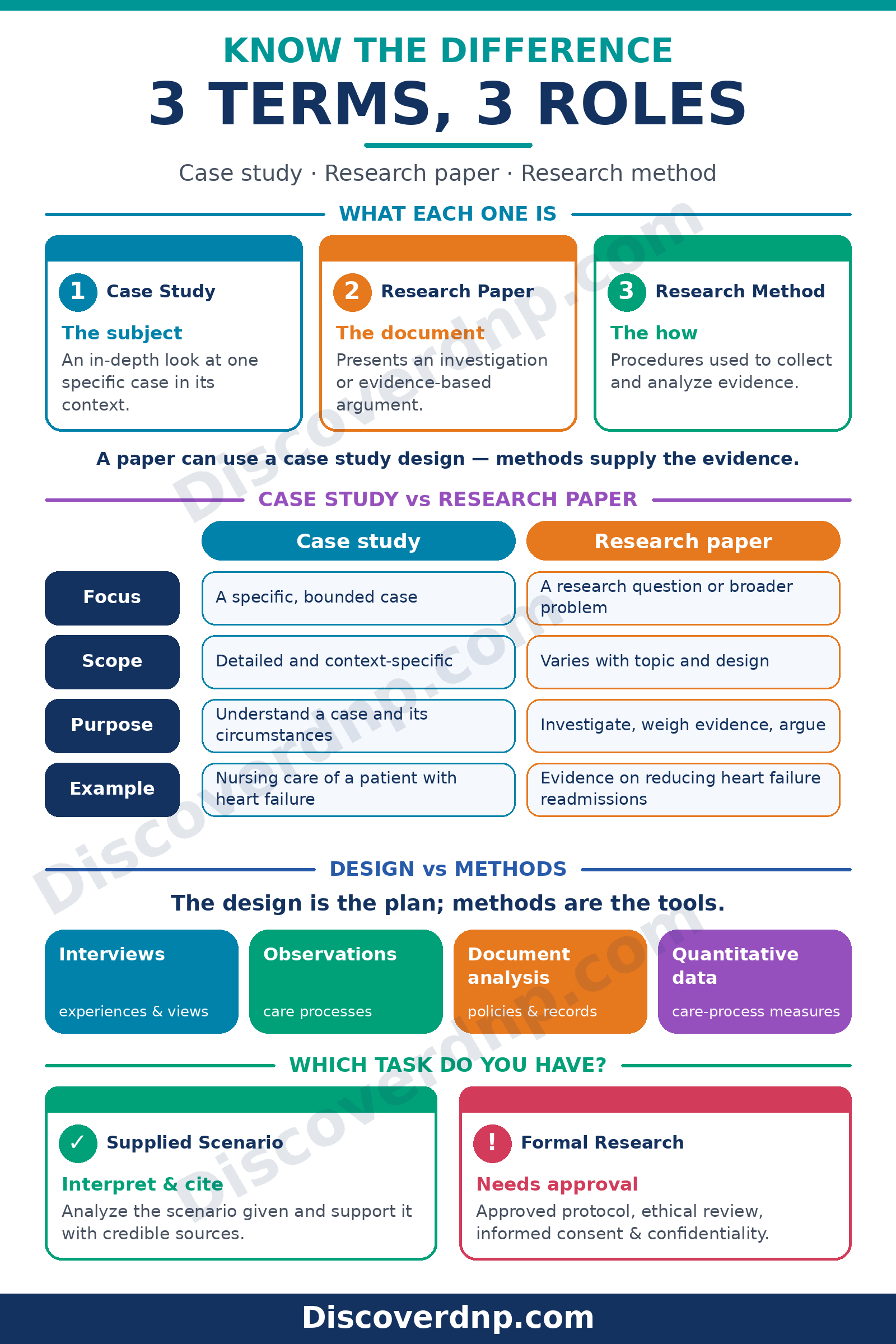
Conclusion
Learning how to write a case study for nursing students involves more than presenting a patient’s medical history and describing the care provided. A well-developed case study connects patient information, assessment findings, clinical reasoning, nursing interventions, and measurable outcomes to explain the significance of a clinical situation. A clear case study format helps organize these components, while relevant research strengthens the analysis and supports evidence-based conclusions.
Effective case study writing also requires careful interpretation of patient data, objective evaluation of nursing interventions, and recognition of the factors that influence clinical outcomes. Reviewing case study examples can provide useful guidance on structure and presentation, but each paper should reflect the specific case, assignment requirements, and available evidence. Protecting patient confidentiality, using credible sources, and distinguishing documented facts from assumptions are equally important for maintaining academic and professional integrity.
Ultimately, a strong nursing case study transforms clinical information into meaningful learning. By examining what happened, why particular interventions were appropriate, how the patient responded, and what could be improved, writers develop a deeper understanding of nursing practice and clinical decision-making. These skills support clearer academic writing while encouraging thoughtful, compassionate, and evidence-based care.
Frequently Asked Questions
1. How to write a nursing case study?
To write a nursing case study, select a relevant clinical case, identify the main patient problem, collect relevant history and assessment findings, describe nursing interventions, and analyze the patient’s outcomes. Support your discussion with credible research, explain the clinical significance of the findings, protect patient confidentiality, and follow the required academic format.
2. What is the format of a nursing case study?
A typical nursing case study format includes:
- Title and introduction
- Patient background and medical history
- Presenting problem and assessment findings
- Nursing diagnoses or identified care priorities
- Nursing interventions and their rationale
- Patient outcomes and evaluation
- Discussion and evidence-based analysis
- Conclusion
- References
The exact structure may vary depending on the assignment instructions.
3. What is an example of a case study in nursing?
An example is a case study of a patient with type 2 diabetes and a diabetic foot wound. The paper describes the patient’s medical history, wound assessment, blood glucose findings, and relevant risk factors. It then examines nursing interventions, such as wound monitoring, prescribed wound care, glucose monitoring, and patient education, before evaluating documented outcomes and identifying lessons for future care.
4. How to write a case study step by step?
Follow these steps:
- Choose a clinical case: Select a patient situation relevant to the assignment.
- Define the main problem: Establish the clinical issue the case study will examine.
- Collect relevant information: Gather patient history, assessment findings, diagnostic results, and documented care.
- Create an outline: Organize the information under appropriate headings.
- Describe nursing interventions: Explain the care provided and its clinical rationale.
- Analyze the findings: Interpret patient data and compare outcomes with expected goals.
- Use evidence-based sources: Support clinical explanations with credible research and guidelines.
- Write the conclusion: Summarize the key findings and lessons learned.
- Review the paper: Check accuracy, confidentiality, citations, grammar, and formatting.
