

Compare and Contrast Essay Topics for Nursing Students in 2026: Good Topics, Writing Prompts, and Interesting Ideas
Comparing and contrasting is an essential part of academic writing because it helps explain how two subjects relate, where they differ, and why those differences matter. A well-developed compare and contrast essay goes beyond describing separate characteristics; it examines meaningful connections, evaluates evidence, and develops a clear understanding of the subjects under discussion. In nursing and healthcare, this approach is particularly useful for examining clinical practices, patient care interventions, ethical principles, educational methods, and professional responsibilities. By analyzing these areas systematically, writers can strengthen their critical thinking skills and develop a more balanced understanding of complex healthcare issues.
Choosing an appropriate essay topic is an important first step in this process. A strong compare and contrast essay topic should be focused enough to allow detailed analysis while offering sufficient similarities and differences to support a meaningful discussion. For example, comparing online learning with the traditional classroom approach can reveal differences in flexibility, student interaction, accessibility, and practical skill development. Similarly, comparing two nursing interventions can help explain their indications, effectiveness, limitations, and suitability for different patient needs. These comparisons become more valuable when they are supported by credible evidence rather than personal assumptions or surface-level observations.
Developing effective compare and contrast essay ideas also requires an understanding of the purpose, scope, and structure of the assignment. Some topics are relatively straightforward and suitable for shorter essays, while others require extensive research, careful evaluation of scholarly sources, and a deeper understanding of clinical or ethical principles. The choice of topic should therefore reflect the assignment requirements, available evidence, expected level of analysis, and word count. A clearly defined topic makes it easier to formulate a strong thesis statement, organize the main ideas, and maintain a logical flow throughout the essay.
This guide explores Compare and Contrast Essay Topics for Nursing Students, including ideas related to nursing education, clinical practice, professional ethics, healthcare technology, and nursing specialties. It also examines how to select a suitable topic, adapt ideas to different academic levels, develop interesting writing prompts, and organize a comparison using the block method or point-by-point method. Understanding these principles provides a foundation for producing focused, well-supported essays that explain similarities and differences clearly while demonstrating sound analytical reasoning.
Top 50 Compare and Contrast Essay Topics for Nursing Students in 2026
Choosing a suitable topic is one of the most important steps in developing a successful compare and contrast essay. A strong topic provides two subjects that can be examined meaningfully, offers enough similarities and differences to support a detailed discussion, and allows the writer to develop an evidence-based argument. In nursing and healthcare, these comparisons can focus on education, clinical interventions, professional ethics, healthcare technology, and the responsibilities associated with different nursing specialties.
The best Compare and Contrast Essay Topics for Nursing Students encourage more than a simple description of two subjects. They create opportunities to evaluate evidence, explain practical implications, and demonstrate critical thinking skills. For example, comparing online learning with traditional classroom instruction can reveal how different educational environments influence flexibility, interaction, and clinical skills development. Similarly, comparing two approaches to pain management can help explain their benefits, limitations, and suitability for different patient needs.
When selecting from the following topic ideas, consider the assignment requirements, expected essay length, availability of credible sources, and level of analysis required. Each comparison should involve two subjects that share a meaningful connection, such as belonging to the same category or addressing a similar healthcare problem. This makes it easier to identify relevant comparison points and avoid a surface-level essay that merely lists characteristics.
The following list organizes 50 compare and contrast essay ideas into four areas relevant to nursing education and practice. The topics can be adapted into short assignments, extended academic essays, or more advanced analytical discussions, depending on the purpose of the assignment.
Nursing Education and Learning
Nursing education offers many opportunities for comparison because different teaching methods, learning environments, and assessment approaches influence how knowledge and practical skills are developed. These topics allow an essay to examine how learners acquire theoretical knowledge, prepare for clinical placements, practice procedures, and develop professional competence.
Research can provide a useful starting point. A 2024 systematic review and meta-analysis published in Nurse Education in Practice examined online teaching for practical nursing skills and reported improvements in several measured outcomes, including skills, knowledge, confidence, and satisfaction. However, the effectiveness of any teaching approach depends on the methods used and the outcomes assessed.
This makes nursing education a particularly useful area for evidence-based comparison rather than relying on assumptions about which method is best.
1. Online learning versus traditional classroom learning in nursing education. Compare flexibility, student–instructor interaction, access to learning resources, and opportunities for collaborative learning. Consider how online learning supports theoretical instruction while laboratory sessions and supervised placements provide opportunities for practical skill development.
2. Simulation-based learning versus clinical placement learning. Examine how simulated scenarios and real patient encounters contribute to clinical judgment, communication, procedural competence, and confidence. An essay could explore how simulation permits repeated practice in a controlled environment, whereas clinical placements expose learners to real patients, changing conditions, and actual healthcare team dynamics.
3. Lectures versus problem-based learning in nursing education. Compare instructor-led explanations with learning activities built around clinical problems. Consider how lectures communicate foundational knowledge efficiently while problem-based learning encourages independent research, collaboration, and application of concepts to patient scenarios.
4. Individual study versus group study for nursing examinations. Analyze differences in concentration, accountability, peer teaching, time management, and opportunities to identify knowledge gaps. A focused comparison might examine how individual revision supports personal learning needs while group discussions allow participants to explain difficult concepts and challenge one another’s reasoning.
5. Textbook learning versus digital learning resources in nursing. Compare textbooks with electronic resources such as interactive modules, online databases, video demonstrations, and digital flashcards. Relevant comparison points include accessibility, currency of information, depth of explanation, reliability, and the ability to review material at different speeds.
6. Formative assessment versus summative assessment in nursing programs. Examine how ongoing quizzes, feedback, and practice activities differ from final examinations and graded competency assessments. The essay could explore their respective roles in identifying learning gaps, measuring achievement, and determining readiness for progression.
7. Case-based learning versus traditional lecture-based teaching. Compare how clinical case studies encourage learners to apply knowledge to realistic situations while lectures provide structured explanations of theories, principles, and procedures. Consider their effectiveness in developing clinical reasoning and retaining foundational information.
8. Peer learning versus instructor-led learning in nursing education. Analyze differences in feedback, communication, knowledge sharing, supervision, and accountability. An important distinction is that peer learning can strengthen understanding through discussion, while instructors remain responsible for correcting misconceptions and providing authoritative guidance.
9. Blended learning versus fully online nursing education. Compare programs that combine online instruction with face-to-face teaching or laboratory sessions against those delivered entirely online. Consider accessibility, flexibility, opportunities for hands-on practice, technological requirements, and the suitability of each model for different learning outcomes.
10. Written examinations versus practical skills assessments in nursing. Explore how written tests measure theoretical understanding and how practical assessments evaluate procedural performance, communication, and the application of clinical knowledge. A strong essay would explain why competence in one area does not automatically demonstrate competence in the other.
11. Self-directed learning versus instructor-guided learning in nursing. Compare the independence required for identifying learning needs, selecting resources, and monitoring progress with the structured guidance provided by educators. Relevant factors include motivation, feedback, responsibility, and the ability to recognize misunderstandings.
12. Virtual simulation versus high-fidelity manikin simulation. Examine computer-based clinical scenarios alongside sophisticated manikins that reproduce selected physiological responses. Compare realism, feedback, accessibility, cost, technical requirements, and the kinds of clinical decisions each method can help learners practice.
13. Clinical skills laboratory practice versus supervised bedside practice. Compare opportunities to rehearse procedures in a controlled laboratory with opportunities to perform appropriate skills under supervision during patient care. Consider how laboratory practice supports repetition and error correction, while bedside practice introduces patient variability, consent, communication, and real-world clinical responsibilities.
Clinical Practice and Patient Care
Clinical practice and patient care provide some of the most relevant material for a comparison essay because nurses regularly evaluate interventions, care settings, assessment methods, and approaches to managing patient needs. A good topic should identify two approaches that address a related problem while allowing the writer to examine their indications, benefits, limitations, safety considerations, and outcomes.
Evidence-based comparison is particularly important in this area. Rather than assuming that one intervention is superior, the writer should consider the patient population, clinical circumstances, available evidence, and outcomes being measured. For example, a systematic review of telehealth compared with in-person care found that results varied across clinical areas and outcomes, illustrating why comparisons need clearly defined criteria.
14. Community nursing versus hospital-based nursing. Compare the environments, patient populations, responsibilities, and priorities associated with community and hospital care. Community nursing often emphasizes prevention, health education, and continuity of care, while hospital nursing commonly involves acute assessment, treatment, monitoring, and coordination during admission.
15. Preventive care versus curative care in nursing practice. Examine interventions intended to prevent illness or complications alongside interventions designed to treat existing health problems. Examples include vaccination education and screening compared with wound treatment or the management of an acute infection. Consider their goals, timing, resource requirements, and effects on population health.
16. Nonpharmacological pain management versus pharmacological pain management. Compare approaches such as relaxation, positioning, guided breathing, and selected physical therapies with prescribed analgesic medication. Discuss indications, potential benefits, limitations, contraindications, and the importance of individualized assessment. The essay should recognize that these approaches may complement rather than replace one another.
17. Routine vital-sign monitoring versus continuous patient monitoring. Compare periodic measurements of temperature, pulse, respiratory rate, blood pressure, and oxygen saturation with continuous monitoring systems. Explore differences in patient populations, early detection of deterioration, staff workload, alarm fatigue, and the need to interpret readings in clinical context.
18. Sterile technique versus clean technique in nursing procedures. Examine the purpose, principles, and appropriate applications of each approach. The essay should distinguish procedures requiring aseptic practices intended to prevent contamination of critical sites from activities that use clean practices to reduce the spread of microorganisms. Support the comparison with current infection-prevention guidance.
19. Oral medication administration versus intravenous medication administration. Compare absorption, onset of action, convenience, monitoring requirements, and potential complications. Oral medication may be appropriate when a patient can swallow and absorb the medicine, while intravenous administration may be required when rapid delivery or another specific clinical indication makes that route suitable.
20. Intermittent catheterization versus indwelling urinary catheterization. Analyze differences in indications, patient comfort, frequency of care, infection risks, and practical considerations. The comparison should consider the patient’s clinical condition and current guidelines rather than presenting either approach as universally preferable.
21. Enteral nutrition versus parenteral nutrition. Compare feeding through the gastrointestinal tract with the delivery of nutrients through intravenous access. Relevant points include indications, nutritional adequacy, complications, monitoring, and the condition of the digestive system. An evidence-based discussion should explain why the route depends on the patient’s needs and clinical assessment.
22. Manual blood pressure measurement versus automated blood pressure measurement. Examine equipment, technique, accuracy, repeatability, efficiency, and potential sources of error. The essay can discuss how patient positioning, cuff size, movement, device validation, and staff competency influence the reliability of readings.
23. Face-to-face patient education versus telehealth-based patient education. Compare in-person instruction with remote education delivered through telephone or video consultations. Consider accessibility, privacy, demonstration of practical skills, communication barriers, patient engagement, and follow-up. Evidence on telehealth suggests that suitability varies with the clinical problem and the information needed during an assessment.
24. Acute care nursing versus long-term care nursing. Compare the priorities, pace, goals, and continuity of care in acute treatment settings and long-term care facilities. Acute care may emphasize stabilization and recovery from sudden illness, whereas long-term care often focuses on ongoing support, functional ability, chronic conditions, and quality of life.
25. Individualized patient care versus standardized care protocols. Examine how care plans tailored to individual needs differ from protocols designed to promote consistency and reduce avoidable variation. A balanced essay should explain that standardized protocols can support safety, but their implementation must account for patient characteristics, clinical judgment, and relevant exceptions.
26. Hospital discharge planning versus admission assessment. Compare the information gathered when a patient enters a healthcare facility with the preparation required for a safe transition out of care. Admission assessment focuses on identifying needs and establishing a baseline, whereas discharge planning emphasizes ongoing treatment, medication understanding, follow-up, warning signs, and coordination with caregivers or community services.
27. Early mobilization versus prolonged bed rest after illness or surgery. Examine how appropriate movement may support functional recovery and reduce certain complications compared with extended immobility. Consider clinical stability, procedure-specific restrictions, fall risk, pain, and individualized rehabilitation plans. Avoid treating early mobilization as suitable for every patient regardless of condition.
28. Patient-controlled analgesia versus nurse-administered analgesia. Compare the two methods of delivering prescribed pain relief in terms of patient participation, dosing safeguards, monitoring, access to medication, and suitability for different circumstances. The discussion should distinguish patient control within a prescribed system from independent authority to change a medication regimen.
Nursing Ethics and Professional Responsibilities
Nursing ethics offers meaningful compare and contrast essay ideas because professional practice involves balancing patient rights, safety, confidentiality, fairness, and accountability. These topics are especially useful for exploring situations in which two important principles appear to conflict or where different professional responsibilities influence a decision.
The American Nurses Association’s revised 2025 Code of Ethics for Nurses provides a relevant foundation for exploring these issues, including nurses’ responsibilities toward patients, colleagues, themselves, the profession, and society.
Writers should also consult applicable national nursing codes, local laws, institutional policies, and professional standards, since ethical and legal requirements may vary across jurisdictions.
29. Patient autonomy versus beneficence in nursing decisions. Compare respect for a patient’s informed choices with the responsibility to promote the patient’s welfare. For example, an adult with decision-making capacity may refuse a recommended intervention even when the care team believes it would be beneficial. The essay can examine informed consent, communication, respect, and ethical decision-making.
30. Confidentiality versus the duty to disclose information for patient safety. Examine the obligation to protect private patient information alongside circumstances in which disclosure may be legally required or necessary to address a serious safety concern. Consider consent, authorized recipients, minimum necessary disclosure, applicable law, and institutional policy.
31. Equality versus equity in nursing care. Compare providing the same resources or services to everyone with allocating support according to differing needs and barriers. For example, patients with language barriers, disabilities, or limited access to transportation may require additional assistance to obtain a comparable opportunity for safe care.
32. Advocacy versus professional boundaries in nurse–patient relationships. Analyze how nurses can defend patient rights and communicate concerns while maintaining appropriate professional limits. An essay could examine supportive communication, conflicts of interest, dependency, and the importance of following professional standards.
33. Mandatory reporting versus patient confidentiality. Compare privacy obligations with reporting duties that may apply to suspected abuse, certain communicable diseases, or other legally specified circumstances. The discussion should distinguish jurisdiction-specific legal requirements from situations in which disclosure is discretionary and should not imply that every concern automatically permits unrestricted disclosure.
34. Individual responsibility versus team accountability in patient safety. Examine a nurse’s personal duty to follow safe procedures and report errors alongside the healthcare organization’s responsibility for staffing, training, communication systems, and quality improvement. A useful comparison explores how individual actions and organizational conditions can interact to influence patient outcomes.
35. Ethical decision-making versus legal compliance in nursing practice. Compare decisions guided by moral principles and professional values with actions required or prohibited by law. These frameworks often overlap, but a legally permissible action may still raise ethical concerns, and ethical reasoning must not be used to disregard applicable legal duties.
36. Patient-centered care versus task-oriented nursing care. Examine approaches that prioritize individual preferences, values, communication, and shared decisions against approaches organized primarily around completing clinical tasks. Consider how workload and time constraints affect care, while recognizing that essential clinical tasks remain necessary for safety.
37. Informed consent versus implied consent in healthcare. Compare explicit permission given after an appropriate explanation with consent inferred from a person’s conduct in circumstances where implied consent is recognized. Discuss patient understanding, decision-making capacity, urgency, and the limits of implied consent, particularly for invasive procedures or situations requiring formal authorization.
38. Whistleblowing versus internal reporting of unsafe practice. Compare raising serious concerns through external or protected disclosure channels with reporting concerns through established organizational systems. Explore patient safety, confidentiality, documentation, retaliation risks, and legal protections, noting that internal reporting may not be sufficient in every situation.
39. Cultural competence versus cultural humility in nursing. Compare developing knowledge and skills for working across cultural contexts with an ongoing process of self-reflection, openness, and recognition of personal assumptions. The essay can examine how both approaches support respectful communication and individualized care without stereotyping patients.
40. Delegation versus direct nursing care. Compare assigning appropriate tasks to qualified team members with personally carrying out nursing activities. Discuss scope of practice, staff competency, supervision, patient acuity, and accountability. Delegation does not remove the nurse’s responsibility to follow applicable professional standards or evaluate the safety of the arrangement.
Healthcare Technology and Nursing Specialties
Healthcare technology and nursing specialties provide opportunities to examine how different tools, clinical roles, and care models address patient needs. Technology-focused topics can explore the effects of digital systems on communication, documentation, monitoring, and access to services. Specialty-focused topics can examine differences in patient populations, clinical priorities, working environments, and required competencies.
The World Health Organization identifies digital health as an important area for improving health and well-being, while also emphasizing the need for appropriate implementation and effective health information systems.
These topics therefore work best when the comparison considers not only the advantages of innovation but also limitations such as privacy, access, reliability, and the continued need for clinical judgment.
41. Electronic health records versus paper-based patient records. Compare digital documentation with traditional paper records in terms of accessibility, legibility, information sharing, storage, workflow, and security. A strong essay should consider implementation costs, downtime, confidentiality, and the risk of documentation errors rather than assuming that either system is error-free.
42. Telehealth nursing versus in-person nursing care. Examine how remote consultations differ from direct encounters in assessment, communication, accessibility, continuity, and the ability to conduct physical examinations. Consider which patient needs can be managed remotely and which require in-person assessment. Research suggests that outcomes vary by clinical area, so the essay should avoid treating the two approaches as interchangeable in every situation.
43. Artificial intelligence tools versus traditional clinical decision support. Compare AI-enabled systems that identify patterns or generate predictions with conventional tools such as evidence-based checklists, scoring systems, and predefined clinical alerts. Explore transparency, data quality, bias, accountability, workflow, and the nurse’s responsibility to verify relevant information rather than relying blindly on automated recommendations.
44. Wearable health monitors versus routine clinical observations. Compare devices that track selected measurements over time with observations taken by healthcare professionals during patient encounters. Discuss continuous data collection, convenience, accuracy, false alerts, interpretation, and the limitations of consumer devices. The essay should explain why wearable readings may complement, but do not automatically replace, clinical assessment.
45. Pediatric nursing versus geriatric nursing. Compare care for children with care for older adults, considering developmental needs, communication, family involvement, medication safety, functional status, and common health concerns. An effective essay should recognize that each population is diverse and avoid assuming that all children or older adults have identical needs.
46. Emergency nursing versus critical care nursing. Examine differences in the initial assessment and stabilization of patients with urgent conditions compared with the continuous management of patients who are critically ill. Compare priorities, pace, monitoring, teamwork, and clinical decision-making while recognizing that the roles can overlap in emergency and intensive care environments.
47. Medical-surgical nursing versus perioperative nursing. Compare the ongoing assessment and management of patients with medical or surgical conditions against nursing responsibilities before, during, and immediately after surgery. Consider continuity of care, procedural safety, patient preparation, monitoring, recovery, and coordination across different stages of treatment.
48. Mental health nursing versus general medical nursing. Examine differences in assessment, therapeutic communication, care planning, safety considerations, and the management of physical and psychological needs. The comparison should also recognize the close relationship between mental and physical health and the importance of avoiding stigma.
49. Public health nursing versus occupational health nursing. Compare nursing work focused on population health, disease prevention, and community education with nursing practice concerned with employee health, workplace hazards, and occupational safety. Relevant comparison points include the populations served, prevention strategies, collaboration, and the settings in which care is delivered.
50. Nurse practitioner roles versus registered nurse roles. Compare education, scope of practice, clinical responsibilities, and decision-making authority. Explain that nurse practitioners are advanced practice registered nurses in jurisdictions that recognize the role, while registered nurses provide a broad range of assessment, care coordination, patient education, and clinical care. Prescriptive authority and other responsibilities vary according to local laws and regulations.
These 50 topics provide a starting point for a focused comparison essay, but the final choice should match the assignment’s requirements and the evidence available. The strongest topics identify two related subjects, establish clear comparison points, and allow the writer to explain why the similarities and differences matter. For more advanced academic writing, select a topic that supports evaluation of research, clinical implications, ethical considerations, or the effectiveness of different approaches rather than simply describing each subject separately.
How to Choose a Good Compare and Contrast Essay Topic
Choosing a good compare and contrast essay topic requires more than finding two subjects that appear different. The subjects should have a meaningful relationship, offer enough similarities and differences to support an analytical discussion, and allow the writer to develop a clear central argument. A suitable topic also needs to fit the assignment requirements, the intended audience, and the amount of research and writing expected.
When exploring Compare and Contrast Essay Topics for Nursing Students, it helps to consider subjects connected to nursing education, clinical practice, patient safety, professional ethics, and healthcare technology. These areas offer opportunities to examine how different approaches work, why their outcomes may vary, and which factors influence their suitability in particular circumstances. For example, comparing electronic health records with paper-based documentation can lead to an analysis of accessibility, accuracy, confidentiality, workflow, and information sharing. Merely listing the advantages and disadvantages of each system, however, would not provide the same analytical depth.
A good topic should also support a balanced comparison. If one subject has extensive research available but the other has little credible evidence, it may be difficult to develop a well-supported essay. Likewise, subjects that have almost nothing in common may produce a disorganized discussion because there are few meaningful points of comparison. The aim is to identify two subjects that share enough characteristics to make comparison useful while retaining clear differences worth exploring.
Three principles can guide the selection process:
- Relevance: The topic should relate directly to the assignment, course objectives, or a meaningful academic or healthcare issue.
- Manageable scope: The topic should be narrow enough to explore in the available word count without sacrificing important details.
- Evidence availability: Credible scholarly sources should provide enough information to explain the similarities and differences between the subjects.
These principles help distinguish good compare and contrast topics from ideas that are either too broad, too simple, or difficult to research. They also provide a practical foundation for turning an initial idea into a focused essay topic that supports clear reasoning and effective academic writing.
Evaluating Relevance, Scope, and Available Evidence
The first step in choosing a good compare and contrast essay topic is determining whether the proposed subjects are relevant, manageable, and supported by sufficient evidence. A topic may sound interesting, but that alone does not make it suitable for academic writing. The subjects must allow a meaningful comparison, connect to the assignment’s objectives, and provide enough material for a well-developed discussion. Texas A&M University’s University Writing Center recommends considering assignment requirements, audience, personal interest, and the availability of scholarly research when selecting a topic.
Relevance to the assignment and audience
A relevant essay topic connects directly to the subject being studied, the purpose of the assignment, and the knowledge the writer is expected to demonstrate. In nursing education, relevant topics often concern clinical practice, patient safety, healthcare delivery, professional ethics, nursing education, and evidence-based practice. The best choice depends on the course and the specific learning objectives.
For example, an assignment focused on nursing interventions may be better served by comparing pharmacological and nonpharmacological pain management than by comparing online learning with traditional classroom instruction. Although both are valid compare and contrast essay ideas, the first is more closely related to clinical care and intervention selection.
When evaluating relevance, consider the following factors:
- Connection to course objectives: Does the topic relate to the concepts, theories, or professional competencies addressed in the assignment?
- Academic value: Will comparing the subjects help explain an important issue, clarify a clinical concept, or evaluate different approaches to a problem?
- Audience needs: Will the discussion provide information that readers can understand and use within the context of the assignment?
- Scope of analysis: Does the topic allow the writer to examine meaningful similarities and differences instead of simply describing two subjects?
For instance, comparing registered nurses and nurse practitioners can support an informative discussion of education, scope of practice, clinical responsibilities, and professional autonomy. However, the comparison should account for differences in jurisdiction because educational requirements and authorized responsibilities vary across healthcare systems.
Determining whether the topic is manageable
The scope of a topic refers to how much information must be covered to explain the comparison adequately. A topic that is too broad can lead to an essay filled with general statements, while one that is too narrow may not provide enough material for meaningful analysis.
Consider the difference between these two topics:
- Broad: Traditional medicine versus modern medicine.
- More focused: Nurse-led patient education versus physician-led patient education for adults with type 2 diabetes.
The broader topic encompasses many healthcare systems, treatments, historical developments, and cultural practices. Covering all these areas in one essay would be difficult. The narrower topic identifies a specific activity, population, and comparison, making it easier to examine communication, patient engagement, continuity of education, and relevant health outcomes.
A useful way to evaluate scope is to consider the expected assignment length. A short essay may require only two or three comparison points, whereas a longer academic paper may support a more detailed examination of clinical effectiveness, cost, safety, patient preferences, and implementation challenges.
Before settling on a topic, ask whether you can explain the main similarities and differences within the available word count. If the topic requires numerous unrelated subtopics, it may need to be narrowed. If the comparison produces only one obvious difference, it may need to be broadened slightly or replaced with a more analytically useful alternative.
Assessing the availability and quality of evidence
A strong comparison essay depends on reliable information about both subjects. Personal experience and general knowledge can help generate topic ideas, but academic arguments should be supported by credible sources. This is especially important when writing about clinical interventions, patient safety, medication administration, or healthcare technologies, where unsupported generalizations can lead to inaccurate conclusions.
Useful research resources include:
- CINAHL: A nursing and allied health database that provides access to relevant research articles and professional literature.
- PubMed: A free biomedical literature database useful for finding studies on clinical interventions, patient outcomes, and healthcare practices.
- Cochrane Library: A resource for systematic reviews and other evidence relevant to healthcare decisions.
- Professional guidelines: Publications from recognized nursing organizations, public health agencies, and clinical authorities that explain current standards and recommendations.
- Peer-reviewed nursing journals: Sources that can provide original research, systematic reviews, and evidence about clinical practice and nursing education.
University nursing research guides recommend selecting databases according to the subject and using appropriate search strategies to identify relevant evidence.
For example, someone considering the topic telehealth nursing versus in-person nursing care could search for research on patient satisfaction, access to services, continuity of care, clinical outcomes, and limitations of remote assessment. Reviewing the available literature before finalizing the topic helps determine whether the comparison has sufficient evidence and whether the research supports a balanced discussion.
The evidence should also be reasonably comparable. If one approach has been studied extensively in a particular patient population while the other has little relevant research, the writer may struggle to draw meaningful conclusions. Differences in study populations, research methods, settings, and outcome measures should be considered before claiming that one approach is more effective.
It is not necessary to prove that one subject is better than the other. A successful comparison may instead show that each approach has advantages under different circumstances. For instance, telehealth may improve access for patients who face transportation barriers, while in-person care may be necessary when a physical examination or an urgent assessment is required.
Using comparison points to test the topic
Before committing to an essay topic, identify several criteria through which the two subjects can be evaluated. These criteria provide the foundation for the body paragraphs and help determine whether the comparison has sufficient depth.
For example, when comparing electronic health records with paper-based patient records, possible comparison points include:
- Accessibility and retrieval of patient information.
- Accuracy, legibility, and completeness of documentation.
- Confidentiality and information security.
- Communication and coordination among healthcare professionals.
- Implementation costs, training, and workflow requirements.
If these points lead to substantive discussion supported by credible sources, the topic is likely suitable for an extended essay. If the comparison produces only superficial observations, consider refining the subjects or choosing a more specific question.
Narrowing Broad Ideas Into Focused Writing Prompts
Many strong compare and contrast essay topics begin as broad interests rather than fully developed ideas. A writer may want to explore patient safety, nursing education, healthcare technology, or professional ethics but may not yet know which two subjects to compare or what the essay should demonstrate. Narrowing the topic transforms that general interest into a focused writing prompt with a clear direction for research and analysis.
The goal is not simply to shorten the wording. It is to identify two related subjects, establish meaningful comparison points, and define the aspect of the relationship that deserves closer examination. University writing resources similarly emphasize narrowing broad subjects to avoid vague generalizations and selecting comparisons that reveal significant similarities or differences.
Start with a broad area of interest
Begin by identifying a general subject connected to the assignment. This could be a nursing specialty, a clinical procedure, an educational method, an ethical principle, or a healthcare delivery model.
For example, nursing education is a broad area that could lead to several compare and contrast essay ideas:
- Online learning versus traditional classroom learning.
- Simulation-based learning versus clinical placement learning.
- Individual study versus group study.
- Written examinations versus practical skills assessments.
Each option examines a different aspect of nursing education. Selecting one allows the essay to develop a coherent argument instead of attempting to cover every dimension of the subject.
Choose two subjects that share a meaningful connection
The next step is to choose two subjects that can be compared using relevant criteria. They do not need to be identical, but they should have enough in common for the comparison to be useful.
For example, comparing community nursing with hospital-based nursing is meaningful because both involve nursing care, assessment, patient education, and coordination. However, their environments, patient populations, and priorities may differ considerably.
By contrast, comparing an unrelated nursing procedure with a general entertainment activity may offer little academic value unless there is a clear and defensible reason for bringing the subjects together.
A useful principle is to select subjects from the same category or subjects that address a shared problem. This creates a logical basis for examining their similarities and differences.
Define the specific focus of the comparison
Even when two subjects are related, the topic can remain too broad until the writer decides which aspects to investigate. A comparison of online and classroom learning, for example, could examine accessibility, student engagement, learning outcomes, practical skills, cost, or assessment methods.
Trying to cover all these dimensions in a short essay may result in a shallow discussion. Selecting two or three central comparison points allows more space for evidence, examples, and explanation.
The following progression illustrates how a broad idea can be refined:
| Stage | Example |
|---|---|
| Broad area | Healthcare technology |
| General comparison | Electronic health records versus paper records |
| Focused topic | Electronic health records versus paper records in nursing documentation |
| Analytical writing prompt | Compare electronic and paper-based nursing documentation in terms of accessibility, accuracy, confidentiality, and communication. |
The focused prompt tells the writer what to investigate without dictating the conclusion. It also establishes a practical direction for research and essay organization.
Turn the topic into an analytical writing prompt
A topic identifies the subjects being compared, while a writing prompt clarifies what the writer should examine or explain. Strong prompts encourage analysis rather than a simple list of characteristics.
For instance, pharmacological versus nonpharmacological pain management identifies two approaches but leaves the scope open. A more focused prompt could be:
Compare pharmacological and nonpharmacological approaches to pain management by examining their applications, benefits, limitations, and roles in individualized patient care.
This prompt establishes clear comparison points and encourages the writer to consider how the approaches may complement one another. It also avoids assuming that one option is universally superior.
Other examples of focused writing prompts include:
- Nursing education: Compare online learning and traditional classroom instruction in terms of flexibility, interaction, and opportunities for practical skills development.
- Patient safety: Examine how routine vital-sign monitoring differs from continuous monitoring in detecting changes in a patient’s condition.
- Professional ethics: Compare patient autonomy and beneficence, explaining how nurses can respect patient choices while promoting well-being.
- Healthcare technology: Evaluate electronic health records and paper-based records in relation to documentation quality, information access, and confidentiality.
These prompts provide a clear analytical direction while leaving room for evidence-based conclusions.
Use a framework to organize clinical comparisons
For topics involving clinical care, a structured framework can help identify the most important concepts before research begins. One useful approach is PICO, which stands for Patient or Population, Intervention, Comparison, and Outcome. It is commonly used to frame focused clinical questions and organize searches for relevant evidence.
For example, a writer exploring two approaches to preventing falls among hospitalized older adults could identify:
- Population: Older adults admitted to hospital.
- Intervention: A defined fall-prevention approach.
- Comparison: An alternative intervention or usual care.
- Outcome: Fall incidence or another clearly specified patient-safety measure.
PICO is not required for every compare and contrast essay, particularly those focused on literature, general education, or ethical principles. However, it can be helpful when a topic involves clinical interventions and measurable outcomes.
Check the final topic before beginning the essay
Once the topic has been narrowed, review it against the assignment requirements and research availability. Confirm that the two subjects are clearly identified, the comparison has a meaningful purpose, and enough credible evidence exists to support the intended discussion.
A final checklist can help:
- The topic directly relates to the assignment.
- The two subjects have a meaningful connection.
- The comparison can be completed within the required word count.
- Several clear comparison points can be identified.
- Credible and relevant evidence is available for both subjects.
- The prompt encourages analysis rather than a surface-level description.
- The topic allows a clear thesis statement and logical essay structure.
A carefully narrowed topic makes the subsequent stages of essay writing more manageable. It helps the writer identify relevant sources, develop a focused thesis statement, organize the main ideas, and explain why the similarities and differences matter. The most suitable choice is not necessarily the most complicated or unusual topic; it is the one that supports a clear, relevant, and well-evidenced comparison.
Compare and Contrast Essay Topics for Different Academic Levels
The most appropriate compare and contrast essay topic depends on the writer’s academic level, familiarity with the subject, research skills, and the requirements of the assignment. A topic that works well for a beginner may be too simple for a university-level paper, while an advanced clinical comparison may require knowledge of nursing theory, research methods, and professional guidelines that a younger learner has not yet acquired.
For this reason, choosing among Compare and Contrast Essay Topics for Nursing Students involves considering both the complexity of the subjects and the depth of analysis expected. Beginners can develop foundational skills by comparing familiar experiences, learning methods, and everyday healthcare concepts. High school writers exploring healthcare can progress to basic medical science, health promotion, and professional roles. College and university writers can investigate more complex clinical interventions, ethical dilemmas, healthcare technologies, and evidence-based practice.
Across all three levels, a strong comparison should do more than identify obvious similarities and differences. It should establish meaningful comparison points, support important claims with evidence where appropriate, and explain why the findings matter. The following five major areas provide a practical way to organize topic ideas at each academic level.
Easy Topics for Beginners and Middle School Students
At beginner and middle school levels, compare and contrast essay writing should focus on familiar subjects, simple concepts, and clearly identifiable similarities and differences. These topics help writers learn how to organize ideas, use comparison words, develop main ideas, and explain observations in complete paragraphs.
An effective beginner-level essay does not need complicated terminology or extensive research. It should have two subjects that are easy to understand and enough comparison points to support a clear discussion. For example, comparing reading a printed book with reading an electronic book allows a writer to examine convenience, accessibility, reading habits, and personal preferences.
The following five areas offer 50 easy compare and contrast essay ideas suitable for beginners and middle school students.
Area 1: School and Learning
- Reading printed books versus reading electronic books.
- Studying alone versus studying with friends.
- Online learning versus classroom learning.
- Homework assignments versus classroom exercises.
- Group projects versus individual projects.
- Taking handwritten notes versus typing notes.
- Reading silently versus reading aloud.
- School libraries versus public libraries.
- Morning classes versus afternoon classes.
- Learning through videos versus learning through textbooks.
Area 2: Daily Life and Personal Experiences
- Living in a city versus living in the countryside.
- Walking to school versus traveling by bus.
- Cooking at home versus eating at a restaurant.
- Shopping online versus shopping in physical stores.
- Spending free time indoors versus outdoors.
- Weekdays versus weekends.
- Celebrating birthdays at home versus celebrating them outdoors.
- Watching movies at home versus watching them at a cinema.
- Playing board games versus playing video games.
- Traveling by train versus traveling by bus.
Area 3: Health and Healthy Habits
- Eating homemade meals versus eating fast food.
- Drinking water versus drinking sugary beverages.
- Walking versus cycling for exercise.
- Playing team sports versus exercising individually.
- Getting enough sleep versus staying up late.
- Brushing teeth manually versus using an electric toothbrush.
- Washing hands with soap and water versus using hand sanitizer when appropriate.
- Eating fresh fruit versus drinking fruit juice.
- Indoor exercise versus outdoor exercise.
- Preventive health checkups versus seeking care only when symptoms appear.
Area 4: Technology and Communication
- Smartphones versus desktop computers.
- Text messaging versus voice calls.
- Social media communication versus face-to-face communication.
- Digital photographs versus printed photographs.
- Watching television versus watching online videos.
- Using a calculator versus solving calculations manually.
- Digital calendars versus paper planners.
- Printed newspapers versus online news.
- Listening to music through headphones versus using speakers.
- Online shopping applications versus traditional shopping methods.
Area 5: Nature, Environment, and Community
- Living in a house versus living in an apartment.
- Cats versus dogs as household pets.
- Planting flowers versus growing vegetables.
- Rural communities versus urban communities.
- Public parks versus private gardens.
- Walking versus driving for short journeys.
- Reusable shopping bags versus disposable plastic bags.
- Solar energy versus electricity generated from fossil fuels.
- Recycling paper versus recycling plastic.
- Visiting a zoo versus observing animals in their natural habitats.
When developing these topics, beginners should choose two or three comparison points rather than attempting to cover every possible difference. For instance, an essay on online learning versus classroom learning might compare flexibility, interaction, and access to learning materials. Each point can become a body paragraph containing an explanation and a relevant example.
Topics for High School Students Exploring Healthcare
High school writers exploring healthcare can work with more specialized topics that introduce medical science, health promotion, nursing responsibilities, and healthcare delivery. These compare and contrast essay ideas require more explanation than beginner topics, but they can still be developed using accessible sources and straightforward analytical reasoning.
At this level, the aim is to move beyond personal preference and begin examining causes, functions, applications, benefits, and limitations. For example, comparing viruses and bacteria introduces differences in biological structure, reproduction, and treatment. Similarly, comparing prevention and treatment encourages discussion of how healthcare professionals address health risks and existing illness.
The following five areas provide 50 topics for high school students interested in healthcare and nursing.
Area 1: Basic Medical Science and Human Biology
- Viruses versus bacteria: structure, reproduction, and treatment.
- Arteries versus veins: structure and function in circulation.
- The respiratory system versus the circulatory system.
- Innate immunity versus adaptive immunity.
- Type 1 diabetes versus type 2 diabetes.
- Communicable diseases versus noncommunicable diseases.
- Signs versus symptoms in clinical assessment.
- Acute illness versus chronic illness.
- Red blood cells versus white blood cells.
- Aerobic exercise versus anaerobic exercise and their effects on the body.
Area 2: Health Promotion and Disease Prevention
- Primary prevention versus secondary prevention.
- Vaccination versus disease treatment after infection.
- Balanced nutrition versus restrictive dieting for general health.
- Physical activity versus sedentary behavior.
- Sleep hygiene versus irregular sleep habits.
- Individual health education versus community health education.
- Routine health screening versus symptom-based assessment.
- Hand hygiene versus the use of personal protective equipment.
- Health promotion in schools versus health promotion in community settings.
- Smoking prevention programs versus smoking cessation programs.
Area 3: Nursing Roles and Healthcare Environments
- Registered nurses versus licensed practical or vocational nurses.
- Community nurses versus hospital nurses.
- Pediatric nursing versus geriatric nursing.
- Emergency nursing versus critical care nursing.
- School nursing versus occupational health nursing.
- Public health nursing versus home health nursing.
- Medical-surgical nursing versus perioperative nursing.
- Nurse practitioners versus registered nurses.
- Inpatient care versus outpatient care.
- Primary healthcare versus specialized healthcare.
Area 4: Patient Care and Clinical Procedures
- Oral medication administration versus intravenous medication administration.
- Sterile technique versus clean technique.
- Manual blood pressure measurement versus automated measurement.
- Nasal oxygen delivery versus oxygen delivery through a face mask.
- Enteral nutrition versus parenteral nutrition.
- Intermittent catheterization versus indwelling urinary catheterization.
- Hot applications versus cold applications in appropriate clinical situations.
- Pharmacological pain management versus nonpharmacological pain management.
- Routine vital-sign monitoring versus continuous monitoring.
- Physical assessment versus diagnostic laboratory testing.
Area 5: Healthcare Ethics, Technology, and Communication
- Patient confidentiality versus legally required disclosure.
- Patient autonomy versus beneficence in healthcare decisions.
- Electronic health records versus paper-based records.
- Telehealth consultations versus in-person consultations.
- Verbal handoffs versus written handoffs in healthcare communication.
- Artificial intelligence-assisted healthcare versus clinician-led assessment.
- Empathy versus sympathy in professional communication.
- Individual patient care versus standardized care protocols.
- Informed consent versus implied consent.
- Cultural competence versus cultural humility in healthcare.
For these topics, writers should distinguish general educational information from clinical recommendations. A high school essay comparing medical interventions, for example, should explain their purposes and limitations using reliable sources rather than making treatment recommendations for individual patients.
Contrast Essay Topics for College and University Students
College and university assignments generally require more developed arguments, careful source evaluation, and a stronger understanding of how evidence supports conclusions. A successful comparison essay at this level should identify meaningful similarities and differences, evaluate their implications, and acknowledge limitations or contextual factors that affect the comparison.
For nursing-related assignments, this may involve examining clinical outcomes, healthcare policies, professional responsibilities, research findings, or the effectiveness of different interventions. The writer should avoid assuming that one approach is superior merely because it has certain advantages. Instead, the analysis should explain which outcomes matter, what the available evidence shows, and under which circumstances each approach may be appropriate.
The following five areas provide 50 more advanced contrast essay topics for college and university writers.
Area 1: Nursing Education, Research, and Professional Development
- Competency-based nursing education versus traditional time-based education.
- Simulation-based clinical education versus supervised clinical placement.
- Problem-based learning versus lecture-based nursing instruction.
- Formative assessment versus summative assessment in nursing education.
- Evidence-based practice education versus experience-based clinical learning.
- Quantitative nursing research versus qualitative nursing research.
- Randomized controlled trials versus observational studies in clinical research.
- Systematic reviews versus individual clinical studies.
- Continuing professional development versus formal postgraduate nursing education.
- Mentorship-based clinical development versus self-directed professional development.
Area 2: Clinical Interventions, Patient Safety, and Outcomes
- Nurse-led care versus physician-led care for selected chronic conditions.
- Early mobilization versus prolonged bed rest in appropriate postoperative populations.
- Multimodal analgesia versus single-modality pain management.
- Protocol-driven sepsis screening versus clinician-initiated recognition of deterioration.
- Intermittent vital-sign monitoring versus continuous monitoring in selected hospital patients.
- Central venous access versus peripheral intravenous access for appropriate treatment indications.
- Noninvasive ventilation versus invasive mechanical ventilation in clinically appropriate circumstances.
- Nurse-led discharge education versus usual discharge education for selected patient populations.
- Individualized fall-prevention interventions versus standardized fall-prevention protocols.
- In-person rehabilitation versus tele-rehabilitation for selected clinical conditions.
Area 3: Nursing Ethics, Law, and Professional Accountability
- Patient autonomy versus beneficence in ethically complex clinical decisions.
- Confidentiality obligations versus mandatory reporting requirements.
- Individual professional accountability versus organizational accountability for patient safety.
- Ethical decision-making frameworks versus rule-based approaches to professional dilemmas.
- Distributive justice versus utilitarian approaches to healthcare resource allocation.
- Patient advocacy versus professional boundary obligations.
- Shared decision-making versus clinician-directed decision-making.
- Informed consent versus emergency treatment under legally recognized exceptions.
- Whistleblowing versus internal reporting of unsafe clinical practice.
- Standardized triage criteria versus individualized ethical considerations during resource scarcity.
Area 4: Healthcare Technology, Policy, and Service Delivery
- Electronic health records versus interoperable health information systems.
- Artificial intelligence-based clinical decision support versus conventional rule-based decision support.
- Remote patient monitoring versus episodic in-person assessment for selected chronic conditions.
- Hospital-at-home services versus conventional inpatient care for eligible patients.
- Value-based healthcare reimbursement versus fee-for-service reimbursement.
- Centralized healthcare delivery versus decentralized community-based services.
- Task-shifting models versus traditional professional role allocation in healthcare.
- Digital health education versus face-to-face health education for underserved populations.
- Predictive analytics versus traditional risk-scoring methods in clinical care.
- Standardized electronic documentation versus narrative clinical documentation.
Area 5: Nursing Specialties, Leadership, and Healthcare Systems
- Transformational nursing leadership versus transactional nursing leadership.
- Shared governance versus centralized decision-making in nursing organizations.
- Acute care nursing versus long-term care nursing in managing complex patient needs.
- Public health nursing versus hospital-based preventive services.
- Advanced practice nursing versus traditional registered nursing roles within defined scopes of practice.
- Primary nursing versus team nursing models of care delivery.
- Case management nursing versus direct bedside nursing in care coordination.
- Integrated care models versus fragmented healthcare delivery.
- Interprofessional collaboration versus profession-specific care planning.
- Nurse-led quality improvement versus externally directed quality improvement initiatives.
For advanced topics, the writer should define the population, setting, intervention or professional model, and outcomes being compared. For example, early mobilization versus prolonged bed rest is more analytically useful when limited to a clearly defined postoperative population and supported by evidence on outcomes such as mobility, complications, and recovery. Without these boundaries, the essay may make claims that cannot be supported across all patients or clinical circumstances.
Across all academic levels, the same core principle applies: select subjects that share a meaningful connection, establish clear comparison points, and develop an argument that explains why their similarities and differences matter. Beginners can focus on familiar characteristics, high school writers can introduce healthcare concepts, and university writers can evaluate research and professional implications. This progression helps make compare and contrast essay writing more purposeful, evidence-based, and appropriate to the assignment.
Funny and Interesting Compare and Contrast Essay Ideas
Humorous Topics Based on Everyday Student Experiences
- Studying Alone vs. Studying in a Group
- Early Preparation vs. Last-Minute Studying
- Handwritten Notes vs. Digital Notes
- Attending Lectures in Person vs. Watching Recorded Lectures
- A Carefully Organized Study Desk vs. a Cluttered Study Desk
- Paper Planners vs. Digital Calendars
- Group Project Leaders vs. Group Project Procrastinators
- Coffee-Fueled Studying vs. Studying With Regular Breaks
- The Student Who Asks Questions vs. the Student Who Searches Online First
- Studying in Silence vs. Studying With Music
- Morning People vs. Night Owls During Examination Week
- Reading Assignment Instructions vs. Guessing What the Instructor Wants
- Carrying Every Textbook vs. Using Digital Study Resources
- The Perfect Study Schedule vs. the Real Study Schedule
- Submitting an Assignment Early vs. Submitting It at the Last Minute
Creative Topics That Encourage Critical Thinking
- Artificial Intelligence Tools vs. Traditional Research Methods
- Online Learning vs. Face-to-Face Learning
- Preventive Healthcare vs. Curative Healthcare
- Hospital-Based Nursing vs. Community Health Nursing
- Patient Autonomy vs. Beneficence in Nursing Ethics
- Electronic Health Records vs. Paper-Based Records
- Standardized Nursing Protocols vs. Individualized Patient Care
- Task-Oriented Nursing vs. Patient-Centered Nursing
- Telehealth vs. In-Person Healthcare Consultations
- Qualitative Research vs. Quantitative Research in Nursing
- Evidence-Based Practice vs. Tradition-Based Practice
- Independent Study vs. Collaborative Learning
- Equality vs. Equity in Healthcare
- Preventing Medical Errors vs. Responding to Medical Errors
- Leadership vs. Management in Nursing
- Short-Term Treatment Outcomes vs. Long-Term Patient Outcomes
- Preventive Screening vs. Diagnostic Testing
- General Nursing Care vs. Specialized Nursing Care
- Written Handover vs. Verbal Handover in Nursing
- Human Clinical Judgment vs. Decision-Support Technology
How to Write a Compare and Contrast Essay
Learning how to write a compare and contrast essay involves more than identifying similarities and differences between two subjects. A successful essay develops a clear argument, organizes information logically, and uses relevant examples or credible evidence to explain why the comparison matters. Whether the assignment focuses on nursing education, patient care, healthcare technology, ethical principles, or general academic topics, the same fundamental principles apply: select appropriate subjects, establish meaningful comparison points, develop a focused thesis statement, and support each main idea with evidence.
The first step in compare and contrast essay writing is understanding the assignment requirements. Review the instructions to determine which subjects must be compared, the expected length, the required sources, and whether the essay should emphasize similarities, differences, or both. Some assignments require a balanced comparison, while others ask the writer to argue that one approach is more suitable under specific circumstances. Identifying the purpose early helps prevent the essay from becoming a simple list of observations.
Next, choose two subjects that share a meaningful connection. They should have enough similarities and differences to support a detailed discussion. For example, comparing online learning with traditional classroom learning allows a writer to examine accessibility, flexibility, interaction, assessment, and practical skill development. In a nursing-related essay, comparing electronic health records with paper-based records provides opportunities to discuss documentation, information accessibility, patient safety, privacy, and workflow efficiency. Both examples offer several points of comparison that can be developed into a coherent argument.
Before drafting, identify the main ideas that will guide the discussion. A Venn diagram can help organize shared characteristics and distinctive features, while a simple comparison chart can group evidence according to relevant categories. These planning tools help writers move beyond surface-level observations and recognize meaningful connections between two or more subjects.
A well-developed compare-and-contrast essay typically includes an introduction, organized body paragraphs, and a conclusion. The introduction establishes the subjects and presents the thesis statement. The body paragraphs examine the selected comparison points using an appropriate organizational method, and the conclusion summarizes the most significant findings and reinforces the central argument without merely repeating the introduction.
For a strong essay, every paragraph should contribute to the comparison. Avoid discussing one subject in detail and then mentioning the other only briefly, unless the chosen structure deliberately separates the subjects and provides an equally thorough analysis in the corresponding section. Use transitions to show relationships between ideas, and support factual claims with appropriate sources when the assignment requires research. These practices make the entire essay easier to follow and help demonstrate analytical reasoning.
Essay Structure: Block Method and Point-by-Point Method
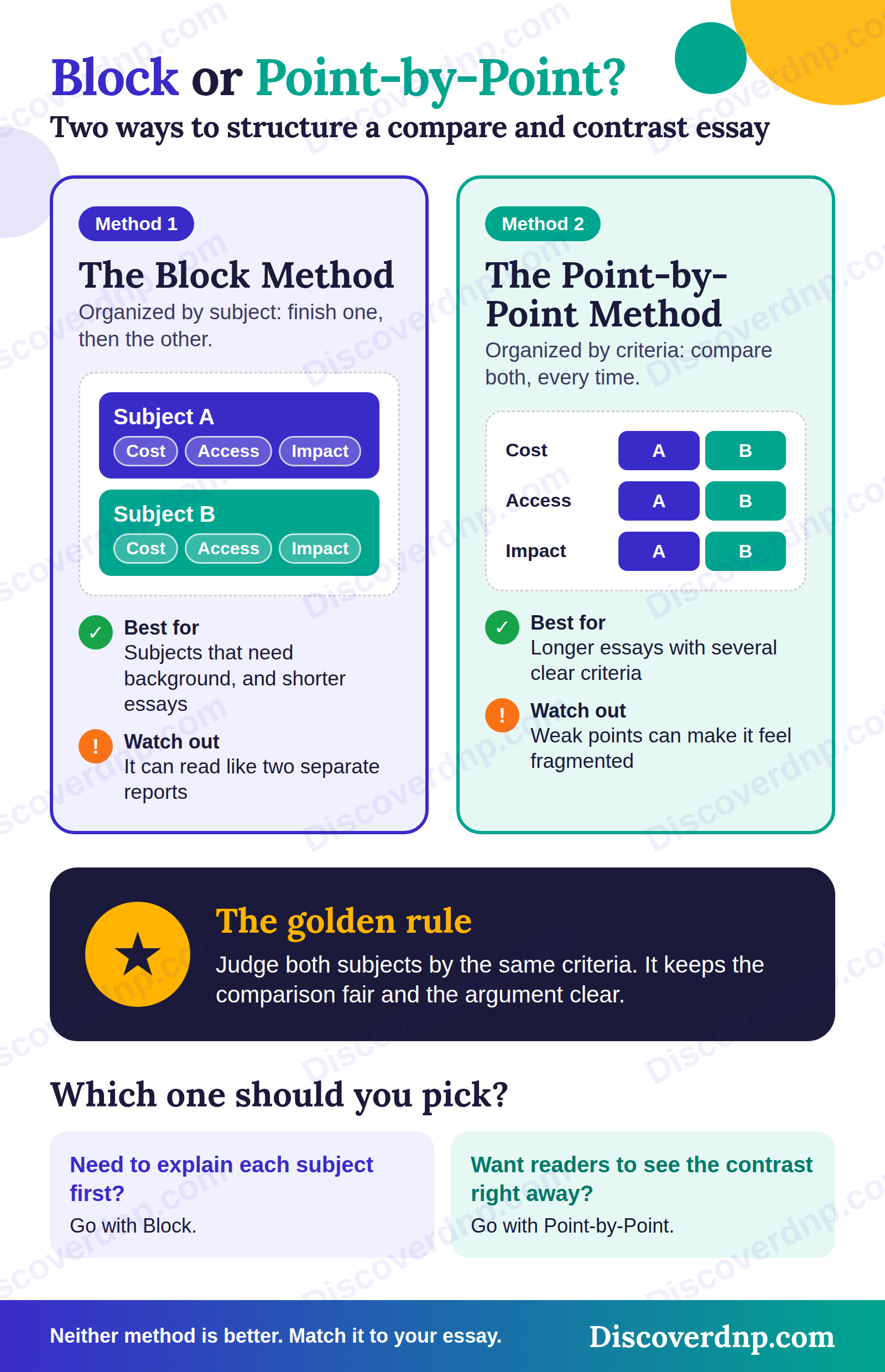
The two most common ways to organize a compare and contrast essay are the block method and the point-by-point method. Both approaches can produce a successful essay, but they arrange information differently. Choosing the right method depends on the complexity of the subjects, the number of comparison points, the assignment length, and how directly the writer wants readers to evaluate the similarities and differences.
The Block Method
The block method organizes the essay by subject. The writer discusses the major characteristics of the first subject in one section and then examines the corresponding characteristics of the second subject in another section. The introduction and conclusion surround these two main blocks of discussion.
A typical block-method essay follows this structure:
- Introduction: Introduce both subjects, explain their relevance, and present the thesis statement.
- Body section one: Discuss the first subject using the selected comparison criteria.
- Body section two: Discuss the second subject using the same or closely related criteria.
- Conclusion: Summarize the most important similarities and differences and explain what the comparison demonstrates.
For example, an essay comparing online learning with traditional classroom learning might first discuss online learning in terms of flexibility, access to resources, interaction, and practical learning opportunities. The next section would examine traditional classroom learning using those same criteria.
The block method can work well when the subjects require background explanation before readers can compare them directly. It may also be appropriate for shorter essays or topics where each subject has several features that are easier to understand separately.
However, this method has a potential weakness: readers may need to remember details from the first section while reading the second. If the writer does not make the relationships clear, the essay may read like two separate descriptive reports rather than a genuine comparison. To prevent this problem, use consistent comparison points, connect related ideas with transitions, and explain the significance of the similarities and differences in the conclusion.
The Point-by-Point Method
The point-by-point method organizes the essay around individual comparison criteria rather than discussing each subject in a separate block. Each body paragraph examines one aspect of both subjects, allowing readers to see their similarities and differences immediately.
A typical point-by-point structure includes:
- Introduction: Introduce both subjects and establish the main argument.
- Body paragraph one: Compare the subjects according to the first criterion.
- Body paragraph two: Compare them according to the second criterion.
- Body paragraph three: Compare them according to the third criterion.
- Additional body paragraphs: Address other relevant comparison points when the assignment requires them.
- Conclusion: Synthesize the findings and explain their overall significance.
For example, an essay comparing electronic health records with paper-based records could be organized as follows:
- Accessibility: Compare how quickly healthcare professionals can retrieve information using each system.
- Accuracy and legibility: Examine how each system supports clear documentation and the identification of errors.
- Privacy and security: Compare the risks associated with unauthorized access, data breaches, misplaced documents, and inappropriate disclosure.
- Workflow and continuity of care: Evaluate how each system supports information sharing and communication among healthcare professionals.
Each body paragraph directly compares the two systems according to one criterion. Rather than describing electronic records in one section and paper records in another, the writer explains how both systems perform in relation to accessibility, accuracy, security, and workflow.
The point-by-point method is often effective for longer academic essays, particularly when the comparison involves several dimensions that readers need to evaluate side by side. It can make the argument easier to follow because the relationship between the subjects remains visible throughout the discussion. Nevertheless, it requires careful planning. If the comparison points are poorly selected or the paragraphs contain too many unrelated ideas, the essay can become fragmented.
Choosing Between the Two Methods
Neither method is automatically superior. The most suitable structure depends on the purpose and scope of the essay.
| Consideration | Block method | Point-by-point method |
|---|---|---|
| Organization | Groups discussion by subject | Groups discussion by comparison criterion |
| Main advantage | Provides space to explain each subject in detail | Makes similarities and differences easy to evaluate directly |
| Potential limitation | Connections between subjects may be less immediate | Requires careful paragraph planning and transitions |
| Suitable use | Subjects needing substantial background explanation | Subjects with several clear, comparable criteria |
| Common challenge | Avoiding two separate descriptive essays | Avoiding repetitive or overly fragmented paragraphs |
For a short essay comparing two familiar subjects, either structure may work. For a more complex comparison, the point-by-point method often makes it easier to develop a connected argument. The block method may be more practical when readers need a clear explanation of each subject before considering their relationship.
Regardless of the chosen structure, the essay should compare the subjects using consistent criteria. If the first subject is evaluated according to cost, accessibility, and effectiveness, the second should be assessed using those same criteria wherever appropriate. This creates a fair comparison and prevents the discussion from favoring one subject simply because it receives more attention.
Developing a Thesis Statement and Organizing Main Ideas
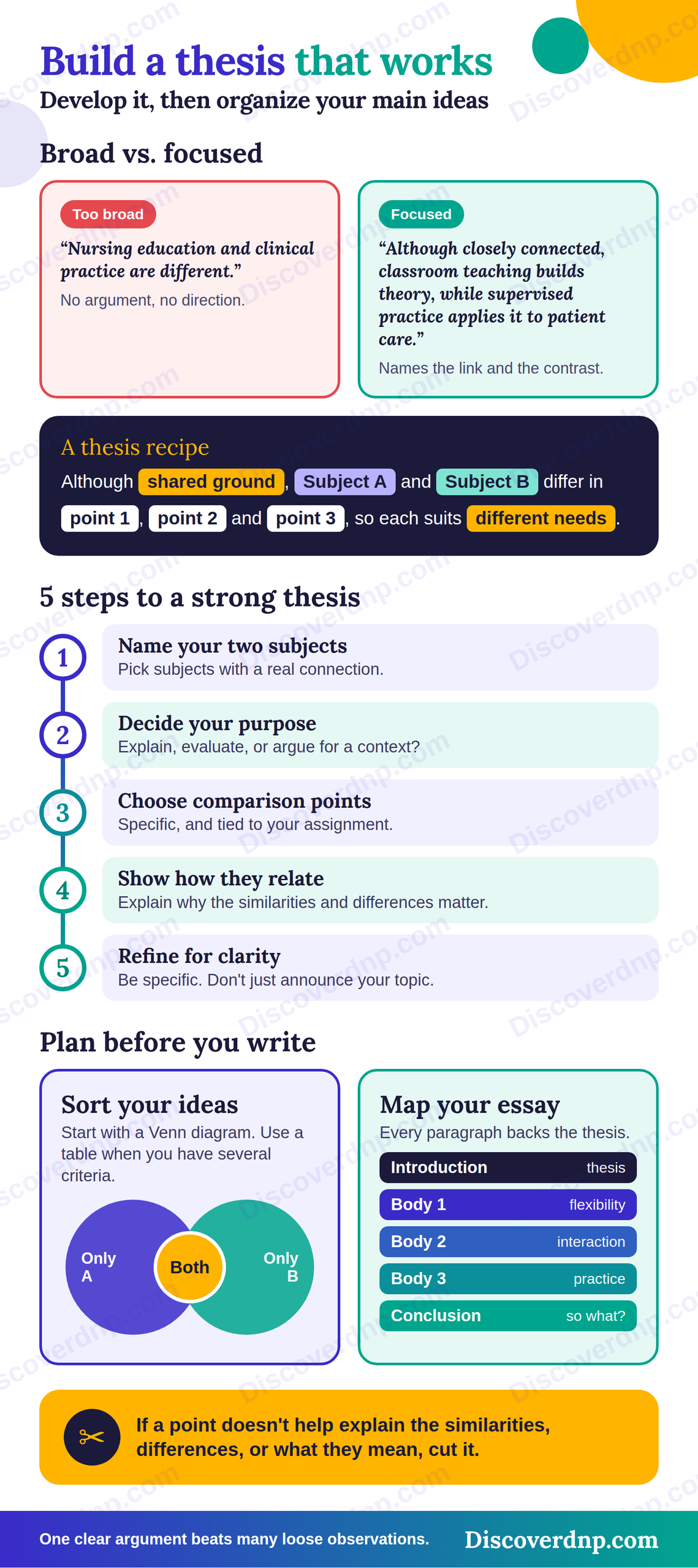
A thesis statement is the central argument of a compare and contrast essay. It tells readers which subjects are being compared and identifies the most important similarities, differences, or conclusions that the essay will examine. A strong thesis statement gives the essay direction by moving beyond the simple observation that two subjects are alike or different.
For example, the statement “Online learning and traditional classroom learning have similarities and differences” identifies the general purpose of the essay but does not communicate a meaningful argument. It is too broad to guide the discussion effectively.
A more developed thesis statement would be:
“Although online learning and traditional classroom learning both provide opportunities to acquire knowledge, they differ in flexibility, face-to-face interaction, and opportunities for supervised practical learning, making each approach suitable for different educational needs.”
This version establishes the relationship between the subjects, identifies specific comparison points, and presents a central idea that can be developed throughout the essay.
Steps for Developing an Effective Thesis Statement
1. Identify the two subjects.
Begin by naming the subjects you intend to compare. They should have a meaningful relationship, such as two educational methods, clinical interventions, nursing specialties, or approaches to healthcare delivery.
For example, an essay might compare hospital-based nursing with community health nursing. Both involve caring for patients, but they differ in typical work environments, patient needs, and the emphasis placed on prevention and acute treatment.
2. Determine the purpose of the comparison.
Ask what the reader should understand after reading the essay. Are you explaining how two subjects differ, evaluating their effectiveness, examining their shared characteristics, or arguing that one is more appropriate in a particular context?
The purpose influences the direction of the thesis statement. A comparison of two nursing interventions, for example, may focus on their indications, benefits, limitations, and suitability for different patient conditions rather than attempting to identify one universally superior intervention.
3. Select the main comparison points.
Choose the most relevant characteristics that will form the body of the essay. These should be specific enough to support detailed analysis and closely connected to the assignment question.
For example, when comparing electronic health records with paper-based records, possible comparison points include:
- Accessibility and retrieval of information
- Accuracy and legibility of documentation
- Privacy and information security
- Communication and continuity of care
- Costs and workflow requirements
The thesis statement does not necessarily need to list every point, especially in a longer essay. However, it should communicate the central direction of the analysis.
4. Establish a meaningful relationship between the subjects.
A strong thesis explains why the similarities and differences matter. It may show that two approaches serve similar purposes but differ in how they achieve them, or that their advantages depend on the circumstances in which they are used.
For example:
“Hospital-based nursing and community health nursing share a commitment to patient well-being, but their different settings, patient populations, and priorities create distinct approaches to assessment, health education, and continuity of care.”
This thesis establishes both common ground and important differences without implying that one specialty is more valuable than the other.
5. Refine the statement for clarity and scope.
Avoid vague claims, overly broad comparisons, and statements that merely announce what the essay will discuss. A useful thesis should be specific enough to guide the body paragraphs while remaining manageable within the assignment length.
Consider these examples:
- Too broad: “Nursing education and clinical practice are different.”
- More focused: “Although nursing education and clinical practice are closely connected, classroom instruction emphasizes theoretical knowledge, while supervised clinical practice allows learners to apply that knowledge to patient assessment, communication, and care.”
The second statement gives the writer clear comparison points and establishes a relationship that can be explored through examples and evidence.
Organizing Main Ideas Before Writing
After developing the thesis statement, organize the main ideas into a logical sequence. Planning helps ensure that the entire essay supports the central argument rather than becoming a collection of unrelated observations.
A Venn diagram is useful when beginning a comparison because it separates characteristics unique to each subject from those shared by both. A comparison table may be more effective when the essay involves several criteria, particularly when comparing clinical methods, technologies, or professional roles.
For example, a preliminary comparison of online learning and traditional classroom learning might look like this:
| Comparison point | Online learning | Traditional classroom learning |
|---|---|---|
| Flexibility | Often allows learners to access materials remotely and at different times | Usually follows a fixed timetable and location |
| Interaction | May rely on discussion boards, video meetings, and digital communication | Commonly allows direct, in-person interaction |
| Learning resources | Uses digital materials, recorded lessons, and online platforms | May use printed materials, classroom demonstrations, and digital resources |
| Practical activities | Can support virtual simulations and remote demonstrations | Can provide access to supervised in-person activities when facilities are available |
This planning table identifies possible body paragraph topics and helps the writer distinguish description from analysis. In the finished essay, each comparison point should be developed with relevant examples and an explanation of its significance.
When organizing the main ideas, place the strongest or most relevant comparison points where they support the argument most effectively. In a point-by-point essay, each body paragraph should generally focus on one criterion. In a block-method essay, the writer should maintain consistent criteria across both subject sections so that readers can make meaningful comparisons.
A practical outline might include the following:
- Introduction: Introduce the subjects, provide necessary context, and present the thesis statement.
- Body paragraph one: Examine flexibility and access.
- Body paragraph two: Compare interaction and communication.
- Body paragraph three: Evaluate practical learning opportunities.
- Body paragraph four: Discuss the implications of the comparison for different educational needs.
- Conclusion: Synthesize the findings and explain what the comparison demonstrates.
The number of body paragraphs should reflect the assignment length and the complexity of the subjects. A brief essay may need only two or three comparison points, while a research-based university assignment may require a more detailed structure.
Each paragraph should contribute to the central argument. If a point does not help explain the similarities, differences, or implications of the subjects, it may not belong in the essay. This focused approach makes the writing clearer and helps maintain a logical flow from the introduction to the conclusion.
Analyzing Similarities and Differences With Supporting Evidence
The central purpose of a compare and contrast essay is to analyze the relationship between two subjects rather than simply describe them separately. Effective analysis identifies relevant similarities and differences, explains their significance, and uses examples or credible evidence to support the conclusions. This process requires the writer to examine not only what is similar or different but also why those similarities and differences matter.
A weak comparison might state that two nursing interventions are different without explaining how their purposes, indications, or outcomes vary. A stronger comparison identifies the relevant characteristics and explains their practical implications. For example, comparing two approaches to pain management may involve their intended effects, routes of administration, potential adverse effects, monitoring requirements, and suitability for individual patients. Specific clinical claims should be supported by current evidence and relevant professional guidance.
Identifying Meaningful Similarities
Similarities establish the common ground between the subjects. They help readers understand why the two subjects can reasonably be compared and which characteristics they share.
For example, when comparing hospital-based nursing with community health nursing, a writer may identify several similarities:
- Both require clinical knowledge and sound professional judgment.
- Both involve communication with patients and other healthcare professionals.
- Both require attention to patient safety, dignity, and confidentiality.
- Both contribute to health outcomes and continuity of care.
However, simply listing these shared characteristics is not sufficient for a comprehensive essay. The writer should explain how the similarities appear in each context.
For instance, communication is essential in both settings, but the circumstances may differ. A hospital nurse may communicate frequently with an interdisciplinary team to coordinate treatment for an acutely ill patient, while a community health nurse may emphasize health education, follow-up, and coordination with local services. The shared principle is effective communication, but its practical application depends on the setting and the patient’s needs.
This level of analysis makes the comparison more informative and helps the essay move beyond general statements.
Identifying Clear Differences
Differences reveal the characteristics that distinguish the subjects. They may involve purpose, structure, effectiveness, accessibility, cost, risks, outcomes, or the circumstances in which each approach is appropriate.
When comparing electronic health records with paper-based records, for example, the writer might examine differences in information retrieval, storage, sharing, and security. Electronic records can support rapid retrieval and authorized information sharing, but their use depends on reliable systems, appropriate access controls, and adequate training. Paper records do not depend on electronic infrastructure, yet they may be more difficult to retrieve, share, and organize across multiple care settings.
A strong comparison acknowledges the advantages and limitations of both systems. It avoids presenting electronic records as flawless or assuming that paper documentation is always less safe. Actual performance depends on the design of the system, the quality of implementation, staff practices, and the clinical environment.
When analyzing differences, consider the following questions:
- What specific characteristic distinguishes the two subjects?
- Why does the difference exist?
- How does it affect their purpose, use, or outcome?
- Under what circumstances is the difference important?
- Does the available evidence support the conclusion?
Answering these questions helps develop a more balanced and persuasive comparison.
Using Evidence to Support Comparison Points
Evidence gives credibility to an academic essay. Depending on the assignment, appropriate support may include peer-reviewed journal articles, systematic reviews, clinical guidelines, official healthcare publications, textbooks, research findings, or carefully selected examples.
In nursing and healthcare writing, evidence is particularly important because unsupported claims about treatment, patient safety, or clinical effectiveness can be misleading. Writers should use recent and relevant sources where appropriate, evaluate the quality of the evidence, and distinguish established findings from personal interpretations.
For example, a comparison of telehealth and in-person consultations should not simply claim that one method produces better outcomes in every situation. The writer could examine research on access, patient satisfaction, clinical suitability, and outcomes for a specific condition or type of consultation. The findings should then be interpreted within the limits of the available evidence.
Similarly, when comparing qualitative and quantitative research, the writer can use research-methodology sources to explain how each approach answers different types of questions. Qualitative research may help explore patients’ experiences and perceptions, while quantitative research may measure variables or examine associations. Neither approach is inherently better for every research question; the appropriate choice depends on the purpose of the investigation.
Evidence should be integrated into the discussion rather than inserted without explanation. A useful paragraph often follows this sequence:
- Topic sentence: Introduce the comparison point.
- Explanation: Describe how the characteristic applies to each subject.
- Evidence or example: Support the discussion with a credible source, finding, or relevant illustration.
- Analysis: Explain what the evidence demonstrates and why the difference or similarity matters.
- Link: Connect the paragraph to the thesis or the next comparison point.
For instance, a paragraph comparing online and classroom learning could begin by identifying flexibility as a major distinction. It could then explain how remote access may help learners manage competing responsibilities while scheduled classroom sessions provide a structured environment for direct interaction. Evidence from relevant educational research could support claims about access or learning outcomes. The paragraph should conclude by explaining how these findings relate to the suitability of each approach for particular educational needs.
Distinguishing Analysis From Description
Description explains the characteristics of a subject; analysis interprets those characteristics and explains their significance. Both are necessary, but a successful compare and contrast essay should not remain at the descriptive level.
Consider the following example:
- Description: Electronic health records allow information to be stored digitally, while paper-based records use physical documents.
- Analysis: Electronic health records can make information retrieval and authorized sharing more efficient, whereas paper-based systems may be easier to access during certain electronic system disruptions. These differences affect workflow and continuity of care, but neither format guarantees accurate documentation without appropriate procedures and staff practices.
The analytical version explains the consequences of the difference and acknowledges relevant limitations. This is especially important in advanced academic writing, where the task often requires evaluation rather than a simple summary.
Writers should also avoid assuming that a similarity proves two approaches are equally effective or that a difference automatically establishes one as superior. A meaningful comparison considers the purpose, context, available evidence, and limitations of each subject.
Using Examples Effectively
Examples make abstract comparison points easier to understand. They can illustrate how a principle works in practice, clarify a difference, or demonstrate why a particular finding matters.
For example, an essay comparing patient-centered care with task-oriented nursing could describe a nurse who completes required observations and documentation while also explaining a procedure to a patient and responding to the patient’s concerns. The example demonstrates that task completion and patient-centered communication can occur together. The analysis can then explore how time pressure, staffing, patient needs, and organizational expectations influence the balance between these responsibilities.
Examples should remain relevant to the argument and should not replace research evidence when the assignment requires scholarly support. In clinical topics, use hypothetical or appropriately anonymized examples and avoid presenting invented scenarios as actual research findings.
Maintaining Balance and Logical Flow
A fair comparison gives both subjects appropriate attention. Avoid selecting favorable examples for one subject while emphasizing only the limitations of the other. Apply the same comparison criteria to both, and acknowledge limitations when the evidence warrants them.
Transitions help readers understand how ideas relate. Terms such as similarly, in contrast, whereas, both, however, and on the other hand can signal relationships between points. These transitions should be used naturally rather than added to every sentence.
For example:
Both hospital-based nursing and community health nursing emphasize patient well-being. However, hospital-based care may focus on acute assessment and treatment, whereas community health nursing often gives greater attention to prevention, education, and care within community settings.
This sentence establishes a similarity before introducing a distinction. The following sentences should expand the comparison with examples and, where necessary, supporting evidence.
Before submitting the essay, review whether the comparison points directly support the thesis statement, whether each major claim has adequate support, and whether the conclusion reflects the analysis presented in the body. Check that the paragraphs are logically organized, the evidence is accurately represented, and the assignment’s citation and formatting requirements have been followed.
A successful compare and contrast essay brings together a focused thesis, a suitable organizational method, meaningful comparison points, and well-supported analysis. By examining both similarities and differences fairly, writers can produce an essay that does more than describe two subjects: it explains their relationship, evaluates their significance, and develops a clear conclusion based on reasoned analysis.
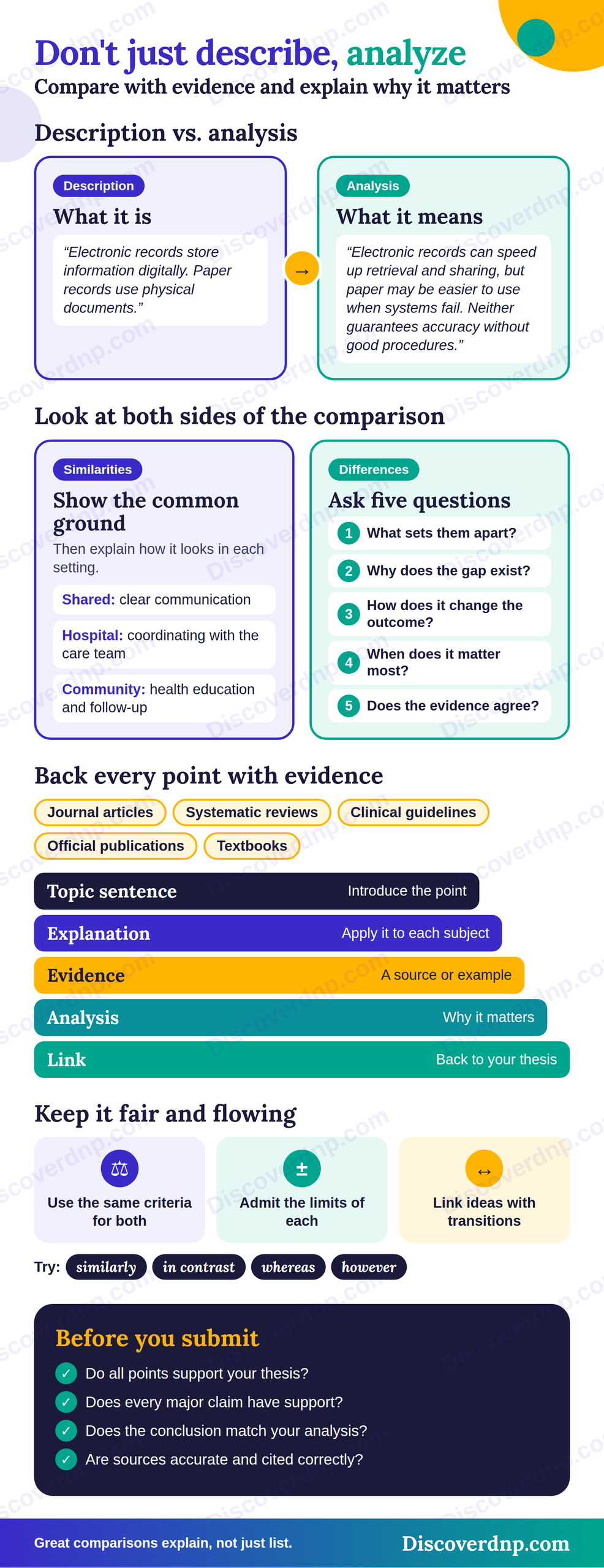
Conclusion
Writing a successful compare and contrast essay requires more than identifying how two subjects are alike or different. It involves selecting a meaningful topic, developing a focused thesis statement, organizing main ideas logically, and supporting each comparison with relevant examples or credible evidence. Whether using the block method or the point-by-point method, writers should aim to explain why the similarities and differences matter rather than simply describing separate characteristics.
Choosing the right compare and contrast essay topic also influences the quality of the final paper. A focused topic makes it easier to establish clear comparison points, develop a coherent argument, and maintain an appropriate level of detail. From everyday academic experiences to complex nursing practices, ethical principles, and healthcare technologies, effective comparisons encourage deeper analysis and more informed conclusions. By applying these principles, writers can strengthen their critical thinking skills, improve their academic writing, and produce well-structured essays that communicate meaningful insights.
Frequently Asked Question
1. What are some good nursing topics for essays?
Good nursing essay topics include patient safety, infection prevention, nursing ethics, evidence-based practice, patient-centered care, medication errors, mental health nursing, health promotion, nursing leadership, and the role of technology in healthcare.
2. What are some good topics for a comparison and contrast essay?
Good compare and contrast essay topics include:
- Online learning vs. traditional classroom learning
- Hospital nursing vs. community health nursing
- Electronic health records vs. paper-based records
- Preventive healthcare vs. curative healthcare
- Qualitative research vs. quantitative research
- Patient autonomy vs. beneficence
- Telehealth vs. in-person consultations
- Studying alone vs. studying in a group
- Public healthcare vs. private healthcare
- Task-oriented nursing vs. patient-centered nursing
3. What are 10 good essay topics?
- The importance of mental health awareness.
- The role of nurses in patient safety.
- Benefits and challenges of online learning.
- How technology is transforming healthcare.
- Strategies for preventing hospital-acquired infections.
- The importance of effective communication in nursing.
- Ethical challenges in modern healthcare.
- The impact of social media on health awareness.
- Strategies for managing academic stress.
- The importance of evidence-based nursing practice.
4. What are the top 10 research topics for nursing students?
- The effectiveness of hand hygiene in preventing healthcare-associated infections.
- Factors contributing to medication administration errors among nurses.
- The impact of nurse staffing levels on patient outcomes.
- The effectiveness of patient education in managing chronic diseases.
- Strategies for preventing pressure ulcers in hospitalized patients.
- The relationship between nurse burnout and quality of patient care.
- The effectiveness of pain management interventions in postoperative patients.
- The impact of telehealth on access to healthcare services.
- Factors influencing adherence to treatment among patients with chronic illnesses.
- The effectiveness of nursing interventions in reducing patient falls.
