

AMA Citation Format: A Quick Guide to AMA Style, Citation Examples, and Referencing (11th Edition)
AMA Citation Format is an important component of academic writing in medicine, nursing, and other health sciences because it provides a consistent method for acknowledging sources and documenting scientific evidence. Medical and scientific writing depends on credible research, accurate reporting, and the ability to verify information. A standardized citation system allows readers to trace the evidence supporting clinical claims, locate original studies, and distinguish published findings from a writer’s own analysis. The American Medical Association (AMA) citation style uses a numerical referencing system in which numbered citations in the text correspond to entries in a reference list, helping maintain clarity while supporting the precise presentation of scientific information.
Understanding AMA Citation Format involves more than placing citation numbers after statements. It requires familiarity with the AMA Manual of Style, including the rules for formatting in-text citations, organizing references in numerical order, presenting author names and journal titles, and documenting publication details. Writers must also understand when to include information such as a digital object identifier (DOI), URL, publication date, and accessed date for electronic sources. Consistent application of these conventions helps ensure that sources can be identified and retrieved while reducing errors in academic papers, research reports, literature reviews, and other scholarly publications.
The AMA citation style is particularly relevant in health sciences, where journal articles, clinical guidelines, research findings, and evidence-based recommendations frequently inform academic discussion and professional practice. Its conventions differ from those of APA and MLA, especially in the use of superscript numbers and the organization of the reference list. For example, a source cited several times in a paper generally retains its original citation number rather than receiving a new number each time it appears. Journal titles may also require standard abbreviations, making it important to consult reliable reference resources when preparing citations.
Accurate referencing also involves selecting appropriate sources and checking citation details carefully. Citation generators can help organize bibliographic information and produce an initial AMA reference, but their output may contain errors in author names, journal abbreviations, punctuation, DOI links, or publication details. The AMA Manual of Style, university library LibGuides, and educational resources such as Purdue OWL can provide additional guidance, although specific AMA requirements should be verified against the applicable edition of the official manual.
This guide examines the main principles of AMA Citation Format, with particular attention to the 11th edition. It explains how AMA style works in health sciences, how to format superscript in-text citations and reference lists, and how to cite common sources such as journal articles, books, websites, and clinical guidelines. It also addresses punctuation, journal abbreviations, electronic references, and the use of citation generators and other learning resources. Understanding these conventions makes it easier to acknowledge sources accurately, maintain academic integrity, and present medical and scientific information in a clear, consistent, and verifiable format.
Understanding AMA Citation Style in Health Sciences
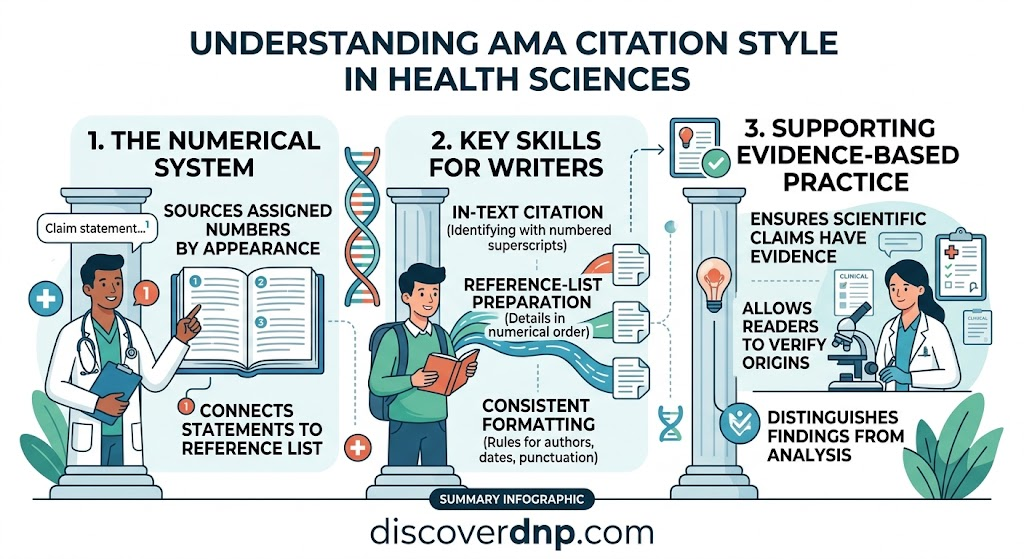
AMA Citation Format is a numerical citation system used in medical, nursing, and other health sciences publications to acknowledge sources and connect scientific claims with their supporting evidence. It provides a standardized approach to documenting research findings, clinical guidelines, journal articles, books, and electronic sources. By following established citation rules, writers can present information consistently, allow readers to locate original research, and distinguish their own analysis from findings reported by other authors.
The AMA citation style is particularly relevant to medical and scientific writing because research findings frequently inform clinical decisions, professional recommendations, and evidence-based practice. A statement about medication safety, disease prevalence, diagnostic accuracy, or a nursing intervention, for example, should be supported by appropriate evidence when it is not common knowledge. Accurate citation enables readers to identify the original source and assess whether the evidence supports the statement being made.
A central feature of AMA Citation Format is its use of numbered citations rather than the author–date system commonly associated with APA style. Sources are assigned numbers according to the order in which they first appear in the text. These numbers connect individual statements to complete entries in the reference list, allowing the main discussion to remain readable without repeatedly displaying authors’ names and publication dates.
Consider the following simplified example:
Example of AMA in-text citation
Accurate medication reconciliation can help identify discrepancies between a patient’s existing medications and newly prescribed treatments.¹
Corresponding reference
1. Smith AB, Jones CD. Improving medication reconciliation in clinical practice. Journal of Clinical Practice. 2024;18(2):115-121.
Note: This reference is illustrative and does not represent a verified publication.
The superscript number directs readers to the corresponding reference. In a complete paper, the reference list would provide sufficient bibliographic information to identify the source. The exact formatting of the reference depends on the source type and the applicable AMA guidelines.
Understanding AMA Citation Format involves three connected skills:
- In-text citation: Identifying borrowed information with the appropriate citation number and placing that number correctly within the sentence.
- Reference-list preparation: Providing complete details for cited sources and arranging references according to their first appearance in the text.
- Consistent formatting: Applying the relevant rules for author names, journal titles, publication dates, DOI links, URLs, abbreviations, and punctuation.
These skills work together to support academic integrity and make scientific information easier to verify. A citation number without a corresponding reference is incomplete, while a reference-list entry that is never cited in the text may not belong in a standard AMA reference list. Writers should therefore check the relationship between every in-text citation and its corresponding reference.
The American Medical Association Manual of Style and the 11th Edition
The AMA Manual of Style is the principal reference for the American Medical Association’s conventions for medical and scientific writing. Published by the American Medical Association, the manual provides guidance on citation format, references, grammar, punctuation, terminology, abbreviations, tables, figures, and other aspects of scholarly communication.
The manual is especially important when a paper must follow a specific AMA citation style. Online summaries and university writing guides can explain common rules, but they may omit exceptions or present simplified examples. When a detailed question arises, consulting the relevant section of the official manual is the more reliable approach.
The 11th edition, published in 2020, provides guidance on preparing medical and scientific manuscripts and documenting sources. Writers should confirm which edition is required by their institution, instructor, journal, or publisher because submission requirements may specify a particular edition or include additional house rules.
The AMA Manual of Style addresses several important aspects of citation and scholarly writing:
- Citation numbering: How sources are numbered when first cited and how those numbers are reused when the same sources appear again.
- Author names: How to present surnames and initials, including the conventions for works with multiple authors.
- Journal references: How to arrange article titles, journal titles, publication dates, volume and issue information, and page numbers.
- Electronic sources: How to document online publications, DOI links, URLs, and access dates when applicable.
- Abbreviations and punctuation: How to use standard journal abbreviations, capitalization, commas, periods, colons, and other punctuation consistently.
For example, a writer referencing a peer-reviewed article about infection prevention must provide more than the article’s title. The complete AMA reference generally needs the authors, article title, journal title in the appropriate form, publication year, volume, issue when applicable, page range or article identifier, and DOI when available and required by the relevant rules.
The manual also helps writers distinguish between information that belongs in a reference and information that belongs in the main text. The title of a journal article, for instance, is included in the reference entry, while the superscript citation number is placed in the text where the source supports the discussion.
It is also important to distinguish the official AMA Manual of Style from resources that explain it. Purdue OWL, university writing labs, and library LibGuides can provide useful introductory explanations and citation examples. However, they are supplementary resources, not substitutes for the official manual when resolving edition-specific requirements. A citation generator can help create a draft reference, but the writer remains responsible for checking its accuracy.
AMA Citation Format Compared With APA and MLA
AMA, APA, and MLA are established citation styles, but they differ in how they identify sources, organize references, and present bibliographic information. Choosing the correct citation style depends on the requirements of the academic institution, journal, publisher, or assignment. In health sciences, AMA is commonly associated with medical and scientific writing, while APA is widely used in nursing, psychology, education, and social sciences. MLA is primarily associated with language, literature, and other humanities disciplines.
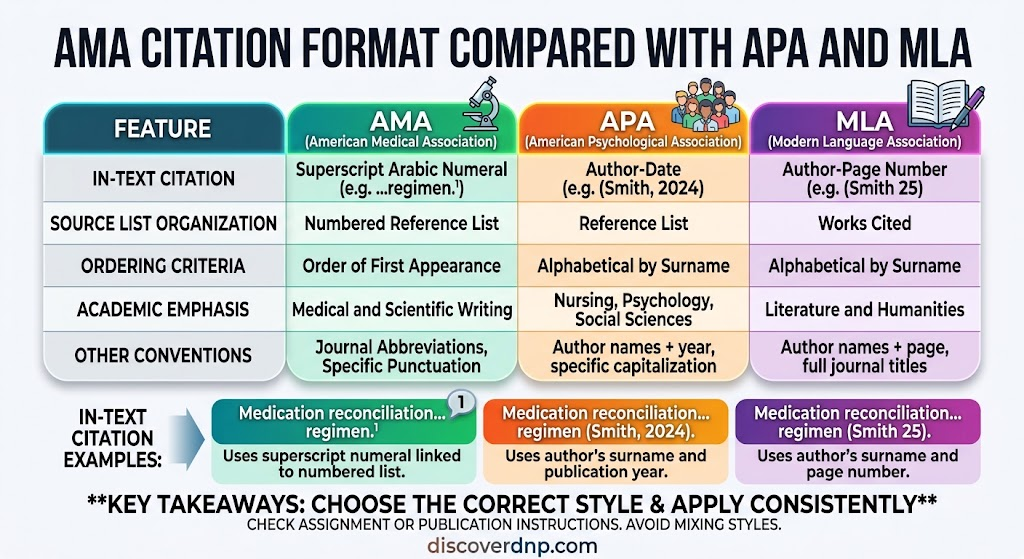
The most noticeable difference is the way each style handles in-text citations. AMA uses superscript Arabic numerals that correspond to numbered entries in a reference list. APA generally uses the author–date system, while MLA uses the author’s surname and a page number when applicable. These differences affect how citations appear within paragraphs and how readers locate the original sources.
Consider the following examples of a sentence discussing medication safety.
AMA citation style
Medication reconciliation can help identify discrepancies between prescribed treatments and a patient’s existing medication regimen.¹
Uses a superscript number linked to the numbered reference list.
APA citation style
Medication reconciliation can help identify discrepancies between prescribed treatments and a patient’s existing medication regimen (Smith, 2024).
Uses the author’s surname and publication year.
MLA citation style
Medication reconciliation can help identify discrepancies between prescribed treatments and a patient’s existing medication regimen (Smith 25).
Uses the author’s surname and page number when the source provides relevant pagination.
These are illustrative citation patterns, not citations to verified publications. The exact requirements depend on the source and applicable style rules.
The differences extend beyond in-text citations. Each style has its own rules for organizing and formatting the final list of sources.
| Feature | AMA | APA | MLA |
|---|---|---|---|
| In-text citation | Superscript Arabic numeral | Author and year | Author and page number, when applicable |
| Final source list | Numbered reference list | Reference list | Works Cited |
| Ordering | Order of first citation | Alphabetical by author surname | Alphabetical by author surname |
| Typical emphasis | Medical and scientific writing | Social and behavioral sciences, nursing, and education | Literature and humanities |
AMA generally uses the abbreviated form of a journal title in journal references, following the relevant abbreviation standards. APA and MLA have different conventions for journal titles, capitalization, and bibliographic presentation. AMA also uses specific punctuation between bibliographic elements, so a reference prepared in APA format cannot simply be relabeled as AMA without being revised.
For example, an APA journal reference may place the year in parentheses immediately after the author’s name. In AMA, the year generally appears after the journal title, followed by a semicolon before the volume number. The article title, journal title, volume, issue, page range, and DOI must therefore be rearranged according to the chosen citation style.
These distinctions matter when preparing academic assignments and manuscripts. Using APA in a paper that requires AMA may result in incorrect in-text citations, an improperly ordered reference list, and inconsistent formatting even if the sources themselves are credible.
Before writing, check the instructions provided for the assignment or publication. If AMA is required, use it consistently throughout the document, including citations in the main text and any references associated with tables or figures. Avoid mixing AMA superscript numbers with APA author–date citations or MLA parenthetical citations unless a specific instruction calls for a different treatment.
When to Use AMA Style in Nursing and Health Sciences
AMA citation style is appropriate when an assignment, research project, medical journal, or other scholarly publication requires or recommends the American Medical Association’s referencing conventions. Its numerical system is especially useful in medical and scientific writing, where a manuscript may contain many references to research studies, clinical guidelines, and other technical sources.
In nursing and health sciences, the AMA citation style may be used in several contexts:
- Research papers and literature reviews: When discussing findings from peer-reviewed journal articles, clinical studies, systematic reviews, or meta-analyses, AMA citations connect claims to the evidence supporting them.
- Evidence-based practice assignments: When evaluating an intervention or comparing approaches to patient care, citations help readers locate the studies and guidelines on which conclusions are based.
- Clinical and professional reports: Medical and health-related reports may use AMA to document clinical recommendations, research evidence, and relevant professional guidance.
- Scientific manuscripts and journal submissions: Authors submitting work to medical or scientific publications may need to follow AMA conventions or a journal’s own version of them.
- Health sciences presentations and academic projects: AMA may be required for written reports, posters, or other scholarly work, depending on the institution’s instructions.
For example, a paper evaluating strategies to prevent hospital-acquired infections might discuss evidence from clinical trials, systematic reviews, and infection-prevention guidelines. AMA Citation Format allows the writer to place a numbered citation beside each relevant claim and provide the complete source details in the reference list. Readers can then identify the original studies without interrupting the flow of the discussion with lengthy author–date citations.
The style is also useful when a paper discusses several studies in one paragraph. Instead of repeating publication dates and author names throughout the text, the writer can cite the relevant sources using their assigned superscript numbers. Multiple references can be grouped together where appropriate, provided the numbering and punctuation follow AMA rules. This helps keep technical discussions readable while preserving traceability.
However, AMA is not mandatory for every nursing assignment. Some nursing schools, departments, instructors, and journals require APA or another citation style. A nursing research paper may therefore use APA even when it discusses medical evidence, while a manuscript intended for a journal that specifies AMA may require AMA formatting.
When deciding which citation style to use, consider the following:
- Assignment requirements: Follow the citation style explicitly specified by the instructor or academic institution.
- Publication requirements: Consult the journal’s author instructions because a publisher may modify certain conventions or require a particular edition of the style manual.
- Source type: Determine whether you are citing a journal article, book, website, clinical guideline, or another source, since each has its own reference format.
- Consistency and verification: Apply the selected style throughout the paper and check the references against the appropriate manual or reliable citation guide.
The key principle is that accurate citation depends on both selecting the appropriate style and applying it correctly. AMA is particularly suited to many medical and scientific publications, but the requirements of the specific assignment or journal should always determine the final choice. The official AMA Manual of Style and supplementary university guides can help clarify the rules when a source presents unusual details or when a citation does not fit a common example.
AMA In-Text Citations and Superscript Rules
AMA in-text citations identify the sources supporting information presented in a paper, research report, or other scholarly document. In AMA Citation Format, these citations use superscript Arabic numerals that correspond to numbered entries in the reference list. This system allows writers to acknowledge research findings, clinical recommendations, statistics, and other borrowed information without repeatedly inserting full bibliographic details into the main text.
In medical and health sciences writing, accurate in-text citations are important because readers need to distinguish established evidence from interpretation, identify the research behind a claim, and locate the original publication when further investigation is necessary. A citation should appear close enough to the relevant statement that readers can tell which information it supports.
For example, consider a discussion of infection prevention:
Consistent hand hygiene is an important component of strategies to reduce healthcare-associated infections.¹
The superscript number directs the reader to reference 1 in the reference list. The reference provides the details needed to identify the source. In an actual academic paper, the cited publication must genuinely support the claim; a citation should not be added merely to make a statement appear authoritative.
AMA in-text citations require attention to three main areas:
- Numbering and superscript: Sources receive numbers according to their first appearance in the document.
- Multiple citations and reuse: Writers may cite several sources together, and a previously cited source retains its original number.
- Citation placement: Superscript numbers must be positioned appropriately in relation to the words, quotation marks, and punctuation they support.
These rules apply throughout the manuscript, including relevant citations in tables, figures, and their accompanying legends. Maintaining a consistent system helps readers follow the evidence and ensures that each citation corresponds to the correct reference-list entry.
Numbering Sources and Using Superscript Citations
The defining feature of AMA Citation Format is the use of superscript Arabic numerals to identify sources within the text. Arabic numerals are the familiar numbers 1, 2, 3, and so forth. Superscript formatting places a number slightly above the normal line of text, making it visually distinct from the surrounding words.
The first source cited in a document receives the number 1. The next previously uncited source receives 2, followed by 3, 4, and so on. The numbering reflects the order in which sources are first introduced, not the alphabetical order of authors or the publication dates of the sources.
For example, imagine a paper discussing medication safety, patient falls, and pressure injury prevention. If the first source supports the discussion of medication safety, the second supports the discussion of patient falls, and the third supports the discussion of pressure injury prevention, their initial citation numbers would be 1, 2, and 3, respectively.
Example of consecutive citation numbering
Medication reconciliation can help identify discrepancies in treatment plans.¹
Fall-prevention interventions are an important part of patient safety.²
Pressure injury prevention requires appropriate risk assessment and preventive care.³
Corresponding reference-list order
1. First source cited in the paper.
2. Second source cited in the paper.
3. Third source cited in the paper.These examples demonstrate numbering order only; they are not complete references to published research.
The reference list at the end of the paper follows this same numerical order. It is not arranged alphabetically by the authors’ last names, as is typical in APA reference lists. Each reference receives its own number, and two separate publications should not be combined into a single reference-list entry merely because they support the same statement.
Where should the superscript number appear?
In AMA style, the citation number should be placed immediately after the relevant information, with the exact position determined by the surrounding punctuation. Under the standard 11th edition conventions:
- Place the superscript number outside commas and periods.
- Place it inside colons and semicolons.
- Place it after closing quotation marks and closing parentheses when it identifies the source of the quoted or parenthetical material.
- Avoid inserting a space between the relevant text or punctuation and the superscript number.
Examples illustrate these conventions:
After a period
Hand hygiene helps reduce the transmission of pathogens.¹
After a comma
In the clinical setting,¹ appropriate infection-prevention procedures should be followed.
Before a colon
The review identified one major concern¹: inconsistent documentation.
Before a semicolon
The first study reported an improvement in adherence¹; the second evaluated patient outcomes.
Illustrative examples of citation placement. In the final paper, place each citation directly beside the specific claim it supports.
The placement of the citation is not merely a cosmetic formatting issue. It helps establish the relationship between a source and the statement being documented. If a sentence contains two separate claims supported by different studies, placing one citation at the very end may leave readers uncertain about which source supports each claim. Positioning citations near the relevant clauses makes the evidence easier to interpret.
For example, suppose a paragraph explains that a particular intervention improved medication adherence in one study but reduced documentation errors in another. If the findings come from different publications, each citation should be positioned so that the reader can distinguish the evidence for the two outcomes.
Writers should also take care when a citation follows a number. AMA guidance cautions against placing a superscript reference immediately after a numeral in a way that could make the reference look like an exponent. For instance, a statement about a study involving 3 patients should be worded and punctuated so that the patient count is clearly distinguished from the citation number. Rewriting the sentence may be necessary to avoid ambiguity.
When an author is mentioned in the sentence, the citation number still needs to be included. For example:
Smith and Jones¹ reported that the intervention improved adherence to the prescribed treatment plan.
For a source with three or more authors, AMA in-text conventions generally use the first author’s surname followed by et al when the authors are named in the prose:
Smith et al¹ examined the relationship between the intervention and patient outcomes.
Mentioning an author by name does not replace the numbered citation. The superscript still links the discussion to the complete reference.
Citing Multiple Sources and Reusing Citation Numbers
Academic writing in nursing and health sciences often draws on more than one source to support a claim, compare research findings, or explain a clinical recommendation. AMA Citation Format allows writers to cite multiple sources at the same point in a sentence while preserving a clear connection between the evidence and the reference list. The key is to use the correct citation numbers and punctuation and to ensure that each source genuinely supports the statement.
Citing multiple sources in the same sentence
When two or more publications support a statement, their citation numbers can appear together as superscripts. Separate individual, nonconsecutive citation numbers with commas and no spaces. When citing a consecutive sequence of three or more references, use a hyphen to indicate the range.
For example:
- Two sources: Several studies have examined strategies for improving medication safety.¹,²
- Three consecutive sources: Evidence from several studies supports the importance of structured patient education.³⁻⁵
- A combination of consecutive and nonconsecutive sources: Research has investigated different approaches to preventing hospital-acquired infections.¹,³⁻⁵,⁸
These examples demonstrate how the numbers are grouped. In a real paper, the numbers must correspond to the sources that support the statement.
A citation range should only be used when the numbers represent a consecutive sequence of references. If sources 3, 4, and 5 are cited, the writer can use a range rather than listing each number separately. However, if sources 3 and 5 are cited without source 4, they should remain separate numbers: ³,⁵.
Multiple citations are useful when a statement summarizes a body of research rather than a single publication. For instance, a literature review examining the effectiveness of pressure injury prevention strategies may draw on several studies that investigated different interventions. Citing those studies together can demonstrate that the discussion considers more than one source of evidence.
However, the number of citations should be appropriate to the claim. Adding many references does not automatically make a statement stronger. Writers should prioritize relevant, credible sources and ensure that each cited publication supports the specific information presented.
Reusing citation numbers for previously cited sources
One important rule of AMA Citation Format is that a source retains the number assigned to it when it first appears in the document. It does not receive a new number every time it is cited.
Consider a paper in which the first source discusses medication reconciliation and the second examines patient falls. If the writer later returns to the medication reconciliation study, its citation remains ¹ rather than receiving a new number.
For example:
Medication reconciliation can help identify discrepancies in a patient’s treatment plan.¹
Fall-prevention strategies should be adapted to individual patient risks.²
Accurate medication histories are also important when patients transition between healthcare settings.¹
In this example, the first and third statements refer to the same source, so both use citation number 1. The second source retains number 2.
This approach prevents the reference list from becoming unnecessarily repetitive. Each distinct publication appears as its own numbered entry, while multiple mentions of that publication point to the same entry.
When using a previously cited source to support a different claim, however, the writer must confirm that the publication actually supports the new statement. Reusing a number is a formatting rule, not permission to use a source outside its evidentiary scope.
What happens when a new source is introduced later?
A newly introduced source receives the next available number in the sequence. Suppose a paper first cites sources 1 and 2, then returns to source 1, and subsequently introduces a new source. The new source receives number 3, not number 4, because reusing source 1 does not create an additional reference.
A simplified sequence would look like this:
| Order of appearance | Source used | Citation number |
|---|---|---|
| First citation | Study A | ¹ |
| Second citation | Study B | ² |
| Third citation | Study A again | ¹ |
| Fourth citation | Study C | ³ |
| Fifth citation | Study B again | ² |
This sequence illustrates the difference between the order in which citations appear and the number of unique sources in the paper. Only newly introduced sources receive new numbers.
Writers should also avoid assigning one reference number to two separate publications. Even if two articles support the same conclusion or have overlapping authors, each publication must have its own reference-list entry and citation number.
If a manuscript is substantially reorganized, the numbering may need to be checked again because the order of first appearance determines the sequence. Reference-management software can help maintain consistency, but the final manuscript should still be reviewed to ensure that every number matches the intended source.
In-Text Citation Placement Within Sentences
Correct citation placement is an essential part of AMA in-text formatting. A superscript number should appear close to the information it supports, allowing readers to identify the source of a fact, interpretation, quotation, or research finding. Although the basic principle is straightforward, sentence structure and punctuation can affect where the number belongs.
Placing citations beside the relevant claim
When a sentence contains one claim supported by a source, the citation usually appears at the end of the relevant clause or sentence. When a sentence contains several claims supported by different publications, it may be more appropriate to place citations immediately after the individual claims rather than grouping all the numbers at the end.
For example:
Medication reconciliation can identify discrepancies in a patient’s medication history.¹
If the next sentence introduces a different finding from another publication, it should have its own citation:
Structured discharge education can improve patients’ understanding of their treatment instructions.²
In a longer paragraph, this placement helps readers distinguish the evidence supporting each point. It is especially useful in literature reviews and evidence-based practice discussions, where several studies may be compared within the same paragraph.
Citations in sentences that mention authors
AMA permits writers to mention an author’s surname in the prose, provided the appropriate numbered citation is included. The surname itself does not replace the superscript number.
For a publication with one author, the sentence might read:
Smith¹ examined the relationship between patient education and treatment adherence.
For a publication with two authors:
Smith and Jones² evaluated the effectiveness of a structured discharge intervention.
For a publication with three or more authors:
Smith et al³ investigated factors associated with medication errors.
In these examples, the citation number directs readers to the complete reference. When using et al, writers should follow the appropriate AMA conventions for author mentions rather than listing every author in the sentence.
Citations with quotation marks and parentheses
When directly quoting a source, the citation should be positioned according to AMA punctuation conventions, generally after the closing quotation mark and outside a closing parenthesis. Direct quotations should be used selectively in scientific and nursing writing, where accurate paraphrasing is often more effective for explaining research findings.
For example:
The report described the intervention as “effective in improving adherence.”¹
When a citation is associated with material in parentheses, its placement should remain consistent with the applicable punctuation rules. Writers should avoid adding spaces between the relevant text or punctuation and the superscript number.
Citations near colons and semicolons
AMA’s standard 11th edition conventions place superscript citations before colons and semicolons, but after periods and commas. This distinction is easy to overlook when a sentence contains several clauses.
For example:
The study identified two important limitations¹: the small sample size and the short follow-up period.
The first intervention improved adherence¹; the second focused on reducing documentation errors.
The superscript number belongs immediately before the colon or semicolon in these examples. When editing a paper, checking these small punctuation details can help ensure that the in-text citation follows the required format.
Avoiding ambiguity when a sentence contains numbers
Writers should take particular care when a citation appears near a numeral, measurement, or statistical result. A superscript reference number can be mistaken for an exponent if it follows a number directly.
For example, rather than writing a sentence in which a citation appears immediately after the number of patients, the writer can reposition the citation or revise the sentence so that the relationship between the patient count and the source number is unmistakable.
The same care applies to statistical values, dosages, percentages, and other numerical information. A citation should support the relevant finding without making the numerical expression difficult to interpret.
A final accuracy check
Before submitting a paper, review the in-text citations for the following:
- Every citation number corresponds to the correct source in the reference list.
- Sources are numbered according to their first appearance.
- Previously cited sources retain their original numbers.
- Multiple references are separated and grouped correctly.
- Superscript numbers follow the appropriate punctuation rules.
- Each citation is placed close to the claim it supports.
- Numerical values and citation numbers are clearly distinguishable.
Following these principles makes AMA Citation Format more than a numbering exercise. Properly placed in-text citations help readers trace scientific claims to their sources, assess the evidence behind clinical recommendations, and follow the reasoning presented in a nursing or health sciences paper.
AMA Reference List Format and Requirements
The reference list is an essential component of AMA Citation Format because it provides the complete publication details for sources cited throughout a paper. While superscript in-text citations identify the evidence supporting a statement, the reference list enables readers to locate the original publication, examine its findings, and evaluate its relevance to the discussion. In nursing and health sciences, accurate references are particularly important when writing about clinical interventions, patient safety, medication management, research findings, and evidence-based practice.
In the AMA citation style, the reference list is generally titled References and appears at the end of the manuscript. Entries are numbered according to the order in which sources first appear in the text, rather than arranged alphabetically by the author’s last name. Each source receives its own number, and that number corresponds to the superscript citation used in the body of the paper.
For example, if a paper first cites a journal article about infection prevention, then a book about nursing research, and subsequently a clinical guideline, the references are numbered 1, 2, and 3 in that order. The reference list should preserve this sequence even if the book author’s surname would appear before the journal article author’s surname alphabetically.
A well-prepared reference list serves several purposes:
- Acknowledging original work: It gives credit to the authors and organizations responsible for the research, guidance, or ideas used.
- Supporting verification: It allows readers to identify and retrieve the original source.
- Strengthening academic integrity: It distinguishes documented evidence from the writer’s own analysis and interpretation.
- Maintaining consistency: It applies a uniform citation format across different source types, including journal articles, books, reports, and electronic publications.
AMA Citation Format requires attention to the details of each reference. These include author names, article or book titles, journal abbreviations, publication dates, volume and issue numbers, page numbers, edition information, and DOI or URL details where applicable. The required elements vary according to the source type, so a journal article should not be formatted in exactly the same way as a book, website, or chapter in an edited volume.
Reference Order, Author Names, and Initials
Reference order and numbering
AMA references are numbered in the order in which each source first appears in the document. The first distinct source cited receives number 1, the next new source receives number 2, and subsequent sources follow the same sequence. If an existing source is cited again later, it retains its original number.
For example, if a paper cites a journal article first and then a nursing textbook, the journal article remains reference 1 and the textbook becomes reference 2. If the writer later cites the journal article again, the citation number remains 1.
Each distinct publication must have a separate entry. Two sources should never be combined under one reference number simply because they support the same point. Similarly, a source cited repeatedly should not be listed multiple times merely because it appears in different sections of the paper.
Formatting author names and initials
AMA references generally present an author’s surname first, followed by the first and middle initials without periods between the initials. The names of multiple authors are separated by commas, without inserting the word “and” before the final author.
For example, a reference with two authors might begin:
Smith AB, Jones CD.
Here, Smith and Jones are the authors’ surnames, while AB and CD represent their respective initials. The initials identify the authors without spelling out their given names in full.
When preparing a reference, follow these principles:
- Retain the author’s surname and available initials in the correct order.
- Do not insert periods between initials.
- Separate author names with commas.
- Preserve the appropriate spelling of names, including relevant prefixes and suffixes.
- Do not invent a middle initial if the source does not provide one.
AMA’s 11th edition generally requires the names of all authors when a work has six or fewer authors. For a work with more than six authors, list the first three authors followed by et al.
For example, a journal article written by three authors would list all three names:
Smith AB, Jones CD, Brown EF.
If a journal article has eight authors, the reference would list the first three authors followed by et al, rather than reproducing all eight names. The precise reference should always be checked against the source’s author list.
Corporate and organizational authors
Not every publication has individual authors. Clinical guidelines, public health reports, and institutional publications may be issued by an organization, government agency, or professional body. When the organization is identified as the author, its name generally occupies the author position in the reference.
For example, a report published by a national health agency may begin with the agency’s name, followed by the report title and the relevant publication details. Writers should use the organization identified as responsible for the work rather than automatically treating the website hosting the document as its author.
If a source genuinely has no identifiable author, the reference may begin with the title, depending on the source type and applicable AMA rules. Do not write “No author” as a substitute unless a specific instruction explicitly requires it.
The guiding principle is to represent the source accurately and consistently. Correct author names and initials help readers identify the publication, distinguish authors with similar names, and retrieve the source without confusion.
Publication Dates, Page Numbers, and Edition Details
Publication dates, page numbers, and edition details help readers identify the precise source being cited. These elements are important in AMA Citation Format because a publication may have multiple editions, appear in different versions, or be published online before being assigned to a journal issue. Including the appropriate bibliographic details helps distinguish one source from another and allows readers to locate the material supporting a claim.
Publication dates and journal details
For a standard journal article, the reference generally includes the publication year after the abbreviated journal title. The year is followed by a semicolon, the volume number, an issue number in parentheses when applicable, and a colon before the page range or other article identifier.
A typical journal article reference follows this pattern:
Author AA, Author BB. Title of article. Abbreviated Journal Title. Year;Volume(Issue):Page range. doi:DOI
For example, the structure of an illustrative journal reference would be:
Smith AB, Jones CD. Improving medication safety in clinical practice. J Clin Nurs. 2024;33(4):250-258. doi:10.xxxx/example
This example demonstrates the reference structure only; the DOI and publication details are placeholders, not a verified publication.
The semicolon separates the publication year from the volume information, while the colon separates the volume and issue details from the page range. These punctuation conventions are part of the AMA reference format and should be applied consistently.
Some journal articles are published online before they are assigned a volume, issue, or page range. In such cases, the reference should reflect the publication information actually available. An online-first article may require a publication date and DOI rather than the volume, issue, and page details used for a completed journal issue. Writers should not invent missing bibliographic information simply to make the reference resemble a standard example.
The date also matters when citing reports, web pages, and other electronic sources. Depending on the source type, the reference may need the full publication date, the date of the latest update, or other identifying information. The relevant AMA guidelines determine which elements are required.
Page numbers and article identifiers
Page numbers identify the location of a journal article or a specific portion of a book. For a journal article with conventional pagination, include the first and last pages using the format required by AMA.
For example:
Smith AB. Patient safety in clinical practice. J Clin Nurs. 2024;33(4):250-258.
The page range indicates where the article appears in the journal. When a publication uses an electronic article number instead of conventional page numbers, include the article identifier in the appropriate position rather than inventing a page range.
Page numbers are also important when citing a specific chapter in an edited book. The reference for a chapter typically includes the chapter’s page range, helping readers locate that contribution within the larger publication.
However, page numbers do not serve the same purpose in every situation. A reference-list entry identifies the complete source, while a page number used in a direct quotation or a reference to a particular passage identifies a specific location within that source. Writers should follow the applicable AMA guidance and any instructions provided by their instructor or publisher.
Edition numbers in book references
An edition number identifies which version of a book was consulted. This matters because later editions may contain revised research, updated clinical recommendations, new chapters, or changes in terminology.
A standard reference for a book follows this general structure:
Author AA. Title of Book. 2nd ed. Publisher; Year.
For example:
Smith AB. Foundations of Nursing Research. 3rd ed. Example Academic Press; 2024.
This is an illustrative reference, not a verified book.
The edition number is included when the source is a numbered edition, but it is generally omitted for a first edition unless the applicable reference rules or publication details require otherwise. The publisher’s location is not required under the AMA 11th edition’s standard book-reference format.
When citing a specific chapter in an edited book, the reference must distinguish the chapter author from the book editor or editors. It should include the chapter title, the word “In,” the relevant editor information, the book title, edition details when applicable, publisher, year, and chapter page range.
The same principle applies to the AMA Manual of Style itself. If a paper specifically refers to the 11th edition, the edition number and publication year should be included in the reference so readers know which version informed the discussion.
Accurate publication dates, page numbers, and edition details make references more useful and reliable. Before finalizing an entry, compare it with the original publication rather than relying solely on a citation generator or a secondary website that may contain incomplete information.
DOI, URLs, and Electronic Source References
Electronic sources are common in nursing and health sciences. Research articles, clinical guidelines, institutional reports, books, and other publications may be accessed online, even when they were originally published in print. AMA Citation Format requires writers to identify these sources using the appropriate bibliographic details and, where applicable, a digital object identifier (DOI) or URL.
A DOI is a persistent identifier assigned to a digital publication or other scholarly object. Unlike an ordinary URL, which points to a location on the internet, a DOI is intended to provide a stable way of identifying a resource even if its online location changes.
For journal references, the AMA 11th edition recommends including the DOI when one is available. When a DOI is supplied, use the DOI format specified by the relevant guidelines. In the traditional AMA reference format, this is commonly presented as doi: followed by the identifier. Do not add a period immediately after the DOI because it may be mistaken for part of the identifier.
For example:
Smith AB, Jones CD. Evidence-based approaches to infection prevention. J Clin Nurs. 2024;33(4):250-258. doi:10.xxxx/example
The DOI shown here is a placeholder. In a real reference, the writer must verify the identifier against the original article.
When to use a DOI or URL
A DOI is generally preferred when one is available and applicable. If a suitable DOI is not available, a URL may be used for an electronic source when required by the relevant AMA rules.
The following distinctions are useful:
- Journal article with a DOI: Include the DOI in the reference. A separate URL and accessed date are generally unnecessary when the DOI adequately identifies the article.
- Online source without a DOI: Include the appropriate URL and, when required, the date accessed.
- Website or online report: Include the responsible author or organization, title, website or issuing body as appropriate, relevant publication or update date, accessed date when required, and URL.
- Online book or chapter: Follow the specific reference structure for the book or chapter and include the appropriate electronic identifier when applicable.
The required elements vary by source type, so writers should not assume that every online source uses exactly the same format.
Using publication dates and accessed dates
The publication date identifies when a source was published. The accessed date records when the writer viewed an online resource. These dates serve different purposes and should not be treated as interchangeable.
An accessed date is particularly useful for online material that may be updated or changed over time. If the reference requires a URL and accessed date, the date should accurately reflect when the source was consulted.
For example, a reference to an online clinical guideline may require the responsible organization, the guideline title, the publication or update date, the date accessed, and the URL. If the source provides a DOI and the applicable AMA rules direct the writer to use it, the reference should follow those requirements instead.
Choosing the correct URL
When a URL is required, use the most direct and stable link to the source rather than a general homepage or a search-results page. A reader should be able to use the link to locate the specific article, report, guideline, or other material cited.
Writers should also check that the URL works and leads to the intended source. A link that redirects to an unrelated page, requires a different document, or no longer identifies the cited material weakens the usefulness of the reference.
For electronic journal articles, verify the DOI and bibliographic details against the publisher’s article page or the original publication. For websites and organizational reports, confirm the responsible author or organization and check whether the page has a publication or update date.
Citation generators can assist with collecting this information, but they may omit access dates, produce incorrect DOI links, or confuse the website hosting a document with the organization responsible for its content. Reviewing the final reference against the source and the AMA Manual of Style helps prevent these errors.
AMA Reference List Versus Bibliography
The terms reference list and bibliography are sometimes used interchangeably in everyday academic writing, but they do not always mean the same thing. In AMA Citation Format, the distinction is important because the numbered list at the end of a manuscript is intended to identify the sources cited in the text.
A reference list contains the sources directly cited in the paper. Each entry corresponds to an in-text citation and is numbered according to the order in which that source first appears. Readers can use the superscript number in the text to locate the matching entry and retrieve the original publication.
A bibliography, in its broader academic meaning, may include works consulted during research even when they are not directly cited in the final paper. Depending on the assignment or publication, it may also include additional background reading.
The main differences are summarized below.
| Feature | AMA reference list | Bibliography |
|---|---|---|
| Purpose | Documents sources cited in the text | May document cited and consulted works |
| Organization | Numbered by first appearance in the text | Depends on the required style |
| Connection to in-text citations | Each entry corresponds to a citation | Not every entry necessarily appears in the text |
| Typical use | Standard AMA manuscript referencing | Assignments or projects that specifically request a bibliography |
For example, suppose a nursing research paper cites four journal articles and one clinical guideline. The AMA reference list should include those five sources in the order they first appear in the paper. If the writer also consulted two textbooks during background research but did not cite them, those textbooks would not normally be added to the standard AMA reference list merely because they were consulted.
This distinction helps maintain the connection between the evidence presented in the paper and the sources readers can retrieve. Including uncited works in a reference list can create confusion about which publications support particular claims.
However, assignment instructions take priority. If an instructor explicitly requests a bibliography containing both cited sources and additional reading, follow that requirement and clarify which format is expected. A bibliography should not automatically be substituted for the numbered AMA reference list when the assignment requires AMA citation style.
Before submitting a paper, check that every numbered in-text citation has a corresponding reference, every reference-list entry is cited in the text where required, and the numbering follows the order of first appearance. Confirm that author names, publication dates, page numbers, edition details, DOI links, and URLs accurately represent the original sources.
A carefully prepared reference list strengthens the credibility of academic work by making its evidence traceable and verifiable. Consistent use of AMA Citation Format helps readers move from a statement in the text to the original publication, supporting transparency, academic integrity, and clear communication in nursing and the broader health sciences.
AMA Citation Examples for Common Sources
Understanding the rules of AMA citation format becomes easier when you apply them to actual source types. Although the basic principles remain consistent, the details of a citation depend on whether you are referencing a journal article, book, book chapter, website, online report, or clinical guideline. Each source has specific formatting requirements, including author names, publication dates, article or chapter titles, journal titles, page numbers, edition details, DOI links, and URLs.
The AMA citation style uses a numbered referencing system. Sources receive superscript Arabic numerals in the text according to the order in which they first appear, and the corresponding entries are listed in the reference list using those same numbers. This means the first source cited receives reference number 1, the next new source receives number 2, and subsequent sources continue in numerical order. When a source is cited again, its original number is reused rather than assigning a new one.
Accurate AMA citation format is particularly important in nursing and health sciences because academic papers frequently rely on medical research, clinical practice guidelines, textbooks, public health reports, and evidence-based recommendations. Correctly citing these sources allows readers to identify the original evidence, assess its reliability, and locate the information for further study.
The examples below demonstrate how to cite common sources using AMA style. They are illustrative examples designed to explain formatting conventions; placeholder publication details and DOI information should not be treated as verified references. When preparing an academic assignment or manuscript, always confirm the source details and consult the applicable AMA Manual of Style requirements.
Journal Articles and Multiple Authors
Journal articles are among the most frequently cited sources in medical and nursing publications. They may present original research, systematic reviews, clinical trials, observational studies, or other findings relevant to patient care. Because these publications provide evidence that supports clinical decisions and academic arguments, knowing how to cite a journal article correctly is an essential part of AMA citation format.
A standard reference for a journal article generally includes the author’s surname and initials, the article title, the abbreviated journal title, the year of publication, the volume number, the issue number when applicable, the page range or article identifier, and the DOI when available.
A typical journal article reference follows this pattern:
Author AA, Author BB. Title of article. Abbreviated Journal Title. Year;Volume(Issue) range. doi
Each element serves a specific purpose. Author names identify the people responsible for the research, while the article title describes the work. The journal title identifies the publication, and the year, volume, issue, and page numbers help readers locate the article. The DOI provides a persistent identifier for the publication when one is available.
Example of a journal article with one author
Suppose a fictional article examines hand hygiene compliance in hospital settings. Its reference could be formatted as follows:
- Morgan AB. Improving hand hygiene compliance in acute care settings. Journal of Clinical Nursing Research. 2024;18(2):115-122. doi:10.xxxx/example
The example demonstrates the general order of the information. The journal title is italicized here for readability, and the sample DOI is a placeholder rather than a functioning identifier. In an actual reference, use the journal’s correct abbreviated title and the real DOI, if available.
Example of a journal article with two authors
When a journal article has two authors, include both authors in the reference list. Write each author’s surname first, followed by their initials without periods, and separate the names with a comma.
- Patel R, Green LM. Nurses’ use of evidence-based interventions in postoperative care. Journal of Nursing Practice. 2023;12(4):240-247.
This format makes the author information consistent and easy to scan. The initials should not be expanded into full first or middle names unless the relevant AMA guidance specifically requires otherwise. Pay attention to the order of the authors as they appear in the original publication; do not rearrange them alphabetically.
Example of a journal article with multiple authors
The number of authors affects how names are presented in an AMA reference. Under the commonly used AMA rule, list all authors when a work has six or fewer authors. When there are more than six, list the first three authors followed by et al. Always check the current edition and any journal-specific instructions before submitting a manuscript.
For example, a fictional article with four authors might be referenced as follows:
- Lewis KJ, Ahmed R, Carter M, Brown TP. Factors associated with medication adherence among adults with chronic conditions. Clinical Health Review. 2022;9(3):150-158.
For a fictional article with eight authors, the entry would use the first three names followed by et al:
- Lewis KJ, Ahmed R, Carter M, et al. Evaluating patient education strategies for chronic disease management. International Journal of Health Practice. 2021;15(1):30-39.
The phrase et al is a Latin abbreviation meaning “and others.” In AMA references, it follows the specified author-list rule; it is not a substitute for checking the original author list. Do not add the omitted authors after et al unless the applicable instructions require a different format.
How journal article citations appear in the text
AMA in-text citations use superscript numbers that correspond to the reference list. For example:
Patient education can support medication adherence and improve understanding of treatment instructions.¹
If the same article is discussed later in the paper, reuse its original superscript number. A new number is assigned only when a different source is introduced for the first time.
If a sentence refers to more than one source, cite each relevant source using its assigned number. For example:
Several studies have examined strategies for improving medication adherence.¹,²
When the cited sources have consecutive reference numbers, a range may be used according to AMA conventions. Apply the appropriate punctuation and superscript formatting consistently.
Abbreviating journal titles correctly
An important feature of AMA citation format is the use of standard journal title abbreviations. The full journal name is not always used in the reference list. Instead, the title is generally abbreviated according to recognized medical indexing standards, including the National Library of Medicine (NLM) Catalog and its journal abbreviation information.
For example, the journal JAMA uses its established title rather than an invented abbreviation. Other journal names may have less obvious abbreviations, so do not shorten them based only on intuition. Check the NLM Catalog or another authoritative journal record to identify the accepted abbreviation.
Correct journal abbreviations matter because a small formatting error can make a source harder to identify. Citation generators may supply an abbreviation automatically, but their results should still be checked against the journal’s official record.
Before finalizing a journal article reference, verify the following details:
- The author names and their order match the published article.
- The article title is accurate and follows the appropriate capitalization conventions.
- The journal title uses the correct standard abbreviation.
- The publication year, volume, issue, and page range or article identifier are correct.
- The DOI is accurate and belongs to the cited article.
- The reference number matches the superscript citation used in the text.
These checks help ensure that the AMA citation format is not only consistent but also useful to readers who need to locate and evaluate the original research.
Books and Book Chapters
Books and book chapters are valuable sources in nursing and health sciences because they provide foundational knowledge, explain complex medical concepts, and discuss established theories, clinical procedures, and evidence-based practices. A nursing paper may cite a pharmacology textbook, a medical-surgical nursing reference, a research methods book, or a chapter discussing a particular clinical intervention.
The AMA citation format for books differs from the format used for journal articles. A standard book reference generally includes the author or authors, the book title, the edition number when the book is a second edition or later, the publisher, and the copyright year. The publisher’s location is generally not required under the 11th edition of the AMA Manual of Style.
Citing an entire book
When citing an entire book, use the author’s surname followed by initials, the book title, the edition if applicable, the publisher, and the year of publication.
The general format is:
Author AA. Book Title. 2nd ed. Publisher; Year.
For example, consider a fictional nursing textbook about pharmacology:
- Bennett LM. Foundations of Clinical Pharmacology for Nurses. 2nd ed. Academic Health Press; 2024.
This example illustrates the placement of the edition number, publisher, and publication year. In a real citation, use the exact title, author details, edition, publisher, and year shown in the book’s publication information.
If the book is in its first edition, it is generally unnecessary to write “1st ed.” If it is the second edition, however, the edition number should be included. The same principle applies to later editions. Edition information is important because the content of a textbook can change significantly between editions, particularly when new clinical recommendations, medication information, or professional guidelines are incorporated.
Citing a book with multiple authors
When a book has multiple authors, list their names in the order given in the publication. Apply the appropriate AMA author-list rules rather than automatically shortening every list of authors. For a book with six or fewer authors, list all of them; when there are more than six, the commonly used rule is to list the first three followed by et al.
For example:
- Bennett LM, Carter RJ, Davis P. Evidence-Based Nursing Practice: Principles and Applications. 3rd ed. Academic Health Press; 2023.
Notice that each author’s surname comes before their initials. Commas separate the names, and the initials do not have periods. The book title is presented in title case and italicized in the example.
When citing a book, do not confuse the author with the publisher or editor. Authors are responsible for writing the work, editors oversee a collection of contributions, and publishers produce and distribute the publication. The role identified in the original book determines how the names should appear in the reference.
Citing a chapter in an edited book
A chapter citation is necessary when the information comes from one specific chapter in a book containing contributions from different authors. This is common in medical and scientific publications in which individual specialists write chapters on different topics.
A book chapter reference generally includes the chapter author’s name, the chapter title, the word “In,” the editor or editors, the book title, the edition when applicable, the publisher, the year, and the chapter’s page range.
The general format is:
Chapter Author AA. Chapter title. In: Editor AA, Editor BB, eds. Book Title. 2nd ed. Publisher; Year range.
For example:
- Harris KL. Preventing medication errors in acute care. In: Bennett LM, Carter RJ, eds. Contemporary Nursing Safety. 2nd ed. Academic Health Press; 2024:85-102.
In this illustrative reference, Harris is the chapter author, whereas Bennett and Carter are the book editors. The chapter title identifies the specific contribution, and the page range directs readers to the relevant section of the larger work.
Pay attention to the distinction between citing an entire book and citing one chapter. If the entire book supports your discussion, use the book reference format. If a specific chapter is the source of the information, cite the chapter and provide the editor and page details required by the applicable format.
Citing an electronic book
Electronic books, or e-books, can also be used in AMA citation format. The reference should identify the book and provide sufficient information for readers to locate the version consulted. The exact details depend on the type of electronic publication and whether a DOI or URL is available.
For example, an illustrative e-book reference might follow this pattern:
- Bennett LM. Foundations of Clinical Pharmacology for Nurses. 2nd ed. Academic Health Press; 2024. Accessed October 10, 2026. https://example.org/clinical-pharmacology
The URL in this example is a placeholder, not a verified book link. For a real e-book, include the relevant access date and online location when required by the source type and applicable AMA rules. If a DOI is available and appropriate, use it according to the relevant guidance.
A book available both in print and electronically does not necessarily require the same reference details in every situation. Check the version you actually consulted and follow the requirements for that format.
Common mistakes when citing books and chapters
Several errors can make a book reference incomplete or difficult to verify:
- Omitting the edition number when citing a second or later edition.
- Confusing the book’s publication year with the year a particular chapter was accessed online.
- Listing the book editor as the chapter author.
- Leaving out the chapter page range when it is required.
- Including the publisher’s location unnecessarily under the AMA 11th edition rules.
- Using a book title or author name that differs from the publication itself.
- Treating a chapter in an edited book as though it were a journal article.
Checking the title page, copyright page, chapter opening page, and publication details can help resolve these problems. A citation generator may save time, but the final AMA reference should still be checked against the original book.
Websites, Online Reports, and Health Science Guidelines
Websites, online reports, and health science guidelines are frequently used in nursing assignments because they provide information about public health, patient safety, disease prevention, clinical recommendations, and professional standards. Examples include government health agency webpages, hospital policies published online, reports from professional organizations, and clinical practice guidelines.
Although these resources may be accessed through a browser, they do not all follow the same citation format. A webpage, an online report, and a guideline published as a journal article may require different reference elements. The most important step is to identify the type of source before applying the AMA citation format.
Citing a webpage
A webpage reference generally identifies the author or responsible organization, the specific page title, the website name, relevant publication or update dates when available, the access date when required, and the URL.
A general format is:
Author or Organization. Title of webpage. Website Name. Published date. Updated date. Accessed date. URL
Not every webpage contains all these details. Include the elements that are available and applicable to the source, following the AMA rules for that type of material.
For example, a fictional webpage about infection prevention might be referenced as follows:
- National Center for Clinical Safety. Preventing healthcare-associated infections. Clinical Safety Information Hub. Updated September 15, 2026. Accessed October 10, 2026. https://example.org/infection-prevention
The organization, website, dates, and URL are illustrative placeholders. They are included to show the order of the elements rather than to represent a real health agency or publication.
When citing a webpage, distinguish between the page title and the website name. The page title identifies the particular content being cited, whereas the website name identifies the larger platform hosting it. A webpage can also be published by an organization whose name differs from the website’s name.
Citing a webpage without a named individual author
Many medical and public health websites publish information under the name of an organization rather than an individual. Examples of organizational authors include government agencies, professional associations, and public health institutions.
When a webpage has no named individual author, the name of the organization responsible for the material may be used as the author, provided that the organization can be identified from the source.
For example, a hypothetical organizational webpage could be cited as follows:
- National Institute for Patient Safety. Guidance on safe medication administration. Patient Safety Resources. Accessed October 10, 2026. https://example.org/medication-safety
This example demonstrates how a corporate author can be used in place of an individual author. For an actual source, verify the official organization name and include publication or update dates when they are available and relevant.
Do not automatically use the name of the website’s owner as the author if another organization or individual is explicitly credited with creating the content. The citation should accurately reflect who is responsible for the information.
Citing online reports
Online reports are common in health sciences. They may be published by government departments, research institutions, professional associations, or international health organizations. Reports can contain epidemiological data, policy recommendations, healthcare statistics, research findings, or evaluations of health programs.
A report is not always cited like an ordinary webpage. Depending on the publication, its reference may need the author or organization, report title, report number if applicable, publisher, publication year, and online access details.
A simplified illustrative format is:
Organization Name. Title of Report. Publisher; Year. Accessed date. URL
For example:
- Center for Community Health Research. Annual Report on Patient Safety in Clinical Settings. Center for Community Health Research; 2025. Accessed October 10, 2026. https://example.org/patient-safety-report
All publication details in this example are fictional. In a real reference, use the actual report title and publication information. If the organization is both the author and publisher, follow the applicable AMA convention for that source rather than duplicating information unnecessarily.
When a report includes a report number, series title, or other identifying information, check whether that information should be included. These details can be especially useful when an organization publishes several reports on similar topics.
If the report is available as a PDF, cite the report itself rather than treating the PDF file format as the title. The URL should direct readers to the most specific, stable location available for the document.
Citing clinical practice guidelines
Clinical practice guidelines provide recommendations intended to support healthcare decisions. They may be issued by professional associations, government agencies, expert panels, or other health organizations. In nursing, such guidelines can inform discussions of infection prevention, wound care, chronic disease management, medication safety, and other clinical topics.
The correct AMA citation format depends on how the guideline was published. A guideline appearing as a journal article should generally follow the journal article format. A guideline published as a standalone report or on an organization’s website should follow the applicable report or webpage format.
For example, a fictional guideline published online by a professional organization might be referenced as follows:
- Association for Clinical Nursing Standards. Guideline for Safe Peripheral Intravenous Catheter Care. Association for Clinical Nursing Standards; 2025. Accessed October 10, 2026. https://example.org/iv-catheter-guideline
This example illustrates a standalone online guideline. The organization and publication details are fictional, and the URL is not a real source.
When citing a clinical guideline, identify the exact version used. Guidelines may be updated as new evidence becomes available, so the publication date, revision date, or version number can affect how readers interpret the recommendations. If a guideline has been published in a journal, use the journal citation details rather than assuming the website format is appropriate.
It is also important to distinguish a formal clinical practice guideline from a general webpage that offers health advice. A webpage may summarize recommendations without being the original guideline. Whenever possible, cite the original guideline if it is the source directly supporting the discussion.
DOIs, URLs, and access dates for online sources
A DOI, or Digital Object Identifier, is a persistent identifier that helps readers locate a digital publication. In AMA citation format, a DOI is generally preferred for journal articles when one is available and applicable. Follow the relevant source-specific instructions for presenting it, and do not automatically include both a DOI and a URL when the manual’s rules call for the DOI alone.
For online sources without an appropriate DOI, a URL may be required. An access date is commonly included for webpages and other electronic materials when required by the applicable AMA reference format. It records when the material was consulted, which can be useful if the content changes over time.
Keep these distinctions in mind:
- Publication date: When the material was originally published.
- Updated date: When the material was most recently revised, if stated.
- Access date: When you viewed or retrieved the online material.
- DOI: A persistent identifier for a digital publication.
- URL: The web address used to locate the material.
Do not invent a publication date or an updated date if neither is provided. Likewise, do not assume every online source needs identical electronic details. Check the requirements for journal articles, books, reports, and webpages separately.
When entering a URL, use the most direct, reliable link to the cited material. Avoid citing a search results page or a website homepage if a specific article, report, or guideline is available. Also verify that the URL works and leads to the intended source.
Using AMA in-text citations with online sources
Online material uses the same basic AMA in-text citation system as print material. When you first cite a webpage, report, or guideline, assign it the next available superscript number. The corresponding reference-list entry receives that number. If you cite the same webpage again later, reuse the original number.
For example:
A clinical organization has published recommendations for improving infection prevention practices.¹³
The superscript number should lead to the complete reference for the source in the numbered reference list. The number is not a substitute for the full reference: readers need both the in-text citation and the corresponding reference-list entry to identify and retrieve the material.
If several online sources support the same statement, cite each relevant source according to AMA rules. Ensure that the sources genuinely support the claim being made, rather than including references simply because they discuss a similar topic.
Verifying online sources before citing them
The availability of a webpage does not automatically make it a reliable source for medical or nursing writing. Before using an online resource, consider who published it, whether the information is supported by evidence, how current it is, and whether the content is relevant to the claim being made.
For health science material, give particular attention to the following:
- Authority: Is the source published by a recognized health agency, professional organization, scholarly journal, or qualified author?
- Currency: Is the information recent enough for the topic, especially where clinical recommendations or treatment practices may change?
- Evidence: Does the material identify research, supporting references, or a clear basis for its recommendations?
- Purpose: Is the resource intended to inform clinical practice, report research, promote a product, or provide general information?
- Traceability: Can the original report, guideline, journal article, or other source be located and checked?
A citation generator can help arrange reference elements, but it cannot determine whether the underlying evidence is suitable for an academic argument. Verify the original source and make sure that the citation accurately represents it.
Correctly citing journal articles, books, websites, reports, and clinical guidelines helps make AMA citation format consistent across different source types. The essential principle is to identify the publication accurately, apply the rules that correspond to that publication type, and ensure that each in-text superscript points to the correct numbered reference. When a source does not fit a familiar example, consult the AMA Manual of Style, 11th edition, or an authoritative library guide instead of forcing it into an unsuitable format.
AMA Formatting Rules and Journal Abbreviations
Applying AMA citation format involves more than adding superscript numbers and creating a numbered reference list. Consistent capitalization, punctuation, spacing, italics, abbreviations, and numerical formatting also help make medical and scientific writing clear and professional. These details are especially important in nursing and health sciences, where a paper may contain clinical terminology, medication names, research findings, statistical results, and references to medical journals.
The AMA Manual of Style, 11th edition, provides guidance on these conventions, including the presentation of titles, abbreviations, punctuation, and references. Following its formatting rules helps ensure that readers can interpret information consistently and identify the sources supporting an academic discussion.
Although the general principles of AMA style apply across many types of writing, individual requirements can vary by source type and publication. A journal may also have submission instructions that specify additional formatting preferences. When preparing an assignment, follow the instructor’s requirements; when preparing a manuscript, check the target journal’s guidelines.
Capitalization and General Punctuation Conventions
Capitalization and punctuation are essential parts of AMA citation format because they distinguish article titles from journal names, separate bibliographic details, and clarify how information should be read. A reference can contain all the correct source details and still be incorrectly formatted if its punctuation, capitalization, or spacing does not follow the required conventions.
Capitalization of article titles
In AMA reference lists, journal article titles generally use sentence case. This means that the first word of the title and proper nouns are capitalized, while other words are usually lowercase unless another rule requires capitalization. The first word of a subtitle is also generally lowercase unless it is a proper noun or another capitalization rule applies.
For example, an article title might appear as:
Improving medication safety through nurse-led patient education
If the title includes a proper noun or a recognized abbreviation, that element retains its appropriate capitalization. For instance:
Understanding HIV prevention strategies in rural communities
Here, HIV remains capitalized because it is an established abbreviation. Sentence case does not mean that every word must be lowercase; it means that capitalization is used selectively rather than applied to every major word.
This rule is particularly important when using a citation generator. Some tools automatically apply title case to article titles, capitalizing words such as “Through,” “Nurse-Led,” and “Patient.” If the generated reference does not match AMA conventions, correct it before submitting the paper.
Capitalization of journal titles and book titles
Journal titles are generally abbreviated in AMA references and presented in italics. The words in the journal title follow the appropriate capitalization conventions for journal names, which differ from the sentence case used for article titles. Book titles are also generally italicized and use title-style capitalization under AMA conventions.
Compare the following illustrative formats:
- Article title: Improving medication safety through nurse-led patient education.
- Journal title: J Nurs Care Qual.
- Book title: Foundations of Nursing Research.
The abbreviated journal title in this example is illustrative; it should not be assumed to be the verified abbreviation of a particular journal. The distinction is what matters: article titles generally use sentence case, while journal names use their standard publication title and accepted abbreviation.
Capitalization of proper nouns and abbreviations
Proper nouns retain their required capitalization in AMA writing. These may include people’s names, geographic locations, organizations, recognized clinical trials, and official names of institutions or programs. Established abbreviations such as DNA, HIV, and MRI also retain their conventional capitalization.
For example:
- The study evaluated HIV prevention education in community health settings.
- Researchers examined MRI findings in patients with neurological symptoms.
- The report discussed healthcare delivery in Kenya.
These examples demonstrate ordinary capitalization in scientific prose rather than special citation rules. The key is to preserve the accepted spelling and capitalization of technical terms and official names.
When an article title includes a proper noun, do not change its capitalization simply to make the title appear uniformly lowercase. Conversely, do not capitalize every clinical term merely because it is important to the subject. Generic names of diseases, procedures, and clinical concepts usually follow ordinary capitalization rules unless they contain a proper noun or another recognized exception.
Punctuation in AMA references
Punctuation separates the elements of a reference and helps readers identify where one piece of information ends and another begins. AMA citation format uses periods, commas, semicolons, colons, parentheses, and other marks for specific purposes. These marks should not be added or removed randomly.
A typical journal article reference follows this pattern:
Author AA, Author BB. Title of article. Abbreviated Journal Title. Year;Volume(Issue) range. doi
Each punctuation mark has a role:
- Commas separate author names and initials in the reference.
- Periods separate major reference elements, such as the article title and journal title.
- Semicolons separate the publication year from the volume number.
- Parentheses enclose the issue number when one is included.
- Colons separate the volume and issue information from the page range.
- Hyphens indicate a page range in the conventional reference format.
- Periods and commas in the body text follow the relevant rules for sentence structure and superscript citations.
For example, a fictional journal reference might look like this:
- Carter LM, Davis P. Patient education and medication adherence. J Clin Nurs. 2024;33(2):120-128.
The reference is illustrative, not a verified publication. Notice the semicolon after the year, the issue number in parentheses, and the colon before the page range. These elements should appear in the correct order, without unnecessary spaces.
Using commas, colons, and semicolons in academic writing
Commas separate items within a sentence, introduce or distinguish certain clauses, and separate author names in references. Colons can introduce an explanation, list, or specification, while semicolons can connect closely related independent clauses or separate complex items in a list.
For example:
The intervention addressed three priorities: patient education, medication reconciliation, and follow-up care.
The study included participants from three settings; however, the sample size differed across locations.
In the first sentence, the colon introduces a list. In the second, the semicolon separates two closely related clauses. These examples illustrate general punctuation use; the AMA Manual of Style contains additional rules for specialized cases, including scientific lists, numerical expressions, and reference entries.
When using commas, colons, and semicolons, consider whether the punctuation makes the relationship between ideas clear. Avoid inserting punctuation solely because a sentence is long. Correct punctuation should improve readability without changing the intended meaning.
Punctuation around superscript citations
AMA in-text citations use superscript Arabic numerals. Their placement relative to punctuation is an important formatting rule.
In general, place the superscript citation number outside periods and commas. For example:
Patient education can improve understanding of medication instructions.¹
The evidence also supports structured discharge planning,² particularly for patients with complex care needs.
When a citation follows a phrase ending in a comma or period, the citation number comes after that punctuation. AMA conventions differ for colons and semicolons: a superscript citation associated with material preceding these marks is generally placed before the colon or semicolon.
For example:
The study identified two major concerns¹: incomplete documentation and delayed follow-up.
The superscript should be formatted as a true superscript in the final document rather than as an ordinary numeral placed on the baseline. If your word processor or citation manager has an AMA style setting, check that it applies the correct superscript formatting automatically.
Spacing and page-number conventions
Correct spacing is another important aspect of AMA citation format. In a standard journal reference, the publication year, volume, issue, and page range are arranged with specific punctuation and without unnecessary spaces.
For example:
J Clin Nurs. 2024;33(2):120-128.
Do not insert spaces around the semicolon after the year, between the volume and issue number, or around the colon before the page range. Use the complete page range as required rather than arbitrarily removing digits from the ending page number.
A page range should also be distinguished from an article number. Some electronic journals identify an article by an article number rather than a conventional sequence of page numbers. In such cases, use the publication’s actual bibliographic information instead of inventing a page range.
When a reference continues onto another line, apply the layout required by the applicable AMA or institutional instructions. Do not automatically copy indentation rules from APA or MLA because different citation styles have different reference-list conventions.
URLs, DOIs, and final punctuation
A DOI helps readers locate a digital publication, while a URL directs them to an online resource. When a DOI or URL is the final element of an AMA reference, the 11th edition generally does not place a period after it.
For example, the structure may appear as:
Author AA. Title of article. Abbreviated Journal Title. 2024;12(3):100-108. doi:10.xxxx/example
The DOI shown is a placeholder. In a real citation, use the correct DOI and follow the required presentation for the source type. Do not add a final period immediately after a DOI or URL when it is the final reference element under the applicable rule.
This detail matters because punctuation can sometimes be mistaken as part of a web address when a reader copies a URL. A correctly formatted reference should make it clear where the link ends.
Abbreviations and acronyms in scientific writing
AMA style also provides guidance on abbreviations and acronyms. These terms can make technical writing more concise, but excessive or unexplained abbreviations can make an article difficult to understand. In general, define an unfamiliar abbreviation at its first use when appropriate, then use it consistently if it appears repeatedly.
For example:
Evidence-based practice (EBP) integrates research evidence, clinical expertise, and patient preferences.
After defining EBP, the writer can use the abbreviation in subsequent passages when it remains clear to the reader. However, familiar terms do not always need to be defined in the same way as specialized terminology, and the relevant AMA guidance should be consulted for specific cases.
Do not confuse abbreviations used in the body of a paper with standard journal abbreviations used in a reference list. Journal title abbreviations follow established indexing conventions and should not be created by simply shortening words. This distinction is especially important when writing about medical and scientific literature.
Common formatting mistakes to avoid
Several small errors can reduce the consistency of AMA citation format:
- Capitalizing every word in a journal article title instead of using sentence case.
- Using the full journal title when an accepted abbreviation is required.
- Creating an unofficial abbreviation for a journal name.
- Adding spaces around punctuation in the year, volume, issue, and page details.
- Placing superscript citation numbers incorrectly in relation to punctuation.
- Adding a period after a final DOI or URL when the applicable AMA rule excludes it.
- Changing the spelling or capitalization of an official name or established abbreviation.
- Applying APA or MLA formatting conventions to an AMA reference list.
A useful way to prevent these errors is to review each reference from left to right. First check the author names, then the title, journal abbreviation, year, volume, issue, pages, and DOI. Finally, check capitalization, punctuation, italics, and spacing. This systematic approach is more reliable than checking only whether the source appears in the reference list.
National Library of Medicine Journal Abbreviations and JAMA Examples
Journal abbreviations are an important part of AMA citation format. Medical and scientific literature includes thousands of journals, and many have long or similar-sounding titles. Using standardized abbreviations helps keep references concise while allowing readers, librarians, and researchers to identify the publications accurately.
In AMA style, journal titles in reference entries are generally abbreviated according to recognized medical indexing conventions and italicized. The National Library of Medicine (NLM) is a key resource for identifying standard journal title abbreviations. Its catalog provides journal records that can help writers distinguish the accepted abbreviation from an informal or incorrectly shortened version.
This is particularly useful when citing nursing research, clinical trials, public health studies, and medical literature. A journal title may contain several words, a subtitle, or punctuation that should not be carried into the abbreviated form. Rather than guessing which words to shorten, use an authoritative catalog or indexing record to verify the journal’s title and abbreviation.
What are National Library of Medicine journal abbreviations?
National Library of Medicine journal abbreviations are standardized shortened forms of journal titles used in medical and scientific references. They help identify journals consistently across bibliographies, databases, and research publications.
For example, the full title Journal of the American Medical Association is associated with the journal title JAMA. Similarly, a journal with a longer title may have an abbreviation formed from the significant words in its name, following recognized abbreviation conventions.
The goal is not simply to make a title shorter. The abbreviation must correspond to the correct journal. Two journals may have similar names, and an abbreviation created informally could point readers toward the wrong publication.
The NLM Catalog is especially helpful when:
- A journal has a long or complex title.
- The journal title includes a subtitle.
- You are unsure whether a word should be abbreviated.
- A citation generator has supplied an unfamiliar journal abbreviation.
- Several journals have similar names.
- You need to confirm whether a journal has an established abbreviation.
Use the official NLM Catalog to search for the journal by its full title or another identifying detail. Check the record carefully and confirm that it refers to the exact publication you used. A journal title may change over time, so it is also important to check the relevant title history if the article was published under an earlier name.
How to find a journal abbreviation in the NLM Catalog
You can verify a journal abbreviation by following a simple process:
- Identify the journal’s full title from the original article or the journal website.
- Open the National Library of Medicine Catalog and search for that title.
- Review the results to ensure that you have selected the correct journal, not a similarly named publication.
- Check the catalog record for the journal’s standardized title abbreviation.
- Use the accepted abbreviation in the AMA reference and verify that the remaining publication details are correct.
The NLM Catalog can be accessed through the National Library of Medicine website. Search for “NLM Catalog journals” to locate the relevant catalog page.
If a journal does not have a readily identifiable NLM abbreviation, do not automatically invent one. Consult the AMA Manual of Style or an authoritative library guide for the appropriate procedure. Some journals have single-word titles that remain unabbreviated, and other title types follow specific conventions.
Rules for abbreviating journal titles
Journal title abbreviations follow established rules rather than ordinary informal shortening. Significant words may be abbreviated, while articles, conjunctions, and certain prepositions are often omitted. Punctuation in the original journal title is generally not retained in the abbreviated title, and subtitles may not be included in the abbreviated form.
For example, the NLM abbreviation guidance gives the following transformations:
- The Journal of Biocommunication becomes J Biocommun.
- Injury Prevention: Journal of the International Society for Child and Adolescent Injury Prevention becomes Inj Prev.
- Journal of Neuro-Oncology becomes J Neurooncol.
These examples illustrate why writers should check an authoritative abbreviation record instead of shortening every word independently. Some words are abbreviated in ways that may not be obvious, and punctuation or hyphens in the original title may not appear in the standard form.
A single-word journal title, such as Pediatrics, generally remains unabbreviated under the applicable NLM conventions. The same is true of certain titles written in character-based languages. Always confirm the actual journal record rather than assuming every title needs to be shortened.
How JAMA appears in AMA citation format
JAMA is a useful example because it is a well-known medical journal and its title is widely recognized. In an AMA reference, the journal title is written as JAMA, not expanded into the older full title or shortened to an invented form. The title should be presented consistently with the journal’s accepted name.
A fictional example of a journal reference might look like this:
- Taylor AB, Morgan CD. Improving communication during hospital discharge. JAMA. 2024;331(5):400-408. doi:10.xxxx/example
This is an illustrative formatting example, not a verified article citation. The author names, article title, volume, issue, pages, and DOI are placeholders and should not be used as a real reference.
The example demonstrates the general arrangement of the reference elements:
- Author names: Surnames followed by initials.
- Article title: Sentence case, with proper nouns and established abbreviations capitalized as needed.
- Journal title: The accepted journal name, JAMA.
- Publication year: The year the article was published.
- Volume and issue: The volume followed by the issue number in parentheses.
- Page range: The first and last pages, when the article uses conventional pagination.
- DOI: The real digital object identifier, if available and applicable.
Do not assume that every article published by JAMA or another medical journal uses exactly the same bibliographic details. Some online publications may use article identifiers or have other publication-specific details. Use the information supplied by the actual article and follow the relevant AMA requirements.
JAMA, journal titles, and the reference list
JAMA also illustrates why accurate journal titles matter in medical and scientific writing. A reference list may contain articles from JAMA, nursing journals, specialty medical journals, and public health publications. Each journal title must be identified in the correct form.
When citing an article from JAMA, retain the journal’s established title. When citing another journal, verify its standard abbreviation rather than copying the JAMA format and applying it to a different publication.
For example, these two reference structures are different in one important respect:
- Article published in JAMA: the journal title appears as JAMA.
- Article published in another medical journal: the accepted abbreviated title for that specific journal should be used.
The same principle applies to other major medical journals. Do not use a familiar abbreviation simply because the journal is widely known, and do not assume that every journal affiliated with the same publisher shares the same title format.
How journal abbreviations work with superscript citations
Journal abbreviations belong in the reference list, while superscript Arabic numerals appear in the body of the paper. These are related but separate parts of AMA citation format.
For example, the text may state:
A review of published research examined approaches to improving patient safety.¹⁵
The corresponding entry in the reference list contains the complete bibliographic details, including the journal’s accepted abbreviation. The superscript number helps the reader connect the statement to that entry; the abbreviated title helps identify the publication.
A common mistake is to focus on getting the superscript numbers correct while overlooking the journal title. Another is to shorten the journal title correctly but use the wrong volume, issue, page range, or DOI. Both the citation number and the reference details must be accurate for the citation to be useful.
Using citation generators to verify journal abbreviations
An AMA citation generator can reduce manual formatting work, particularly when you have many journal articles to cite. Some tools retrieve journal metadata automatically and may provide an abbreviated journal title. However, automated results are not always complete or accurate.
A citation generator may use the full journal title, an outdated title, an incorrect abbreviation, or details from a different publication with a similar name. It may also introduce capitalization or punctuation errors when converting a source into AMA style.
To verify the result, compare the generated reference with the original article and the relevant NLM Catalog record. Check the author names, title, journal abbreviation, publication year, volume, issue, page range, and DOI. If a DOI is supplied, confirm that it resolves to the intended article.
Library guides, including LibGuides that explain AMA style, can provide practical examples and quick guidance. However, when a source does not fit the examples or when instructions conflict, consult the AMA Manual of Style, 11th edition, and any applicable journal requirements.
Correct journal abbreviations make AMA references more consistent, searchable, and reliable. By using the NLM Catalog, preserving established titles such as JAMA, and checking the remaining reference details, writers can avoid guessing and produce more accurate citations for medical and health science work.
AMA Citation Generators, Purdue OWL, and LibGuides
Preparing references manually can be time-consuming, particularly when a nursing paper includes journal articles, textbooks, clinical practice guidelines, government reports, and electronic sources. AMA citation generators and online referencing guides can simplify this process by helping writers organize source details, format references, and apply the basic rules of AMA style.
However, using a citation tool does not guarantee that every reference will be correct. A generator may select the wrong publication, omit an author, apply incorrect capitalization, use an outdated journal title, or produce a reference that does not follow the 11th edition of the AMA Manual of Style. For this reason, automated tools should support the citation process rather than replace careful verification.
Resources such as Purdue OWL, university library LibGuides, and the official AMA Manual of Style provide different forms of assistance. Citation generators help create references, quick guides explain common rules, and the official manual provides more detailed guidance for complex or unusual sources.
Choosing and Verifying an AMA Citation Generator
An AMA citation generator is an online tool that creates a formatted reference from information about a source. Depending on the tool, you may enter the author names, publication title, journal, publication date, DOI, URL, and other bibliographic details manually. Some generators can also retrieve publication information from a DOI, ISBN, article URL, or database record.
These tools can be useful when preparing an assignment with many references because they reduce repetitive formatting work. Instead of manually arranging every author name, publication date, journal abbreviation, and page range, you can use a generator to produce a preliminary reference and then check it against AMA guidelines.
What an AMA citation generator does
A citation generator takes the bibliographic information supplied or retrieved for a source and arranges it according to a selected citation style. When AMA is selected, the tool should format the reference using AMA conventions rather than those of APA, MLA, or another referencing system.
For example, suppose you are citing a journal article about medication safety. The source information may include two authors, an article title, a journal title, a publication year, a volume and issue number, page numbers, and a DOI. An AMA citation generator should arrange these elements in the appropriate order, format the author names correctly, use the accepted journal abbreviation, and present the DOI according to the applicable rules.
A simplified illustrative reference might look like this:
- Morgan AB, Lewis CD. Improving medication safety through nurse education. J Health Care Qual. 2024;18(2):115-122. doi:10.xxxx/example
This example is fictional, and the DOI is a placeholder. It demonstrates the general structure of a journal article reference rather than a real publication.
A citation generator may also help format other source types, including books, book chapters, webpages, reports, and electronic publications. However, the available options vary between tools. Some may handle journal articles well but provide limited support for clinical guidelines, organizational reports, conference presentations, or other specialized sources.
How to choose an appropriate AMA citation generator
Not every citation generator offers the same features or level of accuracy. Before choosing one, consider whether it supports the AMA citation style you need and whether it allows you to verify or edit the information used to create the reference.
Important features to consider include:
- AMA style support: The tool should explicitly offer AMA rather than simply a generic numbered citation style.
- Edition compatibility: Check whether the generator follows the requirements relevant to the 11th edition of the AMA Manual of Style or the specific instructions provided by your institution.
- Source-type coverage: Look for support for journal articles, books, book chapters, websites, online reports, and other sources used in your assignment.
- DOI and URL handling: The generator should allow you to include a DOI or URL when appropriate and format electronic sources correctly.
- Journal abbreviation support: It should use recognized journal abbreviations rather than shortening journal titles arbitrarily.
- Editing options: You should be able to correct missing or inaccurate author names, dates, page numbers, and publication details.
- Transparency: The tool should show the information used to build the reference so that you can compare it with the original source.
- Privacy: Review the tool’s data-handling practices before uploading unpublished work or entering information that should remain confidential.
A free tool may be sufficient for a short assignment, while a reference manager may be more useful for a lengthy research paper containing dozens or hundreds of sources. The best choice depends on the complexity of the work and the level of citation management required.
How to use an AMA citation generator correctly
A reliable workflow involves more than copying a citation from a website. Begin with the original source, confirm its publication details, generate the reference, and then compare the result with the applicable AMA requirements.
Consider the following process:
- Identify the source. Determine whether you are citing a journal article, book, book chapter, webpage, online report, or clinical guideline. This matters because each source type may require different reference elements.
- Collect the bibliographic details. Record the author’s surname and initials, the exact title, publication date, journal or publisher, volume, issue, page range, edition number, DOI, or URL, as applicable.
- Select AMA citation style. Make sure the generator is using AMA rather than APA, MLA, or another numerical citation system.
- Enter or retrieve the source information. If the tool supports DOI, ISBN, or URL lookup, use the identifier to retrieve the source details. Do not assume the retrieved information is correct without checking it.
- Generate the reference. Review the output and make sure that the elements appear in the correct order and follow AMA formatting conventions.
- Verify the source. Compare the reference with the original publication, journal website, publisher record, or another authoritative source. Correct any missing or inaccurate information.
- Insert the in-text citation. Assign the appropriate superscript Arabic numeral according to the order in which the source first appears in your paper. Make sure it corresponds to the correct entry in the numbered reference list.
- Review the complete reference list. Check numbering, repeated citations, journal abbreviations, punctuation, capitalization, and electronic identifiers before submitting the paper.
This process helps prevent the common mistake of assuming that a citation is accurate simply because it looks professionally formatted.
Common errors made by AMA citation generators
Citation generators can save time, but they may produce errors when the source metadata is incomplete, inconsistent, or difficult to retrieve. Some errors are obvious, while others can be difficult to detect without comparing the reference with the original publication.
For example, a generator may retrieve the full journal title instead of its standard abbreviation. It may capitalize every word in an article title, omit a middle initial, assign an incorrect publication year, or use the wrong page range. A webpage citation may also lack an update date or access date when the applicable format requires one.
Another frequent problem occurs when a generator imports the wrong version of a publication. An article may have an early online publication date and a later issue publication date, or a book may have several editions. The reference should identify the source and version actually used.
The following checks are particularly important:
- Verify the spelling and order of the author names.
- Confirm the article or book title against the original source.
- Check the journal title abbreviation using an authoritative record.
- Confirm the year, volume, issue, page range, and article identifier.
- Check that the DOI belongs to the exact article being cited.
- Ensure that website references identify the correct page rather than only the website homepage.
- Confirm that the in-text superscript number matches the reference-list number.
- Remove formatting that belongs to another citation style.
These checks are essential when citing clinical research because a small bibliographic error can make it difficult for a reader to locate the evidence supporting a clinical or academic claim.
Citation generators versus reference management software
A citation generator and a reference manager are related but serve different purposes. A generator primarily helps create an individual citation. A reference manager helps collect, organize, store, and reuse references throughout a larger research project.
For example, a simple online generator may be sufficient when writing a short nursing assignment that uses five journal articles and one textbook. A reference manager may be more practical for a research project involving many articles, repeated literature searches, collaborative writing, or several drafts.
Reference management software can also insert in-text citations and generate a numbered reference list within a word-processing document. Depending on the software and its available style files, it may help maintain AMA numbering as sources are added, removed, or rearranged. Nevertheless, the output should still be reviewed because the selected style file or imported metadata may not reflect every requirement of the AMA Manual of Style.
Whichever method you choose, the goal is accurate and traceable referencing, not simply producing a document with correctly numbered entries.
Using the AMA Manual of Style and Library Quick Guides
Citation generators are useful for routine formatting, but they cannot replace a reliable explanation of why a citation follows a particular rule. When a source is unusual or a formatting decision is unclear, consult the AMA Manual of Style, 11th edition, and use reputable library guides for additional examples.
The official manual, Purdue OWL, and library LibGuides serve complementary purposes. The manual provides detailed instructions, Purdue OWL explains many common citation conventions in an accessible format, and LibGuides offer practical examples tailored to particular source types and academic needs.
The AMA Manual of Style, 11th edition
The AMA Manual of Style: A Guide for Authors and Editors is the principal reference for applying AMA style in medical, health, and scientific writing. The 11th edition was published in 2020 and includes detailed guidance on references, manuscript preparation, abbreviations, punctuation, terminology, and other conventions used in scientific publications.
The manual is especially useful when a citation does not fit a basic example found on a quick-reference page. For instance, you may need to cite a journal article published online ahead of print, a chapter in an edited book, a government report, an organizational guideline, a database, or an electronic resource with unusual publication details.
Rather than forcing such a source into the nearest familiar template, identify the appropriate source category and consult the relevant section of the manual. Its detailed examples help clarify which elements are required, how they should be arranged, and which details can be omitted when they are unavailable or inapplicable.
The manual is also helpful when different online guides appear to give conflicting instructions. Some library pages may summarize a particular edition, use institution-specific recommendations, or simplify rules to make them easier to follow. If the assignment or target journal specifically requires AMA style, the official manual and the relevant institutional or journal instructions should guide the final decision.
Access to the full manual may require a purchase or an institutional subscription. A university library may provide electronic access, print copies, or other ways to consult it.
Using Purdue OWL for AMA citation guidance
Purdue OWL, the Online Writing Lab at Purdue University, is a widely used educational resource for research writing and citation. Its AMA style section explains important conventions for in-text citations and reference lists, with examples for print and electronic sources.
Purdue OWL can be particularly helpful when you need a quick explanation of how AMA citation format works. It covers core rules such as using superscript Arabic numerals, numbering references according to their first appearance in the text, formatting author names, and abbreviating journal titles.
For example, if you are unsure whether the reference list should be arranged alphabetically by author surname, Purdue OWL’s AMA guidance can clarify that sources are numbered in the order they are first cited rather than alphabetized as in some other citation styles.
Purdue OWL also provides examples of common source types. These examples can help you recognize the expected arrangement of a journal article reference or understand the information required for an electronic source.
However, Purdue OWL should be used as a practical guide rather than as a substitute for the complete AMA Manual of Style. If your source is unusual, your instructor has provided specific instructions, or you are preparing a manuscript for publication, consult the applicable primary guidance before finalizing the citation.
Understanding LibGuides and university library quick guides
LibGuides are online research guides commonly created by academic libraries. They organize subject-specific resources, databases, search strategies, and citation instructions in one place. A library may create a guide for nursing research, public health, medical literature, or AMA citation style.
An AMA LibGuide may include a brief explanation of superscript citations, a sample numbered reference list, examples for journal articles and books, instructions for citing websites, and links to additional resources. Some guides also explain how to locate journal abbreviations through the National Library of Medicine Catalog.
These guides are especially useful when you need a practical example without reading a full style manual. For example, a nursing research guide might show the general reference format for a journal article and explain where the publication year, volume, issue, page range, and DOI belong.
Different universities may present their examples differently, so it is important to check which edition or guidance the guide follows. A guide created for a specific institution may also include local requirements for assignment presentation. Those local requirements should not automatically be treated as universal AMA rules.
When using a LibGuide, look for the guide’s publication or review date, its stated edition, and whether it refers readers to the official manual. Prefer guides maintained by recognized academic libraries, and verify unusual citation questions against the primary guidance.
How to use the AMA Manual, Purdue OWL, and LibGuides together
These resources work best when used for different stages of the citation process.
Suppose you are writing a nursing paper about infection prevention and need to cite a journal article, a clinical guideline, and a government report. You could use a citation generator to prepare the initial references, consult a library LibGuide for examples of each source type, and use Purdue OWL to review the basic AMA numbering and formatting conventions.
If the clinical guideline does not fit the example shown in the LibGuide, consult the AMA Manual of Style to determine how that particular source should be referenced. After making the necessary corrections, check that every in-text citation corresponds to the correct reference-list entry.
A practical approach is to use each resource for the task it handles best:
- Citation generator: Creates a preliminary reference and may retrieve bibliographic details.
- Purdue OWL: Explains common AMA rules and provides accessible examples.
- Library LibGuide: Offers quick-reference examples, subject-specific resources, and instructions for locating sources.
- AMA Manual of Style: Provides the detailed guidance needed for complex or uncertain formatting decisions.
- Original publication: Confirms the actual authors, title, date, journal, pages, DOI, or URL being cited.
This combination is more reliable than depending on a single tool. It also helps you learn the reasoning behind the citation format, making it easier to recognize errors in future assignments.
A final AMA citation verification checklist
Before submitting a nursing paper or other health science assignment, review your references systematically.
- The selected citation style is AMA, and the required edition or institutional instructions have been checked.
- Every source cited in the text appears in the reference list.
- Each source has the correct superscript number based on its first appearance.
- Repeated citations reuse the original number.
- Author names and titles match the original publication.
- Journal titles use the correct standard abbreviations.
- Publication dates, volume numbers, issue numbers, page ranges, and edition details are accurate.
- DOIs and URLs lead to the intended sources.
- Capitalization, punctuation, spacing, and italics follow the applicable AMA rules.
- Any reference produced by a citation generator has been checked rather than accepted automatically.
- The final document follows any additional requirements supplied by the instructor or target journal.
AMA citation generators, Purdue OWL, and LibGuides can make the referencing process more manageable, particularly when working with a large number of medical and scientific sources. Their greatest value comes from combining convenience with verification. Use automated tools to reduce repetitive work, quick guides to understand common rules, and the AMA Manual of Style for authoritative guidance when the details are more complicated. This approach helps produce references that are accurate, consistent, and useful to readers.
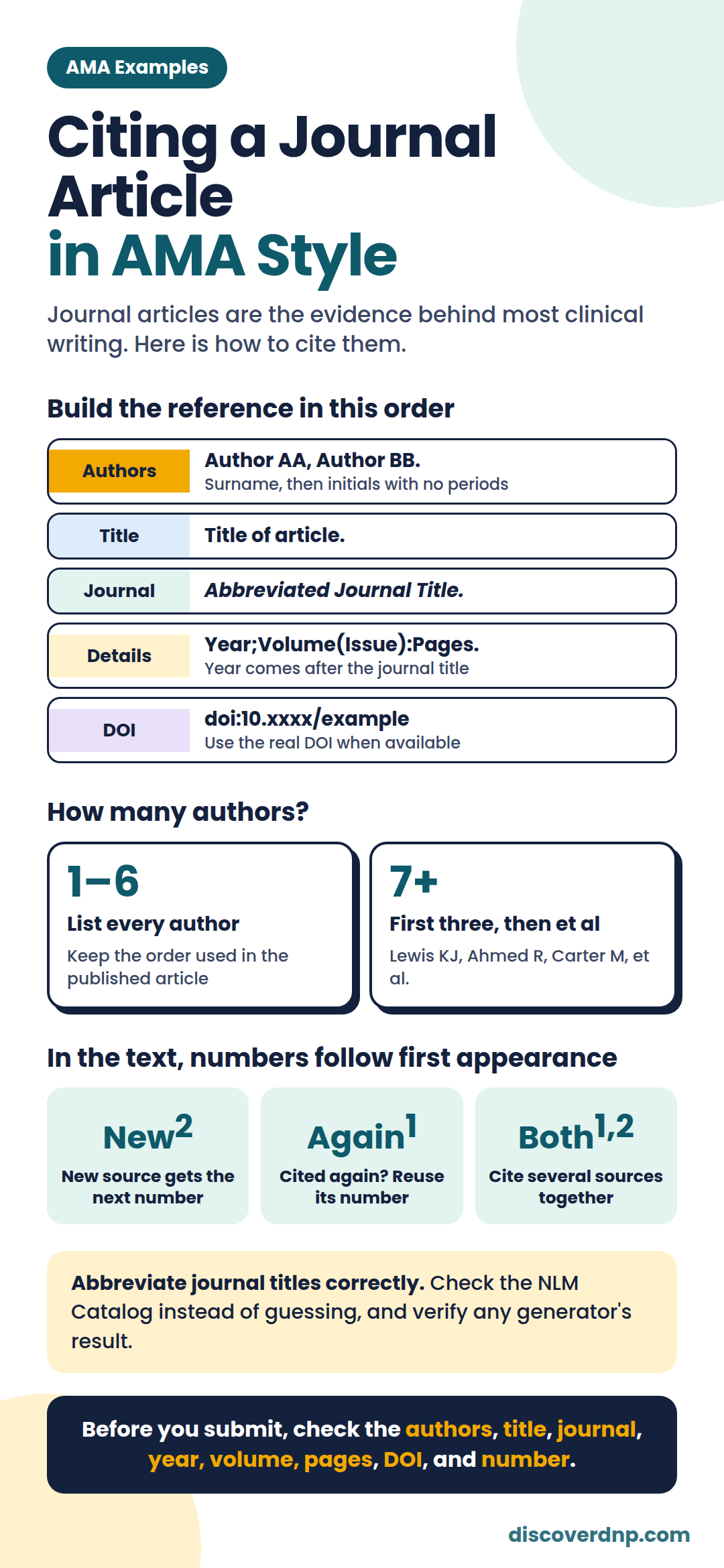
Conclusion
Mastering the AMA citation format is an essential skill for producing accurate, credible, and professional academic writing in nursing and health sciences. By understanding how to use superscript in-text citations, number references in order of appearance, format different source types, and apply the correct capitalization, punctuation, and journal abbreviations, writers can present research findings clearly and make it easier for readers to locate supporting evidence. The AMA Manual of Style, 11th edition, provides the primary guidance for these requirements, while resources such as Purdue OWL, library LibGuides, and citation generators offer practical assistance throughout the referencing process.
However, accurate referencing requires more than following a template or relying on an automated tool. Every citation should be checked against the original publication, particularly when dealing with journal articles, clinical practice guidelines, electronic sources, and medical reports. Paying attention to author names, publication dates, DOIs, URLs, and standard journal abbreviations helps prevent errors that could undermine the credibility of an academic paper. With consistent practice and careful verification, AMA citation format becomes easier to apply, supporting responsible scholarship, effective communication, and evidence-based practice in healthcare.
Frequently Asked Questions
1. What is the AMA format for citations?
The AMA citation format is a numbered referencing style established by the American Medical Association for medical, nursing, and other health sciences writing. It uses superscript Arabic numerals in the text to identify sources, with a numbered reference list arranged in the order each source first appears. The AMA Manual of Style, 11th edition, provides detailed guidance on formatting citations and references.
2. How do I create an AMA citation?
To create an AMA citation, identify the source type, collect the necessary details (such as author names, title, publication date, journal or publisher, page numbers, and DOI or URL), and format the information according to AMA guidelines. Assign each source a number based on its first appearance in the text, use that number as a superscript in-text citation, and include the complete reference in the numbered reference list. Check the final citation against the original source.
3. How to cite AMA in-text example?
AMA in-text citations use superscript numbers placed after the relevant statement, generally outside periods and commas. For example:
Patient education can improve medication adherence.¹
If you cite the same source again later, reuse its original number rather than assigning a new one. If you cite another source for the first time, assign the next available number.
4. Can you provide an example of an AMA referencing style?
Yes. Here is an illustrative journal article reference in AMA style:
Reference list:
- Carter LM, Davis P. Patient education and medication adherence. J Clin Nurs. 2024;33(2):120-128.
In-text citation:
Patient education can support medication adherence.¹
This example is fictional and demonstrates the format only. For an actual assignment, use the source’s verified author names, article title, journal abbreviation, publication details, and DOI when available.
