

Informative Speech Topics and Ideas: 100+ Best Informative Speeches for College Students
Informative speech topics and ideas are central to effective communication, knowledge sharing, and the development of strong public speaking skills. An informative speech provides a structured way to explain concepts, clarify unfamiliar subjects, and help an audience understand a particular issue, process, event, or discovery. Unlike a persuasive speech, which seeks to influence beliefs, attitudes, or actions, an informative speech focuses on presenting accurate, relevant information in a clear and balanced manner. Its effectiveness depends on the speaker’s ability to simplify complex ideas, organize information logically, and make the subject meaningful to the audience. Whether the presentation addresses a healthcare procedure, a scientific discovery, a social issue, or an everyday activity, the central purpose is to educate the audience rather than persuade them to adopt a particular position.
Choosing the right informative speech topic is an essential step in preparing a successful presentation. A good topic should provide sufficient information for meaningful discussion while remaining focused enough to cover within the available time. Broad subjects, such as healthcare or technology, may need to be narrowed to specific areas, such as infection prevention in hospitals or the role of artificial intelligence in medical diagnosis. Similarly, a topic that is too narrow may not provide enough material to develop substantial main points. Effective topic selection therefore involves considering the purpose of the speech, the audience’s existing knowledge, the available research, and the level of detail required. Subjects related to patient safety, mental health awareness, medical ethics, nutrition, and advances in healthcare can offer valuable opportunities to explain important concepts, while topics in psychology, environmental science, history, arts, and entertainment provide equally useful alternatives.
Developing informative speech ideas into a well-structured presentation requires research, organization, and careful explanation. Speakers need to identify credible sources, distinguish established facts from unsupported claims, and select evidence that directly supports the purpose of the speech. Information should be arranged in a logical sequence, with each main point contributing to the audience’s understanding of the subject. Definitions can clarify unfamiliar terminology, comparisons can explain differences between related concepts, and real-life examples can demonstrate how information applies in practical situations. For instance, a speech about infection prevention can explain how microorganisms spread, describe appropriate hand hygiene practices, and illustrate how consistent infection control measures reduce the risk of healthcare-associated infections. Visual aids, relevant statistics, and clear explanations can further strengthen an informative presentation when they help clarify the subject rather than distract from it.
An effective informative speech also depends on the speaker’s ability to communicate information at an appropriate level of complexity. A technically accurate presentation may still be difficult to follow if it contains excessive jargon, poorly connected ideas, or unexplained assumptions. Speakers should consider what the audience already knows, which concepts require additional explanation, and how the information can be presented in an accessible and engaging way. Preparation should include organizing the introduction, body, and conclusion; allocating sufficient time to each main point; citing sources appropriately; and practicing delivery to improve clarity, pacing, and confidence. These skills help transform research into an informative presentation that is coherent, credible, and useful.
This guide explores informative speech topics and ideas across a range of academic, professional, scientific, and everyday subjects. It covers the different types of informative speeches, the characteristics of an effective presentation, and the criteria for selecting and researching a suitable topic. It also examines topics related to college education, nursing and healthcare, science and technology, psychology, health, sports, arts, entertainment, environmental issues, society, and culture. In addition to providing topic ideas, the discussion explains how to narrow a broad subject, organize main points, incorporate credible evidence, use examples and visual aids, and deliver information effectively. Understanding these principles makes it easier to develop a presentation that is accurate, well organized, and appropriate for its intended audience, while strengthening the communication skills needed in academic, clinical, and professional settings.
Understanding Informative Speeches and Their Purpose
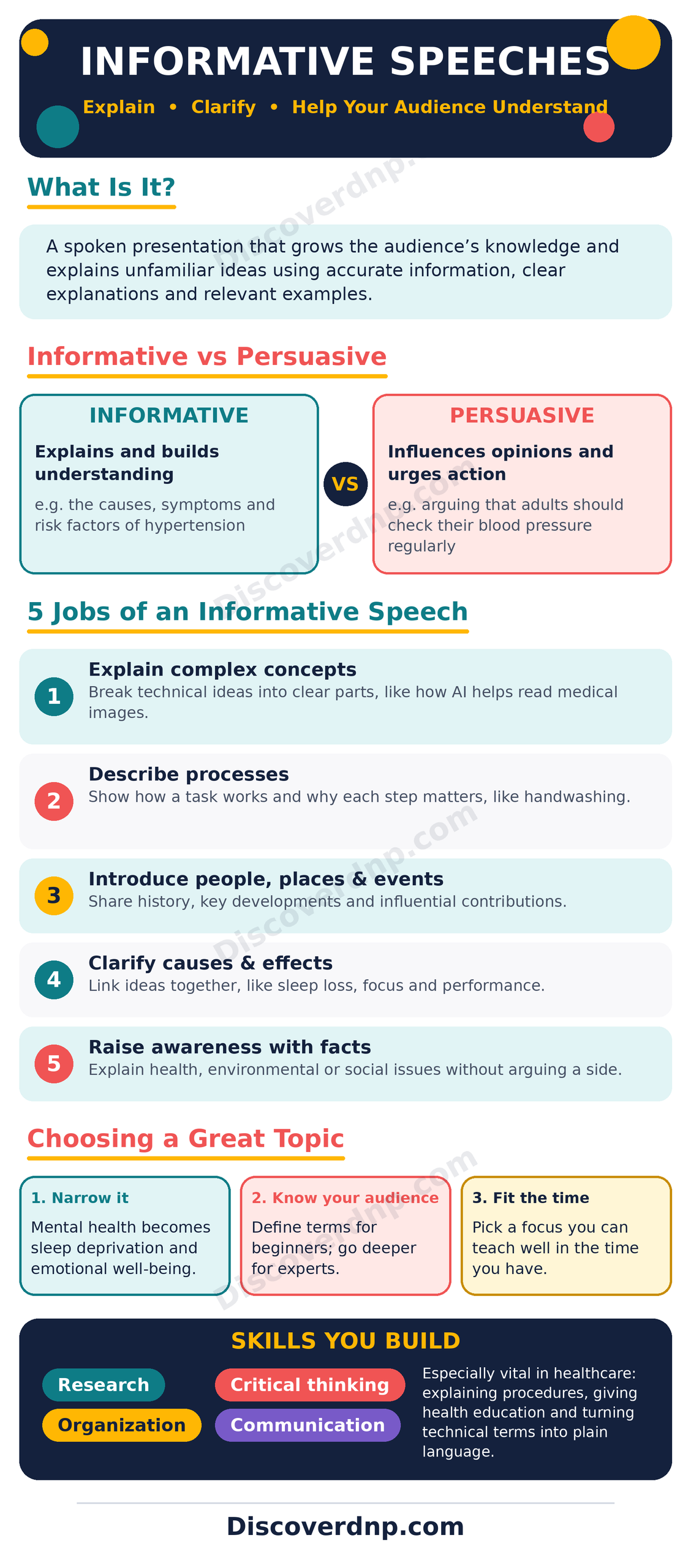
Informative speeches are a form of oral communication designed to increase an audience’s knowledge, explain unfamiliar concepts, and improve understanding of a particular subject. Unlike everyday conversations, an informative speech follows a deliberate structure that allows a speaker to present information in a logical, organized, and accessible manner. The subject may involve explaining a scientific discovery, describing a historical event, demonstrating a practical skill, or examining how a healthcare procedure works. The primary objective is to help the audience understand the topic through accurate information, clear explanations, and relevant examples.
An informative speech differs from a persuasive speech in its central purpose. While persuasive speaking aims to influence opinions, encourage a particular action, or convince listeners to accept an argument, informative speaking emphasizes explanation and understanding. For example, a presentation about the causes and symptoms of hypertension would explain the condition, its risk factors, and its effects on the body. A persuasive speech on the same subject might argue that adults should monitor their blood pressure regularly. Although informative speeches can influence how people think by increasing their knowledge, they should not rely on manipulating emotions or presenting opinions as established facts.
The purpose of an informative presentation can be understood through several important functions:
- Explaining complex concepts: A speaker breaks down unfamiliar or technical information into understandable parts. For example, a presentation on artificial intelligence in healthcare might explain how algorithms analyze medical images and assist clinicians in identifying abnormalities.
- Describing processes and procedures: An informative speech can explain how a process occurs or how a task is performed. A presentation on hand hygiene, for instance, can describe the steps involved in effective handwashing and explain why each step matters.
- Introducing people, places, and events: Speakers can provide historical background, describe significant developments, or explain the contributions of influential individuals.
- Clarifying causes, effects, and relationships: A presentation can explore how one event or condition relates to another, such as the relationship between sleep deprivation, concentration, and cognitive performance.
- Increasing awareness through reliable information: Speakers can explain public health concerns, environmental challenges, or social developments without turning the presentation into an argument designed to compel agreement.
Choosing suitable informative speech topics and ideas begins with understanding what the audience should learn. A topic is not simply a subject that interests the speaker; it should provide an opportunity to communicate meaningful knowledge within the available time. A broad subject such as mental health can be narrowed to the effects of sleep deprivation on emotional well-being, while a general topic such as medical technology can be developed into an explanation of how pulse oximeters estimate peripheral oxygen saturation.
The audience’s existing knowledge also influences how information should be presented. A presentation about medication safety for a general audience may need to define terms such as dosage, adverse reaction, and drug interaction. A presentation for a clinically experienced audience may instead examine medication reconciliation, high-alert medications, and systems for reducing administration errors. In both cases, the speaker should select relevant information and explain it at a level that supports understanding.
Informative speeches also contribute to academic and professional development by strengthening research, critical thinking, organization, and communication. Preparing a speech requires the speaker to identify credible sources, evaluate evidence, distinguish facts from interpretations, and explain findings accurately. These skills are particularly valuable in healthcare, where professionals regularly communicate clinical information, explain procedures, provide health education, and translate technical concepts into language that patients and colleagues can understand.
A well-chosen informative speech topic therefore serves two connected purposes: it gives the speaker a clear direction for research and gives the audience a meaningful learning objective. Whether the subject involves anatomy, infection prevention, environmental sustainability, or the history of scientific discoveries, the success of the presentation depends on how effectively it communicates accurate information and helps listeners develop a clearer understanding of the subject.
Types of Informative Speeches
Informative speeches can be classified according to the kind of information being communicated and the way the subject is explained. Understanding the different types of informative speech helps speakers choose an appropriate approach, organize their main points, and determine which examples or supporting materials will make the topic easier to understand.
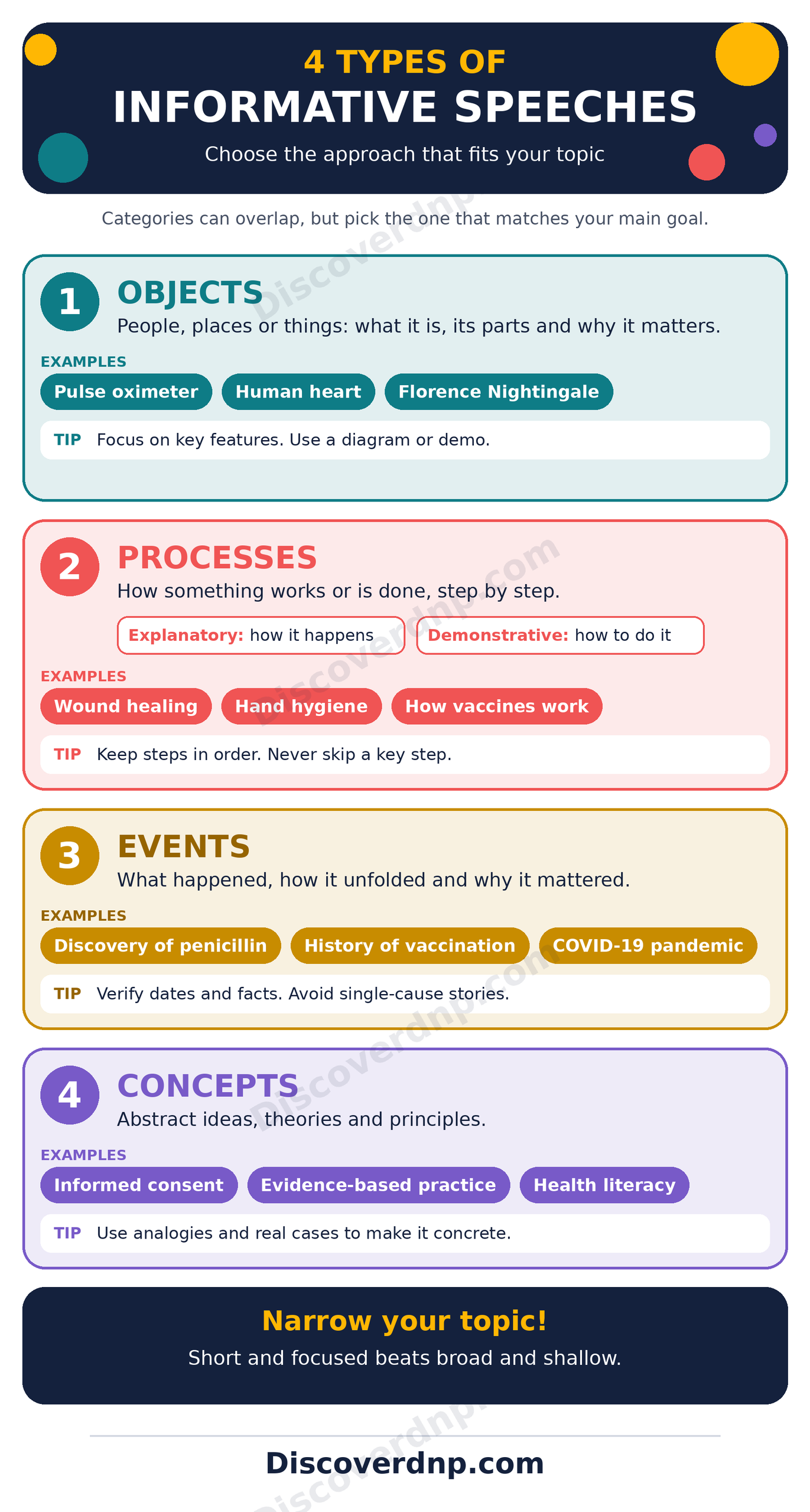
Although some presentations combine more than one approach, four widely used categories are speeches about objects, processes, events, and concepts. These categories provide a practical starting point for selecting a good topic and developing it into a focused presentation.
1. Informative Speeches About Objects
Object-focused speeches explain the characteristics, components, functions, or significance of a particular person, place, physical item, or other identifiable subject. The word object is interpreted broadly in public speaking; the subject does not have to be an inanimate item. It may include a medical device, an anatomical structure, a historical monument, or an influential individual.
The purpose is to help the audience understand what the subject is, what distinguishes it, how its parts relate to one another, or why it matters.
Examples of topics for informative speeches about objects include:
- The structure and functions of the human heart.
- The parts and operation of a pulse oximeter.
- The role of an autoclave in sterilization.
- The anatomy and functions of the kidneys.
- The development and significance of the stethoscope.
- The contributions of Florence Nightingale to modern nursing.
A presentation about a pulse oximeter, for example, could explain the device’s sensor, display, light-based measurement principle, and reported readings. It could clarify the difference between oxygen saturation (SpO₂) and pulse rate, helping the audience understand what the device measures and what its readings can and cannot establish.
When preparing an object-focused presentation, the speaker should identify the most important features rather than attempt to describe every detail. A diagram, photograph, labeled illustration, or physical demonstration can be useful when it helps listeners visualize the subject. The information should remain focused on the object itself, although its uses and significance may be discussed to provide context.
2. Informative Speeches About Processes
Process-focused speeches explain how something works, how an event develops, or how a task is completed. These presentations often follow a chronological or step-by-step structure, allowing the audience to understand the sequence of actions or stages involved.
There are two common approaches to explaining a process:
- Explanatory processes: These describe how something happens or functions, without requiring the audience to perform the process themselves.
- Demonstrative processes: These explain how to carry out a task, often through instructions, illustrations, or a practical demonstration.
For example, a speech on how the body regulates temperature would explain the physiological responses involved in maintaining homeostasis. A presentation on measuring blood pressure manually could describe equipment preparation, cuff placement, auscultation, and interpretation of the reading.
Other process-based informative speech ideas include:
- How wound healing progresses through its major phases.
- How vaccines stimulate an immune response.
- How microorganisms spread through contact and contaminated surfaces.
- How a laboratory processes a blood sample.
- How artificial intelligence systems analyze medical images.
- How to perform effective hand hygiene in a healthcare setting.
A process speech should present information in an order that the audience can follow. If the process involves a series of actions, omitting an important step may make the explanation incomplete or misleading. If the process describes a biological or scientific mechanism, the speaker should explain the relationships between stages rather than simply listing them.
For instance, a presentation about wound healing could explain hemostasis, inflammation, proliferation, and remodeling. It should also clarify that these phases overlap and that healing varies according to factors such as wound type, infection, circulation, nutrition, and the individual’s overall health.
Process-focused topics are especially useful when the learning objective involves understanding a mechanism or procedure. However, the speaker should avoid allowing a short presentation to become an exhaustive technical manual. The selected steps and details should match the purpose, audience, and available presentation time.
3. Informative Speeches About Events
Event-focused speeches explain something that happened, how it unfolded, why it was significant, or what consequences followed. The subject may be a historical event, a scientific breakthrough, a public health emergency, a major cultural development, or a significant event in a professional field.
These presentations commonly use chronological organization, although a cause-and-effect structure may be more appropriate when the goal is to explain the reasons for an event and its consequences.
Examples include:
- The discovery and development of penicillin.
- The history of vaccination and its role in disease prevention.
- The development of modern anesthesia.
- The emergence and global effects of the COVID-19 pandemic.
- The evolution of nursing education and professional practice.
- Major milestones in organ transplantation.
A speech about the development of penicillin, for example, could describe Alexander Fleming’s observation of antibacterial effects in 1928, the subsequent research that helped develop penicillin into a usable treatment, and its broader impact on medicine. This approach helps the audience understand not only what happened but also how scientific discoveries develop through observation, testing, collaboration, and further investigation.
Event-based informative speeches should distinguish verified historical facts from disputed interpretations. Dates, names, and claims about significance should be checked against credible historical, scientific, or institutional sources. A speaker should also avoid presenting complex events as the result of a single action when many individuals, circumstances, and developments contributed to them.
When choosing event-based topics, it is helpful to consider whether the event offers enough reliable material for a coherent explanation. A narrow topic, such as the introduction of a particular vaccine, may be more manageable than a broad subject such as the entire history of medicine.
4. Informative Speeches About Concepts
Concept-focused speeches explain abstract ideas, theories, principles, conditions, or systems of thought. These subjects often require definitions, comparisons, examples, and explanations of relationships because the audience may not be able to observe the concept directly.
Concept-based topics are useful when the purpose is to clarify what an idea means, how it is understood, or how it applies in a particular setting.
Examples include:
- The principles of patient autonomy and informed consent.
- The relationship between stress and physical health.
- The concept of evidence-based practice in nursing.
- The ethical principles guiding healthcare decisions.
- The role of health literacy in patient education.
- The meaning of cultural competence in healthcare.
- The relationship between artificial intelligence and clinical decision-making.
A presentation on evidence-based practice, for example, could explain how research evidence, clinical expertise, and patient preferences contribute to healthcare decisions. It could use a real-life example, such as selecting an appropriate pressure injury prevention strategy, to demonstrate how the concept informs clinical practice.
Concept-based speeches require particular attention to clarity. Abstract terminology can become confusing if the speaker relies on definitions alone. Comparisons, analogies, brief case examples, and practical applications help make the subject more concrete. A presentation about informed consent, for instance, could explain the principles of disclosure, understanding, voluntariness, and decision-making capacity, then illustrate their relevance through a hypothetical patient scenario.
Because concepts can be broad, narrowing the topic is important. A speech about ethics in healthcare might attempt to cover many competing principles, whereas a presentation on patient autonomy in treatment decisions allows for a more focused discussion.
These four categories are useful planning tools rather than rigid boundaries. A speech about infection prevention could explain the concept of transmission, describe the process of hand hygiene, and discuss historical developments in infection control. The main category should reflect the presentation’s central learning objective, while any additional approaches should support that objective.
Essential Characteristics of an Informative Speech
An effective informative speech does more than present a collection of facts. It transforms information into a clear, meaningful explanation that helps listeners understand a subject. A speaker may have extensive knowledge of a topic, but the presentation will be less effective if the information is inaccurate, poorly organized, overly technical, or unrelated to the audience’s needs. Strong informative speeches combine reliable research, a clearly defined purpose, logical organization, appropriate supporting evidence, and accessible language.
Public-speaking resources from the University of Arkansas and the University of Florida emphasize that informative presentations should explain, describe, define, or demonstrate a subject in a way that allows the audience to understand it. The structure and delivery should reflect the specific purpose of the presentation.
The following characteristics distinguish an effective informative speech from a presentation that simply lists information.
1. A clear purpose and focused topic
Every informative speech should have a specific purpose that identifies what the audience is expected to learn. Without a clear objective, the speaker may include unrelated details, move between different subjects, or provide more information than the available time allows.
A focused informative speech topic makes it easier to identify relevant research, develop main points, and determine which details deserve the most attention.
For example, consider the broad subject of healthcare technology. This subject could include electronic health records, robotic surgery, artificial intelligence, telehealth, wearable devices, and many other developments. Attempting to cover all these areas in a five-minute presentation would result in a superficial discussion.
A narrower topic, such as How Artificial Intelligence Supports Medical Image Analysis, provides a more manageable focus. The speaker could explain how AI systems process images, describe their potential role in identifying abnormalities, and discuss the importance of clinician oversight.
A clear purpose statement might be:
The purpose of this speech is to explain how artificial intelligence assists healthcare professionals in analyzing medical images.
This statement identifies the educational objective without asking the audience to agree with an argument. It also establishes boundaries for the research and helps prevent the presentation from drifting into unrelated discussions about technology.
2. Accuracy and credibility of information
An informative speech should be based on information that can be verified through reliable evidence. Accuracy is especially important when discussing scientific discoveries, medical conditions, historical events, statistics, or technical processes. Incorrect information can create misunderstandings and undermine the speaker’s credibility.
Research should draw on sources appropriate to the subject, such as:
- Peer-reviewed scholarly articles and systematic reviews.
- Academic textbooks and established reference works.
- Government health departments and public health agencies.
- Professional organizations and recognized scientific institutions.
- Official clinical guidelines and evidence-based practice recommendations.
For a presentation about infection prevention, for example, a speaker could consult guidance from the World Health Organization or the U.S. Centers for Disease Control and Prevention, alongside relevant peer-reviewed research. These sources can help verify recommendations and explain the evidence supporting particular practices.
The speaker should also distinguish between established facts, preliminary findings, expert interpretations, and unresolved questions. A single study may suggest an association between two variables without proving that one causes the other. Similarly, a promising experimental treatment should not be described as an established standard of care unless the available evidence supports that conclusion.
Credibility also depends on citing sources appropriately. When a speech includes a statistic, research finding, expert quotation, or specific factual claim, the speaker should identify its source according to the assignment’s requirements. This allows the audience to evaluate the evidence and demonstrates that the presentation is grounded in research rather than unsupported personal opinion.
The University of Florida’s guidance on speech writing emphasizes the importance of communicating information completely and clearly, while academic public-speaking materials highlight the need for credible evidence and appropriate organization.
3. Logical organization and a coherent structure
A well-organized speech presents information in an order that makes sense to the audience. Even accurate facts can be difficult to understand when they are introduced without context or arranged randomly.
Most informative speeches follow three major structural components:
- Introduction: Introduces the topic, establishes its relevance, captures attention, and previews the main points.
- Body: Develops the central ideas through explanations, supporting evidence, examples, and relevant details.
- Conclusion: Summarizes the most important information and reinforces the central learning objective.
Within the body, the speaker can use different organizational patterns depending on the subject.
| Organizational pattern | How it works | Example topic |
|---|---|---|
| Chronological | Presents information in time order. | The history of penicillin |
| Sequential | Explains steps or stages in order. | The process of wound healing |
| Topical | Divides a subject into related categories. | Major functions of the kidneys |
| Cause and effect | Explains relationships between causes and outcomes. | How sleep deprivation affects concentration |
| Compare and contrast | Explains similarities and differences. | CT scans and MRI examinations |
These patterns help the speaker arrange main points according to the information being communicated. A speech about a historical discovery may benefit from chronological organization, while a presentation comparing two diagnostic procedures may be easier to follow when organized by similarities and differences.
For example, an informative presentation on wound healing could begin with an explanation of the body’s response to injury, then discuss the major phases of healing, and finish by explaining factors that can delay recovery. This sequence provides a conceptual foundation before introducing more detailed information.
A coherent structure also requires transitions between ideas. Phrases such as the next stage, another important function, and this process differs from help listeners recognize how one point connects to the next. These transitions should clarify relationships rather than simply fill space.
4. Clear language and accessible explanations
Informative speeches should make information understandable without oversimplifying important facts. The speaker needs to consider the audience’s knowledge level and explain technical terms, unfamiliar abbreviations, and complex concepts when necessary.
This characteristic is particularly important when discussing healthcare, where medical terminology can be precise but unfamiliar to people outside the profession.
For example, a presentation about hypertension could define the condition as persistently elevated blood pressure and explain the meaning of systolic and diastolic measurements before discussing complications. Simply using terms such as cardiovascular morbidity or end-organ damage without explanation may prevent some listeners from following the discussion.
Several techniques can improve clarity:
- Define unfamiliar terminology when it first appears.
- Divide complex explanations into smaller, connected ideas.
- Use comparisons or analogies when they accurately represent the concept.
- Explain abbreviations before using them repeatedly.
- Replace unnecessary jargon with familiar language.
- Provide examples that demonstrate how abstract concepts apply in real situations.
Consider a speech about oxygen saturation. Instead of merely stating that SpO₂ is a peripheral estimate of arterial oxygen saturation obtained through pulse oximetry, the speaker could explain that a pulse oximeter uses light to estimate how much hemoglobin carries oxygen. The explanation can then clarify that the reading is not a direct measurement of the amount of oxygen dissolved in the blood and that readings may be affected by several technical and physiological factors.
The goal is not to remove all technical terminology. Rather, the speaker should introduce terminology in a way that builds understanding progressively.
5. Relevant examples and supporting evidence
Examples help listeners connect information with situations they can recognize. They can illustrate how a process works, clarify a definition, demonstrate the practical significance of a concept, or show how research findings apply outside an academic text.
Useful supporting materials include:
- Real-life examples and hypothetical case scenarios.
- Relevant statistics and research findings.
- Expert explanations and properly attributed quotations.
- Comparisons, illustrations, and demonstrations.
- Diagrams, charts, photographs, and other appropriate visual aids.
For example, a presentation about medication errors could explain common categories of errors and then describe a hypothetical scenario in which two medications have similar packaging. The example could demonstrate why medication identification, label verification, and established administration procedures matter.
The example should support the educational objective rather than become a lengthy story that distracts from the main points. Likewise, statistics should be explained in context. A number without a clear reference population, timeframe, or explanation may sound impressive without helping the audience understand its significance.
Examples should also be selected carefully. In healthcare presentations, hypothetical cases must not be presented as documented events, and real patient information should be handled in accordance with privacy requirements. Supporting material should clarify the subject without introducing unsupported claims or unnecessary detail.
6. Objectivity and a balanced presentation
The purpose of an informative speech is to explain a subject accurately rather than manipulate the audience toward a predetermined conclusion. Objectivity requires the speaker to distinguish factual information from personal beliefs and to represent the available evidence fairly.
This does not mean that every subject must be presented as though all claims have equal scientific support. When reliable evidence strongly supports one explanation over another, the speech should communicate that distinction. Balance means representing the evidence proportionately, not giving unsupported claims the same weight as well-established findings.
For example, a speech about vaccine development could explain how vaccines stimulate immune responses, describe the process used to evaluate safety and effectiveness, and discuss recognized limitations or adverse effects using reliable evidence. It should not present unsupported claims as equivalent to findings from extensive scientific research.
Similarly, a presentation about artificial intelligence in healthcare could explain potential benefits, such as assisting with pattern recognition, while also discussing limitations involving data quality, bias, privacy, and the need for clinical judgment.
The speaker should avoid emotionally loaded wording, selective statistics, and exaggerated conclusions. If evidence remains uncertain or researchers disagree about an issue, that uncertainty should be acknowledged. This approach helps maintain the distinction between an informative speech and a persuasive speech.
7. Audience relevance and appropriate depth
A topic can be accurate and well researched but still fail to communicate effectively if it does not account for the audience’s needs. An informative speech should provide information that is relevant to the listeners while remaining within the scope of the assignment.
Audience relevance involves considering:
- Existing knowledge of the subject.
- The reason the audience is listening.
- The terminology and background knowledge required.
- The practical or academic value of the information.
- The amount of detail that can be covered within the time limit.
For instance, a presentation about pressure injuries intended for a general audience might explain what pressure injuries are, why prolonged pressure can damage tissue, and how repositioning and skin assessment contribute to prevention. A presentation for a healthcare audience could examine staging, risk assessment, pressure redistribution, and evidence-based prevention protocols in greater detail.
Both presentations address the same general subject, but the depth, vocabulary, and supporting examples differ according to the intended audience.
Audience relevance should not be confused with entertaining the audience at all costs. A serious subject can be engaging when the speaker explains why it matters, presents information clearly, and uses examples that make the material easier to understand.
8. Appropriate delivery and use of visual aids
An informative speech is a spoken presentation, so the delivery must support the content. Clear pronunciation, appropriate pacing, effective pauses, and purposeful eye contact help listeners follow the explanation. Reading every sentence directly from slides or notes can make the presentation difficult to engage with, particularly when the speaker speaks too quickly or fails to explain important points.
Visual aids can strengthen understanding when they serve a specific purpose. A labeled anatomical diagram may help explain the structure of the heart, while a flowchart may clarify the stages of a laboratory process. A chart may be appropriate for comparing research findings, provided that the axes, units, and relevant limitations are explained.
However, visual aids should complement rather than replace the speaker’s explanation. Slides crowded with paragraphs, unexplained abbreviations, or decorative images can distract from the message. Each visual should help answer a relevant question about the topic or make a difficult concept easier to understand.
For example, in a presentation on blood circulation, a clearly labeled diagram can show the pathway through the heart, lungs, and systemic circulation. The speaker can then explain the movement of blood and the role of each chamber rather than expecting the audience to interpret the illustration independently.
The delivery should also match the nature of the subject. A demonstration requires enough visibility and time for the audience to follow the process, while a concept-based presentation may require slower explanations and additional examples.
Taken together, these characteristics help distinguish a genuinely informative presentation from a speech that simply contains a large amount of material. A strong informative speech has a clear educational purpose, relies on credible information, follows a logical structure, uses accessible language, and presents relevant evidence fairly. Its examples, visuals, and delivery techniques should all serve the same objective: helping the audience understand and retain the most important information.
For further guidance on informative speaking and speech organization, useful educational resources include the University of Arkansas’s Advanced Public Speaking textbook, the University of Florida’s speech-writing guidance, and the University of South Florida’s Speech Communication textbook.
Choosing and Researching an Informative Speech Topic
Choosing and researching an informative speech topic are essential steps in developing a clear, accurate, and engaging presentation. The topic determines what information the speaker will explore, which sources will be needed, how the main points will be organized, and what the audience should understand by the end of the speech. Even a confident speaker may struggle to deliver an effective presentation if the subject is too broad, lacks reliable research, or does not match the purpose of the assignment.
The process involves more than selecting something interesting to discuss. A suitable topic must be manageable within the available presentation time, relevant to the audience, appropriate for the assignment, and supported by credible information. Public-speaking textbooks and university communication resources emphasize that effective topic selection involves narrowing a broad subject, identifying a specific purpose, considering audience needs, and evaluating whether sufficient research material is available.
For example, healthcare is a broad subject that could include medical ethics, disease prevention, nursing practice, diagnostic technology, mental health, and healthcare policy. Attempting to cover all these areas in a short presentation would leave little opportunity to explain any of them in depth. A more focused topic, such as how hand hygiene reduces the transmission of healthcare-associated infections, allows the speaker to explain a defined process, discuss relevant evidence, and use practical examples to clarify the subject.
The same principle applies to other academic and general subjects. Rather than discussing technology as a whole, a speaker could explain how artificial intelligence supports medical image analysis. Instead of covering environmental problems broadly, the presentation could examine how plastic waste affects marine ecosystems. These narrower informative speech topics create a clearer direction for research and make it easier to select meaningful supporting details.
A systematic approach to topic selection and research generally involves three connected tasks:
- Evaluating potential topics: Identifying subjects that are interesting, relevant, sufficiently focused, and appropriate for an informative presentation.
- Matching the topic to the assignment and audience: Ensuring that the subject meets academic requirements, fits the time limit, and addresses the audience’s level of understanding.
- Finding and evaluating evidence: Locating credible sources, checking factual claims, and selecting supporting material that strengthens the explanation.
These tasks are closely related, but each serves a distinct purpose. A topic may be interesting yet unsuitable for a particular assignment; it may fit the assignment but lack sufficient reliable evidence; or it may be well researched but too broad for the available time. Evaluating these factors together helps the speaker develop an informative presentation that is both academically appropriate and educationally valuable.
Criteria for Selecting a Suitable Speech Topic
A suitable informative speech topic should provide enough material for a meaningful explanation without becoming too broad, too technical, or too difficult to research. The best informative speech topics are not necessarily the most complicated or unusual subjects. They are topics that allow the speaker to communicate useful knowledge clearly, support explanations with reliable evidence, and maintain a consistent focus throughout the presentation.
Several criteria can help determine whether a potential topic is appropriate.
1. Relevance to the purpose of the speech
The first consideration is whether the topic supports the goal of informing the audience. An informative speech should explain a subject, describe an event, clarify a concept, or demonstrate how a process works. If the primary objective is to convince listeners to adopt a particular belief or take a specific action, the presentation may be better suited to a persuasive speech.
Consider the difference between these topics:
- Informative: How vaccines stimulate the immune system.
- Informative: The development and clinical applications of artificial intelligence in healthcare.
- Persuasive: Why every adult should receive a particular vaccine.
- Persuasive: Why hospitals should replace all traditional diagnostic methods with artificial intelligence.
The informative examples focus on explanation, whereas the persuasive examples advocate a position. Although an informative speech may discuss benefits, limitations, and controversies, these details should help the audience understand the subject rather than serve as arguments designed to secure agreement.
When evaluating potential informative speech topics and ideas, identify the main learning objective first. Ask what the audience should understand after hearing the presentation. If the objective can be expressed as an explanation of a process, concept, event, or subject, the topic may be appropriate for informative speaking.
2. A manageable scope and level of specificity
One of the most common topic-selection mistakes is choosing a subject that is too broad to cover adequately. A broad topic may contain enough information for an entire course or book, making it difficult to decide which details deserve attention during a short presentation.
For example, consider how the following subjects can be narrowed:
| Broad subject | More focused informative speech topic |
|---|---|
| Healthcare | The role of hand hygiene in preventing hospital-acquired infections |
| Mental health | The relationship between sleep deprivation and concentration |
| Technology | How artificial intelligence assists medical image analysis |
| Nutrition | The role of dietary fiber in digestive health |
| Environment | How plastic pollution affects marine ecosystems |
| Nursing | The purpose and principles of patient assessment |
The more specific topic provides a clearer direction for research and organization. It also helps the speaker avoid including unrelated information simply because it falls within the same general subject.
A useful way to narrow a subject is to move through three stages:
- Identify a broad area: For example, patient safety.
- Select a specific aspect: Medication administration safety.
- Define a manageable focus: The role of medication reconciliation in identifying discrepancies between a patient’s medication records.
The final topic offers a defined area for explanation without requiring the speaker to cover every aspect of patient safety or medication management.
Topic scope should also reflect the presentation time. A four-minute speech may support one central idea and two or three carefully developed main points. A longer presentation may allow additional examples, comparisons, and supporting evidence. The objective is not to include as many facts as possible but to explain a manageable subject sufficiently well.
The University of South Florida and other open educational public-speaking resources emphasize narrowing topics to match the available time and selecting a specific purpose that can realistically be accomplished within the presentation.
3. Personal interest and familiarity with the subject
Interest is another important consideration because it influences the effort a speaker is willing to invest in researching and preparing a presentation. A topic that stimulates curiosity is often easier to investigate, organize, and explain with enthusiasm.
Personal familiarity can also provide a useful starting point. Someone interested in technology may explore artificial intelligence, cybersecurity, or digital learning. A person interested in healthcare may investigate wound healing, patient safety, nutrition, or the development of diagnostic procedures.
However, prior familiarity should not replace research. Knowing something about a subject does not guarantee that every assumption is accurate or that the speaker understands the latest evidence.
For instance, a person familiar with pulse oximeters may know that these devices display oxygen saturation and pulse rate. Further research can clarify how pulse oximetry works, why poor peripheral perfusion can affect readings, and why a pulse oximeter cannot independently establish every aspect of a patient’s respiratory status.
A useful approach is to select a subject at the intersection of three areas:
- What the speaker finds interesting.
- What the audience can learn from the presentation.
- What can be supported by credible, accessible information.
This balance makes it easier to develop engaging ideas without sacrificing relevance or accuracy. University of Tennessee guidance on speech research similarly recommends considering the audience, the purpose of the presentation, and the availability of authoritative supporting material.
4. Availability of credible research material
A topic may sound interesting but become difficult to develop if reliable information is scarce. Before committing to a subject, conduct preliminary research to determine whether reputable sources provide enough evidence to explain it.
This does not mean that a topic must have hundreds of scholarly articles. A historical subject may be supported by archival records, authoritative books, and museum resources, while a medical topic may require peer-reviewed studies, clinical guidelines, and public health publications.
For example, a presentation about infection prevention can draw on established guidance from public health agencies and research examining healthcare-associated infections. A presentation about a newly developed medical device may require recent scientific publications and information from relevant regulatory authorities.
Preliminary research should establish whether the topic has:
- Reliable definitions and background information.
- Evidence that supports its main explanations.
- Relevant examples, case studies, or illustrations.
- Sufficient material for the required number of main points.
- Sources appropriate to the subject and academic level.
If the available information consists mainly of personal blogs, unsupported claims, promotional content, or repeated references to a single unverified source, it may be necessary to narrow the topic differently or choose another subject.
5. Educational value and audience interest
A good topic should offer a meaningful learning opportunity. It does not have to be serious or directly related to a profession to be educational. Subjects involving hobbies, everyday technology, music, sports, food, and cultural practices can all support informative presentations when they explain something clearly.
For example, a speech about knitting could examine the basic structure of knitted fabric, the differences between knitting techniques, and the development of common patterns. The topic becomes informative because it explains a skill and its underlying principles rather than simply announcing that knitting is enjoyable.
Likewise, a speech about social media could explain how recommendation algorithms select content, how engagement metrics work, and how online platforms organize information. The educational value comes from the knowledge communicated, not merely the popularity of the subject.
The speaker should also consider whether the topic offers something meaningful to the intended audience. A familiar subject can still be interesting when approached from a new perspective. Explaining how common household thermometers work, for example, may be more educational than providing a general description of temperature measurement.
6. Appropriate complexity and ethical considerations
Some topics involve technical information, sensitive experiences, disputed claims, or potentially harmful misconceptions. These subjects are not automatically unsuitable, but they require careful planning.
A highly specialized medical topic may require extensive background knowledge to explain accurately. If the speaker cannot understand the evidence well enough to communicate it responsibly, a simpler related topic may be more appropriate.
Similarly, topics involving mental health, reproductive health, substance use, disability, or patient experiences should be handled with accurate language, respect, and awareness of privacy. A speech should avoid stigmatizing descriptions, unsupported generalizations, and sensationalized examples.
Controversial subjects also require careful distinctions between verified information and opinion. For example, a presentation on the use of artificial intelligence in clinical decision-making can explain current applications, reported benefits, documented limitations, and unresolved research questions. It should not present every potential benefit as a proven clinical outcome or assume that all applications are equally effective.
The aim is to choose a topic that can be explained accurately and responsibly at the level required by the assignment.
Matching Topics to Academic Requirements and Audience Needs
Selecting a suitable topic requires more than finding something interesting. The subject must fit the academic task, the intended audience, and the circumstances in which the presentation will be delivered. A topic that works well for a general classroom presentation may require a different approach for a professional seminar, patient education session, or specialized healthcare discussion.
Matching the topic to these requirements helps the speaker determine the appropriate depth, terminology, organizational pattern, and supporting evidence.
1. Understanding the assignment requirements
Before beginning extensive research, review the assignment instructions carefully. Academic speech assignments may specify the general purpose, subject area, presentation duration, number of sources, citation style, use of visual aids, or required organizational format.
These requirements determine which topics are feasible and how they should be developed.
For example, an assignment requiring a five-minute informative speech supported by three scholarly sources may be well suited to a focused subject such as the role of sleep in memory consolidation. A topic such as the complete history of neuroscience would be too extensive for the same assignment.
Similarly, an assignment focused on demonstrating a process might be better suited to explaining how a pulse oximeter is used and interpreted than to discussing the broad history of medical technology.
Before finalizing the topic, establish:
- Purpose: Must the presentation inform, demonstrate, explain, or compare?
- Duration: How much information can be covered within the allotted time?
- Research requirements: Are scholarly articles, textbooks, interviews, or other sources required?
- Format: Must the presentation follow a particular outline or organizational pattern?
- Assessment criteria: Will marks depend on content accuracy, research quality, organization, delivery, or all these elements?
These considerations prevent unnecessary work on a topic that does not meet the assignment’s expectations. The University of Pittsburgh’s Department of Communication explains that speech topics should be selected in relation to the speaking occasion and its purpose, while Ohio University Libraries highlights the importance of meeting assignment requirements and choosing a subject with sufficient research material.
2. Considering the audience’s knowledge level
An informative speech should be designed around what the audience is likely to know already and what it needs to learn. The same subject can require very different explanations depending on whether the listeners are beginners, experienced professionals, or people with specialized academic knowledge.
For example, a presentation about diabetes intended for a general audience might explain what diabetes is, distinguish type 1 from type 2 diabetes, and describe how insulin regulates blood glucose. A presentation for an audience with clinical knowledge could explore insulin resistance, glucose monitoring, common complications, and the clinical interpretation of relevant measurements.
The second presentation can use more specialized terminology because the audience is expected to have the necessary background knowledge. However, technical language should still be explained when it is essential to the discussion.
Understanding the audience’s knowledge level also helps determine which details can be omitted. Spending several minutes defining familiar concepts may reduce the time available for new information, while skipping essential definitions may leave less experienced listeners confused.
A useful planning question is: What does the audience need to understand before it can follow the central explanation?
For a presentation on antibiotic resistance, for example, listeners may first need a brief explanation of how antibiotics act against bacteria. The speech can then explain how resistant bacteria survive and multiply, why resistance complicates treatment, and how the phenomenon affects healthcare.
This progression builds understanding rather than assuming that the audience already knows the scientific background.
3. Connecting the topic to the audience’s needs and interests
Relevance helps listeners understand why a subject deserves their attention. A presentation does not need to focus exclusively on the audience’s daily experiences, but it should establish a meaningful connection between the topic and the knowledge being communicated.
In healthcare, subjects such as patient identification, infection prevention, medication safety, and communication during clinical handovers can be relevant because they illustrate important principles of safe practice. In a general academic setting, topics involving digital privacy, memory, sleep, online misinformation, or environmental sustainability may offer similar educational value.
The speaker can establish relevance by explaining:
- Why the subject is important to understand.
- How the information relates to a familiar situation.
- What misconception or knowledge gap the presentation addresses.
- How the subject connects to a broader scientific, social, or professional issue.
For example, a presentation on antibiotic resistance can begin by explaining that antibiotics are used to treat bacterial infections and that resistance can make some infections more difficult to treat. This context establishes the importance of understanding the subject before the speaker explains the biological mechanisms involved.
Audience relevance does not require turning the presentation into a persuasive speech. A speaker can explain the significance of antibiotic resistance, describe its causes, and present current evidence without making an unsupported argument or relying on emotional pressure.
4. Aligning the topic with the academic discipline
Academic context also influences which topics are most appropriate. An assignment in a nursing communication course may favor subjects related to patient education, clinical communication, or health literacy. A biology assignment may require an explanation of physiological mechanisms, while a psychology course may focus on cognition, behavior, or mental processes.
For a nursing-related presentation, possible topics include:
- How healthcare-associated infections develop and spread.
- The role of patient assessment in identifying changes in clinical condition.
- How pulse oximetry estimates oxygen saturation.
- The stages of wound healing and factors that affect recovery.
- The principles of informed consent in healthcare.
- How therapeutic communication supports patient understanding.
Each topic connects a broader subject to a specific learning objective. It also provides opportunities to explain professional terminology, research findings, and practical examples.
The selected topic should remain within the scope of the assignment. A presentation about medication safety, for instance, may discuss how medication reconciliation identifies discrepancies, but it should not become a general discussion of every aspect of prescribing, dispensing, administering, and monitoring medication.
5. Adjusting the topic to the presentation setting and duration
The speaking environment influences the amount of detail that is appropriate and the way information should be delivered. A short classroom speech may require a simple outline and a few well-chosen examples. A longer academic presentation may accommodate more detailed research, additional comparisons, and several forms of supporting evidence.
The topic should be narrowed until it can be explained adequately within the available time.
Consider a five-minute presentation on the broad subject of mental health. Covering all major mental health conditions would be unrealistic. A more manageable topic, such as how sleep deprivation affects attention and memory, provides a defined focus and allows the speaker to explain a small number of connected findings.
The same principle applies to visual aids. A presentation about the anatomy of the heart may benefit from a labeled diagram, whereas a presentation comparing two research findings may need a simple chart. The presentation setting should determine which aids are practical and useful.
6. Developing a clear purpose statement
Once the assignment, audience, and topic have been considered, write a specific purpose statement. This statement guides research and helps determine what information belongs in the presentation.
A useful structure is:
The purpose of this speech is to explain [specific subject] to [intended audience].
Examples include:
- The purpose of this speech is to explain how hand hygiene interrupts the transmission of microorganisms in healthcare settings.
- The purpose of this speech is to describe how pulse oximeters estimate peripheral oxygen saturation and identify factors that can affect their readings.
- The purpose of this speech is to explain the relationship between sleep deprivation and cognitive performance.
- The purpose of this speech is to describe how artificial intelligence is used in medical image analysis.
A clear purpose statement provides a practical test for relevance. When researching, ask whether a fact, example, or explanation helps accomplish that purpose. If it does not, it may belong in a different presentation.
For example, a speech about pulse oximetry may briefly explain the development of the technology, but a detailed history of every optical sensor used in medicine is unlikely to be necessary unless it directly supports the learning objective.
This approach keeps the presentation focused, reduces unnecessary material, and makes the research process more efficient.
Finding Credible Sources and Supporting Evidence
Research is the foundation of an informative speech because it provides the evidence needed to explain a subject accurately. Once a topic has been selected and narrowed, the next task is to identify reliable sources, evaluate their relevance, and extract information that supports the speech’s main points.
A strong presentation does not depend on the number of sources collected. It depends on whether the selected material is trustworthy, appropriate to the subject, sufficiently current, and clearly connected to the purpose of the speech.
The University of Tennessee’s public-speaking research guidance recommends using tangible, relevant examples from authoritative sources. Ohio University Libraries also provides guidance on locating research material for speech assignments and selecting topics that can be supported with credible evidence.
1. Identifying appropriate research sources
Different subjects require different types of evidence. A medical presentation may need peer-reviewed studies and clinical guidelines, while a speech about a historical event may rely on archival documents, scholarly books, and reputable historical institutions.
Useful source categories include the following.
- Peer-reviewed scholarly articles: These report original research, review existing evidence, or examine a particular scientific or academic question. They are especially useful for healthcare, psychology, education, and science topics.
- Systematic reviews and evidence syntheses: These assess findings from multiple studies and can provide a broader overview of the evidence on a particular question.
- Government and public health agencies: Organizations such as the World Health Organization, the U.S. Centers for Disease Control and Prevention, and relevant national health authorities publish guidance, statistics, and educational material.
- Professional organizations: Recognized professional bodies may provide standards, practice recommendations, position statements, and technical explanations.
- Academic textbooks and university resources: These can help explain established concepts, introduce terminology, and provide a foundation for more specialized research.
- Official statistics and research datasets: Government statistical agencies and recognized research institutions can provide information about population trends, disease prevalence, education, employment, and other measurable outcomes.
No source category is automatically suitable for every claim. A government webpage may be appropriate for a current public health recommendation, while a peer-reviewed research article may be more useful for explaining the findings of a specific clinical study.
Similarly, a textbook may provide an excellent introduction to a well-established concept but may not be the best source for the latest developments in a rapidly changing field.
2. Using academic databases and search tools effectively
Search engines can help locate information, but effective research requires more than entering a broad topic and selecting the first few results. Targeted searches help identify sources that directly address the subject.
For healthcare and nursing-related topics, useful resources include:
- PubMed — https://pubmed.ncbi.nlm.nih.gov/
- Cochrane Library — https://www.cochranelibrary.com/
- Google Scholar — https://scholar.google.com/
- CINAHL — https://www.ebsco.com/products/research-databases/cinahl-database
- World Health Organization — https://www.who.int/
- Centers for Disease Control and Prevention — https://www.cdc.gov/
For other academic subjects, university library databases, scholarly books, government publications, and established research institutions can provide relevant material.
Search terms should be specific enough to retrieve useful evidence. For example, instead of searching only for infection prevention, a speaker might search for:
- “Hand hygiene and healthcare-associated infections systematic review”
- “Hand hygiene compliance in hospital settings”
- “WHO hand hygiene recommendations healthcare”
- “Factors affecting hand hygiene adherence among healthcare workers”
These searches target different kinds of evidence: a synthesis of research, studies of practice, official recommendations, and investigations into implementation.
Boolean operators can make searches more precise. For example:
- AND combines concepts:
hand hygiene AND infection prevention. - OR searches related terms:
pressure injury OR pressure ulcer. - Quotation marks search for a specific phrase:
"health literacy".
Search filters can also help narrow results by publication date, article type, subject area, or availability of full text. However, filters should be used thoughtfully. Restricting a search to very recent publications may exclude important foundational research, while relying exclusively on freely available full text may omit relevant studies accessible through a university library.
3. Evaluating source credibility and relevance
Finding a source is only the beginning. Before using it in an informative speech, assess its credibility and determine whether it supports the claim being made.
Several questions can guide this evaluation:
| Criterion | Questions to consider |
|---|---|
| Authority | Who wrote or published the material? Do they have relevant expertise? |
| Accuracy | Are claims supported by evidence, references, data, or transparent methods? |
| Currency | Is the publication date appropriate for the topic? |
| Relevance | Does the source directly address the speech’s purpose? |
| Objectivity | Does it distinguish evidence from opinion or promotional claims? |
| Verification | Can important claims be confirmed through independent, reliable sources? |
The importance of each criterion depends on the subject. For a presentation about a historical event, an older primary document may be valuable because it provides evidence from the period being studied. For a presentation about current clinical recommendations, more recent authoritative guidance may be necessary.
Consider a hypothetical article claiming that a particular supplement prevents a common disease. Before including the claim, the speaker should examine the author’s qualifications, the study design, the sample size, potential conflicts of interest, and whether other reliable studies support the conclusion. An advertisement or personal testimonial would not provide the same level of evidence as a well-conducted clinical study.
The speaker should also distinguish between different forms of evidence. An observational study may identify an association, but it cannot always establish causation. A small preliminary trial may suggest a potential benefit without proving that the intervention is effective across a wider population.
Source evaluation is especially important when researching medical topics because inaccurate statements can reinforce misconceptions about symptoms, diagnosis, treatment, or prevention.
4. Prioritizing current evidence without overlooking foundational information
The appropriate publication date depends on the subject. Some topics change rapidly, while others involve established principles that remain relevant over time.
For current medical recommendations, drug safety information, public health statistics, and emerging technologies, recent sources are often essential. A presentation about artificial intelligence in healthcare, for example, should account for recent developments and clearly distinguish established applications from experimental ones.
For foundational topics such as the basic structure of the heart or the principles of cell division, established textbooks and authoritative reference sources can still be valuable. Recent studies may add detail, but the underlying concepts do not necessarily need to be explained using the newest publication available.
A practical research strategy is to combine foundational sources with current evidence:
- Begin with an authoritative textbook, review article, or institutional resource to understand the subject.
- Identify the major concepts and questions relevant to the speech.
- Search for recent research or updated guidance where current evidence matters.
- Verify important claims against additional reliable sources.
- Record publication details and note which main point each source supports.
This approach helps prevent two common mistakes: relying entirely on outdated material and using recent sources without first understanding the subject’s basic principles.
5. Selecting and integrating supporting evidence
Supporting evidence should help explain the topic, clarify a difficult concept, or demonstrate why a particular fact is significant. It should not be included merely to make the presentation appear more academic.
Common forms of supporting material include:
- Statistics: Numerical information that describes a measurable pattern or outcome.
- Research findings: Results from scientific studies or other systematic investigations.
- Examples: Specific situations that illustrate a concept.
- Expert testimony: Relevant explanations or interpretations from qualified specialists.
- Definitions: Explanations of technical terms and unfamiliar concepts.
- Comparisons: Information that clarifies similarities and differences.
- Demonstrations and visual evidence: Diagrams, charts, photographs, or practical illustrations.
For example, a speech about pressure injuries might use a clinical guideline to explain risk assessment, a research review to discuss prevention strategies, and a hypothetical patient scenario to demonstrate how prolonged pressure can contribute to tissue damage. Each source serves a different purpose while supporting the same central topic.
Evidence should be integrated into the explanation rather than presented as a disconnected list of quotations or numbers. A speaker should explain what the evidence means, why it matters, and how it relates to the main point.
A statistic about infection rates, for example, should be accompanied by its source, population, timeframe, and relevant context when those details affect interpretation. Without context, a number may be misleading even when it has been accurately copied.
6. Citing sources and avoiding plagiarism
Academic speeches often require verbal citations during the presentation and a written reference list or bibliography. Verbal citations allow listeners to recognize the origin and credibility of important information, while written references make it possible to locate the original material.
A verbal citation might sound like this:
According to the World Health Organization’s guidance on hand hygiene, appropriate hand hygiene is a key component of preventing the spread of infections in healthcare settings.
For a specific research finding, the speaker should identify the author or research team, the publication or institution, and the date when appropriate. The level of detail should meet the assignment’s requirements without interrupting the flow of the speech.
When paraphrasing a source, express the idea in your own words while preserving its original meaning and citing the source. When quoting directly, reproduce the wording accurately and follow the required citation conventions.
Changing a few words from a source does not automatically make the writing an acceptable paraphrase. Likewise, presenting a researcher’s interpretation as an established fact without attribution can mislead the audience and undermine academic integrity.
Keeping research notes organized can help prevent these problems. For each source, record:
- The author or responsible organization.
- The title and publication date.
- The URL, DOI, or other retrieval information.
- The key finding or explanation.
- The main point in the speech that it supports.
- Any limitations or qualifications that affect how the evidence should be used.
This record makes it easier to verify claims, prepare citations, and build the reference list when writing the presentation.
7. Turning research into a focused speech
Research can quickly become overwhelming when a topic has many relevant sources. The speaker may collect far more information than can fit into the allotted time. The final task is therefore to select the material that most directly supports the educational objective.
Suppose the topic is how pulse oximeters estimate oxygen saturation. The research might reveal information about the history of the technology, light absorption, sensor placement, peripheral perfusion, skin pigmentation, device limitations, and clinical applications.
A short presentation does not need to explore every detail equally. The speaker might organize the content around three main points:
- The basic principle behind pulse oximetry.
- How a pulse oximeter produces and displays a reading.
- Factors that can affect the accuracy and interpretation of the reading.
Information about the history of the device could be included briefly if it helps establish context, while highly specialized engineering details could be omitted unless they are necessary to explain the main points.
This process transforms a collection of research findings into a coherent informative presentation. Each supporting fact should contribute to the explanation, clarify a relationship, or help the audience understand an important detail.
A final review should check that the speech answers its stated purpose, uses credible evidence, explains technical terms, distinguishes established findings from uncertainty, and stays within the assigned time.
When topic selection and research are handled carefully, informative speech topics and ideas become more than a list of possible subjects. They provide a foundation for a focused, evidence-based presentation that communicates meaningful information clearly and responsibly.
200+ Best Informative Speech Topics for Students
Informative Speech Topics for College Students
- The Impact of Artificial Intelligence on Higher Education
- The Importance of Financial Literacy for College Students
- How Social Media Influences Academic Performance
- The Benefits of Studying Abroad
- Time Management Strategies for Academic Success
- The Role of Internships in Career Development
- How Student Loan Debt Affects Young Adults
- The Importance of Critical Thinking in College
- The Benefits of Joining Student Organizations
- How Online Learning Has Changed Higher Education
- The Role of Academic Integrity in Education
- The Importance of Networking for Career Opportunities
- How Sleep Affects Learning and Memory
- The Benefits of Learning a Second Language
- How Digital Libraries Support Academic Research
- The Importance of Emotional Intelligence in the Workplace
- How College Students Can Develop Leadership Skills
- The Role of Research in Solving Real-World Problems
- The Effects of Part-Time Employment on Academic Performance
- How Technology Is Transforming Career Opportunities
Informative Speech Topics for High School Students
- The Effects of Cyberbullying on Teenagers
- How Peer Pressure Influences Decision-Making
- The Importance of Career Planning Before Graduation
- How Social Media Affects Teen Self-Esteem
- The Benefits of Extracurricular Activities
- How Teenagers Can Develop Healthy Study Habits
- The Importance of Digital Citizenship
- How Music Influences Concentration and Learning
- The Effects of Sleep Deprivation on Teenagers
- The Importance of Internet Safety for Young People
- How Advertising Influences Teen Consumer Behavior
- The Benefits of Volunteering in the Community
- How Career Guidance Helps Students Choose Professions
- The Importance of Healthy Friendships During Adolescence
- How Video Games Influence Learning and Problem-Solving
- The History and Evolution of School Uniforms
- How Public Libraries Support Student Learning
- The Importance of Environmental Responsibility Among Teenagers
- How Smartphones Have Changed Classroom Learning
- The Role of Goal Setting in Academic Achievement
Informative Speech Topics for Nursing and Healthcare Students
- The Importance of Hand Hygiene in Infection Prevention
- The Five Stages of Wound Healing
- How Antibiotic Resistance Develops
- The Role of Nurses in Patient Safety
- How Pulse Oximeters Measure Oxygen Saturation
- The Importance of Accurate Medication Administration
- The Principles of Evidence-Based Nursing Practice
- How Blood Pressure Is Regulated in the Human Body
- The Role of Therapeutic Communication in Patient Care
- The Importance of Informed Consent in Healthcare
- How Vaccines Stimulate the Immune System
- The Causes and Prevention of Pressure Injuries
- How Diabetes Affects the Human Body
- The Role of Personal Protective Equipment in Healthcare
- How Healthcare-Associated Infections Spread
- The Importance of Pain Assessment in Nursing
- The Functions of the Human Cardiovascular System
- How Telehealth Improves Access to Healthcare
- The Role of Nutrition in Postoperative Recovery
- How Artificial Intelligence Supports Clinical Decision-Making
Informative Speech Topics on Science and Technology
- How Artificial Intelligence Systems Learn From Data
- The Science Behind Solar Energy
- How Smartphones Communicate With Cellular Networks
- The Principles of Genetic Engineering
- How 3D Printing Works
- The Role of Quantum Computing in Modern Technology
- How Satellites Support Global Communication
- The Science Behind Electric Vehicles
- How Virtual Reality Creates Immersive Experiences
- The Importance of Cybersecurity in the Digital Age
- How CRISPR Gene Editing Works
- The Science of Human Sleep Cycles
- How Weather Forecasting Technologies Work
- The Role of Robotics in Modern Manufacturing
- How Nuclear Energy Generates Electricity
- The Development of Space Exploration Technology
- How Blockchain Technology Stores Information
- The Science Behind Earthquakes and Seismic Waves
- How Facial Recognition Technology Works
- The Role of Biotechnology in Modern Medicine
Informative Speech Topics on Psychology, Health, and Sports
- How Stress Affects the Human Body
- The Relationship Between Sleep and Mental Health
- How Physical Exercise Improves Brain Function
- The Psychology of Habit Formation
- How Memory Works in the Human Brain
- The Effects of Social Isolation on Mental Well-Being
- The Science Behind Motivation and Goal Setting
- How Nutrition Influences Athletic Performance
- The Physiology of Muscle Growth
- The Importance of Hydration During Exercise
- How Anxiety Affects Concentration and Performance
- The Psychology of Teamwork in Sports
- How the Body Regulates Temperature During Exercise
- The Role of Endorphins in Physical Activity
- How Sleep Deprivation Affects Decision-Making
- The Science Behind Sports Injuries and Recovery
- How Meditation Influences Stress Regulation
- The Effects of Caffeine on Physical Performance
- The Psychology of Competitive Sports
- How Childhood Experiences Influence Adult Behavior
Informative Speech Topics on Arts, Entertainment, and Media
- The Evolution of Animation From Hand-Drawn to Digital
- How Music Influences Human Emotions
- The History and Development of Hip-Hop Culture
- How Streaming Platforms Changed the Film Industry
- The Role of Photography in Documenting History
- The Evolution of Video Games as an Entertainment Medium
- How Special Effects Are Created in Movies
- The History of African Cinema
- The Influence of Fashion on Cultural Identity
- How Podcasts Have Changed Digital Media
- The Psychology Behind Horror Films
- The Role of Documentary Films in Public Education
- How Social Media Influences Music Trends
- The History and Meaning of Traditional Dance
- How Graphic Novels Combine Art and Storytelling
- The Development of Digital Illustration
- How Advertising Uses Visual Design to Communicate Messages
- The Role of Satire in Political and Social Commentary
- How Celebrity Culture Influences Consumer Behavior
- The Evolution of Radio Broadcasting in the Digital Age
Informative Speech Topics on Environment, Society, and Culture
- The Causes and Effects of Climate Change
- How Plastic Pollution Affects Marine Ecosystems
- The Importance of Biodiversity Conservation
- How Deforestation Changes Local Ecosystems
- The Role of Renewable Energy in Sustainable Development
- How Urbanization Affects Community Life
- The History and Significance of Cultural Festivals
- How Traditional Foods Reflect Cultural Identity
- The Causes and Consequences of Food Waste
- How Recycling Systems Process Household Waste
- The Importance of Access to Clean Drinking Water
- How Migration Influences Cultural Diversity
- The Role of Women in Historical Social Movements
- How Language Shapes Cultural Identity
- The Impact of Fast Fashion on the Environment
- How Public Transportation Reduces Urban Pollution
- The History and Significance of Indigenous Knowledge
- How Population Growth Affects Natural Resources
- The Role of Community Gardens in Urban Sustainability
- How Digital Technology Is Changing Social Relationships
Unique, Creative, and Fun Informative Speech Ideas
Unique, creative, and fun informative speech ideas can make a presentation more memorable by introducing the audience to unfamiliar subjects, unexpected facts, or interesting aspects of everyday life. While traditional informative speech topics often focus on established academic subjects such as science, history, healthcare, and technology, less conventional topics allow speakers to explore subjects that may not receive much attention in ordinary classroom discussions. These topics can be equally educational, provided they have a clear purpose, reliable supporting information, and enough substance to develop meaningful main points.
An engaging informative speech does not necessarily require an extraordinary subject. Even familiar experiences, such as preparing a meal, organizing a workspace, using a smartphone, or communicating through emojis, can provide opportunities to explain scientific principles, cultural practices, psychological processes, or technological developments. The key is to approach the subject from an informative perspective rather than simply describing a personal experience. For example, a presentation about coffee can explore how caffeine affects the nervous system, how coffee beans are processed, or how coffee culture developed across different societies.
When choosing a unique informative speech topic, speakers should consider the audience’s interests, the available research, and the time allowed for the presentation. A topic that sounds unusual may attract attention, but it must also offer sufficient information to support a well-organized speech. Selecting a focused subject makes it easier to explain unfamiliar concepts, use real-life examples, and keep the audience engaged throughout the presentation.
Unusual Topics That Explore Lesser-Known Subjects
Unusual topics offer opportunities to explore overlooked discoveries, little-known cultural practices, unusual natural phenomena, and the hidden processes behind familiar objects. These subjects can be particularly effective when the speaker introduces a surprising question, explains an unexpected fact, or reveals how something works. The purpose is not simply to entertain the audience but to expand its knowledge of a subject that may initially seem unfamiliar.
A successful speech on a lesser-known subject should provide accurate explanations and answer relevant questions about the topic. For instance, a presentation about bioluminescence can explain how certain organisms produce light through chemical reactions, identify examples of organisms that use this ability, and describe its functions in nature. Similarly, a speech about the science of fingerprints can examine the formation of fingerprint patterns, their individual variation, and their applications in identification.
Speakers should also ensure that unusual subjects are supported by credible sources. Scientific topics may require scholarly research, while cultural or historical subjects may benefit from museum collections, academic publications, and reputable historical records. When explaining a complex or unfamiliar concept, definitions, comparisons, and practical examples can help the audience understand the main points without becoming overwhelmed by technical details.
The following informative speech topics provide ideas for exploring lesser-known subjects across science, culture, technology, history, and everyday life.
- The Science Behind Why Humans Experience Déjà Vu
- How Bioluminescent Organisms Produce Their Own Light
- Why Fingerprints Differ From Person to Person
- The History and Cultural Significance of Unusual Superstitions
- How Optical Illusions Reveal the Way the Brain Processes Visual Information
- Why Some Animals Can Regenerate Lost Body Parts
- The Origins and Evolution of Secret Codes and Ciphers
- How Forgotten Inventions Influenced Modern Technology
- Why Certain Sounds Trigger Strong Emotional Responses
- The Science Behind Hiccups, Sneezing, and Yawning
- How Ancient Civilizations Measured Time Before Modern Clocks
- The Role of Mycorrhizal Networks in Forest Ecosystems
- How Underwater Sound Helps Marine Animals Communicate
- The History and Development of Unusual Measuring Systems
- Why Some Materials Change Color When Exposed to Heat or Light
- How Museums Preserve Fragile Historical Objects
- The Origins of Untranslatable Words in Different Languages
- How the Human Brain Recognizes Faces
- The Science Behind Magnetic Levitation
- How Archaeologists Reconstruct Everyday Life From Ancient Objects
These topics can be adapted to different academic levels and presentation lengths. For a short, four-minute speech, a speaker might focus on how optical illusions affect visual perception or explain why humans experience déjà vu. A longer presentation could examine the scientific theories, relevant research, and practical implications of the same subject.
The most effective approach is to narrow a broad topic into a specific question. Instead of discussing animal regeneration generally, for example, the speech could focus on how axolotls regenerate limbs. This narrower subject provides a clear direction for research and makes it easier to organize the presentation around biological mechanisms, examples, and current scientific applications.
Lesser-known topics can also encourage interdisciplinary learning. A presentation about ancient timekeeping may combine astronomy, mathematics, and history, while a speech about untranslatable words may explore linguistics, culture, and human emotion. Such connections help demonstrate that informative speaking can explain not only isolated facts but also the relationships between different areas of knowledge
Fun Topics Inspired by Everyday Life and Experiences
Everyday experiences provide a rich source of fun informative speech ideas because they involve objects, routines, habits, and interactions that most people recognize. Familiar subjects can attract attention immediately, allowing the speaker to introduce scientific, psychological, cultural, or technological information without requiring extensive background knowledge from the audience.
The difference between a basic description and an effective informative speech lies in the depth of explanation. A presentation about making a cup of tea, for instance, can explain how water temperature influences flavor extraction, how different tea varieties are processed, and why steeping time affects the final drink. A speech about smartphone notifications can examine how notification systems work and how frequent interruptions may influence attention and task performance.
Personal experiences can also provide useful starting points for topic selection. A speaker who enjoys cooking might explore the chemistry of baking, while someone interested in fashion could explain how clothing materials are manufactured or how trends spread through social media. These connections make research more enjoyable and help the speaker communicate enthusiasm without allowing personal opinions to replace factual evidence.
Fun informative speech topics are particularly useful when an assignment allows creativity but still requires an educational purpose. The speaker can use humor, relatable examples, demonstrations, or visual aids to make the presentation interesting while maintaining a clear structure and accurate content.
The following topics draw on common experiences, familiar objects, hobbies, and modern routines.
- Why People Sing in the Shower
- The Science Behind Making the Perfect Cup of Coffee
- How Emojis Have Changed Digital Communication
- Why Certain Songs Get Stuck in Our Heads
- How Food Presentation Influences the Dining Experience
- The History and Evolution of Sneakers
- Why People Talk to Their Pets
- How Smartphones Recognize Fingerprints and Faces
- The Science Behind Popcorn Popping
- How Board Games Have Evolved Across Generations
- Why People Develop Collecting Hobbies
- How Clothing Choices Can Communicate Identity
- The Origins of Birthday Cakes and Candles
- How Memes Spread Across the Internet
- Why People Enjoy Watching Cooking Videos
- How Sleep Routines Influence Daily Energy Levels
- The Science Behind the Smell of Freshly Baked Bread
- How Music Streaming Services Recommend Songs
- Why People Procrastinate and How Habits Develop
- How Different Cultures Approach Greeting and Handshaking
- The History of Shopping Malls and Modern Retail Experiences
- How Video Filters and Photo Editing Tools Work
- Why People Enjoy Solving Puzzles and Brain Teasers
- How Sneakers Are Designed for Different Sports
- The Process of Turning Cocoa Beans Into Chocolate
- How Packaging Influences Consumer Decisions
- Why People Use Nicknames and How They Develop
- The Evolution of Text Messaging From SMS to Instant Messaging
- How Everyday Objects Are Designed for Ergonomic Use
- The Science of Taste, Smell, and Flavor Perception
When developing one of these topics, the speaker should identify the central question the presentation will answer. For example, a speech about why songs get stuck in our heads could explain the phenomenon of involuntary musical imagery, discuss factors that make melodies memorable, and describe why certain songs repeat mentally. Each main point would contribute to the audience’s understanding of the experience.
Similarly, a presentation about how memes spread online could examine the role of humor, imitation, social networks, and shared cultural references. Examples of familiar internet formats can make the explanation accessible, while research on digital communication can provide supporting evidence. The goal is to explain the mechanisms behind a familiar trend rather than simply display amusing examples.
Everyday subjects can also be adapted to different audience interests and academic requirements. A healthcare-related presentation might examine why handwashing techniques matter in daily life, how sleep habits affect concentration, or how food labels communicate nutritional information. A technology-focused speech could explain how recommendation algorithms influence the videos or music people encounter online. These approaches connect familiar routines with broader scientific or professional concepts.
To keep the audience engaged, speakers can incorporate a brief demonstration, comparison, image, or real-life example when it supports the purpose of the speech. Demonstrating how chocolate melts at different temperatures, for example, may help explain changes in texture and the importance of tempering. A visual comparison of different sneaker designs can illustrate how materials and construction vary according to intended use. Any demonstration should be simple, safe, relevant, and easy for the audience to follow.
Ultimately, the strongest fun informative speech ideas combine an accessible subject with a clear educational purpose. Whether the topic involves food, hobbies, technology, communication, or ordinary habits, the speaker should help the audience discover something new about an experience it may already know well. This balance between familiarity, curiosity, and reliable information makes an informative presentation both enjoyable and worthwhile.
Developing and Delivering an Effective Informative Speech
Developing and delivering an effective informative speech involves transforming a broad subject into a clear, well-researched, and engaging presentation that helps the audience understand new information. Identifying suitable informative speech topics and ideas is only the first stage of speech preparation. The speaker must also determine the specific purpose of the presentation, organize relevant information into logical main points, support explanations with credible sources, and communicate the material in a way that matches the audience’s knowledge level and interests.
An effective informative speech focuses on educating the audience rather than persuading listeners to adopt a particular belief or take a specific action. Although a speaker may explain the benefits of a medical procedure, describe the effects of a social issue, or discuss the development of artificial intelligence, the presentation should prioritize accurate explanations and balanced information. This distinction is important when choosing between an informative speech topic and a persuasive speech topic because the purpose influences the evidence, organization, language, and overall direction of the presentation.
For example, a speech about antibiotic resistance could explain how bacteria develop resistance, how resistant infections spread, and how healthcare professionals identify these infections. A persuasive speech on the same subject might focus on convincing an audience to support a particular policy or change its behavior. Both presentations can address the same issue, but their objectives differ.
Preparation also involves considering the available speaking time. A four-minute speech may require two or three carefully selected main points, whereas a longer presentation may accommodate additional background information, comparisons, and examples. Including too many details can make a speech difficult to follow, even when the information is accurate. Effective speech writing therefore requires the speaker to select material that directly supports the purpose of the speech and helps the audience understand the topic.
Whether the presentation addresses nursing practice, science and technology, psychology, education, culture, or everyday experiences, a successful informative speech combines careful topic selection, logical organization, reliable evidence, and confident delivery. These elements work together to make the presentation educational, coherent, and interesting without overwhelming the audience with unnecessary information.
Narrowing the Topic and Organizing Main Points
Narrowing an informative speech topic is the process of moving from a broad subject to a specific, manageable focus that can be explained adequately within the available time. Broad subjects may initially seem attractive because they offer many possible directions, but they often become difficult to research and organize. A focused topic helps the speaker identify relevant information, establish clear boundaries, and develop main points that contribute directly to the purpose of the speech.
For example, healthcare is too broad for most short presentations because it encompasses medical treatment, public health, nursing, health policy, technology, and many other areas. Narrowing the subject to infection prevention in hospitals provides a more manageable direction. It can be narrowed further to how hand hygiene reduces healthcare-associated infections, which gives the speaker a specific process to explain.
A useful way to narrow a subject is to move through three stages:
- General subject: The broad area of interest, such as technology.
- Specific topic: A defined aspect of the subject, such as artificial intelligence in healthcare.
- Focused speech topic: A precise issue that can be covered within the presentation, such as how artificial intelligence supports the interpretation of medical images.
This approach helps the speaker avoid trying to cover an entire field in a single speech. It also makes research more efficient because the speaker can identify specific questions, search for relevant evidence, and exclude material that does not contribute to the presentation.
Establishing the purpose and scope of the speech
After choosing a topic, the speaker should identify the general purpose and specific purpose of the presentation. The general purpose is usually to inform, while the specific purpose states what the audience should understand by the end of the speech.
For example:
- General purpose: To inform.
- Specific purpose: To explain how pulse oximeters estimate peripheral oxygen saturation and why readings may be inaccurate under certain conditions.
- Central idea: Pulse oximeters estimate oxygen saturation using light absorption, but factors such as poor peripheral perfusion, movement, and sensor placement can affect measurement accuracy.
This structure gives the speech a clear direction. It also helps the speaker decide which facts, examples, and explanations deserve attention. Information about the history of pulse oximetry, for instance, may be useful as brief background, but an extended discussion of unrelated medical devices would distract from the specific purpose.
The scope should reflect the assignment requirements, audience knowledge, and speaking duration. A topic intended for a five-minute speech should not attempt to cover every aspect of diabetes, mental health, or artificial intelligence. Instead, the speaker should identify a particular question or process that can be explained meaningfully in the time available.
Selecting and organizing the main points
Main points are the principal ideas that support the central purpose of an informative speech. They form the structure of the presentation and guide the audience through the subject. Most short speeches can be organized around two to four main points, although the appropriate number depends on the complexity of the topic and the available time.
Consider an informative speech on antibiotic resistance. The speaker could organize the presentation around three main points:
- How antibiotic resistance develops in bacteria.
- How resistant bacteria spread between people and healthcare environments.
- How laboratory testing and infection prevention help manage resistant infections.
Each point addresses a distinct aspect of the subject while contributing to the central idea. The sequence also follows a logical progression from the development of resistance to its spread and management.
A topic about the history of smartphones could use a chronological structure, explaining early mobile phones, the development of smartphones, and their modern capabilities. A speech comparing two types of renewable energy could use a comparison-and-contrast structure. A presentation explaining how to perform a particular process could follow a sequence of steps.
The most appropriate organizational pattern depends on the nature of the topic.
| Organizational pattern | How it works | Example topic |
|---|---|---|
| Chronological | Arranges information according to time or historical development | The evolution of medical imaging |
| Sequential or process-based | Explains stages or steps in a process | How a vaccine stimulates an immune response |
| Topical | Divides the subject into related categories | The major functions of the human cardiovascular system |
| Cause and effect | Explains causes, consequences, or relationships | How sleep deprivation affects concentration |
| Comparison and contrast | Identifies similarities and differences | CT scans compared with MRI scans |
| Spatial | Organizes information according to physical location or arrangement | The structure and functions of the human brain |
The selected pattern should make the information easier to understand rather than forcing the subject into an unsuitable structure. A process-based speech, for example, usually benefits from a sequence that follows the actual steps involved. A speech about the functions of the kidneys may be better organized topically around filtration, regulation of fluid and electrolytes, and waste excretion.
Maintaining unity and logical transitions
Each main point should connect directly to the specific purpose of the speech. Information that is interesting but irrelevant should be removed or reserved for another presentation. This principle helps prevent repetition and keeps the speech focused on the topic at hand.
Supporting details should also be arranged logically beneath the appropriate main points. These details may include definitions, statistics, research findings, brief case examples, comparisons, or demonstrations. For instance, a speech about pressure injuries might explain the role of prolonged pressure, identify common risk factors, and describe how pressure redistributing equipment supports prevention. Each detail should clarify the relevant point rather than introduce an unrelated subject.
Transitions connect one main point to the next and show the audience how the ideas relate. Without transitions, even a well-researched speech may sound like a collection of disconnected facts. A speaker explaining how wounds heal might move from the inflammatory phase to the proliferative phase by explaining that the initial response to injury prepares the wound environment for tissue repair. Such a transition makes the sequence easier to follow.
A simple outline can help organize the presentation before the full speech is written:
- Introduction: Establish the importance of the topic and state the central idea.
- Main point 1: Explain the basic concept or background.
- Main point 2: Describe the key process, mechanism, or relationship.
- Main point 3: Present relevant applications, examples, or limitations.
- Conclusion: Summarize the main points and reinforce the central idea.
The outline should remain flexible enough to accommodate useful research findings while retaining a clear structure. Speakers should also check that each main point receives an appropriate amount of attention. Giving too much time to background information can leave insufficient room for the most important explanations.
Researching and prioritizing supporting evidence
Once the structure is established, the speaker should select credible sources that support the main points. Depending on the subject, useful sources may include peer-reviewed journal articles, textbooks, government publications, professional organizations, and established research institutions. Healthcare topics may require evidence from sources such as the World Health Organization, the Centers for Disease Control and Prevention, or scholarly databases such as PubMed and CINAHL.
The quality of the evidence matters more than the quantity of information collected. A speech should not become a series of statistics or quotations without explanation. Instead, the speaker should interpret the evidence, explain why it matters, and connect it to the central idea. If a statistic is included, the speaker should verify its source, date, population, and context so the audience can understand what the figure actually represents.
For example, a presentation about sleep and learning could explain how sleep supports memory consolidation, refer to relevant research, and illustrate the concept with an example of learning a new skill. The speaker should distinguish well-established findings from preliminary research and avoid presenting an association as proof of causation.
Effective topic selection and organization therefore depend on more than choosing an interesting subject. A well-defined purpose, a manageable scope, logical main points, credible evidence, and clear transitions provide the foundation for a coherent and informative presentation.
Writing the Introduction, Body, and Conclusion
An informative speech generally consists of three main parts: an introduction, a body, and a conclusion. Each part serves a distinct purpose, and together they guide the audience from an initial understanding of the subject to a clearer grasp of the most important information. A well-written speech uses these sections to create a logical flow, maintain interest, and ensure that the presentation fulfills its educational purpose.
The introduction prepares the audience for the subject, the body develops the main points using explanations and supporting evidence, and the conclusion reinforces the central idea. Although the exact structure may vary depending on the type of speech, these components provide a reliable framework for most academic and professional presentations.
Writing an effective introduction
The introduction establishes the direction of the presentation and helps the audience understand why the topic deserves attention. It should capture interest, introduce the subject, establish its relevance, and communicate the central idea or purpose of the speech. A strong introduction also provides a natural transition into the first main point.
Several techniques can help make an introduction effective:
- Begin with an attention-getter: A surprising fact, a relevant question, a brief scenario, or a short anecdote can encourage the audience to become interested in the subject.
- Introduce the topic clearly: State what the speech will explain without using unnecessarily complicated language.
- Establish relevance: Show how the subject connects to the audience’s experiences, interests, academic work, or professional responsibilities.
- Present the central idea: Identify the main message or concept the presentation will develop.
- Preview the main points: Briefly explain the order in which the key ideas will be discussed.
For example, an informative speech about medication safety could begin with a short scenario in which two medications have similar names but different uses. The speaker could then explain that medication safety depends on accurate identification, appropriate administration, and careful monitoring. This introduction establishes the importance of the subject and prepares the audience for a discussion of medication errors, prevention strategies, and the role of healthcare professionals.
A speech about artificial intelligence could begin with a question such as, “How does a computer system identify a possible abnormality in a medical image?” The speaker could introduce the role of machine learning in medical imaging and preview the process of training an algorithm, analyzing images, and evaluating its output. This opening encourages curiosity while remaining directly connected to the subject.
An attention-getter should be relevant and accurate. A dramatic statistic that has no reliable source may attract attention initially but weaken the credibility of the presentation. Similarly, an opening anecdote should not be so long that it takes time away from the main discussion. The purpose is to establish interest, not to entertain at the expense of the informative objective.
The introduction should also be proportionate to the length of the speech. A brief presentation may require only a few sentences to establish the subject and preview the main points. A longer presentation may need additional background information to explain unfamiliar terminology or provide historical context. In either case, the audience should understand what the speech is about before the main discussion begins.
Developing the body of the speech
The body contains the main explanations, facts, examples, and evidence that help the audience understand the topic. Each main point should address a distinct part of the central idea and be developed with enough detail to make the explanation meaningful.
A useful paragraph or section within the body often follows a simple pattern:
- Introduce the main point.
- Explain the concept in clear language.
- Provide evidence, an example, or a comparison.
- Explain how the supporting information relates to the main point.
- Transition to the next idea.
For instance, in a speech about wound healing, the first main point might explain the body’s initial response to tissue injury. The speaker could define inflammation, describe its role in the healing process, and explain why redness, warmth, swelling, and pain may occur. The next main point could discuss tissue formation and repair, followed by an explanation of remodeling and the factors that influence healing.
This approach prevents the body from becoming a list of disconnected facts. It also allows the speaker to explain technical information in manageable stages.
Use evidence to clarify rather than overwhelm. Supporting evidence may include research findings, definitions, relevant statistics, expert explanations, and real-life examples. The speaker should explain unfamiliar terms when they first appear and avoid assuming that the audience already understands specialized vocabulary.
For example, a presentation about pulse oximetry should explain that oxygen saturation, commonly reported as SpO₂, is an estimate of the percentage of hemoglobin carrying oxygen. The speaker can then explain how the device uses light absorption to estimate this value and why factors such as movement, poor peripheral perfusion, and sensor positioning can affect readings. This is more informative than simply stating that a pulse oximeter measures oxygen levels.
Maintain a clear sequence. Each main point should follow the chosen organizational pattern, and transitions should make the relationships between ideas explicit. Phrases such as “To understand this process, it is first necessary to examine…” or “A second factor that influences the result is…” can help the audience follow the discussion. Transitions should sound natural rather than repetitive or overly formal.
Avoid unnecessary repetition. Repeating an important concept in different words can reinforce understanding, but restating the same information without adding meaning can weaken a speech. Each paragraph should contribute something useful, whether through a new explanation, an example, a comparison, or evidence that supports the central idea.
Writing a meaningful conclusion
The conclusion brings the presentation to a clear close. It reminds the audience of the central idea, reinforces the most important information, and creates a sense of completion. A conclusion should not introduce an entirely new major topic because the audience has little opportunity to examine it in sufficient detail.
An effective conclusion usually includes three elements:
- A transition to the ending: A phrase such as “In summary” or “Taken together” signals that the main discussion is concluding.
- A brief review of the main points: Summarize the most important ideas without repeating every detail from the body.
- A closing statement: End with a meaningful observation, a relevant implication, or a concise statement that reinforces the importance of understanding the topic.
For example, a speech about infection prevention might conclude by summarizing how microorganisms spread, how hand hygiene interrupts transmission, and how consistent infection prevention practices help protect patients and healthcare workers. The final sentence could reinforce the relationship between understanding transmission and applying appropriate infection control measures.
A speech about the history of artificial intelligence might conclude by reviewing key stages in its development, explaining how modern systems use data to perform particular tasks, and emphasizing the importance of understanding both their capabilities and limitations. The conclusion should leave the audience with a clear understanding of what the presentation has explained.
A strong conclusion is concise but meaningful. It should not merely repeat the introduction word for word or end abruptly after the final supporting detail. Instead, it should bring the main points together and demonstrate how they answer the purpose established at the beginning.
Example of an informative speech structure
Consider a five-minute informative speech titled How Sleep Supports Learning and Memory. Its structure could look like this:
- Introduction: Introduce the relationship between sleep and learning, explain why the subject matters, and preview the main points.
- Main point 1: Explain the role of sleep in attention and the ability to acquire new information.
- Main point 2: Describe memory consolidation and how sleep contributes to retaining learned information.
- Main point 3: Explain how insufficient sleep can affect concentration, learning, and everyday performance.
- Conclusion: Summarize the relationship between sleep, memory, and learning, reinforcing the importance of understanding sleep as part of normal cognitive functioning.
This structure provides a clear educational direction without attempting to cover every aspect of sleep science. The speaker can use research findings, simple explanations, and relevant examples to make each point understandable.
Writing an effective informative speech requires the introduction, body, and conclusion to work together. When each section has a clear purpose, the presentation becomes easier to follow, more coherent, and better suited to its intended audience.
Using Examples, Visual Aids, and Clear Delivery Techniques
Examples, visual aids, and effective delivery techniques help transform researched information into a presentation that an audience can understand and remember. Even when the content is accurate and well organized, the speech may be difficult to follow if explanations are too abstract, slides are overcrowded, or the speaker delivers the material without variation or sufficient preparation.
The purpose of these techniques is to support understanding. They should clarify the central idea, illustrate difficult concepts, and help the audience connect information with practical situations. They should not distract from the subject or replace the speaker’s responsibility to explain it clearly.
Using examples to make complex ideas understandable
Examples connect general information with specific situations. They are especially valuable when the topic involves scientific mechanisms, professional procedures, unfamiliar terminology, or abstract concepts. A speaker can use a hypothetical scenario, a real-life application, a comparison, or a brief demonstration to show how a concept works.
For example, a presentation about the body’s cardiovascular system may explain that the heart pumps blood through a network of vessels. A practical example could describe how the heart rate changes during physical activity as the body responds to increased oxygen and energy demands. This illustration helps the audience connect the physiological explanation with an experience it may recognize.
In a speech about cybersecurity, the speaker might explain phishing by describing a fictional email that appears to come from a legitimate service but directs the recipient to a fraudulent website. The example can illustrate how deceptive messages exploit trust and why checking the sender and destination of links matters. The scenario should be used to explain the process rather than simply warn the audience against online threats.
Examples are also useful for comparing unfamiliar concepts. A speaker explaining the difference between bacteria and viruses could describe their basic biological differences, how they reproduce or replicate, and why the distinction matters when discussing infections and treatment. The comparison makes the subject easier to understand than a collection of technical definitions alone.
When selecting examples, speakers should consider the following principles:
- Relevance: Each example should directly support a main point.
- Accuracy: Scientific, historical, and health-related examples should reflect reliable evidence.
- Clarity: The example should make the concept easier to understand rather than introduce additional confusion.
- Variety: Where useful, combine practical examples, comparisons, brief scenarios, and research findings.
- Proportion: Examples should support the explanation without taking over the presentation.
A speech should also distinguish between a hypothetical illustration and a documented real-world case. If an example comes from a published study, the speaker should identify the source appropriately. If it is fictional, it should not be presented as an actual event. This distinction helps preserve credibility and prevents the audience from confusing illustration with evidence.
Selecting effective visual aids
Visual aids are materials that help the audience see information that might be difficult to communicate through spoken explanation alone. They may include photographs, diagrams, charts, graphs, maps, timelines, short videos, physical objects, or demonstration materials. The most suitable visual aid depends on the subject and the learning objective.
For example, a labeled diagram of the heart can help explain the direction of blood flow through its chambers and major vessels. A timeline can illustrate the historical development of smartphones, while a chart can compare renewable energy sources using clearly identified measures. A process diagram may help explain how a vaccine stimulates an immune response, provided it presents the biological process accurately and at an appropriate level of detail.
Visual aids are most effective when they reinforce the speech’s main points. A slide containing a complex diagram may be useful if the speaker guides the audience through its important features. The same diagram may be less effective if it contains numerous labels that cannot be read from the back of the room.
Good visual design includes:
- Readable text: Use sufficiently large fonts and concise wording.
- Simple layouts: Present one main idea per slide when possible.
- Relevant images: Select visuals that explain or illustrate the subject rather than decorate the presentation.
- Clear labels: Identify important parts of diagrams and explain unfamiliar abbreviations.
- Accurate data: Label charts with appropriate units, time periods, and sources.
- Consistent formatting: Use a consistent layout and style so the audience can focus on the information.
- Accessible design: Use strong text-background contrast and avoid relying on color alone to communicate meaning.
A graph, for instance, should make its main comparison easy to identify. If the speech examines changes in a disease’s reported incidence over time, the speaker should explain what the axes represent, which population is included, and what period the data covers. The audience should not be expected to interpret a graph without guidance.
Visual aids should also be tested before the presentation. Speakers should check that slides display correctly, video or audio works when needed, and physical demonstration materials are safe and easy to see. Having a backup plan is useful in case the technology fails.
Integrating visual aids into the speech
Visual aids should be introduced at the point where they contribute most to understanding. The speaker should briefly explain what the audience is viewing and direct attention to the relevant information.
For example, during a presentation about the respiratory system, the speaker might display a diagram of the lungs and identify the trachea, bronchi, and alveoli. The explanation can then focus on how air travels through the respiratory tract and how gas exchange occurs in the alveoli. The diagram supports the explanation, while the spoken content provides the meaning.
A common mistake is to read every word from the slides. This can make the speech feel like a reading exercise rather than a presentation. Slides should contain selected key terms, short statements, or visual information, while the speaker provides the detailed explanation. Similarly, decorative animations and unrelated images should be avoided when they do not contribute to the educational purpose.
Developing clear and confident delivery
Delivery refers to how the speaker communicates the prepared content through voice, pace, body language, eye contact, and interaction with the audience. Strong delivery does not require theatrical performance or memorizing every sentence. It requires preparation, clarity, and the ability to communicate information in a way that listeners can follow.
Several techniques can improve the delivery of an informative speech.
1. Use an appropriate speaking pace.
Speaking too quickly can make complex explanations difficult to understand, while speaking too slowly may cause the audience to lose interest. The pace should reflect the complexity of the subject. Technical terms, numerical information, and important definitions often require a slower delivery, with brief pauses to allow listeners to process the information.
For example, when explaining a sequence of steps in a clinical procedure, the speaker should allow enough time for the audience to understand each stage before moving to the next. Important distinctions should not be rushed.
2. Speak clearly and vary vocal emphasis.
Clear pronunciation helps the audience understand the content, particularly when a speech contains specialized vocabulary. Changes in pitch, emphasis, and volume can highlight important ideas and prevent the presentation from sounding monotonous. Vocal variation should remain natural and should not distract from the subject.
A speaker discussing the difference between oxygen saturation and perfusion index, for example, should emphasize that these measurements represent different aspects of pulse oximeter readings. A slight pause before explaining the distinction can help listeners recognize its importance.
3. Maintain natural eye contact.
Eye contact helps establish a connection with the audience and allows the speaker to observe whether listeners appear engaged or confused. Rather than looking continuously at notes or slides, the speaker can look at different sections of the audience throughout the presentation. In virtual presentations, looking toward the camera at appropriate moments can help create a similar sense of connection.
4. Use purposeful body language.
An upright but relaxed posture, natural gestures, and appropriate facial expressions can support the spoken message. Gestures may help indicate a sequence, compare two ideas, or draw attention to a visual aid. Repetitive movements, pacing without purpose, and constantly adjusting clothing or equipment may distract listeners.
5. Use notes rather than reading the entire speech.
Brief speaking notes can help the presenter remember the order of the main points, supporting evidence, and transitions. Notes should function as prompts rather than a complete script that the speaker reads continuously. This allows for a more conversational delivery while preserving accuracy.
For presentations involving complex scientific or clinical information, carefully prepared notes are particularly useful for remembering terminology and accurately describing data. The speaker should still practice explaining the concepts in clear, natural language.
6. Practice before presenting.
Rehearsal helps identify awkward wording, unclear explanations, timing problems, and transitions that need improvement. Practicing aloud is more useful than simply reading the speech silently because it reveals how the material sounds when spoken.
A speaker preparing a five-minute speech can rehearse with a timer, check whether each main point receives adequate attention, and adjust the content if the presentation is too long. Recording a practice session may also help identify distracting habits, excessive pauses, or sections that sound rushed.
7. Adapt delivery to the audience and setting.
An academic presentation may require formal language and carefully cited evidence, while a short classroom presentation may allow a more conversational style. A speech for a general audience should explain specialized terminology, whereas a presentation for a group with relevant background knowledge may use more technical detail. In all cases, the speaker should avoid assuming that every listener has the same level of understanding.
Managing nervousness and keeping the audience engaged
Nervousness is common during public speaking, especially when the topic is unfamiliar or the presentation is assessed. Preparation, rehearsal, and familiarity with the main points can help the speaker feel more confident. Taking a few steady breaths before beginning, pausing when necessary, and focusing on communicating the information rather than achieving perfect performance can also help.
Keeping the audience engaged does not mean turning every informative speech into entertainment. Engagement comes from making the subject understandable, relevant, and worth following. Speakers can achieve this by opening with a useful question, using relatable examples, explaining an unexpected finding, or briefly demonstrating a process. They should also avoid introducing too many facts at once, as excessive information can make even interesting topics difficult to follow.
For example, a speech about the science of taste could begin by asking why the same food may taste different when a person’s sense of smell is reduced. The speaker could then explain the relationship between taste and smell, use a simple illustration of flavor perception, and summarize the main sensory processes involved. The opening question creates curiosity, while the explanation ensures the presentation remains informative.
Speakers should also respect the time limit. A well-prepared presentation that fits its allotted duration is generally more effective than one that rushes through too much material or ends before the main points have been explained. Prioritizing the most relevant information helps maintain a steady pace and gives the audience time to understand the subject.
An effective informative speech brings together a focused topic, clear organization, credible evidence, relevant examples, appropriate visual aids, and practiced delivery. These elements allow speakers to explain complex ideas without unnecessary complication and help the audience retain the central message. By applying these principles to informative speech topics and ideas across healthcare, science, technology, education, culture, and everyday life, speakers can develop presentations that are accurate, engaging, and suited to their intended purpose.
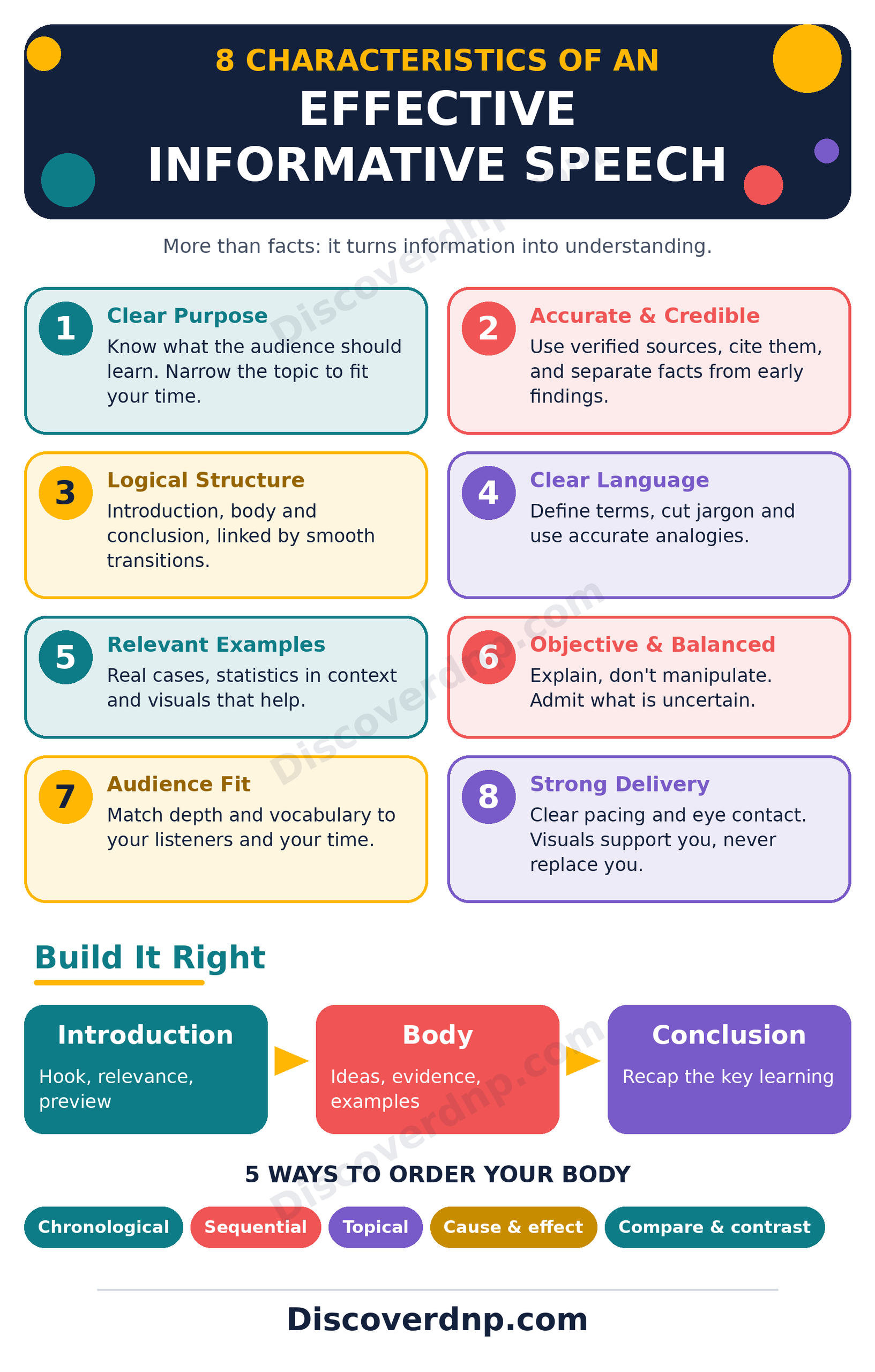
Conclusion
Choosing the right informative speech topics and ideas is the foundation of a meaningful and effective presentation. A successful informative speech goes beyond presenting facts; it helps the audience understand unfamiliar concepts, recognize important relationships, and gain useful knowledge through clear explanations and credible evidence. Whether the subject involves nursing and healthcare, science and technology, psychology, education, culture, or everyday experiences, selecting a focused topic that matches the audience’s interests and knowledge level makes the presentation more relevant and manageable.
Developing an effective speech also requires careful research, logical organization, and thoughtful delivery. Narrowing a broad subject, arranging main points in a coherent sequence, supporting explanations with reliable sources, and using examples and visual aids can make complex information easier to understand. Practicing clear delivery and maintaining audience engagement further strengthen the presentation while ensuring that the central message remains the focus.
The best informative speech topics are those that balance the speaker’s interests with the audience’s need to learn something valuable. By choosing a specific subject, verifying information, and presenting ideas in an accessible and engaging manner, speakers can transform ordinary topics into informative experiences that encourage curiosity and expand understanding. With careful preparation and effective communication, informative speeches become valuable opportunities to strengthen public speaking skills, share knowledge, and communicate confidently in academic, clinical, and professional settings.
Frequently Asked Questions
1. What are some good nursing informative speech topics?
Good nursing informative speech topics include infection prevention and hand hygiene, medication safety, wound healing, patient communication, pressure injury prevention, pain assessment, antibiotic resistance, evidence-based nursing practice, patient confidentiality, and the role of nurses in patient education.
2. What are some good topics for an informative speech?
Good informative speech topics include the effects of artificial intelligence on education, how sleep affects memory, the science behind climate change, the psychology of habit formation, how social media influences communication, the benefits of renewable energy, the history of smartphones, and how vaccines stimulate the immune system.
3. What are 10 good topics for a speech?
- The importance of mental health awareness
- How artificial intelligence is changing everyday life
- The effects of sleep deprivation on learning
- The importance of financial literacy
- How social media influences human behavior
- The science behind human memory
- The causes and effects of climate change
- How technology improves healthcare
- The history and cultural significance of music
- The importance of healthy eating habits
4. What are some interesting topics in nursing?
Interesting nursing topics include the use of artificial intelligence in patient care, the importance of therapeutic communication, emergency nursing interventions, ethical dilemmas in healthcare, the role of nurses in preventing hospital-acquired infections, telehealth in modern nursing, pain management techniques, neonatal nursing, mental health nursing, and the impact of nurse staffing on patient safety.
