

Annotated Bibliographies: How to Write an Annotated Bibliography in APA and MLA Format, with Examples
An annotated bibliography is an essential component of academic research, providing a systematic approach to identifying, organizing, and evaluating sources related to a specific research topic. Unlike a conventional bibliography or reference list, an annotated bibliography combines a complete citation with a brief discussion of the source’s content, credibility, and relevance. This process goes beyond listing publications by encouraging a closer examination of the information they contain, the evidence supporting their conclusions, and their contribution to existing knowledge. Through this approach, researchers can develop a clearer understanding of a subject, identify valuable scholarly resources, and establish a strong foundation for academic writing.
In nursing research, an annotated bibliography helps organize evidence from journal articles, clinical studies, textbooks, systematic reviews, and other relevant publications. Evaluating these sources is particularly important when investigating clinical interventions, patient safety, disease prevention, healthcare policies, or evidence-based nursing practice. A source may present useful findings, but its value depends on factors such as the author’s expertise, the research design, the quality of the evidence, and the limitations acknowledged in the study. Examining these elements helps determine whether the information is appropriate for the research question and how it may contribute to a research paper, literature review, or broader research project.
Preparing an annotated bibliography also requires an understanding of academic citation practices and formatting conventions. The required citation style determines how bibliographic information is presented, how entries are organized, and how annotations appear beneath citations. Common citation styles include the American Psychological Association (APA), the Modern Language Association (MLA), and Chicago style. Although these styles share the general purpose of acknowledging sources, they differ in their rules for author names, publication details, punctuation, indentation, and other formatting elements. Following the appropriate guidelines promotes consistency, supports accurate attribution, and enables readers to locate the original publications.
A complete annotated bibliography generally brings together three essential elements:
- Citation: Identifies the source using the required citation style and provides the publication details needed to locate it.
- Summary: Briefly explains the source’s central argument, purpose, methods, or main findings.
- Evaluation and relevance: Examines the source’s credibility, evidence, and limitations while explaining its usefulness to the research topic.
The emphasis placed on each element depends on the assignment requirements and the type of annotation being prepared. Some annotations primarily describe a source, while others critically evaluate its strengths and weaknesses or explain how it contributes to a particular research question.
Understanding the principles behind an annotated bibliography makes the research process more organized and purposeful. Careful source selection, accurate citation, objective evaluation, and clear writing help establish a reliable collection of academic evidence. These skills are valuable when developing research papers, preparing literature reviews, and examining evidence that may inform professional nursing practice. By understanding the different annotation approaches, essential components, writing process, citation styles, and formatting requirements, researchers can produce an annotated bibliography that demonstrates thoughtful engagement with scholarly literature and communicates the value of each source clearly.
Understanding Annotated Bibliographies
An annotated bibliography is a structured academic research tool that helps organize, summarize, and evaluate published information related to a specific research topic. It brings together bibliographic citations and written annotations, allowing the researcher to examine individual sources and understand how each contributes to a broader area of study. Unlike a simple list of publications, an annotated bibliography provides information about the content, credibility, limitations, and usefulness of each source.
In nursing and healthcare research, this process is particularly valuable because academic arguments and clinical recommendations often depend on evidence from multiple sources. A researcher investigating infection prevention, for example, may need to examine clinical trials, systematic reviews, observational studies, and professional guidelines. Preparing an annotated bibliography makes it easier to keep track of these publications, distinguish between different types of evidence, and determine which sources are most appropriate for a research paper.
Understanding annotated bibliographies also involves recognizing how they differ from other academic research tools. A reference list identifies the works cited in a paper, while a literature review synthesizes findings from multiple publications to explain what is known about a topic, where evidence agrees or conflicts, and what questions remain unanswered. An annotated bibliography occupies a different role: it presents individual sources alongside concise descriptions and, when required, critical evaluations of their contribution to the research question.
Definition and Purpose
An annotated bibliography is a list of sources on a particular subject in which each bibliographic citation is followed by an annotation. The citation identifies the publication, while the annotation provides a short written discussion of its content and significance. Depending on the assignment, this discussion may summarize the source, evaluate its reliability, explain its relevance, or combine all three approaches.
The term bibliography refers to a list of publications or other materials consulted during research, while an annotation is an explanatory note attached to an individual entry. Together, these elements create a research document that does more than record where information was found. They help establish what each source contributes and whether it is suitable for the intended academic purpose.
For example, consider a research project examining whether structured patient education improves medication adherence among adults with hypertension. An annotated bibliography for this topic might include:
- A randomized controlled trial evaluating the effects of a nurse-led education program on medication adherence.
- A systematic review comparing different approaches to improving adherence among patients with chronic conditions.
- A longitudinal study examining medication-taking behavior over an extended period.
- A clinical practice guideline discussing patient education and hypertension management.
Each entry would contain the appropriate citation and an annotation explaining the publication’s main findings, the quality or limitations of its evidence, and its relevance to the research question. The researcher could then compare the sources and decide which publications are most useful for developing the final paper.
The main purposes of an annotated bibliography include the following:
1. Organizing research sources
Research often involves reviewing numerous publications from academic databases, journals, books, and professional organizations. Without a systematic approach, it can become difficult to remember what each source discusses, which findings it reports, and why it was selected.
An annotated bibliography provides a central record of these materials. Each entry connects the citation to a brief summary and assessment, making it easier to retrieve relevant information during the writing process. Organizing entries alphabetically by the author’s last name is common under several citation styles, although the required arrangement depends on the assignment and style guide.
2. Summarizing important findings
Reading a source and writing a brief summary encourages a clear understanding of its central argument, research purpose, methods, and conclusions. Rather than relying on the article title or abstract alone, the researcher identifies the information most relevant to the specific research topic.
For instance, a journal article about nurse-led discharge education may report improvements in patients’ understanding of medication instructions but show no significant reduction in hospital readmissions. A useful summary would distinguish between these findings rather than broadly claiming that the intervention improved all patient outcomes.
3. Evaluating the quality and credibility of evidence
An annotated bibliography can help researchers assess whether a publication offers reliable and relevant information. Depending on the source, this may involve examining the author’s qualifications, the journal or publisher, the research design, the sample size, the methods of data collection, potential bias, and the limitations identified by the authors.
For example, a small observational study may provide useful preliminary evidence about patient experiences, but it may not establish that a particular nursing intervention caused an improvement in clinical outcomes. Recognizing this limitation helps prevent conclusions that extend beyond what the research supports.
Evaluation should be evidence-based rather than based on personal preference. A source should not be dismissed simply because its findings differ from the researcher’s expectations; instead, its methods, context, and relevance should be considered carefully.
4. Establishing relevance to a research question
Not every credible publication is useful for every assignment. A source may be authoritative but address a population, intervention, or outcome that differs substantially from the subject under investigation.
The annotation should therefore explain how the source contributes to the research question. If the project examines fall-prevention interventions among older adults in acute-care hospitals, a study of falls among children in community settings may have limited direct relevance, even if it is methodologically sound.
Explaining relevance helps the researcher prioritize sources and avoid including publications merely because they contain related keywords.
5. Identifying gaps and differences in existing research
As multiple annotations accumulate, researchers may begin to notice patterns across the literature. Several studies might report similar benefits, while others identify inconsistent outcomes or limitations in the available evidence. Some publications may focus on short-term outcomes, leaving long-term effects less understood.
For example, research on nursing interventions for pressure injury prevention may include studies measuring nurses’ knowledge, studies examining adherence to prevention protocols, and studies evaluating patient outcomes. Comparing these sources can reveal whether evidence about staff education consistently translates into measurable improvements in patient care.
An annotated bibliography does not replace a full synthesis of the literature, but it can help identify areas that warrant closer investigation.
6. Preparing for more extensive academic writing
Creating an annotated bibliography is often an early stage in preparing a research paper, proposal, or literature review. It allows the researcher to assess available evidence before deciding how to structure the discussion or which sources deserve closer attention.
This preparation can reduce unnecessary repetition, improve the selection of supporting evidence, and make it easier to connect claims in the final paper to appropriate publications. It also supports accurate attribution by keeping citation information associated with the notes taken from each source.
Differences Between an Annotated Bibliography, a Reference List, and a Literature Review
An annotated bibliography, a reference list, and a literature review are closely related academic research tools, but they serve different purposes. All three help researchers work with published information, yet they differ in structure, level of analysis, and how sources are presented. Understanding these distinctions is important when preparing a research paper because using one in place of another may not satisfy the assignment requirements.
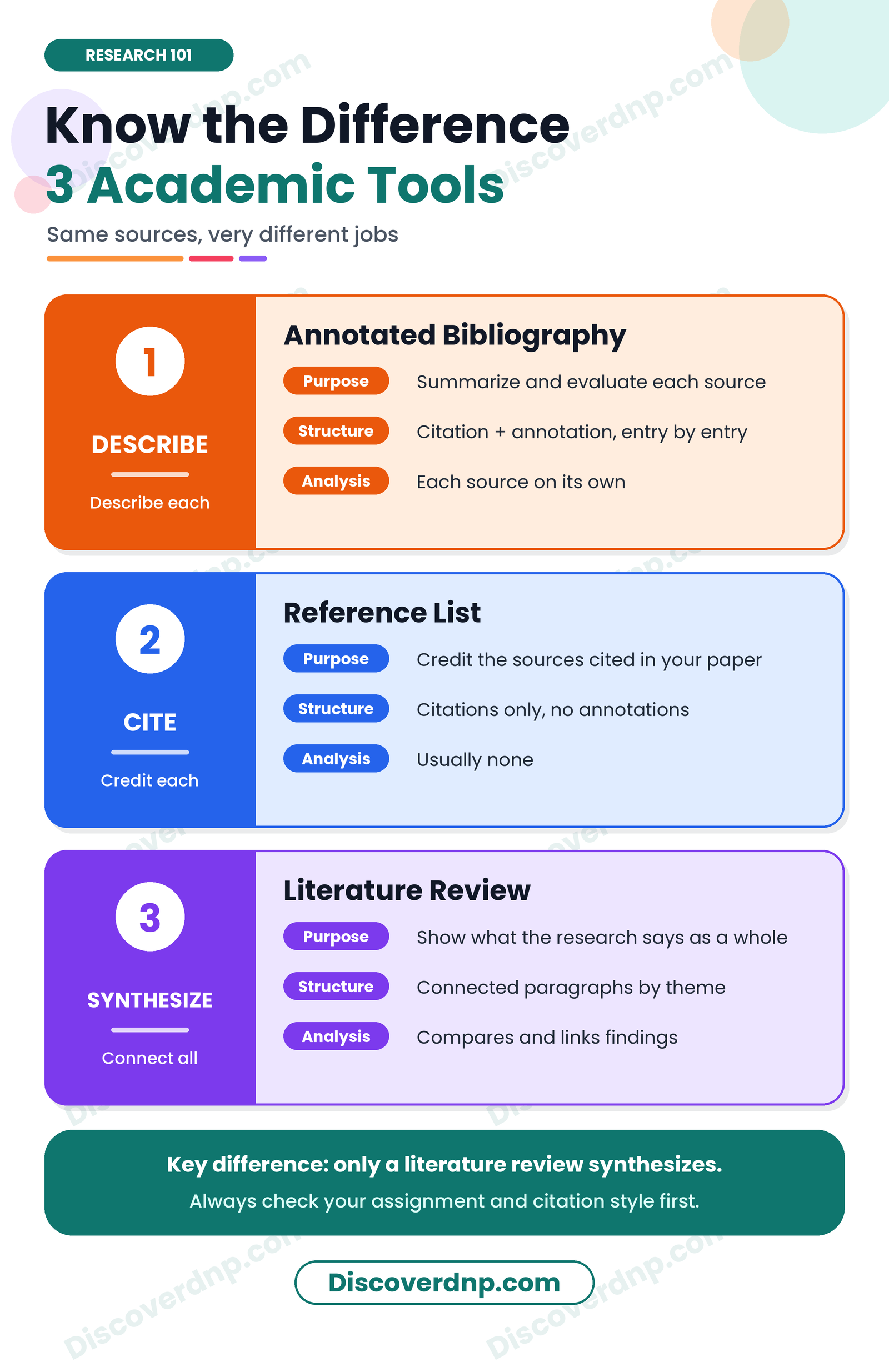
The primary difference is that an annotated bibliography discusses individual sources separately, a reference list identifies the works cited in a document, and a literature review synthesizes findings across multiple sources to develop a broader understanding of a research topic.
1. Annotated bibliography
An annotated bibliography presents a list of citations, with each citation followed by an annotation. The annotation usually summarizes the source and may also evaluate its credibility, identify limitations, and explain its usefulness for the research project.
The entries are generally presented individually, allowing the reader to understand the contribution of each publication without needing to consult the complete research paper. The annotation may also explain how the source relates to the research question or differs from other sources under consideration.
For example, an annotated bibliography on preventing hospital-acquired infections might include separate entries for a clinical trial examining hand hygiene education, a systematic review of infection prevention interventions, and a study investigating nurses’ compliance with infection control procedures. Each annotation would explain the individual publication’s findings and assess its value for the research topic.
The defining feature is the combination of a citation and a descriptive or evaluative note. The exact content and length of the annotation depend on the assignment instructions.
2. Reference list
A reference list identifies the sources cited in the body of a research paper or other academic document. Its primary purpose is to acknowledge the original authors and provide sufficient publication information for readers to locate the cited works.
Unlike an annotated bibliography, a standard reference list does not normally include a paragraph summarizing or evaluating every source. Each entry provides bibliographic details according to the required citation style.
For example, a nursing research paper discussing medication adherence might cite three journal articles in its main text. Its reference list would provide the corresponding publication details, but it would not normally explain each article’s methodology, findings, limitations, or relevance in a separate paragraph.
The heading used for this list depends on the citation style. In APA style, the section is generally titled References, while MLA style uses Works Cited for sources cited in the paper. A bibliography, depending on the style and assignment, may include works consulted even when they are not directly cited.
3. Literature review
A literature review examines and synthesizes existing research to explain the current state of knowledge about a particular subject. Rather than discussing each source only in an independent entry, it connects findings across publications to identify common themes, disagreements, methodological differences, and gaps in the evidence.
For example, a literature review on nurse-led interventions for hypertension management might compare several studies to determine whether patient education, medication counseling, and follow-up appointments improve blood pressure control. The discussion could examine differences in study populations, intervention methods, follow-up periods, and reported outcomes to explain why the findings agree or differ.
A literature review therefore requires synthesis as well as critical analysis. It does not simply summarize one article after another; it develops a connected discussion that explains what the body of evidence suggests and what remains uncertain.
The differences can be summarized as follows:
| Feature | Annotated bibliography | Reference list | Literature review |
|---|---|---|---|
| Main purpose | Describe and, where required, evaluate individual sources | Identify sources cited in a paper | Synthesize research on a topic |
| Structure | Separate citation entries with annotations | Bibliographic entries without annotations | Connected paragraphs organized around themes or arguments |
| Source analysis | Focuses on each source individually | Usually no separate analysis | Compares and integrates findings across sources |
| Typical content | Summary, evaluation, and relevance | Author, title, publication details, and other required citation elements | Themes, evidence, disagreements, limitations, and research gaps |
| Common use | Organizing and assessing research sources | Documenting sources used in academic writing | Establishing the state of knowledge and supporting a research argument |
These distinctions are general; assignment requirements may vary.
An annotated bibliography can also serve as preparation for a literature review. The annotations help the researcher record the purpose, methods, findings, and limitations of individual publications. This information can later be compared across sources to identify patterns and develop a coherent discussion. However, completing an annotated bibliography does not automatically produce a literature review, because the latter requires a deliberate synthesis of the evidence rather than a collection of separate source descriptions.
For a nursing research assignment, the appropriate format depends on the task. If the requirement is to document and assess selected publications, an annotated bibliography may be appropriate. If the assignment asks for a list of sources cited in a completed paper, a reference list is generally required. If it asks for a critical discussion of what existing studies collectively demonstrate, a literature review is the more suitable approach.
The key is to identify the purpose of the assignment before beginning the research process and to follow the required citation style and instructions. University writing centers and research guides, including Purdue University’s Online Writing Lab, provide additional guidance on distinguishing these academic formats and preparing them correctly.
Types of Annotated Bibliographies
Annotated bibliographies can be classified according to the purpose of the annotation and the depth of analysis required. Some annotations primarily describe the content of a source, while others critically assess its credibility, strengths, limitations, and usefulness. Reflective annotations focus on how a publication contributes to a particular research project, and combined annotations bring together description, evaluation, and relevance in one entry.
Understanding the different types of annotated bibliographies helps researchers determine what information to include when documenting scholarly sources. The appropriate approach depends on the assignment instructions, the research question, the discipline, and the required citation style. For example, an assignment may require a brief summary of each journal article, while another may expect a detailed evaluation of research methods and an explanation of how each publication supports a proposed study.
In nursing and healthcare research, the distinction is especially important because sources vary in purpose, design, and evidential strength. A clinical trial, a qualitative interview study, a systematic review, and a professional practice guideline provide different kinds of information. An effective annotation should reflect these differences rather than treat every publication in the same way.
The main approaches discussed below are descriptive, evaluative, reflective, and combined annotations. Although these categories are useful for understanding annotation methods, they are not always mutually exclusive. Assignment requirements may call for one approach or a combination of several.
Descriptive Annotations
A descriptive annotation provides a concise account of a source’s content, purpose, and main ideas. Its primary function is to help readers understand what the publication covers without offering an extensive critique of its quality or usefulness. It answers questions such as what the author investigated, what subjects were discussed, which methods were used, and what findings or conclusions were presented.
A descriptive annotation is particularly useful when preparing an initial list of sources for a research project. During this stage, researchers may need to establish which publications address their topic before deciding which sources require deeper evaluation. The annotation records the essential information needed to identify the source’s contribution and distinguish it from other publications.
A well-written descriptive annotation may include the following elements:
- Purpose or objective: The issue, question, or problem addressed by the author.
- Scope and subject matter: The population, setting, intervention, or concepts examined.
- Methods or approach: The research design or method used, when applicable.
- Main findings or arguments: The most important results, conclusions, or ideas presented.
- Coverage: The boundaries of the discussion, including the particular aspects of the topic emphasized by the source.
Not every descriptive annotation needs to include all these elements. The information selected should reflect the type of publication and the requirements of the assignment. For example, an annotation for a research study may describe the sample, methods, and results, whereas an annotation for a nursing textbook chapter may focus on its major concepts and areas of coverage.
Example of a descriptive annotation
Consider a hypothetical journal article examining whether structured discharge education improves medication understanding among adults leaving hospital.
Illustrative example — not a real publication
Citation: Author, A. A. (2024). The role of structured discharge education in medication understanding. Journal of Nursing Practice, 18(2), 100–108.
Annotation: This article examines the relationship between structured discharge education and patients’ understanding of prescribed medications following hospitalization. It describes an educational intervention in which nurses explain medication schedules, potential adverse effects, and follow-up instructions before discharge. The article discusses patients’ understanding of medication information and identifies education and communication as important components of the discharge process. Its findings contribute to the discussion of how nurses can communicate medication instructions more effectively during transitions from hospital to home.
This example summarizes the subject, intervention, and contribution of the article. It does not extensively judge the study’s methodological quality, compare it with other research, or explain how it will be used in a specific assignment. Those features would be more prominent in an evaluative or reflective annotation.
When writing a descriptive annotation, accuracy is more important than including every detail from the source. The objective is to summarize the publication’s central content without reproducing the abstract word for word or introducing claims that the author did not make.
A practical approach is to identify the source’s main purpose, select two or three important points, and express them in a brief, coherent paragraph. If the publication reports original research, distinguish between what the researchers intended to investigate, what they actually found, and what they concluded. This prevents a summary from exaggerating the significance of the results.
Descriptive annotations should also avoid unsupported judgments. Statements such as “this is an excellent article” do not describe the source’s content and provide little useful information. Such judgments belong in an evaluative annotation when they can be supported by specific evidence.
Evaluative Annotations
An evaluative annotation goes beyond describing a publication by critically examining its credibility, methodological quality, strengths, weaknesses, and usefulness for a particular research purpose. It includes a summary of the source’s central ideas or findings but also explains how convincingly the author supports the conclusions and whether the evidence is appropriate for the topic being investigated.
This type of annotation is particularly valuable when the quality of evidence matters to the research question. In nursing and healthcare, publications may differ considerably in their research design, sample size, clinical setting, relevance to current practice, and potential for bias. An evaluative annotation helps the researcher determine what a source can reasonably establish, where caution is needed, and how the findings might contribute to a broader investigation. University research guides similarly emphasize examining the reliability, strengths, weaknesses, and relevance of individual sources.
An effective evaluative annotation generally addresses several considerations:
- Author expertise and publication credibility: Examine the authors’ relevant qualifications, institutional affiliations, publication history, and the credibility of the journal or publisher. Peer review can provide an additional quality-control measure, although it does not guarantee that every finding is accurate.
- Research design and methodology: Consider whether the methods are suitable for the research question. A randomized controlled trial may be appropriate for assessing the effects of an intervention, whereas a qualitative study may be more useful for understanding patients’ experiences.
- Quality of evidence: Examine whether the conclusions are supported by the results, whether the sample and measurements are appropriate, and whether the authors acknowledge important limitations.
- Strengths and weaknesses: Identify features that increase or reduce the source’s usefulness, such as a clearly defined sample, validated measurement tools, a short follow-up period, or limited generalizability.
- Relevance and usefulness: Explain how the publication contributes to the specific research topic and whether its findings can reasonably be applied to the population or setting being studied.
Evaluation should be balanced and supported by evidence. A small study is not automatically poor quality, just as a large study is not automatically reliable. The research design, methods, findings, and limitations must be considered together.
Example of an evaluative annotation
Consider a hypothetical study investigating whether nurse-led discharge education improves medication adherence among adults with hypertension.
Illustrative example — not a real publication
Citation: Author, A. A. (2024). The role of structured discharge education in medication adherence among adults with hypertension. Journal of Nursing Practice, 18(2), 100–108.
Annotation: This study examines whether structured discharge education improves medication adherence among adults with hypertension. The authors report that patients receiving nurse-led education demonstrated better understanding of their medication schedules and higher adherence scores during follow-up. A strength of the study is its use of a clearly defined intervention and measurable adherence outcomes, which allows the researchers to examine changes following the educational program. However, the relatively short follow-up period limits conclusions about whether the improvement continues over time, and the findings may not apply equally to patients in settings with different staffing levels or access to follow-up care. The source may be useful for research examining nursing interventions that support medication adherence, although its findings should be considered alongside evidence from other studies.
This example illustrates the distinction between reporting findings and evaluating them. The annotation identifies a potential strength, explains a limitation, and considers the implications for the research topic. It does not simply label the article reliable or unreliable; it provides reasons for its assessment.
When preparing an evaluative annotation, avoid unsupported statements such as “the article is excellent” or “the research is weak.” Instead, explain what makes the source useful or limited. For instance, if a study includes only patients from one hospital, the annotation can explain that the findings may not generalize to other clinical settings. If a publication uses a validated instrument to measure patient outcomes, this may strengthen confidence in the measurement process, although the overall quality of the study still depends on other methodological factors.
An evaluative annotation should also distinguish between the quality of a study and its relevance to a particular assignment. A well-designed study may investigate a population that differs from the one in the research question. Conversely, a study with limitations may still provide useful preliminary evidence if those limitations are acknowledged. The purpose of evaluation is to establish the appropriate weight and use of a source, not to force every publication into a simple category of good or bad.
Reflective and Combined Annotations
Reflective and combined annotations help researchers move from understanding an individual source to considering its contribution to their own research. Although these approaches are related, they serve different purposes. A reflective annotation explains how the source informs the researcher’s thinking or planned work, while a combined annotation integrates several annotation functions, typically summary, evaluation, and relevance or reflection.
Reflective annotations
A reflective annotation explains how a publication influences the direction, interpretation, or development of a research project. Rather than concentrating exclusively on what the author says or whether the evidence is convincing, it considers what the researcher learns from the source and how that information may be used.
Reflection should be specific and academically grounded. It is not simply a personal reaction such as “I liked this article” or “the study was interesting.” Instead, it explains how the publication informs the research question, supports a particular line of investigation, identifies an area requiring further study, or changes the way the researcher understands a topic. The University of Virginia Writing Center identifies reflection as one of the principal components that annotations may emphasize or combine with summary and evaluation.
A reflective annotation may address the following:
- Contribution to the research question: Explain which part of the investigation the source helps clarify.
- Influence on the research direction: Identify whether the source suggests a new issue, comparison, or population worth examining.
- Application in academic writing: State how the findings may support a particular argument or section of the research paper.
- Relationship to other evidence: Explain whether the publication reinforces, challenges, or adds context to findings from other sources.
For example, a researcher examining fall prevention among older adults may review a qualitative study exploring patients’ experiences of mobility assistance in hospitals. The study might reveal that some patients avoid requesting help because they fear disturbing staff or losing independence. A reflective annotation could explain that this finding broadens the researcher’s perspective beyond physical risk factors and suggests examining communication, patient confidence, and staff responsiveness when investigating fall-prevention practices.
Example of a reflective annotation
Illustrative example — not a real publication
Citation: Author, B. B. (2023). Older adults’ experiences of hospital fall-prevention practices. Journal of Clinical Nursing Research, 12(3), 145–153.
Annotation: This qualitative study explores how older adults perceive fall-prevention measures during hospitalization, with particular attention to communication, mobility assistance, and patients’ willingness to request help. The findings highlight that patients’ perceptions of staff availability and independence may influence their participation in safety practices. This source informs the research project by identifying communication and patient involvement as factors worth examining alongside environmental hazards and physical risk factors. It may therefore help broaden the research question and guide the selection of additional studies on patient-centered fall prevention.
The annotation explains how the source shapes the researcher’s approach without claiming that the study proves a particular intervention will reduce falls. Reflection remains connected to what the publication actually reports.
Combined annotations
A combined annotation brings together two or more functions in a single entry. In many assignments, this means providing a brief summary, evaluating the source’s quality, and explaining its relevance to the research question. Some assignments also expect an explicit reflective statement about how the publication will inform the final paper.
This approach is particularly useful when an annotated bibliography is intended to demonstrate both an understanding of the literature and the ability to assess evidence critically. Rather than creating separate entries for description, evaluation, and reflection, the researcher develops one coherent paragraph that connects these elements.
A combined annotation commonly follows this sequence:
- Summarize the source: Identify its purpose, approach, and main findings.
- Evaluate the evidence: Discuss relevant strengths, limitations, or methodological concerns.
- Explain its relevance: Connect the source to the research question and describe its intended contribution to the project.
The sequence is a useful writing strategy rather than a universal rule. Some assignments may require a different order, additional elements, or a specific word count. Always follow the instructions provided for the assignment and the required citation style.
Example of a combined annotation
Illustrative example — not a real publication
Citation: Author, C. C., & Author, D. D. (2025). Nurse-led education and medication adherence in adults with chronic conditions. Journal of Evidence-Based Nursing, 20(1), 25–36.
Annotation: This study examines the relationship between nurse-led education and medication adherence among adults managing chronic conditions. The authors report improvements in patients’ understanding of prescribed treatment and describe educational strategies involving medication counseling, written instructions, and follow-up communication. A strength of the study is its focus on practical nursing interventions and measurable patient outcomes; however, differences in the populations and follow-up periods examined limit the extent to which the findings can be generalized to all chronic conditions. The source is relevant to a research project on medication adherence because it identifies nursing education as an area for further investigation and provides a basis for comparing educational approaches across patient populations. Its findings should be considered alongside other research before drawing conclusions about the effectiveness of a particular intervention.
This example combines all three functions. It summarizes the study, evaluates its strengths and limitations, and explains its usefulness to a research project. The result is a more informative entry than a summary alone because it communicates both what the source contributes and how its findings should be interpreted.
When creating an annotated bibliography, the choice between descriptive, evaluative, reflective, and combined approaches should be guided by the assignment’s purpose. A descriptive annotation may be sufficient when the task is to document the scope of selected publications. An evaluative annotation is appropriate when source quality and evidence must be assessed. A reflective annotation is useful when explaining how research informs a particular project, while a combined annotation is suitable when all these dimensions are required.
The most important consideration is consistency. If an assignment requests critical evaluation, the entries should not consist entirely of summaries. If reflection is required, each annotation should explain the source’s contribution to the research rather than relying on vague personal opinions. Checking the instructions before writing ensures that the annotations address the expected criteria and provide a clear, useful account of each source.
Essential Components of an Annotation
An effective annotation provides a clear and meaningful account of an individual source, helping readers understand what the publication discusses, how its conclusions are supported, and why it matters to a particular research topic. Although the exact requirements vary by assignment and citation style, most annotations bring together three essential components: a summary of the source, an assessment of its credibility and evidence when evaluation is required, and an explanation of its relevance to the research question.
These components work together to make an annotated bibliography more useful than a simple list of citations. A summary establishes what the author investigated or argued, an evaluation considers the quality and limitations of the information, and a relevance statement explains how the source contributes to the research project. Some assignments require only a descriptive annotation, while others expect critical evaluation and explicit discussion of usefulness. The annotation should therefore reflect the required approach rather than follow a rigid formula.
In nursing and healthcare research, these elements are particularly important because publications may present different types of evidence, address different patient populations, or reach different conclusions. For example, a clinical trial investigating a nursing intervention provides different information from a qualitative study exploring patients’ experiences or a systematic review comparing results across multiple studies. An effective annotation captures these distinctions without overstating what the source demonstrates.
Source Summary and Main Findings
The source summary is the descriptive foundation of an annotation. It explains the publication’s central purpose, subject matter, research approach, and main findings or arguments. Its role is to give readers an accurate understanding of the source without requiring them to read the entire publication before deciding whether it is relevant to their work.
A strong summary does more than repeat the article title or copy information from the abstract. It identifies the ideas that matter most to the research topic and presents them in the researcher’s own words. The level of detail depends on the source type, the annotation’s required length, and the purpose of the assignment.
For a research-based journal article, the summary may address the following elements:
- Research purpose: What problem, question, or knowledge gap did the study investigate?
- Population and setting: Who participated in the study, and where was the research conducted?
- Methods: What research design, intervention, data collection process, or analytical approach did the authors use?
- Main findings: What were the principal results, patterns, or themes?
- Authors’ conclusions: What did the researchers conclude, and what implications did they identify?
Not every annotation needs to discuss all five elements in equal detail. A quantitative study may require a brief explanation of its sample, intervention, and measured outcomes, whereas a qualitative study may focus on participant experiences and emerging themes. An annotation for a professional guideline or textbook chapter may instead summarize its recommendations, key concepts, and scope.
For example, consider a hypothetical study investigating whether nurse-led education improves medication adherence among adults with hypertension. A useful summary might explain that the study compared patients receiving structured medication education with those receiving routine discharge instructions, measured adherence during follow-up, and examined differences between the groups. If the researchers found improved medication understanding but inconsistent changes in adherence, the annotation should report both findings rather than suggesting that education improved every outcome.
This distinction matters because understanding medication instructions and consistently taking prescribed medication are related but different outcomes. Reporting the findings precisely prevents a summary from making a stronger claim than the study supports.
Example of a source summary
Illustrative example — hypothetical publication
Citation: Author, A. A. (2024). Nurse-led medication education and adherence among adults with hypertension. Journal of Nursing Research, 18(2), 100–108.
Summary: This study examines the relationship between nurse-led medication education and adherence among adults with hypertension. The researchers compare structured education with routine discharge instructions and assess patients’ understanding of medication schedules and adherence during follow-up. The findings suggest that structured education may improve medication understanding, although the effects on adherence require further investigation.
The example focuses on the study’s purpose, approach, and findings without introducing an unsupported judgment about its quality. The citation is illustrative rather than a verified publication.
When writing a summary, researchers should distinguish among the study’s objectives, results, and conclusions. The objective explains what the authors intended to investigate; the results describe what the data showed; and the conclusion explains how the authors interpreted those findings. These elements should not be treated as interchangeable.
For example, if researchers investigate whether a discharge education program reduces hospital readmissions but observe only an improvement in patients’ knowledge, the annotation should not claim that the program reduced readmissions unless that outcome was measured and supported by the results.
A concise summary should also avoid unnecessary details. Long descriptions of every procedure, background statement, or secondary finding can obscure the source’s main contribution. The most useful approach is to identify the information that directly supports the research question and communicate it in a brief, coherent paragraph.
Credibility, Evidence, and Limitations
Evaluating credibility and evidence is an important part of an annotation when the assignment requires critical analysis. A source may contain relevant information, but its usefulness depends on the trustworthiness of the publication, the quality of the evidence, and the extent to which the findings support the author’s conclusions. An effective Annotated Bibliography therefore moves beyond reporting what a source says to examining how convincingly it supports its claims.
Credibility does not depend on a single factor. A publication from a respected journal may still have methodological weaknesses, while a smaller study may offer valuable insights into a narrowly defined clinical question. Researchers should consider several aspects of the source together rather than relying on the journal’s reputation, the author’s qualifications, or the publication date alone.
Key factors to examine when evaluating a source include:
1. Author expertise and publication credibility
Consider whether the author has relevant knowledge or experience in the subject area. Academic qualifications, professional affiliations, previous research, and contributions to the field may help establish expertise. The publication venue also matters: scholarly journal articles, peer-reviewed studies, official clinical guidelines, and publications from recognized research institutions may provide useful evidence, depending on the topic.
However, peer review and institutional reputation should not be treated as automatic guarantees of accuracy. Researchers must still examine the methods, evidence, and conclusions presented in the publication.
2. Research design and methodology
The research design should be appropriate for the question being investigated. For example:
- A randomized controlled trial may help evaluate whether a nursing intervention produces a measurable effect.
- A qualitative study may explain patients’ experiences, concerns, or perceptions of care.
- A longitudinal study may examine changes in health outcomes or behavior over an extended period.
- A systematic review may synthesize findings from multiple studies to identify patterns and inconsistencies.
The design alone does not establish quality. Researchers should also consider how participants were selected, how information was collected, whether measurements were appropriate, and whether the analysis was conducted transparently.
3. Quality and sufficiency of the evidence
An annotation should consider whether the evidence supports the claims being made. Relevant questions include whether the sample was appropriate, whether the outcomes were measured reliably, whether the findings were reported clearly, and whether alternative explanations were considered.
For instance, a study reporting that nurses who completed additional training had better infection-prevention knowledge does not necessarily demonstrate that the training reduced hospital-acquired infections. Knowledge scores and infection rates are different outcomes. A careful annotation distinguishes between the outcome actually measured and the broader clinical implications suggested by the findings.
4. Bias, limitations, and generalizability
Every research method has limitations, and identifying them helps establish how the findings should be interpreted. Common limitations include small samples, short follow-up periods, self-reported data, missing information, selection bias, and research conducted in a single healthcare facility.
For example, a study involving nurses from one urban hospital may provide useful information about local infection-control practices. However, its findings may not apply equally to rural facilities or hospitals with different staffing arrangements and resources.
A limitation does not automatically make a source unusable. Instead, the researcher should explain how that limitation affects the conclusions that can reasonably be drawn.
Example of a critical source assessment
Illustrative example — hypothetical publication
Annotation excerpt: The study examines nurses’ adherence to hand hygiene procedures in a single hospital and identifies an association between staff training and higher compliance. Its use of direct observation provides information about actual clinical behavior rather than relying entirely on self-reported practices. However, the single-site setting limits generalizability, and staff awareness of being observed may have influenced behavior. The findings are useful for understanding local infection-prevention practices but should be compared with research from other healthcare settings before drawing broader conclusions.
This assessment identifies the study’s focus, a methodological strength, a possible limitation, and the implications for interpreting its findings. It avoids making an unsupported judgment about the entire publication.
A strong annotation should also distinguish between an author’s stated limitations and the researcher’s own assessment. If the authors acknowledge that their sample was small, this can be reported directly. If the researcher identifies an additional concern, such as the lack of a comparison group, that concern should be explained accurately and fairly.
When evaluating a source, the aim is not to criticize every publication. It is to determine what the evidence can establish, where uncertainty remains, and how the source should be used in the research process. University research guides recommend considering the author’s expertise, methodology, evidence, limitations, and relevance together when preparing critical annotations.
Relevance to the Research Topic
Relevance explains how a source contributes to the specific research question or project. Even a credible, well-designed study may have limited value if it investigates a different population, setting, intervention, or outcome from the one under consideration. An effective annotation should therefore establish a clear connection between the publication and the purpose of the research.
Relevance is more specific than simply stating that an article is “about nursing” or “related to healthcare.” It explains what the source contributes, which part of the research question it helps address, and how its information may be used in the final paper.
For example, a researcher investigating strategies to prevent falls among older adults in acute-care hospitals may find several publications about fall prevention. A study examining hospital environmental hazards may provide background information, while a study evaluating nurse-led mobility assessments may offer evidence about a specific intervention. Research involving falls among children in schools may be less directly relevant because the population and setting differ.
To determine relevance, consider the following factors:
- Connection to the research question: Does the source address the main issue being investigated, or does it discuss only a related topic?
- Population and setting: Are the participants and healthcare environment similar to those specified in the research question?
- Concepts and outcomes: Does the source examine the intervention, experience, or outcome that the project seeks to understand?
- Contribution to the argument: Does it provide supporting evidence, background information, an alternative perspective, or findings that challenge other research?
- Usefulness for further investigation: Does it identify unanswered questions, limitations in existing knowledge, or areas requiring additional research?
These considerations help researchers explain why a source deserves a place in the Annotated Bibliography rather than merely listing publications that contain similar terminology.
Example of a relevance statement
Suppose the research question is: How do nurse-led educational interventions influence medication adherence among adults with hypertension?
Consider two hypothetical publications:
Source A: Nurse-led medication counseling
This study examines whether structured counseling improves medication understanding and adherence among adults with hypertension.
Direct relevance
The source addresses the target population, the nursing intervention, and the outcome of interest. It may provide evidence for the main discussion of the research paper.
Source B: General patient satisfaction in outpatient clinics
This study examines patients’ satisfaction with waiting times, staff communication, and appointment scheduling across several outpatient services.
Indirect relevance
The source may provide background on healthcare communication or patient experience, but it does not directly investigate medication adherence or the specific intervention. Its inclusion would require a clear explanation of how it supports the research question.
The distinction illustrates why source selection should be guided by the research question. A publication does not become essential merely because it concerns patient care. Its contribution must be identifiable and appropriate to the scope of the project.
A relevance statement should also be specific about how the source will be used. Instead of writing, “This article is useful for my research,” explain that it provides evidence about patient education, identifies barriers to adherence, or offers a comparison with another intervention. Specific language demonstrates that the researcher has considered the publication’s contribution.
For example:
This study is relevant to the research question because it examines nurse-led medication counseling among adults with hypertension and measures adherence during follow-up. Its findings may help explain the potential role of structured education, while its short observation period makes it important to compare the results with studies examining longer-term outcomes.
This statement connects the source to the research question while acknowledging the limits of its contribution.
Relevance can also change as the research develops. An article initially selected for general background may later become less important when the research question narrows. Conversely, a source that identifies an unexpected barrier or contradicts an early assumption may become more valuable. Revisiting annotations during the writing process helps keep the bibliography aligned with the project’s final direction. The University of Guelph’s research guide similarly emphasizes explaining a source’s usefulness to the research topic and identifying its potential contribution to further investigation.
Taken together, the three components make an annotation informative and purposeful. The summary explains what the source says, the credibility assessment examines how much confidence its evidence deserves, and the relevance statement establishes why it matters to the research. When all three are required, they should work together in a coherent paragraph rather than appear as disconnected comments. The result is an Annotated Bibliography that supports careful source selection, critical engagement with academic literature, and a clearer foundation for the research paper.
How to Write an Annotated Bibliography
Writing an annotated bibliography involves more than collecting publications and placing them in alphabetical order. It is a structured research process that requires careful source selection, close reading, accurate citation, and clear explanation of each source’s contribution to a particular topic. Every entry should help the reader understand what the publication covers, how its evidence can be assessed, and why it may be useful for the research question.
The exact requirements depend on the assignment and the required citation style. Some assignments call for descriptive annotations that summarize sources, while others require evaluative or combined annotations that assess credibility, discuss limitations, and explain relevance. Before writing, it is important to establish what the instructor expects, how many sources are required, which types of publications are acceptable, and how the final document should be formatted.
In nursing research, this process can help organize evidence on subjects such as patient safety, infection prevention, medication adherence, chronic disease management, and evidence-based practice. For example, someone investigating nurse-led interventions to reduce hospital readmissions might identify clinical trials, observational studies, systematic reviews, and professional guidelines. The Annotated Bibliography would then document each source and explain its specific contribution without treating every publication as equally strong or directly applicable.
A systematic approach can be divided into four main stages:
- Select appropriate sources and review the assignment requirements.
- Analyze each publication and record useful research notes.
- Draft accurate citations and informative annotations.
- Organize the entries and proofread the completed document.
Following these stages makes the writing process more manageable and helps ensure that the final bibliography is accurate, relevant, and consistent.
Selecting Sources and Reviewing Assignment Requirements
The first step in creating an annotated bibliography is to understand the assignment and define the scope of the research. Source selection should be guided by the research question rather than by the number of publications available or the convenience of finding them. A clear understanding of the requirements also prevents unnecessary work, such as collecting sources that do not meet the instructor’s criteria or preparing annotations in the wrong citation style.
Review the assignment instructions
Before searching for publications, identify the specific requirements governing the assignment. These may include:
- Research topic and question: Establish the issue being investigated and the population, intervention, concept, or outcome of interest.
- Number of sources: Determine how many entries are required and whether a minimum number of scholarly or peer-reviewed sources must be included.
- Source types: Check whether the assignment permits journal articles, books, clinical guidelines, government publications, websites, or other materials.
- Required citation style: Confirm whether APA, MLA, Chicago, or another citation style must be used.
- Annotation requirements: Establish whether the annotations should be descriptive, evaluative, reflective, or combined.
- Word count and formatting: Check the expected annotation length, spacing, indentation, page layout, and any additional instructions.
- Publication dates: Determine whether the sources must fall within a specified time frame or whether older foundational publications are acceptable.
These details influence the entire writing process. For example, an assignment requiring eight peer-reviewed studies published within the past five years should not be completed using eight general health websites, even if those websites contain relevant information.
It is also important to check with your instructor when the requirements are unclear. University research guides and writing centers can help explain common citation conventions, but the assignment instructions take priority when they specify particular expectations.
Define the research question and search for relevant sources
A focused research question makes source selection more efficient. Broad topics can produce an overwhelming number of results, many of which may have little direct relevance to the project.
For example, the topic patient safety could involve medication errors, falls, surgical complications, infection prevention, or communication failures. Narrowing the topic to the effectiveness of nurse-led interventions in preventing falls among hospitalized older adults provides a clearer direction for searching.
Once the research question has been established, search academic databases and trusted research resources. Depending on the topic, these may include PubMed, CINAHL, the Cochrane Library, Google Scholar, university library databases, and professional or government publications. Research guides and library resources, including LibGuides, can help identify appropriate databases and develop effective search strategies.
Useful search techniques include:
- Combining key concepts with AND, such as
nurse-led education AND medication adherence. - Using OR to include related terms, such as
falls OR fall prevention. - Applying date, language, publication type, or population filters where appropriate.
- Reviewing the reference lists of relevant publications to identify additional sources.
- Searching for systematic reviews or evidence-based guidelines to understand the broader research landscape.
Search results should be assessed individually rather than accepted simply because the title contains the right keywords. An article may mention medication adherence without examining an intervention that is relevant to the research question.
Assess the suitability of potential sources
After identifying publications, determine whether each source is credible, sufficiently informative, and appropriate for the assignment. Consider the author’s expertise, the publication venue, the research design, the quality of the evidence, and the connection to the topic.
For a nursing research project, a peer-reviewed journal article may provide detailed information about a clinical intervention, while a government guideline may establish recommended practice. Both may be useful, but they serve different purposes and should be evaluated according to their intended function.
Recency also requires judgment. Current clinical guidance and recent research are often important in healthcare topics because recommendations and evidence can change. However, an older publication may still be valuable when it provides foundational theory, explains the development of a practice, or represents an important earlier study.
A practical source-selection checklist is:
- Does the publication address the research question?
- Is the author or issuing organization identifiable and credible?
- Is the evidence appropriate for the claims being made?
- Are the methods, sources, or supporting arguments sufficiently clear?
- Does the publication meet the assignment’s requirements?
- Does it contribute information that is not already adequately covered by other selected sources?
The goal is not to collect the largest possible list of citations. It is to select a balanced set of sources that provides useful evidence and perspectives for the research project.
Analyzing Sources and Taking Research Notes
After selecting suitable publications, the next step is to read each source carefully and record the information needed for the annotation. This stage is essential because an accurate Annotated Bibliography depends on understanding the publication rather than relying only on its title, abstract, or search-engine description.
A source should be examined with the research question in mind. The objective is to identify the author’s main argument or research purpose, understand the evidence presented, assess any important limitations, and determine how the publication contributes to the topic. Purdue University’s Online Writing Lab explains that annotations may summarize, assess, and reflect on sources, depending on the assignment requirements.
Read strategically before writing
For a research-based journal article, it can be helpful to examine the publication in stages:
- Review the title and abstract. Identify the research topic, objectives, population, methods, and reported findings. This initial review helps establish whether the article deserves closer attention.
- Examine the introduction and research question. Determine the problem being investigated, the rationale for the study, and the specific objectives or hypotheses.
- Read the methods section. Identify the research design, sample, setting, data collection methods, and analytical approach. These details are especially important when evaluating clinical research.
- Study the results and discussion. Record the main findings, distinguish statistically significant results from other observations, and consider how the authors interpret the evidence.
- Review the conclusion and limitations. Note the authors’ principal conclusions, acknowledged weaknesses, and recommendations for future research.
This approach makes the reading process more efficient without encouraging superficial analysis. If the abstract suggests that an article is relevant, reading the complete publication helps confirm whether its findings actually address the research question.
For example, an abstract may describe a study as investigating the effectiveness of a nurse-led education program. Reading the full article may reveal that the researchers measured patient knowledge but did not measure medication adherence or hospital readmissions. Recording this distinction prevents the annotation from claiming that the intervention improved outcomes that were never assessed.
Record structured research notes
Taking notes while reading helps separate the source’s content from the researcher’s interpretation. Instead of copying long passages, record concise points that can later be developed into an original annotation.
A useful note-taking framework includes:
| Information to record | Questions to consider |
|---|---|
| Bibliographic details | Who wrote the publication, when was it published, and where can it be found? |
| Purpose | What question, problem, or argument does the source address? |
| Methods or approach | How did the authors investigate the issue or develop their argument? |
| Main findings | What are the most important results, claims, or themes? |
| Credibility and limitations | What supports the conclusions, and what weaknesses should be considered? |
| Research relevance | How does the source contribute to the specific research question? |
This framework can be adapted to different publication types. A qualitative study may require notes on participant experiences and recurring themes, whereas a systematic review may require notes on the studies included, the review methods, and the consistency of the findings.
Distinguish the source’s statements from your own analysis
Accurate notes should make it clear which information comes directly from the publication and which conclusions represent the researcher’s assessment. This distinction helps prevent misinterpretation and makes it easier to write an annotation in original language.
For example, notes on a hypothetical study of hospital fall prevention might read:
- Author’s finding: Nurses reported greater adherence to fall-prevention procedures after a training program.
- Researcher’s assessment: The improvement is relevant to nursing practice, but the study’s short follow-up period may limit conclusions about sustained adherence.
- Connection to the research question: The source may support discussion of staff education as a strategy for improving compliance with safety procedures.
These notes capture three distinct functions: summary, evaluation, and relevance. They can later be developed into a coherent annotation without repeating the article’s wording.
When recording exact quotations, include the page number or another appropriate location reference so that the original passage can be verified. Most annotations should be written through accurate paraphrasing rather than extensive quotation. Copying an abstract or another writer’s annotation and presenting it as original work constitutes plagiarism, even if the publication itself is cited. Purdue’s guidance specifically advises writers to develop their own annotations rather than copy existing descriptions.
Compare sources when useful
Although annotations generally focus on individual publications, taking notes across several sources can reveal differences that matter to the research project. Two studies may investigate the same intervention but use different populations, outcomes, or follow-up periods. One may report improved patient knowledge, while another finds no significant change in readmission rates.
Recording these differences helps the researcher understand the scope of the evidence and avoid treating all findings as interchangeable. It can also identify sources that offer complementary perspectives or address gaps left by earlier research.
The comparison should not replace the individual source summary. Rather, it helps determine why each publication belongs in the Annotated Bibliography and how it may contribute to later academic writing.
Drafting Citations and Annotations
Once the sources have been analyzed and the research notes are complete, the next stage is to prepare the citation and write the annotation for each entry. These two parts serve different purposes: the citation identifies the publication, while the annotation explains its content and, where required, evaluates its quality and relevance.
The citation must follow the required citation style. APA, MLA, and Chicago have different rules for author names, publication dates, titles, journal information, punctuation, and other bibliographic details. The annotation should then follow the citation in the arrangement required by the assignment and applicable style guidelines.
Prepare the citation accurately
Begin by recording the complete bibliographic information for each source. For a journal article, this generally includes:
- Author or authors.
- Year of publication, where required by the citation style.
- Article title.
- Journal title.
- Volume and issue information, where applicable.
- Page range or article number, where applicable.
- DOI or other publication identifier, when required or available.
The precise order and punctuation depend on the required citation style. Do not assume that a citation copied from a database is automatically correct; automatically generated citations can contain capitalization errors, incomplete author information, incorrect dates, or inconsistent formatting.
For example, the same journal article would be formatted differently under APA and MLA. APA generally places the publication year immediately after the author information, whereas MLA typically places the publication year later in the entry, according to its applicable rules. These differences should be checked against the relevant style guide rather than mixed together.
Write the annotation in your own words
After preparing the citation, draft the annotation using the notes collected during reading. The content should reflect the type of annotation required.
A descriptive annotation may focus primarily on the source’s purpose and findings. An evaluative annotation adds an assessment of credibility, methods, evidence, and limitations. A reflective or combined annotation also explains how the publication contributes to the research question.
A practical drafting sequence is:
- Introduce the publication’s central topic or purpose.
- Summarize its main argument, methods, findings, or conclusions.
- Evaluate relevant strengths and limitations if the assignment requires critical analysis.
- Explain how the source contributes to the research question or project.
These elements do not have to appear as separate paragraphs. In many assignments, they are integrated into a single, coherent paragraph.
Example of a drafted annotation
The following example is hypothetical and illustrates the structure rather than representing a verified source.
Citation
Author, A. A. (2024). Nurse-led education and medication adherence among adults with hypertension. Journal of Nursing Research, 18(2), 100–108.
Annotation
This study examines whether structured nurse-led education improves medication understanding and adherence among adults with hypertension. The researchers compare patients receiving structured education with those receiving routine instructions and assess outcomes during follow-up. The study’s focus on a defined nursing intervention and measurable patient outcomes may help explain the role of education in chronic disease management. However, the short follow-up period limits conclusions about long-term adherence, and the findings may not apply equally to healthcare settings with different resources. The source is relevant to research on nursing strategies for supporting medication adherence and could be compared with studies examining longer-term outcomes.
This annotation summarizes the study, identifies a methodological consideration, and explains its usefulness to the research topic. It avoids simply describing the article as “good” or “informative” without explaining why it matters.
Maintain appropriate length and academic tone
The required annotation length should be established from the assignment instructions. Some annotations are only a few sentences, while more extensive evaluations may be several hundred words. There is no single word count suitable for every Annotated Bibliography. University of Wisconsin–Madison’s Writing Center likewise emphasizes that annotation length and content vary according to the purpose and assignment.
Regardless of length, the writing should be precise, objective, and focused. Avoid repeating the full title in the opening sentence when it adds no information, using vague statements about usefulness, or including details that do not contribute to the research question.
Academic phrasing can help communicate what a source does without unnecessary repetition. For example:
- “The study examines…” introduces the research purpose.
- “The authors report…” presents findings.
- “The analysis suggests…” describes an interpretation supported by the source.
- “A limitation is…” introduces a weakness.
- “This publication contributes to the research question by…” explains relevance.
Use such expressions accurately. Do not write “the study proves” when the findings establish only an association, and do not claim that an intervention is effective when the source does not support that conclusion.
Organizing and Proofreading Entries
The final stage involves arranging the entries and checking the completed document for accuracy, consistency, and compliance with the assignment requirements. Even a carefully researched Annotated Bibliography can be weakened by incomplete citations, inconsistent formatting, unclear annotations, or errors that misrepresent the original sources.
Arrange the entries according to the required format
Entries are commonly organized alphabetically by the first author’s last name, especially in APA and MLA assignments. However, some assignments may require chronological organization, grouping by theme, or ordering by importance. The assignment instructions and applicable citation style should determine the arrangement.
When alphabetical order is required, check the first author’s surname for each entry rather than arranging sources by article title or the order in which they were found. If an entry has no individual author, follow the relevant style’s rules for determining its position.
Apply consistent formatting
Formatting requirements vary by citation style, but the following details commonly need attention:
- Citation format: Ensure that every entry follows the same required citation style.
- Indentation: Apply the correct hanging indent or other indentation rules to citations and annotations.
- Spacing: Follow the required line-spacing and paragraph-spacing conventions.
- Margins and alignment: Check that the document follows the assignment’s page-layout requirements.
- Titles and punctuation: Verify capitalization, italics, commas, periods, and other details according to the applicable guide.
- Entry separation: Make sure each annotation is clearly associated with its citation and that the entries are easy to distinguish.
A hanging indent places the first line of a citation at the left margin while subsequent lines are indented. This is commonly used for bibliographic entries, although the precise layout of the annotation and spacing between entries should be verified for the required style and assignment.
Do not assume that APA, MLA, and Chicago use identical formatting rules. The purpose is consistency within the selected style, not combining features from several citation formats.
Proofread the annotations for accuracy and clarity
Proofreading should address both the document’s presentation and the accuracy of its content. Read each annotation alongside the original publication or your research notes to confirm that the summary represents the source correctly.
Check that:
- The author’s name, publication year, title, and other citation details are accurate.
- The annotation correctly reports the source’s purpose, methods, and findings.
- Evaluative statements are supported by specific evidence.
- Limitations are described fairly and are not exaggerated.
- The source’s relevance to the research question is clearly explained when required.
- Paraphrased material uses original wording and accurately preserves the author’s meaning.
- The annotation follows the required length and content expectations.
- Grammar, spelling, punctuation, and sentence structure are consistent throughout.
Pay particular attention to claims about clinical outcomes. If a study reports an association, do not rewrite it as proof of causation. If the researchers identify a limitation, explain its implications without suggesting that the entire publication is invalid.
Use citation tools carefully
Reference management software and citation generators can help organize sources, store bibliographic information, and generate preliminary citations. However, they should be treated as aids rather than substitutes for checking the original publication and official style rules. Errors can arise when databases contain incomplete metadata or when software applies the wrong citation settings.
A final review against the assignment instructions and a reliable university writing guide can help identify problems that automated tools miss. Purdue OWL and university writing centers provide practical guidance on preparing annotations and checking citation conventions.
Completing these checks ensures that the Annotated Bibliography is not merely a list of sources, but a carefully prepared research document. Each entry should accurately identify its publication, explain its central contribution, and meet the required standards for analysis and formatting. This provides a dependable foundation for a research paper, literature review, or other academic project.
Annotated Bibliography Examples
Reviewing annotated bibliography examples is one of the most effective ways to understand how citations and annotations work together. An annotated bibliography is a list of sources in which each bibliographic citation is followed by a short paragraph that describes, evaluates, or explains the source’s relevance to a specific research topic. Unlike a conventional reference list, which generally provides publication details without additional commentary, an annotated bibliography helps readers understand what each source contributes to a research project.
The appearance and organization of an annotated bibliography depend on the required citation style, such as APA, MLA, or Chicago. Although these citation styles have different rules for author names, publication dates, titles, punctuation, and source details, the purpose of the annotation remains similar: to communicate the source’s main ideas, assess its usefulness, and explain how it relates to the research question.
The following annotated bibliography examples demonstrate how to organize entries in APA and MLA format and how to develop an annotation for a nursing research topic. The examples use clearly identified hypothetical sources for illustration. They demonstrate formatting and writing techniques rather than provide verified research findings or real publications.
APA Annotated Bibliography Example
An APA annotated bibliography follows the citation rules established by the American Psychological Association. APA style is commonly used in nursing, psychology, public health, education, and other health-related disciplines because it emphasizes the author and publication date, making the timing of research easy to identify.
When preparing an annotated bibliography in APA format, each entry typically begins with a complete APA-style citation. The annotation appears on the next line as a paragraph below the citation. The reference entries are generally arranged alphabetically by the first author’s last name, and the document follows the formatting requirements of the assignment or the APA Publication Manual, 7th edition.
Common APA formatting considerations include:
- Author: Write the author’s surname first, followed by the initials of their given names.
- Publication date: Place the year in parentheses immediately after the author information.
- Article title: Use sentence case, capitalizing the first word, the first word after a colon or dash, and proper nouns.
- Journal title: Use title case and italics for the journal name.
- Volume and issue: Italicize the volume number, but place the issue number in parentheses without italics.
- Page range and DOI: Include the relevant page range and a DOI or URL when required and available.
- Annotation: Begin the annotation on the next line, using the indentation and spacing specified by the assignment.
A hanging indent is generally used for the citation, meaning the first line begins at the left margin and subsequent lines are indented. The annotation’s indentation should follow the instructor’s directions or the applicable institutional guide. APA requirements can vary depending on whether the assignment calls for a student paper, a professional manuscript, or a specific annotated bibliography template, so the instructions should be checked carefully.
APA annotated bibliography example
The following is a hypothetical journal article citation. The author names, article title, journal, and publication details are illustrative and should not be treated as a real source.
Illustrative APA 7th edition entry
Morgan, L. R., & Patel, S. K. (2024). Nurse-led education and medication adherence among adults with hypertension. Journal of Hypothetical Nursing Research, 18(2), 115–128. https://doi.org/10.0000/example.2024.001
This hypothetical study examines whether nurse-led patient education is associated with improved medication adherence among adults receiving treatment for hypertension. The researchers describe an educational intervention that includes medication counseling, opportunities for patients to ask questions, and follow-up discussions about barriers to treatment. The study’s findings would help readers understand how structured education may influence medication-taking behaviors. A strength of the research design would be the use of a clearly defined patient population and measurable adherence outcomes. However, the usefulness of the findings would depend on factors such as the sample size, the accuracy of adherence measurements, the presence of a comparison group, and the duration of follow-up. This source would be relevant to a research project investigating nursing interventions that support medication adherence and patient self-management.
This example illustrates how an APA annotated bibliography combines the formal citation with a focused paragraph. The citation identifies the source, while the annotation summarizes the research topic, considers the evidence and potential limitations, and explains the source’s relevance.
The annotation should not merely repeat the article title or abstract. It should demonstrate that the writer has read and evaluated the source. For instance, a statement such as “The article discusses hypertension” is too general to be useful. A stronger annotation identifies the intervention, population, outcome, and potential contribution to the research question.
When preparing an actual APA annotated bibliography, confirm that the source exists and that every bibliographic detail matches the published article. Verify the author’s last name, publication year, journal title, volume, issue, page numbers, and DOI. A citation generator may help organize the details, but it should not replace checking the original publication.
MLA Annotated Bibliography Example
MLA (Modern Language Association) style is commonly used in literature, language, cultural studies, and other humanities disciplines. An MLA annotated bibliography follows the basic structure of an MLA Works Cited page, but each citation is followed by an annotation that summarizes, evaluates, or reflects on the source.
The main difference between MLA and APA is how publication information is presented. MLA generally places the author’s full name first and does not put the publication year immediately after the author. APA, in contrast, places the year directly after the author information. MLA also uses its own conventions for article titles, journal details, volume and issue numbers, and publication dates.
When preparing an MLA annotated bibliography, consider these guidelines:
- Author’s name: Write the author’s last name first, followed by the given name.
- Title: Place the title of an article in quotation marks and italicize the title of a book or journal.
- Publication details: Include the relevant container title, volume, issue, publisher, date, page range, and DOI or URL when applicable.
- Alphabetical order: Organize entries by the first author’s last name, following MLA Works Cited conventions.
- Hanging indent: Format each citation so that the first line begins at the left margin and subsequent lines are indented.
- Annotation placement: Place the annotation beneath its citation. MLA guidance commonly uses a one-inch indent for the annotation, although the instructor’s template takes precedence.
MLA annotated bibliography example
The following example uses a hypothetical source to illustrate the format. It is not a real publication.
Illustrative MLA 9 entry
Morgan, Laura, and Samuel Patel. “Nurse-Led Education and Medication Adherence among Adults with Hypertension.” Journal of Hypothetical Nursing Research, vol. 18, no. 2, 2024, pp. 115–128.
This hypothetical article explores the relationship between nurse-led education and medication adherence among adults with hypertension. It describes how structured counseling, clear medication instructions, and follow-up communication may help patients understand their treatment plans and address barriers to taking prescribed medication. The source would be useful for a project examining how nursing education supports long-term management of chronic conditions. Its value would depend on the quality of the research design, the representativeness of the participants, and whether the authors measured adherence consistently. The annotation identifies the subject of the article, considers the evidence that would be needed to support its conclusions, and explains its relevance to a specific research topic.
This MLA annotated bibliography example shows how the citation and annotation serve different functions. The citation allows readers to locate the source, while the annotation explains its subject, potential value, and limitations.
An effective annotation should offer more than a brief description. For example, stating that an article is “about medication adherence” provides little insight into its usefulness. Explaining that it examines nurse-led education, identifies barriers to treatment, and may inform research into chronic disease management gives readers a clearer understanding of its contribution.
The annotation should also match the assignment’s purpose. A descriptive annotation may focus primarily on the author’s argument and the source’s content. An evaluative annotation examines the quality and credibility of the evidence, while a reflective annotation explains how the source may support a particular research project. These approaches can be combined when the assignment requires summary, evaluation, and relevance.
Nursing Research Annotated Bibliography Example
A nursing research annotated bibliography applies the same citation and annotation principles to healthcare evidence. It may include peer-reviewed journal articles, systematic reviews, clinical practice guidelines, research reports, and other credible sources relevant to a clinical question or nursing practice issue.
For example, a research project might investigate whether structured discharge education reduces hospital readmissions among adults with heart failure. The annotated bibliography would contain sources that address patient education, medication management, follow-up care, self-monitoring, and readmission outcomes. Each annotation would summarize the source, evaluate its credibility and limitations, and explain how it contributes to the research question.
When assessing a nursing journal article, pay particular attention to:
- Research purpose: What clinical problem or research question did the authors investigate?
- Study design: Was the research a randomized controlled trial, observational study, qualitative study, systematic review, or another design?
- Participants and setting: Who took part in the research, and where was it conducted?
- Methods and findings: How did the researchers collect and analyze the data, and what did they report?
- Strengths and limitations: Were the sample, measurements, analysis, and follow-up appropriate for the research question?
- Clinical relevance: How might the findings inform nursing assessment, patient education, care planning, or evidence-based practice?
These considerations help make an annotation analytical rather than purely descriptive. A study may be relevant to a clinical question but still have limitations that affect how confidently its findings can be applied to other patients or healthcare settings.
Nursing research annotated bibliography example
Suppose the research question is: How does nurse-led discharge education affect hospital readmissions among adults with heart failure?
The following hypothetical entry demonstrates how a nursing research annotation can combine a brief summary, critical evaluation, and explanation of relevance.
Illustrative nursing research entry — hypothetical source
Williams, A. J., Chen, R. M., & Davis, P. L. (2023). Nurse-led discharge education and hospital readmissions among adults with heart failure. Journal of Hypothetical Clinical Nursing, 12(3), 201–214.
This hypothetical study examines whether a structured discharge education program is associated with fewer hospital readmissions among adults with heart failure. The intervention includes medication instructions, guidance on monitoring symptoms and daily weight, dietary education, and information about when to seek medical assistance. The researchers compare patient outcomes before and after implementation of the education program. The source would be relevant to a research project investigating how nursing interventions support continuity of care and reduce preventable readmissions. However, if the study uses a before-and-after design without a comparison group, it may be difficult to determine whether changes in readmission rates resulted from the education program or other factors, such as differences in patient characteristics or follow-up services. The findings would therefore need to be considered alongside evidence from other studies with different research designs. This source could help identify important components of discharge education and guide further investigation into effective nursing strategies for heart failure management.
The example illustrates the difference between summarizing a study and critically evaluating it. The summary describes the intervention and the outcome being investigated. The evaluation considers a potential weakness in the research design, while the final sentences explain how the source could contribute to the research question.
In an actual nursing research annotated bibliography, these statements must be based on the published study rather than assumptions. If the authors used a randomized controlled trial, for instance, the annotation should accurately describe the comparison groups and allocation process. If the source is a systematic review, it should identify the scope of the review and consider the quality and consistency of the included studies.
A strong annotation also distinguishes between association and causation. If a study finds that patients receiving discharge education have fewer readmissions, that finding does not automatically establish that education alone caused the reduction. Other interventions, differences between patient groups, or changes in healthcare services may have influenced the results.
The relevance statement should connect the source directly to the research question. A study about medication adherence may support a discussion of patient education, while a study examining follow-up appointments may provide evidence about continuity of care. Together, these sources can help a researcher identify patterns, differences in findings, and gaps that deserve further investigation.
When creating an annotated bibliography for a nursing research project, include sources that address different aspects of the clinical question rather than selecting articles that all repeat the same conclusion. A balanced collection may include primary research, systematic reviews, and relevant clinical guidelines, provided they meet the assignment’s requirements. This approach helps establish a more comprehensive understanding of the evidence and provides a useful foundation for a later literature review.
The key lesson from these annotated bibliography examples is that every entry should do more than list a source. Whether the assignment uses APA, MLA, or another citation style, a well-developed annotation identifies what the source contributes, assesses its usefulness and limitations, and explains how it relates to the specific research topic. Always verify source details, follow the required citation format, and check with your instructor about annotation length, indentation, and the expected balance of summary and evaluation.
Annotated Bibliography Format and Citation Styles
The format of an annotated bibliography determines how sources are cited, how annotations are presented, and how the entries are organized on the page. Although APA, MLA, and Chicago style share the same basic purpose, each uses different conventions for author names, publication dates, titles, punctuation, indentation, and bibliographic details.
A properly formatted annotated bibliography contains two connected parts: the citation and the annotation. The citation provides the information needed to locate the source, while the annotation summarizes its main ideas, evaluates its credibility or limitations, and explains its usefulness for a particular research topic. Depending on the assignment, an annotation may be descriptive, evaluative, reflective, or a combination of these approaches.
Before writing, check the assignment instructions to establish the required citation style, number of sources, annotation length, and formatting rules. An instructor may provide a specific template that differs slightly from a general online guide. This is especially important because the exact format of an annotated bibliography can vary according to the discipline, institution, and purpose of the research.
The three citation styles discussed below illustrate the main differences and explain how to apply them when preparing an annotated bibliography.
APA Style and Format
APA style, developed by the American Psychological Association, is widely used in nursing, psychology, public health, education, and other social and behavioral sciences. It emphasizes the author and publication date, allowing readers to identify when research was published and consider whether its findings remain relevant.
The current widely used edition is the Publication Manual of the American Psychological Association, 7th edition. APA 7 provides guidance for citing journal articles, books, online resources, and other publications. Its conventions also provide a framework for preparing an annotated bibliography, although assignment-specific instructions should take precedence when they are explicit.
Key APA annotated bibliography formatting rules
- Title and page layout: Follow the standard APA student-paper requirements or the specific template supplied by the instructor. If the assignment requires a separate title page, include the required information. Use the specified margins, font, spacing, and page numbering.
- Citation order: Arrange entries alphabetically by the first author’s last name, as in an APA reference list.
- Author names: List the surname first, followed by initials. For a source with multiple authors, follow APA’s rules for author order and the number of authors listed.
- Publication date: Place the year in parentheses after the author information.
- Titles and publication details: Use sentence case for article and book titles, italicize journal titles and volume numbers where appropriate, and include issue numbers, page ranges, and DOI or URL details when required.
- Hanging indent: Format each citation with its first line at the left margin and subsequent lines indented by 0.5 inches.
- Annotation placement: Place the annotation in a new paragraph directly below its citation. In the standard APA 7 annotated bibliography example, the annotation is indented 0.5 inches from the left margin and remains double-spaced. If it contains multiple paragraphs, indent the first line of each subsequent paragraph further, following APA guidance.
Example of an APA-style entry
The following citation is fictional and is included only to demonstrate formatting.
Illustrative APA 7 format
Morgan, L. R., & Patel, S. K. (2024). Nurse-led education and medication adherence among adults with hypertension. Journal of Hypothetical Nursing Research, 18(2), 115–128.
This hypothetical article examines the relationship between nurse-led education and medication adherence among adults with hypertension. It describes how medication counseling and follow-up communication may help patients understand treatment instructions and manage barriers to adherence. The source could support a research project on nursing interventions for chronic disease management. Its usefulness would depend on the study design, sample characteristics, measurement methods, and limitations reported by the authors.
The example demonstrates how an APA citation identifies the publication and the annotation explains its contribution to a research question. The annotation should not simply restate the title or repeat the abstract word for word. It should provide a concise summary and, when required, a critical assessment of the source’s methods, evidence, relevance, and limitations.
For nursing research, the publication date can be particularly important because clinical guidelines, treatment recommendations, and healthcare technologies may change. However, a newer source is not automatically more reliable than an older one. Assess the quality of the evidence, the relevance of the research question, and whether the information remains applicable to current practice.
When using a citation generator, verify every detail against the original publication. Incorrect author initials, missing DOIs, inaccurate page ranges, or inconsistent capitalization can weaken an otherwise well-prepared annotated bibliography.
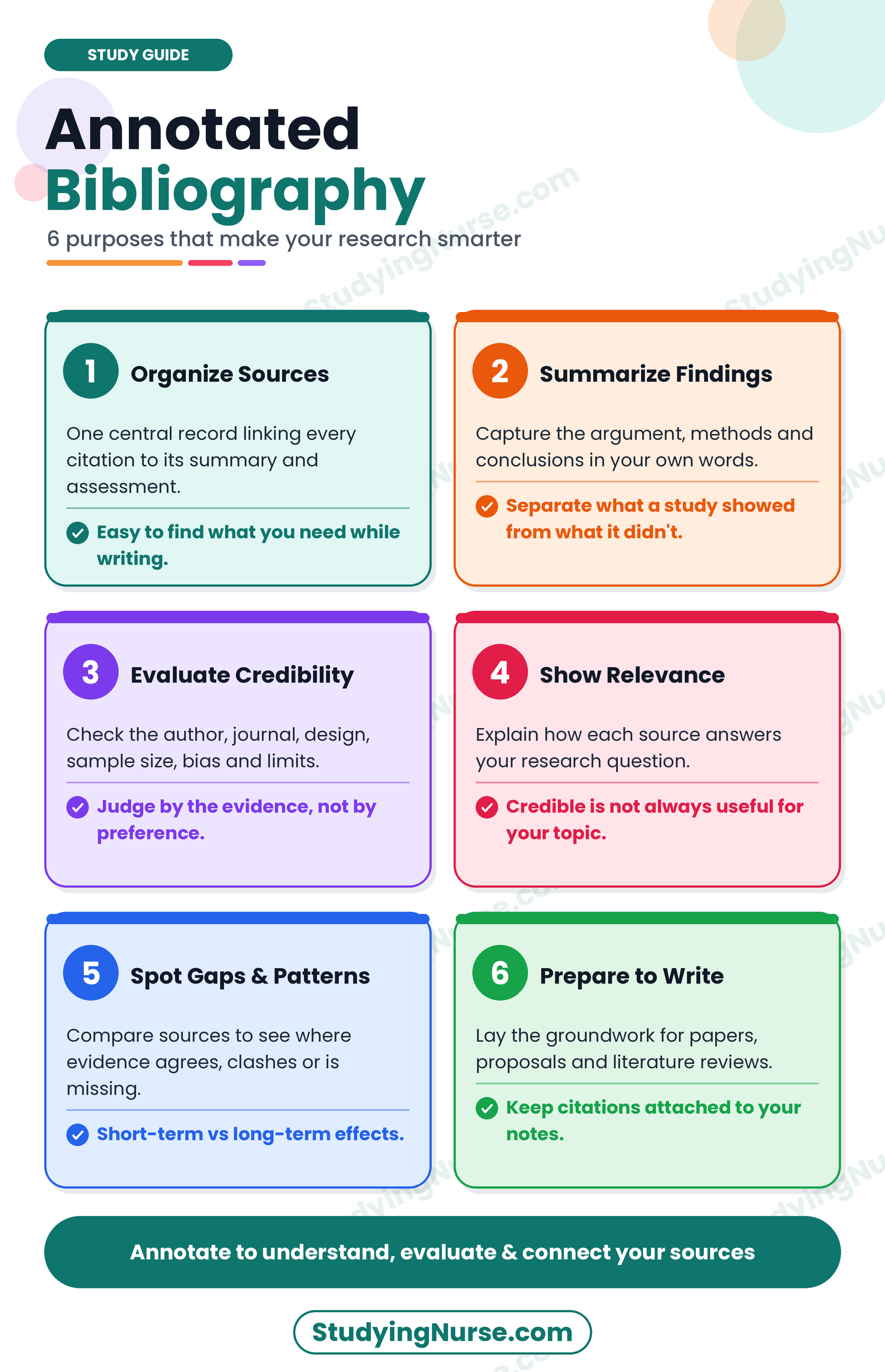
MLA Style and Format
MLA style, developed by the Modern Language Association, is commonly used in literature, language, cultural studies, and related humanities disciplines. Although it is less common than APA in nursing research, MLA may be required for writing-intensive courses, interdisciplinary assignments, or research projects in which the instructor specifies this citation style.
An MLA annotated bibliography follows the core citation conventions of an MLA Works Cited list, with an annotation added to each entry. MLA’s citation system uses a flexible template of core elements, including the author, title of source, title of container, contributors, version, number, publisher, publication date, and location. Not every source requires all these elements.
Key MLA annotated bibliography formatting rules
- Title: Use the title required by the assignment, commonly Annotated Bibliography or Annotated List of Works Cited. Follow the instructor’s directions if a specific title is required.
- Author’s name: For a source with one author, begin with the author’s last name, followed by the first name. For multiple authors, follow MLA’s rules for listing names.
- Publication details: Include the relevant title, container, volume, issue, publisher, publication date, page range, DOI, or URL, depending on the source type.
- Capitalization: Apply MLA’s capitalization conventions to source titles and publication details.
- Alphabetical order: Entries are usually arranged alphabetically by the first element of the citation, often the author’s last name. Some assignments permit organization by topic or chronology.
- Hanging indent: Use a 0.5-inch hanging indent for each citation.
- Annotation placement: Place the annotation after the citation and indent it approximately one inch from the left margin, according to the standard MLA annotated bibliography format. The annotation generally occupies one paragraph unless the assignment requires more.
- Spacing: MLA papers are generally double-spaced, including citations and annotations, with no additional blank lines between entries unless instructed otherwise.
Example of an MLA-style entry
The following citation is fictional and demonstrates the basic format only.
Illustrative MLA 9 format
Morgan, Laura R., and Samuel K. Patel. “Nurse-Led Education and Medication Adherence among Adults with Hypertension.” Journal of Hypothetical Nursing Research, vol. 18, no. 2, 2024, pp. 115–128.
This hypothetical article examines how nurse-led education may influence medication adherence among adults with hypertension. It focuses on patient counseling, understanding treatment instructions, and addressing barriers to taking prescribed medication. The source could be useful for a research project on patient education and chronic disease management. Its contribution would need to be assessed by examining the study’s methodology, participant selection, outcome measures, and limitations.
This example highlights a major difference between MLA and APA. MLA places the author’s name in a more conventional first-name-last-name format after the initial author’s surname, and it does not place the publication year immediately after the author’s name. It also uses MLA-specific punctuation and publication details.
When writing an annotation in MLA format, focus on what the source says, how effectively it supports its claims, and why it is relevant to the research topic. A descriptive annotation may explain the source’s main argument, while an evaluative annotation considers the credibility of the author and the quality of the evidence. A combined annotation may include both approaches.
For example, an annotation for a source about patient education could explain the educational intervention and the outcomes examined, then assess whether the research design provides sufficient evidence to support the authors’ conclusions. The final sentence might explain how the source could help answer a research question about patient understanding or medication adherence.
An MLA annotated bibliography should remain consistent throughout. Do not format one citation according to MLA rules and another according to APA simply because a citation generator produced different results. Confirm that each source’s publication details are accurate, and use the same citation style for all entries unless the assignment explicitly requires otherwise.
Chicago Style and Format
Chicago style is based on The Chicago Manual of Style and is used in many humanities, history, and social science disciplines. It offers two main documentation systems: Notes and Bibliography and Author-Date. The appropriate system depends on the discipline and the assignment’s requirements.
In the Notes and Bibliography system, sources are commonly documented using footnotes or endnotes, with a bibliography listing the works consulted. In the Author-Date system, citations typically use the author’s surname and publication year in the text, with a corresponding reference list. An annotated bibliography adds a summary or evaluation to each bibliographic entry.
Chicago style is flexible about how annotations are positioned. Depending on the assignment and the chosen format, the annotation may follow the citation on the same line, appear in brackets, or begin in a separate indented paragraph. The University of Alberta Libraries’ guidance, for example, describes these alternatives under Chicago’s 18th edition.
Key Chicago annotated bibliography formatting rules
- Choose the correct system: Confirm whether the assignment requires Notes and Bibliography or Author-Date.
- Author names: In a bibliography entry, the first author’s name is generally written surname first, followed by the given name. Subsequent authors’ names follow the applicable Chicago convention.
- Titles: Italicize titles of books and journals. Place titles of journal articles and chapters in quotation marks.
- Publication information: Include the details appropriate to the source, such as the journal title, volume, issue, page range, publication year, publisher, and DOI or URL.
- Alphabetical order: Entries are generally arranged alphabetically by the first author’s last name unless the assignment specifies a different organization.
- Indentation: Use a hanging indent for the bibliographic citation. Indent the annotation when required by the chosen template.
- Spacing and placement: Follow the assigned Chicago format or institutional guide. Do not assume that all Chicago annotated bibliographies use identical spacing or annotation placement.
Example of a Chicago-style entry
The following is a fictional example using Chicago’s Author-Date conventions for a journal article. It is intended to demonstrate the general format rather than represent a real publication.
Illustrative Chicago Author-Date format
Morgan, Laura R., and Samuel K. Patel. 2024. “Nurse-Led Education and Medication Adherence among Adults with Hypertension.” Journal of Hypothetical Nursing Research 18 (2): 115–128.
This hypothetical article examines the role of nurse-led education in supporting medication adherence among adults with hypertension. It considers how patient counseling and follow-up communication may help patients understand treatment plans and manage barriers to medication use. The source could contribute to research on nursing interventions for chronic disease management. Its strength would depend on the quality of the study design and evidence, while potential limitations might include a small sample, a short follow-up period, or restricted generalizability. Reviewing these features would help determine how much weight the findings should receive in the wider research project.
The Chicago example differs from the APA and MLA entries in its punctuation and placement of the publication year. In this Author-Date citation, the year follows the authors’ names without parentheses. The journal title is italicized, and the volume and issue information appears before the page range.
If the assignment instead requires Chicago’s Notes and Bibliography system, the citation must follow that system’s bibliography conventions. Footnotes or endnotes may also be required in the associated research paper. Do not combine the Author-Date citation pattern with Notes and Bibliography formatting unless the instructor has specifically requested a hybrid approach.
An effective Chicago annotation should still explain the source’s purpose, main findings, reliability, limitations, and relevance to the research question. For a nursing-related topic, this may involve considering whether a study’s findings are applicable to a particular patient population or clinical setting. If the source reports an association rather than a causal relationship, the annotation should preserve that distinction.
The most important consideration is consistency. Each entry should follow the selected Chicago system, and each annotation should provide useful information rather than simply repeat the source’s title or abstract. When an assignment specifies Chicago’s 18th edition or provides a department-specific template, use that guidance to resolve questions about publication details, indentation, and spacing.
Across APA, MLA, and Chicago, the core principles of an annotated bibliography remain the same: provide accurate citations, summarize sources fairly, evaluate evidence when required, and explain relevance to the research topic. The main differences lie in the citation details and page layout. Following the correct style makes the bibliography easier to read, helps readers locate the original sources, and supports a clear and credible research process.
Common Annotated Bibliography Mistakes
Creating an annotated bibliography involves more than collecting sources and placing citations in alphabetical order. Each entry should demonstrate that the source has been read, understood, assessed, and connected to a specific research topic. Errors in source analysis, relevance, citation, academic integrity, and formatting can weaken the quality of the entire bibliography, even when the selected sources appear credible.
An effective annotated bibliography combines an accurate citation with a meaningful annotation. The annotation may summarize the source’s purpose and findings, evaluate the quality of its evidence, and explain how it contributes to the research question. The precise balance of these elements depends on the assignment requirements.
The following common mistakes explain what can go wrong when writing an annotated bibliography and how to correct each problem.
Inadequate Source Analysis and Irrelevant Annotations
One of the most common mistakes is writing an annotation that describes a source without analyzing its content, credibility, or usefulness. An annotation should help readers understand not only what a journal article, book, or report discusses but also what it contributes to the research topic.
1. Summarizing the title instead of the actual source
A weak annotation often repeats information that readers can already obtain from the title. For example, an annotation for an article about medication adherence might state that the article discusses why patients should take their medication as prescribed. This provides little information about the research question, methods, findings, or significance of the source.
A stronger annotation identifies the article’s specific purpose, the population examined, the methods used, and the main findings. For a study on medication adherence, it might explain whether researchers examined patient education, medication costs, treatment complexity, or communication between nurses and patients.
To avoid this mistake, read the source itself rather than relying exclusively on its title, search-result snippet, or abstract. An abstract is useful for screening articles, but it may not contain enough detail to assess the study’s limitations or determine how well it supports the research question.
2. Providing a summary without evaluating the source
A descriptive annotation may be appropriate when the assignment asks only for a summary. However, when evaluation is required, simply reporting the author’s conclusions is incomplete.
For example, an annotation might explain that a study investigated a nurse-led intervention and found improved patient outcomes. An evaluative annotation would go further by considering whether the study included a suitable comparison group, used reliable outcome measures, had an adequate sample, and followed participants for a sufficient period.
These details matter because a study’s findings may be affected by selection bias, limited follow-up, missing data, or other methodological weaknesses. A source may be relevant to a research topic without providing strong enough evidence to support every claim associated with that topic.
A useful approach is to assess the author’s expertise, the publication’s credibility, the research design, the quality of the evidence, and any limitations acknowledged by the authors. Evaluation should be based on the actual source rather than unsupported personal opinions.
3. Including irrelevant information
Another mistake is filling an annotation with background information that does not help explain the source’s value. An annotation for a research project on preventing hospital-acquired pressure injuries, for example, does not need a lengthy explanation of the general history of nursing or a broad description of hospital care.
Instead, it should focus on information that helps answer the research question, such as the prevention strategy studied, the patient population, the outcomes measured, and the evidence supporting the conclusions.
Before including a detail, ask whether it helps readers understand the source’s content, credibility, limitations, or relevance. If it does not serve one of these purposes, it may not belong in the annotation.
4. Failing to connect the source to the research question
An annotation may accurately summarize a source but still be ineffective if it does not explain why the source was selected. The relevance statement should establish how the source supports, challenges, expands, or provides context for the research topic.
For example, if the research question concerns how discharge education affects readmissions among adults with heart failure, a source about medication reconciliation may be relevant because medication understanding is one component of discharge preparation. However, the annotation should explain this connection instead of merely stating that the article is about medication.
A useful relevance statement could read:
This source may support the research project by explaining how medication reconciliation and patient education contribute to safer transitions from hospital to home. Its findings can be considered alongside studies that measure readmission rates to assess whether improvements in discharge practices are associated with better patient outcomes.
This statement identifies a specific contribution without claiming that the source proves a conclusion it may not have investigated directly.
5. Writing annotations that are too long, too short, or inconsistent
An annotation that is only one vague sentence may omit essential information, while an excessively long paragraph may repeat the article’s background, methods, and discussion without explaining their significance. Annotations of similar sources should generally have a reasonably consistent level of detail.
There is no universal word count for every annotated bibliography. Some assignments require brief annotations, while others expect more extensive critical analysis. Follow the instructor’s instructions rather than applying a fixed word count to every task. University writing guides commonly recommend concise entries that focus on the source’s most important contribution.
A practical way to maintain consistency is to draft each annotation around three questions:
- What is the source about, and what are its main findings or arguments?
- How credible and useful is the source, and what limitations should readers consider?
- How does the source contribute to the research question or project?
Not every assignment requires all three elements for every entry, so adjust the structure to match the requested annotation type.
6. Treating an annotated bibliography as a literature review
An annotated bibliography generally discusses sources individually, with each citation followed by its own annotation. A literature review, by contrast, synthesizes multiple sources to develop a broader understanding or argument about a topic.
For example, an annotated bibliography might explain what three separate studies report about patient education and medication adherence. A literature review would compare their findings, examine areas of agreement and disagreement, and discuss patterns or gaps across the evidence.
Confusing these two formats can lead to an assignment that does not meet its purpose. Keep each annotation centered on the individual source, while noting relevant connections to the wider research topic when appropriate.
Citation Errors, Plagiarism, and Formatting Inconsistencies
A second major group of mistakes involves inaccurate citations, improper use of source material, and inconsistent formatting. These errors can make an annotated bibliography difficult to verify and may raise concerns about academic integrity. Even a well-written annotation loses credibility if readers cannot locate the original source or if the citation does not accurately represent the publication.
1. Using incomplete or incorrect citations
Every bibliographic citation should contain the information required by the selected citation style. Common errors include misspelling an author’s last name, omitting the publication year, using an incorrect article title, leaving out a journal’s volume or issue number, and providing a broken or inaccurate DOI or URL.
These mistakes are particularly problematic in nursing research because readers may need to locate the original study to verify its methods, results, or clinical implications.
For example, a citation may list the correct article title but identify the wrong publication year. This could lead readers to retrieve a different version of the research or misunderstand how current the evidence is. Similarly, an incorrect DOI may direct readers to an unrelated publication or prevent them from locating the intended article.
To prevent these errors:
- Compare the citation with the original article, book, or official publication record.
- Verify the author’s name, publication date, title, journal or publisher, volume, issue, and page range when applicable.
- Check that a DOI or URL leads to the intended source.
- Confirm that the punctuation, capitalization, italics, and author-name order follow APA, MLA, or Chicago style.
- Use a citation generator as a starting point, then review its output manually.
Citation generators can save time, but they may import incomplete metadata or apply the wrong citation format. The responsibility for producing an accurate citation remains with the writer.
2. Mixing citation styles
Another frequent mistake is combining elements from different citation styles in the same annotated bibliography. APA, MLA, and Chicago have distinct conventions for author names, publication dates, punctuation, and publication details. Switching between them without a specific reason creates inconsistencies.
For example, an APA citation generally places the year in parentheses immediately after the author information. MLA does not follow that same arrangement, while Chicago’s Author-Date system places the year after the author name without parentheses.
If an annotated bibliography contains ten sources, all ten should normally follow the style required by the assignment. A writer should not use APA for journal articles, MLA for websites, and Chicago for books simply because different online citation generators produced those formats.
Before writing, identify the required citation style and use the corresponding university writing center guide, library guide, or official style manual throughout the document. If the assignment provides a template, use it consistently.
3. Plagiarizing source material
Plagiarism occurs when a writer presents another person’s words or ideas as their own without appropriate acknowledgment. In an annotated bibliography, this can happen when a writer copies sentences from an article’s abstract, reproduces a passage from a book, or closely follows the original wording without adequate paraphrasing.
An annotation should demonstrate the writer’s own understanding of the source. Copying an abstract does not show that the source has been independently analyzed, even when the citation is accurate.
Consider the following illustrative example.
Weak approach: copied wording
The article states: “Structured discharge education improves patient understanding of medication instructions and follow-up care.”
Better approach: original paraphrase
The source examines whether organized education before discharge helps patients understand their medication regimens and the care they need after leaving the hospital.
The second version expresses the idea in different wording and sentence structure. In a real annotated bibliography, it must still represent the source accurately, and the source must be cited appropriately. If exact wording is necessary, use quotation marks and follow the relevant citation style’s rules for quotations and page or paragraph locations.
Paraphrasing requires more than replacing a few words with synonyms. Read the passage, identify its main meaning, set the original wording aside, and explain the idea in your own sentence structure. Then compare your version with the original to ensure that the meaning remains accurate.
4. Paraphrasing without preserving the author’s meaning
A writer can also misrepresent a source while attempting to avoid plagiarism. This happens when the annotation changes the author’s conclusions, exaggerates findings, or presents a possible explanation as an established fact.
For example, a study may find an association between nurse-led education and improved medication adherence. An inaccurate annotation might claim that the intervention definitively caused the improvement, even though the study design does not establish causation.
A more accurate annotation would state that the study found an association or reported improved adherence following the intervention, depending on the actual results and research design.
When summarizing a journal article, distinguish among:
- What the researchers measured or observed.
- What the researchers concluded.
- What the evidence can reasonably support.
- What limitations might affect interpretation or generalizability.
This distinction is particularly important when an annotated bibliography informs evidence-based nursing practice. Accurate summaries protect the integrity of the original research and help readers assess the strength of the evidence.
5. Using sources that cannot be verified
A citation should refer to a real, identifiable source that readers can verify. Problems arise when writers rely on incomplete search results, cite articles they have not actually accessed, or use fabricated references generated by an artificial intelligence tool.
For example, a citation may contain a plausible journal title, article name, author, and DOI but still refer to a publication that does not exist. A convincing-looking reference is not proof that a source is genuine.
To avoid this problem, search for the article through the publisher’s website, a scholarly database, a university library catalogue, or another reliable publication record. Confirm that the author, title, date, and publication details match. If only an abstract is available, do not claim to have evaluated methods or results that cannot be verified from the available material.
Citation verification is especially important when evaluating research articles for clinical topics, because inaccurate or fabricated sources can undermine the entire research process.
6. Applying inconsistent formatting
Formatting errors may seem minor, but they can make an annotated bibliography appear disorganized and may cause the writer to lose marks when formatting is part of the assessment criteria.
Common problems include:
- Omitting the hanging indent from citations.
- Using different fonts, margins, or spacing in different entries.
- Failing to alphabetize sources when alphabetical order is required.
- Placing annotations inconsistently relative to their citations.
- Applying italics or quotation marks incorrectly to titles.
- Using inconsistent capitalization or punctuation.
- Including additional blank lines between some entries but not others.
To correct these problems, review the document after completing the annotations. Check the citation format separately from the annotation’s content, and compare several entries side by side to identify inconsistencies.
A hanging indent, for example, means that the first line of a citation begins at the left margin while subsequent lines are indented. It helps readers distinguish individual entries and locate bibliographic details quickly. However, the annotation’s indentation and spacing may differ according to the required style or assignment template, so follow the relevant instructions rather than assuming that one layout applies to every format.
7. Failing to proofread the finished annotated bibliography
The final mistake is submitting the document without checking both the writing and the citations. Spell-checking alone is insufficient because it may not identify an inaccurate finding, a missing publication detail, or an annotation that does not address the research question.
During proofreading, check that each annotation accurately represents its source, uses clear academic language, includes the required analysis, and explains the source’s relevance. Confirm that every citation matches the correct publication and that the entire bibliography follows one consistent citation style.
A useful final review is to ask whether another reader could use each entry to locate the source, understand its main contribution, assess its limitations, and determine why it belongs in the bibliography. If any of these elements is missing, revise the entry before submission.
Correcting these common mistakes produces an annotated bibliography that is accurate, organized, and useful for further research. The goal is not simply to create a bibliography that looks correct, but to demonstrate careful source selection, meaningful analysis, academic integrity, and a clear connection between the selected literature and the research topic.
Tips for Improving an Annotated Bibliography
A strong annotated bibliography requires more than correct citations and brief descriptions of sources. Each entry should communicate the source’s main ideas clearly, evaluate its credibility when required, and explain its usefulness for a specific research topic. Careful source selection, objective writing, accurate citation details, and consistent formatting make an annotated bibliography more valuable as a research tool.
Whether the assignment follows APA, MLA, or Chicago style, the goal is to produce a bibliography that readers can navigate easily and use to understand the available evidence. For research projects in nursing, this means choosing reliable sources, representing findings accurately, and distinguishing between evidence that supports a conclusion and evidence that merely suggests a possible relationship.
The following strategies can help improve the quality, clarity, and academic credibility of an annotated bibliography.
Writing Concise and Objective Annotations
An effective annotation communicates essential information without unnecessary repetition. It should provide enough detail for readers to understand the source’s purpose, main findings, credibility, limitations, and relevance to the research question, according to the assignment’s requirements. Concise writing does not mean removing important analysis; it means presenting the most useful information in a clear and organized way.
1. Focus on the source’s most important contributions
Before drafting an annotation, identify the information that readers need to understand the source. For a journal article, this may include the research question, study design, participant population, main findings, and implications. For a book chapter or clinical guideline, the emphasis may instead be on the central argument, recommendations, scope, or intended audience.
For example, if a source examines nurse-led education for adults with hypertension, the annotation should focus on the intervention, the outcomes investigated, the findings reported, and how the source contributes to research on medication adherence. A lengthy explanation of hypertension in general would be unnecessary unless it helps clarify the source’s particular contribution.
A practical drafting method is to identify three elements:
- Summary: What is the source about, and what does it report?
- Evaluation: How credible and useful is the source, and what limitations should be considered?
- Relevance: How does it contribute to the research question or project?
Not every assignment requires all three elements in equal detail. A descriptive annotation may emphasize summary, whereas an evaluative or combined annotation should devote more attention to the quality of the evidence and its usefulness.
2. Use precise language and avoid repetition
An annotation becomes less effective when it repeats the same idea in several sentences. For example, saying that a study examines patient education, explores the effects of education, and investigates how education influences patients may communicate essentially the same point.
A more concise version would identify the intervention and the outcomes directly:
Less effective
The article discusses patient education. It explains the importance of education for patients and explores how patient education can help patients understand their healthcare.
Improved
The article examines how structured patient education influences understanding of treatment instructions and supports self-management of chronic conditions.
The improved sentence communicates the central idea without unnecessary repetition. Similar revisions can help reduce wordiness throughout an annotated bibliography.
Use specific verbs to describe the author’s work. For example, examines, compares, evaluates, identifies, reports, and investigates can clarify what a source does. However, choose verbs that accurately reflect the research design and the authors’ actual findings.
3. Maintain an objective academic tone
Objective annotations describe and assess evidence rather than relying on unsupported personal opinions. Statements such as “This is an amazing article” or “The researcher did a terrible job” do not explain the source’s quality or limitations.
A stronger evaluation identifies specific evidence:
- Instead of saying, “This is a very reliable study,” explain that the study uses a clearly described method, appropriate outcome measures, and a relevant participant population, if those features are actually present.
- Instead of saying, “The research is useless,” explain that the small sample or narrow study setting may limit the generalizability of the findings.
- Instead of saying, “The article proves that education works,” describe the results accurately and acknowledge whether the design supports a causal conclusion.
Objectivity does not require avoiding criticism. It means grounding criticism in the source’s methods, evidence, reasoning, and limitations. It also means acknowledging strengths where appropriate rather than treating every source as either completely reliable or entirely unhelpful.
4. Distinguish the author’s findings from your own evaluation
An annotation should make clear which statements describe the source and which express the writer’s assessment. This distinction is important when the source’s conclusions are stronger than its research design can support.
For instance, a hypothetical observational study may report that patients who receive additional discharge education experience fewer readmissions. An objective annotation should not automatically claim that the education caused the reduction. Other factors, such as illness severity, access to follow-up care, or differences in patient characteristics, may influence the outcome.
A balanced annotation could state:
The study reports an association between additional discharge education and lower readmission rates. Its findings may support further investigation of patient education as a nursing intervention, although the observational design limits conclusions about causation.
This wording presents the reported finding, identifies its potential value, and acknowledges an important limitation.
5. Keep annotations consistent in length and structure
Consistency makes an annotated bibliography easier to read and compare. If one entry contains a detailed evaluation of methods and limitations while another provides only a vague sentence, readers may struggle to understand why the sources were selected.
There is no universal word count for all annotations. Follow the assignment’s required length and annotation type. If no word count is specified, aim for enough detail to explain the source’s main contribution without reproducing the abstract or writing a full literature review.
A useful editing checklist is to ask:
- Does the annotation identify the source’s central purpose or argument?
- Does it accurately summarize the important findings or ideas?
- Does it evaluate credibility or limitations when required?
- Does it explain the source’s relevance to the research topic?
- Can any repeated or irrelevant sentence be removed?
Editing with these questions in mind helps produce annotations that are concise, objective, and informative.
Verifying Sources and Citation Accuracy
Accurate citations and reliable sources are essential to a credible annotated bibliography. Even a well-written annotation can be misleading if the cited article does not exist, the publication details are incorrect, or the source does not support the claims attributed to it. Verification helps readers locate the original publication and assess the evidence independently.
This is particularly important in nursing research, where information may influence discussions of clinical interventions, patient safety, healthcare outcomes, and evidence-based practice.
1. Verify the source against the original publication
Do not rely solely on a search-result snippet, a citation generator, or a reference copied from another paper. Locate the original source through the publisher’s website, a university library database, or a scholarly database such as PubMed or CINAHL, where appropriate.
Check the following details:
- Author information: Confirm the spelling and order of authors’ names, including initials and any additional authors.
- Publication date: Verify the year and, where relevant, the full publication date.
- Title: Ensure that the article or book title matches the published version.
- Journal or publisher: Confirm the journal title, book publisher, or other publication information.
- Volume, issue, and pages: Check these details for journal articles when applicable.
- DOI or URL: Make sure the identifier or web address leads to the intended publication.
- Publication status: Determine whether the article has been corrected, retracted, or replaced by a later version when this information is relevant.
A citation can appear convincing while containing inaccurate information. Therefore, the goal is not simply to make the reference look correct but to ensure that it identifies a real source accurately. University library guidance also emphasizes checking generated citations for completeness, capitalization, punctuation, and style consistency.
2. Assess the credibility and relevance of each source
Verification involves more than confirming that a publication exists. The writer should also determine whether the source is suitable for the research question.
Consider the author’s expertise, the publication venue, the methods used, the quality of the evidence, the intended audience, and the source’s publication date. For nursing research, a peer-reviewed journal article may be useful, but peer review alone does not guarantee that every conclusion is valid or applicable to all clinical settings.
For example, a study on medication adherence conducted with a small group of patients in one hospital may offer valuable insights but may not apply equally to patients in different healthcare systems. An annotation should acknowledge this limitation when it affects the source’s usefulness.
Similarly, a clinical guideline may be authoritative but outdated. Check whether a more recent version is available and whether the older guideline remains relevant to the research question.
Purdue University’s guidance on evaluating sources recommends assessing credibility and usefulness rather than assuming that all information found online is valid.
3. Check that the annotation accurately represents the evidence
A citation may be completely accurate while the annotation misstates the findings. To prevent this, compare each statement in the annotation with the original source.
For example, if researchers report that a patient education program was associated with improved treatment adherence, do not write that the program definitively caused the improvement unless the evidence supports that conclusion. Likewise, do not describe a study as a randomized controlled trial if it used an observational design.
When evaluating a journal article, review the methods and results sections instead of relying only on the abstract. This helps ensure that the annotation reflects the actual participant population, intervention, outcome measures, and limitations.
If the annotation includes a statement about the source’s relevance, make sure that the connection is reasonable. An article about patient satisfaction may provide context for a project on nursing communication, but it may not directly establish whether a particular intervention reduces hospital readmissions.
4. Keep a record of source details while researching
Recording bibliographic information as soon as a source is selected can prevent citation errors later. Create a research record containing the complete citation, a working DOI or URL, the source’s main findings, relevant page numbers, and notes about credibility and limitations.
A simple record might look like this:
| Information to record | Example |
|---|---|
| Research topic | Medication adherence among adults with hypertension |
| Source type | Peer-reviewed journal article |
| Main contribution | Examines patient education and adherence |
| Possible limitation | Follow-up period may be short |
| Relevance | Supports discussion of nursing education interventions |
| Verification | Author details, publication record, and DOI checked |
The example is illustrative; the details of an actual source must be taken from the publication itself.
Organizing information in this way makes it easier to write the annotation later and reduces the risk of confusing sources with similar titles or topics. It also helps distinguish direct quotations from paraphrased notes and the writer’s own evaluation.
5. Perform a final citation audit
Before submitting an annotated bibliography, review the entire document against the required citation style.
- Confirm that all sources are real and can be located.
- Check every author name, date, title, and publication detail.
- Verify that each DOI or URL works as expected.
- Ensure that citations follow one consistent style, such as APA, MLA, or Chicago.
- Check alphabetical order if required.
- Review the formatting of titles, journal names, volume numbers, punctuation, and hanging indents.
- Confirm that the annotation accurately summarizes the source and does not exaggerate its findings.
These checks are useful even when reference management software has generated the citations automatically. The writer remains responsible for the accuracy and academic integrity of the final annotated bibliography.
Using Citation Generators and Reference Management Tools
Citation generators and reference management tools can make creating an annotated bibliography more efficient. They help organize bibliographic information, apply citation styles, store source details, and produce formatted references. However, they serve different purposes, and neither replaces the need to read, evaluate, and accurately describe the sources.
1. Understanding citation generators
A citation generator is a tool that creates a citation from information supplied by the user or retrieved from a database. Depending on the tool, the user may enter an article title, DOI, ISBN, URL, or author details and select a citation style.
Citation generators can be useful when preparing a short annotated bibliography or when a writer needs to format a limited number of sources quickly. Some university library databases and word-processing applications also provide built-in citation features.
Common options include:
- Online citation generators that format individual references.
- Citation features available through scholarly databases and library catalogues.
- Citation tools built into word-processing applications.
- Quick bibliography generators that create references in multiple citation styles.
The University of Washington Libraries distinguishes between quick citation tools for smaller, one-time tasks and citation management software designed to organize larger collections of references.
A citation generator can reduce manual formatting work, but the output should always be checked. It may omit information, misidentify an author, use an incorrect source type, or apply the wrong edition of a citation style. It may also produce a technically formatted citation for a source that is unsuitable for the research topic.
2. Understanding reference management tools
Reference management tools, also called citation managers or bibliographic management software, offer broader functions than basic citation generators. They help researchers collect, store, organize, annotate, and retrieve references throughout the research process.
Examples include:
- Zotero: Helps collect sources from websites and library databases, organize references into folders or collections, attach files, and create citations and bibliographies.
- Mendeley: Supports organizing research references, working with article PDFs, and generating citations and bibliographies.
- EndNote: Provides reference organization and citation-formatting features for academic writing.
- RefWorks: Offers web-based reference organization and bibliography-generation features, subject to available institutional access and subscription arrangements.
The features, integrations, storage limits, and costs of these tools may differ. Choose a tool that fits the assignment, available software, and size of the research project rather than assuming that every tool offers the same functions. University libraries provide comparisons and guidance to help researchers select suitable software.
3. How to use these tools when creating an annotated bibliography
A reference manager can support several stages of the writing process.
- Collect sources. Import bibliographic details from a scholarly database, publisher website, or library catalogue. Save the source’s DOI or URL so that you can return to the original publication.
- Organize references. Create a collection for the specific research topic, such as pressure injury prevention or medication adherence. Use folders, tags, or notes to distinguish relevant sources from those that may not be included.
- Record research notes. Save a concise summary of the study’s purpose, methods, findings, limitations, and relevance. Keep direct quotations clearly marked and record page numbers when available.
- Generate citations. Select the required style, such as APA, MLA, or Chicago, and use the tool to create a preliminary citation.
- Draft the annotation. Use your notes and the original publication to write an independent summary and evaluation. A citation manager does not determine what the source contributes to your research question.
- Review and export. Check the generated citation against the original source, correct errors in the reference record, and export or insert the formatted entry into the document.
This workflow is particularly helpful when a research project involves many sources or when citations will be reused in later assignments.
4. Recognizing the limitations of automated citation tools
The most important limitation is that generating a citation is not the same as verifying a source. An automated tool may format incomplete or incorrect information consistently, making an inaccurate citation look professional.
Reference managers also cannot independently determine whether a source is credible, whether its research methods are appropriate, or whether its conclusions support a particular argument. Those tasks require the writer to examine the publication and apply critical judgment.
For example, a citation generator might produce a correctly formatted reference for a study on nurse-led patient education. However, it cannot decide whether the study’s small sample, short follow-up period, or specific clinical setting limits the relevance of its findings to a broader research question. The annotation must communicate those considerations when they are supported by the evidence.
Automated tools can also create difficulties when the source type is incorrectly identified. A webpage may be treated as a journal article, a chapter may be recorded as an entire book, or an author’s name may be imported incorrectly. Always inspect the reference record before using the generated citation.
5. Use tools to support academic integrity, not replace it
Citation generators and reference management software should help organize the writing process, not substitute for reading and analysis. Avoid copying an annotation from another website, relying on a generated summary without checking the original source, or accepting a reference simply because software has formatted it.
When using any automated or AI-assisted tool, verify that the source exists, that the publication details are accurate, and that the annotation faithfully represents the research. Follow institutional rules on the use and disclosure of such tools when applicable.
The most effective approach combines automation with careful judgment: use software to manage bibliographic details and formatting, then review each source and write an accurate, objective annotation in your own words.
By writing concise annotations, verifying sources, and using citation tools responsibly, writers can create an annotated bibliography that is easier to read, academically credible, and useful for developing a research paper or literature review.
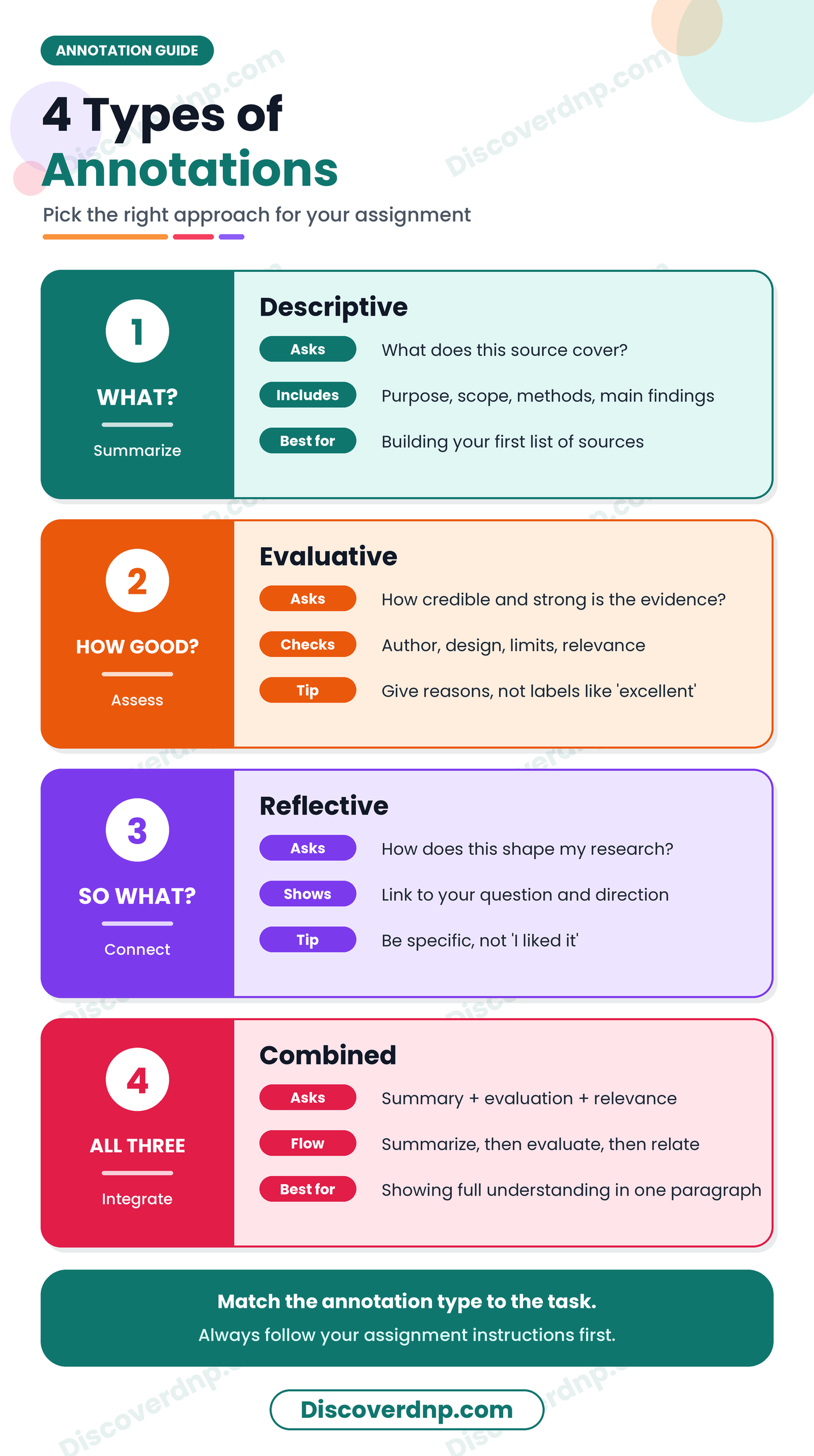
Conclusion
An annotated bibliography is more than a list of sources accompanied by brief descriptions; it is an essential part of the research process that demonstrates how effectively a writer can identify, understand, and evaluate scholarly information. By combining accurate citations with clear summaries, critical evaluations, and explanations of relevance, an annotated bibliography helps establish a strong foundation for academic writing, research papers, and literature reviews.
Writing an effective annotated bibliography requires careful source selection, objective analysis, and attention to citation requirements. Whether using APA, MLA, or Chicago style, each entry should accurately represent the original publication, acknowledge its strengths and limitations, and explain how it contributes to the research question. Avoiding common mistakes, verifying bibliographic details, and using citation generators and reference management tools responsibly can further improve the accuracy and consistency of the final document.
For nursing research, these skills are particularly valuable because the quality of a research project depends partly on the credibility and relevance of the evidence informing it. A well-prepared annotated bibliography helps distinguish reliable findings from limited or inconclusive evidence, identify gaps in existing knowledge, and organize information that may inform evidence-based practice. With a systematic approach to reading, evaluating, and documenting sources, writers can create annotated bibliographies that go beyond meeting assignment requirements to support deeper understanding, sound academic judgment, and more informed research decisions.
Frequently Asked Questions
1. How do I start writing an annotated bibliography?
Start by identifying your research topic and reviewing the assignment instructions. Find credible, relevant sources, read them carefully, and record their publication details. Choose the required citation style, such as APA, MLA, or Chicago. For each source, write a short annotation that summarizes its main ideas, evaluates its credibility when required, and explains its relevance to your research question. Arrange and format the entries according to the required style.
2. How to write a bibliography for nursing?
To write a bibliography for nursing, select reliable sources such as peer-reviewed nursing journals, systematic reviews, clinical practice guidelines, and relevant textbooks. Follow the required citation style, which is often APA in nursing assignments. Include accurate publication details and organize the entries alphabetically when required. If an annotated bibliography is requested, add a paragraph after each citation summarizing the source, evaluating its evidence and limitations, and explaining how it contributes to the nursing research topic.
3. Can you provide a good example of an annotated bibliography?
Here is a brief example using a hypothetical source to demonstrate the format:
APA-style citation:
Morgan, L. R. (2024). Nurse-led education and medication adherence among adults with hypertension. Journal of Hypothetical Nursing Research, 18(2), 115–128.
Annotation:
This hypothetical article examines how nurse-led education may influence medication adherence among adults with hypertension. It explores the role of patient counseling and follow-up communication in helping patients understand their treatment plans. The source could support research on nursing interventions for chronic disease management. Its usefulness would depend on the study design, sample size, and quality of the evidence.
Note: The citation is fictional and should not be used as a real academic reference.
4. What is an annotated bibliography with an example?
An annotated bibliography is an organized list of sources in which each citation is followed by a brief paragraph called an annotation. The annotation summarizes the source and may evaluate its credibility, limitations, and relevance to a particular research topic.
For example, in a nursing assignment about preventing hospital-acquired pressure injuries, a citation might be followed by an annotation explaining that the article examines repositioning schedules, skin assessments, and preventive nursing interventions. The annotation would then evaluate the quality of the evidence and explain how the findings could inform the research project. Unlike a standard bibliography, an annotated bibliography provides commentary on each source rather than listing publication details alone.
