

The Three NIMS Guiding Principles: Unity, Preparedness, Standardization, and Resource Management in Incident Management and the Incident Command System
Modern healthcare systems function within an environment where emergencies can escalate quickly, overwhelm infrastructure, and require coordination across multiple agencies and disciplines. Natural disasters, infectious disease outbreaks, technological hazards, and mass casualty incidents all demand more than clinical expertise; they require a structured approach to incident management that ensures clarity, coordination, and accountability. Within this framework, the Three NIMS Guiding Principles—unity, preparedness, and standardization—serve as the foundational concepts that enable organized and effective response.
The Three NIMS Guiding Principles originate from the Federal Emergency Management Agency under the broader framework of the National Incident Management System. NIMS provides a nationwide model for emergency management and response, ensuring that organizations across jurisdictions operate under shared principles and structures. At the center of this system are the Three NIMS Guiding Principles, which shape how the incident command system (ICS) functions, how the command structure is organized, and how response activities are coordinated across diverse operational environments.
Unity, as one of the Three NIMS Guiding Principles, emphasizes clarity in authority and responsibility. It reinforces the importance of unity of command and a defined chain of command within the incident command system. In practical terms, unity ensures that personnel report to a single supervisor, reducing confusion and eliminating conflicting directives during incident response. This principle strengthens the command system by promoting disciplined communication, minimizing duplication of efforts, and preserving operational efficiency. Unity is central to NIMS because it stabilizes the organizational structure during complex emergencies where multiple agencies may be involved.
Preparedness, another of the Three NIMS Guiding Principles, focuses on proactive planning, training, and capacity development before an incident occurs. Preparedness extends beyond stockpiling supplies; it includes management by objectives, development of the incident action plan, and participation in exercises that test emergency response capabilities. Through preparedness, organizations build capacity for emergency management, ensuring that emergency management and response personnel understand their roles within the incident command post and broader emergency operations center. By institutionalizing preparedness, NIMS supports consistent readiness across agencies and jurisdictions.
Standardization, the third of the Three NIMS Guiding Principles, provides the structural consistency that allows organizations to operate seamlessly together. Standardized management processes, terminology, and communications and information systems principles enable interoperability among multiple organizations. This standardization ensures that resource management systems function efficiently and that comprehensive resource management can occur without ambiguity. Whether coordinating resource management task assignments or facilitating information and intelligence management, standardized management eliminates confusion and enhances effective incident management.
Together, the Three NIMS Guiding Principles form an integrated framework that supports unified command, modular organization, and coordinated incident support. They influence how incident facilities and locations are established, how establishment and transfer of command occur, and how information systems principles guide communication flow. The principles and structures embedded within NIMS components ensure that organizations can scale operations, adopt virtual structures with staff participating remotely, and maintain resource coordination throughout the incident.
Understanding the Three NIMS Guiding Principles requires examining how they operate collectively rather than in isolation. Unity reinforces disciplined command relationships; preparedness strengthens operational readiness; and standardization ensures interoperability and consistency. When these principles are applied effectively, they enhance response and management across diverse emergency scenarios. They support interoperability among agencies, strengthen communications and information management, and create a stable organizational framework capable of adapting to dynamic incident conditions.
This article provides an in-depth examination of the Three NIMS Guiding Principles and their influence on incident management and the incident command system. It explores how these guiding principles shape unified command structures, comprehensive resource management, and information and intelligence management within modern emergency management systems. By analyzing the foundational concepts, operational applications, and structural components of NIMS, the discussion offers a detailed understanding of how unity, preparedness, and standardization remain central to effective incident management across complex and evolving response environments.
Foundations of the Three NIMS Guiding Principles in the National Incident Management System
The Three NIMS Guiding Principles—unity, preparedness, and standardization—form the structural and philosophical base of the National Incident Management System. Developed and maintained by the Federal Emergency Management Agency, NIMS provides a nationwide, systematic approach to incident management that ensures consistency in emergency management, coordination in incident response, and interoperability among participating organizations.
At their foundation, the Three NIMS Guiding Principles serve as core principles that anchor all NIMS components. They are not optional recommendations; rather, they are central to NIMS and embedded into every operational structure and management process. These principles ensure that emergency management and response personnel operate within an integrated and predictable system during routine events and large-scale disasters alike.
The foundational importance of the Three NIMS Guiding Principles can be understood through four key dimensions:
- Structural Consistency
- Unity ensures a stable command structure with clearly defined reporting relationships.
- This stability prevents fragmentation of authority within the incident organization.
- Operational Readiness
- Preparedness reinforces planning, training, exercises, and capacity-building efforts.
- It strengthens the overall capacity for emergency management across jurisdictions.
- System-Wide Interoperability
- Standardization ensures consistent terminology, procedures, and communications and information systems principles.
- It supports interoperability among multiple organizations engaged in related emergency management.
- Scalability and Adaptability
- Because NIMS components are adaptable, the Three NIMS Guiding Principles apply to both small-scale and complex incidents.
- Organizations that adopt NIMS can expand or contract their operational structures without compromising coordination.
In essence, the Three NIMS Guiding Principles create a stable yet flexible architecture that governs how response and management activities unfold. They ensure that even in rapidly evolving situations, there is clarity in authority, predictability in procedures, and cohesion in execution.
The Core Guiding Principle Framework Within NIMS Components
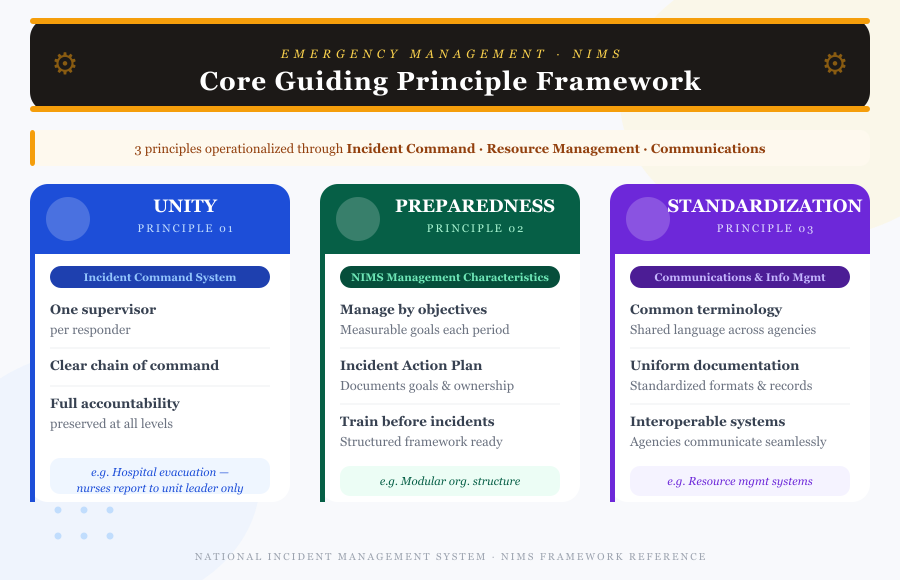
The Three NIMS Guiding Principles are operationalized through specific nims components, including:
- Incident command
- Resource management
- Communications and information management
Each component reflects how a guiding principle transitions from theory into structured practice.
1. Unity Within the Incident Command System
Unity and unity of command are embedded in the incident command system (ICS) and its defined organizational structure. The chain of command and unity ensure:
- Each individual reports to only one supervisor.
- Conflicting instructions are eliminated.
- Accountability is preserved within the command system.
This principle is operationalized through:
- Clearly defined supervisory roles
- Structured reporting relationships
- Defined span-of-control limits
For example, during a hospital evacuation, nurses assigned to the operations section would report only to their designated unit leader. Unity of command helps maintain discipline and prevents operational confusion.
2. Preparedness Through NIMS Management Characteristics
Preparedness is reflected in the nims management characteristics, which include:
- Management by objectives
- Modular organization
- Establishment and transfer of command
- Incident action planning
The phrase “nims management characteristic refers” to standardized processes that guide how incidents are managed. For example:
- Management by objectives ensures that measurable goals are defined at the beginning of each operational period.
- The incident action plan documents those objectives and assigns responsibility for achieving them.
Preparedness ensures that incident management personnel are trained to operate within this structured framework before an emergency occurs.
3. Standardization in Communications and Information Management
Standardization is embedded in:
- Communications and information management
- Information and intelligence management
- Resource management systems
The management characteristic helps to eliminate ambiguity by:
- Establishing common terminology
- Standardizing documentation formats
- Promoting interoperable communication systems
For example, standardized terminology prevents misunderstandings between agencies that might otherwise use different operational language. This is especially critical during multi-agency emergency response efforts.
How the Three NIMS Guiding Principles Shape the Incident Command System (ICS)
The Three NIMS Guiding Principles directly shape the structure and function of ICS, a standardized management framework designed to enable effective incident management across diverse scenarios.
1. Unity and Unity of Command in ICS
Unity influences the ICS command structure in several ways:
- The incident commander holds overall responsibility.
- Each operational element operates within a defined chain of command.
- The principle that unity of command helps preserve accountability ensures that personnel are not assigned multiple supervisors.
This structured approach prevents operational fragmentation and strengthens coordinated incident support.
2. Preparedness and Management by Objectives
Preparedness shapes ICS by requiring:
- Development of an incident action plan for each operational period.
- Clear articulation of objectives.
- Ongoing evaluation of performance outcomes.
Management by objectives ensures that:
- All operational units work toward shared goals.
- Resources are allocated strategically.
- Incident support aligns with evolving priorities.
For example, during a public health emergency, objectives may include increasing surge capacity, securing additional supplies, and coordinating information sharing with the emergency operations center.
3. Standardization and Modular Organization
Standardization influences ICS through:
- Clearly defined roles and responsibilities
- Modular organization
- Standardized management processes
The modular organization allows ICS to scale:
- A small incident may require only a limited command staff.
- A complex disaster may activate a full incident management team.
This adaptability ensures effective incident management while maintaining structural integrity.
The Role of Standardization in Building a Unified Command System
Standardization is essential in establishing a cohesive unified command structure, particularly during incidents involving multiple agencies or jurisdictions.
1. Establishing Unified Command
Unified command allows leaders from different agencies to:
- Collaboratively establish incident objectives.
- Share decision-making authority.
- Maintain jurisdictional responsibility.
Standardized management ensures:
- Consistent terminology.
- Shared operational planning processes.
- Integrated communications and information systems principles.
2. Supporting Resource Coordination Throughout the Incident
Standardization strengthens comprehensive resource management by ensuring:
- Resource typing and credentialing consistency.
- Accurate tracking and accountability.
- Efficient deployment across agencies.
The resource management task enables resource coordination across organizational boundaries, reducing duplication and improving operational efficiency.
3. Facilitating Establishment and Transfer of Command
Standardization ensures that:
- The establishment and transfer of command occur seamlessly.
- Documentation and reporting processes preserve continuity.
- Command transitions do not disrupt operational momentum.
This continuity is critical during prolonged emergencies or leadership shifts.
4. Supporting Virtual and Hybrid Command Structures
Standardized management also supports:
- Virtual structures with staff participating remotely.
- Structures with staff participating remotely during public health emergencies.
Through consistent communications and information management, unified command can function effectively even when personnel are geographically dispersed.
Unified Command and Multi-Agency Coordination in Complex Incidents
Complex emergencies rarely involve a single organization. Large-scale disasters, public health crises, hazardous materials incidents, and regional infrastructure failures often require collaboration among healthcare institutions, fire services, law enforcement, emergency medical services, and public health agencies. In these situations, the Three NIMS Guiding Principles provide the structural stability necessary for coordinated incident management, particularly through the implementation of unified command.
Unified command is a core element within the incident command system (ICS) and is embedded in the broader national incident management system framework. It allows multiple agencies with jurisdictional or functional authority to work together within a shared command structure, rather than operating in parallel or competing systems. This approach reinforces unity while respecting the legal authorities of participating organizations.
Under unified command:
- Agencies share responsibility for setting incident objectives.
- Decision-making authority is collaborative rather than centralized in a single incident commander.
- The chain of command and unity are preserved within each participating agency.
- Resource coordination throughout the incident occurs in a structured, integrated manner.
This model ensures effective incident management during complex events where no single agency has sole authority. For example, during a large-scale infectious disease outbreak affecting hospitals and community settings, healthcare systems, public health authorities, and emergency management agencies may operate under unified command to ensure consistent response and management.
The Three NIMS Guiding Principles are particularly evident in unified command structures:
- Unity ensures alignment of objectives and coordinated action.
- Preparedness enables agencies to collaborate because they have pre-established interoperable procedures.
- Standardization ensures consistent terminology, planning processes, and communications and information management across agencies.
Together, these principles support interoperability among multiple organizations and strengthen coordinated incident support.
When and Why Unified Command Is Implemented in the Command System
Unified command is implemented within the command system when:
- Multiple agencies have jurisdictional responsibility.
- An incident crosses political or geographic boundaries.
- The event requires functional expertise from different sectors.
- Legal authorities must remain intact for each responding entity.
The decision between an incident commander or unified command depends on the complexity and jurisdictional scope of the emergency. In a localized event managed by a single organization, one incident commander may be sufficient. However, in a multi-agency emergency—such as a regional wildfire affecting hospitals, transportation networks, and residential communities—unified command ensures coordinated leadership.
Unified command is used because it:
- Prevents duplication of effort.
- Reduces conflicting directives.
- Enhances information and intelligence management.
- Strengthens resource management systems.
For instance, in a chemical spill affecting both a hospital campus and surrounding neighborhoods:
- Fire services may oversee hazardous materials containment.
- Hospital leadership may manage patient surge capacity.
- Public health authorities may coordinate community notifications.
Rather than issuing separate directives, unified command allows these leaders to jointly establish objectives within the incident action plan. This structured collaboration supports comprehensive resource management and ensures that resource management tasks enable resource coordination without jurisdictional conflict.
Unified command also reinforces the principles of unity while maintaining unity of command within each agency. Personnel still report to their designated supervisors, preserving accountability within the broader collaborative structure.
Unified Command and the Development of a Coordinated Incident Action Plan
One of the most critical functions of unified command is the development of a coordinated incident action plan (IAP). The Three NIMS Guiding Principles shape how this plan is created and implemented.
Under unified command, the IAP is:
- Developed collaboratively.
- Based on shared objectives.
- Structured through management by objectives.
- Documented using standardized management processes.
The planning process typically follows these steps:
- Situation Assessment
Unified leaders analyze current conditions using information and intelligence management systems. - Objective Setting
Incident objectives are jointly established, reflecting the priorities of all participating agencies. - Resource Allocation
Comprehensive resource management ensures that available personnel, equipment, and supplies are distributed efficiently. - Operational Assignment
Specific tasks are assigned to operational units within the ICS framework. - Communication Strategy
Communications and information management protocols are defined to support interoperability among agencies.
By integrating these steps, unified command ensures that the incident action plan reflects coordinated strategy rather than fragmented efforts. This approach enhances effective incident management by aligning tactical operations with shared strategic goals.
For example, during a pandemic surge:
- Hospitals may prioritize patient flow and critical care capacity.
- Emergency management agencies may focus on logistics and supply distribution.
- Public health authorities may emphasize testing and community mitigation.
Through unified command, these priorities are consolidated into a single IAP, strengthening coordinated response and management.
Establishment and Transfer of Command in Unified Structures
The establishment and transfer of command is a critical nims management characteristic that ensures continuity within unified command environments. The Three NIMS Guiding Principles guide this process to maintain stability during leadership transitions.
Establishment of unified command typically occurs when:
- Additional jurisdictions become involved.
- The incident escalates in complexity.
- Multiple agencies assert legal authority.
The process involves:
- Formal identification of participating leaders.
- Clarification of roles and responsibilities.
- Documentation within the incident action plan.
- Communication to all incident management personnel.
Transfer of command may occur when:
- Operational periods change.
- Incident complexity increases or decreases.
- Jurisdictional authority shifts.
Standardized management ensures that:
- All relevant information is documented.
- Incoming leaders receive comprehensive briefings.
- The chain of command and unity remain intact.
The management characteristic includes maintaining accurate situational awareness, which prevents disruption during leadership transitions. By preserving continuity, unified command supports sustained operational effectiveness.
The Relationship Between Incident Facilities and Locations and Unified Command
Unified command relies heavily on clearly defined incident facilities and locations to coordinate multi-agency activities. These facilities may include:
- The incident command post (ICP) for on-scene incident organization.
- Staging areas for resource deployment.
- The emergency operations center (EOC) for strategic coordination.
Each facility supports unified command in distinct ways:
- Incident Command Post
- Serves as the primary location for unified leadership.
- Houses command staff and supports on-site coordination.
- Emergency Operations Center
- Provides strategic oversight and resource support.
- Facilitates communications and information management between agencies.
- Virtual Structures with Staff Participating Remotely
- Enable coordination when physical colocation is impractical.
- Support interoperability among geographically dispersed organizations.
Standardization ensures that these facilities operate under consistent protocols. Communications and information systems principles enable seamless data exchange, reinforcing coordinated incident support.
For example, during a regional disaster affecting multiple hospitals:
- Unified command may operate from a central ICP.
- The EOC may coordinate resource requests and policy decisions.
- Remote specialists may participate through virtual command structures.
This integrated approach strengthens effective incident management and ensures resource coordination throughout the incident.
Preparedness as a Guiding Principle for Effective Incident Management
Preparedness is one of the Three NIMS Guiding Principles and serves as a foundational element of effective incident management. Within the framework of the National Incident Management System, preparedness is not limited to pre-event planning; it is a continuous, structured process that strengthens emergency management, enhances incident response, and builds sustained capacity for coordinated operations.
As a guiding principle, preparedness ensures that organizations do not wait for a crisis to define roles, allocate resources, or establish communication pathways. Instead, preparedness requires that agencies adopt NIMS, integrate nims management characteristics, and develop operational familiarity with the incident command system (ICS) before an event occurs.
Preparedness contributes to effective incident management in several critical ways:
- Strategic Planning Before Incidents
- Development of hazard vulnerability assessments.
- Identification of resource gaps within resource management systems.
- Establishment of standardized protocols aligned with communications and information systems principles.
- Training and Exercises
- Simulation of multi-agency events to test interoperability among organizations.
- Reinforcement of unity of command and chain of command procedures.
- Practice in establishment and transfer of command.
- Capacity Development
- Strengthening the overall capacity for emergency management.
- Preparing emergency management and response personnel to function within structured command environments.
- Ensuring incident management personnel understand their responsibilities within the broader incident organization.
Preparedness, therefore, supports response and management continuity. It ensures that when an emergency occurs, operational structures are already familiar, objectives can be quickly defined, and coordinated incident support can be initiated without delay.
Preparedness and Management by Objectives in the Incident Command System
A central operational expression of preparedness within ICS is management by objectives. This NIMS management characteristic involves using clearly defined, measurable goals to guide incident operations. Management by objectives is essential because it transforms broad strategic intentions into actionable operational tasks.
Within ICS, preparedness and management by objectives operate through a structured process:
- Establish Incident Objectives
- Objectives are set by the incident commander or unified command.
- They align with jurisdictional priorities and the guiding principles of NIMS.
- Develop the Incident Action Plan (IAP)
- The incident action plan outlines specific strategies and tactical assignments.
- It ensures unity and unity of effort across operational sections.
- Assign Responsibilities
- Operational tasks are delegated through the chain of command.
- Each unit understands its role within the command structure.
- Evaluate and Revise Objectives
- Ongoing assessment ensures adaptability.
- Preparedness includes revising strategies as conditions evolve.
For example, during a hospital surge event, management by objectives may include:
- Expanding treatment capacity within four hours.
- Coordinating supply requests through comprehensive resource management.
- Enhancing information and intelligence management to track patient flow.
Preparedness ensures that these objectives can be developed rapidly and executed efficiently because personnel are already trained in standardized management processes.
The phrase “nims management characteristic refers” to structured practices like management by objectives that ensure consistency in operations. This management characteristic helps to eliminate ambiguity in decision-making and enhances effective incident management by aligning all operational elements with shared priorities.
The Role of the Incident Command Post in Operational Readiness
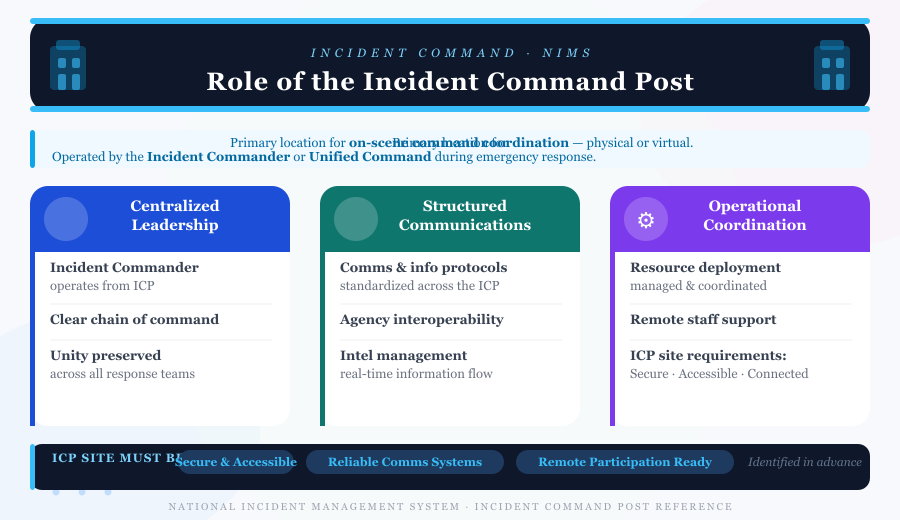
The incident command post (ICP) is a critical facility that supports preparedness and operational readiness. It functions as the primary location for on-scene incident organization and command coordination during an emergency.
The ICP supports preparedness in several ways:
- Centralized Leadership
- Provides a physical or virtual location where the incident commander or unified command can operate.
- Maintains clear chain of command and unity.
- Structured Communications
- Supports communications and information management protocols.
- Ensures interoperability among participating agencies.
- Operational Coordination
- Facilitates real-time information and intelligence management.
- Coordinates resource management tasks and deployment.
Preparedness planning includes identifying potential ICP locations in advance. These sites must be:
- Secure and accessible.
- Equipped with reliable communications systems.
- Capable of supporting structures with staff participating remotely if necessary.
For instance, during a regional natural disaster, the ICP may be established at a central healthcare facility while additional support is provided through virtual structures with staff participating remotely. Standardized management ensures that even in hybrid operational environments, coordination remains intact.
By establishing and equipping the ICP in advance, organizations strengthen their response capability and reinforce the Three NIMS Guiding Principles in practice.
Incident Management Teams and Preparedness Planning
An incident management team (IMT) plays a central role in preparedness planning and operational execution. IMTs consist of trained incident management personnel who can assume leadership roles within the ICS structure during emergencies.
Preparedness activities involving IMTs include:
- Training in modular organization.
- Participating in full-scale exercises.
- Practicing establishment and transfer of command.
- Reviewing resource management systems for accuracy and completeness.
The modular organization ensures that IMTs can scale operations based on incident complexity. For example:
- A small-scale incident may require only a limited planning and logistics staff.
- A large-scale disaster may activate a fully staffed command system with expanded operational branches.
Preparedness also ensures that IMTs understand how to support interoperability among multiple organizations and maintain resource coordination throughout the incident. By practicing unified operations in advance, IMTs strengthen coordinated incident support and reduce delays during actual emergencies.
Moreover, preparedness ensures that IMTs are familiar with nims command and coordination structures, enabling seamless integration with other agencies and reinforcing effective incident management across jurisdictions.
How the Emergency Operations Center Supports Incident Command
The emergency operations center (EOC) functions as a strategic coordination facility that supports the incident command structure. While the incident command post manages on-scene operations, the EOC provides broader resource and policy support.
The EOC enhances preparedness and incident management through:
- Strategic Resource Coordination
- Oversees comprehensive resource management.
- Ensures that resource management tasks enable resource coordination beyond the immediate operational area.
- Information and Intelligence Management
- Aggregates situational reports from multiple sources.
- Supports communications and information management across agencies.
- Policy and Administrative Support
- Addresses legal and financial considerations.
- Maintains continuity of governance during emergencies.
- Interoperability Enhancement
- Supports interoperability among participating organizations.
- Reinforces standardized management processes.
For example, during a public health emergency, the incident command post may coordinate patient care logistics while the EOC secures additional medical supplies and facilitates coordination with state-level authorities. This separation of tactical and strategic functions ensures balanced and effective incident management.
Preparedness planning requires that organizations define the relationship between the ICP and the EOC before an incident occurs. Clear delineation of responsibilities prevents duplication and strengthens unity of effort.
Resource Management Under the Three NIMS Guiding Principles
Resource management is a cornerstone of effective incident management and directly reflects the application of the Three NIMS Guiding Principles: unity, preparedness, and standardization. Within the National Incident Management System, resource management ensures that personnel, equipment, and supplies are effectively allocated, tracked, and utilized across diverse operational contexts. By embedding resource management within NIMS components and ICS structures, emergency management agencies achieve coordinated response and operational efficiency while supporting interoperability among multiple organizations.
Resource management under the Three NIMS Guiding Principles emphasizes:
- Unity – Clear command and control for resource allocation ensures that resource requests, deployment, and use occur under a defined command structure and within the chain of command and unity.
- Preparedness – Advance planning ensures resources are pre-identified, pre-staged, and available for rapid deployment. Pre-incident exercises validate the readiness of personnel and equipment.
- Standardization – Consistent resource management systems, standardized resource typing, credentialing, and reporting processes facilitate interoperability among agencies and jurisdictions.
For example, during a multi-hospital public health emergency, coordinated resource management ensures ventilators, PPE, and medical personnel are allocated efficiently, avoiding duplication and ensuring all facilities meet critical operational needs.
Comprehensive Resource Management in the ICS Framework
Comprehensive resource management (CRM) is a NIMS management characteristic that operationalizes preparedness and standardization within ICS. CRM involves planning, acquisition, mobilization, tracking, and demobilization of resources during the entire incident lifecycle.
Key components of comprehensive resource management include:
- Resource Identification and Ordering
- Maintaining an inventory of available personnel, equipment, and facilities.
- Activating standardized request procedures through ICS or incident management teams.
- Resource Deployment and Tracking
- Monitoring the location, status, and assignment of resources in real time.
- Using interoperable systems to ensure consistent reporting across agencies.
- Resource Recovery and Demobilization
- Returning resources to their home units after use.
- Documenting resource utilization to support lessons learned and continuous improvement.
Within the ICS framework, CRM ensures that resources are used effectively, contributes to operational continuity, and strengthens the capacity for emergency management. For example, during a multi-county flood, EMS teams, rescue boats, and mobile medical units are tracked and redeployed strategically to areas of greatest need.
Resource Typing, Credentialing, and Accountability in Incident Management
To support the Three NIMS Guiding Principles, resource management incorporates standardized resource typing, credentialing, and accountability:
- Resource Typing
- Categorizing personnel, teams, equipment, and facilities according to capability and functional role.
- Example: Classifying medical personnel as critical care nurses, triage nurses, or paramedics ensures appropriate deployment.
- Credentialing
- Verifying qualifications and certifications before personnel are assigned to tasks.
- Ensures personnel can safely perform assigned duties, maintaining unity of effort and operational integrity.
- Accountability
- Tracking the assignment, location, and status of resources to ensure efficient utilization.
- Supports information and intelligence management by providing accurate situational awareness.
By standardizing these processes, agencies enhance interoperability and reduce operational errors. For instance, during a wildfire affecting multiple jurisdictions, resource typing ensures firefighting crews and medical teams are deployed where their capabilities are most needed, while credentialing confirms legal and operational authorization to operate across boundaries.
Coordination Between Incident Command and the Emergency Operations Center
Coordination between the incident command post (ICP) and the emergency operations center (EOC) is critical for implementing effective resource management under the Three NIMS Guiding Principles. The ICP manages on-scene operational deployment, while the EOC provides strategic oversight, resource support, and policy coordination.
This coordination includes:
- Resource Requests and Allocation
- ICP identifies resource needs.
- EOC mobilizes additional personnel, equipment, or supplies as required.
- Status Reporting and Tracking
- Continuous updates from the ICP feed into the EOC’s comprehensive resource management systems.
- Ensures real-time visibility of resource status and availability.
- Decision Support
- EOC evaluates regional or multi-agency implications of resource deployment.
- Facilitates standardized management across jurisdictions.
For example, during a large-scale chemical spill, the ICP coordinates on-site hazmat teams and triage units, while the EOC arranges additional resources such as decontamination equipment and specialized medical teams from surrounding counties. This partnership enhances operational unity, preserves preparedness, and ensures standardization in resource deployment.
Scaling Resources Through Modular Organizational Structure
The ICS framework supports modular organization, which enables dynamic scaling of resources to match incident complexity while maintaining adherence to the Three NIMS Guiding Principles. Modular organization provides:
- Flexible Command Structure
- Incident command can expand or contract based on operational needs.
- Sections such as Operations, Planning, Logistics, and Finance/Administration can be activated as necessary.
- Efficient Resource Assignment
- Resources are deployed to operational sections based on priorities outlined in the incident action plan.
- Promotes unity of effort and preserves chain of command integrity.
- Adaptive Capacity for Emergency Management
- Allows rapid incorporation of additional personnel, specialized teams, or equipment.
- Supports interoperability among agencies during multi-jurisdictional incidents.
For example, in a regional flooding event, initial response may involve a limited ICP with basic logistics and operations. As the incident escalates, modular organization allows full activation of additional branches, including resource management teams, communications specialists, and emergency medical units, without disrupting ongoing operations. Standardized procedures within this modular framework ensure all new units are integrated effectively, maintaining preparedness and operational clarity.
Information and Intelligence Management in the Command System
Information and intelligence management is a critical NIMS component that underpins effective incident management and reinforces the Three NIMS Guiding Principles: unity, preparedness, and standardization. Within the incident command system (ICS), information management is essential for decision-making, resource allocation, and operational coordination. Accurate, timely, and structured information ensures that the incident commander and other leaders maintain situational awareness, direct response activities efficiently, and maintain unity of effort across multiple operational elements.
Information and intelligence management within the command system focuses on:
- Collection and Verification
- Gathering real-time data from operational units, field reports, and external sources.
- Verifying information to prevent errors and maintain credibility in decision-making.
- Analysis and Interpretation
- Transforming raw data into actionable intelligence.
- Using structured processes to identify trends, risks, and resource needs.
- Dissemination
- Sharing critical information with ICS sections, incident management teams, and the emergency operations center (EOC).
- Ensuring all personnel have access to consistent, standardized information for effective incident response.
For example, during a multi-hospital outbreak of an infectious disease, information and intelligence management helps identify emerging hotspots, prioritize patient transfers, and guide resource deployment, reinforcing preparedness and enabling coordinated incident support.
Information and Intelligence Management as a NIMS Component
The National Incident Management System (NIMS) identifies information and intelligence management as a formal component, emphasizing structured communication, data integration, and interoperability. Key functions of this NIMS component include:
- Data Integration Across Agencies
- Ensures interoperability among multiple organizations.
- Supports communications and information systems principles, reducing duplication and improving situational awareness.
- Centralized Intelligence Coordination
- Designated intelligence staff analyze incoming reports.
- Findings are briefed to the incident commander, unified command, or planning section to guide strategic and operational decisions.
- Standardization of Information Processes
- Uses consistent formats, terminology, and reporting mechanisms.
- Facilitates resource coordination throughout the incident and supports comprehensive resource management.
This component is particularly vital for complex incidents involving multiple jurisdictions or agencies. For example, during a large-scale hazardous materials incident, unified command relies on intelligence from environmental monitoring, medical teams, and law enforcement to inform evacuation decisions, decontamination procedures, and hospital surge planning.
Supporting Effective Incident Management Through Data Sharing
Data sharing is essential for effective incident management, as it ensures operational units, planning teams, and command staff are aligned. The Three NIMS Guiding Principles are embedded in this process:
- Unity – Shared data promotes coordinated action and prevents conflicting decisions.
- Preparedness – Pre-established protocols for data collection, verification, and distribution reduce response delays.
- Standardization – Common data formats, coding, and terminology facilitate interoperability across agencies.
Best practices in data sharing include:
- Establishing secure and interoperable communications networks.
- Utilizing centralized databases or dashboards for real-time updates.
- Implementing standardized reporting forms for field personnel.
For instance, during a wildfire affecting multiple municipalities, field units provide data on fire spread, resource needs, and evacuation progress. This information is shared with the ICP and EOC to guide resource allocation, logistical support, and public safety messaging.
Integrating Intelligence into the Incident Action Plan
The incident action plan (IAP) relies heavily on information and intelligence management to define objectives, prioritize tasks, and assign resources. Intelligence integration ensures that the IAP is both realistic and responsive to evolving circumstances. Key steps include:
- Assessment of Operational Environment
- Intelligence staff identify current hazards, risks, and resource gaps.
- Situational awareness informs objective setting.
- Prioritization of Objectives
- Incident objectives are defined based on verified intelligence and risk analysis.
- Resources are allocated efficiently through resource management tasks.
- Operational Planning
- Tactical assignments reflect intelligence-derived insights.
- Management by objectives ensures each operational unit contributes to the overall strategy.
Example: During a hospital surge incident, intelligence on patient influx, bed availability, and staffing levels is integrated into the IAP, allowing operations and logistics sections to deploy personnel and equipment optimally.
Communication Flow Within the Organizational Structure
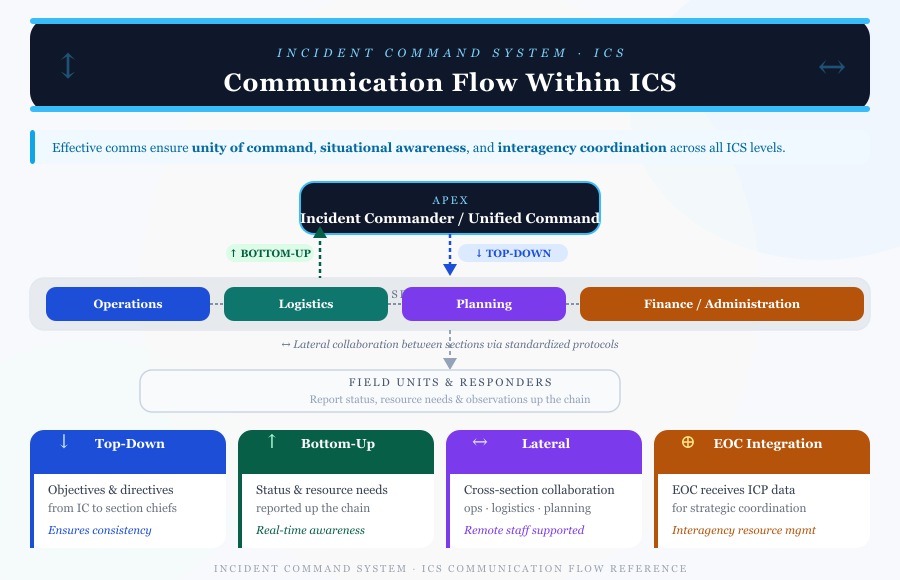
Effective communication flow within the ICS organizational structure is fundamental to operational success. Information and intelligence management ensures that:
- Top-Down Communication
- The incident commander or unified command disseminates objectives, priorities, and directives to section chiefs.
- Ensures consistency and unity of command.
- Bottom-Up Reporting
- Field units report status, resource needs, and operational observations through the chain of command.
- Supports real-time situational awareness and decision-making.
- Lateral Communication
- Collaboration between operations, logistics, planning, and finance/administration sections promotes management by objectives and operational integration.
- Virtual structures with staff participating remotely can be supported using standardized communication protocols.
- Integration with Emergency Operations Center
- The EOC receives data from the ICP and other operational units.
- Enables strategic coordination, resource allocation, and interagency communication.
For example, in a multi-agency emergency involving both hospitals and public safety responders, a clear communication flow ensures that each operational unit receives updated directives, reports critical field information, and contributes to a unified, coordinated response. Standardization and interoperability of communication systems are essential to prevent information silos and ensure the incident command structure functions cohesively.
Applying the Three NIMS Guiding Principles in Healthcare and Nursing Practice
The Three NIMS Guiding Principles—unity, preparedness, and standardization—are not limited to federal or large-scale emergency management operations; they are equally critical in healthcare and nursing practice. Hospitals, clinics, and community health organizations operate within increasingly complex emergency environments, including mass casualty incidents, infectious disease outbreaks, and natural disasters. By embedding the principles of NIMS into daily operations, healthcare institutions enhance patient safety, optimize incident management, and strengthen resource management and operational coordination.
Applying these principles in healthcare requires translating national-level strategies into hospital-based practices:
- Unity – Ensuring coordinated action among multidisciplinary teams, including nurses, physicians, allied health professionals, and administrative staff.
- Preparedness – Establishing protocols, training programs, and exercises to anticipate and respond to a variety of clinical emergencies.
- Standardization – Implementing uniform policies, communication systems, and clinical guidelines to maintain consistency across departments and facilities.
Incident Command in Hospital Emergency Management
Hospitals implement the incident command system (ICS) to manage internal emergencies and integrate with external agencies when required. The hospital ICS mirrors the broader national incident management system (NIMS) but is adapted to clinical settings. Key aspects include:
- Activation of Hospital Incident Command (HIC): During a surge in patients or an internal crisis, the incident commander or unified command establishes a hospital-based ICP.
- Management by Objectives: Clinical priorities such as patient triage, treatment capacity, and staff allocation are defined clearly.
- Resource Coordination: Hospital staff, medical equipment, and supplies are tracked and allocated using comprehensive resource management principles.
For example, during a mass casualty event in an urban area, the incident commander coordinates multiple departments—emergency, ICU, surgical, and laboratory services—to ensure patient flow is maintained, resources are deployed efficiently, and communication channels remain open.
Maintaining Unity of Effort in Clinical Response Teams
Unity of effort is essential in nursing and clinical operations to prevent fragmented care and duplication of tasks. In a hospital setting, this principle ensures that multidisciplinary teams:
- Operate toward shared objectives, guided by the hospital’s incident action plan.
- Maintain a clear chain of command and unity, preserving accountability while allowing decentralized decision-making at operational levels.
- Coordinate with external agencies such as EMS, public health authorities, and regional hospitals to maintain interoperability.
For example, during an infectious disease outbreak, clinical response teams—including nurses, infection control specialists, and pharmacists—must collaborate to manage patient isolation, medication distribution, and staff safety. Unified objectives ensure that patient care remains consistent and resources are allocated where they are most needed.
Nursing Roles Within the Incident Management Team
Nurses play a central role within incident management teams (IMTs), contributing operational expertise, clinical assessment, and patient care coordination. Specific nursing responsibilities within NIMS-guided structures include:
- Operational Planning and Execution: Nurses provide input for developing the incident action plan, particularly regarding patient flow, staffing needs, and clinical priorities.
- Resource Management Tasks: Nurses track the use of medical supplies and personnel, ensuring resource management task enables resource coordination across the hospital.
- Information and Intelligence Management: Nurses participate in real-time reporting, contributing to situational awareness and intelligence sharing.
- Training and Preparedness Activities: Nurses engage in simulation exercises and preparedness drills, building capacity for emergency response and reinforcing standardization of clinical procedures.
By integrating nursing roles into the ICS, hospitals ensure that incident management personnel are not only operationally coordinated but also strategically positioned to maintain patient care standards during emergencies.
Translating NIMS Guiding Principles into Everyday Emergency Preparedness
The application of the Three NIMS Guiding Principles extends beyond large-scale emergencies into routine healthcare operations. Hospitals and clinics can reinforce preparedness, standardization, and unity by:
- Developing Standard Operating Procedures (SOPs): Protocols for triage, infection control, and patient transfer reflect standardized management practices.
- Conducting Regular Training and Drills: Exercises simulate potential emergencies, enhancing readiness and reinforcing preparedness.
- Establishing Clear Communication Channels: Integrating communications and information management principles ensures that information flows smoothly between departments and external partners.
- Creating Resource Inventories: Maintaining updated records of medical supplies, personnel credentials, and equipment supports comprehensive resource management.
- Integrating Incident Command into Daily Practice: Even in non-emergency situations, using ICS structures for coordinating complex patient care or multi-department initiatives strengthens unity, accountability, and operational clarity.
For instance, during routine hospital flu seasons, an ICS-informed approach might involve:
- Assigning nurses to triage stations and monitoring patient throughput.
- Coordinating vaccine distribution across units using standardized protocols.
- Utilizing the hospital EOC for strategic oversight of staffing and supply needs.
By adopting these practices, healthcare institutions internalize NIMS principles, ensuring that incident management teams can respond effectively when true emergencies occur while maintaining high standards of patient care during everyday operations.
Conclusion
The Three NIMS Guiding Principles—unity, preparedness, and standardization—serve as the foundation for effective incident management across all levels of emergency response, from federal operations to hospital and clinical settings. By embedding these principles into the incident command system (ICS), organizations can maintain a coherent command structure, ensure coordinated resource management, and enable clear information and intelligence management. Preparedness ensures that personnel, equipment, and protocols are ready before a crisis arises, while standardization guarantees that operations are consistent, interoperable, and aligned across agencies. Unity and unity of effort maintain cohesion among multidisciplinary teams, preventing fragmentation and enhancing operational efficiency.
In healthcare, these principles are equally transformative. Nurses and clinical staff integrated within incident management teams leverage ICS structures to optimize patient care, manage critical resources, and maintain situational awareness during emergencies. The translation of NIMS principles into daily practice—through standardized protocols, training exercises, and strategic coordination with the emergency operations center (EOC)—reinforces organizational resilience and ensures continuity of operations.
Ultimately, understanding and applying the Three NIMS Guiding Principles empowers healthcare organizations and emergency management personnel to respond effectively, adapt to evolving challenges, and uphold safety and accountability. By fostering unity, strengthening preparedness, and maintaining standardized procedures, organizations enhance their capacity for emergency management, ensure effective incident management, and provide a structured, reliable framework for both routine operations and complex emergency responses. This integration of NIMS into practice is not only a strategic requirement but a practical roadmap for operational excellence, sustained readiness, and the protection of lives and resources in any emergency scenario.
Frequently Asked Questions
What are NIMS 3 guiding principles?
The Three NIMS Guiding Principles are unity, preparedness, and standardization. Unity ensures coordinated action and cohesion among teams; preparedness emphasizes readiness and planning before an incident; and standardization promotes consistency and interoperability in procedures, communications, and resource management.
Why are NIMS principles important?
NIMS principles are important because they provide a structured framework for effective incident management, enhance coordination among agencies, ensure comprehensive resource management, and enable predictable, reliable responses to both routine and complex emergencies. They strengthen operational efficiency, safety, and capacity for emergency management.
Which NIMS guiding principle supports interoperability among multiple organizations?
Unity of effort supports interoperability among multiple organizations by aligning actions and objectives across agencies while maintaining a shared command structure and standardized procedures.
What term is a NIMS guiding principle?
A term that is a NIMS guiding principle is preparedness, unity, or standardization, each representing one of the core principles central to the National Incident Management System (NIMS).
