

Interdependence in Ecological Theory: James Gordon Kelly’s Ecological Model in Psychology and the Field of Community Psychology
Interdependence in Ecological Theory represents a foundational shift in how psychology conceptualizes human behavior, social systems, and community life. Rather than locating the causes of behavior solely within individual traits or internal processes, this perspective situates individuals within interconnected ecological systems that shape and are shaped by human action. At the center of this intellectual transformation is James Gordon Kelly, whose ecological model significantly influenced the development of community psychology and expanded the theoretical boundaries of the broader field of psychology.
Historically, much of traditional clinical psychology emphasized diagnosis and treatment at the individual level. Psychological distress, maladaptive behavior, and mental health conditions were frequently understood through intrapsychic frameworks that focused on cognition, personality, or pathology. While these approaches advanced important therapeutic methods, they often overlooked the social context in which behavior occurs. Ecological theory challenged this limitation by asserting that human behavior cannot be separated from the environments in which people live, work, and interact. Individuals exist within networks of relationships among families, organizations, neighborhoods, and policy systems, all of which exert influence through dynamic and reciprocal processes.
The development of ecological thinking emerged alongside broader systems theory movements within social science. Scholars began recognizing that social problems—such as community mental health disparities, poverty, violence, and educational inequities—were not merely individual failures but outcomes of complex systems. In response, the field of community psychology adopted an ecological perspective that emphasized prevention, social change, and collaborative engagement with community members. Kelly’s ecological view provided a coherent framework for understanding how social ecology operates across multiple ecological levels, integrating research and practice in ways that addressed both contextual factors and structural conditions.
Central to this framework is the principle of interdependence, which holds that components within ecological systems are mutually influencing and cannot be understood in isolation. Change in one aspect of a system inevitably affects other parts. For example, modifications in organizational policies within healthcare institutions can alter professional roles, reshape relationships among staff, and influence patient outcomes. Similarly, public health interventions implemented at the policy level may affect community participation, access to resources, and health and social well-being across populations. Interdependence in Ecological Theory therefore provides a framework for understanding the relationships among individuals, organizations, and broader social systems as dynamic and interconnected.
Kelly’s contributions also influenced methodological approaches within psychological research. By emphasizing contextual factors, cycling of resources, adaptation, and community integration, his ecological model encouraged research methods that capture complexity rather than reduce it. Participatory community research, systems mapping, and multi-level intervention design reflect this shift. Professional bodies such as the American Psychological Association and the Society for Community Research and Action have supported ecological approaches that align closely with Kelly’s theory and practice.
Interdependence in Ecological Theory continues to shape contemporary discussions in community psychology, public health, applied psychology, and social psychology. Its emphasis on context, relationships among systems, and collaborative intervention strategies provides a structured framework for understanding complex social settings. Rather than isolating problems within individuals, it invites examination of the broader social environment and the interconnected systems that sustain or constrain health and well-being.
This article examines the foundations, principles, methodological implications, and applied relevance of Interdependence in Ecological Theory. It traces the development of ecological concepts within psychology, explores the ecological model proposed by James Gordon Kelly, and analyzes how the principle of interdependence operates across ecological levels. Through this comprehensive discussion, the enduring significance of Kelly’s ecological view within the field of community psychology and the broader field of psychology becomes evident as both a theoretical advancement and a practical guide for addressing contemporary social issues.
Foundations of Ecological Theory in Psychology and Community Psychology
The Emergence of Ecological Thinking in Psychology
The foundations of Interdependence in Ecological Theory are rooted in a major intellectual transition within the field of psychology. This transition involved moving away from narrowly individual-focused explanations of human behavior toward an ecological systems orientation that recognizes the influence of broader social systems and contextual factors.
1. Shift from Individual-Focused Psychology to Ecological Systems Thinking
For much of the early and mid-20th century, dominant models in psychology—particularly within traditional clinical psychology—emphasized:
- Internal traits (personality structures, cognition, psychopathology)
- Individual diagnosis and treatment
- Linear cause-and-effect explanations
While these models contributed significantly to therapeutic practice, they often underemphasized the social environment and structural determinants of behavior. Over time, scholars in social psychology and applied psychology began to critique this narrow focus.
Ecological systems thinking emerged in response, grounded in several key realizations:
- Human behavior occurs within interdependent ecological levels, not in isolation.
- Social issues such as community mental health disparities, violence, and educational inequities cannot be reduced to individual pathology.
- Social context and community systems shape opportunities, risks, and outcomes.
This shift laid the groundwork for Interdependence in Ecological Theory, emphasizing that:
- Individuals influence their environments.
- Environments influence individuals.
- These influences occur simultaneously and reciprocally.
Rather than asking, “What is wrong with this individual?”, ecological theory asks:
- What contextual factors shape this behavior?
- How do relationships among social systems sustain or constrain outcomes?
- What systemic changes are necessary to promote health and well-being?
2. Historical Development Within the Field of Community Psychology
The development of community psychology in the 1960s marked a formal turning point in the application of ecological thinking. Several historical forces shaped this transformation:
- Public health reform movements emphasizing prevention over treatment.
- Federal funding initiatives, including programs supported by the National Institute of Mental Health.
- Dissatisfaction with institutional mental health systems that relied heavily on hospital-based care.
The emerging participatory field of community psychology prioritized:
- Prevention and health promotion
- Community participation
- Social change initiatives
- Collaborative engagement with community members
Ecological concepts became central because practitioners recognized that:
- Social problems are embedded in complex systems.
- Effective community intervention must operate across multiple ecological levels.
- Sustainable change requires addressing structural conditions within community settings.
Organizations such as the American Psychological Association later formalized the identity of community psychology, reinforcing ecological theory as a defining framework for understanding relationships among individuals and community systems.
Interdependence in Ecological Theory thus became foundational to community psychology’s theory and practice, guiding both research and intervention.
James Gordon Kelly and the Development of the Ecological Model
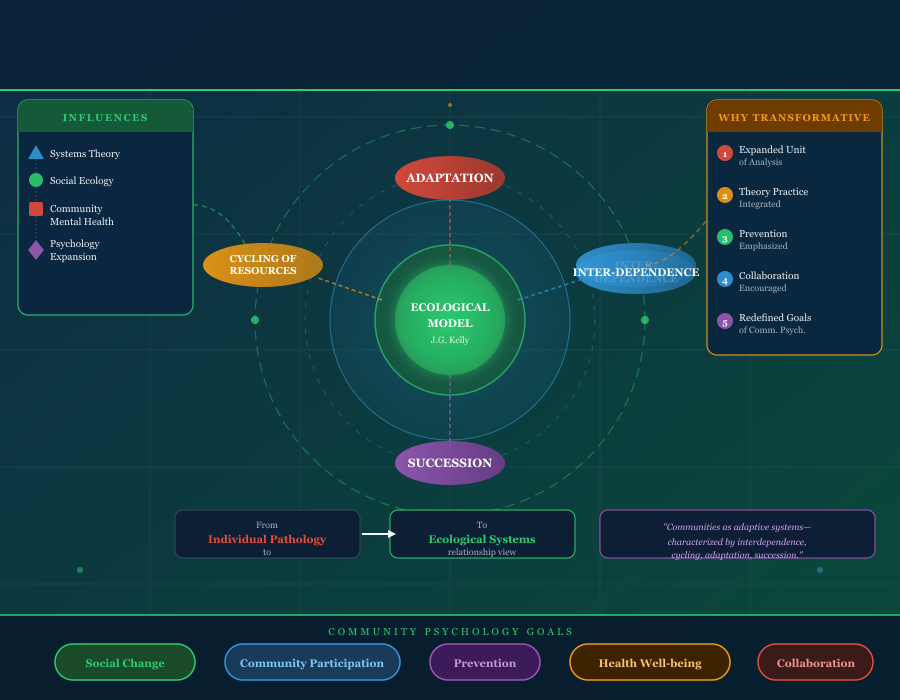
The development of the ecological model within community psychology is most closely associated with James Gordon Kelly, often referred to as Jim Kelly. His work provided a coherent systems model that integrated ecological principles into both psychological research and applied practice.
1. Intellectual Influences
Kelly’s ecological theory was shaped by multiple interdisciplinary influences:
- Systems theory – Emphasizing complex systems and relationships among components.
- Social ecology – Highlighting environmental influences on social behavior.
- Community-based mental health reforms – Stressing prevention and local engagement.
- Emerging discussions within departments of psychology about expanding beyond individual-level models.
These influences converged in Kelly’s ecological view, which framed communities as adaptive systems characterized by:
- Adaptation – Communities adjust to internal and external pressures.
- Cycling of resources – Tangible and intangible resources circulate within community systems.
- Succession – Social settings change over time.
- Interdependence – Elements within ecological systems are mutually influencing.
Kelly proposed four guiding principles that collectively formed the backbone of Interdependence in Ecological Theory.
2. Why Kelly’s Ecological View Was Transformative
Kelly’s ecological view was transformative for several reasons:
- It expanded the unit of analysis
- From individual pathology → to relationships among ecological systems.
- It integrated theory and practice
- Ecological theory was not abstract; it directly informed intervention strategies.
- It emphasized prevention
- Rather than waiting for pathology to emerge, the ecological approach promoted preventive interventions targeting contextual factors.
- It encouraged collaboration
- Community psychologists’ work became inherently collaborative, engaging community leaders and partners in intervention design.
- It redefined the goals of community psychology
- Promoting social change
- Strengthening community participation
- Enhancing health and social well-being
Texts such as the Handbook of Community Psychology reflect the enduring impact of Kelly’s ecological framework on theories in the field.
Interdependence in Ecological Theory therefore did not merely add another model to psychology—it reshaped the framework for understanding human behavior within social systems.
Core Assumptions of Ecological Theory in Community Psychology
At the heart of Interdependence in Ecological Theory are several foundational assumptions that distinguish ecological theory from traditional psychological paradigms.
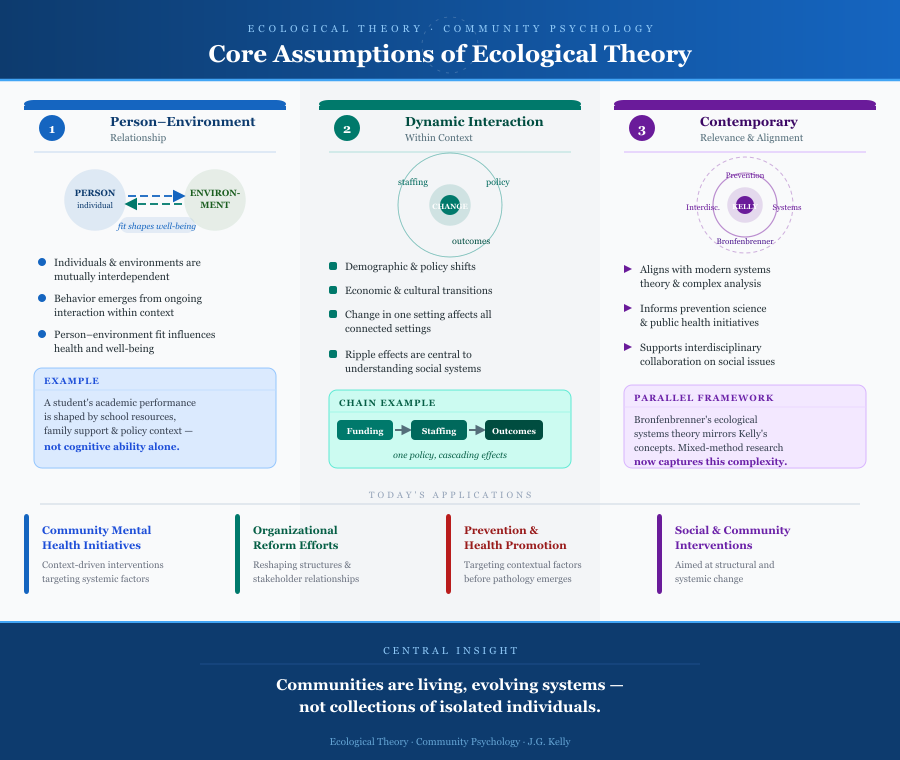
1. Person–Environment Relationship
Ecological theory asserts that:
- Individuals and environments are interdependent.
- Behavior emerges from ongoing interaction within context.
- Person–environment fit influences health and well-being.
For example:
- A student’s academic performance cannot be explained solely by cognitive ability.
- It is shaped by school resources, family support, organizational climate, and broader policy structures.
The ecological model thus provides a framework for understanding how contextual factors influence human behavior across ecological levels.
2. Dynamic Interaction Within Context
Ecological systems are not static—they evolve through:
- Demographic changes
- Policy reforms
- Economic transitions
- Cultural shifts
This dynamic quality reflects the principle of interdependence:
- Change in one social setting affects other settings.
- Modifications in organizational structures alter relationships among stakeholders.
- Shifts in public health policy reshape community intervention strategies.
For example:
- A new healthcare funding policy may influence hospital staffing, which affects service delivery, which then influences patient outcomes.
Interdependence in Ecological Theory emphasizes that such ripple effects are central to understanding social systems.
3. Relevance to Contemporary Theories in the Field
Ecological theory remains central to contemporary psychology because:
- It aligns with modern systems theory and complex systems analysis.
- It informs prevention science and public health initiatives.
- It supports interdisciplinary collaboration in addressing social issues.
For instance:
- Bronfenbrenner’s ecological systems framework, developed by Urie Bronfenbrenner, parallels many ecological concepts articulated in Kelly’s theory.
- Current community research often employs mixed-method and systems-based research methods that capture contextual complexity.
Today, Interdependence in Ecological Theory continues to guide:
- Community mental health initiatives
- Organizational reform efforts
- Prevention and health promotion strategies
- Social and community interventions aimed at structural change
The Principle of Interdependence in Ecological Systems
The principle of interdependence is central to Interdependence in Ecological Theory and serves as a defining feature of the ecological model developed by James Gordon Kelly. Within ecological systems, no component exists in isolation; rather, individuals, organizations, and broader community systems are interconnected through ongoing relationships among social settings. Understanding this principle provides a framework for understanding how change unfolds across complex systems and why effective intervention must operate beyond the individual level.
Defining Interdependence Within the Ecological Model
1. The Principle of Interdependence Explained
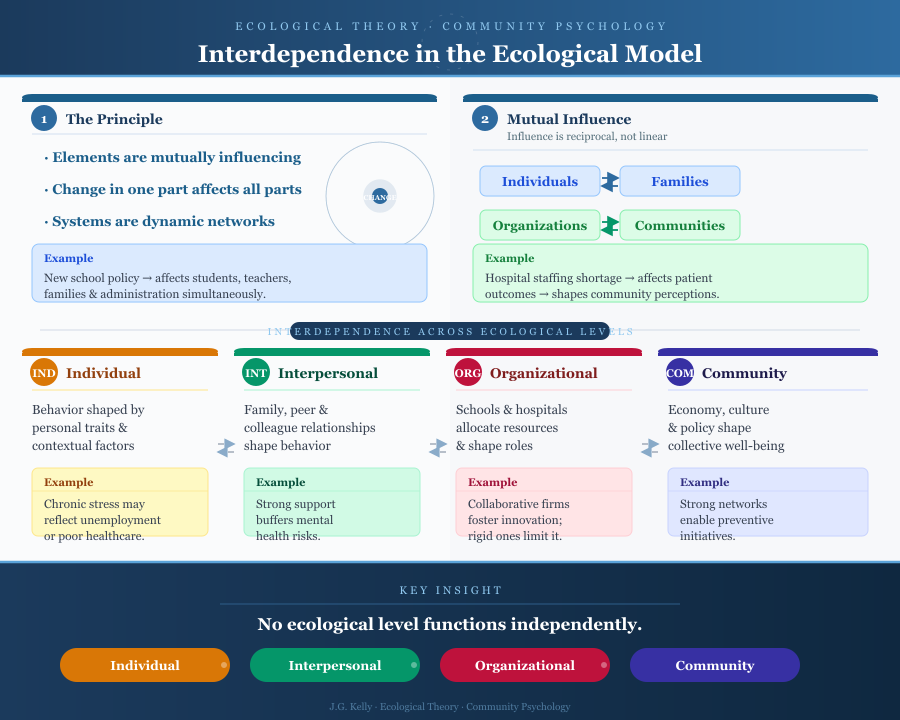
Within the ecological model, the principle of interdependence asserts that:
- Elements within ecological systems are mutually influencing.
- A change in one part of a system produces changes in other parts.
- Systems are dynamic networks rather than isolated units.
Kelly proposed four guiding ecological principles, and interdependence is often considered the most integrative because it connects adaptation, cycling of resources, and succession. Interdependence in Ecological Theory emphasizes that:
- Human behavior is shaped by continuous exchanges within the social environment.
- Social systems cannot be analyzed effectively in isolation from their social context.
- Effective community intervention must account for ripple effects across ecological levels.
For example:
- When a school implements a new disciplinary policy, the change affects not only student behavior but also teacher roles, family relationships, administrative workload, and peer interactions.
- When a public health initiative increases access to preventive interventions, it may alter healthcare utilization patterns, community participation, and organizational resource allocation.
In each case, the ecological approach highlights that systems function as interconnected units within a broader social ecology.
2. Mutual Influence Across Systems
Interdependence in Ecological Theory underscores that influence is reciprocal rather than linear. Mutual influence occurs:
- Between individuals and families
- Between organizations and communities
- Between policy systems and local social settings
This mutual influence operates through:
- Shared resources
- Social support networks
- Organizational structures
- Cultural context
- Policy decisions
For instance:
- A hospital experiencing staffing shortages (organizational level) may influence patient outcomes (individual level), which in turn shapes community perceptions of healthcare quality (community level).
- Community leaders advocating for health and social reforms may influence policy, which then affects funding streams and the cycling of resources within local community systems.
Thus, Interdependence in Ecological Theory moves beyond cause-and-effect models and instead conceptualizes complex systems as continuously interacting entities.
Interdependence Across Ecological Levels
A key strength of the ecological model is its recognition of multiple ecological levels within which interdependence operates.
1. Individual Level
At the individual level:
- Human behavior is shaped by personal characteristics and contextual factors.
- Psychological outcomes are influenced by social support, access to resources, and environmental stability.
For example:
- A person experiencing chronic stress may be responding not only to internal coping limitations but also to structural unemployment, community instability, or limited healthcare access.
Interdependence in Ecological Theory suggests that individual outcomes reflect broader systemic conditions.
2. Interpersonal Level
At the interpersonal level:
- Relationships among family members, peers, and colleagues influence behavior.
- Social settings create norms and expectations that shape adaptation.
For example:
- Strong social support networks can buffer against mental health risks.
- Conversely, exposure to violence within peer groups may reinforce maladaptive behavior patterns.
Here, the principle of interdependence explains how interpersonal dynamics are embedded within larger ecological systems.
3. Organizational Level
Organizations represent critical components of community systems. Schools, hospitals, workplaces, and community agencies:
- Allocate resources
- Establish policies
- Shape roles and expectations
Organizational structures can either reinforce or constrain behavior. For example:
- A workplace promoting collaborative practices may foster innovation and collective problem-solving.
- Conversely, rigid bureaucratic systems may inhibit community participation and limit intervention effectiveness.
Interdependence in Ecological Theory highlights how organizational decisions reverberate across other ecological levels.
4. Community Level
At the community level:
- Economic conditions
- Cultural context
- Infrastructure
- Policy frameworks
interact to shape opportunities and risks. Community integration, sense of belonging, and access to health and social services influence collective well-being.
For example:
- Communities with strong networks of community partners and participatory governance structures are often better positioned to implement preventive interventions.
- Communities experiencing resource depletion may see increased social problems due to disrupted cycling of resources.
Across these ecological levels, systems reinforce or constrain behavior through interconnected mechanisms. Interdependence in Ecological Theory emphasizes that no level functions independently.
Interdependence, Context, and Social Issues
1. Social Problems as System-Level Outcomes
Ecological theory reframes social problems as outcomes of complex systems rather than individual failings. Examples include:
- Community mental health disparities
- Public health inequities
- Violence in community settings
- Educational underachievement
These issues often reflect:
- Structural inequalities
- Inadequate organizational coordination
- Limited community participation
- Unequal distribution of resources
From the perspective of Interdependence in Ecological Theory, such social problems emerge when relationships among systems are disrupted or imbalanced.
For instance:
- A reduction in funding for community mental health programs may increase emergency room visits, strain healthcare institutions, and affect family stability.
- Economic decline may alter community systems, influence interpersonal relationships, and reshape organizational priorities.
The ecological metaphor captures this complexity by portraying communities as living systems in which imbalance in one domain affects the whole.
2. Understanding Context in Community Psychology
Understanding context is essential within community psychology’s ecological framework. Context includes:
- Social context (norms, relationships, social networks)
- Cultural context (values, beliefs, traditions)
- Organizational context (institutional policies and structures)
- Political and economic context (resource distribution and governance)
Interdependence in Ecological Theory provides a framework for understanding how contextual factors shape both risk and resilience. Community psychologists’ research and practice frequently examine contextual factors when designing interventions, recognizing that sustainable social change requires alignment across systems.
For example:
- A community intervention targeting youth violence must consider family relationships, school climate, neighborhood safety, and policy enforcement simultaneously.
- Prevention and health promotion strategies in public health must address both individual behaviors and structural determinants of health.
By situating behavior within ecological systems, Interdependence in Ecological Theory offers a comprehensive systems model that connects theory and practice. It clarifies how mutual influence across ecological levels shapes outcomes and underscores why addressing social issues requires coordinated, multi-level intervention.
Understanding Context Through the Ecological Perspective in Psychology
Context is a central construct in Interdependence in Ecological Theory and serves as the lens through which human behavior, social systems, and community interventions are understood. Within the ecological perspective, context is not simply background information; it constitutes the dynamic environment in which individuals and communities interact. James Gordon Kelly emphasized that understanding context is essential for developing effective community interventions, analyzing social problems, and guiding research and practice in psychology and community psychology.
Context as a Central Construct in Ecological Theory
1. Social, Cultural, Institutional, and Policy Context
In Kelly’s ecological framework, context encompasses multiple dimensions:
- Social context: Patterns of relationships among individuals, families, and community members; social networks; and norms that shape behavior.
Example: Peer influences on adolescent substance use are mediated by the broader social networks of friends, family, and school groups. - Cultural context: Shared values, beliefs, and traditions that influence how individuals interpret their experiences and respond to interventions.
Example: Community attitudes toward mental health may determine participation in preventive interventions. - Institutional context: Structures and practices within organizations that regulate behavior and resource distribution.
Example: School policies on inclusive education affect student engagement and access to learning resources. - Policy context: Local, regional, and national legislation and regulatory frameworks that influence resource allocation, service delivery, and social support systems.
Example: Public health policies that expand access to preventive care can reshape community mental health outcomes.
By integrating these contextual factors, the ecological model highlights that behavior and outcomes are products of multi-level interactions rather than isolated individual traits.
2. Why Context Matters More Than Isolated Variables
Traditional psychological research often isolates variables to determine cause-and-effect relationships. While such approaches have analytical value, they overlook the interconnectedness emphasized in ecological systems theory. Kelly argued that:
- Human behavior is contextually embedded.
- Isolated variables may misrepresent causality if ecological interdependencies are ignored.
- Effective interventions require understanding the full ecosystem in which behaviors and outcomes occur.
Example: A community mental health intervention aimed at reducing depression cannot rely solely on individual therapy; it must account for social support networks, economic stability, cultural attitudes toward mental health, and institutional resources. Neglecting these contextual factors can limit the intervention’s efficacy.
Ecological Model vs. Traditional Clinical Psychology Approaches
1. Individual Pathology vs. Systems Thinking
- Traditional clinical psychology: Focuses on diagnosing and treating individual pathology; assumes behavior problems reside within the person.
- Ecological perspective: Considers behavior as the outcome of relationships among multiple ecological levels, emphasizing interdependence and context.
Example: In clinical psychology, childhood anxiety might be addressed through cognitive-behavioral therapy. In contrast, an ecological approach would examine school environment, family dynamics, neighborhood safety, and policy-level stressors to fully understand and address the causes of anxiety.
2. Prevention vs. Treatment Focus
Kelly’s ecological framework shifted emphasis from reactive treatment to proactive prevention:
- Prevention-oriented: Focuses on reducing risk factors and strengthening protective factors across ecological levels.
- Treatment-oriented: Focuses on correcting existing problems at the individual level.
Example: A preventive intervention for community violence could include youth mentorship programs (interpersonal), organizational policies promoting safe school climates (organizational), and local policy initiatives to improve neighborhood infrastructure (community level). This contrasts with solely addressing individual behavioral problems after violence has occurred.
Applying Ecological Thinking to Complex Social Issues
1. Poverty, Violence, and Public Health Disparities
Complex social issues are rarely attributable to single causes; they emerge from the interaction of multiple ecological systems:
- Poverty: Results from economic policies, educational access, social support disparities, and neighborhood infrastructure.
- Violence: Influenced by community norms, family relationships, school climate, and law enforcement policies.
- Public health disparities: Reflect inequalities in institutional resources, healthcare access, and cultural context.
Interdependence in Ecological Theory helps practitioners understand these issues as systemic rather than purely individual, highlighting the need for coordinated, multi-level intervention strategies.
2. How Ecological Analysis Reframes Intervention Strategies
Ecological thinking reframes interventions by:
- Targeting multiple levels: Individual, interpersonal, organizational, and community interventions are designed simultaneously.
- Emphasizing context-specific solutions: Strategies are adapted to the unique social, cultural, and institutional environments of each community.
- Promoting collaboration: Community partners, leaders, and organizations are engaged to co-develop interventions.
- Focusing on preventive approaches: By addressing risk and protective factors across ecological levels, interventions aim to reduce the incidence of social and health problems.
Example: A public health program addressing adolescent obesity might integrate:
- School-based nutrition education (organizational level)
- Family engagement workshops (interpersonal level)
- Community policy initiatives for safer recreational spaces (community level)
- Media campaigns promoting healthy behaviors (social context)
Through this ecological lens, interventions are not isolated treatments but part of a comprehensive strategy informed by interdependence and context.
Applying Ecological Principles to Community Intervention and Prevention
The ecological perspective developed by James Gordon Kelly provides a practical framework for designing and implementing interventions that address complex social problems. Interdependence in Ecological Theory emphasizes that effective community intervention must account for interactions across multiple ecological levels—individual, interpersonal, organizational, and community systems—while integrating the social, cultural, and policy context. This approach informs not only psychological research and practice but also public health, community mental health, and applied nursing settings.
Applying Ecological Strategies in Community Psychology Practice
1. Multi-Level Intervention Design
Ecological interventions recognize that social problems are embedded in interdependent systems. Multi-level intervention design involves simultaneous action across several ecological levels:
- Individual level: Enhancing coping skills, knowledge, and self-efficacy.
Example: Psychoeducation programs that teach stress management strategies to adolescents. - Interpersonal level: Strengthening relationships and social support networks.
Example: Family counseling or peer mentorship programs to prevent youth substance abuse. - Organizational level: Modifying institutional practices and policies to support health and well-being.
Example: Schools implementing inclusive disciplinary policies that reduce behavioral disparities. - Community level: Promoting structural and policy changes to address systemic risk factors.
Example: Local government initiatives to improve neighborhood safety, create recreational spaces, and enhance access to community resources.
By addressing multiple levels simultaneously, interventions align with the principle of interdependence, ensuring that changes in one system reinforce positive changes across others.
2. Prevention and Health Promotion
Prevention and health promotion are central to ecological approaches in psychology and community psychology. Instead of reacting solely to problems after they arise, ecological interventions aim to:
- Reduce exposure to risk factors
- Strengthen protective factors
- Enhance resilience across ecological levels
Example: In community mental health, preventive interventions might include:
- Early childhood programs to support social-emotional development (individual/interpersonal levels)
- Training community members and teachers to recognize mental health warning signs (organizational level)
- Policies increasing access to mental health services in underserved areas (community/policy level)
Such strategies illustrate how applying ecological thinking allows community psychologists to intervene proactively, targeting upstream determinants of social and health problems.
Interdependence and Participatory Community Interventions
1. Collaborative Models
Community interventions informed by the ecological model emphasize collaboration and shared responsibility among stakeholders. Collaborative models typically involve:
- Partnerships between community psychologists, community members, local organizations, and policymakers
- Participatory decision-making to ensure interventions are contextually relevant
- Co-design of programs that address community-identified needs
Example: A youth violence prevention program may involve:
- School administrators implementing behavioral monitoring
- Local community organizations facilitating mentorship
- Policy advocacy to improve neighborhood safety
Through collaboration, interventions leverage the interdependent relationships among ecological levels, enhancing sustainability and effectiveness.
2. Empowerment and Shared Resources
Ecological approaches emphasize empowerment and the equitable distribution of resources. Community members are recognized as active participants rather than passive recipients. Key strategies include:
- Providing access to knowledge, skills, and social support
- Encouraging participation in program planning and evaluation
- Sharing resources to strengthen community capacity
Example: In public health promotion, community members might co-lead workshops on nutrition or mental health literacy, reinforcing social networks while building local expertise. Empowerment ensures that interventions do not impose external solutions but integrate community participation and leverage the cycling of resources principle from Kelly’s ecological framework.
Applying Ecological Approaches in Public Health and Mental Health
1. Prevention Science
The ecological model underpins prevention science by identifying risk and protective factors across ecological levels. For instance:
- Risk factors: Exposure to community violence, lack of social support, insufficient organizational resources.
- Protective factors: Family cohesion, collaborative organizational policies, access to preventive interventions.
Community psychologists and public health professionals use ecological assessments to develop evidence-based interventions that address both individual and systemic determinants of health.
Example: Preventing adolescent obesity might include:
- Individual nutrition education
- School-based healthy lunch programs
- Community policies supporting safe recreational spaces
By integrating preventive strategies across ecological levels, interventions increase the likelihood of long-term health and well-being.
2. Systems-Level Change in Nursing and Healthcare Settings
Ecological principles extend to nursing, healthcare, and organizational interventions. Systems-level changes leverage interdependence to improve both clinical and community outcomes:
- Organizational interventions: Implementing interdisciplinary care teams, adjusting workflows, or changing hospital policies to improve patient outcomes.
- Community-level interventions: Public health campaigns to prevent chronic disease, improve vaccination coverage, or reduce hospital-acquired infections.
- Contextual integration: Accounting for cultural context, resource availability, and social support networks in planning healthcare delivery.
Example: A preventive intervention to reduce pressure injuries in hospital settings may involve:
- Nurses implementing individualized patient care (individual level)
- Coordinating care teams to ensure consistent pressure relief protocols (organizational level)
- Engaging patients and families to participate in care planning (interpersonal level)
- Adapting hospital policies to mandate preventive care standards (community/organizational level)
By using the ecological model, healthcare professionals can create sustainable, multi-level interventions that recognize interdependence across systems and reinforce positive outcomes.
Research and Methodology in Ecological Community Psychology
Research and methodology in Interdependence in Ecological Theory provide the empirical foundation for understanding complex relationships within ecological systems. James Gordon Kelly emphasized that human behavior, community functioning, and social problems cannot be studied in isolation; instead, they require a multi-level, contextually grounded approach. Ecological research integrates participatory, mixed-method, and systems-based designs to capture the dynamic interplay among individuals, organizations, and communities. These approaches are critical for informing evidence-based community intervention, public health strategies, and organizational change.
Ecological Research Methods in Community Psychology
1. Participatory Research
Participatory research aligns with the ecological principle of interdependence by involving community members as active partners in the research process. Key features include:
- Co-design of research objectives: Community members help identify pressing social issues and research questions.
- Shared decision-making: Decisions about data collection, analysis, and interpretation are made collaboratively.
- Empowerment of participants: Enhances community capacity and ensures interventions are contextually relevant.
Example: In a study examining mental health in urban neighborhoods, researchers collaborated with local community leaders to map social support networks, identify barriers to services, and co-create preventive interventions. This approach strengthened community participation while providing data grounded in real-world ecological contexts.
2. Mixed-Method and Systems-Based Approaches
Ecological research frequently employs mixed-method designs, combining qualitative and quantitative approaches to capture the complexity of human behavior across social systems:
- Quantitative methods: Surveys, structured assessments, and ecological metrics measure social networks, resource distribution, or health outcomes.
- Qualitative methods: Interviews, focus groups, and ethnographic observations provide rich contextual data on cultural, institutional, and social dynamics.
- Systems-based approaches: Map relationships among ecological levels and identify interdependencies, feedback loops, and cycles of resources.
Example: A public health study addressing adolescent substance use might:
- Quantitatively track prevalence and risk factors at individual and school levels.
- Conduct qualitative focus groups to understand family and peer influences.
- Use system mapping to visualize interconnections between community organizations, schools, and social networks.
This combination ensures that research reflects the dynamic interaction within context, a core assumption of ecological theory.
Measuring Context and Interdependence in Community Studies
1. Social Networks
Social network analysis is a primary method for operationalizing interdependence in community psychology research. It identifies:
- Patterns of relationships among individuals, organizations, and community actors
- Influence of social ties on behavior and outcomes
- Central actors who facilitate or constrain the flow of resources and information
Example: In studies of community mental health, mapping social networks can reveal which individuals or organizations serve as hubs for disseminating information about preventive interventions, such as mental health literacy programs.
2. Resource Flow and System Mapping
Understanding the cycling of resources within ecological systems is essential for intervention design:
- Resource flow mapping: Tracks distribution of tangible and intangible resources (e.g., funding, social support, skills) across systems.
- System mapping: Visualizes interconnections among ecological levels, highlighting interdependencies and potential points for intervention.
Example: In a hospital setting, resource flow analysis might reveal that understaffing in one department affects patient care quality and social support for families, illustrating interdependence across organizational and interpersonal levels.
These methods enable researchers to quantify contextual factors, evaluate system-level risk, and plan multi-level interventions.
Case Applications of the Ecological Model in Practice
1. Community-Based Prevention Programs
Applying ecological methods in community-based interventions ensures programs address social and ecological determinants of health:
- Multi-level interventions combine individual, interpersonal, organizational, and community strategies.
- Participatory design ensures relevance to local contexts.
- Evaluation integrates social network data, resource mapping, and outcome metrics.
Example: A community-wide program to reduce adolescent obesity might include:
- Individual education on nutrition and exercise
- Peer mentoring to reinforce healthy behaviors
- School policies mandating physical activity
- Local government initiatives improving access to parks and recreational spaces
Evaluation of outcomes would incorporate measures of social support, resource availability, and organizational effectiveness.
2. Organizational Change Examples
Ecological methodology also informs interventions within organizations, particularly in nursing, public health, and social service settings:
- Workplace interventions: Systems-based assessments can identify inefficiencies, communication gaps, and interdependencies affecting staff performance.
- Policy adaptation: Mapping interdependent relationships helps leaders predict the consequences of policy changes on service delivery and community outcomes.
- Health and social outcomes: Organizational change informed by ecological analysis can improve patient care, reduce health disparities, and enhance collaborative functioning.
Example: In a hospital implementing preventive protocols for pressure injuries:
- Staff training at the individual level ensures skill acquisition.
- Team-based workflow adjustments improve organizational coordination.
- Policy mandates reinforce adherence to preventive interventions.
- Family engagement enhances patient-centered care, bridging organizational and interpersonal systems.
This illustrates how interdependence in ecological systems drives systemic improvements.
Influence of Kelly’s Ecological View on the Field of Community Psychology
The work of James Gordon Kelly has had a profound and enduring impact on community psychology and the broader field of psychology. By emphasizing interdependence in ecological systems, Kelly reshaped how researchers, practitioners, and policymakers conceptualize human behavior, social problems, and community interventions. His ecological view has informed theories, institutional practices, professional associations, and interdisciplinary collaborations, creating a framework for understanding and addressing complex social issues across multiple levels of analysis.
Contributions to Theories in the Field of Community Psychology
How Ecological Theory Reshaped Foundational Assumptions
Kelly’s ecological theory challenged the prevailing individual-focused models in traditional clinical psychology by introducing the notion that human behavior is inseparable from its social context and ecological environment. Key contributions include:
- Person–Environment Interdependence: Kelly emphasized that individuals are active participants within social systems, and outcomes emerge from reciprocal interactions across ecological levels.
Example: Community mental health outcomes cannot be understood solely by individual diagnoses; factors such as family support, organizational policies, and neighborhood resources are integral. - Dynamic Systems Thinking: His ecological view introduced the concept that systems are adaptive, interdependent, and subject to feedback loops. This perspective informs community psychologists’ understanding of how interventions ripple across social settings.
- Multi-Level Analysis: Kelly’s framework promoted research and interventions that operate simultaneously at individual, interpersonal, organizational, and community levels.
Example: Preventive interventions for adolescent substance use include family support programs (interpersonal), school policies (organizational), and neighborhood initiatives (community level).
Through these innovations, kelly’s ecological model provided a framework for understanding behavior in context, reinforcing that social problems are systemic rather than merely individual.
Institutional and Organizational Impact
1. Professional Associations
Kelly’s ecological principles influenced the development and priorities of professional organizations in psychology, particularly the American Psychological Association (APA) and the Society for Community Research:
- The APA’s divisions on community psychology began incorporating ecological systems thinking into training, research guidelines, and professional practice.
- The Society for Community Research promoted participatory research and systems-level interventions consistent with kelly’s ecological framework.
- These associations fostered collaboration among psychologists, public health professionals, and community leaders, advancing interdisciplinary practice.
Example: APA-funded community mental health initiatives now routinely require evaluation of context, social networks, and organizational factors, reflecting interdependence in ecological systems.
2. Policy Development and Systems Reform
Kelly’s ecological approach also informed policy and organizational reform, demonstrating the practical utility of ecological analysis in addressing social issues:
- Policies increasingly emphasize multi-level intervention strategies, including preventive and health promotion approaches.
- Organizations adopt frameworks that recognize cycling of resources, collaborative partnerships, and participatory engagement.
Example: Community-based health programs addressing chronic disease prevention integrate:
- Individual-level education
- Organizational support from healthcare institutions
- Community-wide policy initiatives promoting equitable access to resources
This approach operationalizes kelly’s ecological principles to produce sustainable social change.
Ecological Systems Thinking in Contemporary Community Psychology
1. Integration with Public Health
The ecological model is now foundational in public health and community mental health, supporting preventive interventions that address systemic determinants of health:
- Risk and protective factors are evaluated across ecological levels, allowing for comprehensive intervention design.
- Interdependence in ecological systems informs programs addressing social determinants such as poverty, violence, and health disparities.
Example: A multi-level obesity prevention program integrates:
- Individual nutrition education (individual level)
- Family-based meal planning (interpersonal level)
- School wellness policies (organizational level)
- Urban planning to enhance recreational spaces (community level)
Such integration demonstrates how Kelly’s ecological view strengthens both applied psychology and public health outcomes.
2. Relevance for Interdisciplinary Practice
Kelly’s ecological framework encourages collaborative, interdisciplinary approaches, bridging psychology, social work, public health, and nursing:
- Ecological concepts guide cross-sectoral strategies that recognize interdependent relationships among health systems, social services, and community structures.
- Professionals employ systems-level thinking to design interventions that are culturally responsive, sustainable, and contextually grounded.
Example: In addressing youth violence, collaboration among schools, law enforcement, community organizations, and healthcare providers reflects ecological levels of interdependence and demonstrates the applicability of Kelly’s theory in interdisciplinary practice.
Critiques, Challenges, and Future Directions of the Ecological Model
While Interdependence in Ecological Theory has significantly influenced community psychology, applied psychology, and public health, implementing Kelly’s ecological perspective in research and practice is not without challenges. Understanding the limitations, ethical considerations, and future opportunities of the ecological model is essential for advancing the field of community psychology and designing sustainable, multi-level interventions that reflect the principle of interdependence.
Conceptual and Practical Challenges in Applying Ecological Theory
1. Complexity of Ecological Systems
One of the central critiques of Kelly’s ecological approach is the complexity inherent in ecological systems:
- Ecological models require consideration of multiple interacting systems, including individuals, families, organizations, communities, and policy structures.
- Interdependence across these systems makes predicting outcomes challenging because changes in one system can produce unintended consequences in others.
- Measuring variables across ecological levels, such as social support, contextual factors, or resource flow, demands sophisticated research designs and analytical tools.
Example: Attempting to reduce adolescent substance abuse using an ecological model requires interventions at individual, family, school, and community levels. Evaluating effectiveness involves tracking behavioral changes, organizational policies, and neighborhood influences, illustrating the multi-dimensional complexity.
2. Implementation Barriers
Practical challenges arise when translating ecological theory into community interventions:
- Multi-level interventions are resource-intensive, requiring collaboration among multiple stakeholders.
- Community psychologists may face resistance from organizations or policymakers when proposing systemic changes.
- Coordinating data collection and evaluation across ecological levels can be logistically challenging, especially in resource-limited settings.
Example: Implementing a community-wide obesity prevention program may fail if schools lack administrative support, families cannot participate due to work constraints, or local governments do not allocate adequate resources for recreational infrastructure.
Power, Equity, and Ethics in Ecological Community Psychology
1. Addressing Structural Inequality
Kelly’s ecological framework emphasizes that social problems often arise from systemic inequities:
- Structural inequality in access to education, healthcare, housing, or employment can influence individual and community outcomes.
- Ecological interventions must target these systemic inequities rather than solely focusing on individual-level solutions.
Example: In community mental health, addressing disparities requires not only counseling at the individual level but also policy advocacy for equitable mental health services in marginalized communities.
2. Participatory Ethics
Ethical implementation of ecological approaches relies on participatory practices:
- Community members must be treated as co-researchers and partners, not passive subjects.
- Decisions about resource allocation, program design, and evaluation should reflect shared responsibility.
- Participatory ethics ensures that interventions respect cultural context, empower communities, and minimize unintended harm.
Example: In a violence prevention program, engaging local youth in designing intervention strategies ensures that solutions are culturally relevant, socially accepted, and aligned with community priorities.
Advancing Ecological Theory for Scalable Community Impact
1. Bridging Theory and Evidence-Based Intervention
To maximize impact, ecological theory must inform scalable interventions that integrate research and practice:
- Interventions should be guided by systems-level analysis while adaptable to local contexts.
- Evidence-based strategies can be combined with participatory methods to maintain both scientific rigor and community relevance.
Example: A public health initiative to reduce chronic disease could use social network analysis to identify key community influencers, while co-designing programs with community members to ensure participation and sustainability.
2. Future Research Directions
Key areas for advancing ecological theory include:
- Quantifying interdependence: Developing metrics for measuring multi-level interactions, resource flows, and feedback loops within ecological systems.
- Integrating technology: Using digital platforms for real-time data collection, system mapping, and monitoring of community interventions.
- Cross-sectoral research: Exploring collaborations among psychology, public health, social work, education, and nursing to address complex social problems.
- Evaluation of scalability: Investigating how ecological interventions can be implemented at larger population levels while maintaining fidelity and effectiveness.
- Addressing equity and inclusion: Ensuring interventions are culturally responsive, promote empowerment, and reduce disparities in social and community outcomes.
Example: Future studies could evaluate how participatory digital platforms facilitate community engagement, monitor resource distribution, and measure interdependent relationships to improve health and well-being at the neighborhood or municipal level.
Conclusion
Interdependence in Ecological Theory, as articulated by James Gordon Kelly, offers a transformative lens for understanding human behavior, social systems, and the complex challenges faced by communities. By emphasizing that individuals, organizations, and communities are embedded within interdependent ecological systems, Kelly shifted the focus of psychology from isolated, individual-level analysis to a contextually grounded, systems-oriented perspective. His ecological model underscores that outcomes in public health, community mental health, and social well-being are not merely products of individual behavior but emerge from dynamic interactions across multiple ecological levels—individual, interpersonal, organizational, and community.
The application of kelly’s ecological view has profoundly influenced the field of community psychology, shaping theories, guiding participatory and preventive interventions, and informing policy development. By integrating the principle of interdependence into research, practitioners can design multi-level strategies that address complex social problems such as poverty, violence, and health disparities. Participatory methods and collaborative models enhance community engagement, empower stakeholders, and ensure that interventions are sustainable, culturally relevant, and evidence-informed.
At the same time, the ecological model presents challenges, including conceptual complexity, logistical barriers, and ethical considerations around power and equity. Yet, these challenges also highlight opportunities for innovation—advancing systems-level research, leveraging technology, and bridging theory with scalable, preventive interventions across diverse social and community settings.
Ultimately, Kelly’s contributions demonstrate that understanding context, interdependence, and ecological relationships is essential not only for effective community interventions but also for fostering social change, promoting health and well-being, and guiding interdisciplinary practice. The ecological perspective continues to provide a robust framework for understanding, analyzing, and addressing the multifaceted interactions that shape human behavior and community outcomes, ensuring that psychology remains relevant, responsive, and socially engaged in an increasingly complex world.
Frequently Asked Questions
What is Kelly’s ecological theory?
Kelly’s ecological theory is a framework in community psychology that emphasizes the interdependence of individuals, organizations, and communities within their social and environmental context. It posits that behavior and social outcomes result from dynamic interactions across multiple ecological levels, including individual, interpersonal, organizational, and community systems. The theory guides research, community intervention, and preventive strategies by focusing on the relationships among people, social systems, and their environments.
Why is Gibson’s theory an ecological theory?
Gibson’s ecological theory, often called ecological psychology, focuses on how perception and action are shaped by the environmental context. It emphasizes the direct interactions between organisms and their surroundings, highlighting that behavior cannot be separated from the ecological context. Like Kelly’s approach, it considers the dynamic interplay between individuals and their environment, making it an ecological theory.
What is Kelly’s theory of psychology?
Kelly’s theory of psychology, sometimes referred to as his ecological view, frames human behavior as the product of interactions within interdependent systems. Unlike traditional clinical psychology, which focuses on individual pathology, Kelly’s approach stresses contextual factors, social systems, and multi-level influences on behavior. It provides a framework for understanding how environmental, social, and organizational factors shape human behavior and outcomes.
What are the principles of community psychology by James Kelly?
James Kelly proposed four key ecological principles that guide community psychology practice:
-
- Interdependence: All components of a system—individuals, organizations, and communities—are interconnected and mutually influence each other.
- Adaptation: Systems and individuals adjust in response to changes in their environment to maintain equilibrium and functionality.
- Resource Cycling: Resources, whether material, social, or informational, flow through systems and can be optimized for community well-being.
- Succession: Systems evolve over time, and understanding historical and developmental context is essential for effective intervention.
