

How to Cite a Book Chapter in APA Style 7th Edition: Complete APA Citation Guide for Book Chapter References
Accurate scholarly documentation is a fundamental component of academic writing in the health sciences. Whether preparing literature reviews, research papers, or evidence-based practice reports, writers must clearly acknowledge the intellectual contributions of others through proper citation. Understanding How to Cite a Book Chapter in APA is therefore an essential skill because many academic texts—particularly in nursing and other healthcare disciplines—are composed of chapters written by different contributors. In such cases, each book chapter represents a distinct scholarly work that must be documented correctly within an APA citation framework.
The conventions for documenting scholarly work in many social and health science disciplines are guided by the American Psychological Association, which developed a widely adopted citation style to ensure consistency, transparency, and traceability in academic writing. The most current guidelines are outlined in the 7th edition of the Publication Manual, which provides detailed instructions for documenting a wide variety of sources. These include articles from peer-reviewed journals, online resources, conference papers, and chapters found within an edited book. Because chapters often have their own authors and editors, learning How to Cite a Book Chapter in APA involves understanding how multiple contributors are represented within a single reference list entry.
Citing a chapter requires careful attention to the structural elements that make up a complete book citation. Unlike a whole book written by a single author, a chapter in an edited book is attributed to the specific contributor who wrote that section. As a result, the chapter authors are listed first, followed by the year of publication, the title of chapter, and information about the larger work in which the chapter appears. Additional details—such as the editor’s last name, the book title, and the page range indicated with pp—help identify the exact location of the material within the text. These components are organized according to a precise format established by APA style.
In addition to reference entries, academic writing also requires proper in-text citation within the body of a paper. When paraphrasing or summarizing ideas from a chapter, writers typically include the author’s last name and publication year in parenthesis, a format commonly referred to as a parenthetical citation. If a direct quotation is used, the citation must also include the relevant page number to allow readers to locate the exact wording. These conventions are central to the broader system of citing sources, which emphasizes intellectual honesty and allows readers to verify information or explore the original scholarship.
Learning How to Cite a Book Chapter in APA has become increasingly important as scholarly materials are distributed in multiple formats. While traditional print texts remain common, many academic libraries now provide access to digital ebooks and other online resources. When citing an ebook, it may be necessary to include a DOI or URL, depending on how the source is accessed. In some cases, references retrieved from academic research databases also include database information or the name of the database, although the APA style guidelines generally prioritize persistent identifiers such as DOIs whenever they are available.
Another reason accurate citation matters is that it allows readers to retrieve the original material used in a research paper. A properly constructed reference list placed on the reference page enables readers to trace a claim back to its source, examine the context of the argument, and assess the reliability of the evidence presented. For disciplines that rely heavily on scholarly literature, including nursing and allied health fields, this transparency is essential for maintaining academic integrity and supporting evidence-based decision-making.
Because chapters may appear in either an authored book or a collection that is authored or edited by multiple contributors, the specific formatting rules vary slightly depending on the structure of the text. For example, a chapter in an authored book may be cited differently from a chapter within a multi-author compilation. Details such as the last name and initials of contributors, the correct placement of a comma, the use of an ampersand between authors, and the requirement for a hanging indent in the reference list all contribute to the final presentation of the citation. These seemingly small formatting conventions help maintain clarity and consistency across scholarly publications.
This guide provides a comprehensive explanation of How to Cite a Book Chapter in APA, focusing on the standards outlined in APA style 7th and the APA 7th ed documentation system. The discussion explores the essential elements of chapter citations, explains how to construct a reference list entry, and demonstrates how these sources should appear within an in-text citation. Additional sections examine differences between chapters in edited volumes and chapters within an entire book, outline formatting rules for ebooks book chapter sources, and highlight common errors that occur when writers cite a chapter incorrectly.
By examining these guidelines in detail, it becomes easier to understand the structure and reasoning behind APA citation practices. Rather than functioning as arbitrary formatting rules, these conventions provide a systematic method for acknowledging scholarly contributions and organizing research sources. Mastering How to Cite a Book Chapter in APA ultimately strengthens academic writing by ensuring that every source—whether drawn from a specific chapter, an ebook, or another scholarly publication—is documented clearly, accurately, and consistently.
Understanding APA Citation Style 7th Edition for Book Chapters
Academic writing relies on consistent and transparent documentation practices that allow readers to trace ideas back to their original sources. One of the most widely recognized systems used for citing sources in the social sciences and health professions is APA style, developed by the American Psychological Association. This standardized citation style provides clear rules for documenting scholarly materials in research papers, essays, and professional publications.
Understanding How to Cite a Book Chapter in APA requires familiarity with the broader documentation framework outlined in the 7th edition of the official publication manual. These guidelines explain how authorship, publication details, and titles should be presented in both the body of a paper and the reference list. Because many academic textbooks contain contributions from multiple experts, chapters must often be cited individually rather than referencing the whole book. Learning the principles behind this process helps writers create accurate, consistent references that align with the expectations of modern scholarly communication.
Overview of APA citation style and the APA 7th edition guidelines
The style 7th edition framework provides comprehensive rules for organizing bibliographic information in academic writing. The APA manual explains how to present authorship details, publication data, and titles in a way that allows readers to quickly identify the source being referenced. When learning How to Cite a Book Chapter in APA, it is helpful to first understand the foundational principles that guide APA citation.
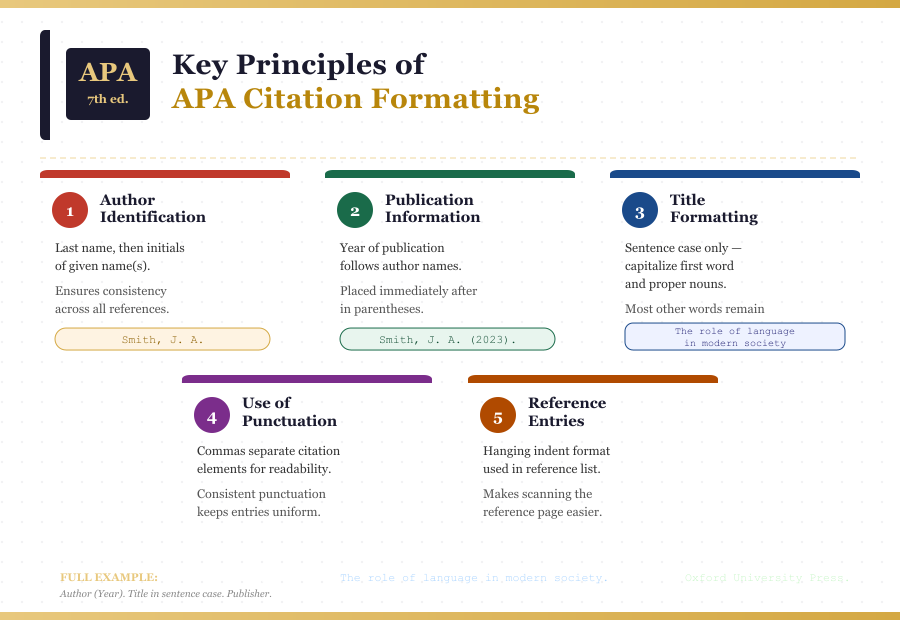
Key Principles of APA Citation Formatting
The APA 7th ed guidelines are built on several core formatting conventions:
- Author identification
- Citations begin with the author’s last name followed by the initial of the given name.
- The last name and initials format ensures consistency across references.
- Publication information
- The year of publication or date of publication appears immediately after the author names in parenthesis.
- Title formatting
- Titles follow sentence case, meaning only the first word and proper nouns are capitalized.
- Writers should capitalize the first letter of the title and the first word of the title while leaving most other words lowercase.
- Use of punctuation
- Elements in a citation are separated using a comma to maintain readability.
- Formatting of reference entries
- Each reference list entry is arranged with a hanging indent, making it easier to scan the reference page.
These formatting principles ensure that each book citation contains the necessary information for readers to identify and locate the original source. Writers can also consult institutional writing resources such as university libguides or the official APA style website for explanations of the most current rules.
Why accurate citation is important in nursing academic writing
Accurate documentation plays a central role in maintaining scholarly integrity. In fields that rely on evidence-based practice, such as nursing and other healthcare disciplines, proper citation helps establish credibility and allows readers to verify the sources supporting an argument.
Key Reasons Accurate Citation Matters
- Maintaining academic integrity
- Correct APA citation ensures that the original creators of an idea receive appropriate recognition.
- Supporting evidence-based research
- Proper citing sources allows readers to evaluate the reliability of information used in scholarly work.
- Helping readers retrieve sources
- A well-organized reference list provides enough information for others to retrieve the original publication.
- Clarifying authorship
- In many academic textbooks, each specific chapter may be written by a different contributor.
- Writers must therefore cite the chapter rather than the entire book to accurately credit the chapter authors.
- Strengthening professional communication
- Applying APA style guidelines consistently demonstrates attention to detail and adherence to recognized scholarly standards.
Because many healthcare textbooks contain multiple contributors, understanding How to Cite a Book Chapter in APA ensures that each author’s work is acknowledged correctly within the broader scholarly record.
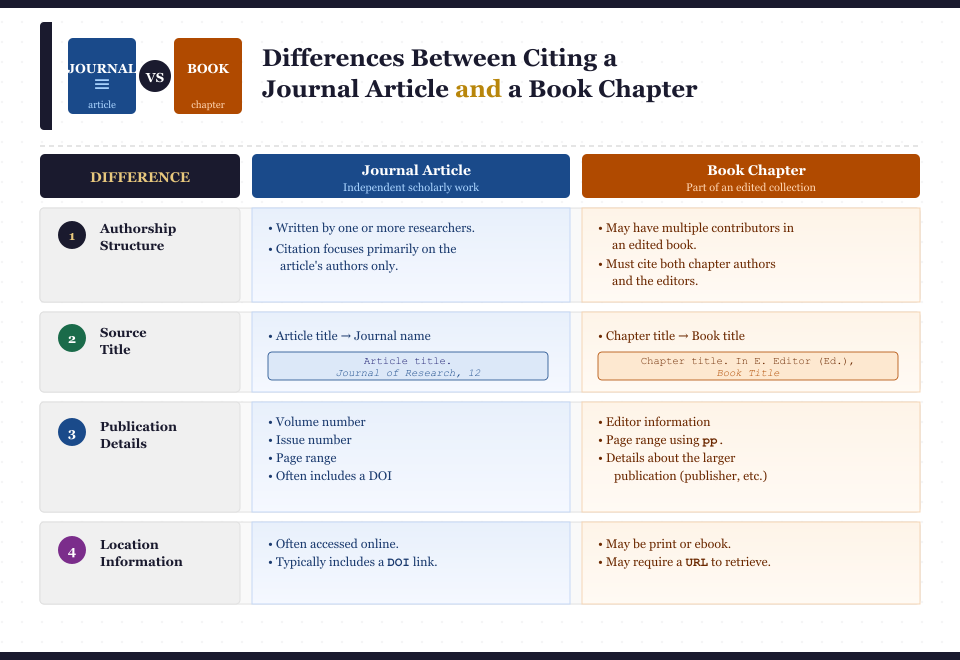
Differences between citing a journal article and a book chapter
Although both sources follow the same citation style, the structure of a citation differs depending on the type of publication. A journal article is an independent scholarly work published within an academic periodical, while a chapter in an edited book forms part of a larger collection of contributions.
Key Differences Between These Source Types
1. Authorship structure
- Journal article
- Written by one or more researchers.
- The citation focuses primarily on the article’s authors.
- Book chapter
- May appear in an edited book where multiple contributors write different sections.
- The citation must acknowledge both the chapter authors and the editors.
2. Source title
- Journal article
- Includes the title of the article followed by the journal name.
- Book chapter
- Includes the title of chapter followed by the book title.
3. Publication details
- Journal article
- Typically includes:
- Volume number
- Issue number
- Page range
- Often a doi
- Typically includes:
- Book chapter
- Includes:
- Editor information
- The page range using pp
- Information about the larger publication.
- Includes:
4. Location information
- Journal article
- Often accessed online and may include a doi.
- Book chapter
- May appear in print or as an ebook, sometimes requiring a url to retrieve the source.
Understanding these differences is essential when learning How to Cite a Book Chapter in APA, because the citation must reflect the structure of the source itself.
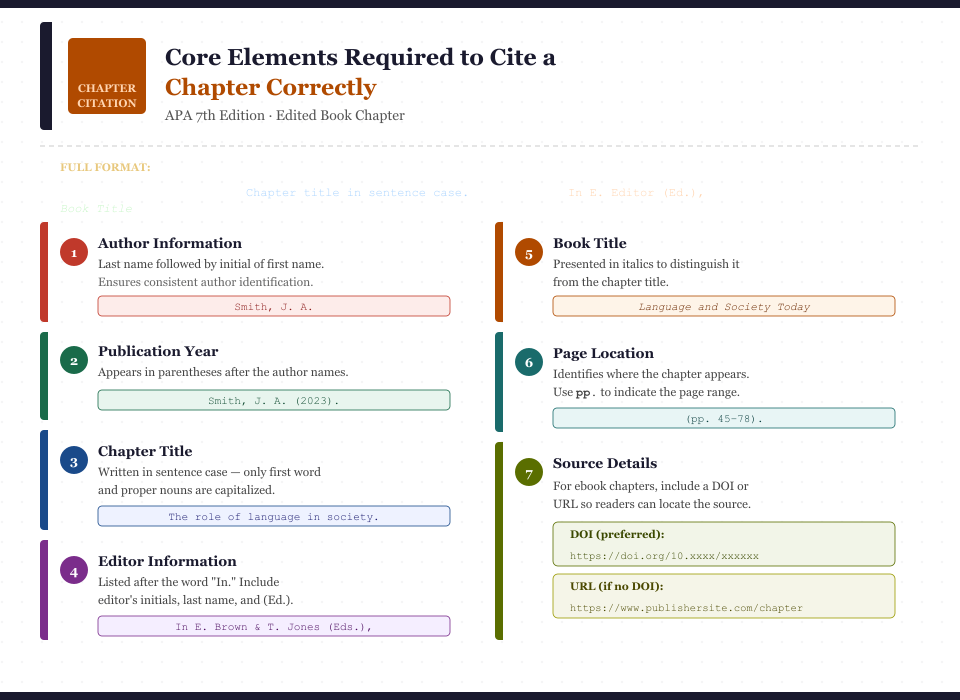
Core elements required to cite a chapter correctly in APA style
A properly formatted citation for a chapter in an edited book contains several components arranged in a specific order. Each element contributes to identifying the source accurately and helping readers locate it efficiently.
Essential Components of a Chapter Citation
- Author information
- The citation begins with the author’s last name followed by the initial of the first name.
- The last name followed by the initial ensures consistent author identification.
- Publication year
- The publication year appears in parenthesis after the author names.
- Chapter title
- The title of chapter is written in sentence case, meaning only the first word and proper nouns are capitalized.
- Editor information
- Editors are listed after the word “In.”
- The editor’s last name is included along with the abbreviation eds.
- Book title
- The book title is presented in italics to distinguish it from the chapter title.
- Page location
- The page range identifies where the chapter appears within the book.
- The abbreviation pp is used to indicate pages.
- Source details
- If the chapter is accessed online as an ebook, the citation may include a doi or url so that readers can easily locate the source.
Example of a Basic Chapter Citation Structure
A simplified structure for How to Cite a Book Chapter in APA can be represented as follows:
- Author’s last name, Initial. (Publication year). Title of chapter. In Editor Initial. Editor’s last name (Eds.), Book title (pp. xx–xx). Publisher. DOI or URL.
This structured approach ensures that each reference list entry contains all necessary bibliographic details. Writers must also ensure that formatting on the reference page includes a hanging indent, which improves readability and aligns with APA style 7th standards.
Reference List Format for a Chapter in an Edited Book (APA 7th Edition)
Understanding the reference list structure is one of the most important steps when learning How to Cite a Book Chapter in APA. In many academic texts, chapters are written by different scholars and compiled into a single edited book by one or more editors. Because each chapter represents an individual contribution, the reference must identify the specific author responsible for that section rather than the editors of the entire volume.
In APA style, all sources cited within a paper appear on the reference page at the end of the document. Each reference list entry contains enough bibliographic information to allow readers to locate the original source easily. When creating a book citation for a chapter, writers must include details about the chapter itself as well as information about the larger book in which the chapter appears.
Learning How to Cite a Book Chapter in APA involves understanding the order of these elements and applying the formatting rules established in APA 7th documentation.
Standard APA reference list format for a chapter in an edited book
The format for a chapter reference follows a consistent structure. According to APA style guidelines, the citation must include the chapter author, publication information, the title of chapter, editor details, the book title, the page range, and publication information for the book.
A general APA citation structure for a chapter in an edited book looks like this:
Author’s last name, Initial. (Year). Title of chapter. In Initial. Editor’s last name (Eds.), Book title (pp. xxx–xxx). Publisher.
This structure ensures that readers can identify both the individual contributor and the larger publication. When learning How to Cite a Book Chapter in APA, it is useful to break the citation into its core components:
Basic Structure of the Citation
- Author information
- Publication year
- Chapter title
- Editor information
- Book title
- Page range
- Publisher information
Each of these elements plays a specific role in helping readers locate the source.
Example of a Reference List Entry
Smith, J. A. (2020). Patient safety strategies in clinical nursing practice. In R. L. Brown & K. D. Taylor (Eds.), Advanced nursing practice and patient care (pp. 45–68). Academic Health Press.
In this example, the chapter author is identified first, followed by the year of publication, the title of chapter, the editors of the book, the book title, and the pages where the chapter appears. Understanding this structure is fundamental when learning How to Cite a Book Chapter in APA.
Formatting chapter author names (last name and initials)
The first element in a chapter citation is the name of the contributor responsible for writing that chapter. According to APA style 7th, authors are listed using the last name and initials format.
Key Rules for Formatting Author Names
- Use the author’s surname first
- The author’s last name is written before the initial of the given name.
- Separate elements with punctuation
- A comma separates the surname and initials.
- List multiple authors in order
- Authors are listed in the same order as they appear in the original publication.
- Use an ampersand before the final author
- When a chapter has multiple contributors, the final name is joined with an ampersand.
- Follow the multi-author rule
- The APA 7th ed guidelines allow citations with up to 20 authors before truncation is required.
Example: Single Author
Williams, T. R. (2019). Nursing leadership in acute care settings. In D. M. Clark (Eds.), Clinical leadership in healthcare (pp. 85–102). Medical Education Press.
Example: Multiple Authors
Garcia, L. P., Ahmed, S. R., & Patel, K. M. (2021). Infection control strategies in hospital environments. In J. A. Rogers & B. L. Green (Eds.), Principles of modern healthcare management (pp. 110–134). Global Health Publishers.
Correctly formatting the names of chapter authors is a crucial step when learning How to Cite a Book Chapter in APA, because the citation must clearly attribute the work to the appropriate contributor.
Writing the book chapter title and book title correctly
After listing the author and the publication year, the next element in the citation is the title of chapter. This title must follow specific formatting rules established in APA style.
Rules for Writing the Chapter Title
- Use sentence case
- Only the first word and proper nouns are capitalized.
- Do not italicize the chapter title
- The chapter title remains in standard text.
- Place a period after the title
- This separates it from the editor information that follows.
Example:
Brown, L. M. (2022). Evidence-based strategies for managing chronic illness. In R. D. Martin (Eds.), Contemporary approaches to healthcare management (pp. 200–224). Clinical Press.
In contrast, the book title must follow different formatting rules.
Rules for Writing the Book Title
- The book title must be italicized.
- It also follows sentence case, meaning that only the first word and proper nouns are capitalized.
- The title appears immediately after the editor information.
Example:
Johnson, R. A. (2021). Health promotion strategies in community nursing. In P. L. Harris & D. K. Moore (Eds.), Foundations of community health practice (pp. 50–72). Public Health Publishing.
Understanding these distinctions between chapter titles and book titles is essential when learning How to Cite a Book Chapter in APA, because formatting errors frequently occur in this section of the citation.
Including editors in an edited book citation
In a chapter in an edited book, the editors are responsible for compiling and organizing the chapters contributed by different authors. As a result, the citation must acknowledge their role.
How to Format Editor Information
Editors are introduced using the word In followed by their names and the abbreviation eds.
The basic structure looks like this:
In Initial. Editor’s last name (Eds.),
Key Rules for Editor Formatting
- Editors are listed after the chapter title.
- Names follow the same format as author names.
- The abbreviation eds indicates editorial responsibility.
Example:
Lopez, M. J. (2018). Ethical decision-making in patient care. In H. T. Walker & S. L. Bennett (Eds.), Ethics in modern healthcare (pp. 120–138). Health Sciences Press.
When learning How to Cite a Book Chapter in APA, recognizing the distinction between chapter authors and editors is essential. The author receives primary credit for the chapter, while the editors are acknowledged for organizing the larger work.
Placement of page range and publisher information
The final elements of a reference list entry identify where the chapter appears within the book and who published the work.
Page Range Formatting
The page range tells readers exactly where the chapter appears within the book.
Key formatting rules include:
- Use the abbreviation pp before the page numbers.
- Include the full range of pages where the chapter appears.
- Place the page range inside parentheses after the book title.
Example:
(pp. 145–168)
This information is essential for locating the specific chapter within a multi-author volume.
Publisher Information
After the page range, the citation ends with the name of the publisher. According to APA style guidelines, the publisher name is written without additional location information.
Example:
Anderson, P. R. (2020). Clinical assessment techniques in nursing practice. In K. L. Foster (Eds.), Advanced clinical nursing skills (pp. 60–82). Healthcare Education Press.
Example of a Complete Citation
A fully formatted reference might look like this:
Davis, L. T. (2022). Patient-centered communication strategies. In M. J. Carter & R. S. Lee (Eds.), Modern approaches to nursing communication (pp. 98–120). Professional Nursing Publications.
This example demonstrates the complete APA citation structure required when learning How to Cite a Book Chapter in APA. Each element—from the author’s last name to the book title and page range—contributes to a clear and organized reference that allows readers to identify and locate the original source with ease.
Citing Chapters in Authored Books vs Edited Books
Citing a chapter in a book requires understanding whether the book is authored or edited, as this distinction determines how contributors are credited and how the APA citation is structured. In nursing and health sciences literature, books are often either single-author texts (authored books) or compilations with chapters written by multiple experts (edited books). Learning How to Cite a Book Chapter in APA effectively depends on recognizing these differences and applying the APA 7th edition rules consistently.
Differences between authored books and edited books in APA citation
Understanding the difference between authored and edited books is the first step in determining the proper citation style.
- Authored books
- Written entirely by a single author or a team of authors.
- All content, including chapters, reflects the work of the same contributor(s).
- Citations may reference either the entire book or a specific chapter depending on the focus of the content.
- Editors are typically not listed, because the authors wrote the complete text.
- Edited books
- Comprised of chapters written by different authors.
- One or more editors are responsible for compiling, organizing, and reviewing the chapters.
- Each chapter author must be cited individually when referencing a specific chapter.
- Editors are included in the citation using the abbreviation Eds after their names.
Key takeaway: In edited books, the focus is on the chapter author, while in authored books, the author(s) of the entire book are cited unless a specific chapter needs emphasis.
When to cite the chapter author versus the book author
Proper attribution depends on the type of source and the intent of the reference:
- Citing a chapter in an edited book
- Always use the chapter author(s) in the reference list entry.
- Include the editors of the book after the chapter title.
- Example:
Patel, R. M. (2021). Nutrition strategies for pediatric patients. In S. L. Thompson & J. R. Lee (Eds.), Advanced pediatric nursing (pp. 55–78). Health Sciences Press. Here, Patel is the chapter author, while Thompson and Lee are the editors. - Citing a chapter in an authored book
- Use the book author(s) because all chapters are authored by the same individual(s).
- If referencing a specific chapter, include the chapter title and page range.
- Example:
Williams, T. J. (2019). Clinical assessment techniques in nursing. In Comprehensive nursing assessment (pp. 120–145). Nursing Education Press. In this case, Williams authored the entire book, so the chapter author and book author are the same.
Rule of thumb:
- If the book is edited → credit the chapter author.
- If the book is authored → credit the book author, unless a specific chapter is emphasized.
Proper citation format for chapters in authored books
When citing chapters in authored books, the format is simplified compared to edited books. According to APA 7th edition, the reference list entry for a chapter in an authored book includes:
- Author(s) of the book – Use last name and initials.
- Publication year – Placed in parenthesis after author names.
- Chapter title – Written in sentence case and not italicized.
- Book title – Italicized, also in sentence case.
- Page range – Introduced with pp., placed in parentheses.
- Publisher – Listed after the page range, without location.
Example:
Garcia, L. P. (2020). Pain management in acute care. In Advanced nursing interventions (pp. 145–168). Medical Education Press.
Notice that no editors are included because the book is fully authored.
Examples comparing authored and edited book citations
Understanding the visual and structural differences helps clarify the application of APA style 7th rules:
| Type of Book | Reference List Example | Notes |
|---|---|---|
| Edited Book | Nguyen, P. T. (2022). Infection prevention in clinical settings. In R. L. Adams & K. J. Simmons (Eds.), Modern approaches to hospital nursing (pp. 90–112). Healthcare Press. | Chapter author listed first; editors included with Eds. |
| Authored Book | Thompson, J. D. (2021). Nursing ethics in practice. In Foundations of nursing ethics (pp. 75–102). Academic Health Press. | Book author and chapter author are the same; no editors listed. |
Key distinctions:
- Edited books require acknowledgment of both chapter authors and editors.
- Authored books may cite the entire book or a specific chapter, but only the book author(s) are listed.
- The page range and book title remain integral in both types of citations.
By mastering these distinctions, writers can ensure proper attribution when learning How to Cite a Book Chapter in APA, maintain APA style 7th compliance, and prevent common errors related to chapter authors and editors.
Creating In-Text Citations for Book Chapters in APA Style
In addition to constructing accurate reference list entries, in-text citations are a critical component of APA style 7th edition. They provide brief information within the body of a paper that directs readers to the full reference list entry, maintaining scholarly transparency and integrity. When learning How to Cite a Book Chapter in APA, understanding both parenthetical and narrative in-text citation formats, along with rules for quoting and paraphrasing, is essential.
Parenthetical in-text citation format
Parenthetical citations place the author’s name, publication year, and sometimes page numbers inside parentheses at the end of a sentence or after a paraphrased idea. This format is commonly used when the emphasis is on the content rather than the author.
Key Rules for Parenthetical In-Text Citations
- Author name(s) – Include the author’s last name. For chapters in edited books, this refers to the chapter author, not the editor.
- Year of publication – Placed immediately after the author name, separated by a comma.
- Page numbers – Use p. for a single page or pp. for multiple pages, typically included when quoting directly.
- Placement – Parentheses are placed at the end of the sentence, before the period.
Examples
- Paraphrasing from a chapter: (Smith, 2020)
- Direct quotation with page number: (Smith, 2020, pp. 45–46)
Example in context (paraphrased):
Research indicates that implementing structured handoff protocols can significantly reduce errors in clinical nursing settings (Smith, 2020).
Example in context (direct quotation):
“Structured handoff protocols improve patient safety by standardizing communication between shifts” (Smith, 2020, pp. 45–46).
Narrative in-text citation format
Narrative citations integrate the author’s name into the text of the sentence itself, placing the year of publication in parentheses immediately after the author’s name. This format is useful when emphasizing the author’s contribution or when the sentence naturally includes the author.
Key Rules for Narrative In-Text Citations
- Introduce the chapter author within the sentence.
- Place the year of publication in parentheses immediately after the author’s name.
- Include page numbers in parentheses following a direct quotation.
Examples
- Paraphrasing from a chapter: Example:
Smith (2020) highlights the importance of structured handoff protocols in reducing errors during nursing shift changes. - Direct quotation: Example:
Smith (2020) stated, “Structured handoff protocols improve patient safety by standardizing communication between shifts” (pp. 45–46).
Tip: Narrative citations are particularly effective in academic writing where the author’s expertise is central to the argument.
Citing page numbers for direct quotations
Whenever a direct quotation is used from a chapter in an edited book, APA style requires the inclusion of the page number(s) to pinpoint the location of the information.
Rules for Page Number Formatting
- Use p. for a single page (e.g., p. 52) and pp. for a range of pages (e.g., pp. 52–54).
- Include the page number immediately after the quotation or at the end of the parenthetical citation.
- When paraphrasing, including the page number is optional but recommended for precision and credibility.
Examples
- Direct quotation (parenthetical):
“Effective delegation requires clear communication and understanding of team roles” (Garcia & Patel, 2021, pp. 102–103). - Direct quotation (narrative):
Garcia and Patel (2021) emphasized that “effective delegation requires clear communication and understanding of team roles” (pp. 102–103).
Examples of paraphrasing and quoting book chapters
Using both paraphrasing and direct quotations is essential in academic writing to demonstrate comprehension of material while maintaining proper attribution. When learning How to Cite a Book Chapter in APA, the correct application of these techniques ensures compliance with APA style guidelines.
Paraphrasing Examples
- Edited book chapter:
Thompson (2020) notes that patient education programs improve adherence to post-operative care plans, highlighting the role of structured teaching interventions. - Authored book chapter:
Williams (2019) emphasizes that consistent monitoring of vital signs allows for early detection of potential complications in hospitalized patients.
Direct Quotation Examples
- Edited book chapter:
“Structured patient education significantly increases adherence to post-operative care protocols” (Thompson, 2020, pp. 56–57). - Authored book chapter:
Williams (2019) stated, “Consistent monitoring of vital signs enables nurses to identify early signs of patient deterioration” (pp. 120–121).
Best Practices
- Always credit the chapter author in edited books, not the editors.
- Use page numbers for any direct quotation from the chapter.
- Integrate the author’s name in narrative citations to emphasize contribution.
- Paraphrase accurately to reflect the original meaning while using your own words.
- Maintain consistency across all in-text citations and ensure they match the reference list entry.
How to Cite Ebook Chapters in APA 7th Edition
With the rise of digital learning and online research, ebooks have become a primary source of academic content. Understanding How to Cite a Book Chapter in APA now requires familiarity with the differences between print and ebook chapter citations, and how to properly include DOIs, URLs, and other retrieval information. Accurate citation ensures that digital sources are traceable, properly attributed, and comply with APA style 7th edition guidelines.
Differences between print and ebook chapter citations
While the core components of a chapter citation—such as chapter authors, publication year, chapter title, book title, editors, and page range—remain consistent, there are subtle distinctions when citing ebooks versus print books:
- Retrieval Information
- Print books rely solely on publisher information for source identification.
- Ebook chapters often include a DOI or URL to enable direct access.
- Page Numbering
- Page ranges (pp. xx–xx) are used in print citations.
- Many ebooks use dynamic pagination; in such cases, paragraph numbers or chapter numbers can be substituted if page numbers are unavailable.
- Formatting
- The citation structure remains the same, but DOI or URL is placed at the end of the reference entry.
- Italicization of the book title and sentence case for chapter titles is unchanged.
Example: Print Chapter Citation
Nguyen, P. T. (2022). Infection prevention in clinical settings. In R. L. Adams & K. J. Simmons (Eds.), Modern approaches to hospital nursing (pp. 90–112). Healthcare Press.
Example: Ebook Chapter Citation with DOI
Nguyen, P. T. (2022). Infection prevention in clinical settings. In R. L. Adams & K. J. Simmons (Eds.), Modern approaches to hospital nursing (pp. 90–112). Healthcare Press. https://doi.org/10.1234/ebook12345
How to include a DOI in APA citation
A DOI (Digital Object Identifier) is a permanent alphanumeric string assigned to online content that provides a stable link for retrieval. APA 7th strongly recommends including the DOI for ebooks and other digital academic resources whenever available.
Rules for DOI Formatting
- Format as a hyperlink starting with
https://doi.org/. - Do not include “Retrieved from” before a DOI.
- Place the DOI at the end of the reference after the publisher.
Example:
Garcia, L. P., & Patel, K. M. (2021). Infection control strategies in hospital environments. In J. A. Rogers & B. L. Green (Eds.), Principles of modern healthcare management (pp. 110–134). Global Health Publishers. https://doi.org/10.5678/healthcare123
Using the DOI ensures that the source can be reliably retrieved even if URLs change over time.
When to include a URL for ebook references
Some ebooks or book chapters do not have a DOI but are available online. In these cases, APA allows the inclusion of a direct URL.
Rules for Including a URL
- Use the URL where the ebook can be retrieved, preferably a stable link.
- Avoid URLs that require logins or subscriptions unless the source is widely accessible to readers.
- Place the URL at the end of the reference entry, following the publisher information.
Example:
Thompson, R. L. (2020). Patient education strategies. In K. L. Foster (Ed.), Advanced clinical nursing skills (pp. 60–82). Healthcare Education Press. https://www.healthcareebooks.org/advanced-clinical-nursing
Notes
- Do not include retrieval dates unless the content is likely to change over time (e.g., a wiki or evolving online publication).
- For ebooks accessed via institutional databases, APA 7th does not require including the database name unless the ebook is only available there and cannot be accessed via DOI or publisher URL.
Whether to include academic database names in citations
APA 7th edition clarifies that including database information is generally unnecessary for ebooks if a DOI or URL is provided. The primary goal is to provide sufficient information to retrieve the source.
Key Guidelines
- Include database names only when necessary
- For example, if an ebook is exclusive to a specific database and has no DOI or public URL, the database name should be included.
- Do not include subscription database names if a DOI or stable URL is available.
- Use the format “Name of the database” after the publisher if no DOI or URL is available.
Example: Ebook from a Database (No DOI/URL)
Williams, T. J. (2019). Clinical assessment techniques in nursing practice. In Comprehensive nursing assessment (pp. 120–145). Nursing Education Press. ProQuest Ebook Central.
By following these principles, you ensure that ebook chapter citations are complete, transparent, and fully aligned with APA 7th style guidelines.
Special APA Citation Cases for Book Chapters
In academic writing, especially in nursing research and practice, sources often present unique authorship situations. Understanding these special APA citation cases is crucial for correctly attributing work in a chapter in an edited book or authored book. APA 7th edition provides specific rules for citing multiple authors, group authors, or chapters with no identifiable author. Accurate citation in these cases ensures clarity, avoids plagiarism, and maintains consistency across the reference list and in-text citations.
Citing chapters with multiple authors
Chapters often have two or more authors, requiring careful formatting in both reference list entries and in-text citations.
Reference List Rules
- Two authors: List both authors’ last names and initials, separated by an ampersand (&).
- Three to 20 authors: List all authors in the order they appear in the book, using commas between names and an ampersand before the last author.
- More than 20 authors: List the first 19 authors, insert an ellipsis (…), and then add the last author’s name.
Examples
- Two authors:
Garcia, L. P., & Patel, K. M. (2021). Infection control strategies in hospital environments. In J. A. Rogers & B. L. Green (Eds.), Principles of modern healthcare management (pp. 110–134). Global Health Publishers. - Three authors:
Thompson, R. L., Nguyen, P. T., & Lopez, M. J. (2022). Pediatric patient safety interventions. In D. K. Miller & S. L. Carter (Eds.), Advanced pediatric nursing (pp. 50–74). Academic Health Press. - More than 20 authors:
Include first 19 authors, then ellipsis, then last author:
Author1, A. A., Author2, B. B., … Author20, T. T. (Year). Title of chapter. In Initial. Editor (Eds.), Book title (pp. xxx–xxx). Publisher.
Formatting citations for three or more authors
APA 7th edition distinguishes between reference list and in-text citation formatting for three or more authors:
Reference List
- List all authors up to 20 in full (last name, initials).
- Separate names with commas, use ampersand before the last author.
In-Text Citations
- Parenthetical: Use the first author’s last name followed by et al. for three or more authors.
- Narrative: Similarly, introduce the first author in the sentence and follow with et al.
Examples
- Parenthetical citation:
(Thompson et al., 2022) - Narrative citation:
Thompson et al. (2022) emphasized that pediatric patient safety interventions reduce adverse events in clinical settings.
Citing chapters with a group author or organization
Sometimes, a chapter is authored by a group author or organization rather than individual contributors. This is common in policy, governmental, or institutional publications.
Rules
- Use the full name of the organization as the author.
- If the organization has a commonly recognized abbreviation, provide it in brackets on first mention.
- Do not use individual editors unless citing an edited book.
Examples
- Without abbreviation:
American Nurses Association. (2021). Ethical considerations in nursing practice. In S. L. Carter & D. K. Miller (Eds.), Foundations of nursing ethics (pp. 34–56). Professional Nursing Press. - With abbreviation:
Centers for Disease Control and Prevention [CDC]. (2020). Infection control guidelines for hospitals. In J. R. Lee & M. P. Thompson (Eds.), Healthcare safety protocols (pp. 77–95). Health Publications.
In-text citation:
- First mention: (Centers for Disease Control and Prevention [CDC], 2020)
- Subsequent mentions: (CDC, 2020)
Citing a chapter with no author
Occasionally, chapters have no identifiable author. In such cases, APA 7th provides rules to maintain traceability.
Guidelines
- Start the citation with the title of the chapter in sentence case.
- The rest of the reference entry follows the standard edited book chapter format.
- For in-text citations, use a shortened version of the chapter title in quotation marks.
Examples
- Reference list entry:
Patient safety protocols in critical care (2021). In R. L. Adams & K. J. Simmons (Eds.), Modern approaches to hospital nursing (pp. 90–112). Healthcare Press. - Parenthetical in-text citation:
(“Patient Safety Protocols,” 2021) - Narrative in-text citation:
The chapter Patient Safety Protocols in Critical Care (2021) outlines key interventions for reducing medical errors.
Note: Even without an author, including editors, book title, and page range ensures the chapter is fully retrievable, meeting APA style 7th edition requirements.
Best Practices for Special Cases
- Always verify the type of authorship (individual, multiple, group, none) before formatting.
- Ensure in-text citations match the reference list to maintain consistency.
- Follow APA rules for et al., group authors, and no-author cases precisely to avoid errors.
- Maintain proper sentence case for titles, italicize book titles, and include page ranges.
Applying APA Style Guidelines for Accurate Book Chapter Citations
Accurate and consistent citation of book chapters is essential in scholarly nursing writing. APA 7th edition provides detailed rules to ensure sources are clearly attributed, retrievable, and professionally formatted. Applying APA style guidelines effectively minimizes errors, maintains academic integrity, and supports evidence-based practice.
Using the APA manual and official APA style guidelines
The APA Publication Manual (7th edition) is the authoritative resource for citation rules, covering both edited and authored books, ebooks, and special cases. Following the manual ensures compliance with formal academic standards. Key strategies include:
- Reference to official examples:
- The manual provides templates for chapter in an edited book, authored book, and ebook chapters, including author names, publication year, chapter title, book title, editors, page ranges, and DOIs/URLs.
- Consulting APA style resources:
- The APA Style website and academic libguides provide updated guidance and examples of in-text citations, reference list entries, and special cases.
- Understanding the core elements:
- Every book chapter citation requires accurate author(s) or editor(s), title of chapter, book title, page range, publisher, and retrieval information if digital.
Example from APA manual:
- Edited book chapter:
Smith, J. R. (2018). Nursing informatics and patient safety. In L. K. Brown & T. M. Jones (Eds.), Contemporary nursing technologies (pp. 45–67). HealthTech Press. https://doi.org/10.1234/abcde
Ensuring consistency in citation style formatting
Consistency is critical for readability and professionalism in academic writing. APA style 7th requires uniform application of formatting rules across all references and in-text citations:
- Author names and initials: Use last name followed by initials, maintain consistent punctuation, and apply ampersands (&) for multiple authors.
- Title formatting: Chapter titles in sentence case (capitalize first word and proper nouns), book titles in italicized sentence case.
- Publication information: Include year, page range, and publisher consistently.
- Digital identifiers: Always provide DOI or URL for ebooks; avoid unnecessary database names unless required.
- Hanging indent: Apply a 0.5-inch hanging indent for all reference entries.
- In-text citations: Ensure parenthetical and narrative citations match the reference list author names and publication year.
Example demonstrating consistency:
- Edited book chapter:
Patel, R. M., & Lopez, M. J. (2021). Evidence-based wound care strategies. In S. L. Thompson & J. R. Lee (Eds.), Advanced clinical nursing practice (pp. 90–115). Nursing Press. https://doi.org/10.5678/nursingbook2021 - Corresponding in-text citation (parenthetical):
(Patel & Lopez, 2021) - Corresponding in-text citation (narrative):
Patel and Lopez (2021) emphasize evidence-based strategies for wound care.
Checking references for APA 7th edition compliance
Before submission, it is important to audit references for APA 7th compliance:
- Match in-text citations and reference list entries: Every in-text citation must have a corresponding reference.
- Verify author names: Ensure initials, last names, and order match exactly as published.
- Confirm publication year: Double-check that the year of publication is accurate.
- Review page ranges and DOI/URL: Page numbers for chapters and digital identifiers must be correct and formatted according to APA style.
- Hanging indents and line spacing: All reference entries should use a 0.5-inch hanging indent and double-spacing.
Practical tip: Use tools like APA style website, citation generators, and library guides (libguides) to cross-check formatting, but always manually verify against the APA manual to avoid errors.
Examples of correctly formatted reference list entries
- Edited book chapter with DOI:
Thompson, R. L., & Nguyen, P. T. (2022). Pediatric patient safety interventions. In D. K. Miller & S. L. Carter (Eds.), Advanced pediatric nursing (pp. 50–74). Academic Health Press. https://doi.org/10.1234/pedsafety2022 - Authored book chapter:
Williams, T. J. (2019). Clinical assessment techniques in nursing. In Comprehensive nursing assessment (pp. 120–145). Nursing Education Press. - Ebook chapter with URL:
Garcia, L. P., & Patel, K. M. (2021). Infection control strategies in hospital environments. In J. A. Rogers & B. L. Green (Eds.), Principles of modern healthcare management (pp. 110–134). Global Health Publishers. https://www.healthcareebooks.org/ebook2021 - Chapter with group author:
American Nurses Association. (2021). Ethical considerations in nursing practice. In S. L. Carter & D. K. Miller (Eds.), Foundations of nursing ethics (pp. 34–56). Professional Nursing Press.
Key Points:
- Italicize book titles, not chapter titles.
- Use sentence case for chapter titles.
- Include editors for edited books with the abbreviation Eds.
- Include DOI or URL for digital sources.
- Apply hanging indent and double spacing for all references.
By rigorously applying APA 7th edition guidelines, academic writers can ensure their book chapter citations are precise, consistent, and professionally formatted, enhancing credibility and supporting the retrieval of sources.
Common Mistakes When Citing Book Chapters in APA Style
Even experienced writers can encounter challenges when citing a chapter in a book using APA style 7th edition. Inaccurate citations can undermine credibility, complicate source retrieval, and result in noncompliance with academic standards. Understanding common mistakes and how to avoid them is essential for precise and professional referencing.
Incorrect author formatting
One of the most frequent mistakes in APA citation is improperly formatting chapter authors or editors. This issue often arises when distinguishing between authored books and edited books, or when handling multiple authors.
Common Errors:
- Using first names instead of initials: APA requires last name followed by initials.
- ❌ Incorrect: John Smith
- ✅ Correct: Smith, J.
- Confusing chapter authors with editors in edited books: In edited books, the chapter author should appear first in the reference, followed by the editors with the abbreviation Eds.
- ❌ Incorrect: Thompson, R. L. (Ed.), Nguyen, P. T. Chapter title…
- ✅ Correct: Thompson, R. L., & Nguyen, P. T. (2022). Chapter title… In D. K. Miller & S. L. Carter (Eds.), Book title (pp. xx–xx). Publisher
- Misusing ampersands: Use & before the last author in both reference lists and in-text citations for multiple authors.
Example Correction:
- ❌ Incorrect: Garcia, L. P., Patel, K. M., Thompson, R. L.
- ✅ Correct: Garcia, L. P., Patel, K. M., & Thompson, R. L.
Errors with chapter titles and book titles
Improper formatting of chapter titles and book titles is another prevalent mistake. APA 7th edition has specific rules:
- Chapter titles: Use sentence case (capitalize only the first word, proper nouns, and the first word after a colon). Do not italicize.
- ❌ Incorrect: EVIDENCE-BASED Wound Care Strategies
- ✅ Correct: Evidence-based wound care strategies
- Book titles: Use italicized sentence case. Do not capitalize all major words, unlike title case.
- ❌ Incorrect: ADVANCED CLINICAL NURSING PRACTICE
- ✅ Correct: Advanced clinical nursing practice
- Combining chapter and book title incorrectly: Ensure the chapter and book title are clearly separated by “In” and include editors if applicable.
Example:
- ❌ Incorrect: Smith, J. (2020). Evidence-based wound care strategies. Advanced Clinical Nursing Practice.
- ✅ Correct: Smith, J. (2020). Evidence-based wound care strategies. In S. L. Thompson & J. R. Lee (Eds.), Advanced clinical nursing practice (pp. 90–115). Nursing Press
Misplaced editors or page numbers
Misplacement of editors or page ranges often occurs due to misunderstanding the APA 7th edition format for edited books:
- Editors: Must follow the chapter title, preceded by “In” and followed by Eds in parentheses.
- Page numbers: Enclosed in parentheses with pp. and placed immediately after the book title.
Common Mistakes:
- ❌ Incorrect: In S. L. Thompson & J. R. Lee, Advanced clinical nursing practice (pp. 90–115) (Eds.), Nursing Press.
- ✅ Correct: In S. L. Thompson & J. R. Lee (Eds.), Advanced clinical nursing practice (pp. 90–115). Nursing Press
Tip: Misplacing editors after the page range or omitting “Eds” can create confusion about authorship attribution.
Missing DOI or URL in ebook citations
For ebooks or digital chapters, omitting the DOI or URL is a frequent error that affects the retrievability of the source. APA 7th edition provides clear guidelines:
- Include DOI when available: Always provide a hyperlinked DOI at the end of the reference.
- Include URL if no DOI exists: Prefer a stable publisher URL rather than a database link unless the ebook is exclusive to that database.
- Do not include both DOI and database name unnecessarily: If a DOI is available, the database name is not required.
Examples
- ❌ Missing DOI:
Patel, R. M., & Lopez, M. J. (2021). Evidence-based wound care strategies. In S. L. Thompson & J. R. Lee (Eds.), Advanced clinical nursing practice (pp. 90–115). Nursing Press. - ✅ Correct (with DOI):
Patel, R. M., & Lopez, M. J. (2021). Evidence-based wound care strategies. In S. L. Thompson & J. R. Lee (Eds.), Advanced clinical nursing practice (pp. 90–115). Nursing Press. https://doi.org/10.5678/nursingbook2021 - ✅ Correct (with stable URL, no DOI):
Thompson, R. L. (2020). Patient education strategies. In K. L. Foster (Ed.), Advanced clinical nursing skills (pp. 60–82). Healthcare Education Press. https://www.healthcareebooks.org/advanced-clinical-nursing
Best Practices to Avoid Common Mistakes
- Always cross-check author names, editor names, and initials with the publication.
- Ensure chapter titles are in sentence case and book titles are italicized.
- Place editors immediately after “In” and page ranges immediately after book titles.
- Include DOI or URL for digital sources to enable retrieval.
- Review each entry against the APA 7th edition manual or APA Style website before submission.
Practical APA Citation Examples for Book Chapters
Understanding How to Cite a Book Chapter in APA is greatly enhanced by reviewing practical examples. These examples demonstrate proper formatting for edited books, authored books, and ebooks, and show how to combine reference list entries with in-text citations according to APA 7th edition guidelines. Using real-world examples ensures clarity and reinforces the application of APA style rules in scholarly nursing writing.
Example of a chapter in an edited book citation
Edited books contain chapters written by different authors and compiled by editors. Correct APA 7th formatting requires listing chapter authors first, followed by editors, book title, page range, and publisher.
Reference List Entry:
Nguyen, P. T., & Lopez, M. J. (2022). Pediatric patient safety interventions. In D. K. Miller & S. L. Carter (Eds.), Advanced pediatric nursing (pp. 50–74). Academic Health Press.
In-Text Citations:
- Parenthetical: (Nguyen & Lopez, 2022)
- Narrative: Nguyen and Lopez (2022) discuss interventions that reduce pediatric medical errors.
Key Points:
- Chapter title in sentence case, not italicized.
- Book title italicized, in sentence case.
- Include page range for the chapter.
- Editors indicated with Eds.
Example of a chapter in an authored book citation
In authored books, the entire book is written by the same author(s). When citing a specific chapter, the chapter author and book author are typically the same, but APA allows specifying the chapter title for clarity.
Reference List Entry:
Williams, T. J. (2019). Clinical assessment techniques in nursing. In Comprehensive nursing assessment (pp. 120–145). Nursing Education Press.
In-Text Citations:
- Parenthetical: (Williams, 2019)
- Narrative: Williams (2019) provides detailed techniques for clinical assessment in nursing practice.
Key Points:
- If the author of the chapter and book are identical, editors are not included.
- Include page ranges when referencing a specific chapter.
Example of an ebook chapter citation
For ebook chapters, a DOI or URL should be included at the end of the citation. Formatting is otherwise consistent with print chapters.
Reference List Entry (with DOI):
Garcia, L. P., & Patel, K. M. (2021). Infection control strategies in hospital environments. In J. A. Rogers & B. L. Green (Eds.), Principles of modern healthcare management (pp. 110–134). Global Health Publishers. https://doi.org/10.1234/healthcare12345
Reference List Entry (with URL, no DOI):
Thompson, R. L. (2020). Patient education strategies. In K. L. Foster (Ed.), Advanced clinical nursing skills (pp. 60–82). Healthcare Education Press. https://www.healthcareebooks.org/advanced-clinical-nursing
In-Text Citations:
- Parenthetical: (Garcia & Patel, 2021) / (Thompson, 2020)
- Narrative: Garcia and Patel (2021) emphasize infection control protocols, whereas Thompson (2020) outlines patient education strategies in clinical nursing.
Sample reference list and in-text citation combinations
To illustrate combined use, here is a mini reference list for various types of chapters:
Reference List
- Nguyen, P. T., & Lopez, M. J. (2022). Pediatric patient safety interventions. In D. K. Miller & S. L. Carter (Eds.), Advanced pediatric nursing (pp. 50–74). Academic Health Press.
- Williams, T. J. (2019). Clinical assessment techniques in nursing. In Comprehensive nursing assessment (pp. 120–145). Nursing Education Press.
- Garcia, L. P., & Patel, K. M. (2021). Infection control strategies in hospital environments. In J. A. Rogers & B. L. Green (Eds.), Principles of modern healthcare management (pp. 110–134). Global Health Publishers. https://doi.org/10.1234/healthcare12345
- Thompson, R. L. (2020). Patient education strategies. In K. L. Foster (Ed.), Advanced clinical nursing skills (pp. 60–82). Healthcare Education Press. https://www.healthcareebooks.org/advanced-clinical-nursing
In-Text Citation Examples
- Parenthetical citations:
(Nguyen & Lopez, 2022; Williams, 2019; Garcia & Patel, 2021; Thompson, 2020) - Narrative citations:
Nguyen and Lopez (2022) discuss pediatric interventions, while Williams (2019) outlines clinical assessment techniques. Garcia and Patel (2021) describe infection control strategies, and Thompson (2020) presents patient education methods.
Best Practices Highlighted by Examples:
- Always maintain author name order and ampersand usage for multiple authors.
- Use sentence case for chapter titles and italicize book titles.
- Include page ranges for chapters and DOIs/URLs for ebooks.
- Ensure in-text citations match the reference list for consistency.
Tools and Resources to Help Nursing Students Cite Book Chapters Correctly
Citing a chapter in a book accurately according to APA 7th edition can be challenging, especially when handling edited books, authored books, ebooks, or special cases such as multiple authors and group authors. To ensure precise and consistent APA style citations, it is important to leverage official manuals, guides, digital tools, and verification strategies. These resources help maintain academic integrity, save time, and ensure retrievability of sources.
Using the APA manual and APA style guides
The APA Publication Manual (7th edition) is the definitive guide for citing book chapters, providing detailed instructions for edited books, authored books, and ebooks, including special cases such as group authors or no-author chapters.
Key Uses:
- Reference Templates:
- Provides formats for chapter in an edited book, chapter in an authored book, and ebook chapters.
- Details the order of authors, editors, book title, page ranges, publisher, and DOI/URL.
- In-Text Citation Rules:
- Demonstrates parenthetical vs narrative citations.
- Explains handling of three or more authors, group authors, and no-author chapters.
- APA Style Guides:
- The APA Style website offers online guidance, including examples and downloadable templates.
- Many academic libraries provide libguides, which summarize APA rules with examples specific to nursing and health sciences.
Example from APA manual:
- Edited book chapter:
Smith, J. R. (2018). Nursing informatics and patient safety. In L. K. Brown & T. M. Jones (Eds.), Contemporary nursing technologies (pp. 45–67). HealthTech Press. https://doi.org/10.1234/abcde
Benefit: Provides a reliable source for citation style consistency and ensures adherence to APA 7th edition standards.
Citation generators and academic tools
Several digital tools can assist in creating accurate book chapter citations, but they should be used with caution to avoid errors:
- Online Citation Generators:
- Tools such as Zotero, Mendeley, Citation Machine, and EndNote allow users to input author names, chapter title, book title, editors, page range, and DOI/URL, automatically generating an APA-formatted reference.
- Academic Databases:
- Platforms like PubMed, CINAHL, and Google Scholar often provide a ready-made APA citation for book chapters or journal articles. Users should always verify that the citation aligns with APA 7th edition.
- Library Resources (Libguides):
- University library libguides provide step-by-step examples for citing edited books, authored books, and ebooks.
- Often include screenshots, hanging indent formats, and instructions for in-text citations.
Example Using a Citation Generator:
- Input: Chapter author, chapter title, editors, book title, page range, publisher, DOI.
- Output: Automatically formatted APA 7th edition reference.
- Example: Thompson, R. L., & Nguyen, P. T. (2022). Pediatric patient safety interventions. In D. K. Miller & S. L. Carter (Eds.), Advanced pediatric nursing (pp. 50–74). Academic Health Press. https://doi.org/10.1234/pedsafety2022
Note: Always cross-check auto-generated references against the APA manual to prevent common mistakes like incorrect author order, missing DOI, or wrong formatting of chapter titles.
Strategies for checking citation accuracy before submission
Even with tools, verification is essential. Strategies for ensuring accuracy and consistency include:
- Cross-Reference with the APA Manual:
- Compare each reference against the APA 7th edition templates for chapters in edited books, authored books, and ebooks.
- Check Author and Editor Details:
- Ensure last name and initials are correct.
- Verify the order of authors for multiple-author chapters.
- Verify Titles and Formatting:
- Chapter titles in sentence case, not italicized.
- Book titles italicized and in sentence case.
- Include page ranges, DOIs, or URLs where applicable.
- Consistency Between Reference List and In-Text Citations:
- Every in-text citation must have a matching reference list entry.
- Parenthetical and narrative citations should reflect the author names and year of publication exactly.
- Use Proofreading Tools and Peer Review:
- Use digital tools like Grammarly or Microsoft Word referencing tools to detect errors in punctuation, italics, and hanging indents.
- Peer review or consultation with a librarian ensures compliance with APA 7th edition.
Example Strategy:
- Step 1: Generate citation using a library libguide template.
- Step 2: Compare the entry with the APA manual example.
- Step 3: Check in-text citations for author-year match.
- Step 4: Ensure DOI or URL is included for digital chapters.
- Step 5: Apply hanging indent and double-spacing for the reference list.
Conclusion
Citing a chapter in a book accurately using APA 7th edition is a fundamental skill in scholarly writing, particularly in the nursing and healthcare fields where evidence-based practice relies on precise source attribution. Mastery of APA style 7th ensures that chapter authors receive proper credit, readers can retrieve sources easily, and academic work maintains professional credibility.
Throughout this guide, we have explored key components of APA citations for book chapters, including reference list entries for edited and authored books, in-text citation formats, ebook considerations, and special cases such as group authors or multiple authors. We also examined common mistakes, practical examples, and tools and resources to enhance citation accuracy. Each step—from formatting author names, chapter titles, and book titles, to including page ranges, editors, and DOIs/URLs—plays a critical role in producing compliant and reliable references.
An important takeaway is that consistent application of APA style guidelines not only demonstrates scholarly rigor but also supports ethical writing practices by preventing plagiarism and promoting transparency. Leveraging the APA manual, libguides, citation generators, and rigorous verification strategies ensures that citations are accurate, complete, and professional.
Ultimately, understanding how to cite a book chapter in APA strengthens the quality of academic writing, supports evidence-based discussions, and enhances the credibility of the work. Whether dealing with edited books, authored books, or digital formats, adherence to APA 7th edition standards empowers writers to communicate their ideas clearly, uphold academic integrity, and contribute meaningfully to the body of nursing knowledge.
Final Note: Developing confidence in citing chapters correctly requires practice, attention to detail, and continual reference to APA style resources. By systematically applying these principles, writers can transform citation from a routine task into a tool for scholarly precision and clarity.
Frequently Asked Questions
How to cite a book chapter in APA 7th edition?
- Identify the chapter author(s), year of publication, chapter title, editors, book title, page range, publisher, and DOI/URL if applicable.
- Edited book example:
Smith, J. R., & Lee, T. M. (2020). Patient safety interventions. In L. K. Brown & D. A. White (Eds.), Advanced nursing practice (pp. 45–67). HealthPress. https://doi.org/10.1234/abcde
How do you cite a book chapter in APA format?
- Follow this general template:
Author(s). (Year). Chapter title. In Editor(s) (Eds.), Book title (pp. page range). Publisher. DOI/URL - Authored book chapter example:
Williams, T. J. (2019). Clinical assessment techniques in nursing. In Comprehensive nursing assessment (pp. 120–145). Nursing Education Press.
How do you cite Potter and Perry: Fundamentals of Nursing, 11th edition in APA?
- Edited book example (if citing a specific chapter):
McKinney, A., & James, C. (2018). Nursing process and critical thinking. In P. A. Potter, A. G. Perry, & J. D. Stockert (Eds.), Fundamentals of nursing (11th ed., pp. 50–75). Elsevier. - Entire book citation (authored or edited book):
Potter, P. A., Perry, A. G., Stockert, J. D., & Hall, A. M. (2018). Fundamentals of nursing (11th ed.). Elsevier.
How to cite a book within a book in APA 7?
- Treat the chapter or section as a part of the larger work. Include the chapter author, chapter title, editors of the main book, book title, page range, and publisher.
- Example:
Johnson, R. L. (2017). Evidence-based interventions for patient care. In K. M. Roberts & L. P. Green (Eds.), Current nursing practices (pp. 100–120). HealthScience Press.
