

PICOT Question Examples: Evidence Based Practice PICO Question Format and PICOT Questions Examples for Nursing Research
PICOT Questions
PICOT Question is a popular mnemonic in nursing. P stands for Patient/Problem, I for Intervention, C for Comparison, O for Outcome, and T for Time. PICOT is used by nursing students to generate answers to seemingly vague questions. Nursing PICOT question examples, such as “How effective is handwashing in reducing infections?” can be broken down in the following manner:
- What Population is this question referring to? Is it adults, adolescents, or children?
- The Intervention is handwashing.
- Comparison – Are there other methods that can reduce infections other than handwashing?
- Outcome – the intended outcome in this scenario is reduced infections.
- Time
Format of a clinical question using the PICOT Framework in Nursing Practice
The PICO framework is an essential tool in evidence-based nursing practice. It helps nurses formulate clear, focused clinical questions that can be answered through research. Let’s break down each component:
- P (Population/Patient/Problem): Describes the patient or group of patients with a particular condition or characteristic.
- I (Intervention): Refers to the treatment, procedure, or action being considered.
- C (Comparison): The alternative to the intervention, which could be another treatment or no treatment at all.
- O (Outcome): The desired result or effect of the intervention.
- T (Time): The duration over which the outcome is measured (optional, but often included).

How Do You Create a Nursing PICOT Question for Nursing Research?
Creating a PICOT question is a systematic process that involves careful consideration of each component. Here’s a step-by-step guide to developing an effective PICOT question:
- Identify the clinical problem or issue: Start by recognizing a clinical problem or uncertainty in your nursing practice. This could be related to patient care, treatment efficacy, or nursing interventions.
- Determine the population (P): Specify the patient group you’re interested in. Consider factors such as age, gender, medical condition, or setting.
- Define the intervention (I): Identify the specific treatment, procedure, or action you want to investigate. This could be a new medication, a nursing intervention, or a change in practice.
- Establish the comparison (C): Determine what you’ll compare the intervention to. This might be the current standard of care, an alternative treatment, or no intervention at all.
- Specify the outcome (O): Clearly state the desired outcome or effect you’re looking to achieve or measure. This should be specific and measurable.
- Consider the time frame (T): If relevant, include the duration over which the outcome will be measured or observed.
- Formulate the question: Combine all elements into a clear, concise question using the PICOT format.
- Refine and revise: Review your question to ensure it’s focused, answerable, and relevant to your nursing practice.
Example: Let’s say you’re interested in reducing falls in elderly patients. A PICOT question generator might give you something like this:
“In elderly patients in long-term care facilities (P), how does implementing a daily exercise program (I) compared to standard care (C) affect the incidence of falls (O) over six months (T)?”
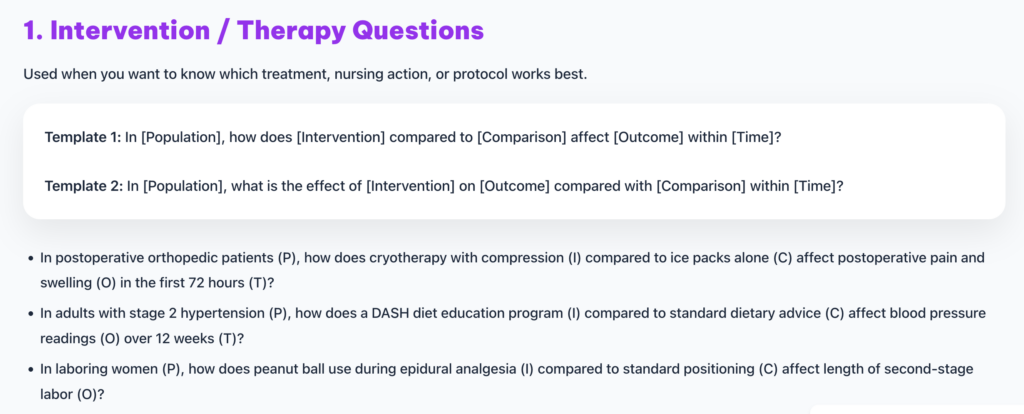
Here are some examples of well-formulated nursing PICOT questions across various nursing specialties:
- In adult patients with type 2 diabetes (P), how does a low-carbohydrate diet (I) compared to a low-fat diet (C) affect blood glucose levels (O) over a 3-month period (T)?
- For postoperative patients (P), does the use of music therapy (I) compared to standard care (C) reduce reported pain scores (O) within the first 24 hours after surgery (T)?
- In pregnant women with gestational diabetes (P), how does daily home blood glucose monitoring (I) compared to weekly clinic visits (C) affect the need for insulin therapy (O) during the third trimester (T)?
These examples demonstrate how PICOT questions can be used to address specific clinical issues in nursing practice.
When creating PICOT questions, it’s important to avoid common mistakes such as:
- Being too broad or vague
- Including multiple interventions or outcomes
- Using terms that are difficult to measure
- Failing to specify a clear comparison
Remember, the goal is to create a question that will guide your research and help you find relevant evidence to improve nursing practice.
PICOT Question Examples
- Influenza vaccine & pneumonia risk in adults 65 and older. In adults aged 65 years and older (P), does the use of an influenza vaccine (I), compared to no vaccination (C), reduce the risk of developing pneumonia (O) during flu season (T)?
- Blood sugar levels in patients newly diagnosed with diabetes. In middle-aged patients newly diagnosed with diabetes (P), does continuous blood sugar level monitoring by healthcare providers (I), compared to standard intermittent testing (C), reduce the risk of developing complications (O) within six months (T)?
- Postpartum depression: first-time vs. second-time mothers. In first-time mothers during pregnancy and six weeks postpartum (P), does structured psychological intervention (I), compared to second-time mothers receiving standard postpartum care (C), reduce the incidence and severity of postpartum depression (O) within six weeks of giving birth (T)?
- Breast cancer screening in women aged 30 years with a history of smoking. Among women aged 30 years and older with a history of smoking (P), does mammography screening every 3 years (I), compared to no routine screening (C), reduce the likelihood of developing breast cancer (O) over five years (T)?
- Obesity & aerobic exercise vs. medical therapy for lowering blood pressure In middle-aged patients with obesity and hypertension (P), does a structured aerobic exercise program (I), compared to medical therapy for reducing blood pressure alone (C), be more effective in lowering blood pressure (O) within six months (T)?
- Pre-surgery cardiac nurse care among patients awaiting cardiac operation. Among patients awaiting cardiac operation with a history of acute myocardial infarction (P), does pre-surgery cardiac nurse-led blood pressure monitoring and patient education (I), compared to standard preoperative care (C), reduce the risk of postoperative complications (O) within 48 hours of surgery (T)?
- Antiviral therapy in female adolescents with hepatitis B & liver function. In female adolescents with hepatitis B (P), does antiviral therapy (I), compared to no intervention (C), improve liver function and reduce the risk of developing liver cancer when compared to untreated peers (O) within six months (T)?
- Raising the head of the bed in ICU patients for oxygen saturation. In ICU patients with pneumonia on mechanical ventilation (P), does raising the head of the bed to 30–45 degrees (I), compared to standard supine positioning (C), improve oxygen saturation levels (O) within 48 hours (T)?
- Pain relief medication vs. ibuprofen in patients with schizophrenia. In patients with schizophrenia experiencing acute pain (P), does opioid pain relief medication (I), compared to ibuprofen (C), provide more effective pain relief — doing more good than harm — without increasing adverse psychiatric effects (O) within 48 hours (T)?
- Injury evaluation for bruises and other injuries in children. In children presenting with bruises and other injuries (P), does systematic injury evaluation using a structured clinical tool (I), compared with kids receiving standard assessment alone (C), be more accurate in diagnosing non-accidental trauma (O) within 48 hours (T)?
- Influenza vaccine for preventing cold during winter in adults 65 and older. In adults aged 65 and older (P), does receiving the influenza vaccine before winter (I), compared to those who have not received the vaccine (C), be more effective in preventing cold and respiratory infections during winter (O) over one flu season (T)
- Wound care in patients recovering from neck cancer. In patients recovering from neck cancer following surgery (P), does the use of wound care protocols with moist dressings (I), compared to drying and wrapping with standard dry dressings (C), reduce the duration of recovery and wound infection rates (O) within six months (T)?
- Skin-to-skin contact vs. drying and wrapping in premature newborns. In premature newborns immediately after birth (P), does immediate skin-to-skin contact with the mother (I), compared to drying and wrapping with standard warming protocols (C), improve oxygen saturation levels and reduce the risk of complications (O) within 48 hours (T)?
- Influenza vaccine in pregnant women & risk of premature birth. In pregnant women during flu season (P), does receiving the influenza vaccine (I), compared to no vaccination (C), reduce the risk of giving birth to premature babies and support maternal health (O) during pregnancy and six weeks postpartum (T)?
- Evidence-based practice training for nursing students In nursing students in clinical placements (P), does structured training in the PICOT framework and evidence-based practice (I), compared to standard nursing research education alone (C), improve clinical question formulation and research utilization skills (O) within six months of training (T)?
- Blood pressure monitoring by healthcare providers in patients with chronic hypertension. In patients with chronic hypertension (P), does regular blood pressure monitoring by healthcare providers using a structured protocol (I), compared to standard self-monitoring at home (C), serve as a more effective medical therapy for reducing cardiovascular risk (O) within twelve months (T)?
- Obesity in female adolescents & risk of developing breast cancer. In female adolescents with obesity aged 15–19 years (P), does a structured weight management and aerobic exercise program (I), compared to no intervention (C), reduce the risk of developing breast cancer among women as they age (O) over five years (T)?
- Etiology of breast cancer among women aged 30 years (nature and cause) Among women aged 30 years with a family history of breast cancer (P), does the presence of multiple risk factors including obesity, hypertension, and history of smoking (I), compared to women with no such risk factors (C), increase the risk and explain the nature and cause of developing breast cancer (O) assessed every 3 years (T)?
Nursing PICOT Question Examples
100 Useful PICO Questions for Nursing Research
- In adult patients with type 2 diabetes (P), how does a low-carbohydrate diet (I) compared to a low-fat diet (C) affect blood glucose levels (O) over 3 months (T)?
- For postoperative patients (P), does the use of music therapy (I) compared to standard care (C) reduce reported pain scores (O) within the first 24 hours after surgery (T)?
- In pregnant women with gestational diabetes (P), how does daily home blood glucose monitoring (I) compared to weekly clinic visits (C) affect the need for insulin therapy (O) during the third trimester (T)?
- For elderly patients with dementia (P), does a structured reminiscence therapy program (I) compared to standard care (C) improve cognitive function and quality of life (O) over 6 months (T)?
- In pediatric patients with asthma (P), how does a school-based education program (I), compared to standard care (C), affect the frequency of emergency room visits (O) over one school year (T)?
- For adult patients with hypertension (P), does a Mediterranean diet (I) compared to a low-sodium diet (C) lead to better blood pressure control (O) over 6 months (T)?
- In elderly patients at risk of falls (P), how does a tai chi program (I), compared to no intervention (C), affect balance and mobility (O) after 12 weeks (T)?
- For patients with chronic pain (P), does cognitive behavioral therapy (I), compared to medication alone (C), improve pain management and quality of life (O) over 3 months (T)?
- In premature infants (P), how does kangaroo care (I), compared to standard incubator care (C), affect weight gain and bonding (O) during the first month of life (T)?
- For adult patients with depression (P), does regular aerobic exercise (I) compared to antidepressant medication (C) improve mood and reduce symptoms (O) over 12 weeks (T)?
- In patients with chronic obstructive pulmonary disease (COPD) (P), how does a pulmonary rehabilitation program (I) compared to standard medical management (C) affect exercise capacity and quality of life (O) over 6 months (T)?
- For women over 50 (P), does yearly mammogram screening (I) compared to biennial screening (C) improve early detection rates of breast cancer (O) over 10 years (T)?
- In adult patients with insomnia (P), how does cognitive behavioral therapy for insomnia (CBT-I) (I), compared to sleep medication (C), affect sleep quality and duration (O) over 3 months (T)?
- For patients undergoing chemotherapy (P), does the use of acupressure wristbands (I) compared to antiemetic medication alone (C) reduce the incidence and severity of nausea and vomiting (O) during the first week of treatment (T)?
- In adolescents with obesity (P), how does a school-based physical activity program (I), compared to nutritional education alone (C), affect body mass index (BMI) and self-esteem (O) over one academic year (T)?
- For adult patients with heart failure (P), does a nurse-led home monitoring program (I), compared to routine clinic visits (C), reduce hospital readmissions and improve quality of life (O) over 6 months (T)?
- In elderly patients with mild cognitive impairment (P), how does a computerized cognitive training program (I), compared to no intervention (C), affect cognitive function and daily living activities (O) over 3 months (T)?
- For patients with venous leg ulcers (P), does the application of honey dressings (I) compared to standard wound dressings (C) improve healing time and reduce infection rates (O) over 8 weeks (T)?
- In adult patients with irritable bowel syndrome (IBS) (P), how does a low FODMAP diet (I) compared to a standard IBS diet (C) affect symptom severity and quality of life (O) over 6 weeks (T)?
- For healthcare workers in high-stress environments (P), does a mindfulness-based stress reduction program (I) compared to no intervention (C) reduce burnout rates and improve job satisfaction (O) over 3 months (T)?
- In patients with diabetic foot ulcers (P), how does negative pressure wound therapy (I), compared to standard wound care (C), affect healing time and amputation rates (O) over 12 weeks (T)?
- For adult patients with generalized anxiety disorder (P), does mindfulness meditation (I), compared to cognitive behavioral therapy (C), reduce anxiety symptoms and improve daily functioning (O) over 8 weeks (T)?
- In postmenopausal women with osteoporosis (P), how does a high-intensity resistance training program (I), compared to low-impact exercise (C), affect bone mineral density and fracture risk (O) over 1 year (T)?
- For patients with chronic kidney disease (P), does a plant-based diet (I) compared to a standard renal diet (C) slow the progression of kidney disease and improve quality of life (O) over 6 months (T)?
- In adult patients with sleep apnea (P), how does a weight loss program (I) compare to continuous positive airway pressure (CPAP) therapy alone (C) affect sleep quality and daytime sleepiness (O) over 3 months (T)?
- For stroke survivors (P), does early mobilization within 24 hours (I) compared to standard care (C) improve functional outcomes and reduce hospital length of stay (O) at 3 months post-stroke (T)?
- In patients with fibromyalgia (P), how does aquatic exercise therapy (I), compared to land-based exercise (C), affect pain levels and overall physical function (O) over 12 weeks (T)?
- For adult patients with major depressive disorder (P), does bright light therapy (I) compared to antidepressant medication (C) improve mood and sleep patterns (O) over 6 weeks (T)?
- In elderly patients with urinary incontinence (P), how does pelvic floor muscle training (I), compared to medication therapy (C), reduce incontinence episodes and improve quality of life (O) over 3 months (T)?
- For patients with chronic low back pain (P), does yoga therapy (I) compared to physical therapy (C) improve pain intensity and functional ability (O) over 12 weeks (T)?
- In adult patients with migraine headaches (P), how does a ketogenic diet (I), compared to standard migraine prophylaxis (C), affect the frequency and severity of migraine attacks (O) over 3 months (T)?
- For patients with peripheral arterial disease (P), does a supervised walking program (I) compared to medication therapy alone (C) improve walking distance and quality of life (O) over 6 months (T)?
- In adult patients with metabolic syndrome (P), how does intermittent fasting (I), compared to a calorie-restricted diet (C), affect weight loss and metabolic markers (O) over 3 months (T)?
- For patients recovering from total knee replacement surgery (P), does early aquatic therapy (I) compared to land-based physical therapy (C) improve range of motion and reduce pain (O) during the first 6 weeks post-surgery (T)?
- In adult patients with psoriasis (P), how does a gluten-free diet (I), compared to standard psoriasis treatment (C), affect skin lesion severity and quality of life (O) over 3 months (T)?
- For patients with chronic fatigue syndrome (P), does graded exercise therapy (I) compared to cognitive behavioral therapy (C) improve fatigue levels and physical functioning (O) over 6 months (T)?
- In adult patients with non-alcoholic fatty liver disease (P), how does a Mediterranean diet (I), compared to a low-fat diet (C), affect liver fat content and liver enzyme levels (O) over 6 months (T)?
- For patients with rheumatoid arthritis (P), does tai chi (I) compared to traditional exercise therapy (C) improve joint flexibility and reduce pain (O) over 12 weeks (T)?
- In adult patients with bipolar disorder (P), how does interpersonal and social rhythm therapy (I), compared to medication management alone (C), affect mood stability and social functioning (O) over 6 months (T)?
- For patients with chronic constipation (P), does abdominal massage (I) compared to laxative use (C) improve bowel movement frequency and quality of life (O) over 4 weeks (T)?
- In adult patients with asthma (P), how does a vitamin D supplementation regimen (I) compared to standard asthma treatment (C) affect the frequency of exacerbations and lung function (O) over 6 months (T)?
- For patients with peripheral neuropathy (P), does acupuncture (I), compared to medication therapy (C), reduce pain and improve sensation (O) over 8 weeks (T)?
- In elderly patients with sarcopenia (P), how does a high-protein diet combined with resistance training (I), compared to standard care (C), affect muscle mass and strength (O) over 3 months (T)?
- For adult patients with atrial fibrillation (P), does yoga therapy (I) compared to standard medical management (C) reduce episodes of arrhythmia and improve quality of life (O) over 6 months (T)?
- In patients with chronic sinusitis (P), how does nasal irrigation with saline solution (I), compared to standard medical therapy (C), affect symptom severity and quality of life (O) over 3 months (T)?
- For adult patients with restless leg syndrome (P), does a regular exercise program (I) compared to medication therapy (C) reduce symptom severity and improve sleep quality (O) over 8 weeks (T)?
- In patients with osteoarthritis of the knee (P), how does platelet-rich plasma therapy (I), compared to hyaluronic acid injections (C), affect pain relief and functional improvement (O) over 6 months (T)?
- For adult patients with social anxiety disorder (P), does virtual reality exposure therapy (I), compared to cognitive behavioral therapy (C), reduce anxiety symptoms and improve social functioning (O) over 12 weeks (T)?
- In patients with Parkinson’s disease (P), how does dance therapy (I), compared to traditional physical therapy (C), affect balance, gait, and quality of life (O) over 3 months (T)?
- For adult patients with chronic insomnia (P), does cognitive behavioral therapy for insomnia (CBT-I) (I), compared to sleep medication (C), affect long-term sleep quality and medication dependence (O) over 1 year (T)?
- In pregnant women with gestational diabetes (P), how does a Mediterranean diet (I) compared to a standard diabetic diet (C) affect glycemic control and pregnancy outcomes (O) throughout the pregnancy (T)?
- For adult patients with PTSD (P), does eye movement desensitization and reprocessing (EMDR) therapy (I), compared to cognitive processing therapy (C), reduce symptom severity and improve daily functioning (O) over 12 weeks (T)?
- In elderly patients with Alzheimer’s disease (P), how does a music therapy program (I), compared to standard care (C), affect cognitive function and mood (O) over 6 months (T)?
- For patients with chronic migraine (P), do botulinum toxin injections (I) compared to oral preventive medications (C) reduce the frequency and severity of migraine attacks (O) over 3 months (T)?
- In adult patients with metabolic syndrome (P), how does a high-intensity interval training program (I), compared to moderate-intensity continuous exercise (C), affect insulin sensitivity and cardiovascular risk factors (O) over 12 weeks (T)?
- For patients with plantar fasciitis (P), does shockwave therapy (I) compared to corticosteroid injections (C) improve pain relief and foot function (O) over 3 months (T)?
- In adult patients with obsessive-compulsive disorder (OCD) (P), how does acceptance and commitment therapy (ACT) (I), compared to exposure and response prevention therapy (C), reduce symptom severity and improve quality of life (O) over 16 weeks (T)?
- For patients with chronic wounds (P), does hyperbaric oxygen therapy (I), compared to standard wound care (C), accelerate wound healing and reduce the risk of amputation (O) over 12 weeks (T)?
- In adult patients with non-specific low back pain (P), how does mindfulness-based stress reduction (I), compared to physical therapy (C), affect pain intensity and functional disability (O) over 8 weeks (T)?
- For patients with type 1 diabetes (P), does continuous glucose monitoring (I) compared to traditional finger-stick monitoring (C) improve glycemic control and reduce hypoglycemic events (O) over 6 months (T)?
- In adult patients with seasonal affective disorder (P), how does light therapy combined with cognitive behavioral therapy (I), compared to light therapy alone (C), affect depressive symptoms and remission rates (O) over a winter season (T)?
- For patients with frozen shoulder (adhesive capsulitis) (P), does hydro dilatation (I) compared to physical therapy (C) improve range of motion and reduce pain (O) over 12 weeks (T)?
- In adult patients with alcohol use disorder (P), how does mindfulness-based relapse prevention (I), compared to traditional 12-step programs (C), affect abstinence rates and quality of life (O) over 6 months (T)?
- For patients with chronic neck pain (P), does dry needling therapy (I) compared to manual therapy (C) reduce pain intensity and improve neck function (O) over 8 weeks (T)?
- In adult patients with polycystic ovary syndrome (PCOS) (P), how does a low glycemic index diet (I) compared to a standard weight loss diet (C) affect menstrual regularity and metabolic parameters (O) over 6 months (T)?
- For patients with diabetic peripheral neuropathy (P), does alpha-lipoic acid supplementation (I) compared to standard medical therapy (C) reduce neuropathic pain and improve nerve function (O) over 12 weeks (T)?
- In adult patients with generalized anxiety disorder (P), how does a smartphone-based mindfulness app (I) compare to in-person mindfulness training (C) affect anxiety symptoms and daily stress levels (O) over 8 weeks (T)?
- For patients with chronic obstructive pulmonary disease (COPD) (P), does high-flow nasal cannula oxygen therapy (I) compared to standard oxygen therapy (C) improve exercise capacity and quality of life (O) over 3 months (T)?
- In adult patients with irritable bowel syndrome (IBS) (P), how does gut-directed hypnotherapy (I), compared to dietary interventions (C), affect symptom severity and psychological distress (O) over 12 weeks (T)?
- For patients with knee osteoarthritis (P), does glucosamine and chondroitin supplementation (I) compared to nonsteroidal anti-inflammatory drugs (NSAIDs) (C) reduce pain and improve joint function (O) over 6 months (T)?
- In adult patients with major depressive disorder (P), how does transcranial magnetic stimulation (TMS) (I), compared to antidepressant medication (C), affect depression severity and remission rates (O) over 6 weeks (T)?
- For patients with chronic tension-type headaches (P), does acupuncture (I) compared to preventive medication (C) reduce headache frequency and intensity (O) over 3 months (T)?
- In adult patients with metabolic syndrome (P), how does a ketogenic diet (I), compared to a low-fat diet (C), affect weight loss and cardiovascular risk factors (O) over 6 months (T)?
- For patients with fibromyalgia (P), does low-dose naltrexone therapy (I) compared to standard pain management (C) reduce pain intensity and improve overall quality of life (O) over 3 months (T)?
- In adult patients with essential hypertension (P), how does intermittent fasting (I), compared to continuous calorie restriction (C), affect blood pressure control and cardiovascular risk factors (O) over 6 months (T)?
- For patients with chronic fatigue syndrome (P), does pacing therapy (I) compared to graded exercise therapy (C) improve fatigue levels and physical functioning (O) over 12 weeks (T)?
- In adult patients with non-alcoholic fatty liver disease (P), how does a probiotic supplement regimen (I) compare to lifestyle modifications alone (C) affect liver fat content and liver enzyme levels (O) over 6 months (T)?
- For patients with chronic pelvic pain (P), does pelvic floor physical therapy (I), compared to pain medication (C), reduce pain intensity and improve sexual function (O) over 8 weeks (T)?
- In adult patients with treatment-resistant depression (P), how does ketamine infusion therapy (I), compared to electroconvulsive therapy (C), affect depression severity and remission rates (O) over 6 weeks (T)?
- For patients with plantar fasciitis (P), does extracorporeal shockwave therapy (I) compared to corticosteroid injections (C) improve pain relief and foot function (O) over 3 months (T)?
- In adult patients with generalized anxiety disorder (P), how does a digital cognitive behavioral therapy app (I), compared to in-person therapy (C), affect anxiety symptoms and quality of life (O) over 12 weeks (T)?
- For patients with chronic rhinosinusitis (P), does nasal irrigation with xylitol solution (I) compared to saline irrigation (C) improve symptom scores and quality of life (O) over 4 weeks (T)?
- In adult patients with type 2 diabetes (P), how does a plant-based diet (I) compared to a conventional diabetic diet (C) affect glycemic control and cardiovascular risk factors (O) over 6 months (T)?
- For patients with rotator cuff tendinopathy (P), does platelet-rich plasma injection (I) compared to corticosteroid injection (C) improve pain relief and shoulder function (O) over 3 months (T)?
- In adult patients with social anxiety disorder (P), how does virtual reality exposure therapy (I), compared to in vivo exposure therapy (C), reduce anxiety symptoms and improve social functioning (O) over 12 weeks (T)?
- For patients with chronic low back pain (P), does mindfulness-based stress reduction (I), compared to cognitive behavioral therapy (C), affect pain intensity and functional disability (O) over 8 weeks (T)?
- In adult patients with atrial fibrillation (P), how does a Mediterranean diet (I), compared to a standard heart-healthy diet (C), affect the recurrence of arrhythmia and quality of life (O) over 12 months (T)?
- For patients with multiple sclerosis (P), does high-dose vitamin D supplementation (I) compared to standard of care (C) reduce relapse rates and improve neurological function (O) over 12 months (T)?
- In adult patients with insomnia (P), how does digital cognitive behavioral therapy for insomnia (CBT-I) (I), compared to sleep hygiene education (C), affect sleep quality and daytime functioning (O) over 8 weeks (T)?
- For patients with knee osteoarthritis (P), does tai chi (I) compared to physical therapy (C) improve pain relief and physical function (O) over 12 weeks (T)?
- In adult patients with major depressive disorder (P), how does psilocybin-assisted psychotherapy (I), compared to conventional antidepressant therapy (C), affect depression severity and remission rates (O) over 6 weeks (T)?
- For patients with chronic migraine (P), does neurofeedback training (I) compared to preventive medication (C) reduce the frequency and intensity of migraine attacks (O) over 3 months (T)?
- In adult patients with irritable bowel syndrome (IBS) (P), how does fecal microbiota transplantation (I) compared to probiotic supplementation (C) affect symptom severity and quality of life (O) over 12 weeks (T)?
- For patients with frozen shoulder (adhesive capsulitis) (P), does ultrasound-guided hydrodilatation (I) compared to corticosteroid injection (C) improve range of motion and reduce pain (O) over 6 weeks (T)?
- In adult patients with post-traumatic stress disorder (PTSD) (P), how does neurofeedback therapy (I), compared to cognitive processing therapy (C), reduce symptom severity and improve daily functioning (O) over 12 weeks (T)?
- For patients with diabetic foot ulcers (P), does hyperbaric oxygen therapy (I), compared to standard wound care (C), accelerate wound healing and reduce the risk of amputation (O) over 12 weeks (T)?
- In adult patients with fibromyalgia (P), how does transcranial direct current stimulation (tDCS) (I), compared to sham stimulation (C), affect pain intensity and cognitive function (O) over 8 weeks (T)?
- For patients with chronic obstructive pulmonary disease (COPD) (P), does singing therapy (I) compared to standard pulmonary rehabilitation (C) improve lung function and quality of life (O) over 12 weeks (T)?
- In adult patients with treatment-resistant depression (P), how does repetitive transcranial magnetic stimulation (rTMS) (I), compared to electroconvulsive therapy (ECT) (C), affect depression severity and cognitive function (O) over 6 weeks (T)?
- For patients with chronic tension-type headaches (P), does mindfulness-based stress reduction (I), compared to relaxation therapy (C), reduce headache frequency and intensity (O) over 8 weeks (T)?
Nursing PICOT Question Examples
- In adult patients with chronic insomnia (P), how does cognitive behavioral therapy (I), compared to sleep medication (C), affect sleep quality and duration (O) over 3 months (T)?
- For patients undergoing chemotherapy (P), does the use of ginger supplements (I) compared to placebo (C) reduce the incidence and severity of nausea (O) during the first week of treatment (T)?
- In elderly patients at risk of falls (P), how does a multifactorial fall prevention program (I), compared to usual care (C), affect the incidence of falls and fall-related injuries (O) over 6 months (T)?
- For adult patients with type 2 diabetes (P), how does a structured diabetes self-management education program (I), compared to standard care (C), affect glycemic control and self-efficacy (O) over 12 months (T)?
- In postoperative patients (P), how does early mobilization (I) compared to standard care (C) affect the length of hospital stay and postoperative complications (O) within the first week after surgery (T)?
- For adult patients with chronic low back pain (P), how does a mindfulness-based stress reduction program (I), compared to physical therapy (C), affect pain intensity and functional disability (O) over 12 weeks (T)?
- In pregnant women with gestational diabetes (P), how does a Mediterranean diet (I), compared to a standard diabetic diet (C), affect maternal and fetal outcomes (O) throughout pregnancy and at delivery (T)?
- For adult patients with heart failure (P), how does a nurse-led telehealth monitoring program (I), compared to usual care (C), affect hospital readmission rates and quality of life (O) over 6 months (T)?
- In adult patients with major depressive disorder (P), how does aerobic exercise (I), compared to antidepressant medication (C), affect depressive symptoms and overall well-being (O) over 12 weeks (T)?
- For patients with chronic obstructive pulmonary disease (COPD) (P), how does a home-based pulmonary rehabilitation program (I), compared to center-based rehabilitation (C), affect exercise capacity and quality of life (O) over 8 weeks (T)?
Pediatrics Nursing PICOT Question Examples
- In children with newly diagnosed type 1 diabetes (P), how does a family-centered education program (I), compared to standard patient education (C), affect glycemic control (O) in the first year after diagnosis (T)?
- For premature infants in the NICU (P), does kangaroo care (I) compared to standard incubator care (C) improve weight gain and reduce length of hospital stay (O) over the first month of life (T)?
- In adolescents with anxiety disorders (P), how does cognitive-behavioral therapy delivered via telemedicine (I), compared to in-person therapy (C), affect anxiety symptoms and treatment adherence (O) over 12 weeks (T)?
- For children with asthma (P), does a school-based asthma education program (I), compared to standard care (C), reduce emergency department visits and school absenteeism (O) over one academic year (T)?
- In obese children aged 7-12 (P), how does a family-based lifestyle intervention program (I), compared to standard nutritional counseling (C), affect BMI and health-related quality of life (O) over 6 months (T)?
Nursing PICOT Question Examples for Diabetes
- In adults with prediabetes (P), how does a plant-based diet intervention (I) compared to standard dietary advice (C) affect the progression to type 2 diabetes (O) over 2 years (T)?
- For patients with type 2 diabetes and obesity (P), how does bariatric surgery (I), compared to intensive medical management (C), affect long-term glycemic control and cardiovascular risk factors (O) over 5 years (T)?
- In adolescents with type 1 diabetes (P), how does continuous glucose monitoring with automated insulin delivery (I), compared to standard pump therapy (C), affect glycemic control and quality of life (O) over 12 months (T)?
Examples of PICOT Nursing Research Topics
- For ICU nurses (P), how does the implementation of a resilience training program (I), compared to no intervention (C), affect burnout rates and job satisfaction (O) over 6 months (T)?
- In hospitalized elderly patients (P), how does a nurse-led mobility program (I), compared to standard care (C), affect functional status and hospital-acquired complications (O) during the hospital stay (T)?
- For new graduate nurses (P), how does a structured mentorship program (I), compared to standard orientation (C), affect job satisfaction and retention rates (O) in the first year of employment (T)?
Nurse Burnout PICOT Question Examples
- In emergency department nurses (P), how does the implementation of a mindfulness-based stress reduction program (I), compared to no intervention (C), affect burnout scores and job retention rates (O) over 1 year (T)?
- For critical care nurses (P), how does the implementation of flexible scheduling (I) compared to traditional fixed scheduling (C) affect work-life balance and burnout levels (O) over 6 months (T)?
Pain Management Nursing PICOT Question Examples
- For adult patients with chronic lower back pain (P), how does a combination of physical therapy and acupuncture (I) compared to physical therapy alone (C) affect pain intensity and functional ability (O) over a 3-month treatment period (T)?
- In postoperative patients (P), how does music therapy (I), compared to standard pain management protocols (C), affect pain scores and opioid consumption (O) within the first 48 hours after surgery (T)?
Nursing PICOT Question Examples for Pregnancy
- In first-time pregnant women (P), how does participation in a prenatal yoga program (I), compared to standard prenatal care (C), affect labor duration and cesarean section rates (O) at delivery (T)?
- For pregnant women at risk of gestational diabetes (P), how does early lifestyle intervention (I) compared to standard prenatal care (C) affect the incidence of gestational diabetes and maternal-fetal outcomes (O) throughout pregnancy (T)?
List of PICO Questions for Emergency Nursing
- In adult patients presenting to the ER with suspected acute coronary syndrome (P), how does the use of a high-sensitivity troponin test (I) compared to standard troponin testing (C) affect time to diagnosis and treatment initiation (O) within the first 4 hours of presentation (T)?
- For patients with sepsis in the emergency department (P), how does the implementation of a nurse-driven sepsis protocol (I), compared to physician-driven care (C), affect time to antibiotic administration and in-hospital mortality (O) during the hospital stay (T)?
Examples of Fall Prevention PICOT Questions
- In community-dwelling older adults (P), how does a home-based exercise program focusing on balance and strength (I), compared to no intervention (C), affect the incidence of falls (O) over 6 months (T)?
- For hospitalized elderly patients (P), how does hourly rounding by nursing staff (I) compared to standard care (C) affect fall rates and patient satisfaction (O) during the hospital stay (T)?
Nursing PICO Question Examples on Anxiety
- For adult patients undergoing elective surgery (P), how does preoperative mindfulness meditation training (I), compared to standard preoperative care (C), affect preoperative anxiety levels and postoperative pain scores (O) within the first 48 hours after surgery (T)?
Sample PICOT Question Example
- In adult patients with hypertension (P), how does a Mediterranean diet combined with regular exercise (I), compared to medication alone (C), affect blood pressure control and cardiovascular risk (O) over 1 year (T)?
PICOT Questions for Managing Hypertension in Patients
- For African American adults with hypertension (P), how does a culturally tailored diet and lifestyle intervention program (I), compared to standard hypertension education (C), affect blood pressure control and medication adherence (O) over 6 months (T)?
Sample PICOT Question Example
For patients with diabetic foot ulcers (P), does hyperbaric oxygen therapy (I) compared to standard wound care (C) accelerate wound healing and reduce the risk of amputation (O) over 12 weeks (T)?
Etiology Clinical Questions for Nursing Students
Etiology explores the meaning and origin of disease within a given clinical domain. Resources from the health sciences library help nurses determine why certain patients are likely to develop breast cancer, how they develop breast cancer when compared to lower-risk groups, and how chronic infections affect liver function, including whether a sedentary lifestyle compared to aerobic activity increases that risk.
Etiology Question
An etiology question investigates the meaning behind why a condition develops, always pairing the exposure with a control or alternative group. Examples include whether women are likely to develop breast cancer or develop breast cancer when compared to peers without risk factors, how infections affect liver function, and whether inactivity compared to aerobic exercise raises cardiovascular risk.
Focused Clinical
A focused clinical question targets a specific clinical domain using precise comparisons, for example, postpartum depression compared to second-episode presentations, injury through evaluation in trauma cases, or the influenza vaccine compared to antivirals. Searching the health sciences library ensures each question holds up compared with standard evidence-based benchmarks.
Nursing students use the health sciences library to build questions across every clinical domain, learning to choose a clear control or alternative for each scenario, whether examining postpartum depression compared to second-time mothers, assessing injury through evaluation in paediatric cases, or determining if the influenza vaccine compared to standard care produces better outcomes compared with standard treatment protocols.
Key Highlights
- Developing effective PICOT questions begins with identifying a clinical problem, practice gap, or research need.
- The large amount of available clinical research evidence can make the research process overwhelming.
- Using the PICOT or PICO framework helps narrow and organize the search process.
- A structured PICOT question improves focus, clarity, and research efficiency.
- PICOT guides researchers toward finding high-quality and relevant clinical evidence.
- The framework supports evidence-based clinical decision-making and evaluation of treatment options.
- Researchers can also use PICOT to compare interventions and explore alternative procedures or therapies.
FAQs on Nursing PICOT questions examples
What are good PICOT questions for nursing?
Good PICOT questions for nursing are specific, measurable, and relevant to current nursing practice. They should clearly define the Population, Intervention, Comparison, Outcome, and Time frame. Here are a few examples of good PICOT questions for nursing:
- In adult patients with type 2 diabetes (P), how does a low-carbohydrate diet (I), compared to a low-fat diet (C), affect blood glucose levels (O) over 3 months (T)?
- For postoperative patients (P), does the use of music therapy (I) compared to standard care (C) reduce reported pain scores (O) within the first 24 hours after surgery (T)?
- In elderly patients at risk of falls (P), how does a multifactorial fall prevention program (I), compared to usual care (C), affect the incidence of falls and fall-related injuries (O) over 6 months (T)?
These questions demonstrate clarity in defining the population, specifying the intervention and comparison, identifying measurable outcomes, and setting a clear timeframe.
What is an example of a PICO question?
Here’s an example of a well-structured PICO question:
“In adult patients with chronic insomnia (P), how does cognitive behavioral therapy for insomnia (CBT-I) (I), compared to sleep medication (C), affect sleep quality and duration (O) over 3 months (T)?”
This question clearly defines:
- Population (P): Adult patients with chronic insomnia
- Intervention (I): Cognitive behavioral therapy for insomnia (CBT-I)
- Comparison (C): Sleep medication
- Outcome (O): Sleep quality and duration
- Time (T): Over 3 months
What is an example of a PICO question for a school nurse?
Here’s an example of a PICO question relevant to school nursing:
“For children with asthma in elementary schools (P), does a school-based asthma education program (I) compared to standard care (C) reduce emergency department visits and school absenteeism (O) over one academic year (T)?”
This question addresses:
- Population (P): Children with asthma in elementary schools
- Intervention (I): School-based asthma education program
- Comparison (C): Standard care
- Outcome (O): Emergency department visits and school absenteeism
- Time (T): Over one academic year
This PICO question is particularly relevant for school nurses as it focuses on a common childhood condition and how a school-based intervention might improve health outcomes and school attendance.
What is an example of a PICOT question for a nursing shortage?
Here’s an example of a PICOT question addressing the nursing shortage:
“For new graduate nurses in acute care hospitals (P), how does a structured mentorship program (I), compared to standard orientation (C), affect job satisfaction and retention rates (O) in the first year of employment (T)?”
This question addresses:
- Population (P): New graduate nurses in acute care hospitals
- Intervention (I): Structured mentorship program
- Comparison (C): Standard orientation
- Outcome (O): Job satisfaction and retention rates
- Time (T): First year of employment
This PICOT question is relevant to the nursing shortage as it focuses on strategies to improve job satisfaction and retention of new nurses, which are crucial factors in addressing the ongoing nursing shortage in many healthcare systems.
These examples demonstrate how PICOT questions can be formulated to address various aspects of nursing practice, from clinical interventions to workforce issues, providing a structured approach to investigating important nursing questions.
